
Foundation of Indian National Congress
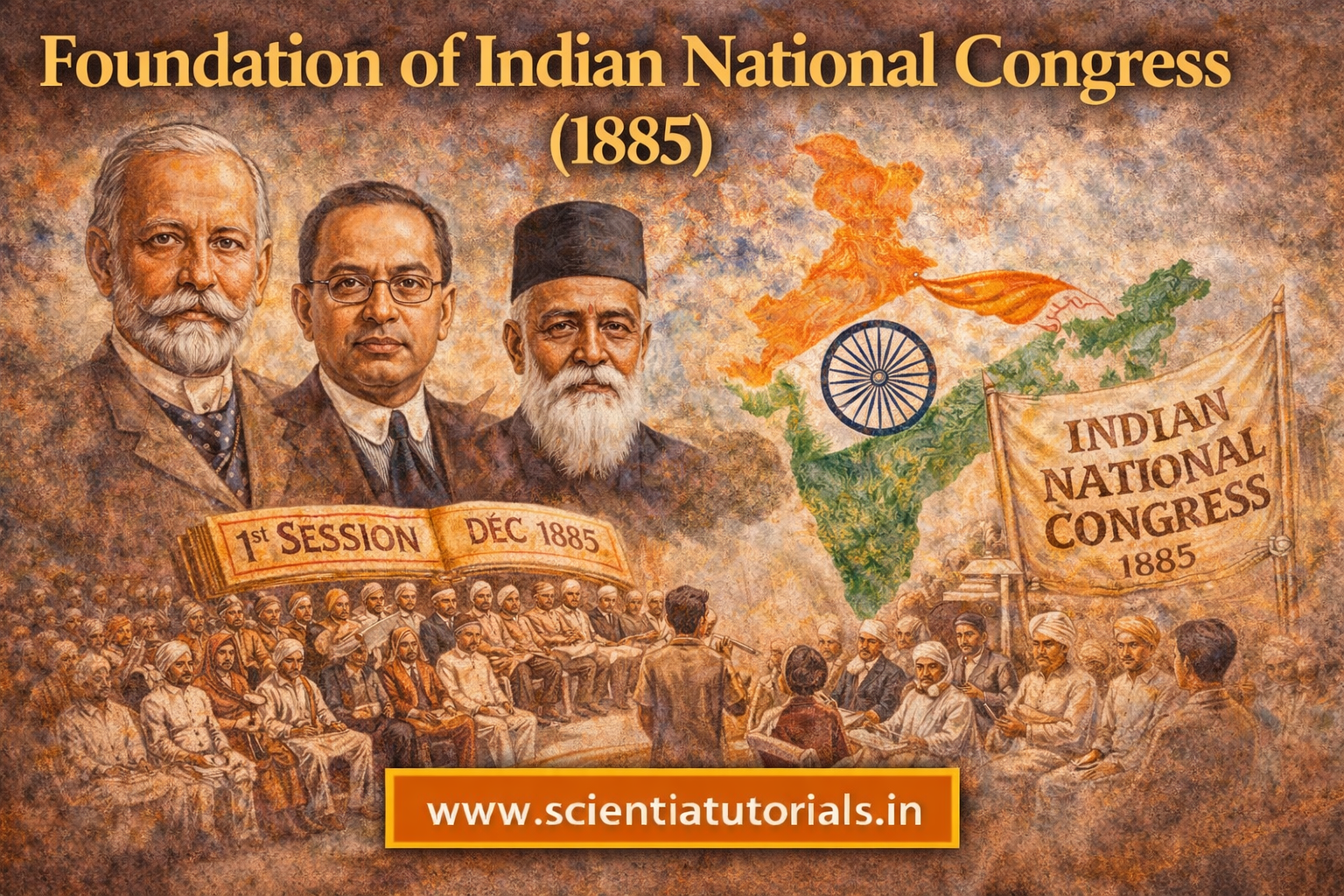

Foundation of Indian National Congress (1885) | History of India
Beginning of the Organized Indian National Movement
I. Introduction: Transition from Social Reform to Political Nationalism
The foundation of the Indian National Congress (INC) in 1885 marks a watershed moment in modern Indian history. It signified the transition from sporadic resistance and socio-religious reform movements to a systematic, organized, all-India political struggle against British colonial rule.
By the late 19th century, the impact of socio-religious reform movements, modern education, and economic exploitation under colonialism had created a new class of politically conscious Indians. This class sought not immediate independence, but constitutional reforms, administrative justice, and Indian participation in governance. The Indian National Congress emerged as the institutional expression of these aspirations.
II. Historical Background: Preconditions for the Foundation of INC
1. Impact of British Colonial Rule
British rule had introduced:
- Political unification of India
- Modern administrative structures
- Railways, postal system, and telegraph
- Western education and legal institutions
While these changes served colonial interests, they also unintentionally fostered national unity and political awareness among Indians.
2. Economic Exploitation and Colonial Policies
Colonial economic policies resulted in:
- Drain of wealth to Britain
- Decline of Indian handicrafts
- Frequent famines
- Heavy taxation on peasants
Indian intellectuals increasingly realized that British rule was economically exploitative, leading to demands for political reform.
3. Role of Western Education
Western education:
- Introduced ideas of liberty, equality, democracy, and nationalism
- Created an educated middle class of lawyers, teachers, journalists, and civil servants
- Enabled Indians to articulate grievances using the language of constitutionalism
This educated class became the backbone of early nationalism.
4. Influence of Socio-Religious Reform Movements
Earlier reform movements:
- Challenged social evils
- Encouraged rational thought
- Created public opinion through press and debate
They laid the moral and intellectual foundations for political nationalism.
5. Racial Discrimination and Administrative Exclusion
Indians faced:
- Racial discrimination in civil services
- Exclusion from higher administrative posts
- Discriminatory policies like the Ilbert Bill controversy (1883)
Such incidents highlighted the racial nature of British rule and intensified political consciousness.
III. Immediate Factors Leading to the Formation of INC
1. The Role of A.O. Hume
Allan Octavian Hume, a retired British civil servant, played a crucial role in organizing the Indian National Congress.
- He believed that political dialogue could prevent violent unrest
- Acted as a mediator between Indian leaders and the British government
- Helped convene the first session of the Congress
Historians debate his role, but it is clear that Indian initiative and leadership were central to the movement.
2. Safety Valve Theory
According to the Safety Valve Theory, the INC was founded to:
- Provide a peaceful outlet for Indian grievances
- Prevent revolutionary violence
While Hume may have supported this idea, Indian leaders soon transformed the Congress into a platform for genuine national demands, going beyond British intentions.
IV. Foundation of the Indian National Congress (1885)
1. First Session of INC
- Held in Bombay (now Mumbai)
- Dates: 28–31 December 1885
- President: Womesh Chandra Bonnerjee
- Delegates: 72 representatives from different parts of India
This session marked the formal birth of an all-India political organization.
2. Objectives of the Indian National Congress
The early objectives of the INC included:
- Promotion of friendly relations among nationalist leaders
- Development of national unity beyond regional and religious boundaries
- Presentation of Indian demands to the British government
- Training Indians in political participation and leadership
The Congress initially adopted moderate and constitutional methods.
V. Ideology and Nature of the Early Congress (1885–1905)
1. Moderate Phase
The early Congress was dominated by Moderate leaders, such as:
- Dadabhai Naoroji
- Gopal Krishna Gokhale
- Surendranath Banerjee
They believed in:
- Loyalty to the British Crown
- Gradual reforms
- Constitutional agitation
- Faith in British sense of justice
2. Methods of the Moderates
The Moderates used:
- Petitions and memorials
- Resolutions and speeches
- Public meetings
- Press and pamphlets
Their approach is often described as “prayer, petition, and protest”.
3. Economic Critique of Colonialism
One of the greatest contributions of early Congress leaders was the economic critique of British rule.
- Dadabhai Naoroji’s Drain Theory exposed how wealth was transferred from India to Britain
- Highlighted poverty, famines, and underdevelopment
- Shifted nationalism from emotional to economic foundations
VI. Demands Raised by the Early Congress
The INC demanded:
- Expansion of legislative councils
- Indianization of civil services
- Reduction of military expenditure
- Separation of judiciary and executive
- Freedom of speech and press
- Reduction in land revenue and taxation
These demands reflected a desire for self-governance within the British Empire, not immediate independence.
VII. British Response to the Early Congress
Initially, the British:
- Viewed the Congress with suspicion
- Considered it a forum of “educated elites”
Over time:
- Repressive policies increased
- British officials dismissed Congress as ineffective
This official indifference later contributed to the rise of more radical nationalism.
VIII. Contribution of INC to National Integration
1. All-India Character
The Congress:
- Brought together leaders from different regions
- Encouraged inter-provincial cooperation
- Created a sense of common Indian identity
2. Political Training Ground
The INC:
- Trained Indians in democratic practices
- Developed leadership and organizational skills
- Created a political culture of debate and consensus
This made it the nursery of Indian nationalism.
IX. Limitations of the Early Congress
Despite its significance, the early INC had limitations:
- Dominated by educated elites
- Limited mass participation
- Slow pace of political progress
- Over-reliance on British goodwill
However, these limitations were historically inevitable in the early phase of nationalism.
X. Historical Evaluation and Significance
1. Short-Term Significance
- Provided a national political platform
- Articulated Indian grievances
- Fostered political unity
2. Long-Term Significance
- Laid the foundation of the freedom struggle
- Evolved into a mass movement in later phases
- Produced leaders who guided India to independence
The Indian National Congress became the central organization of the Indian freedom movement.
XI. Foundation of INC in the Broader Freedom Struggle
The foundation of the INC should be viewed as:
- A beginning, not a culmination
- A shift from reform to resistance
- The first step toward self-rule (Swaraj)
Later phases of the national movement—Extremist, Gandhian, and revolutionary—built upon this foundation.
XII. Conclusion
The foundation of the Indian National Congress in 1885 represents the institutional birth of Indian nationalism. Though moderate in its early aims and methods, the Congress played a historic role in uniting Indians politically, exposing the exploitative nature of colonial rule, and preparing the nation for a prolonged struggle for freedom.
From a platform of elite constitutionalism, the INC evolved into a mass-based revolutionary force, ultimately leading India to independence in 1947. Thus, the foundation of the Indian National Congress stands as a cornerstone in the history of India’s freedom struggle.
Examination Significance
- Core topic for UPSC GS-I (Modern Indian History)
- Frequently asked in State PSCs, UGC NET, CUET-PG
- Important for essays, short notes, and analytical questions
Foundation of Indian National Congress –
Questions and Answers
1. Why is the foundation of the Indian National Congress considered a turning point in Indian history?
Answer:
The foundation of the Indian National Congress (INC) in 1885 marked the beginning of organized, all-India political nationalism, transforming scattered political awareness into a unified national movement.
2. In which year was the Indian National Congress founded?
Answer:
The Indian National Congress was founded in 1885.
3. Where was the first session of the Indian National Congress held?
Answer:
The first session of the INC was held in Bombay (now Mumbai).
4. Who presided over the first session of the Indian National Congress?
Answer:
The first session was presided over by Womesh Chandra Bonnerjee.
5. How many delegates attended the first session of the Indian National Congress?
Answer:
A total of 72 delegates from different parts of India attended the first session.
6. Who played a key role in organizing the Indian National Congress?
Answer:
Allan Octavian Hume, a retired British civil servant, played a key role in organizing the INC.
7. What was the Safety Valve Theory in relation to the INC?
Answer:
The Safety Valve Theory suggests that the INC was formed to provide a peaceful outlet for Indian grievances and prevent revolutionary violence against British rule.
8. Why is the Safety Valve Theory considered inadequate by many historians?
Answer:
Because Indian leaders used the INC as a genuine platform for nationalist demands, not merely as a British-controlled outlet, proving Indian initiative and leadership were central.
9. What were the main objectives of the early Indian National Congress?
Answer:
The objectives included:
- Promoting national unity
- Training Indians in politics
- Presenting Indian demands to the British government
- Encouraging constitutional reforms
10. Which class of Indians dominated the early Congress leadership?
Answer:
The educated middle class, including lawyers, teachers, journalists, and professionals, dominated the early Congress.
11. Which phase of the Indian National Movement is associated with the early Congress (1885–1905)?
Answer:
The early Congress is associated with the Moderate Phase of the Indian National Movement.
12. Name two prominent leaders of the Moderate phase of the Congress.
Answer:
Prominent Moderate leaders included:
- Dadabhai Naoroji
- Gopal Krishna Gokhale
13. What methods were adopted by the Moderates to achieve their demands?
Answer:
They used constitutional and peaceful methods such as petitions, resolutions, speeches, public meetings, and the press.
14. What is meant by the phrase “prayer, petition, and protest”?
Answer:
It describes the Moderate strategy of appealing to British sense of justice through constitutional means rather than confrontation.
15. What economic critique did the early Congress develop against British rule?
Answer:
The Congress exposed the economic exploitation of India, particularly through the Drain of Wealth to Britain.
16. Who propounded the Drain Theory?
Answer:
The Drain Theory was propounded by Dadabhai Naoroji.
17. Mention two major demands raised by the early Indian National Congress.
Answer:
Major demands included:
- Indianization of civil services
- Expansion of legislative councils
18. How did racial discrimination contribute to the formation of the INC?
Answer:
Racial discrimination in administration and incidents like the Ilbert Bill controversy (1883) exposed the racial nature of British rule, intensifying political consciousness.
19. What role did Western education play in the foundation of the INC?
Answer:
Western education introduced ideas of liberty, equality, democracy, and nationalism, enabling Indians to articulate political demands effectively.
20. How did socio-religious reform movements prepare the ground for the INC?
Answer:
They promoted rational thinking, public debate, and social unity, creating the moral and intellectual foundation for political nationalism.
21. How did the British government initially view the Indian National Congress?
Answer:
The British initially viewed the INC with suspicion and indifference, dismissing it as a body of educated elites.
22. Why is the early Congress criticized as being elite-centric?
Answer:
Because it had limited mass participation and was dominated by educated urban elites rather than peasants and workers.
23. Despite its limitations, why was the early Congress historically significant?
Answer:
It provided an all-India political platform, fostered national unity, and laid the foundation for future mass movements.
24. How did the Indian National Congress contribute to national integration?
Answer:
It brought together leaders from different regions, religions, and linguistic backgrounds, creating a sense of common Indian identity.
25. Why is the foundation of the Indian National Congress regarded as the beginning of the Indian freedom struggle?
Answer:
Because it marked the start of organized political resistance to British rule and became the central organization guiding India’s struggle for independence.
Foundation of Indian National Congress –
MCQs with Answers and Explanations
1. The Indian National Congress was founded in the year:
A. 1875
B. 1883
C. 1885
D. 1892
Correct Answer: C
Explanation:
The Indian National Congress (INC) was founded in 1885, marking the beginning of organized political nationalism in India.
2. The first session of the Indian National Congress was held at:
A. Calcutta
B. Madras
C. Bombay
D. Allahabad
Correct Answer: C
Explanation:
The first session of the INC was held at Bombay (now Mumbai) in December 1885.
3. Who presided over the first session of the Indian National Congress?
A. Dadabhai Naoroji
B. Surendranath Banerjee
C. Womesh Chandra Bonnerjee
D. Allan Octavian Hume
Correct Answer: C
Explanation:
Womesh Chandra Bonnerjee was elected as the first President of the INC, reflecting the moderate and constitutional nature of the early Congress.
4. How many delegates attended the first session of the Indian National Congress?
A. 56
B. 72
C. 100
D. 125
Correct Answer: B
Explanation:
A total of 72 delegates from various parts of India attended the first Congress session.
5. Which British official played a key role in organizing the Indian National Congress?
A. Lord Ripon
B. Lord Dufferin
C. Allan Octavian Hume
D. Lord Curzon
Correct Answer: C
Explanation:
A.O. Hume, a retired British civil servant, helped organize the INC by bringing Indian leaders together on an all-India platform.
6. The ‘Safety Valve Theory’ is associated with the foundation of the INC because it suggests that:
A. INC was created to demand independence
B. INC was formed to safeguard British interests
C. INC provided a peaceful outlet for Indian grievances
D. INC promoted revolutionary nationalism
Correct Answer: C
Explanation:
The Safety Valve Theory argues that the INC was intended to channel Indian discontent into constitutional methods, preventing violent rebellion.
7. Why is the Safety Valve Theory considered inadequate by historians?
A. It ignores British repression
B. It underestimates Indian initiative and leadership
C. It exaggerates the role of revolutionaries
D. It denies the role of the British government
Correct Answer: B
Explanation:
Indian leaders used the INC as a genuine nationalist platform, showing that Indian initiative—not British design—was central.
8. The early phase of the Indian National Congress (1885–1905) is known as the:
A. Extremist Phase
B. Revolutionary Phase
C. Gandhian Phase
D. Moderate Phase
Correct Answer: D
Explanation:
The early Congress was dominated by Moderate leaders who believed in gradual reform through constitutional means.
9. Which of the following leaders is associated with the Moderate phase of the Congress?
A. Bal Gangadhar Tilak
B. Bipin Chandra Pal
C. Dadabhai Naoroji
D. Subhas Chandra Bose
Correct Answer: C
Explanation:
Dadabhai Naoroji was a leading Moderate who provided the economic critique of British rule.
10. The main method adopted by the early Congress was:
A. Armed struggle
B. Mass civil disobedience
C. Constitutional agitation
D. Revolutionary terrorism
Correct Answer: C
Explanation:
The Moderates relied on petitions, resolutions, public meetings, and dialogue, often described as “prayer, petition, and protest.”
11. Which phrase best describes the political methods of the early Congress?
A. Direct action
B. Non-cooperation
C. Prayer, petition, and protest
D. Boycott and swadeshi
Correct Answer: C
Explanation:
This phrase captures the peaceful and constitutional approach of the Moderates.
12. One of the major contributions of the early Congress was the:
A. Demand for complete independence
B. Economic critique of colonial rule
C. Organization of armed revolt
D. Establishment of parallel government
Correct Answer: B
Explanation:
The early Congress exposed the economic exploitation of India, especially through the Drain of Wealth.
13. The ‘Drain Theory’ explained that:
A. Indian wealth was reinvested in India
B. British rule improved Indian economy
C. Wealth was transferred from India to Britain
D. India benefited from free trade
Correct Answer: C
Explanation:
The Drain Theory showed how India’s surplus wealth was systematically drained to Britain, causing poverty and underdevelopment.
14. Which demand was commonly raised by the early Indian National Congress?
A. Immediate Swaraj
B. Abolition of zamindari
C. Indianization of civil services
D. Quit India
Correct Answer: C
Explanation:
The early Congress demanded greater Indian participation in administration, including civil services.
15. The Ilbert Bill controversy (1883) is important because it:
A. Ended British rule
B. Promoted communal politics
C. Exposed racial discrimination
D. Created mass nationalism
Correct Answer: C
Explanation:
The controversy highlighted racial arrogance of Europeans and deepened Indian political awareness.
16. Which class mainly led the early Indian National Congress?
A. Peasants
B. Industrial workers
C. Princes and zamindars
D. Educated middle class
Correct Answer: D
Explanation:
Lawyers, teachers, journalists, and professionals formed the backbone of early Congress leadership.
17. Western education contributed to the foundation of the INC by:
A. Promoting loyalty to the British
B. Creating awareness of liberal and nationalist ideas
C. Encouraging religious revivalism
D. Discouraging political participation
Correct Answer: B
Explanation:
Western education introduced ideas of liberty, equality, democracy, and nationalism, shaping political consciousness.
18. Which organization became the main platform of Indian nationalism after 1885?
A. Arya Samaj
B. Brahmo Samaj
C. Indian National Congress
D. Muslim League
Correct Answer: C
Explanation:
The Indian National Congress emerged as the central organization of the Indian freedom struggle.
19. One major limitation of the early Congress was that it:
A. Opposed nationalism
B. Relied on violence
C. Had limited mass participation
D. Rejected political reform
Correct Answer: C
Explanation:
The early Congress was largely elite-centric, with limited involvement of peasants and workers.
20. Despite its limitations, the early Congress was significant because it:
A. Ended British rule
B. Created a united political platform
C. Organized armed resistance
D. Established Swaraj
Correct Answer: B
Explanation:
The Congress provided an all-India political forum, fostering national unity and political training.
21. The early Congress believed in reforms through:
A. Revolution
B. British goodwill and justice
C. Military confrontation
D. Economic boycott
Correct Answer: B
Explanation:
Moderates had faith in the liberal traditions of Britain and sought reforms through persuasion.
22. Which of the following best explains the historical role of the early Congress?
A. Mass revolutionary organization
B. Cultural reform body
C. Political training ground for nationalism
D. British administrative agency
Correct Answer: C
Explanation:
The early Congress trained Indians in political organization, debate, and leadership, preparing them for later mass movements.
23. The foundation of the INC represents a shift from:
A. Political to social reform
B. Violent to peaceful struggle
C. Social reform to political nationalism
D. Regionalism to communalism
Correct Answer: C
Explanation:
It marked the transition from socio-religious reform to organized political nationalism.
24. Which statement best describes the nature of early Congress demands?
A. Revolutionary and radical
B. Moderate and constitutional
C. Separatist and communal
D. Socialist and economic
Correct Answer: B
Explanation:
Early demands focused on administrative reform and representation, not complete independence.
25. The long-term significance of the foundation of the Indian National Congress lies in the fact that it:
A. Delayed the freedom struggle
B. Weakened Indian unity
C. Became the main vehicle of India’s freedom movement
D. Remained an elite debating club
Correct Answer: C
Explanation:
Over time, the INC evolved from a moderate body into a mass movement, ultimately leading India to independence in 1947.
Targeting Exams
This topic is a core pillar of the Indian National Movement, frequently tested for its factual precision, conceptual clarity, and analytical significance.
Targeted Examinations:
-
UPSC Civil Services Examination
(Prelims MCQs & GS-I Mains – Modern Indian History) -
State Public Service Commissions
(APSC, BPSC, UPPSC, WBCS, RPSC, etc.) -
UGC NET / SET (History)
-
CUET-PG (History)
-
University UG & PG History Examinations
-
School Board Exams (Class 10–12: Indian Freedom Struggle)
Related Keyphrases
-
Foundation of Indian National Congress 1885
-
Indian National Congress origin and objectives
-
A O Hume role in INC
-
First session of Indian National Congress
-
Moderate phase of Indian National Movement
-
Safety Valve Theory INC
-
Early Indian nationalism History of India
-
Indian freedom struggle beginning