
Akbar’s Administration & Policy of Sulh-i-Kul
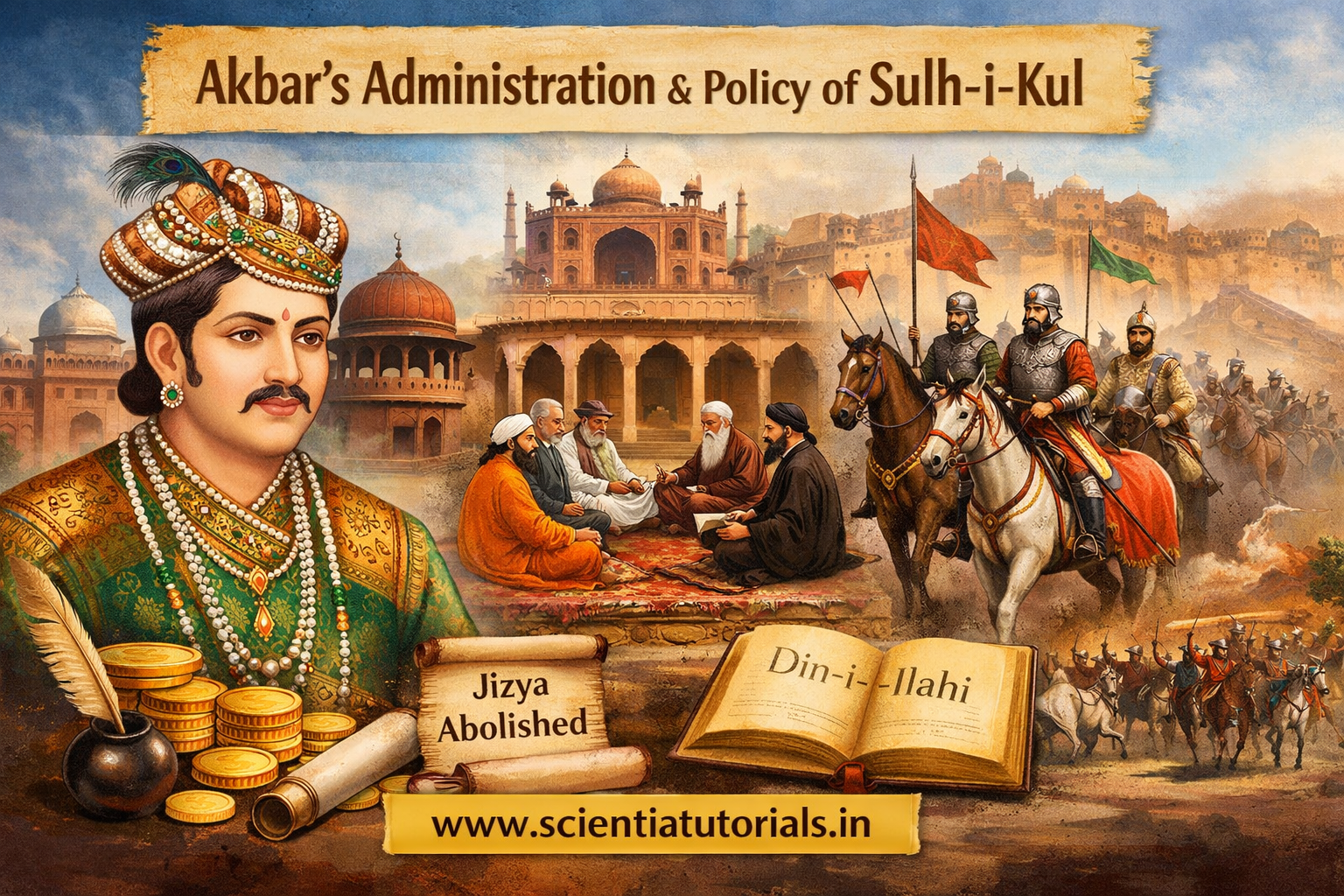

Akbar’s Administration & Policy of Sulh-i-Kul
SECTION 9: Mughal Empire in India (1526 CE – 1707 CE)
Lesson Focus: Administrative System and Religious Policy under Akbar
Introduction: Akbar and the Consolidation of the Mughal Empire
The reign of Akbar (1556–1605 CE) marks a decisive phase in the political, administrative, and ideological evolution of the Mughal Empire. While earlier rulers such as Babur and Humayun laid the foundations of Mughal rule in India, it was Akbar who transformed the empire into a centralised, stable, and inclusive imperial system. His genius lay not merely in territorial expansion but in his ability to govern a vast, culturally diverse population through administrative innovation and ideological tolerance.
Akbar’s administration combined Persian imperial traditions, Turko-Mongol military practices, and Indian socio-political realities. Parallel to administrative consolidation, he introduced the celebrated policy of Sulh-i-Kul (Universal Peace), which became the philosophical backbone of Mughal governance. Together, these measures ensured political stability, economic prosperity, and social harmony during the Mughal classical age.
Historical Background and Early Administrative Challenges (1556–1560 CE)
Akbar ascended the throne in 1556 CE at the age of thirteen after the death of Humayun. Initially, the empire was unstable, facing threats from Afghan nobles, Rajput chiefs, and internal Mughal factionalism. During this formative phase, administration was largely controlled by his regent Bairam Khan, who followed traditional military-centric governance.
The Second Battle of Panipat (1556 CE) against Hemu secured Mughal authority in North India. After assuming personal control in 1560 CE, Akbar began reorganising administration on rational and inclusive lines, moving away from a purely conquest-oriented model toward systematic governance.
Central Administration under Akbar
Akbar established a highly centralised administrative system with clearly demarcated departments, each headed by senior officials responsible directly to the emperor.
The Emperor as Supreme Authority
The Mughal emperor was the supreme executive, military commander, law-giver, and final judicial authority. Akbar strengthened kingship by projecting himself as the guardian of justice (Insaf) and welfare of all subjects, regardless of religion.
Major Central Officials
- Vakil (Prime Minister) – Coordinated between departments
- Diwan (Finance Minister) – Headed revenue and expenditure
- Mir Bakshi – In charge of military organisation and mansabdars
- Sadr-us-Sudur – Religious affairs, charities, and judicial appointments
- Qazi-ul-Quzat – Chief judicial authority
This bureaucratic division ensured administrative efficiency and accountability.
Provincial and Local Administration
For effective governance, the empire was divided into Subas (provinces). Each Suba was administered by:
- Subedar – Provincial governor
- Diwan – Provincial finance officer
- Bakshi – Military administration
- Qazi – Judicial authority
Below Subas were Sarkars, Parganas, and villages, ensuring administrative reach to the grassroots. Akbar respected traditional village institutions, integrating them into imperial governance.
Mansabdari System: Backbone of Mughal Administration
Akbar introduced and perfected the Mansabdari system, a unique administrative-military framework that linked civil administration with military service.
Features of the Mansabdari System
- Mansab denoted rank and status
- Two components:
- Zat – Personal rank and salary
- Sawar – Number of cavalry to be maintained
- Mansabs ranged from 10 to 10,000
Appointments were based on merit and loyalty, not birth. Rajputs, Afghans, Persians, and Indian Muslims were all recruited, reinforcing Akbar’s inclusive policy.
Revenue Administration and Land Reforms
One of Akbar’s greatest achievements was revenue reform, ensuring financial stability and peasant welfare.
Role of Raja Todar Mal
Under the guidance of Raja Todar Mal, Akbar introduced the Dahsala (Zabti) system.
Key Features
- Land measured using standardized units
- Average produce of ten years calculated
- Revenue fixed in cash
- State demand set at one-third of produce
These reforms reduced corruption, increased state income, and protected peasants from arbitrary taxation.
Judicial Administration
Akbar established a uniform judicial system combining Islamic law with imperial regulations. While Qazis administered justice, the emperor remained the final authority.
The Mahzar (1579 CE)
Through the Mahzar, Akbar asserted the right to interpret religious law in matters of state, reducing the dominance of orthodox ulema and strengthening imperial sovereignty.
Military Administration
Akbar maintained a standing army supported by mansabdars. He introduced:
- Branding of horses (Dagh)
- Descriptive rolls (Chehra)
- Fortified frontiers and strategic cantonments
Military efficiency ensured internal stability and successful expansion.
Akbar’s Policy of Sulh-i-Kul (Universal Peace)
Meaning and Philosophical Basis
Sulh-i-Kul literally means “peace with all”. It was a policy of universal tolerance, ethical governance, and equal treatment of all subjects irrespective of religion or ethnicity.
Akbar believed that political stability could not exist without social harmony.
Practical Measures of Sulh-i-Kul
- Abolition of Jizya (1564 CE)
- Abolition of pilgrimage tax
- Appointment of non-Muslims to high offices
- Protection of all religious practices
- Respect for Hindu customs and traditions
Rajput rulers were integrated through alliances and matrimonial relations, not forced conversions.
Religious Debates and the Ibadat Khana
Akbar established the Ibadat Khana (House of Worship) at Fatehpur Sikri, where scholars of Islam, Hinduism, Jainism, Christianity, and Zoroastrianism debated religious ideas.
This exposure led Akbar to reject religious orthodoxy and embrace rationalism and tolerance.
Din-i-Ilahi: A Moral Order
In 1582 CE, Akbar introduced Din-i-Ilahi, not as a religion but as a code of ethical conduct emphasizing loyalty, tolerance, and moral purity. It had very few followers and did not survive Akbar, but it symbolized his intellectual quest.
Impact of Akbar’s Administration and Sulh-i-Kul
Political Impact
- Strengthened imperial authority
- Reduced rebellions
- Created loyal nobility
Social Impact
- Promoted communal harmony
- Reduced religious conflict
- Integrated diverse communities
Economic Impact
- Stable revenue system
- Agricultural growth
- Increased trade and urban prosperity
Evaluation and Historical Significance
Akbar’s administration marked the transition of the Mughal Empire from a conquest state to a governance state. His policy of Sulh-i-Kul laid the foundation for a pluralistic political culture in India.
Historians regard Akbar as one of the greatest rulers in Indian history because he successfully reconciled imperial authority with cultural diversity.
Conclusion
Akbar’s administrative genius and visionary policy of Sulh-i-Kul represent the golden age of Mughal governance. By combining efficient administration with ethical tolerance, Akbar created a stable and inclusive empire that endured long after his death. His reign stands as a benchmark in Indian history for enlightened rule, administrative innovation, and religious harmony.
Akbar’s Administration & Policy of Sulh-i-Kul
Questions with Answers
Q1. Who was Akbar, and why is his reign considered a landmark in Mughal history?
Answer:
Akbar was the third Mughal emperor who ruled from 1556 to 1605 CE. His reign is considered a landmark because he consolidated the Mughal Empire through administrative reforms, military organisation, and the policy of religious tolerance known as Sulh-i-Kul, transforming the empire into a stable and inclusive polity.
Q2. What administrative challenges did Akbar face during the early years of his reign?
Answer:
Akbar faced internal rebellions by Afghan nobles, threats from regional powers, weak central control, and administrative instability inherited from Humayun. His minority rule initially required regency under Bairam Khan, after which Akbar undertook systematic reforms.
Q3. How was the Mughal central administration organised under Akbar?
Answer:
The central administration was organised into departments headed by officials such as the Diwan (finance), Mir Bakshi (military), Vakil (chief advisor), Sadr-us-Sudur (religious and judicial affairs), and Qazi-ul-Quzat (chief justice), all functioning under the emperor’s authority.
Q4. What role did the emperor play in Akbar’s administrative system?
Answer:
The emperor was the supreme authority in administration, military command, justice, and law-making. Akbar personally supervised governance and acted as the final authority in judicial and policy matters.
Q5. Describe the provincial administration under Akbar.
Answer:
The empire was divided into Subas (provinces), each governed by a Subedar. Other officials included the Diwan (finance), Bakshi (military), and Qazi (judicial authority). This ensured decentralised yet controlled administration.
Q6. What was the Mansabdari system introduced by Akbar?
Answer:
The Mansabdari system was an administrative-cum-military ranking system that determined an officer’s status, salary, and military obligations. It formed the backbone of Mughal administration.
Q7. Explain the terms ‘Zat’ and ‘Sawar’ in the Mansabdari system.
Answer:
‘Zat’ indicated the personal rank and salary of a mansabdar, while ‘Sawar’ indicated the number of cavalrymen the officer was required to maintain for imperial service.
Q8. Why was the Mansabdari system significant for imperial integration?
Answer:
It promoted loyalty to the emperor, ensured military efficiency, and integrated diverse groups such as Rajputs, Afghans, Persians, and Indian Muslims into the Mughal administration based on merit.
Q9. What were Akbar’s major revenue reforms?
Answer:
Akbar introduced systematic land measurement, fixed revenue rates, cash assessment, and uniform administration through reforms culminating in the Dahsala or Zabti system.
Q10. Who was Raja Todar Mal, and what was his contribution to revenue administration?
Answer:
Raja Todar Mal was Akbar’s finance minister who implemented the Dahsala system, standardised land measurement, and ensured fair revenue assessment based on average produce.
Q11. What was the Dahsala (Zabti) system?
Answer:
The Dahsala system assessed land revenue based on the average produce of the previous ten years and fixed the state demand at one-third of the produce, payable in cash.
Q12. How did Akbar’s revenue system benefit peasants?
Answer:
It reduced arbitrary taxation, provided predictable revenue demands, encouraged cultivation, and protected peasants from exploitation by local officials.
Q13. Describe the judicial system under Akbar.
Answer:
Justice was administered by Qazis at various levels, while the emperor remained the highest judicial authority. Akbar combined Islamic law with imperial regulations to ensure fairness.
Q14. What was the Mahzar of 1579 CE?
Answer:
The Mahzar was a declaration that empowered Akbar to interpret religious law in matters of state when religious scholars disagreed, thereby reducing orthodox control and strengthening imperial authority.
Q15. How was the Mughal military organised under Akbar?
Answer:
The military was organised through the Mansabdari system, supported by branding of horses (Dagh), descriptive rolls (Chehra), and a standing army maintained by mansabdars.
Q16. What is meant by Sulh-i-Kul?
Answer:
Sulh-i-Kul means “universal peace” and refers to Akbar’s policy of religious tolerance and equal treatment of all subjects, irrespective of faith or ethnicity.
Q17. What were the main objectives of Akbar’s policy of Sulh-i-Kul?
Answer:
The objectives were political stability, social harmony, integration of diverse communities, and the creation of a loyal and inclusive imperial structure.
Q18. Mention any four measures taken by Akbar to implement Sulh-i-Kul.
Answer:
- Abolition of Jizya tax
- Abolition of pilgrimage tax
- Appointment of non-Muslims to high offices
- Protection of all religious practices
Q19. How did Akbar integrate the Rajputs into the Mughal administration?
Answer:
Akbar formed alliances through diplomacy and matrimonial relations, appointed Rajputs to high mansabs, and respected their autonomy and religious practices.
Q20. What was the Ibadat Khana, and why was it significant?
Answer:
The Ibadat Khana at Fatehpur Sikri was a hall for religious debates among scholars of different faiths. It encouraged intellectual exchange and shaped Akbar’s tolerant outlook.
Q21. What was Din-i-Ilahi?
Answer:
Din-i-Ilahi was a moral and ethical order introduced by Akbar in 1582 CE, emphasising loyalty, tolerance, and ethical conduct rather than a new religion.
Q22. Why did Din-i-Ilahi fail to gain popularity?
Answer:
It had no sacred text, rituals, or mass appeal and depended solely on Akbar’s personal authority, leading to its decline after his death.
Q23. Assess the political impact of Akbar’s administrative reforms.
Answer:
They strengthened central authority, reduced rebellions, ensured loyalty among nobles, and transformed the Mughal state into a stable and enduring empire.
Q24. How did Sulh-i-Kul contribute to social harmony in Mughal India?
Answer:
By promoting tolerance, reducing religious discrimination, and encouraging coexistence, Sulh-i-Kul minimised communal tensions and fostered unity among diverse populations.
Q25. Why is Akbar regarded as one of the greatest rulers in Indian history?
Answer:
Akbar is regarded as one of the greatest rulers due to his administrative genius, inclusive governance, policy of religious tolerance, and ability to unify a diverse empire through justice and rational statecraft.
Akbar’s Administration & Policy of Sulh-i-Kul
MCQs with Answers and Explanations
MCQ 1. Akbar ascended the Mughal throne in which year?
A. 1526 CE
B. 1530 CE
C. 1556 CE
D. 1565 CE
Correct Answer: C
Explanation:
Akbar ascended the throne in 1556 CE after the death of Humayun. His early reign began under the regency of Bairam Khan.
MCQ 2. The Second Battle of Panipat (1556 CE) was fought between Akbar and:
A. Sher Shah Suri
B. Sikandar Suri
C. Hemu
D. Rana Pratap
Correct Answer: C
Explanation:
Hemu, the Hindu general of the Sur rulers, challenged Mughal authority. His defeat ensured Mughal control over North India.
MCQ 3. Who served as Akbar’s regent during his minority?
A. Raja Todar Mal
B. Abul Fazl
C. Bairam Khan
D. Birbal
Correct Answer: C
Explanation:
Bairam Khan acted as Wakil-us-Saltanat (regent) and played a key role in stabilising the empire during Akbar’s early years.
MCQ 4. Which Mughal official was responsible for military organisation and appointments?
A. Diwan
B. Sadr-us-Sudur
C. Mir Bakshi
D. Qazi-ul-Quzat
Correct Answer: C
Explanation:
The Mir Bakshi maintained military records, appointed mansabdars, and supervised the army.
MCQ 5. The Mansabdari system primarily combined:
A. Religion and politics
B. Revenue and trade
C. Administration and military service
D. Law and justice
Correct Answer: C
Explanation:
The Mansabdari system linked civil administration with military obligations, forming the backbone of Mughal governance.
MCQ 6. In the Mansabdari system, ‘Zat’ referred to:
A. Number of cavalry maintained
B. Personal rank and salary
C. Land revenue assigned
D. Religious status
Correct Answer: B
Explanation:
Zat indicated the personal status, rank, and salary of a mansabdar.
MCQ 7. ‘Sawar’ in the Mansabdari system denoted:
A. Revenue grade
B. Number of horses owned
C. Number of cavalrymen to be maintained
D. Number of villages assigned
Correct Answer: C
Explanation:
Sawar determined the military responsibility of a mansabdar in terms of cavalry.
MCQ 8. Which system ensured verification of horses and soldiers in Akbar’s army?
A. Zabti
B. Chehra and Dagh
C. Iqta
D. Jagirdari
Correct Answer: B
Explanation:
Chehra (descriptive rolls) and Dagh (branding of horses) prevented corruption and ensured military efficiency.
MCQ 9. Who was the chief architect of Akbar’s revenue reforms?
A. Abul Fazl
B. Birbal
C. Raja Todar Mal
D. Bairam Khan
Correct Answer: C
Explanation:
Raja Todar Mal standardised land measurement and assessment under Akbar.
MCQ 10. The Dahsala system assessed land revenue based on:
A. Annual produce
B. Five-year average
C. Ten-year average
D. Fixed land size
Correct Answer: C
Explanation:
The Dahsala (Zabti) system calculated average produce of the previous ten years for fair assessment.
MCQ 11. Under the Dahsala system, the state demand was approximately:
A. One-fourth of produce
B. One-half of produce
C. One-third of produce
D. Two-thirds of produce
Correct Answer: C
Explanation:
One-third of the produce was fixed as state revenue, usually collected in cash.
MCQ 12. Which Mughal province was known as ‘Suba’?
A. Village
B. Pargana
C. Sarkar
D. Province
Correct Answer: D
Explanation:
Suba was the highest provincial unit in Mughal administration.
MCQ 13. The Mahzar of 1579 CE was significant because it:
A. Established Islamic orthodoxy
B. Abolished Jizya
C. Gave Akbar authority to interpret religious law
D. Introduced Din-i-Ilahi
Correct Answer: C
Explanation:
The Mahzar reduced the power of orthodox ulema and strengthened imperial authority.
MCQ 14. Sulh-i-Kul literally means:
A. Rule of law
B. Peace with all
C. Divine kingship
D. Religious reform
Correct Answer: B
Explanation:
Sulh-i-Kul was Akbar’s doctrine of universal tolerance and harmony.
MCQ 15. Which tax was abolished by Akbar as part of Sulh-i-Kul?
A. Land revenue
B. Zakat
C. Jizya
D. Ushr
Correct Answer: C
Explanation:
Abolition of Jizya removed religious discrimination against non-Muslims.
MCQ 16. Akbar’s religious debates were held at:
A. Agra Fort
B. Lahore
C. Fatehpur Sikri
D. Delhi
Correct Answer: C
Explanation:
The Ibadat Khana at Fatehpur Sikri hosted inter-faith discussions.
MCQ 17. Which religions participated in debates at the Ibadat Khana?
A. Only Islam
B. Islam and Hinduism
C. Islam, Hinduism, Jainism, Christianity, Zoroastrianism
D. Only Indian religions
Correct Answer: C
Explanation:
Akbar encouraged dialogue among multiple faiths to promote understanding.
MCQ 18. Din-i-Ilahi was primarily a:
A. New religion
B. Political ideology
C. Moral and ethical order
D. Legal code
Correct Answer: C
Explanation:
Din-i-Ilahi emphasised ethics and loyalty, not ritual or mass worship.
MCQ 19. Why did Din-i-Ilahi fail to spread widely?
A. Opposition from Rajputs
B. Lack of military support
C. Absence of rituals and mass appeal
D. Economic hardship
Correct Answer: C
Explanation:
It depended on Akbar’s personal authority and lacked institutional structure.
MCQ 20. Akbar’s policy towards the Rajputs was based on:
A. Forced conversion
B. Military suppression
C. Diplomatic alliance and integration
D. Isolation
Correct Answer: C
Explanation:
Akbar integrated Rajputs through alliances, matrimonial relations, and high offices.
MCQ 21. Which principle best explains Akbar’s governance philosophy?
A. Divine Right of Kings
B. Religious orthodoxy
C. Centralised absolutism
D. Inclusive and tolerant rule
Correct Answer: D
Explanation:
Akbar believed stable governance required tolerance and inclusion.
MCQ 22. Who among the following was a prominent court historian of Akbar?
A. Badayuni
B. Abul Fazl
C. Amir Khusrau
D. Minhaj-us-Siraj
Correct Answer: B
Explanation:
Abul Fazl authored the Akbarnama and Ain-i-Akbari.
MCQ 23. Akbar’s administration is often described as:
A. Theocratic
B. Feudal
C. Military-only
D. Centralised bureaucratic
Correct Answer: D
Explanation:
Akbar developed a strong central bureaucracy with defined offices.
MCQ 24. Which factor most contributed to Mughal stability under Akbar?
A. Continuous warfare
B. Heavy taxation
C. Administrative efficiency and tolerance
D. Religious uniformity
Correct Answer: C
Explanation:
Efficient administration combined with Sulh-i-Kul ensured loyalty and peace.
MCQ 25. Akbar’s reign is best described as the:
A. Decline of Mughal power
B. Transitional phase only
C. Golden age of Mughal administration
D. Period of religious conflict
Correct Answer: C
Explanation:
Akbar’s reforms created a strong, stable empire admired by historians as a model of enlightened rule.
🎯 Targeting Exams Section
This content is specifically designed for the following examinations:
-
UPSC Civil Services Examination (Prelims & Mains)
-
State Public Service Commissions (PSC)
-
SSC (CGL, CHSL, GD – History segment)
-
UGC NET / SET (History)
-
University & College Semester Examinations
-
School Board Exams (Class 7–12 History)
-
Competitive Exams with Medieval Indian History syllabus
🔑 Related Keyphrases
-
Akbar administration system
-
Sulh-i-Kul policy of Akbar
-
Mughal administration under Akbar
-
Mansabdari system Akbar
-
Akbar revenue reforms Todar Mal
-
Mughal Empire administration notes
-
Religious policy of Akbar
-
Akbar Ibadat Khana and Din-i-Ilahi
-
Medieval Indian History Mughal period
-
History of India Mughal Empire study material