
Challenges of Nation-Building in Independent India
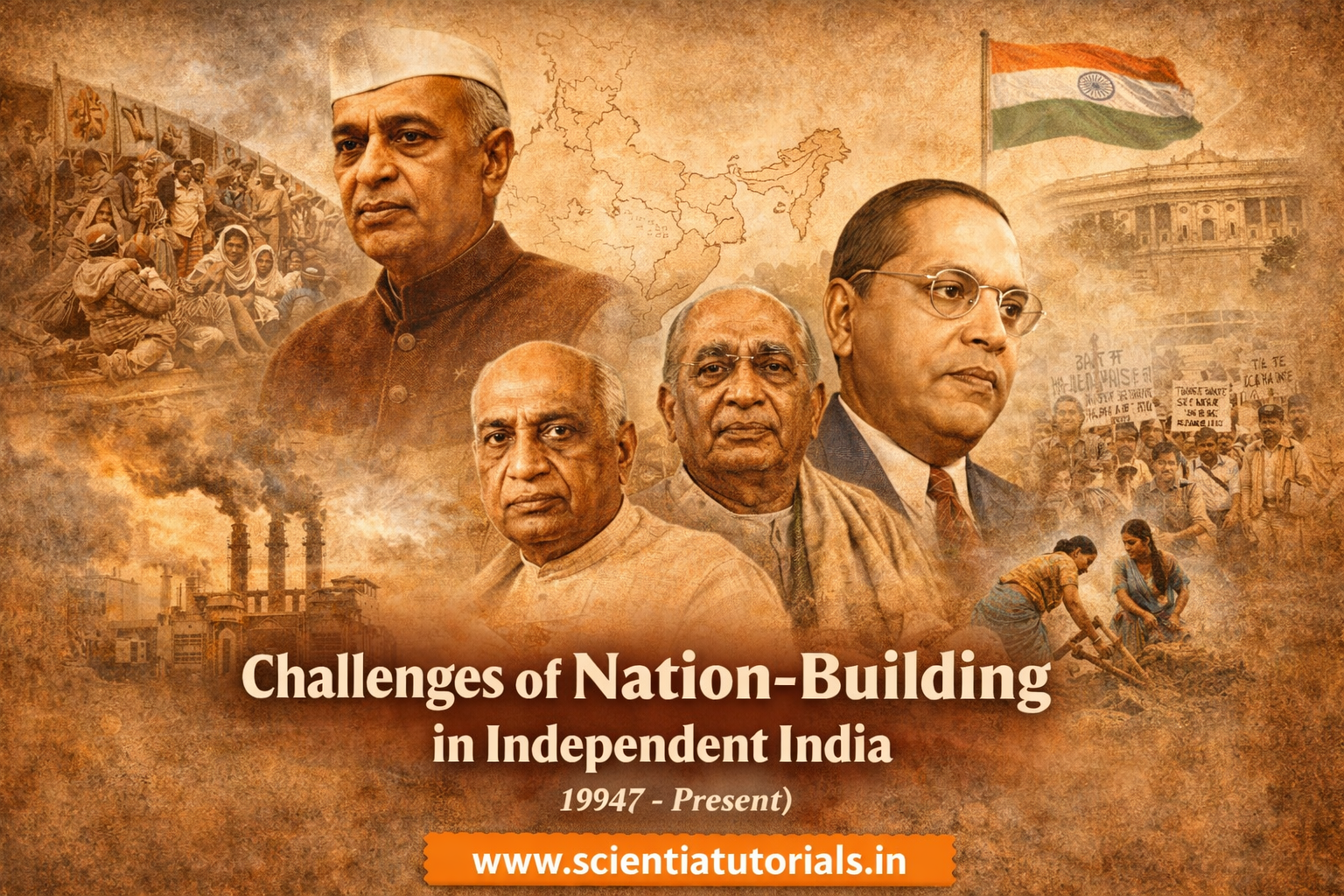

Challenges of Nation-Building in Independent India – History of India
SECTION 16: Post-Independence & Contemporary India
Timeline: 1947 CE – Present
Lesson: Challenges of Nation-Building in Independent India
1. Introduction: The Meaning of Nation-Building After 1947
The attainment of independence on 15 August 1947 marked the end of colonial rule, but it also signified the beginning of a far more complex and demanding task—nation-building. Independent India inherited a legacy of economic underdevelopment, social divisions, political fragmentation, and administrative disruption.
Nation-building in India was not merely about establishing a government; it involved the creation of a unified political community, the consolidation of democracy, economic reconstruction, social integration, and the preservation of national unity in a deeply diverse society.
This lesson examines the major challenges faced by India since independence, tracing them chronologically and thematically to understand how the Indian state responded to these challenges over time.
2. Immediate Challenges at Independence (1947–1950)
2.1 Partition and Refugee Crisis
One of the gravest challenges at independence was the Partition of India, which led to:
- Large-scale communal violence
- The displacement of nearly 14 million people
- Loss of lives and property on an unprecedented scale
The new Indian state had to provide relief, rehabilitation, and resettlement to millions of refugees, while simultaneously restoring law and order.
2.2 Integration of Princely States
India inherited a fragmented political map with over 560 princely states. Their integration into the Indian Union was essential for national unity. This task was successfully carried out under the leadership of Sardar Vallabhbhai Patel, who used diplomacy, persuasion, and firm action where necessary.
Without integration, India risked political disintegration and regional instability.
2.3 Establishment of a Democratic Constitution
Another foundational challenge was the framing and implementation of a democratic constitution. The Constitution, enforced on 26 January 1950, provided:
- Universal adult franchise
- Fundamental Rights
- Federal structure
- Parliamentary democracy
It laid the institutional foundation for nation-building.
3. Political Challenges of Nation-Building
3.1 Building Democratic Institutions
India chose democracy at a time when many newly independent nations opted for authoritarian rule. Conducting free and fair elections, ensuring political participation, and maintaining civil liberties were major challenges.
Under the leadership of Jawaharlal Nehru, India strengthened democratic institutions such as:
- Parliament
- Independent judiciary
- Election Commission
The successful conduct of the first general elections (1951–52) demonstrated the viability of democracy in a poor and diverse society.
3.2 Federalism and Centre–State Relations
Balancing unity with regional autonomy was a persistent challenge. While India adopted a federal structure, the Constitution granted significant powers to the Centre to prevent fragmentation.
Tensions often arose over:
- Distribution of powers
- Financial resources
- Role of Governors
- Use of emergency provisions
Managing these tensions has been a continuous aspect of nation-building.
4. Linguistic and Regional Challenges
4.1 Linguistic Diversity and State Reorganisation
India’s linguistic diversity posed a major challenge. Demands for states based on language gained momentum in the early years after independence.
The States Reorganisation Act, 1956 reorganised states primarily on linguistic lines. While this helped accommodate regional aspirations, it also raised fears of:
- Regionalism
- Threats to national unity
Over time, linguistic reorganisation strengthened rather than weakened Indian unity by giving people a sense of cultural recognition.
4.2 Regionalism and Separatist Movements
Certain regions witnessed separatist or autonomy movements due to:
- Economic neglect
- Cultural identity concerns
- Political marginalisation
The Indian state responded through a mix of accommodation, negotiation, and constitutional safeguards.
5. Economic Challenges of Nation-Building
5.1 Legacy of Colonial Underdevelopment
At independence, India’s economy was:
- Agrarian and stagnant
- Characterised by poverty and unemployment
- Lacking industrial infrastructure
Economic nation-building required transforming a colonial economy into a self-reliant one.
5.2 Planned Economic Development
India adopted a planned development model with the establishment of the Planning Commission in 1950. The objectives included:
- Rapid industrialisation
- Reduction of poverty
- Balanced regional development
Five-Year Plans focused on heavy industries, public sector enterprises, and infrastructure development. While this strategy built an industrial base, it also faced issues of inefficiency and slow growth.
5.3 Poverty and Inequality
Despite economic planning, poverty and inequality remained persistent challenges. Addressing unemployment, rural distress, and unequal development became central to nation-building policies.
6. Social Challenges of Nation-Building
6.1 Caste System and Social Inequality
Indian society was deeply stratified by caste, class, and gender. Nation-building required dismantling centuries-old social hierarchies.
The Constitution addressed this challenge through:
- Abolition of untouchability
- Reservation policies for Scheduled Castes and Scheduled Tribes
- Promotion of social justice
However, social equality has remained an ongoing struggle.
6.2 Gender Inequality
Women played a significant role in the freedom struggle, yet faced marginalisation in post-independence society. Ensuring gender equality through:
- Legal reforms
- Educational access
- Political participation
has been an important dimension of nation-building.
7. Challenges of National Integration and Identity
7.1 Secularism and Communal Harmony
India adopted secularism to manage religious diversity. Maintaining communal harmony in the aftermath of Partition violence was a major challenge.
The state sought to:
- Treat all religions equally
- Prevent communal politics
- Protect minority rights
Despite constitutional safeguards, communal tensions have periodically tested the nation-building process.
7.2 National Identity in a Plural Society
Forging a common national identity while respecting diversity was central to India’s nation-building project. Symbols such as:
- National flag
- National anthem
- Constitution
played a crucial role in fostering a sense of belonging.
8. Internal Security and External Challenges
8.1 Internal Security Issues
Insurgency, extremism, and internal conflicts in certain regions posed serious challenges to state authority. Addressing these required:
- Political dialogue
- Development initiatives
- Security measures
Balancing national security with democratic freedoms remained a delicate task.
8.2 Foreign Policy and National Security
India faced immediate external challenges, including:
- Border disputes
- Refugee influx
- Cold War pressures
India’s foreign policy, based on non-alignment, aimed to safeguard sovereignty and promote peace while focusing on internal development.
9. Democratic Deepening and New Challenges (1970s–Present)
9.1 Expansion of Democracy
Over time, democracy in India deepened through:
- Rise of regional parties
- Greater political participation of marginalised groups
- Coalition governments
This reflected both the success and complexity of India’s democratic experiment.
9.2 Economic Reforms and Globalisation
The economic reforms of the 1990s introduced liberalisation, privatisation, and globalisation. While these reforms accelerated growth, they also created new challenges:
- Economic inequality
- Job insecurity
- Regional disparities
Nation-building in the contemporary era involves balancing growth with social justice.
10. Evaluation of India’s Nation-Building Experience
India’s nation-building journey has been marked by:
- Continuity of democratic institutions
- Peaceful transfer of power
- Constitutional resilience
At the same time, challenges related to inequality, social justice, and governance persist. India’s experience shows that nation-building is an ongoing process, not a one-time achievement.
11. Conclusion
Nation-building in independent India has been a complex, multi-dimensional, and continuous process. From managing the trauma of Partition to consolidating democracy, from integrating diverse regions to pursuing economic development, India has faced formidable challenges.
Despite limitations and setbacks, India’s ability to sustain democracy, preserve unity in diversity, and adapt to changing circumstances stands as a remarkable achievement in world history. The challenges of nation-building continue, but the foundations laid in the early years of independence remain central to India’s political and social life today.
Challenges of Nation-Building in Independent India
Questions with Answers (20–30 Set)
Q1. What is meant by “nation-building” in the Indian context after 1947?
Answer:
Nation-building in independent India refers to the process of creating a unified political, social, and economic community after colonial rule. It involved establishing democratic institutions, integrating diverse regions and communities, promoting economic development, and forging a shared national identity.
Q2. Why did independence in 1947 present more challenges than solutions for India?
Answer:
Independence brought political freedom but also severe challenges such as Partition, communal violence, refugee rehabilitation, economic underdevelopment, social inequalities, and political integration, all of which required immediate and long-term solutions.
Q3. How did Partition affect the nation-building process?
Answer:
Partition caused massive displacement, communal violence, and humanitarian crises. The Indian state had to rehabilitate millions of refugees, restore law and order, and rebuild trust between communities, making nation-building more complex.
Q4. Why was the integration of princely states crucial for nation-building?
Answer:
Without integrating princely states, India risked political fragmentation and instability. Integration ensured territorial unity, administrative uniformity, and the authority of the Indian Union across the subcontinent.
Q5. Who played the most significant role in the integration of princely states?
Answer:
Sardar Vallabhbhai Patel, as Deputy Prime Minister and Home Minister, played the decisive role in integrating princely states through diplomacy and firm action.
Q6. How did the Indian Constitution contribute to nation-building?
Answer:
The Constitution provided a democratic framework with Fundamental Rights, federalism, universal adult franchise, and rule of law, ensuring political stability and national unity.
Q7. Why was democracy considered a challenge in a poor and diverse country like India?
Answer:
Low literacy, widespread poverty, social divisions, and lack of democratic experience raised doubts about democratic success. Sustaining free elections and civil liberties required strong institutions and political commitment.
Q8. How did the first general elections strengthen nation-building?
Answer:
The successful conduct of the 1951–52 elections demonstrated the viability of democracy and enhanced public faith in democratic institutions.
Q9. What role did Jawaharlal Nehru play in nation-building?
Answer:
Nehru promoted democracy, secularism, scientific temper, and planned economic development, shaping India’s political and institutional foundations.
Q10. Why was federalism a major challenge in post-independence India?
Answer:
Balancing national unity with regional autonomy was difficult due to linguistic, cultural, and economic diversity. Centre–state relations often became a source of political tension.
Q11. What led to the reorganisation of states on linguistic lines?
Answer:
Popular demands for cultural recognition and administrative convenience led to linguistic reorganisation, culminating in the States Reorganisation Act, 1956.
Q12. How did linguistic reorganisation affect national unity?
Answer:
Although initially feared to encourage regionalism, linguistic reorganisation ultimately strengthened unity by accommodating regional identities within the constitutional framework.
Q13. What economic challenges did India inherit at independence?
Answer:
India inherited an agrarian economy marked by poverty, unemployment, low industrial growth, and regional disparities due to colonial exploitation.
Q14. Why did India adopt a planned economic model?
Answer:
Planned development was adopted to achieve rapid industrialisation, reduce poverty, promote self-reliance, and ensure balanced regional growth.
Q15. What were the limitations of planned economic development?
Answer:
While it created an industrial base, planning faced inefficiency, bureaucratic delays, slow growth, and persistent poverty.
Q16. Why is poverty considered a major challenge to nation-building?
Answer:
Poverty weakens social cohesion, limits access to education and healthcare, and restricts political participation, hindering inclusive nation-building.
Q17. How did caste-based inequalities challenge nation-building?
Answer:
Deep-rooted caste discrimination undermined social unity. The Constitution addressed this through abolition of untouchability and reservation policies.
Q18. What role did reservations play in nation-building?
Answer:
Reservations aimed to promote social justice and integrate historically marginalised communities into political and administrative structures.
Q19. Why is gender inequality a nation-building challenge?
Answer:
Exclusion of women from education, employment, and politics limits national development and social equality, making gender justice essential for nation-building.
Q20. How does secularism contribute to national integration?
Answer:
Secularism ensures equal treatment of all religions, protects minority rights, and helps manage religious diversity in a plural society.
Q21. What challenges has communalism posed to nation-building?
Answer:
Communalism has periodically threatened social harmony and national unity, testing the secular foundations of the Indian state.
Q22. Why is internal security important for nation-building?
Answer:
Insurgency, extremism, and regional conflicts challenge state authority and stability. Addressing them is vital for development and democratic governance.
Q23. How did foreign policy influence nation-building in early India?
Answer:
A non-aligned foreign policy helped safeguard sovereignty, avoid Cold War entanglements, and focus on internal development.
Q24. How did economic reforms after 1991 change nation-building challenges?
Answer:
Economic liberalisation accelerated growth but also increased inequality and job insecurity, creating new social and economic challenges.
Q25. Why is nation-building described as a continuous process in India?
Answer:
India’s evolving society, economy, and politics mean that integration, equality, and development remain ongoing tasks rather than completed goals.
Challenges of Nation-Building in Independent India
MCQs with Answers and Explanations
MCQ 1
Nation-building in independent India primarily refers to:
A. Establishing colonial administration
B. Creating a unified political and social community
C. Expansion of territorial boundaries
D. Adoption of socialism alone
Correct Answer: B
Explanation:
Nation-building involved integrating diverse regions and communities, establishing democratic institutions, promoting economic development, and forging a shared national identity after independence.
MCQ 2
Which event posed the most immediate humanitarian challenge to India in 1947?
A. Integration of princely states
B. Framing of the Constitution
C. Partition and refugee crisis
D. Linguistic reorganisation
Correct Answer: C
Explanation:
Partition led to mass violence and displacement of millions, requiring urgent rehabilitation and restoration of law and order.
MCQ 3
Why was the integration of princely states essential for nation-building?
A. To increase foreign influence
B. To ensure territorial and political unity
C. To strengthen monarchy
D. To delay constitution-making
Correct Answer: B
Explanation:
Without integration, India risked fragmentation into multiple political units, threatening sovereignty and stability.
MCQ 4
Who played the most decisive role in the integration of princely states?
A. Jawaharlal Nehru
B. Rajendra Prasad
C. Sardar Vallabhbhai Patel
D. C. Rajagopalachari
Correct Answer: C
Explanation:
As Home Minister, Patel used diplomacy, persuasion, and firm action to integrate over 560 princely states.
MCQ 5
The Indian Constitution contributed to nation-building mainly by:
A. Establishing monarchy
B. Promoting regional independence
C. Providing a democratic institutional framework
D. Limiting political participation
Correct Answer: C
Explanation:
The Constitution ensured democracy, fundamental rights, federalism, and rule of law, forming the backbone of nation-building.
MCQ 6
Why was democracy considered a risky experiment in India after independence?
A. Lack of political parties
B. Vast size and social diversity
C. Absence of a Constitution
D. External pressure from colonial powers
Correct Answer: B
Explanation:
Poverty, illiteracy, social divisions, and cultural diversity raised doubts about democratic stability, making its success uncertain.
MCQ 7
The successful conduct of the first general elections (1951–52) proved that:
A. Democracy was unsuitable for India
B. Only elites could vote
C. Democracy could function in a poor society
D. Federalism was unnecessary
Correct Answer: C
Explanation:
The elections demonstrated mass political participation and strengthened faith in democratic institutions.
MCQ 8
Which leader emphasised democracy, secularism, and scientific temper in nation-building?
A. Jawaharlal Nehru
B. Sardar Patel
C. Subhas Chandra Bose
D. B. R. Ambedkar
Correct Answer: A
Explanation:
Nehru shaped India’s early political vision through democratic institutions, planned development, and secular values.
MCQ 9
Federalism posed a challenge to nation-building mainly because:
A. States demanded complete independence
B. India adopted a unitary system
C. Balancing unity and regional autonomy was difficult
D. Provinces rejected the Constitution
Correct Answer: C
Explanation:
India’s diversity required decentralisation, but excessive autonomy risked fragmentation, making balance essential.
MCQ 10
The reorganisation of states in 1956 was based primarily on:
A. Religion
B. Administrative convenience alone
C. Linguistic identity
D. Economic potential
Correct Answer: C
Explanation:
Linguistic reorganisation aimed to accommodate cultural identities while maintaining national unity.
MCQ 11
Initially, linguistic reorganisation was feared to:
A. Strengthen democracy
B. Promote national integration
C. Encourage regionalism and separatism
D. Improve economic growth
Correct Answer: C
Explanation:
There were fears that linguistic states would weaken unity, though in practice they strengthened integration.
MCQ 12
Which economic condition did India inherit at independence?
A. Highly industrialised economy
B. Agrarian economy with widespread poverty
C. Export-oriented economy
D. Socialist economy
Correct Answer: B
Explanation:
Colonial exploitation left India poor, agrarian, and industrially backward.
MCQ 13
Why did India adopt planned economic development?
A. To follow Soviet ideology blindly
B. To ensure rapid industrialisation and reduce poverty
C. To promote private monopolies
D. To discourage public sector growth
Correct Answer: B
Explanation:
Planning aimed at self-reliance, balanced growth, and poverty reduction through state-led development.
MCQ 14
One limitation of the planned economy was:
A. Complete failure of industry
B. Excessive decentralisation
C. Bureaucratic inefficiency and slow growth
D. Absence of public sector
Correct Answer: C
Explanation:
While planning built infrastructure, inefficiency and red-tapism limited outcomes.
MCQ 15
Why is poverty a major obstacle to nation-building?
A. It weakens cultural unity only
B. It limits participation in economic and political life
C. It affects only rural areas
D. It has no political impact
Correct Answer: B
Explanation:
Poverty restricts access to education, health, and political participation, undermining inclusive growth.
MCQ 16
Which constitutional measure addressed caste-based inequalities?
A. Emergency provisions
B. Abolition of untouchability and reservations
C. Linguistic reorganisation
D. Land revenue reforms
Correct Answer: B
Explanation:
The Constitution abolished untouchability and introduced reservations to promote social justice.
MCQ 17
Reservations were intended mainly to:
A. Create permanent privileges
B. Promote social and political inclusion
C. Eliminate federalism
D. Encourage separatism
Correct Answer: B
Explanation:
Reservations aimed at integrating historically marginalised communities into mainstream society.
MCQ 18
Gender inequality challenges nation-building because it:
A. Reduces electoral competition
B. Limits half the population’s contribution to development
C. Has no constitutional relevance
D. Affects only urban areas
Correct Answer: B
Explanation:
Exclusion of women from education, work, and politics weakens national development.
MCQ 19
India adopted secularism mainly to:
A. Promote one religion
B. Separate religion completely from society
C. Manage religious diversity and ensure equality
D. Limit minority rights
Correct Answer: C
Explanation:
Secularism in India ensures equal respect for all religions and protects minority rights.
MCQ 20
Communalism threatens nation-building because it:
A. Encourages political participation
B. Promotes economic growth
C. Undermines social harmony and unity
D. Strengthens democracy
Correct Answer: C
Explanation:
Communal divisions weaken national integration and challenge constitutional values.
MCQ 21
Internal security issues such as insurgency affect nation-building by:
A. Improving governance
B. Strengthening democracy
C. Challenging state authority and stability
D. Reducing regional inequalities
Correct Answer: C
Explanation:
Internal conflicts disrupt development, governance, and democratic functioning.
MCQ 22
India’s early foreign policy aimed primarily at:
A. Military expansion
B. Alignment with superpowers
C. Safeguarding sovereignty and focusing on development
D. Colonial revival
Correct Answer: C
Explanation:
Non-alignment helped India avoid Cold War rivalries and concentrate on internal nation-building.
MCQ 23
Economic reforms after 1991 introduced which new challenge?
A. Decline in growth
B. Complete removal of poverty
C. Rising inequality and job insecurity
D. End of democracy
Correct Answer: C
Explanation:
Liberalisation accelerated growth but widened economic disparities, creating new nation-building challenges.
MCQ 24
The rise of regional parties reflects:
A. Failure of democracy
B. Deepening of democratic participation
C. End of federalism
D. Political instability only
Correct Answer: B
Explanation:
Regional parties represent local aspirations and indicate the expansion of democratic participation.
MCQ 25
Nation-building in India is described as a continuous process because:
A. Independence is incomplete
B. Social, economic, and political challenges keep evolving
C. The Constitution is temporary
D. Democracy has failed
Correct Answer: B
Explanation:
Changing social realities, economic conditions, and political demands make nation-building an ongoing task.
🎯 Targeting Exams Section
This lesson is carefully structured for aspirants preparing for:
-
UPSC Civil Services Examination (Prelims & Mains)
-
State Public Service Commissions (PSC)
-
UGC NET / SET (History)
-
University Undergraduate & Postgraduate History Exams
-
Teaching Eligibility & Other Competitive Exams
The content focuses on Partition, integration of princely states, democracy, federalism, economic planning, social justice, secularism, and contemporary challenges, all of which are frequently tested in both objective and descriptive formats.
🔍 Related Keyphrases
-
Challenges of nation-building in India
-
Post-independence India nation-building
-
History of India after 1947
-
Problems of nation-building in India
-
Indian democracy and nation-building
-
Economic and social challenges of India
-
Post-independence Indian history notes
-
Nation-building in India for UPSC and PSC