
Bhakti Movement: Saints & Teachings
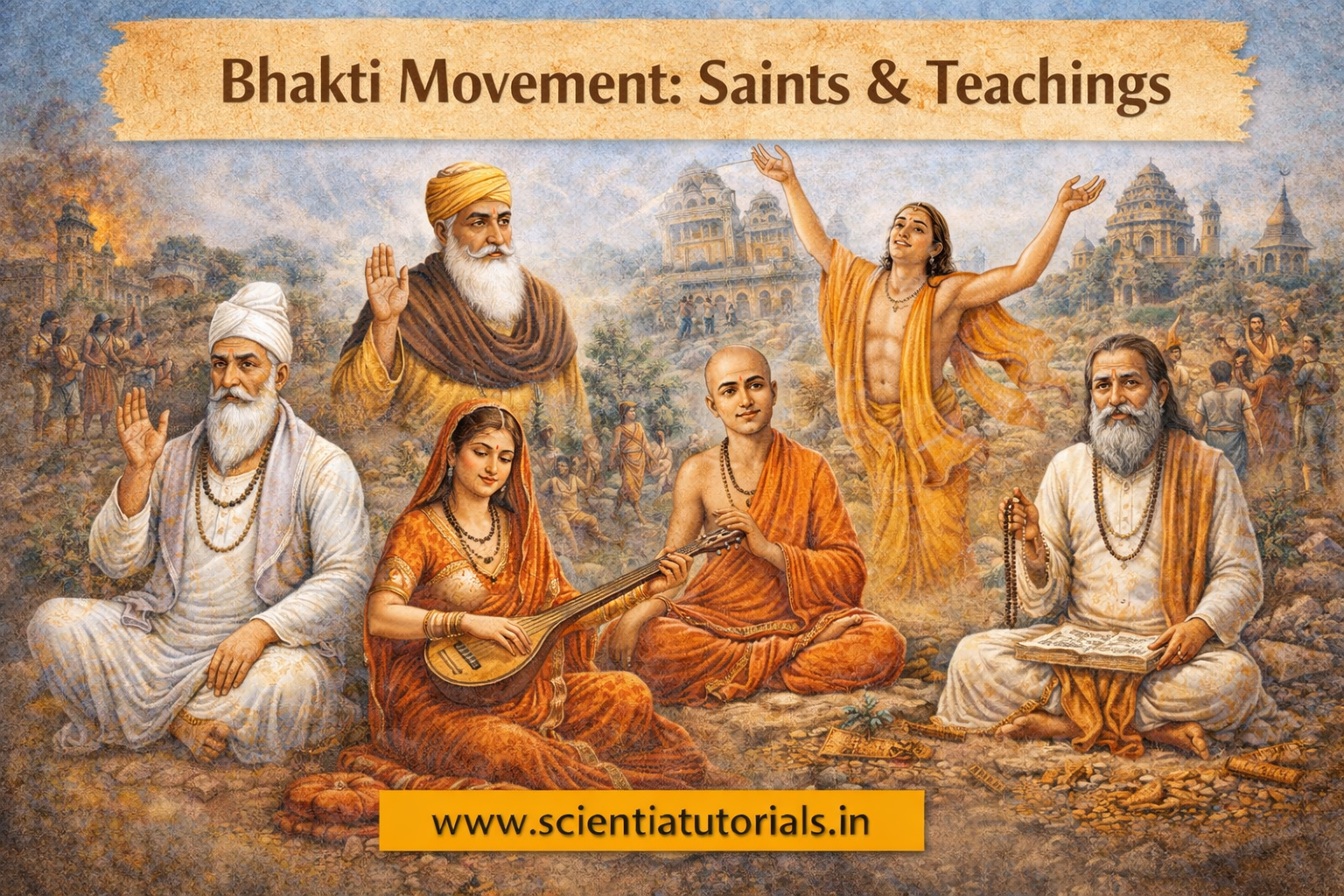

Bhakti Movement: Saints & Teachings
SECTION 10: Cultural & Social Developments in Medieval India
Timeline: c. 1200 CE – 1700 CE
Introduction: Meaning and Significance of the Bhakti Movement
The Bhakti Movement represents one of the most profound religious, social, and cultural transformations in medieval Indian history. Emerging between the 12th and 17th centuries, it emphasised personal devotion (bhakti) to God as the primary means of salvation, rejecting ritualism, caste barriers, and blind dependence on priestly mediation.
The Bhakti movement was not a single, uniform movement but a broad current of devotional ideas, expressed through poetry, songs, and sermons by saint-poets across different regions of India. It played a crucial role in shaping Indian spirituality, vernacular literature, social reform, and cultural unity during the medieval period.
Historical Background of the Bhakti Movement
Early Roots of Bhakti
The roots of Bhakti can be traced to:
- The Upanishadic emphasis on inner spirituality
- The Bhagavad Gita, which advocated devotion as a path to liberation
- The Bhagavata Purana, which popularised devotion to Vishnu
However, Bhakti as a mass movement gained momentum during medieval times due to changing social and political conditions.
Socio-Religious Context (c. 1200 CE onwards)
The emergence of the Bhakti Movement was influenced by:
- Rigid caste system and social inequalities
- Excessive ritualism in Brahmanical religion
- Political upheavals and insecurity under the Delhi Sultanate
- Interaction with Sufi ideas of devotion and equality
The Bhakti saints provided a simple, accessible, and emotionally satisfying path to God for the common people.
Chronological Phases of the Bhakti Movement
1. Early Bhakti Phase (c. 7th–10th Century CE)
This phase developed mainly in South India, led by:
- Alvars (devotees of Vishnu)
- Nayanars (devotees of Shiva)
Though earlier than the medieval timeline, this phase laid the ideological foundation for later Bhakti developments.
2. Medieval Bhakti Phase (c. 1200–1700 CE)
This was the most influential phase, spreading Bhakti across North, West, East, and Central India. It coincided with the Delhi Sultanate and Mughal periods and shaped medieval Indian society profoundly.
Philosophical Foundations of the Bhakti Movement
Core Beliefs
The Bhakti Movement rested on the following principles:
- Personal devotion to a chosen deity
- God is accessible to all, irrespective of caste, gender, or religion
- Inner purity more important than rituals
- Love and surrender (bhakti) lead to salvation
Saguna and Nirguna Bhakti
Bhakti tradition developed into two major streams:
Saguna Bhakti
- Worship of God with form and attributes
- Focus on deities like Rama, Krishna, Vishnu
- Emphasised grace, devotion, and emotional attachment
Nirguna Bhakti
- Worship of a formless, attribute-less God
- Rejected idol worship
- Emphasised knowledge, meditation, and inner realisation
Major Bhakti Saints and Their Teachings
Ramananda
- A pioneer of North Indian Bhakti
- Disciple of Ramanuja tradition
- Emphasised devotion to Rama
- Rejected caste distinctions
- Used Hindi for preaching
Ramananda laid the foundation for later Bhakti saints like Kabir and Ravidas.
Kabir
Kabir was one of the most influential Bhakti saints.
Teachings:
- Believed in Nirguna Bhakti
- Criticised ritualism in both Hinduism and Islam
- Emphasised unity of God
- Rejected caste and religious orthodoxy
Kabir’s verses are preserved in:
- Bijak
- Guru Granth Sahib
Guru Nanak
- Founder of Sikhism
- Preached devotion to one formless God
- Rejected caste system, idol worship, and ritualism
- Emphasised Naam Japna (remembrance of God)
His teachings laid the foundation of a new religious tradition combining Bhakti and Sufi elements.
Mirabai
- Prominent woman Bhakti saint
- Devotee of Krishna
- Composed devotional songs in Rajasthani and Braj
- Challenged patriarchal and social norms
Her life symbolised spiritual independence and devotion beyond social constraints.
Tulsidas
- Advocate of Saguna Bhakti
- Devotee of Rama
- Author of Ramcharitmanas in Awadhi
- Popularised Rama worship among the masses
Tulsidas made Bhakti accessible through vernacular literature.
Surdas
- Devotee of Krishna
- Associated with Vallabhacharya’s Pushtimarga
- Composed poems describing Krishna’s childhood
- His works include Sursagar
Chaitanya Mahaprabhu
- Led Bhakti movement in Bengal
- Promoted devotion to Krishna
- Introduced collective singing (kirtan)
- Emphasised emotional devotion
Ravidas
- From a marginalised caste
- Preached equality and devotion
- Rejected caste hierarchy
- Emphasised moral purity over birth
Bhakti Movement and Vernacular Languages
One of the most significant contributions of the Bhakti Movement was the development of regional languages.
Languages Used
- Hindi, Awadhi, Braj, Rajasthani
- Marathi, Bengali, Gujarati
- Tamil, Telugu, Kannada
This promoted literacy, cultural integration, and regional identities.
Social Impact of the Bhakti Movement
Challenge to Caste System
- Saints rejected caste-based discrimination
- Emphasised equality of all devotees
Position of Women
- Women saints like Mirabai gained prominence
- Encouraged spiritual participation of women
Inter-Religious Harmony
- Promoted unity between Hindus and Muslims
- Shared ethical and devotional values with Sufism
Bhakti Movement and Sufism
The Bhakti Movement developed alongside Sufi mysticism.
Common Features
- Love for God
- Rejection of formal rituals
- Emphasis on inner spirituality
- Stress on equality and compassion
This interaction contributed to composite culture in medieval India.
Limitations of the Bhakti Movement
Despite its impact, Bhakti had limitations:
- Did not completely dismantle caste system
- Some sects reinforced social hierarchies
- Influence remained uneven across regions
Historical Significance of the Bhakti Movement
The Bhakti Movement:
- Humanised religion
- Strengthened vernacular literature
- Promoted social reform
- Fostered cultural unity
- Influenced later reform movements
It represents a major cultural synthesis in Indian history.
Conclusion
The Bhakti Movement was a transformative force in medieval India that reshaped religious practice, social relations, and cultural expression. Through the teachings of saint-poets like Kabir, Mirabai, Tulsidas, and Guru Nanak, Bhakti emphasised devotion, equality, and inner spirituality.
Spanning several centuries and regions, the Bhakti Movement laid the foundation for a more inclusive and humanistic religious outlook, making it one of the most significant developments in the History of India.
Bhakti Movement: Saints & Teachings
Questions with Answers
Q1. What is meant by the Bhakti Movement?
Answer:
The Bhakti Movement was a medieval religious movement that emphasised personal devotion (bhakti) to God as the path to salvation, rejecting ritualism, caste discrimination, and priestly dominance.
Q2. During which period did the Bhakti Movement flourish in medieval India?
Answer:
The Bhakti Movement flourished mainly between c. 1200 CE and 1700 CE, though its roots can be traced to earlier South Indian traditions.
Q3. What were the main factors responsible for the rise of the Bhakti Movement?
Answer:
Rigid caste system, excessive ritualism, social inequalities, political instability, and the influence of Sufi ideas contributed to the rise of the Bhakti Movement.
Q4. What were the philosophical foundations of the Bhakti Movement?
Answer:
The movement was influenced by the Upanishads, the Bhagavad Gita, and the Bhagavata Purana, all of which emphasised devotion, inner spirituality, and surrender to God.
Q5. Distinguish between Saguna and Nirguna Bhakti.
Answer:
Saguna Bhakti worships God with form and attributes (Rama, Krishna), while Nirguna Bhakti believes in a formless, attribute-less God and rejects idol worship.
Q6. Who were the Alvars and Nayanars?
Answer:
The Alvars were Vaishnava saints devoted to Vishnu, and the Nayanars were Shaiva saints devoted to Shiva in South India, forming the early phase of Bhakti.
Q7. Why is Ramananda considered important in the Bhakti Movement?
Answer:
Ramananda popularised Bhakti in North India, preached devotion to Rama, rejected caste distinctions, and used vernacular Hindi.
Q8. Discuss the teachings of Kabir.
Answer:
Kabir preached Nirguna Bhakti, condemned ritualism in Hinduism and Islam, rejected caste distinctions, and emphasised unity of God.
Q9. Why is Kabir regarded as a bridge between Hinduism and Islam?
Answer:
Kabir criticised both religious orthodoxies and emphasised a common spiritual truth, promoting harmony between Hindus and Muslims.
Q10. What was the contribution of Guru Nanak to the Bhakti Movement?
Answer:
Guru Nanak preached devotion to one formless God, rejected caste and ritualism, and laid the foundation of Sikhism.
Q11. Explain the significance of Mirabai in the Bhakti tradition.
Answer:
Mirabai was a woman saint devoted to Krishna who challenged social and patriarchal norms through devotional poetry.
Q12. What role did Tulsidas play in popularising Bhakti?
Answer:
Tulsidas popularised devotion to Rama through Ramcharitmanas, written in Awadhi, making Bhakti accessible to common people.
Q13. Who was Surdas, and what were his contributions?
Answer:
Surdas was a devotee of Krishna who composed devotional poems describing Krishna’s childhood, compiled in Sursagar.
Q14. How did Chaitanya Mahaprabhu influence the Bhakti Movement?
Answer:
Chaitanya Mahaprabhu spread Krishna devotion in Bengal, emphasised emotional devotion, and popularised collective singing (kirtan).
Q15. What were the teachings of Ravidas?
Answer:
Ravidas preached social equality, rejected caste discrimination, and emphasised devotion and moral purity.
Q16. How did the Bhakti Movement contribute to the growth of vernacular languages?
Answer:
Bhakti saints composed hymns and poems in regional languages like Hindi, Marathi, Bengali, and Tamil, promoting literacy and cultural integration.
Q17. What was the impact of the Bhakti Movement on the caste system?
Answer:
The movement challenged caste hierarchy by emphasising equality of all devotees, though it did not completely abolish caste distinctions.
Q18. How did the Bhakti Movement affect the status of women?
Answer:
It allowed women spiritual participation and produced prominent women saints like Mirabai, though social inequalities persisted.
Q19. What similarities existed between the Bhakti Movement and Sufism?
Answer:
Both emphasised love for God, inner devotion, rejection of ritualism, and social equality, fostering Hindu–Muslim harmony.
Q20. In what ways did the Bhakti Movement promote social reform?
Answer:
It questioned social inequalities, criticised orthodox practices, promoted equality, and encouraged moral and ethical living.
Q21. What were the limitations of the Bhakti Movement?
Answer:
The movement did not dismantle caste entirely, had regional limitations, and some sects reinforced social hierarchies.
Q22. How did Bhakti literature influence Indian culture?
Answer:
It enriched vernacular literature, preserved spiritual ideas through poetry, and shaped regional cultural identities.
Q23. Why is the Bhakti Movement described as a mass movement?
Answer:
Because it used local languages, simple teachings, and emotional devotion, making religion accessible to common people.
Q24. How did the Bhakti Movement help in cultural integration of India?
Answer:
By spreading common devotional ideas across regions and communities, it fostered cultural unity despite regional diversity.
Q25. Assess the historical significance of the Bhakti Movement.
Answer:
The Bhakti Movement transformed medieval Indian society by humanising religion, promoting social equality, strengthening vernacular literature, and shaping India’s cultural and spiritual heritage.
Bhakti Movement: Saints & Teachings
MCQs with Answers and Explanations
MCQ 1. The Bhakti Movement primarily emphasised:
A. Ritual sacrifices
B. Caste-based duties
C. Personal devotion to God
D. Priest-led worship
Correct Answer: C
Explanation:
The Bhakti Movement stressed personal devotion (bhakti) as the path to salvation, rejecting ritualism and priestly dominance.
MCQ 2. The Bhakti Movement in medieval India flourished mainly between:
A. 600–1000 CE
B. 800–1100 CE
C. 1200–1700 CE
D. 1500–1800 CE
Correct Answer: C
Explanation:
The medieval Bhakti Movement spread widely between the 12th and 17th centuries across different regions of India.
MCQ 3. Which text strongly influenced the philosophy of Bhakti?
A. Manusmriti
B. Arthashastra
C. Bhagavad Gita
D. Rigveda
Correct Answer: C
Explanation:
The Bhagavad Gita emphasises devotion, surrender, and selfless action, forming a philosophical base for Bhakti thought.
MCQ 4. The early Bhakti saints of South India were known as:
A. Sufis and Fakirs
B. Siddhas and Yogis
C. Alvars and Nayanars
D. Nathpanthis
Correct Answer: C
Explanation:
The Alvars (Vaishnava) and Nayanars (Shaiva) pioneered devotional worship in South India.
MCQ 5. Which feature is common to both Bhakti Movement and Sufism?
A. Idol worship
B. Emphasis on rituals
C. Love and devotion to God
D. Political authority
Correct Answer: C
Explanation:
Both Bhakti and Sufism stressed love, devotion, and inner spirituality, rejecting rigid formalism.
MCQ 6. Saguna Bhakti refers to the worship of God:
A. Without attributes
B. Through rituals only
C. With form and attributes
D. Through knowledge alone
Correct Answer: C
Explanation:
Saguna Bhakti involves devotion to God in a personal form, such as Rama or Krishna.
MCQ 7. Nirguna Bhakti emphasised devotion to:
A. Vishnu only
B. Shiva only
C. A formless, attribute-less God
D. Nature spirits
Correct Answer: C
Explanation:
Nirguna Bhakti rejected idol worship and believed in a formless absolute reality.
MCQ 8. Who among the following popularised Bhakti in North India and preached devotion to Rama?
A. Kabir
B. Ramananda
C. Surdas
D. Chaitanya
Correct Answer: B
Explanation:
Ramananda preached devotion to Rama, rejected caste distinctions, and used vernacular Hindi.
MCQ 9. Which Bhakti saint strongly criticised ritualism in both Hinduism and Islam?
A. Tulsidas
B. Surdas
C. Kabir
D. Chaitanya
Correct Answer: C
Explanation:
Kabir condemned religious hypocrisy and stressed unity of God.
MCQ 10. Kabir belonged to which Bhakti tradition?
A. Saguna Bhakti
B. Shaiva Bhakti
C. Nirguna Bhakti
D. Vaishnava Bhakti
Correct Answer: C
Explanation:
Kabir preached Nirguna Bhakti, rejecting idols and formal religious practices.
MCQ 11. The verses of Kabir are preserved in all the following EXCEPT:
A. Bijak
B. Guru Granth Sahib
C. Sursagar
D. Kabir Granthavali
Correct Answer: C
Explanation:
Sursagar is associated with Surdas, not Kabir.
MCQ 12. Who founded Sikhism and preached devotion to one formless God?
A. Kabir
B. Guru Nanak
C. Ravidas
D. Namdev
Correct Answer: B
Explanation:
Guru Nanak laid the foundation of Sikhism, combining Bhakti and Sufi ideas.
MCQ 13. Which concept was central to Guru Nanak’s teachings?
A. Idol worship
B. Naam Japna
C. Vedic rituals
D. Ascetic isolation
Correct Answer: B
Explanation:
Naam Japna (constant remembrance of God) was a core teaching of Guru Nanak.
MCQ 14. Mirabai was a devotee of:
A. Rama
B. Shiva
C. Vishnu
D. Krishna
Correct Answer: D
Explanation:
Mirabai composed devotional songs dedicated to Krishna.
MCQ 15. Mirabai is significant because she:
A. Led a political revolt
B. Established a sect
C. Challenged social and gender norms
D. Wrote in Sanskrit only
Correct Answer: C
Explanation:
Mirabai defied patriarchal restrictions and asserted spiritual independence.
MCQ 16. Who authored the Ramcharitmanas?
A. Surdas
B. Kabir
C. Tulsidas
D. Ramananda
Correct Answer: C
Explanation:
Tulsidas composed Ramcharitmanas in Awadhi to popularise Rama Bhakti.
MCQ 17. Surdas is best known for his devotion to:
A. Rama
B. Krishna
C. Shiva
D. Nirguna Brahman
Correct Answer: B
Explanation:
Surdas described Krishna’s childhood exploits in lyrical poetry.
MCQ 18. Which Bhakti saint popularised kirtan and Krishna devotion in Bengal?
A. Namdev
B. Tulsidas
C. Chaitanya Mahaprabhu
D. Ravidas
Correct Answer: C
Explanation:
Chaitanya Mahaprabhu emphasised emotional devotion through collective singing.
MCQ 19. Ravidas is associated with which key Bhakti idea?
A. Ritual purity
B. Caste hierarchy
C. Social equality
D. Political power
Correct Answer: C
Explanation:
Ravidas rejected caste distinctions and emphasised equality.
MCQ 20. One major contribution of the Bhakti Movement was the:
A. Decline of regional languages
B. Growth of Sanskrit literature only
C. Development of vernacular literature
D. Spread of temple ritualism
Correct Answer: C
Explanation:
Bhakti saints used regional languages, making religious ideas accessible to the masses.
MCQ 21. Which language was used by Tulsidas to reach common people?
A. Sanskrit
B. Persian
C. Awadhi
D. Urdu
Correct Answer: C
Explanation:
Awadhi enabled wider reach beyond elite audiences.
MCQ 22. The Bhakti Movement challenged the caste system by:
A. Promoting Brahmin dominance
B. Supporting untouchability
C. Emphasising equality of devotees
D. Supporting varna duties
Correct Answer: C
Explanation:
Bhakti saints asserted that devotion, not birth, determined spiritual worth.
MCQ 23. Which group gained greater spiritual visibility due to the Bhakti Movement?
A. Only kings
B. Merchants only
C. Women and lower castes
D. Priests only
Correct Answer: C
Explanation:
The movement allowed participation of women and marginalised groups in spiritual life.
MCQ 24. A major limitation of the Bhakti Movement was that it:
A. Encouraged violence
B. Fully abolished caste system
C. Did not eliminate caste inequalities completely
D. Rejected all social reform
Correct Answer: C
Explanation:
Despite challenging caste ideology, social hierarchies continued in practice.
MCQ 25. The historical significance of the Bhakti Movement lies in its role in:
A. Establishing political unity
B. Humanising religion and society
C. Promoting imperial authority
D. Expanding ritual practices
Correct Answer: B
Explanation:
The Bhakti Movement reshaped medieval Indian society by promoting devotion, equality, and cultural integration, making it a landmark in the History of India.
🎯 Targeting Exams
This content is structured to support preparation for:
-
UPSC Civil Services Examination (Prelims & Mains)
-
State Public Service Commission (PSC) Exams
-
SSC (CGL, CHSL, GD – History sections)
-
UGC NET / SET (History)
-
University & College Semester Examinations
-
School Board Exams (Class 7–12, Medieval Indian History)
-
Other Competitive Exams covering History of India
🔑 Related Keyphrases
-
Bhakti Movement in medieval India
-
Bhakti saints and their teachings
-
Saguna and Nirguna Bhakti
-
Kabir Guru Nanak Mirabai teachings
-
Bhakti Movement social reform
-
Bhakti Movement and Sufism
-
Vernacular literature Bhakti movement
-
Cultural developments in medieval India
-
History of India Bhakti Movement notes
-
UPSC Bhakti Movement study material