
Indian Constitution: Features & Amendments
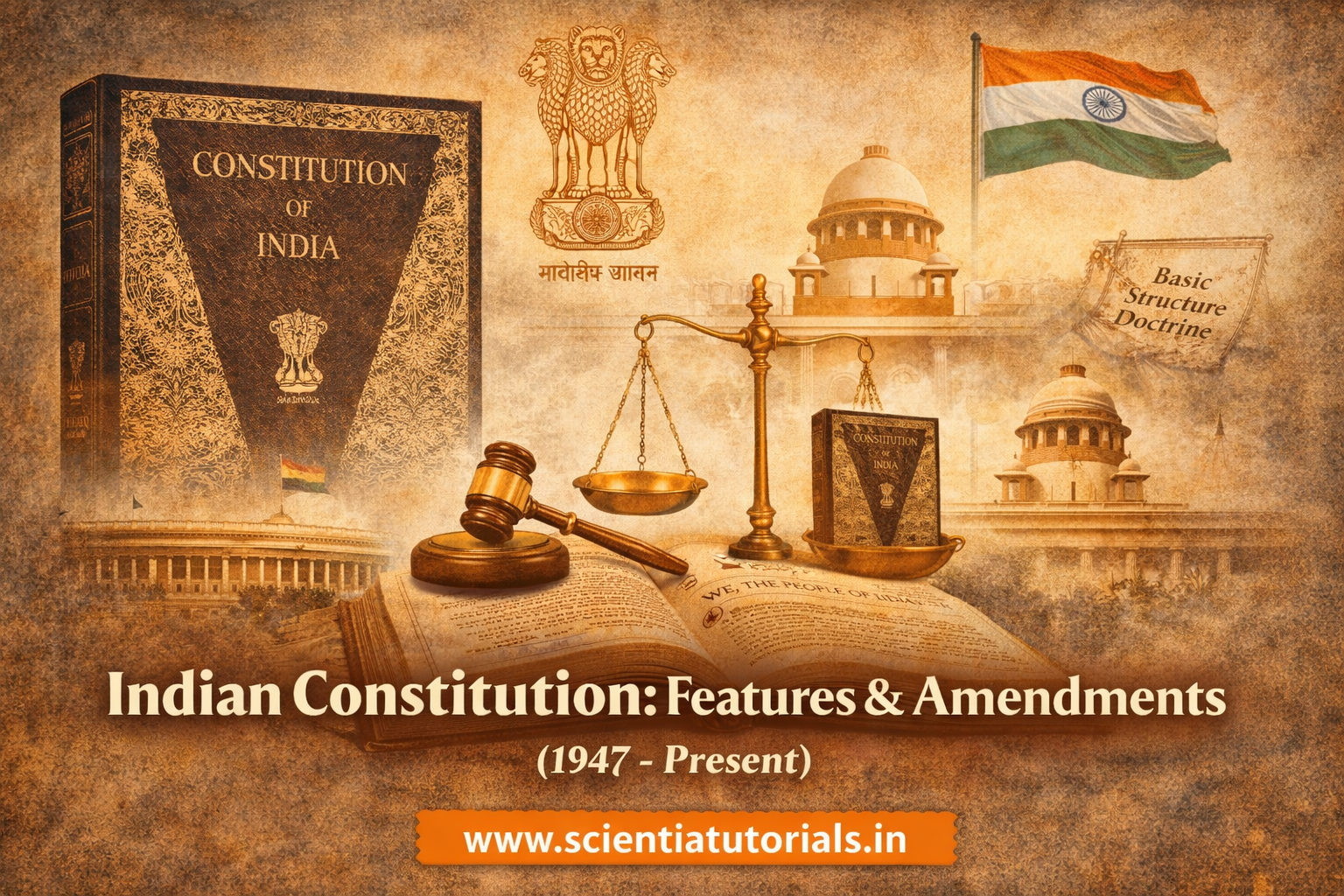

Indian Constitution: Features & Amendments – History of India
SECTION 16: Post-Independence & Contemporary India
Timeline: 1947 CE – Present
Lesson: Indian Constitution – Features & Amendments
1. Introduction: The Constitution as the Foundation of Post-Independence India
The Indian Constitution is the cornerstone of India’s post-independence political system. Enforced on 26 January 1950, it provided the newly independent nation with a democratic, republican, and constitutional framework to govern an extraordinarily diverse society.
Unlike many post-colonial states that experienced constitutional breakdowns, India has sustained constitutional continuity for over seven decades. This durability is rooted in two interrelated aspects:
- Salient Features of the Constitution, which combine flexibility with stability
- The Amendment Process, which allows adaptation to changing social, political, and economic needs
This lesson examines both dimensions chronologically and conceptually, highlighting how the Constitution has functioned as a living document in India’s nation-building process.
2. Historical Context: Adoption of the Constitution (1946–1950)
2.1 Framing and Adoption
The Constitution was framed by the Constituent Assembly between 1946 and 1949 under challenging circumstances marked by:
- Partition and refugee crises
- Integration of princely states
- Economic and administrative disruption
The Drafting Committee, chaired by B. R. Ambedkar, played a central role in shaping the final text.
- Adopted: 26 November 1949
- Enforced: 26 January 1950
India thus emerged as a Sovereign Democratic Republic, replacing colonial rule with constitutional governance.
3. Nature of the Indian Constitution
3.1 Written and Lengthy Constitution
The Indian Constitution is the lengthiest written constitution in the world, originally containing:
- 395 Articles
- 8 Schedules
Its length reflects:
- India’s social diversity
- Detailed administrative provisions
- Need for legal clarity in a newly independent state
3.2 Blend of Rigidity and Flexibility
The Constitution is neither fully rigid nor fully flexible:
- Some provisions can be amended by a simple majority
- Others require a special majority
- Certain amendments need ratification by states
This balance has ensured both stability and adaptability.
4. Salient Features of the Indian Constitution
4.1 Sovereign, Socialist, Secular, Democratic Republic
The Preamble declares India to be:
- Sovereign – free from external control
- Socialist – committed to social and economic justice
- Secular – equal respect for all religions
- Democratic – government by the people
- Republic – elected head of state
These principles guide constitutional interpretation and governance.
4.2 Parliamentary System of Government
India adopted a parliamentary form of government, inspired by the British model:
- Executive responsible to the legislature
- Prime Minister as real executive
- President as nominal head
This system ensures accountability and collective responsibility.
4.3 Federal System with a Strong Centre
India has a quasi-federal structure:
- Division of powers between Centre and States
- Union, State, and Concurrent Lists
However, the Centre is stronger due to:
- Emergency provisions
- Power of Parliament to reorganise states
- Single Constitution and citizenship
This was necessary to maintain unity in a diverse nation.
4.4 Fundamental Rights (Part III)
Fundamental Rights guarantee civil and political liberties such as:
- Right to Equality
- Right to Freedom
- Right against Exploitation
- Right to Freedom of Religion
- Cultural and Educational Rights
- Right to Constitutional Remedies
They are justiciable, meaning enforceable by courts, making the judiciary a guardian of the Constitution.
4.5 Directive Principles of State Policy (Part IV)
The Directive Principles provide non-justiciable guidelines for governance, aiming to:
- Promote social welfare
- Reduce inequality
- Establish a just social order
They reflect the Constitution’s commitment to socio-economic transformation.
4.6 Fundamental Duties (Part IVA)
Added by the 42nd Constitutional Amendment (1976), Fundamental Duties remind citizens of their responsibilities, including:
- Respect for the Constitution
- Promotion of harmony
- Protection of public property
They balance rights with obligations.
4.7 Independent Judiciary and Judicial Review
The Constitution establishes an independent judiciary with the power of:
- Judicial review
- Interpretation of the Constitution
- Protection of Fundamental Rights
The judiciary has played a vital role in constitutional evolution.
4.8 Universal Adult Franchise
The Constitution granted universal adult franchise from the beginning, regardless of:
- Gender
- Caste
- Religion
- Property
This was a revolutionary step in a largely illiterate society and deepened democracy.
4.9 Single Citizenship
India follows single citizenship, unlike some federal states. This promotes:
- National unity
- Equal political identity
5. Constitutional Amendments: Meaning and Procedure
5.1 Need for Amendments
The framers recognised that society evolves. Amendments allow the Constitution to:
- Adapt to social change
- Respond to political challenges
- Correct institutional limitations
5.2 Article 368: Amendment Procedure
Amendments can be made by:
- Simple majority – routine matters
- Special majority – most constitutional provisions
- Special majority + state ratification – federal features
This tiered system preserves core values while allowing reform.
6. Phases of Constitutional Amendments (1951–Present)
6.1 Early Amendments (1951–1967)
The early years focused on:
- Land reforms
- Limiting Fundamental Rights for socio-economic justice
Notable amendments:
- 1st Amendment (1951) – restrictions on freedoms, Ninth Schedule
- 7th Amendment (1956) – reorganisation of states
These reflected nation-building priorities.
6.2 Conflict Phase (1967–1977)
This period saw tension between Parliament and Judiciary over constitutional supremacy.
Key developments:
- 24th Amendment (1971) – Parliament’s power to amend
- 25th Amendment (1971) – curtailed right to property
- Kesavananda Bharati Case (1973) – Basic Structure Doctrine
The Basic Structure Doctrine limited Parliament’s amending power, protecting core constitutional values.
6.3 The 42nd Amendment (1976): “Mini-Constitution”
The 42nd Amendment during the Emergency:
- Strengthened central power
- Curtailed judicial review
- Added “Socialist” and “Secular” to the Preamble
- Introduced Fundamental Duties
It remains one of the most controversial amendments.
6.4 Post-Emergency Corrective Amendments (1977–1980)
To restore democratic balance:
- 44th Amendment (1978) reversed many Emergency-era changes
- Restored civil liberties
- Strengthened judicial safeguards
6.5 Contemporary Amendments (1980s–Present)
Later amendments addressed:
- Anti-defection (52nd Amendment, 1985)
- Panchayati Raj and urban local bodies (73rd & 74th Amendments)
- Right to Education (86th Amendment)
- GST (101st Amendment)
These reflect evolving governance needs.
7. Evaluation of the Amendment Process
7.1 Strengths
- Constitutional adaptability
- Peaceful institutional change
- Judicial oversight through Basic Structure
7.2 Criticisms
- Excessive amendments
- Political misuse of amendment power
- Centralisation tendencies
Despite criticisms, the amendment process has preserved constitutional continuity.
8. Role of Judiciary in Constitutional Evolution
The judiciary has expanded constitutional meaning through doctrines such as:
- Basic Structure
- Public Interest Litigation
- Expansive interpretation of Fundamental Rights
This has strengthened constitutional democracy.
9. The Constitution as a Living Document
The Indian Constitution is not static. Its features and amendments show:
- Balance between tradition and change
- Adaptation to democratic aspirations
- Commitment to justice, liberty, equality, and fraternity
It continues to guide India through political, social, and economic transformations.
10. Conclusion
The Indian Constitution, with its rich features and flexible amendment process, has been central to India’s post-independence journey. It has successfully combined:
- Democratic governance
- Social justice
- National unity
- Institutional stability
While challenges remain, the Constitution’s resilience and adaptability make it one of the most enduring democratic charters in the world. Its features provide strength, and its amendments ensure relevance—together sustaining India’s constitutional democracy in the contemporary era.
✔ Exam-Oriented Key Takeaways
- Constitution enforced: 26 January 1950
- Combination of rigidity and flexibility
- Fundamental Rights + Directive Principles
- Article 368 governs amendments
- Basic Structure Doctrine limits Parliament
- Amendments reflect changing needs
Indian Constitution – Features & Amendments
Questions with Answers
Q1. Why is the Indian Constitution considered the foundation of modern India?
Answer:
The Indian Constitution provides the legal and political framework for governance, guarantees fundamental rights, establishes democratic institutions, and ensures unity and social justice in a diverse nation.
Q2. When was the Indian Constitution adopted and enforced?
Answer:
The Constitution was adopted on 26 November 1949 and enforced on 26 January 1950.
Q3. Who played the central role in drafting the Indian Constitution?
Answer:
B. R. Ambedkar, Chairman of the Drafting Committee, played the central role in shaping the Constitution.
Q4. Why is the Indian Constitution described as a lengthy and detailed document?
Answer:
It is detailed because it addresses India’s social diversity, federal structure, administrative requirements, and legal complexities, making it one of the longest written constitutions in the world.
Q5. What does the Preamble signify in the Indian Constitution?
Answer:
The Preamble reflects the philosophical ideals of the Constitution, declaring India to be sovereign, socialist, secular, democratic, and a republic committed to justice, liberty, equality, and fraternity.
Q6. Explain the concept of “blend of rigidity and flexibility” in the Constitution.
Answer:
Some constitutional provisions can be amended easily, while others require special procedures and state ratification. This ensures stability while allowing adaptation to change.
Q7. What is the parliamentary system of government?
Answer:
It is a system where the executive is responsible to the legislature, with the Prime Minister as the real executive and the President as the nominal head of state.
Q8. How does the Indian Constitution establish federalism?
Answer:
It divides powers between the Centre and States through Union, State, and Concurrent Lists while maintaining a strong central authority.
Q9. Why is India described as a “quasi-federal” state?
Answer:
India is called quasi-federal because it has a federal structure with a strong Centre, especially during emergencies and in matters of national importance.
Q10. What are Fundamental Rights?
Answer:
Fundamental Rights are justiciable rights guaranteed to citizens, ensuring equality, freedom, religious liberty, and constitutional remedies.
Q11. What are Directive Principles of State Policy?
Answer:
They are non-justiciable guidelines for the state to promote social and economic justice and establish a welfare state.
Q12. What are Fundamental Duties and when were they added?
Answer:
Fundamental Duties are moral obligations of citizens, added by the 42nd Constitutional Amendment (1976).
Q13. What is the significance of an independent judiciary?
Answer:
An independent judiciary ensures constitutional supremacy, protects fundamental rights, and interprets the Constitution through judicial review.
Q14. Why is universal adult franchise important for democracy?
Answer:
It ensures political equality by granting voting rights to all adult citizens regardless of caste, gender, religion, or wealth.
Q15. Explain the concept of single citizenship in India.
Answer:
Single citizenship means all Indians are citizens of the Union, promoting national unity and equal political identity.
Q16. Why are constitutional amendments necessary?
Answer:
Amendments allow the Constitution to adapt to changing social, political, and economic conditions, making it a living document.
Q17. What is Article 368 of the Indian Constitution?
Answer:
Article 368 lays down the procedure for amending the Constitution, including different types of amendment processes.
Q18. What were the objectives of the First Constitutional Amendment (1951)?
Answer:
The First Amendment imposed reasonable restrictions on fundamental rights and introduced the Ninth Schedule to protect land reform laws.
Q19. Why is the Kesavananda Bharati case (1973) significant?
Answer:
The Supreme Court introduced the Basic Structure Doctrine, limiting Parliament’s power to amend the Constitution’s core features.
Q20. Why is the 42nd Constitutional Amendment called the “Mini-Constitution”?
Answer:
It made extensive changes to the Constitution, strengthening central power, adding new words to the Preamble, and introducing Fundamental Duties.
Q21. What was the significance of the 44th Constitutional Amendment (1978)?
Answer:
It reversed many authoritarian changes of the Emergency period and restored democratic safeguards.
Q22. Mention two important contemporary constitutional amendments.
Answer:
Examples include:
- 73rd and 74th Amendments (local self-government)
- 86th Amendment (Right to Education)
- 101st Amendment (GST)
Q23. How does the Basic Structure Doctrine protect democracy?
Answer:
It prevents Parliament from altering the fundamental principles of the Constitution, such as democracy, secularism, and judicial independence.
Q24. What are the major strengths of the Indian Constitution?
Answer:
Its strengths include democratic governance, social justice, adaptability, independent judiciary, and federal balance.
Q25. Why is the Indian Constitution described as a “living document”?
Answer:
Because it evolves through amendments and judicial interpretations to meet changing needs of society and governance.
✔ Exam Utility Notes
- High relevance for UPSC Prelims & Mains, State PSC, UGC NET
- Focus areas: Features, Article 368, major amendments, Basic Structure
- Suitable for short notes, long answers, and conceptual clarity
Indian Constitution – Features & Amendments
MCQs with Answers and Explanations
MCQ 1
The Indian Constitution came into force on:
A. 15 August 1947
B. 26 November 1949
C. 26 January 1950
D. 30 January 1950
Correct Answer: C
Explanation:
Although adopted on 26 November 1949, the Constitution was enforced on 26 January 1950, commemorating the Purna Swaraj declaration of 1930.
MCQ 2
Who is regarded as the chief architect of the Indian Constitution?
A. Jawaharlal Nehru
B. Rajendra Prasad
C. Sardar Vallabhbhai Patel
D. B. R. Ambedkar
Correct Answer: D
Explanation:
As Chairman of the Drafting Committee, Dr. B. R. Ambedkar played the most decisive role in shaping the Constitution’s structure, language, and philosophy.
MCQ 3
The Indian Constitution is described as the lengthiest written constitution mainly because:
A. It copies many foreign constitutions
B. It contains detailed administrative provisions
C. It lacks flexibility
D. It was drafted in multiple languages
Correct Answer: B
Explanation:
Its length reflects India’s diversity, federal complexity, administrative needs, and the desire to avoid ambiguities in governance.
MCQ 4
Which feature best explains the flexibility of the Indian Constitution?
A. Parliamentary supremacy
B. Federal structure
C. Amendment procedure under Article 368
D. Judicial review
Correct Answer: C
Explanation:
Article 368 allows different amendment procedures, enabling adaptation without destroying constitutional stability.
MCQ 5
The Preamble declares India to be a:
A. Sovereign Monarchy
B. Socialist Theocracy
C. Sovereign Socialist Secular Democratic Republic
D. Federal Republic only
Correct Answer: C
Explanation:
The Preamble encapsulates the core constitutional philosophy guiding Indian governance.
MCQ 6
Which form of government is adopted by the Indian Constitution?
A. Presidential
B. Parliamentary
C. Federal Presidential
D. Unitary
Correct Answer: B
Explanation:
India follows the parliamentary system, where the executive is collectively responsible to the legislature.
MCQ 7
Why is India often described as a “quasi-federal” state?
A. It has two constitutions
B. States can secede
C. The Centre has overriding powers
D. Judiciary controls federalism
Correct Answer: C
Explanation:
Although federal in structure, strong central powers—especially during emergencies—give India a quasi-federal character.
MCQ 8
Which of the following lists distributes legislative powers in India?
A. Federal, Provincial, Local
B. National, State, Regional
C. Union, State, Concurrent
D. Central, State, Municipal
Correct Answer: C
Explanation:
The Seventh Schedule divides subjects into Union, State, and Concurrent Lists.
MCQ 9
Fundamental Rights are described as justiciable because:
A. They are moral obligations
B. Courts can enforce them
C. Parliament can amend them easily
D. They are part of the Preamble
Correct Answer: B
Explanation:
Citizens can approach courts for enforcement of Fundamental Rights.
MCQ 10
Which Part of the Constitution deals with Directive Principles of State Policy?
A. Part II
B. Part III
C. Part IV
D. Part V
Correct Answer: C
Explanation:
Directive Principles guide the state in promoting social and economic justice but are not legally enforceable.
MCQ 11
Directive Principles are considered non-justiciable because:
A. They are politically irrelevant
B. Courts cannot enforce them
C. They apply only during emergencies
D. They are optional for states
Correct Answer: B
Explanation:
They serve as moral and political guidelines rather than enforceable rights.
MCQ 12
Fundamental Duties were added to the Constitution by which amendment?
A. 24th Amendment
B. 42nd Amendment
C. 44th Amendment
D. 52nd Amendment
Correct Answer: B
Explanation:
The 42nd Amendment (1976) introduced Fundamental Duties to balance rights with responsibilities.
MCQ 13
Which feature ensures that citizens enjoy equal political identity across India?
A. Federalism
B. Dual citizenship
C. Single citizenship
D. Judicial review
Correct Answer: C
Explanation:
Single citizenship promotes national unity by ensuring uniform political identity.
MCQ 14
Universal adult franchise means:
A. Voting rights only for property holders
B. Voting rights only for men
C. Equal voting rights for all adults
D. Voting rights based on education
Correct Answer: C
Explanation:
All adult citizens have the right to vote irrespective of caste, gender, religion, or wealth.
MCQ 15
Article 368 of the Constitution deals with:
A. Fundamental Rights
B. Emergency provisions
C. Constitutional amendments
D. Election procedures
Correct Answer: C
Explanation:
Article 368 outlines the procedure for amending the Constitution.
MCQ 16
Which amendment introduced the Ninth Schedule?
A. 1st Amendment
B. 7th Amendment
C. 24th Amendment
D. 42nd Amendment
Correct Answer: A
Explanation:
The First Amendment (1951) protected land reform laws from judicial review.
MCQ 17
The Kesavananda Bharati case (1973) is significant because it:
A. Abolished Fundamental Rights
B. Strengthened parliamentary supremacy
C. Introduced the Basic Structure Doctrine
D. Ended judicial review
Correct Answer: C
Explanation:
The Supreme Court ruled that Parliament cannot amend the basic structure of the Constitution.
MCQ 18
Which of the following is NOT part of the Basic Structure?
A. Supremacy of the Constitution
B. Judicial review
C. Federalism
D. Ordinary law-making power of Parliament
Correct Answer: D
Explanation:
Ordinary legislative powers can be altered, unlike core constitutional principles.
MCQ 19
Why is the 42nd Amendment called the “Mini-Constitution”?
A. It repealed the Constitution
B. It added only one article
C. It made extensive changes
D. It abolished Fundamental Rights
Correct Answer: C
Explanation:
It introduced wide-ranging changes affecting the Preamble, judiciary, Centre-State relations, and citizens’ duties.
MCQ 20
Which amendment restored democratic safeguards after the Emergency?
A. 38th Amendment
B. 42nd Amendment
C. 44th Amendment
D. 52nd Amendment
Correct Answer: C
Explanation:
The 44th Amendment (1978) reversed several authoritarian provisions introduced during the Emergency.
MCQ 21
The anti-defection law was introduced by which amendment?
A. 44th
B. 52nd
C. 61st
D. 73rd
Correct Answer: B
Explanation:
The 52nd Amendment (1985) aimed to curb political defections and promote stability.
MCQ 22
Which amendments strengthened grassroots democracy?
A. 42nd and 44th
B. 52nd and 61st
C. 73rd and 74th
D. 86th and 101st
Correct Answer: C
Explanation:
The 73rd and 74th Amendments gave constitutional status to Panchayati Raj Institutions and urban local bodies.
MCQ 23
The Right to Education was made a Fundamental Right by:
A. 73rd Amendment
B. 74th Amendment
C. 86th Amendment
D. 101st Amendment
Correct Answer: C
Explanation:
The 86th Amendment (2002) made education for children aged 6–14 a Fundamental Right.
MCQ 24
The introduction of GST required which amendment?
A. 86th
B. 91st
C. 97th
D. 101st
Correct Answer: D
Explanation:
The 101st Constitutional Amendment enabled the Goods and Services Tax, reshaping fiscal federalism.
MCQ 25
The Indian Constitution is described as a “living document” because:
A. It is rewritten every decade
B. It changes with every government
C. It adapts through amendments and judicial interpretation
D. It lacks fixed principles
Correct Answer: C
Explanation:
Through amendments and judicial review, the Constitution evolves while preserving its core values.
🎯 Targeting Exams
This lesson is carefully structured for aspirants preparing for:
-
UPSC Civil Services Examination (Prelims & Mains)
-
State Public Service Commissions (PSC)
-
UGC NET / SET (History & Political Science overlap)
-
University Undergraduate & Postgraduate History Exams
-
Teaching Eligibility & Other Competitive Exams
The content focuses on salient features of the Indian Constitution, Article 368, major constitutional amendments, Basic Structure Doctrine, and post-independence constitutional evolution, which are frequently asked in both objective and analytical questions.
🔍 Related Keyphrases
-
Indian Constitution features notes
-
Constitutional amendments in India
-
Article 368 Indian Constitution
-
Basic Structure Doctrine Kesavananda Bharati
-
Post-independence Indian Constitution
-
History of India Constitution notes
-
Indian Constitution for UPSC and PSC
-
Salient features of Indian Constitution