
Transition from Ancient to Medieval India
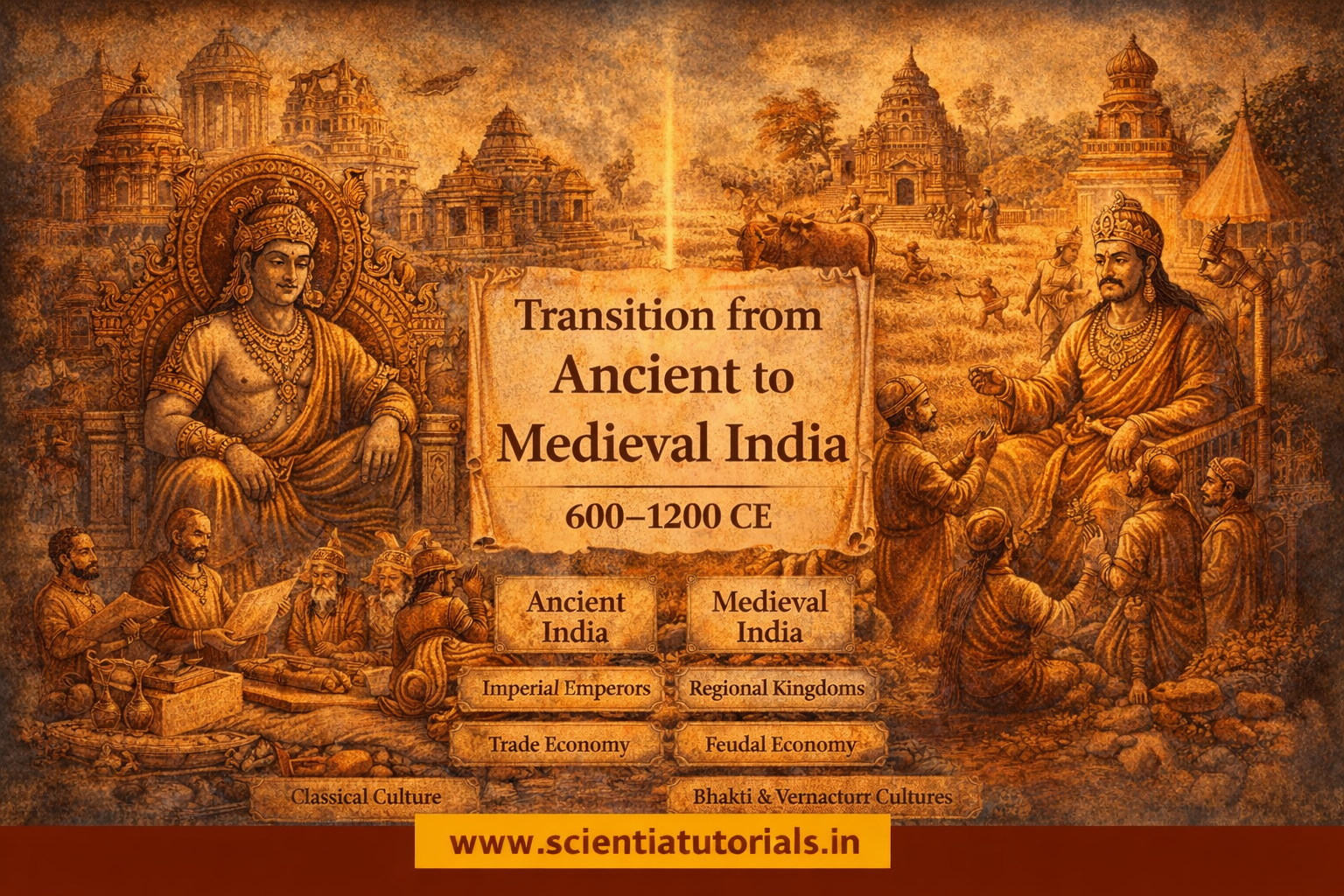

Transition from Ancient to Medieval India (c. 600 CE – c. 1200 CE)
Course: History of India – Complete Chronological and Era-Wise Course
Section 7: Early Medieval India & Regional Kingdoms
Timeline: c. 600 CE – c. 1200 CE
Theme: Structural Transformation of Indian Polity, Economy, Society and Culture
1. Introduction: Understanding the Historical Transition
The period between c. 600 CE and c. 1200 CE marks one of the most significant transitions in Indian history—the transformation from Ancient/Classical India to Medieval India. This change was not abrupt but gradual, complex, and multi-dimensional, affecting political structures, economic systems, social organisation, religious life, and cultural institutions.
Unlike earlier transitions marked by invasions or dynastic changes alone, this transformation represents a structural shift in civilisation—from imperial centralisation to regionalisation, from urban trade economies to agrarian dominance, and from classical institutions to medieval socio-political frameworks.
Historians describe this period as Early Medieval India, which acts as a bridge between the Gupta Classical Age and the Delhi Sultanate period.
2. Chronological Background
2.1 End of the Classical Age
- Decline of the Gupta Empire (6th century CE)
- Collapse of imperial unity in North India
- Political fragmentation and rise of regional powers
2.2 Beginning of Early Medieval India
- Rise of regional dynasties
- Decentralised administration
- Emergence of new socio-economic structures
- Development of medieval political culture
This phase is best understood not as a “decline” but as a reorganisation of Indian society and polity.
3. Political Transition: From Empire to Regional Kingdoms
3.1 Decline of Centralised Imperial Authority
In Ancient India:
- Strong empires (Maurya, Gupta)
- Centralised administration
- Uniform law, taxation, and governance
In Early Medieval India:
- No pan-Indian empire
- Fragmentation into regional kingdoms
- Localised political authority
3.2 Rise of Regional Powers
Important early medieval regional dynasties included:
- Pushyabhutis (North India)
- Palas (Eastern India)
- Pratiharas (North-West India)
- Rashtrakutas (Deccan)
- Cholas, Pandyas, Cheras (South India)
Power shifted from imperial capitals to regional political centres, creating political pluralism.
3.3 Transformation of Kingship
Ancient kingship:
- Imperial ideology
- Centralised sovereignty
- Bureaucratic governance
Medieval kingship:
- Regional legitimacy
- Ritual kingship
- Temple-based authority
- Sacred kingship ideology
Kings became not only rulers but religious patrons and sacred figures.
4. Administrative Transition
4.1 Decline of Bureaucratic Administration
Ancient India:
- Salaried officials
- Central revenue collection
- Professional bureaucracy
Early Medieval India:
- Decline of salaried bureaucracy
- Hereditary offices
- Local administration
4.2 Rise of Feudal Structures
Key features:
- Growth of samantas (feudatories)
- Land grants with administrative rights
- Decentralised governance
- Military service in exchange for land
This marks the emergence of Indian feudalism, a defining feature of medieval polity.
5. Economic Transition
5.1 From Trade Economy to Agrarian Economy
Ancient economy:
- Strong urban centres
- Guild-based crafts
- Long-distance trade
- Monetised economy
Early Medieval economy:
- Decline of urbanisation
- Reduction in trade networks
- Village-centred economy
- Land-based wealth
5.2 Expansion of Agriculture
- Clearing of forests
- Growth of rural settlements
- Land as primary source of power
- Village as basic economic unit
The economy became agrarian-dominant, not trade-dominant.
5.3 Decline of Coinage
- Reduced circulation of gold coins
- Growth of land-based transactions
- Barter systems in local economies
This represents de-monetisation of the economy.
6. Social Transition
6.1 Rise of Feudal Social Order
- Landlords gained power
- Peasants tied to land
- Growth of dependence relationships
- Decline of urban merchant classes
Society shifted from urban-social diversity to rural hierarchy.
6.2 Transformation of Caste System
Ancient phase:
- Relatively flexible social mobility
- Occupational movement
Early medieval phase:
- Rigid caste hierarchy
- Hereditary occupations
- Strong local caste identities
6.3 Emergence of Rural Social Structures
Village communities became:
- Economically self-sufficient
- Socially hierarchical
- Politically autonomous
7. Religious Transition
7.1 Decline of Classical Ritualism
- Decline of elaborate Vedic rituals
- Reduction in sacrificial religion
- End of elite ritual dominance
7.2 Rise of Bhakti Movement
Key features:
- Personal devotion to God
- Emotional worship
- Accessibility of religion
- Equality in spiritual practice
Bhakti traditions transformed religious life into a mass movement.
7.3 Temple-Centred Religion
- Temples as religious centres
- Temples as economic institutions
- Temples as cultural hubs
- Temple patronage by kings
Religion became institutionalised through temples.
7.4 Regional Religious Traditions
- Vaishnavism
- Shaivism
- Shaktism
- Regional devotional cults
Religious diversity expanded with regional expressions.
8. Cultural and Intellectual Transition
8.1 From Classical to Regional Cultures
Ancient culture:
- Sanskrit dominance
- Classical art forms
- Pan-Indian cultural models
Early medieval culture:
- Regional languages rise
- Regional art styles
- Local cultural traditions
8.2 Growth of Vernacular Languages
- Early forms of Hindi, Bengali, Tamil, Kannada, Marathi
- Literature in regional languages
- Decline of Sanskrit monopoly
This marks the democratisation of culture.
8.3 Transformation of Art and Architecture
- Shift from classical simplicity to regional styles
- Temple architecture diversity
- Regional sculptural traditions
9. Urban–Rural Shift
9.1 Decline of Classical Cities
- Reduced trade
- Decline of guilds
- Weak urban economies
9.2 Rise of Rural Centres
- Village dominance
- Agrarian economy
- Temple towns
- Pilgrimage centres
India became a rural-centred civilisation.
10. Military and Strategic Transition
10.1 Change in Warfare Patterns
Ancient warfare:
- Imperial armies
- Standing forces
- Central military command
Medieval warfare:
- Feudal armies
- Land-based military service
- Regional military powers
10.2 Fortification and Regional Defence
- Growth of forts
- Regional military centres
- Defensive strategies
11. Institutional Transformation
11.1 From Imperial Institutions to Local Institutions
- Decline of imperial courts
- Rise of temple institutions
- Rise of village councils
- Growth of local elites
11.2 Temple as a Multi-functional Institution
Temples functioned as:
- Religious centres
- Economic hubs
- Educational spaces
- Cultural institutions
- Political symbols
12. Continuity and Change: A Balanced Perspective
12.1 Elements of Continuity
- Religious traditions continued
- Cultural heritage preserved
- Sanskrit learning survived
- Classical art ideals influenced later styles
12.2 Elements of Change
- Political fragmentation
- Economic restructuring
- Social hierarchy intensification
- Religious massification
This period represents transformation, not decline.
13. Long-Term Historical Significance
The transition period laid the foundation for:
- Medieval political systems
- Feudal institutions
- Regional identities
- Temple-based societies
- Bhakti religious culture
- Vernacular literary traditions
It shaped the entire structure of Medieval India.
14. Examination Perspective (UPSC / State PSC)
Key Analytical Themes
- Transition from centralisation to regionalisation
- Emergence of feudalism
- Agrarianisation of economy
- Bhakti movement as social force
- Temple-centred society
- Urban–rural shift
- Regional political systems
Answer Writing Approach
The transition should be analysed as a structural transformation, not a collapse of civilisation.
15. Conclusion
The transition from Ancient to Medieval India (c. 600–1200 CE) represents a civilisational reorganisation rather than a decline. Political centralisation gave way to regionalisation, urban trade economies transformed into agrarian systems, classical culture evolved into regional traditions, and elite ritual religion transformed into mass devotional movements.
This period created the foundations of medieval Indian society, shaping political structures, social relations, religious practices, and cultural identities that continued for centuries. It stands as one of the most formative phases in Indian history, defining the character of Medieval India.
Below is a well-structured, examination-oriented set of 25 Questions with Answers based strictly on the lesson
“Transition from Ancient to Medieval India” from
Section 7: Early Medieval India & Regional Kingdoms (c. 600–1200 CE).
Transition from Ancient to Medieval India (c. 600–1200 CE)
Questions with Answers
1. What is meant by the “transition from Ancient to Medieval India”?
The transition refers to a gradual structural transformation in Indian polity, economy, society, religion, and culture between c. 600 and 1200 CE, marking the shift from imperial, urban-based Ancient India to regional, agrarian-based Medieval India.
2. Why is this transition considered gradual rather than sudden?
Because changes occurred over several centuries through internal developments such as political decentralisation, agrarian expansion, and social reorganisation rather than through a single conquest or collapse.
3. Which historical event marks the beginning of this transition?
The decline of the Gupta Empire in the 6th century CE marks the beginning of the transition from the Classical Age to Early Medieval India.
4. How did political organisation change during this transition?
Political organisation shifted from centralised imperial empires to regional kingdoms, leading to political fragmentation and decentralised authority.
5. What role did regional kingdoms play in Early Medieval India?
Regional kingdoms became the primary political units, exercising local control and fostering regional identities, cultures, and administrative systems.
6. How did kingship change between the Ancient and Medieval periods?
Kingship evolved from bureaucratic imperial authority to ritual and sacred kingship, where rulers derived legitimacy through religion, temples, and patronage.
7. What administrative change is most characteristic of the early medieval period?
The decline of salaried bureaucracy and the rise of hereditary offices and local administration is the most characteristic administrative change.
8. Explain the emergence of feudalism during this transition.
Feudalism emerged through land grants, the rise of samantas (feudatories), decentralisation of power, and military service in exchange for land.
9. How did the economy change during this transition?
The economy shifted from trade- and urban-centred to agrarian and village-centred, with land becoming the primary source of wealth and power.
10. What happened to urban centres during Early Medieval India?
Many classical cities declined due to reduced trade, while villages, temple towns, and pilgrimage centres gained prominence.
11. Why is the decline of coinage significant for this period?
The decline of coinage reflects de-monetisation, reduced long-distance trade, and the growing importance of land-based economic relations.
12. How did agrarian expansion shape medieval society?
Forest clearing and land cultivation expanded villages, strengthened landlord control, and created a rural-dominated social and economic structure.
13. What major social change occurred in this period?
The emergence of a feudal social order, with peasants increasingly tied to land and dependent on landlords, marked a major social change.
14. How did the caste system transform during Early Medieval India?
The caste system became more rigid and hereditary, with reduced social mobility and stronger local caste identities.
15. What was the impact of this transition on urban merchant classes?
Urban merchant guilds weakened due to declining trade, leading to the reduced influence of urban commercial groups.
16. How did religion change during the transition period?
Religion became more personal and devotional, marked by the rise of the Bhakti movement and temple-centred worship.
17. Why is the Bhakti movement considered a transformative force?
Because it made religion accessible to all, emphasised personal devotion, and reduced dependence on ritualism and priestly mediation.
18. What new role did temples play in medieval India?
Temples became religious, economic, cultural, and political institutions, controlling land, employment, education, and local administration.
19. How did cultural life change during this transition?
Culture shifted from classical uniformity to regional diversity, with the growth of regional art styles, literature, and traditions.
20. Why is the rise of vernacular languages significant?
The rise of regional languages led to the democratisation of culture, making literature and religious ideas accessible to wider sections of society.
21. Did Sanskrit completely decline during the medieval period?
No. Sanskrit continued as a language of scholarship and religion, but lost its monopoly due to the rise of vernacular languages.
22. How did military organisation change during this transition?
Military systems shifted from standing imperial armies to feudal levies, where landholders provided military service.
23. What was the impact of political decentralisation on governance?
Governance became localised, with village councils, temples, and regional elites exercising greater authority.
24. Mention two elements of continuity between Ancient and Medieval India.
- Continuation of religious traditions
- Survival of classical cultural and intellectual heritage
25. Why is the transition from Ancient to Medieval India historically significant?
Because it laid the foundations of medieval Indian society, shaping political structures, economic systems, social relations, religious practices, and cultural identities for centuries.
Below is a well-structured set of 25 Multiple Choice Questions (MCQs) with correct answers and detailed, concept-clearing explanations, prepared strictly from the lesson
“Transition from Ancient to Medieval India” under
Section 7: Early Medieval India & Regional Kingdoms (c. 600–1200 CE).
Transition from Ancient to Medieval India (c. 600–1200 CE)
MCQs with Answers and Explanations
1. The transition from Ancient to Medieval India is best described as a:
A. Sudden political collapse
B. Foreign invasion–driven change
C. Gradual structural transformation
D. Religious revolution
Correct Answer: C
Explanation:
The transition was gradual and structural, involving long-term changes in polity, economy, society, and culture rather than a sudden collapse or single event.
2. Which event is generally considered the starting point of Early Medieval India?
A. Rise of the Delhi Sultanate
B. Arab conquest of Sind
C. Decline of the Gupta Empire
D. Battle of Tarain
Correct Answer: C
Explanation:
The decline of the Gupta Empire (6th century CE) marked the end of the Classical Age and the beginning of Early Medieval transformations.
3. Which political change most clearly marks the transition to the medieval period?
A. Expansion of empires
B. Centralised bureaucracy
C. Regionalisation of power
D. Growth of democracy
Correct Answer: C
Explanation:
The decline of pan-Indian empires led to the rise of regional kingdoms, a hallmark of Early Medieval polity.
4. Which of the following best characterises early medieval kingship?
A. Bureaucratic imperial authority
B. Secular republican rule
C. Ritual and sacred kingship
D. Merchant-controlled governance
Correct Answer: C
Explanation:
Kings derived legitimacy through religious rituals, temple patronage, and sacred ideology, unlike the bureaucratic imperial model of Ancient India.
5. The emergence of samantas indicates the rise of:
A. Democratic institutions
B. Centralised administration
C. Feudal tendencies
D. Urban mercantile dominance
Correct Answer: C
Explanation:
Samantas were feudatory chiefs who held land in return for service, marking the growth of feudalism.
6. Which administrative feature declined during the transition period?
A. Hereditary offices
B. Local administration
C. Salaried bureaucracy
D. Land-based authority
Correct Answer: C
Explanation:
The early medieval period saw the decline of salaried officials and the rise of hereditary and local offices.
7. The economic transition from Ancient to Medieval India involved:
A. Expansion of long-distance trade
B. Growth of industrial production
C. Shift towards agrarian economy
D. Increase in gold coinage
Correct Answer: C
Explanation:
The economy became land- and village-centred, replacing the trade-based urban economy of Ancient India.
8. Which of the following reflects the de-monetisation of the early medieval economy?
A. Increase in foreign trade
B. Decline in coin circulation
C. Expansion of urban markets
D. Growth of guilds
Correct Answer: B
Explanation:
Reduced use of coins indicates declining trade and monetisation, with land replacing cash as wealth.
9. What happened to classical urban centres during this transition?
A. They expanded rapidly
B. They became capitals of empires
C. Many declined or stagnated
D. They were replaced by ports
Correct Answer: C
Explanation:
With declining trade, many classical cities lost importance, while villages and temple towns grew.
10. Which social change is most associated with Early Medieval India?
A. Decline of caste system
B. Increase in social mobility
C. Growth of feudal hierarchy
D. Rise of urban middle class
Correct Answer: C
Explanation:
Society became hierarchical and land-based, with peasants tied to landlords.
11. How did the caste system change during this transition?
A. Became more flexible
B. Lost social importance
C. Became more rigid and hereditary
D. Was abolished
Correct Answer: C
Explanation:
Early medieval society saw increased rigidity in caste relations and occupations.
12. The decline of merchant guilds is linked to:
A. Expansion of trade routes
B. Growth of village economy
C. Rise of maritime commerce
D. Foreign conquests
Correct Answer: B
Explanation:
As the economy became agrarian, urban guilds weakened and villages dominated economic life.
13. Which religious development is a key feature of the transition period?
A. Expansion of Vedic sacrifices
B. Rise of atheistic philosophies
C. Growth of Bhakti movement
D. Decline of temples
Correct Answer: C
Explanation:
The Bhakti movement emphasised personal devotion and accessibility of religion.
14. Why is the Bhakti movement considered socially significant?
A. It promoted ritualism
B. It strengthened priestly dominance
C. It made religion accessible to masses
D. It rejected all traditions
Correct Answer: C
Explanation:
Bhakti reduced dependence on ritual and hierarchy, allowing direct emotional devotion.
15. Temples in Early Medieval India functioned as:
A. Only places of worship
B. Military headquarters
C. Multi-functional institutions
D. Trading guilds
Correct Answer: C
Explanation:
Temples acted as religious, economic, cultural, and political centres, controlling land and resources.
16. Which cultural shift occurred during this transition?
A. Decline of all art forms
B. Uniform classical culture
C. Growth of regional cultures
D. Elimination of Sanskrit
Correct Answer: C
Explanation:
Culture diversified with regional art styles, traditions, and identities.
17. The rise of vernacular languages signifies:
A. Cultural decline
B. Foreign influence
C. Democratisation of culture
D. End of learning
Correct Answer: C
Explanation:
Regional languages made literature and religion accessible beyond elite Sanskrit circles.
18. Which statement about Sanskrit during this period is correct?
A. Sanskrit disappeared completely
B. Sanskrit remained but lost monopoly
C. Sanskrit replaced vernaculars
D. Sanskrit was banned
Correct Answer: B
Explanation:
Sanskrit continued in scholarship but coexisted with growing vernacular traditions.
19. Military organisation in Early Medieval India was characterised by:
A. Standing imperial armies
B. Mercenary forces
C. Feudal levies
D. Naval dominance
Correct Answer: C
Explanation:
Landholders provided soldiers in return for land grants, reflecting feudal military organisation.
20. Which institution gained prominence as imperial courts declined?
A. Merchant guilds
B. Tribal councils
C. Temples and village assemblies
D. Universities
Correct Answer: C
Explanation:
Local institutions such as temples and village councils became centres of authority.
21. The transition from Ancient to Medieval India resulted in:
A. Cultural discontinuity
B. Complete political chaos
C. Structural reorganisation
D. Foreign domination
Correct Answer: C
Explanation:
The period represents reorganisation, not collapse, of Indian civilisation.
22. Which of the following is an element of continuity during the transition?
A. Imperial unity
B. Trade-based economy
C. Religious traditions
D. Urban dominance
Correct Answer: C
Explanation:
Despite changes, religious and cultural traditions continued across the transition.
23. Early Medieval India is best understood as a:
A. Period of decline
B. Transitional bridge
C. Foreign interlude
D. Cultural vacuum
Correct Answer: B
Explanation:
It acts as a bridge between Ancient and Medieval India, carrying forward traditions while reshaping structures.
24. Which long-term outcome resulted from this transition?
A. End of kingship
B. Formation of medieval political systems
C. Loss of regional identities
D. Decline of religion
Correct Answer: B
Explanation:
The transition laid the foundation for medieval polity, economy, and society.
25. Historians today view the transition from Ancient to Medieval India mainly as:
A. A dark age
B. Cultural collapse
C. Civilisational transformation
D. Accidental change
Correct Answer: C
Explanation:
Modern historiography emphasises transformation and continuity, not decline.
Targeting Exams
This content is strategically designed for:
-
UPSC Civil Services Examination (Prelims & Mains – GS I)
-
State Public Service Commissions (APSC, BPSC, UPPSC, WBCS, RPSC, etc.)
-
SSC & Other Competitive Examinations
-
UGC NET / SET (History)
-
University Semester Exams (Ancient & Early Medieval Indian History)
-
School Board Exams (Class 6–12 – Concept Enrichment)
Related Keyphrases
-
Transition from ancient to medieval India UPSC
-
Early Medieval India features
-
Decline of ancient Indian system
-
Rise of feudalism in India
-
Agrarian economy in medieval India
-
Bhakti movement early medieval period
-
Regional kingdoms in early medieval India
-
Ancient to medieval India differences
-
Early medieval polity and society
-
History of India 600 to 1200 CE