
Slave, Khalji, Tughlaq, Sayyid & Lodi Dynasties
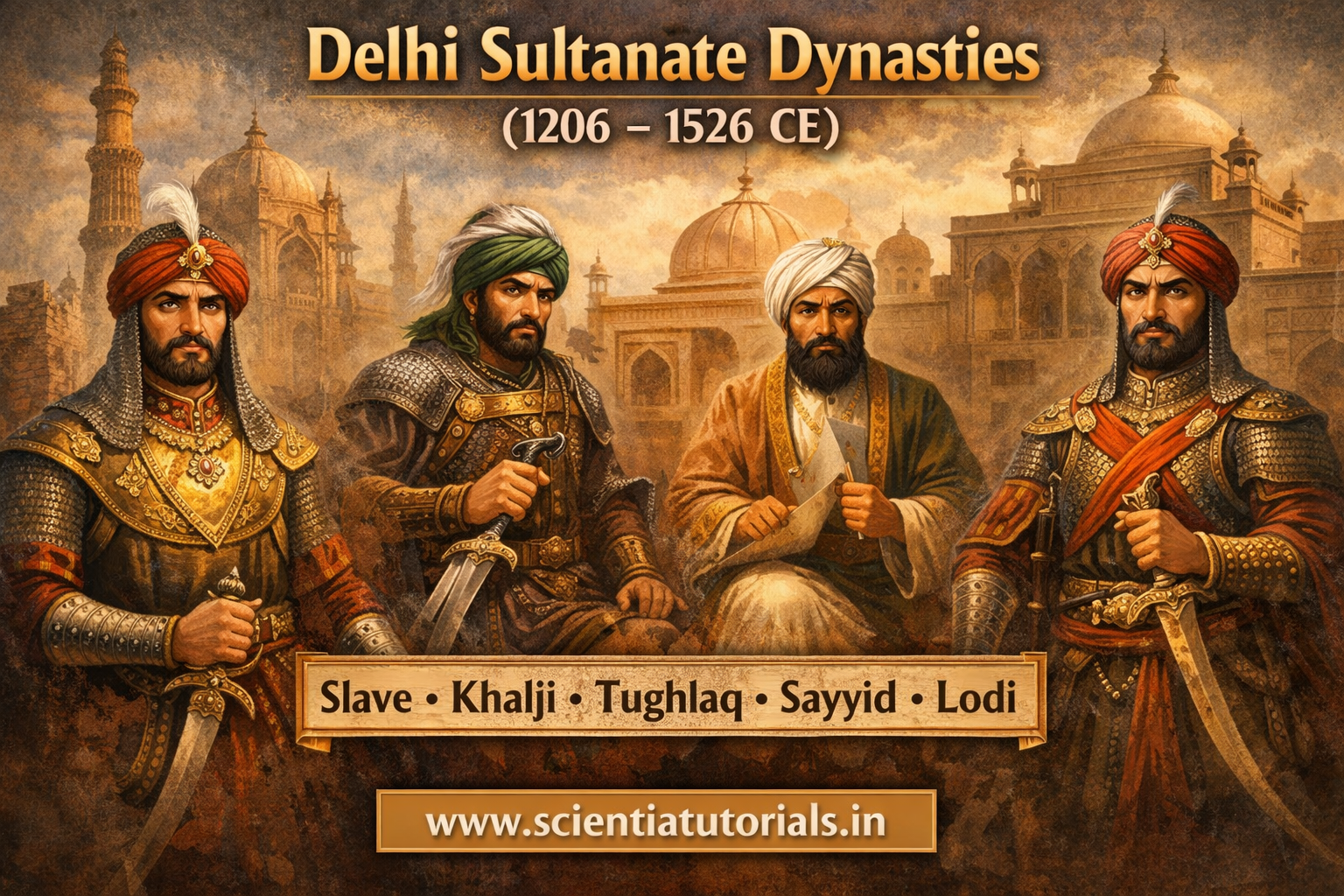

Slave, Khalji, Tughlaq, Sayyid & Lodi Dynasties (1206–1526 CE)
SECTION 8: Delhi Sultanate – Medieval Indian History (Sultanate Phase)
1. Introduction: The Delhi Sultanate as a Medieval Imperial State
The Delhi Sultanate (1206–1526 CE) represents the first long-lasting Islamic political authority in India. Over a span of more than three centuries, it was ruled by five successive dynasties—the Slave (Mamluk), Khalji, Tughlaq, Sayyid, and Lodi dynasties.
Each dynasty reflected a distinct phase in the evolution of medieval Indian polity, marked by:
- Changing power bases (Turkish → Afghan)
- Shifts in administrative experiments
- Military expansion and contraction
- Social and economic transformations
A dynasty-wise chronological study helps understand state formation, governance, and decline within the Sultanate system.
2. The Slave (Mamluk) Dynasty (1206–1290 CE)
2.1 Origin and Nature
The Slave Dynasty was founded by Qutbuddin Aibak in 1206 CE. The rulers were former slaves (mamluks) of Turkish origin who rose to power through military merit.
2.2 Important Rulers and Contributions
Qutbuddin Aibak (1206–1210 CE)
- Established independent rule in India after Muhammad Ghori’s death
- Made Delhi the political centre
- Initiated early Sultanate architecture
- His reign was short and lacked consolidation
Iltutmish (1211–1236 CE)
Iltutmish was the real consolidator of the Sultanate.
Key Achievements:
- Suppressed rival Turkish nobles
- Secured Caliphal recognition, legitimising his rule
- Introduced Iqta system
- Standardised currency (Silver Tanka, Copper Jital)
Raziya Sultana (1236–1240 CE)
- First and only female ruler of the Delhi Sultanate
- Faced opposition from Turkish nobles (Chahalgani)
- Her reign exposed the dominance of nobility over monarchy
Balban (1266–1287 CE)
Balban strengthened the theory of kingship.
Major Policies:
- Doctrine of Divine Kingship (Zill-i-Ilahi)
- Crushed Turkish nobility
- Strengthened central authority
2.3 Significance of the Slave Dynasty
- Laid the administrative foundation of the Sultanate
- Established Delhi as the imperial capital
- Introduced Persian administration and military organisation
3. The Khalji Dynasty (1290–1320 CE)
3.1 Rise of the Khaljis
The Khalji Dynasty marked the shift from Turkish to mixed Turkish-Afghan rule, ending Turkish monopoly over power.
Founded by Jalaluddin Khalji.
3.2 Alauddin Khalji: The Most Powerful Khalji Ruler
Alauddin Khalji (1296–1316 CE)
Alauddin Khalji represented the zenith of the Delhi Sultanate.
Military Achievements:
- Conquests of Gujarat, Malwa, Ranthambore, Chittor
- First Sultan to establish control over the Deccan
Administrative Reforms:
- Market control system to regulate prices
- Reorganisation of army with cash salaries
- Heavy taxation in the Doab region
Significance:
- Reduced power of nobles
- Established a strong centralised monarchy
3.3 Decline of the Khalji Dynasty
- Weak successors
- Court conspiracies
- Over-centralisation leading to instability
4. The Tughlaq Dynasty (1320–1414 CE)
4.1 Establishment
Founded by Ghiyasuddin Tughlaq in 1320 CE.
4.2 Muhammad bin Tughlaq: The Experimenter
Muhammad bin Tughlaq (1325–1351 CE)
One of the most controversial rulers in Indian history.
Major Experiments:
- Transfer of capital from Delhi to Daulatabad
- Introduction of token currency
- Increased taxation in Doab
Outcome:
- Ideas were innovative but poorly implemented
- Led to rebellions and administrative chaos
4.3 Firoz Shah Tughlaq: Welfare Orientation
Firoz Shah Tughlaq (1351–1388 CE)
Policies:
- Reduced taxation
- Encouraged irrigation projects
- Founded new towns
- Promoted orthodox Islam
4.4 Decline of the Tughlaqs
- Weak successors
- Provincial governors became independent
- Invasion of Timur (1398 CE) devastated Delhi
5. The Sayyid Dynasty (1414–1451 CE)
5.1 Nature of Sayyid Rule
Founded by Khizr Khan, the Sayyid rulers claimed descent from the Prophet.
Characteristics:
- Ruled in the name of Timur’s successors
- Weak authority
- Limited territorial control
5.2 Historical Importance
- Acted as a transitional phase
- Preserved the Sultanate framework during political decline
6. The Lodi Dynasty (1451–1526 CE)
6.1 Afghan Ascendancy
Founded by Bahlul Lodi, marking the first Afghan dynasty of the Delhi Sultanate.
6.2 Sikandar Lodi: Administrative Strength
Sikandar Lodi (1489–1517 CE)
Achievements:
- Efficient revenue administration
- Encouraged agriculture
- Founded Agra as a major centre
6.3 Ibrahim Lodi and the Fall of the Sultanate
Ibrahim Lodi (1517–1526 CE)
- Autocratic style
- Alienated Afghan nobles
- Defeated by Babur in First Battle of Panipat (1526 CE)
7. Comparative Overview of the Five Dynasties
| Dynasty | Nature of Rule | Key Feature |
|---|---|---|
| Slave | Turkish | Foundation & consolidation |
| Khalji | Turkish-Afghan | Expansion & reforms |
| Tughlaq | Turkish | Experiments & decline |
| Sayyid | Weak | Transitional phase |
| Lodi | Afghan | Centralisation & fall |
8. Administrative and Socio-Economic Developments
- Persian as official language
- Iqta system institutionalised
- Growth of urban centres
- Integration of India with Islamic world
9. Historical Significance of the Delhi Sultanate Dynasties
- Established a centralised medieval state
- Introduced durable administrative institutions
- Promoted cultural synthesis
- Prepared ground for the Mughal Empire
10. Conclusion
The history of the Slave, Khalji, Tughlaq, Sayyid, and Lodi dynasties reflects the dynamic evolution of the Delhi Sultanate. From its foundation by slave rulers to its fall under Afghan nobles, the Sultanate underwent continuous transformation. Its legacy shaped medieval Indian polity, administration, economy, and culture, making it a crucial phase in the History of India.
Below is a well-structured, examination-oriented set of 25 Questions with Clear and Accurate Answers based on the lesson
“Slave, Khalji, Tughlaq, Sayyid & Lodi Dynasties”, aligned strictly with SECTION 8: Delhi Sultanate (1206–1526 CE).
✔️ Chronological and dynasty-wise
✔️ Suitable for UPSC, State PSC, CUET, UGC NET & University exams
Delhi Sultanate: Slave, Khalji, Tughlaq, Sayyid & Lodi Dynasties – Questions & Answers
Q1. How many dynasties ruled the Delhi Sultanate and during which period?
Answer:
Five dynasties ruled the Delhi Sultanate between 1206 CE and 1526 CE—Slave (Mamluk), Khalji, Tughlaq, Sayyid, and Lodi dynasties.
Q2. Which dynasty founded the Delhi Sultanate?
Answer:
The Delhi Sultanate was founded by the Slave (Mamluk) Dynasty in 1206 CE.
Q3. Who was the founder of the Slave Dynasty?
Answer:
The Slave Dynasty was founded by Qutbuddin Aibak, a former slave and general of Muhammad Ghori.
Q4. Why is the Slave Dynasty also known as the Mamluk Dynasty?
Answer:
It is called the Mamluk (Slave) Dynasty because its rulers were originally slaves who rose to power through military merit.
Q5. Why is Iltutmish regarded as the real consolidator of the Delhi Sultanate?
Answer:
Iltutmish strengthened administration, expanded territory, secured Caliphal recognition, and institutionalised the Iqta system.
Q6. What was the Chahalgani and why was it important?
Answer:
The Chahalgani (The Forty) was a group of powerful Turkish nobles who dominated politics and often interfered in succession.
Q7. Who was Raziya Sultana and why was her reign significant?
Answer:
Raziya Sultana was the first female ruler of the Delhi Sultanate; her reign highlighted resistance from the Turkish nobility to female authority.
Q8. What was Balban’s theory of kingship?
Answer:
Balban propagated the doctrine of Divine Kingship (Zill-i-Ilahi) to strengthen royal authority.
Q9. Which dynasty ended Turkish monopoly over power in the Delhi Sultanate?
Answer:
The Khalji Dynasty ended Turkish monopoly and opened power to non-Turkish Muslims.
Q10. Who founded the Khalji Dynasty?
Answer:
The Khalji Dynasty was founded by Jalaluddin Khalji in 1290 CE.
Q11. Why is Alauddin Khalji considered the most powerful Sultan of the Delhi Sultanate?
Answer:
Alauddin Khalji expanded the empire, conquered the Deccan, controlled markets, and reorganised the army.
Q12. What was the market control policy of Alauddin Khalji?
Answer:
It was a price regulation system to control essential commodities and ensure affordable supplies for soldiers and citizens.
Q13. Which dynasty expanded the Delhi Sultanate to the Deccan for the first time?
Answer:
The Khalji Dynasty, under Alauddin Khalji, expanded the Sultanate into the Deccan.
Q14. Who founded the Tughlaq Dynasty?
Answer:
The Tughlaq Dynasty was founded by Ghiyasuddin Tughlaq in 1320 CE.
Q15. Why is Muhammad bin Tughlaq considered an innovative but unsuccessful ruler?
Answer:
Muhammad bin Tughlaq introduced bold experiments like token currency and capital transfer, but poor execution led to failure.
Q16. Name two major experiments of Muhammad bin Tughlaq.
Answer:
- Transfer of capital from Delhi to Daulatabad
- Introduction of token currency
Q17. What were the main contributions of Firoz Shah Tughlaq?
Answer:
Firoz Shah Tughlaq promoted irrigation, reduced taxes, founded cities, and followed welfare-oriented policies.
Q18. What event severely weakened the Tughlaq Dynasty?
Answer:
The invasion of Timur in 1398 CE devastated Delhi and weakened central authority.
Q19. Who founded the Sayyid Dynasty?
Answer:
The Sayyid Dynasty was founded by Khizr Khan in 1414 CE.
Q20. Why is the Sayyid Dynasty considered a weak dynasty?
Answer:
The Sayyids ruled with limited authority, controlled small territories, and governed in the name of Timur’s successors.
Q21. Which dynasty marked the rise of Afghan power in the Delhi Sultanate?
Answer:
The Lodi Dynasty marked the rise of Afghan power.
Q22. Who founded the Lodi Dynasty?
Answer:
The Lodi Dynasty was founded by Bahlul Lodi in 1451 CE.
Q23. What were the major achievements of Sikandar Lodi?
Answer:
Sikandar Lodi strengthened revenue administration, promoted agriculture, and founded Agra.
Q24. Why did Ibrahim Lodi face opposition from Afghan nobles?
Answer:
Ibrahim Lodi followed an autocratic policy that alienated Afghan chiefs.
Q25. How did the Delhi Sultanate come to an end?
Answer:
The Delhi Sultanate ended in 1526 CE when Ibrahim Lodi was defeated by Babur in the First Battle of Panipat, leading to the establishment of the Mughal Empire.
Below is a well-structured, examination-oriented set of 30 Multiple Choice Questions (MCQs) with correct answers and detailed, concept-clearing explanations, developed strictly from the lesson
“Slave, Khalji, Tughlaq, Sayyid & Lodi Dynasties” under SECTION 8: Delhi Sultanate (1206–1526 CE).
✔️ UPSC / State PSC / CUET / UGC NET / University-ready
Delhi Sultanate: Slave, Khalji, Tughlaq, Sayyid & Lodi Dynasties – MCQs with Answers & Explanations
MCQ 1
The Delhi Sultanate began in 1206 CE with the accession of:
A. Muhammad Ghori
B. Iltutmish
C. Qutbuddin Aibak
D. Balban
Correct Answer: C
Explanation:
The Delhi Sultanate formally began when Qutbuddin Aibak declared independence after the death of Muhammad Ghori.
MCQ 2
Why is the first dynasty of the Delhi Sultanate called the Slave (Mamluk) Dynasty?
A. Slaves formed the majority population
B. Slaves paid special taxes
C. Rulers were former slaves
D. Slavery was abolished
Correct Answer: C
Explanation:
The rulers, including Aibak and Iltutmish, were former slaves (mamluks) who rose to power through merit and military service.
MCQ 3
Who is regarded as the real consolidator of the Delhi Sultanate?
A. Qutbuddin Aibak
B. Raziya Sultana
C. Balban
D. Iltutmish
Correct Answer: D
Explanation:
Iltutmish consolidated the Sultanate by suppressing rivals, expanding territory, and institutionalising administration.
MCQ 4
The Iqta system primarily related to:
A. Judicial reforms
B. Military recruitment
C. Land revenue assignments
D. Trade taxation
Correct Answer: C
Explanation:
Under the Iqta system, officials were assigned land revenues instead of cash salaries, strengthening administrative control.
MCQ 5
Who was the first and only woman ruler of the Delhi Sultanate?
A. Nur Jahan
B. Chand Bibi
C. Raziya Sultana
D. Gulbadan Begum
Correct Answer: C
Explanation:
Raziya Sultana ruled from 1236–1240 CE and faced strong opposition from the Turkish nobility.
MCQ 6
The group of powerful Turkish nobles during the Slave Dynasty was known as:
A. Ulema
B. Mansabdars
C. Chahalgani
D. Amirs
Correct Answer: C
Explanation:
The Chahalgani or “The Forty” frequently interfered in administration and succession.
MCQ 7
Which ruler introduced the theory of Divine Kingship (Zill-i-Ilahi)?
A. Iltutmish
B. Alauddin Khalji
C. Balban
D. Muhammad bin Tughlaq
Correct Answer: C
Explanation:
Balban emphasised royal absolutism to curb noble power.
MCQ 8
Which dynasty ended the Turkish monopoly of power in the Delhi Sultanate?
A. Slave
B. Khalji
C. Tughlaq
D. Lodi
Correct Answer: B
Explanation:
The Khalji Dynasty allowed non-Turkish Muslims to occupy high offices.
MCQ 9
Who founded the Khalji Dynasty?
A. Alauddin Khalji
B. Malik Kafur
C. Jalaluddin Khalji
D. Balban
Correct Answer: C
Explanation:
Jalaluddin Khalji founded the Khalji Dynasty in 1290 CE.
MCQ 10
Alauddin Khalji is especially remembered for:
A. Capital transfer
B. Market control system
C. Token currency
D. Religious tolerance
Correct Answer: B
Explanation:
Alauddin Khalji enforced strict price controls to maintain a large standing army.
MCQ 11
Which ruler first extended the Delhi Sultanate into the Deccan?
A. Balban
B. Alauddin Khalji
C. Muhammad bin Tughlaq
D. Firoz Shah Tughlaq
Correct Answer: B
Explanation:
Alauddin Khalji’s campaigns brought the Deccan under Sultanate influence.
MCQ 12
The Tughlaq Dynasty was founded by:
A. Muhammad bin Tughlaq
B. Firoz Shah Tughlaq
C. Ghiyasuddin Tughlaq
D. Khizr Khan
Correct Answer: C
Explanation:
Ghiyasuddin Tughlaq founded the dynasty in 1320 CE.
MCQ 13
Which ruler attempted to introduce token currency?
A. Alauddin Khalji
B. Firoz Shah Tughlaq
C. Muhammad bin Tughlaq
D. Sikandar Lodi
Correct Answer: C
Explanation:
Muhammad bin Tughlaq introduced token currency, but forgery led to failure.
MCQ 14
Why did Muhammad bin Tughlaq’s reforms largely fail?
A. Lack of ideas
B. Excessive conservatism
C. Poor implementation
D. Foreign invasions
Correct Answer: C
Explanation:
His ideas were innovative, but administrative weakness and resistance caused collapse.
MCQ 15
Which Tughlaq ruler is known for welfare-oriented policies?
A. Ghiyasuddin
B. Muhammad bin Tughlaq
C. Firoz Shah Tughlaq
D. Nasiruddin
Correct Answer: C
Explanation:
Firoz Shah Tughlaq focused on irrigation, tax relief, and public works.
MCQ 16
Which event severely weakened the Tughlaq Dynasty?
A. Deccan revolts
B. Portuguese arrival
C. Timur’s invasion
D. Afghan rebellions
Correct Answer: C
Explanation:
Timur’s invasion in 1398 CE devastated Delhi and broke central authority.
MCQ 17
The Sayyid Dynasty ruled between:
A. 1320–1414 CE
B. 1398–1451 CE
C. 1414–1451 CE
D. 1451–1526 CE
Correct Answer: C
Explanation:
The Sayyids ruled briefly from 1414 to 1451 CE.
MCQ 18
Who founded the Sayyid Dynasty?
A. Timur
B. Khizr Khan
C. Bahlul Lodi
D. Sikandar Lodi
Correct Answer: B
Explanation:
Khizr Khan established Sayyid rule after Timur’s invasion.
MCQ 19
Why is the Sayyid Dynasty considered weak?
A. Lack of religious legitimacy
B. Limited territory and authority
C. Continuous foreign invasions
D. Economic collapse
Correct Answer: B
Explanation:
The Sayyids ruled only a small area around Delhi and governed in Timur’s name.
MCQ 20
Which dynasty marked the rise of Afghan power in the Delhi Sultanate?
A. Khalji
B. Tughlaq
C. Sayyid
D. Lodi
Correct Answer: D
Explanation:
The Lodi Dynasty was the first Afghan dynasty to rule Delhi.
MCQ 21
Who founded the Lodi Dynasty?
A. Sikandar Lodi
B. Ibrahim Lodi
C. Bahlul Lodi
D. Daulat Khan Lodi
Correct Answer: C
Explanation:
Bahlul Lodi founded the dynasty in 1451 CE.
MCQ 22
Which Lodi ruler founded Agra?
A. Bahlul Lodi
B. Sikandar Lodi
C. Ibrahim Lodi
D. Babur
Correct Answer: B
Explanation:
Sikandar Lodi founded Agra as an important administrative centre.
MCQ 23
Why did Ibrahim Lodi face opposition from Afghan nobles?
A. Religious intolerance
B. Weak military
C. Autocratic policies
D. Heavy taxation
Correct Answer: C
Explanation:
Ibrahim Lodi tried to centralise power, angering Afghan chiefs.
MCQ 24
The First Battle of Panipat (1526 CE) was fought between:
A. Babur and Sikandar Lodi
B. Babur and Ibrahim Lodi
C. Timur and Mahmud Tughlaq
D. Babur and Rana Sanga
Correct Answer: B
Explanation:
Babur defeated Ibrahim Lodi, ending the Delhi Sultanate.
MCQ 25
The Delhi Sultanate ended in:
A. 1451 CE
B. 1498 CE
C. 1526 CE
D. 1556 CE
Correct Answer: C
Explanation:
The Sultanate ended in 1526 CE with the establishment of the Mughal Empire.
MCQ 26
Which dynasty represents the peak of the Delhi Sultanate?
A. Slave
B. Khalji
C. Tughlaq
D. Lodi
Correct Answer: B
Explanation:
Under Alauddin Khalji, the Sultanate reached maximum expansion and centralisation.
MCQ 27
Which dynasty is regarded as a transitional phase?
A. Slave
B. Khalji
C. Sayyid
D. Lodi
Correct Answer: C
Explanation:
The Sayyid Dynasty bridged the gap between Tughlaq decline and Afghan rule.
MCQ 28
What was a major administrative legacy of the Delhi Sultanate?
A. Mansabdari system
B. Iqta system
C. Ryotwari system
D. Zamindari abolition
Correct Answer: B
Explanation:
The Iqta system became the backbone of Sultanate administration.
MCQ 29
Which dynasty emphasised strict market regulation?
A. Slave
B. Khalji
C. Tughlaq
D. Lodi
Correct Answer: B
Explanation:
Alauddin Khalji enforced market control to sustain military strength.
MCQ 30
Historically, the Delhi Sultanate is important because it:
A. Ended Indian monarchy
B. Isolated India from the world
C. Established a centralised medieval state
D. Eliminated regional powers
Correct Answer: C
Explanation:
The Sultanate introduced durable political, administrative, and cultural institutions in medieval India.
Targeting Exams
This content is specifically structured to support preparation for:
-
UPSC Civil Services Examination (Prelims & Mains)
-
State Public Service Commissions (PSC)
-
UGC NET (History)
-
CUET-UG & CUET-PG (History)
-
University Semester Exams (BA/MA History)
-
SSC & other Government Recruitment Exams
-
Class 7–12 Board Examinations (Medieval Indian History)
High-frequency exam themes covered include:
-
Dynasty-wise chronology of the Delhi Sultanate
-
Administrative and military reforms
-
Causes of rise and decline of dynasties
-
Transition from Sultanate to Mughal rule
Related Keyphrases
-
Delhi Sultanate dynasties History of India
-
Slave Khalji Tughlaq Sayyid Lodi dynasties
-
Delhi Sultanate dynasty-wise notes
-
Medieval Indian History Delhi Sultanate
-
Alauddin Khalji reforms UPSC
-
Tughlaq dynasty administration
-
Lodi dynasty and fall of Delhi Sultanate
-
Delhi Sultanate chronology 1206–1526 CE
-
UPSC History Delhi Sultanate notes