
British Constitutional Reforms
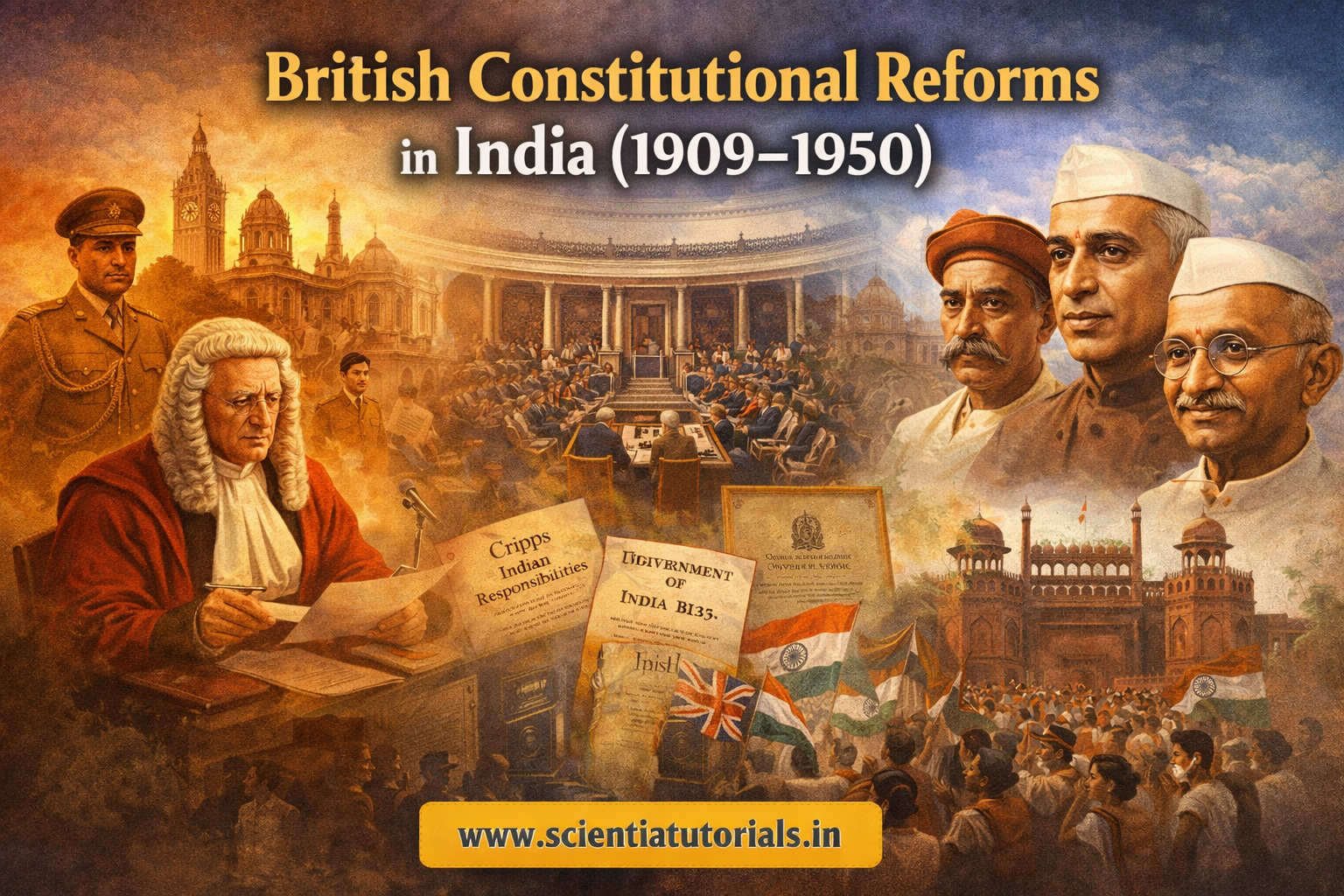

British Constitutional Reforms in India (1909–1950) | History of India
Course: History of India – Complete Chronological and Era-Wise Course
SECTION 15: Constitutional Developments & Independence
Timeline: 1909 CE – 1950 CE
Lesson: British Constitutional Reforms
Lesson Objectives
This lesson aims to:
- Trace the chronological evolution of British constitutional reforms in India from 1909 to 1950.
- Examine the objectives, provisions, and limitations of each major constitutional act.
- Analyze the relationship between colonial reforms and the Indian National Movement.
- Assess how constitutional developments gradually transferred power while retaining British control.
- Understand the transition from colonial constitutionalism to the Constitution of independent India.
- Prepare students for university and competitive examinations through analytical and evaluative perspectives.
I. Background: Constitutionalism under British Rule
British rule in India evolved through a series of constitutional experiments rather than a single written constitution. The British introduced constitutional reforms primarily to:
- Legitimize colonial rule
- Accommodate limited Indian participation
- Contain growing nationalist pressure
However, these reforms were incremental, cautious, and often reactionary, responding to political crises rather than proactive democratic intent.
By the early 20th century, rising nationalism, formation of the Indian National Congress, and increasing mass participation compelled the British to initiate constitutional changes.
II. Indian Councils Act, 1909 (Morley–Minto Reforms)
Historical Context
- Growth of the Indian National Congress
- Demand for greater representation
- British strategy to divide nationalist forces
Major Provisions
- Expansion of Central and Provincial Legislative Councils
- Introduction of separate electorates for Muslims
- Inclusion of Indians in Executive Councils
- Enlargement of deliberative functions
Significance
- First formal introduction of electoral politics in India
- Acknowledged Indian representation in governance
Limitations
- Retained official majority
- Separate electorates institutionalized communalism
- No real transfer of power
III. Government of India Act, 1919 (Montagu–Chelmsford Reforms)
Background
- Home Rule Movement
- Impact of World War I
- British promise of gradual self-government
Key Features
a) Dyarchy in Provinces
- Division of subjects into Reserved and Transferred
- Indian ministers administered transferred subjects
b) Expansion of Legislative Councils
- Bicameral Central Legislature
- Increased elected Indian members
c) Other Provisions
- Public Service Commission
- Extension of communal electorates
Evaluation
- Introduced responsible government at provincial level
- Dyarchy proved unworkable and confusing
Indian Response
- Disappointment and criticism
- Intensification of nationalist agitation
IV. Simon Commission (1927) and Its Impact
Background
- Statutory commission to review 1919 Act
- Absence of Indian members
Indian Reaction
- Nationwide boycott
- Slogan: “Simon Go Back”
Significance
- Unified nationalist opposition
- Led to formulation of Indian constitutional alternatives
V. Nehru Report (1928) and Civil Disobedience Context
Key Proposals
- Dominion Status
- Fundamental Rights
- Parliamentary system
- Joint electorates
Importance
- First major Indian attempt to draft a constitution
- Highlighted divide between British intentions and Indian aspirations
VI. Government of India Act, 1935
Historical Context
- Simon Commission recommendations
- Round Table Conferences
- Growing mass movements
Major Provisions
a) All-India Federation
- Proposed federation of provinces and princely states
b) Provincial Autonomy
- Abolition of dyarchy in provinces
- Responsible government introduced
c) Dyarchy at the Centre
- Defence and foreign affairs reserved
d) Federal Court and RBI
- Establishment of Federal Court
- Creation of Reserve Bank of India
Significance
- Most comprehensive colonial constitution
- Basis of governance till 1950
Limitations
- No real federal structure
- Extensive governor-general powers
- Princely states’ non-cooperation
VII. Provincial Ministries and Constitutional Experience (1937–1939)
- Congress formed ministries in most provinces
- Provided administrative experience
- Exposed limitations of provincial autonomy
Resignation of ministries in 1939 highlighted the fragility of colonial constitutionalism.
VIII. Cripps Mission (1942)
Background
- World War II
- British need for Indian support
Proposals
- Dominion Status after war
- Constituent Assembly
- Right of provinces to secede
Failure
- Immediate transfer of power denied
- Triggered Quit India Movement
IX. Cabinet Mission Plan (1946)
Objectives
- Transfer of power
- Preserve Indian unity
Key Features
- Constituent Assembly
- Interim Government
- Grouping of provinces
Outcome
- Accepted initially
- Later political breakdown led to partition
X. Indian Independence Act, 1947
Major Provisions
- Partition of India
- Creation of two dominions
- End of British sovereignty
Significance
- Legal framework for independence
- Constituent Assemblies became sovereign
XI. Constituent Assembly and Transition to Republican Constitution (1946–1950)
- Drafting of Indian Constitution
- Adoption on 26 November 1949
- Enforcement on 26 January 1950
The Constitution replaced colonial constitutionalism with popular sovereignty.
XII. Critical Evaluation of British Constitutional Reforms
Positive Aspects
- Introduced representative institutions
- Trained Indian leadership
- Provided administrative experience
Negative Aspects
- Gradualism delayed self-rule
- Communal electorates encouraged division
- Ultimate authority remained British
XIII. Conclusion
British constitutional reforms in India were marked by incremental concessions and strategic control. While these reforms failed to satisfy Indian aspirations, they unintentionally prepared the ground for democratic governance. The transition from the Morley–Minto Reforms to the Constitution of India reflects the journey from colonial rule to sovereign republic.
Examination Tip: Answers should highlight chronology, key provisions, limitations, and Indian response with critical analysis to secure high marks in competitive and university examinations.
Questions with Answers
British Constitutional Reforms in India (1909–1950)
Section 15: Constitutional Developments & Independence
Q1. Why did the British introduce constitutional reforms in India during the early 20th century?
Answer: The British introduced constitutional reforms to legitimize colonial rule, respond to growing nationalist pressure, incorporate limited Indian participation, and prevent radical mass movements. These reforms were gradual and aimed at maintaining British control while offering political concessions.
Q2. What were the main objectives of the Indian Councils Act, 1909?
Answer: The Act aimed to expand legislative councils, include Indians in governance, introduce electoral principles, and divide nationalist forces by granting separate electorates to Muslims.
Q3. Why are the Morley–Minto Reforms described as the foundation of communal politics in India?
Answer: They introduced separate electorates for Muslims, institutionalizing communal representation and encouraging political division based on religion.
Q4. How did the Indian Councils Act, 1909 expand legislative councils?
Answer: It increased the number of members in central and provincial councils and allowed limited discussion on budgets and questions, though real power remained with officials.
Q5. What circumstances led to the Government of India Act, 1919?
Answer: The Home Rule Movement, Indian support during World War I, and British promises of gradual self-government led to the Act of 1919.
Q6. Explain the concept of dyarchy introduced by the Government of India Act, 1919.
Answer: Dyarchy divided provincial subjects into reserved (controlled by British officials) and transferred (administered by Indian ministers), creating partial responsible government.
Q7. Why did dyarchy fail in practice?
Answer: Dyarchy failed due to unclear division of powers, limited authority of Indian ministers, and overriding powers of governors.
Q8. How did Indians react to the Government of India Act, 1919?
Answer: Indians were dissatisfied as the Act did not provide real self-rule, leading to intensified nationalist movements including Non-Cooperation.
Q9. Why was the Simon Commission boycotted in India?
Answer: It had no Indian members, symbolizing British disregard for Indian opinion in constitutional matters.
Q10. What was the significance of the slogan “Simon Go Back”?
Answer: It reflected united nationalist opposition and mobilized mass protests against colonial constitutional policies.
Q11. What were the main features of the Nehru Report (1928)?
Answer: It proposed dominion status, a parliamentary system, fundamental rights, and joint electorates.
Q12. Why is the Nehru Report considered an important milestone?
Answer: It was the first major Indian-drafted constitutional framework, reflecting self-rule aspirations.
Q13. What factors led to the Government of India Act, 1935?
Answer: Simon Commission recommendations, Round Table Conferences, and increasing nationalist pressure led to the Act.
Q14. What was provincial autonomy under the Government of India Act, 1935?
Answer: Provinces were given responsible governments with elected ministries, ending dyarchy at the provincial level.
Q15. Why is the Government of India Act, 1935 regarded as the most comprehensive colonial constitution?
Answer: It introduced provincial autonomy, a proposed federation, a federal court, and detailed administrative provisions.
Q16. What were the limitations of the Government of India Act, 1935?
Answer: Extensive governor-general powers, weak federal structure, dyarchy at the centre, and lack of sovereignty.
Q17. What was the significance of Congress provincial ministries (1937–1939)?
Answer: They provided administrative experience and exposed constitutional limitations under British rule.
Q18. Why did Congress ministries resign in 1939?
Answer: Britain involved India in World War II without consulting Indian leaders, violating federal principles.
Q19. What were the main proposals of the Cripps Mission (1942)?
Answer: Dominion status after the war, formation of a Constituent Assembly, and the right of provinces to secede.
Q20. Why did the Cripps Mission fail?
Answer: It did not offer immediate power transfer and allowed possible fragmentation of India.
Q21. What was the Cabinet Mission Plan (1946)?
Answer: It proposed a Constituent Assembly, interim government, and a federal structure to preserve unity.
Q22. How did the Cabinet Mission Plan contribute to independence?
Answer: It paved the way for constitution-making and transfer of power, despite later political breakdown.
Q23. What were the main provisions of the Indian Independence Act, 1947?
Answer: Partition of India, creation of two dominions, and end of British sovereignty.
Q24. Why is the Indian Independence Act considered a landmark constitutional development?
Answer: It provided the legal framework for independence and made constituent assemblies sovereign.
Q25. What was the role of the Constituent Assembly after 1947?
Answer: It drafted and adopted the Constitution of India, establishing a sovereign republic in 1950.
Q26. How did British constitutional reforms prepare India for democracy?
Answer: They introduced elections, legislatures, and administrative experience, training Indian leadership.
Q27. What were the major drawbacks of British constitutional reforms?
Answer: Gradualism, communal division, limited Indian sovereignty, and retention of British authority.
Q28. How should answers on British constitutional reforms be written in examinations?
Answer: By maintaining chronology, explaining provisions, assessing limitations, and linking reforms with nationalist response.
Examination Tip: Focus on chronological continuity, cause–effect relationship, and critical evaluation for high-scoring answers.
MCQs with Answers and Explanations
British Constitutional Reforms in India (1909–1950)
Section 15: Constitutional Developments & Independence
Q1. The primary objective of British constitutional reforms in India was to:
A. Grant immediate independence to India
B. Introduce complete democracy
C. Legitimize colonial rule while controlling nationalism
D. Establish a federal republic
Correct Answer: C
Explanation: British reforms aimed to manage growing nationalism by offering limited participation while retaining ultimate authority, not to grant sovereignty.
Q2. The Indian Councils Act, 1909 is popularly known as:
A. Montagu–Chelmsford Reforms
B. Morley–Minto Reforms
C. Simon Reforms
D. Cripps Proposals
Correct Answer: B
Explanation: The Act was introduced by Secretary of State John Morley and Viceroy Lord Minto.
Q3. A major consequence of the Morley–Minto Reforms was:
A. Provincial autonomy
B. Introduction of dyarchy
C. Separate electorates for Muslims
D. Responsible government at the centre
Correct Answer: C
Explanation: Separate electorates institutionalized communal representation, deeply affecting Indian politics.
Q4. Which factor mainly led to the Government of India Act, 1919?
A. Revolt of 1857
B. First World War and Home Rule Movement
C. Simon Commission Report
D. Quit India Movement
Correct Answer: B
Explanation: Indian support during World War I and Home Rule agitation forced the British to promise reforms.
Q5. Dyarchy introduced under the Act of 1919 was applied at the level of:
A. Centre
B. Provinces
C. Princely states
D. Local governments
Correct Answer: B
Explanation: Dyarchy divided provincial subjects into reserved and transferred categories.
Q6. Which of the following was a ‘reserved subject’ under dyarchy?
A. Education
B. Public health
C. Finance
D. Agriculture
Correct Answer: C
Explanation: Finance remained under British control, limiting Indian ministers’ authority.
Q7. The main reason for the failure of dyarchy was:
A. Lack of elections
B. Overlapping powers and governor’s dominance
C. Absence of Indian ministers
D. Non-cooperation by British officials
Correct Answer: B
Explanation: Governors could override Indian ministers, making dyarchy ineffective.
Q8. The Simon Commission (1927) was opposed because:
A. It demanded partition
B. It abolished legislatures
C. It had no Indian members
D. It supported complete independence
Correct Answer: C
Explanation: Exclusion of Indians symbolized colonial arrogance and triggered nationwide protests.
Q9. The Nehru Report (1928) is significant because it:
A. Supported communal electorates
B. Demanded complete independence
C. Proposed an Indian-drafted constitutional framework
D. Accepted British supremacy
Correct Answer: C
Explanation: It was the first major Indian attempt at constitution-making.
Q10. Which principle was emphasized in the Nehru Report?
A. Separate electorates
B. Joint electorates and fundamental rights
C. Dyarchy at the centre
D. Autocratic governance
Correct Answer: B
Explanation: The report rejected communalism and emphasized civil liberties.
Q11. The Government of India Act, 1935 proposed which major structural change?
A. Complete independence
B. All-India Federation
C. Abolition of provinces
D. Military rule
Correct Answer: B
Explanation: It proposed a federation of provinces and princely states, though it never materialized fully.
Q12. Provincial autonomy under the Act of 1935 meant:
A. Dyarchy at provincial level
B. Governors ruling without ministers
C. Elected ministries with responsibility to legislatures
D. Complete provincial sovereignty
Correct Answer: C
Explanation: Provinces gained responsible government, ending dyarchy there.
Q13. Which institution was established by the Government of India Act, 1935?
A. Supreme Court of India
B. Federal Court
C. Planning Commission
D. Election Commission
Correct Answer: B
Explanation: The Federal Court laid the foundation for India’s judicial system.
Q14. Why is the Government of India Act, 1935 considered colonial in spirit?
A. It abolished elections
B. It centralized power completely
C. It retained extensive powers with the Governor-General
D. It introduced universal adult franchise
Correct Answer: C
Explanation: Real authority remained with British officials despite reforms.
Q15. Congress ministries resigned in 1939 because:
A. Provincial autonomy failed
B. Britain declared war without Indian consent
C. Elections were cancelled
D. The Act of 1935 was repealed
Correct Answer: B
Explanation: India was dragged into World War II without consultation.
Q16. The Cripps Mission (1942) offered:
A. Immediate independence
B. Dominion status after the war
C. Provincial autonomy only
D. Abolition of British rule
Correct Answer: B
Explanation: It promised future self-rule but not immediate power transfer.
Q17. Why did the Cripps Mission fail?
A. Rejection by princely states
B. No provision for Constituent Assembly
C. Delay in transfer of power and right to secede
D. Support for British imperialism
Correct Answer: C
Explanation: Indians demanded immediate freedom and unity.
Q18. The Cabinet Mission Plan (1946) aimed primarily to:
A. Enforce partition
B. Preserve Indian unity while transferring power
C. Abolish Congress
D. Establish military rule
Correct Answer: B
Explanation: It attempted a federal solution to avoid partition.
Q19. The Indian Independence Act, 1947 resulted in:
A. Dominion status within British Empire
B. Complete independence with partition
C. Federal union of South Asia
D. Continued British control
Correct Answer: B
Explanation: It ended British sovereignty and created two dominions.
Q20. A key constitutional impact of the Indian Independence Act was that:
A. British Parliament retained authority
B. Constituent Assemblies became sovereign
C. Dyarchy was restored
D. Governor-General became autocratic
Correct Answer: B
Explanation: India could now frame its own constitution freely.
Q21. The Constituent Assembly completed the Indian Constitution in:
A. 1947
B. 1948
C. 1949
D. 1950
Correct Answer: C
Explanation: The Constitution was adopted on 26 November 1949.
Q22. The Constitution of India came into force on:
A. 15 August 1947
B. 26 November 1949
C. 26 January 1950
D. 30 January 1950
Correct Answer: C
Explanation: This date symbolized the completion of the freedom struggle.
Q23. British constitutional reforms unintentionally helped India by:
A. Ending communalism
B. Training Indians in administration and lawmaking
C. Granting sovereignty early
D. Preventing nationalism
Correct Answer: B
Explanation: Legislative experience prepared Indian leaders for self-rule.
Q24. The most persistent drawback of British constitutional reforms was:
A. Absence of legislatures
B. Excessive democratization
C. Retention of ultimate British control
D. Overrepresentation of Indians
Correct Answer: C
Explanation: Real power never passed to Indians until 1947.
Q25. From an examination perspective, British constitutional reforms are important because they:
A. Only describe legal history
B. Show the transition from colonial rule to sovereignty
C. Ignore nationalism
D. Focus only on personalities
Correct Answer: B
Explanation: They explain how India moved from colonial governance to a democratic republic.
Revision Tip: Focus on acts, years, key provisions, and limitations to answer MCQs accurately.
Targeting Exams
This lesson is highly important for the following examinations:
- UPSC Civil Services Examination (Prelims & Mains) – Modern Indian History, Constitutional Developments
- State Public Service Commissions (PSC) – Freedom Struggle & Constitutional Evolution
- UGC NET / SET (History) – British Rule and Indian Constitution Making
- CUET (UG & PG) – History of India (Modern Period)
- University Examinations (BA / MA History) – Indian Constitutional History
- SSC, Railways & Other Government Exams – General Studies (Modern History)
Related Keyphrases
- Morley Minto Reforms 1909
- Government of India Act 1919
- Dyarchy in British India
- Simon Commission 1927
- Nehru Report 1928
- Government of India Act 1935
- Cripps Mission 1942
- Cabinet Mission Plan 1946
- Indian Independence Act 1947
- Constitutional development during British rule
- History of India constitutional reforms notes