
Arrival of Portuguese, Dutch, French & British
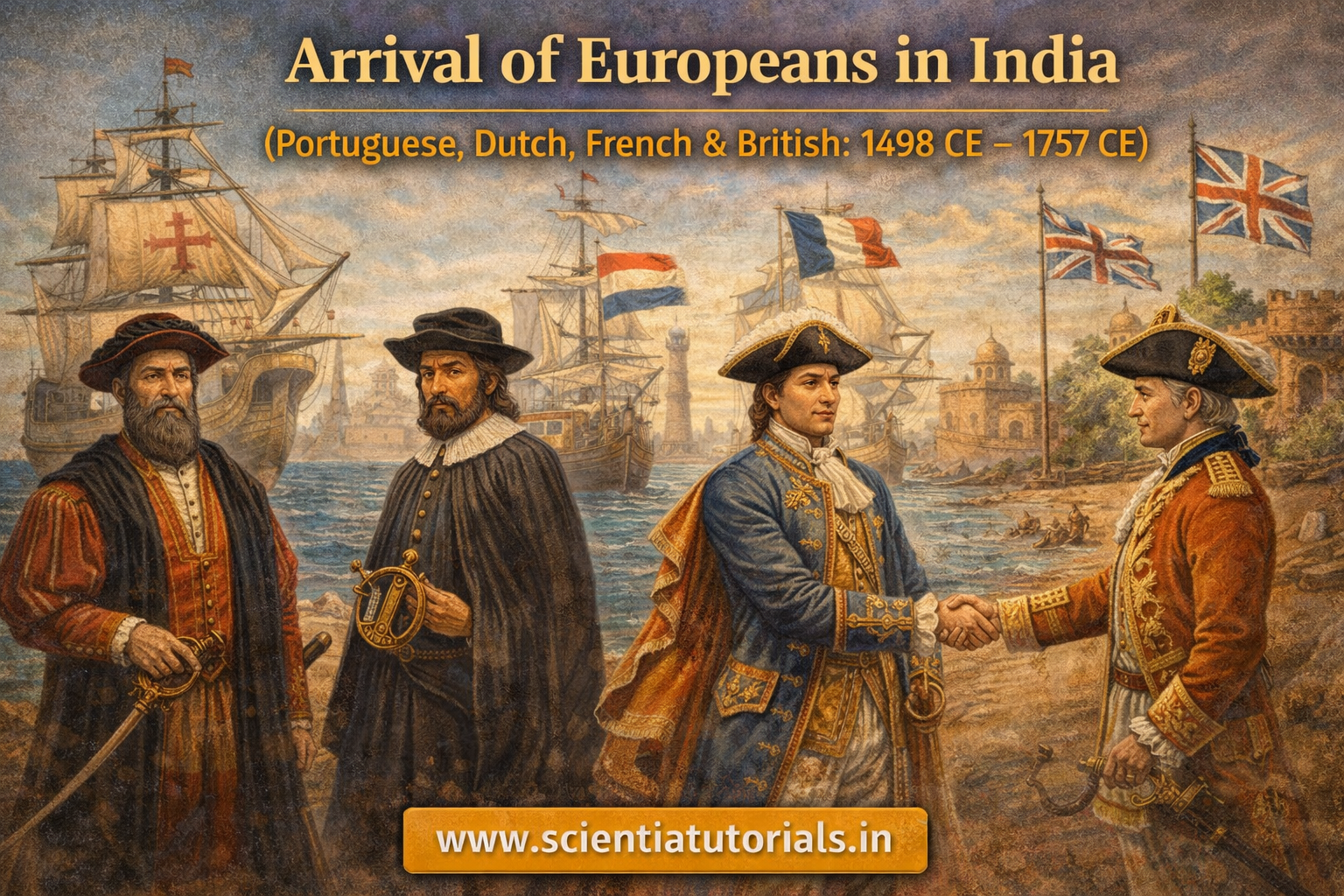

Arrival of Europeans in India | Early Colonial History of India
Advent of Europeans & Colonial Expansion
Timeline: 1498 CE – 1757 CE
(Modern Indian History – Early Colonial Phase)
Lesson: Arrival of Portuguese, Dutch, French & British
1. Introduction: Europe and the Indian Ocean World
The period between 1498 CE and 1757 CE marks a decisive turning point in Indian history, when European trading companies gradually transformed from commercial enterprises into political powers. Unlike earlier foreign contacts, the Europeans arrived with advanced maritime technology, capitalist organisation, and state backing, which enabled them to reshape Indian Ocean trade networks and eventually Indian politics.
The arrival of Europeans did not immediately lead to colonial rule. For nearly two and a half centuries, European powers functioned primarily as traders, negotiating with Indian rulers, competing among themselves, and adapting to existing political and economic structures. However, by 1757 CE, the British East India Company had emerged as a dominant political force, marking the beginning of formal colonial rule.
This lesson traces the chronological arrival, expansion, rivalry, and consolidation of the Portuguese, Dutch, French, and British in India.
2. India and Overseas Trade before 1498 CE
Before European arrival:
- India was a central hub of Indian Ocean trade
- Arab, Persian, and Indian merchants dominated maritime commerce
- Indian textiles, spices, indigo, and precious stones were in global demand
- Trade was conducted through well-established ports like Calicut, Cambay, and Masulipatnam
European intervention altered these long-standing commercial patterns.
3. Arrival of the Portuguese (1498 CE): The First Europeans
3.1 Voyage of Vasco da Gama
The European entry into India began with the arrival of Vasco da Gama at Calicut in 1498 CE, marking the discovery of a direct sea route from Europe to India.
Significance:
- Ended Arab monopoly over spice trade
- Linked Europe directly with Asian markets
- Laid foundation for European colonial expansion
3.2 Portuguese Trading Empire in India
Key features of Portuguese expansion:
- Establishment of fortified trading posts
- Control over strategic ports
- Use of naval power to dominate sea routes
Major centres:
- Goa (capital, captured in 1510)
- Daman and Diu
- Cochin
- Bassein
3.3 Nature of Portuguese Rule
- Monopoly over spice trade
- Naval dominance through cartaz system (naval passes)
- Missionary activities alongside trade
- Strong military presence
Limitations:
- Small population base
- Rigid administration
- Decline by the 17th century due to corruption and European competition
4. Arrival of the Dutch (Early 17th Century)
4.1 Dutch East India Company (VOC)
The Dutch East India Company was established in 1602 CE as a powerful commercial enterprise backed by the Dutch state.
Objectives:
- Control spice trade
- Break Portuguese monopoly
- Establish trading dominance in Asia
4.2 Dutch Settlements in India
Major centres:
- Pulicat (Coromandel Coast)
- Nagapattinam
- Masulipatnam
- Cochin (captured from Portuguese)
4.3 Decline of Dutch Influence in India
Reasons:
- Greater focus on East Indies (Indonesia)
- Limited territorial ambitions in India
- Growing British competition
By the mid-18th century, Dutch influence in India had significantly declined.
5. Arrival of the English (British)
5.1 Formation of the English East India Company
The British East India Company was founded in 1600 CE to trade with the East Indies.
Key advantages:
- Royal charter
- Joint-stock capital
- Strong naval backing
5.2 Early British Factories and Settlements
Important centres:
- Surat (first factory)
- Madras (Fort St. George, 1639)
- Bombay (acquired in 1661)
- Calcutta (Fort William, 1690)
The British followed a policy of trade before territory in the early phase.
5.3 British Relations with Indian Rulers
- Secured trading privileges through farmans
- Maintained diplomatic relations with Mughal authorities
- Avoided direct political confrontation initially
This cautious approach helped the British establish a strong commercial base.
6. Arrival of the French
6.1 French East India Company
The French East India Company was established in 1664 CE under state patronage.
6.2 French Settlements in India
Key centres:
- Pondicherry (headquarters)
- Chandernagore
- Mahe
- Karaikal
- Yanam
6.3 Nature of French Expansion
- Close alliance with Indian rulers
- Strong military involvement
- More direct political ambitions compared to Dutch
French expansion peaked in the mid-18th century.
7. Anglo-French Rivalry in India
7.1 Carnatic Wars (1746–1763)
The Anglo-French rivalry culminated in a series of conflicts known as the Carnatic Wars, fought mainly in South India.
Key features:
- Use of Indian armies trained in European methods
- Interference in succession disputes
- Transformation of commercial rivalry into political struggle
7.2 Outcome of Anglo-French Conflict
- British emerged victorious
- French influence reduced to limited trading posts
- Britain gained political supremacy in India
This rivalry was a crucial step toward British colonial rule.
8. Why Did the British Succeed?
Several factors explain British success over other Europeans:
- Strong naval power
- Stable financial system
- Efficient administration
- Support from British Parliament
- Superior diplomacy
- Ability to exploit Indian political fragmentation
9. Indian Response to European Arrival
Indian rulers:
- Initially welcomed Europeans as traders
- Granted trading privileges
- Later realised political ambitions too late
Indian merchants:
- Benefited from expanded trade
- Adapted to European commercial practices
There was no unified Indian resistance in the early phase.
10. Economic and Social Impact of European Trade
10.1 Trade Transformation
- Integration of Indian economy into global trade
- Increased demand for textiles and spices
- Drain of precious metals into India initially
10.2 Early Signs of Colonial Exploitation
- Monopoly trading practices
- Use of force in trade disputes
- Gradual political interference
These trends became more pronounced after 1757.
11. The Turning Point: Battle of Plassey (1757 CE)
The Battle of Plassey (1757) marked the end of the early colonial phase.
Significance:
- British East India Company became a political power
- Beginning of Company rule in India
- Transition from trade dominance to territorial control
This event concludes the phase of European arrival and rivalry.
12. Historical Significance of European Arrival
- End of Indian Ocean trade autonomy
- Introduction of modern colonialism
- Shift in Indian political and economic structures
- Foundation for British imperial rule
13. Examination Relevance
This topic is crucial for:
- UPSC Prelims & Mains
- State PSC exams
- Understanding colonial foundations
- Linking medieval and modern Indian history
Key themes:
- Trade to territory
- European rivalry
- Indian political fragmentation
- Colonial expansion strategies
14. Conclusion
Between 1498 CE and 1757 CE, India witnessed a gradual yet profound transformation as European trading companies evolved into political powers. The Portuguese initiated European presence, the Dutch challenged early monopolies, the French introduced military-political competition, and the British ultimately emerged victorious.
The arrival of Europeans should be understood not as an immediate conquest but as a long process of commercial penetration, political rivalry, and strategic adaptation, culminating in the establishment of British colonial rule.
Questions with Answers
Lesson: Arrival of Portuguese, Dutch, French & British
1. Why is the period 1498–1757 CE considered a turning point in Indian history?
Answer:
This period marks the transition from India’s dominance in Indian Ocean trade to European commercial and political penetration, culminating in British political supremacy after 1757.
2. What was the nature of India’s overseas trade before the arrival of Europeans?
Answer:
India was a central hub of Indian Ocean trade, dominated by Arab, Persian, and Indian merchants, exporting textiles, spices, indigo, and precious stones.
3. Who was the first European to reach India by sea, and when?
Answer:
Vasco da Gama reached Calicut in 1498 CE, opening a direct sea route between Europe and India.
4. Why was Vasco da Gama’s voyage historically significant?
Answer:
It broke the Arab monopoly over the spice trade, linked Europe directly with Asian markets, and laid the foundation for European colonial expansion in Asia.
5. Which European power was the first to establish a trading empire in India?
Answer:
The Portuguese were the first Europeans to establish a trading and naval empire in India.
6. What were the major Portuguese centres in India?
Answer:
Goa (capital), Daman, Diu, Cochin, and Bassein were major Portuguese centres.
7. What was the cartaz system?
Answer:
The cartaz system was a Portuguese naval pass system that controlled maritime trade by forcing ships to obtain permits to sail in the Indian Ocean.
8. Mention two reasons for the decline of Portuguese power in India.
Answer:
- Rigid administration and corruption
- Growing competition from Dutch and English companies
9. Which company represented Dutch commercial interests in Asia?
Answer:
The Dutch East India Company, founded in 1602 CE.
10. What were the main Dutch settlements in India?
Answer:
Pulicat, Nagapattinam, Masulipatnam, and Cochin were major Dutch centres.
11. Why did the Dutch fail to establish political control in India?
Answer:
The Dutch focused more on Indonesia and spice islands, lacked territorial ambition in India, and faced strong British competition.
12. When was the English East India Company established?
Answer:
The British East India Company was established in 1600 CE.
13. What were the early British settlements in India?
Answer:
Surat, Madras (Fort St. George), Bombay, and Calcutta (Fort William).
14. How did the British initially deal with Indian rulers?
Answer:
They adopted a policy of trade before territory, securing trading privileges through diplomacy and royal farmans.
15. Which European power emerged as Britain’s main rival in India?
Answer:
The French emerged as Britain’s principal rival in India during the 18th century.
16. Name the main French settlements in India.
Answer:
Pondicherry, Chandernagore, Mahe, Karaikal, and Yanam.
17. What was distinctive about French policy in India compared to the Dutch?
Answer:
The French showed greater political and military ambition, frequently intervening in Indian succession disputes.
18. What were the Carnatic Wars?
Answer:
The Carnatic Wars (1746–1763) were a series of conflicts between the British and French in South India, marking the transformation of trade rivalry into political struggle.
19. What was the outcome of the Anglo-French rivalry in India?
Answer:
The British emerged victorious, while French influence was reduced to a few trading posts without political power.
20. Why were the British more successful than other European powers?
Answer:
British success was due to:
- Strong naval power
- Stable finances
- Efficient administration
- Diplomatic skill
- Ability to exploit Indian political fragmentation
21. How did Indian rulers initially view European traders?
Answer:
They generally welcomed Europeans as commercial partners and granted trading privileges, underestimating their political ambitions.
22. What role did Indian merchants play in European trade?
Answer:
Indian merchants collaborated with Europeans, supplied goods, and adapted to new commercial practices, benefiting initially from expanded trade.
23. What were the early economic effects of European trade on India?
Answer:
- Expansion of textile and spice exports
- Integration into global trade networks
- Initial inflow of precious metals into India
24. Why is the Battle of Plassey (1757 CE) considered a watershed moment?
Answer:
It marked the beginning of British political dominance, transforming the East India Company from a trading body into a ruling power.
25. What is the overall historical significance of the arrival of Europeans in India?
Answer:
The arrival of Europeans ended India’s trade autonomy, introduced modern colonialism, reshaped political structures, and laid the foundation for British imperial rule.
MCQs with Answers & Explanations
Lesson: Arrival of Portuguese, Dutch, French & British
These MCQs are suitable for UPSC Prelims, State PSCs, UGC NET, CUET (PG), and university examinations, progressing from factual clarity to analytical understanding.
MCQ 1
The year 1498 CE is considered a landmark in Indian history because it marks:
A. The beginning of British rule
B. The end of Mughal authority
C. The arrival of the first European by sea
D. The start of the Industrial Revolution
Correct Answer: C
Explanation:
In 1498 CE, Vasco da Gama reached Calicut, opening a direct sea route between Europe and India and initiating sustained European involvement in Indian trade and politics.
MCQ 2
Before the arrival of Europeans, Indian Ocean trade was mainly dominated by:
A. European merchants
B. Chinese traders
C. Arab, Persian, and Indian merchants
D. African traders
Correct Answer: C
Explanation:
Indian Ocean commerce before 1498 was controlled largely by Arab, Persian, and Indian merchants, with India as a major exporter of textiles and spices.
MCQ 3
Which European power was the first to establish a maritime trading empire in India?
A. Dutch
B. French
C. Portuguese
D. British
Correct Answer: C
Explanation:
The Portuguese were pioneers in using naval power to control Indian Ocean trade and establish fortified trading centres.
MCQ 4
Which city became the capital of Portuguese possessions in India?
A. Cochin
B. Goa
C. Daman
D. Calicut
Correct Answer: B
Explanation:
Goa, captured in 1510, became the administrative and political centre of Portuguese power in India.
MCQ 5
The cartaz system introduced by the Portuguese aimed to:
A. Promote free trade
B. Control maritime trade through naval passes
C. Encourage Indian shipping
D. Abolish Arab trade
Correct Answer: B
Explanation:
The cartaz system forced ships to obtain Portuguese naval passes, allowing them to monopolise and regulate Indian Ocean trade.
MCQ 6
One major reason for the decline of Portuguese power in India was:
A. Lack of spices
B. Rigid administration and corruption
C. Strong Mughal navy
D. Absence of missionary activity
Correct Answer: B
Explanation:
Portuguese decline resulted from corruption, rigid policies, and rising competition from other European powers.
MCQ 7
Which company represented Dutch commercial interests in Asia?
A. British East India Company
B. French East India Company
C. Dutch East India Company
D. Levant Company
Correct Answer: C
Explanation:
The VOC, founded in 1602, was a powerful state-backed trading company focused mainly on the spice trade.
MCQ 8
Which of the following was a major Dutch settlement in India?
A. Bombay
B. Pondicherry
C. Pulicat
D. Calcutta
Correct Answer: C
Explanation:
Pulicat on the Coromandel Coast was an important Dutch trading centre.
MCQ 9
Why did the Dutch fail to establish political supremacy in India?
A. Weak navy
B. Excessive focus on religious activities
C. Greater interest in Indonesia than India
D. Hostility from Indian merchants
Correct Answer: C
Explanation:
The Dutch concentrated on the East Indies (Indonesia) and lacked strong territorial ambitions in India.
MCQ 10
The English East India Company was founded in:
A. 1498 CE
B. 1556 CE
C. 1600 CE
D. 1664 CE
Correct Answer: C
Explanation:
The British East India Company was established in 1600 CE with a royal charter to trade with Asia.
MCQ 11
Which was the first British factory in India?
A. Madras
B. Bombay
C. Surat
D. Calcutta
Correct Answer: C
Explanation:
Surat served as the first major British trading factory, benefiting from Mughal patronage.
MCQ 12
Which British settlement was acquired as part of a royal marriage?
A. Madras
B. Bombay
C. Calcutta
D. Surat
Correct Answer: B
Explanation:
Bombay was acquired by Britain in 1661 as part of Charles II’s marriage dowry from Portugal.
MCQ 13
The early British policy in India can best be described as:
A. Territorial conquest
B. Religious expansion
C. Trade before territory
D. Military domination
Correct Answer: C
Explanation:
Initially, the British focused on commerce and diplomacy, avoiding direct political confrontation.
MCQ 14
Which European power emerged as Britain’s principal rival in India during the 18th century?
A. Portuguese
B. Dutch
C. French
D. Spanish
Correct Answer: C
Explanation:
The French competed with the British for political and commercial dominance, especially in South India.
MCQ 15
The French East India Company was founded in:
A. 1600 CE
B. 1602 CE
C. 1664 CE
D. 1707 CE
Correct Answer: C
Explanation:
The French East India Company was established in 1664 under strong state patronage.
MCQ 16
Which city served as the headquarters of French possessions in India?
A. Chandernagore
B. Mahe
C. Karaikal
D. Pondicherry
Correct Answer: D
Explanation:
Pondicherry was the administrative and military centre of French power in India.
MCQ 17
What distinguished French policy in India from that of the Dutch?
A. Exclusive focus on trade
B. Greater political and military involvement
C. Avoidance of Indian politics
D. Lack of state support
Correct Answer: B
Explanation:
The French actively intervened in Indian succession disputes, seeking political influence.
MCQ 18
The Carnatic Wars were primarily fought between:
A. British and Portuguese
B. Dutch and Portuguese
C. British and French
D. French and Dutch
Correct Answer: C
Explanation:
The Carnatic Wars reflected Anglo-French rivalry, turning commercial competition into armed conflict.
MCQ 19
One significant outcome of the Carnatic Wars was:
A. Dutch supremacy in India
B. Complete French control
C. British political dominance
D. End of European trade
Correct Answer: C
Explanation:
British victory in the Carnatic Wars paved the way for their political supremacy in India.
MCQ 20
Which factor most strongly contributed to British success over other Europeans?
A. Religious policy
B. Naval power and financial strength
C. Cultural assimilation
D. Missionary activity
Correct Answer: B
Explanation:
British dominance rested on naval superiority, stable finances, and effective administration.
MCQ 21
How did Indian rulers initially respond to European traders?
A. Immediate resistance
B. Complete hostility
C. Welcomed them as traders
D. Unified opposition
Correct Answer: C
Explanation:
Indian rulers viewed Europeans mainly as commercial partners, underestimating their political ambitions.
MCQ 22
Which group initially benefited from European trade expansion?
A. Indian peasants
B. Indian merchants
C. Tribal communities
D. Religious elites only
Correct Answer: B
Explanation:
Indian merchants collaborated with Europeans and profited from expanded overseas trade.
MCQ 23
What was an early economic effect of European trade on India?
A. Immediate deindustrialisation
B. Isolation from global trade
C. Increased export of textiles
D. Collapse of Indian markets
Correct Answer: C
Explanation:
European demand increased exports of Indian textiles and spices, integrating India into global markets.
MCQ 24
The Battle of Plassey (1757) is considered a watershed because it:
A. Ended Mughal rule
B. Began British political dominance
C. Eliminated French trade
D. Established direct Crown rule
Correct Answer: B
Explanation:
Plassey transformed the British East India Company from a trading body into a political power.
MCQ 25
Overall, the arrival of Europeans in India led to:
A. Immediate colonial rule
B. Strengthening of Indian sovereignty
C. Gradual transformation from trade to empire
D. Decline of global trade
Correct Answer: C
Explanation:
European presence evolved from commercial penetration to political domination, culminating in British colonial rule after 1757.
🔹 Targeting Exams
This content is specifically designed to meet the syllabus and analytical needs of:
-
UPSC Civil Services Examination (Prelims & Mains)
-
State Public Service Commission Exams (APSC, BPSC, WBCS, etc.)
-
UGC NET (History)
-
CUET (UG & PG – History)
-
University Semester & Final Examinations
-
Class 11–12 (Modern Indian History – CBSE & State Boards)
🔹 Related Keyphrases
-
Arrival of Europeans in India
-
Portuguese arrival in India 1498
-
Dutch, French and British in India
-
European trading companies in India
-
Advent of Europeans History of India
-
Carnatic Wars and European rivalry
-
British East India Company beginnings
-
Early colonial phase in India
-
Modern Indian history colonial expansion
-
UPSC notes on arrival of Europeans