
Foundation of the Gupta Empire
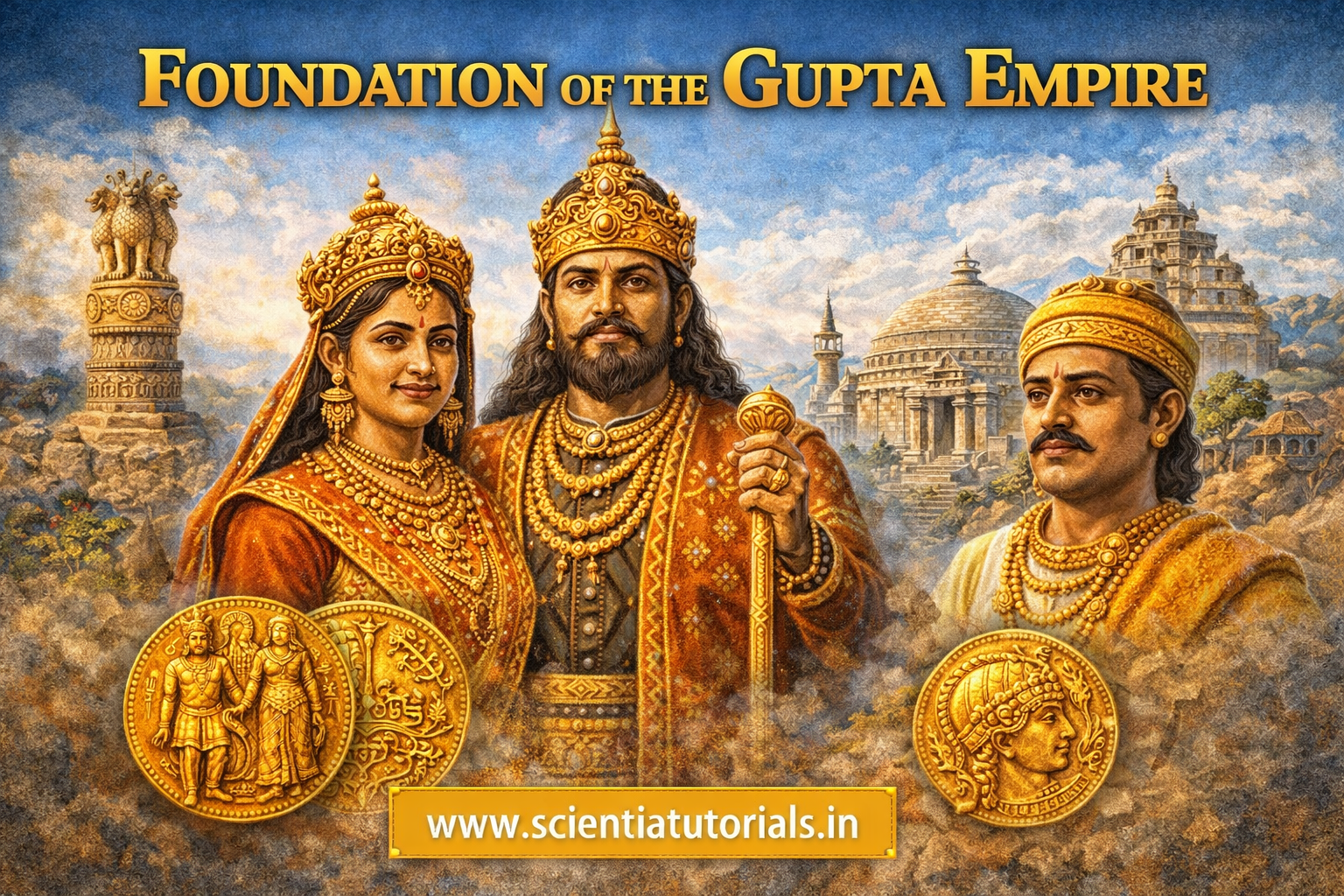

Foundation of the Gupta Empire | History of India
SECTION 6: Gupta Age & Post-Gupta Developments
Timeline: c. 320 CE – c. 600 CE
(Ancient Indian History – Classical Age)
Introduction: The Gupta Age as the Beginning of India’s Classical Phase
The foundation of the Gupta Empire marks one of the most significant turning points in ancient Indian history. Emerging around the beginning of the 4th century CE, the Gupta state laid the political and administrative foundations for what is often described as the Classical Age of India. This period witnessed remarkable developments in governance, economy, culture, art, science, and literature.
Unlike the Mauryas, whose empire arose through conquest and rigid centralisation, the Guptas established their authority gradually through alliances, diplomacy, and selective military expansion. The foundation of the Gupta Empire represents a transition from the Post-Mauryan regional fragmentation to renewed imperial unity, particularly in northern India.
This lesson examines:
- The historical background preceding the Guptas
- The origins and early rulers of the Gupta dynasty
- The political strategies behind their rise
- The significance of the Gupta foundation in Indian history
I. Historical Background: India before the Guptas
1. Political Conditions in the Post-Kushana Period
By the late 3rd century CE, the political landscape of northern India was characterised by:
- Decline of the Kushana Empire
- Weakening of Indo-Scythian and Indo-Parthian powers
- Rise of small regional kingdoms and tribal chiefs
No single power exercised authority over the Gangetic plains, creating conditions favourable for the emergence of a new imperial dynasty.
2. Economic and Social Context
Despite political fragmentation, this period witnessed:
- Expansion of agriculture
- Growth of internal trade
- Gradual revival of urban centres in the Gangetic basin
The stability of agrarian life and trade networks provided a strong economic base for the rise of the Guptas.
II. Origins of the Gupta Dynasty
1. The Early Guptas
The earliest known ruler of the Gupta dynasty was Sri Gupta. Very little is known about his reign, but inscriptions suggest that:
- He ruled over a small territory, possibly in eastern Uttar Pradesh or Magadha
- He held the modest title of Maharaja, not Maharajadhiraja
This indicates that the Guptas initially emerged as local rulers, not imperial monarchs.
2. Ghatotkacha and Early Consolidation
Sri Gupta was succeeded by Ghatotkacha, who continued to consolidate Gupta authority. Like his predecessor, Ghatotkacha also assumed the title Maharaja, suggesting that the Guptas were still in the pre-imperial phase.
However, by the end of his reign:
- The Gupta family had gained political legitimacy
- They were recognised as an emerging power in the middle Gangetic region
III. Chandragupta I and the Formal Foundation of the Gupta Empire
1. Accession of Chandragupta I (c. 320 CE)
The true foundation of the Gupta Empire is associated with the accession of Chandragupta I around c. 320 CE. His reign marks the transition from a regional kingdom to an imperial power.
Chandragupta I assumed the grand title of Maharajadhiraja, symbolising sovereign authority and imperial ambition.
2. The Lichchhavi Alliance: A Turning Point
One of the most crucial factors in the foundation of the Gupta Empire was Chandragupta I’s matrimonial alliance with Kumaradevi, a princess of the powerful Lichchhavi clan.
Significance of the Alliance
- The Lichchhavis were an influential republican clan in the Vaishali region
- The marriage gave Chandragupta I political legitimacy
- It expanded Gupta influence in Bihar and eastern Uttar Pradesh
- It provided access to economic resources and trade routes
Gupta gold coins prominently depicting Chandragupta I and Kumaradevi underline the symbolic and political importance of this alliance.
3. Territorial Expansion under Chandragupta I
As a result of military strength and alliances, Chandragupta I brought under Gupta control:
- Magadha
- Prayaga region
- Parts of eastern Uttar Pradesh and Bihar
This expansion laid the territorial foundation for future imperial growth.
IV. Administrative and Political Features of the Early Gupta State
1. Nature of Kingship
The Gupta concept of kingship combined:
- Divine authority
- Paternal governance
- Military leadership
The king was projected as:
- Protector of Dharma
- Upholder of social order
- Source of political stability
This ideological framework strengthened royal authority.
2. Role of Samantas (Feudatories)
Unlike the Mauryas, the Guptas adopted a flexible administrative system:
- Local rulers were allowed autonomy
- Loyalty was ensured through tribute and military support
This early form of feudatory polity helped the Guptas expand without excessive administrative burden.
V. Economic Basis of the Gupta Foundation
1. Agrarian Expansion
The Guptas encouraged:
- Clearing of forests
- Expansion of cultivable land
- Settlement of Brahmanas through land grants
Agriculture became the backbone of Gupta power.
2. Land Grants and Brahmadeya System
The early Gupta period witnessed:
- Granting of tax-free land to Brahmanas
- Rise of Brahmadeya villages
This helped:
- Consolidate royal authority
- Gain ideological support of Brahmanical elites
- Promote agrarian expansion
3. Trade and Monetisation
Gupta gold coins indicate:
- Prosperous economy
- Active trade networks
- State control over minting
Trade routes along the Ganga played a crucial role in the empire’s growth.
VI. Samudragupta and the Consolidation of the Gupta Empire
Though not part of the foundation strictly speaking, the role of Samudragupta is inseparable from understanding the success of the Gupta foundation.
His military campaigns:
- Eliminated rival powers
- Extended Gupta influence across northern India
- Validated the imperial structure created by Chandragupta I
Samudragupta’s achievements transformed the Gupta state into a pan-northern Indian empire.
VII. Significance of the Gupta Foundation
1. Political Significance
- Restoration of imperial unity in northern India
- End of prolonged political fragmentation
- Creation of a durable imperial framework
2. Administrative Significance
- Decentralised yet stable governance
- Efficient integration of local elites
- Balance between central authority and regional autonomy
3. Cultural and Historical Significance
- Prepared ground for the Classical Age
- Encouraged growth of Sanskrit culture
- Supported Brahmanical traditions alongside religious tolerance
VIII. Comparison with Earlier Empires
| Aspect | Mauryan Empire | Gupta Empire |
|---|---|---|
| Mode of Expansion | Military conquest | Diplomacy + conquest |
| Administration | Highly centralised | Decentralised |
| Ideology | Dhamma-centric | Brahmanical-Dharmic |
| Longevity | Short-lived | Relatively stable |
This comparison highlights why the Gupta foundation proved more enduring.
Conclusion: The Foundation of a Classical Empire
The foundation of the Gupta Empire was not a sudden event but a carefully structured political process involving diplomacy, strategic marriages, military consolidation, and economic expansion. Beginning with modest origins under Sri Gupta and Ghatotkacha, the dynasty achieved imperial status under Chandragupta I and reached greatness under Samudragupta.
For examinations, the foundation of the Gupta Empire should be understood as:
- A gradual transition from regional power to imperial authority
- A departure from Mauryan centralisation
- The starting point of India’s Classical Age
The Gupta foundation laid the political and ideological framework upon which one of India’s most celebrated historical periods was built.
Below is a well-structured, examination-oriented set of 25 Questions with clear and accurate Answers based strictly on the lesson
“Foundation of the Gupta Empire”, aligned with
SECTION 6: Gupta Age & Post-Gupta Developments (c. 320–600 CE).
The content is suitable for UPSC, State PSCs, CUET, NET/SET.
Foundation of the Gupta Empire – Questions with Answers
1. What is meant by the “Foundation of the Gupta Empire”?
Answer:
The foundation of the Gupta Empire refers to the process by which the Gupta dynasty rose from a local power to an imperial authority around c. 320 CE, culminating in the accession of Chandragupta I.
2. In which historical context did the Gupta Empire emerge?
Answer:
The Gupta Empire emerged after the decline of the Kushanas and other foreign powers, during a phase of political fragmentation and regional kingdoms in northern India.
3. Who is considered the earliest known ruler of the Gupta dynasty?
Answer:
The earliest known ruler was Sri Gupta, who ruled over a small territory and held the title Maharaja.
4. Why is Sri Gupta regarded as a pre-imperial ruler?
Answer:
Sri Gupta used the modest title Maharaja and ruled a limited region, indicating that the Gupta state had not yet achieved imperial status.
5. Who succeeded Sri Gupta and what was his contribution?
Answer:
Sri Gupta was succeeded by Ghatotkacha, who continued consolidating Gupta authority and strengthened the dynasty’s political position.
6. Which ruler marks the formal foundation of the Gupta Empire?
Answer:
The formal foundation of the Gupta Empire is associated with Chandragupta I, who ascended the throne around c. 320 CE.
7. What new royal title was adopted by Chandragupta I and why was it significant?
Answer:
Chandragupta I adopted the title Maharajadhiraja, signifying imperial sovereignty and marking the transition from regional kingship to empire.
8. How did matrimonial alliances contribute to the foundation of the Gupta Empire?
Answer:
Matrimonial alliances strengthened political legitimacy and territorial influence, most notably through Chandragupta I’s marriage with a Lichchhavi princess.
9. Who was Kumaradevi and why is she historically important?
Answer:
Kumaradevi was a Lichchhavi princess whose marriage to Chandragupta I enhanced Gupta prestige, territory, and political legitimacy.
10. What was the political importance of the Lichchhavi alliance?
Answer:
The alliance brought the Gupta rulers control over the Vaishali region, access to economic resources, and recognition among powerful north Indian clans.
11. Which regions came under Gupta control during Chandragupta I’s reign?
Answer:
Chandragupta I brought Magadha, Prayaga, and parts of eastern Uttar Pradesh and Bihar under Gupta authority.
12. How does Gupta expansion differ from Mauryan expansion?
Answer:
Gupta expansion relied more on diplomacy, alliances, and selective warfare, whereas Mauryan expansion depended heavily on conquest and centralised administration.
13. What role did the Gangetic plains play in the Gupta foundation?
Answer:
The fertile Gangetic plains provided agricultural surplus, trade routes, and population support essential for imperial expansion.
14. Describe the nature of kingship in the early Gupta period.
Answer:
Gupta kingship combined divine authority, moral responsibility, and military leadership, portraying the king as protector of Dharma and social order.
15. What were samantas, and how did they help Gupta expansion?
Answer:
Samantas were feudatory rulers who enjoyed local autonomy but owed loyalty and military support to the Gupta king, enabling expansion with minimal administrative burden.
16. What economic factors supported the foundation of the Gupta Empire?
Answer:
Agricultural expansion, land grants, flourishing trade, and monetisation through gold coinage strengthened the economic base of the Gupta state.
17. What was the significance of land grants during the early Gupta period?
Answer:
Land grants to Brahmanas helped extend cultivation, secure ideological support, and consolidate royal authority in newly acquired regions.
18. What does Gupta coinage reveal about the early empire?
Answer:
Gupta gold coins indicate economic prosperity, strong trade networks, and royal authority over monetary systems.
19. How did Chandragupta I prepare the ground for future Gupta expansion?
Answer:
By establishing imperial authority, securing strategic territories, and forging alliances, Chandragupta I created a stable base for his successors.
20. Why is Samudragupta important in understanding the success of the Gupta foundation?
Answer:
Samudragupta consolidated and expanded the empire, validating the political framework laid by Chandragupta I.
21. How did Gupta administration differ from Mauryan administration?
Answer:
Gupta administration was decentralised and flexible, relying on feudatories, unlike the rigidly centralised Mauryan system.
22. Why is the foundation of the Gupta Empire considered the beginning of the Classical Age?
Answer:
It ushered in political stability, cultural flourishing, administrative balance, and economic prosperity, characteristic of India’s Classical Age.
23. What role did Brahmanical ideology play in the Gupta foundation?
Answer:
Brahmanical support legitimised Gupta rule, reinforced social order, and linked kingship with Dharma.
24. What were the long-term political consequences of the Gupta foundation?
Answer:
It restored imperial unity in northern India and established a durable political model followed by later dynasties.
25. How should the foundation of the Gupta Empire be evaluated in examinations?
Answer:
As a gradual, strategic process marked by diplomacy, alliances, economic strength, and balanced governance rather than sudden conquest.
Below is a well-structured, examination-oriented set of 25 MCQs with correct answers and detailed, concept-clearing explanations based strictly on the lesson
“Foundation of the Gupta Empire”, aligned with
SECTION 6: Gupta Age & Post-Gupta Developments (c. 320–600 CE).
The content is suitable for UPSC Prelims, State PSCs, CUET, NET/SET.
Foundation of the Gupta Empire – MCQs with Answers & Explanations
1. The foundation of the Gupta Empire is generally dated to:
A. 300 CE
B. c. 320 CE
C. c. 350 CE
D. c. 400 CE
Correct Answer: B
Explanation:
The accession of Chandragupta I around 320 CE marks the formal beginning of the Gupta Empire.
2. The earliest known ruler of the Gupta dynasty was:
A. Ghatotkacha
B. Chandragupta I
C. Sri Gupta
D. Samudragupta
Correct Answer: C
Explanation:
Sri Gupta is known from inscriptions as the first ruler of the dynasty, though his territory was limited.
3. Which title was used by Sri Gupta and Ghatotkacha?
A. Maharajadhiraja
B. Samrat
C. Chakravartin
D. Maharaja
Correct Answer: D
Explanation:
The title Maharaja indicates pre-imperial status, before the Guptas became an empire.
4. Who succeeded Sri Gupta as an early Gupta ruler?
A. Chandragupta I
B. Samudragupta
C. Ghatotkacha
D. Kumaradevi
Correct Answer: C
Explanation:
Ghatotkacha continued consolidating Gupta authority before imperial expansion.
5. The ruler who formally founded the Gupta Empire was:
A. Sri Gupta
B. Ghatotkacha
C. Chandragupta I
D. Samudragupta
Correct Answer: C
Explanation:
Chandragupta I transformed the Guptas from a local power into an empire.
6. Chandragupta I assumed the title:
A. Maharaja
B. Rajadhiraja
C. Maharajadhiraja
D. Samrat
Correct Answer: C
Explanation:
The title Maharajadhiraja symbolised imperial sovereignty.
7. Which matrimonial alliance greatly strengthened Gupta power?
A. Marriage with a Kushana princess
B. Marriage with a Satavahana princess
C. Marriage with the Lichchhavi princess Kumaradevi
D. Marriage with a Vakataka princess
Correct Answer: C
Explanation:
The alliance with the Lichchhavis enhanced legitimacy and territorial influence.
8. Kumaradevi belonged to which clan?
A. Shaka
B. Kushana
C. Lichchhavi
D. Satavahana
Correct Answer: C
Explanation:
The Lichchhavis were a powerful republican clan in the Vaishali region.
9. Evidence of the political importance of the Lichchhavi alliance is found in:
A. Pillar inscriptions
B. Copper plate grants
C. Gupta gold coins
D. Rock-cut caves
Correct Answer: C
Explanation:
Coins depicting Chandragupta I and Kumaradevi highlight the alliance’s significance.
10. Which region formed the core area of early Gupta power?
A. North-West India
B. Deccan plateau
C. Middle Gangetic plains
D. Eastern coastal India
Correct Answer: C
Explanation:
The fertile Gangetic basin provided economic and strategic advantages.
11. Which factor most contributed to the rise of the Guptas?
A. Decline of the Mauryas
B. Decline of the Kushanas
C. Arab invasions
D. Satavahana support
Correct Answer: B
Explanation:
The weakening of Kushana authority created a power vacuum in north India.
12. Gupta expansion differed from Mauryan expansion because it relied more on:
A. Mass conscription
B. Direct annexation
C. Diplomacy and alliances
D. Naval power
Correct Answer: C
Explanation:
The Guptas combined diplomacy, marriage alliances, and limited warfare.
13. Which administrative feature characterised early Gupta rule?
A. Extreme centralisation
B. Bureaucratic uniformity
C. Feudatory elements (samantas)
D. City-state system
Correct Answer: C
Explanation:
Local rulers were allowed autonomy in return for loyalty and service.
14. Samantas under the Guptas were:
A. Buddhist monks
B. Royal priests
C. Feudatory chiefs
D. Foreign governors
Correct Answer: C
Explanation:
Samantas strengthened Gupta control without heavy administrative costs.
15. Which economic factor supported Gupta political expansion?
A. Decline of agriculture
B. Forced labour
C. Agrarian expansion and surplus
D. Barter economy
Correct Answer: C
Explanation:
Agricultural growth ensured revenue and stability.
16. Land grants during the early Gupta period were mainly given to:
A. Merchants
B. Soldiers
C. Brahmanas
D. Artisans
Correct Answer: C
Explanation:
Brahmadeya grants helped agrarian expansion and ideological support.
17. Gupta gold coinage primarily indicates:
A. Military weakness
B. Decline of trade
C. Economic prosperity and monetisation
D. Roman political control
Correct Answer: C
Explanation:
Gold coins reflect flourishing trade and state authority.
18. Which Gupta ruler consolidated and expanded the empire after its foundation?
A. Chandragupta I
B. Ghatotkacha
C. Samudragupta
D. Chandragupta II
Correct Answer: C
Explanation:
Samudragupta’s conquests validated the imperial structure.
19. The political ideology of early Gupta kingship emphasised:
A. Republican values
B. Military dictatorship
C. Dharma and divine kingship
D. Tribal authority
Correct Answer: C
Explanation:
Gupta kings projected themselves as upholders of Dharma.
20. Compared to the Mauryas, Gupta administration was:
A. More rigid
B. Militaristic
C. More decentralised and flexible
D. Urban-centred
Correct Answer: C
Explanation:
Decentralisation made the Gupta system more durable.
21. Which of the following best explains the success of the Gupta foundation?
A. Large standing army
B. Harsh taxation
C. Balance between central power and local autonomy
D. Religious uniformity
Correct Answer: C
Explanation:
Administrative balance ensured stability and expansion.
22. The foundation of the Gupta Empire marks the beginning of:
A. Early Historic Age
B. Post-Mauryan Age
C. Classical Age of India
D. Medieval India
Correct Answer: C
Explanation:
The Gupta period is regarded as India’s Classical Age.
23. Which statement about early Gupta rulers is correct?
A. They ruled from the Deccan
B. They immediately formed a pan-Indian empire
C. They rose gradually from local power
D. They abolished land grants
Correct Answer: C
Explanation:
Gupta imperial status developed step by step.
24. The most decisive event in the foundation of the Gupta Empire was:
A. Kushana invasion
B. Accession of Chandragupta I
C. Samudragupta’s conquests
D. Gupta-Roman trade
Correct Answer: B
Explanation:
Imperial titles and alliances began with Chandragupta I.
25. For examinations, the foundation of the Gupta Empire should be viewed as:
A. A sudden revolution
B. A military coup
C. A gradual and strategic political process
D. A purely economic change
Correct Answer: C
Explanation:
The Gupta rise combined diplomacy, economy, and selective conquest.
🎯 Targeting Exams
-
UPSC Civil Services Examination (Prelims – Ancient History)
-
State Public Service Commissions (PSC)
-
CUET (UG & PG – History)
-
NET / SET (History)
-
University Semester Examinations (BA / MA History)
-
SSC & other competitive examinations (Ancient India syllabus)
🔍 Related / Secondary Keyphrases
-
Foundation of Gupta Empire MCQs
-
Rise of Gupta dynasty objective questions
-
Chandragupta I and Gupta Empire MCQs
-
Early Gupta rulers MCQs with answers
-
Gupta Age Ancient Indian History MCQs
-
History of India Gupta Empire questions
-
UPSC Ancient History Gupta MCQs