
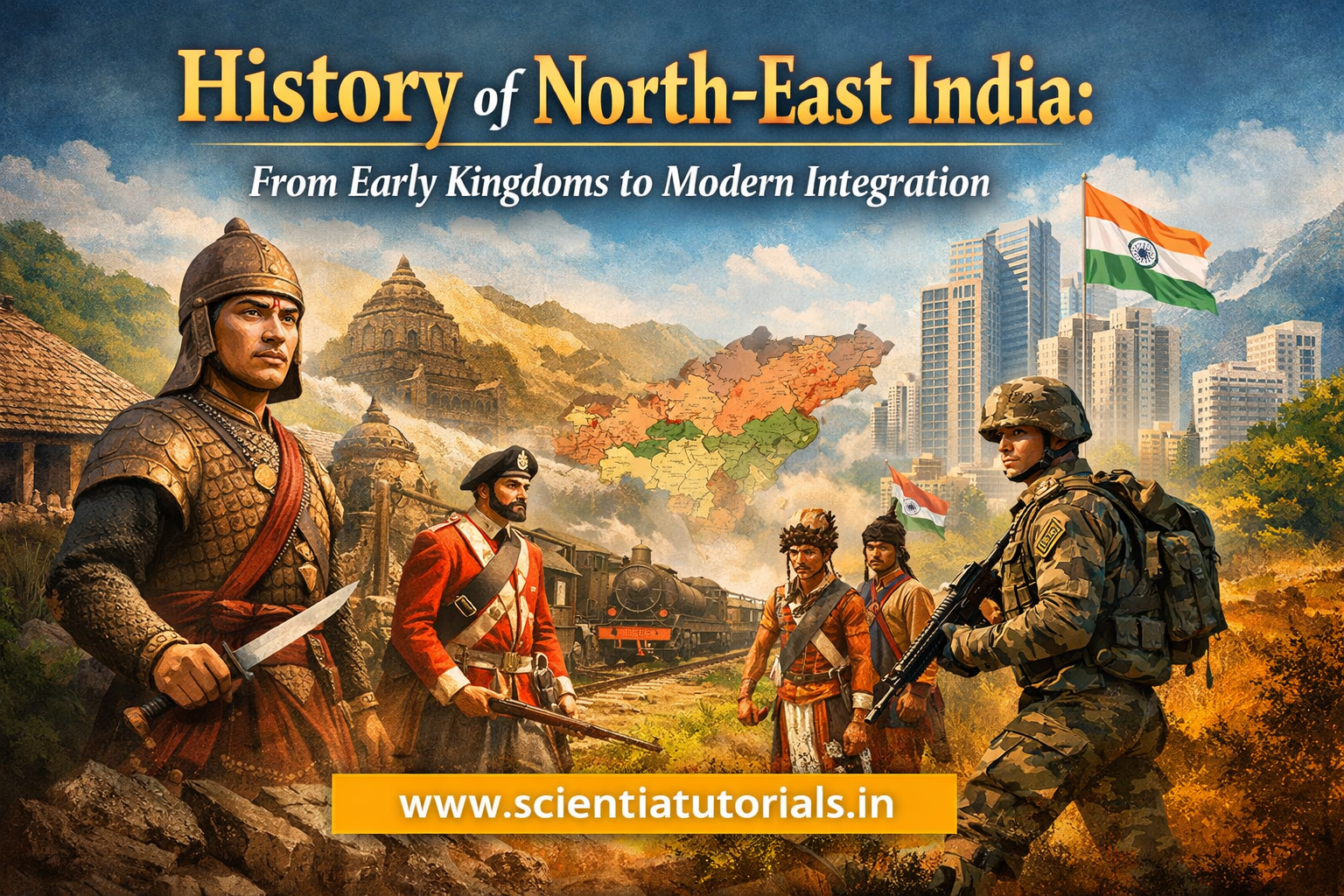
History of North-East India: From Early Kingdoms to Modern Integration
Course Overview History of North-East India: From Early Kingdoms to Modern Integration The online learning course “History of North-East India: From Early Kingdoms to Modern Integration” is a comprehensive, chronologically structured academic programme designed to provide an in-depth understanding of …

Overview
Course Overview
History of North-East India: From Early Kingdoms to Modern Integration
The online learning course “History of North-East India: From Early Kingdoms to Modern Integration” is a comprehensive, chronologically structured academic programme designed to provide an in-depth understanding of the historical evolution of India’s North-Eastern region. The course traces the region’s journey from early kingdoms and tribal societies to colonial encounters and finally to post-independence integration within the Indian Union.
In this Course, each Lesson under the Modules is divided into 4 Sections, as mentioned below:
- Chronologically Structured Study Module,
- Short Answer Type Questions,
- Long Answer Type Questions,
- MCQs with Answers and detailed explanations.
The course is specifically designed to meet the academic and examination needs of aspirants appearing for all major competitive and recruitment examinations across North-East India where a sound understanding of History of North-East India is essential. It is highly beneficial for candidates preparing for APSC (CCE), State Public Service Commission examinations of all North-Eastern states, State Police (SI/Constable) recruitment, ADRE and equivalent state-level direct recruitment exams, State Teacher Eligibility Tests (TETs), CTET, UGC-NET (History / Regional Studies), CUET (UG & PG), SSC examinations with North-East–based postings, and other central and state government recruitment tests conducted in the region.
The course holds equal relevance for students appearing in state board examinations and higher secondary assessments, as well as for learners enrolled in undergraduate and postgraduate programmes in colleges and universities where History of North-East India or Assam and Regional History is offered as a core or optional paper.
The comprehensive syllabus coverage and rigorous analytical framework of this course make it highly valuable for students and aspirants from all eight North-Eastern states of India—Assam, Arunachal Pradesh, Meghalaya, Manipur, Mizoram, Nagaland, Tripura, and Sikkim. By systematically integrating the historical experiences, regional developments, and socio-political transformations of each state, the course ensures balanced regional representation and strong conceptual clarity.
Equally important, the course is well-aligned with the requirements of school-level examinations, college and university undergraduate programmes, and postgraduate studies, where the History of North-East India forms a significant component of the curriculum. This makes it a reliable academic resource for board examinations, internal assessments, semester exams, and competitive tests, while maintaining comprehensive exam-oriented relevance across the entire North-East India region.

Course Title
History of North-East India: From Early Kingdoms to Modern Integration
(Ancient to Contemporary Period | Competitive Exams & Academic Curriculum Aligned)
Module I: Geographical, Ethnic, and Cultural Foundations of North-East India
Timeline / Era Covered: Prehistory – Early Historic Background (Before 4th Century CE)
Lessons
- North-East India: Physical Geography, Strategic Location, and Historical Significance
- Ethnic Composition and Racial Groups of North-East India
- Linguistic Diversity: Tibeto-Burman, Indo-Aryan, and Austroasiatic Traditions
- Prehistoric and Protohistoric Cultures of North-East India
- Migration Theories and Settlement Patterns in the Eastern Himalayas and Brahmaputra Valley
- Sources for the Early History of North-East India: Archaeological, Literary, and Oral Traditions
Focus: North-East India History, Ancient Roots of Assam and Region, Regional History Foundations
Module II: Early Historic Period and the Emergence of Kingdoms
Timeline / Era Covered: c. 4th Century CE – 7th Century CE
Lessons
- Early Political Formations in North-East India
- Rise of Kamarupa: Varman, Salastambha, and Pala Dynasties
- Administrative, Religious, and Cultural Developments in Early Assam
- Trade Routes and Economic Networks in Early North-East India
- Early Kingdoms in Manipur, Tripura, and the Eastern Himalayan Region
- North-East India in Classical Indian Texts and Foreign Accounts
Focus: Early Kingdoms of Assam, Kamarupa History, Ancient North-East India Civilisation
Module III: Early Medieval Transformations and Regional Powers
Timeline / Era Covered: 7th Century CE – 12th Century CE
Lessons
- Political Fragmentation and Regional Consolidation in North-East India
- Medieval Assam: Post-Kamarupa Developments
- Kingdom of Manipur: Political Evolution and Cultural Identity
- Tripura’s Early Medieval History and Dynastic Traditions
- Tribal Polities and Chieftainships in Hills and Frontier Regions
- Religion, Art, Architecture, and Cultural Continuity
Focus: Medieval Assam History, Regional Kingdoms of North-East India
Module IV: Late Medieval Period and the Rise of Indigenous States
Timeline / Era Covered: 13th Century CE – 18th Century CE
Lessons
- The Ahom State: Foundation, Expansion, and Administration
- Koch, Kachari, Jaintia, and Dimasa Kingdoms
- Hill–Plain Interactions and Political Negotiations
- Society, Economy, and Agrarian Expansion in Medieval North-East India
- Religious Movements and Cultural Synthesis
- Conflicts, Alliances, and Regional Diplomacy
Focus: Ahom Kingdom History, Medieval North-East India Political History
Module V: North-East India on the Eve of Colonial Rule
Timeline / Era Covered: 18th Century CE – Early 19th Century CE
Lessons
- Political Conditions in Assam, Manipur, Tripura, and Hill Regions
- Burmese Invasions and Regional Instability
- Anglo-Burmese Wars and Strategic Importance of North-East India
- Treaty of Yandabo and the British Entry into the Region
- Socio-Economic Conditions before Colonial Intervention
Focus: Pre-Colonial Assam History, British Expansion in North-East India
Module VI: Colonial Rule and Administrative Reorganisation
Timeline / Era Covered: 1826 CE – 1900 CE
Lessons
- British Annexation of Assam and Administrative Policies
- Revenue Systems, Land Settlements, and Plantation Economy
- Colonial Policies towards Tribal and Hill Areas
- Introduction of Modern Education, Missionaries, and Christianity
- Resistance Movements and Early Anti-Colonial Responses
- Socio-Cultural Impact of Colonialism in North-East India
Focus: British Rule in Assam, Colonial History of North-East India
Module VII: National Movement and Political Awakening
Timeline / Era Covered: 1900 CE – 1947 CE
Lessons
- Growth of Political Consciousness in North-East India
- Role of Assam in the Indian National Movement
- Tribal Responses to Colonial Rule
- Partition of India and Its Impact on North-East India
- Refugee Crisis, Demographic Changes, and Boundary Issues
- North-East India at the Threshold of Independence
Focus: Freedom Movement in Assam, North-East India and Indian Nationalism
Module VIII: Post-Independence Integration and State Formation
Timeline / Era Covered: 1947 CE – 1971 CE
Lessons
- Integration of North-East India into the Indian Union
- Reorganisation of States in the North-East
- Formation of Assam, Manipur, Tripura, and Sikkim
- Emergence of New States: Nagaland, Meghalaya, Mizoram, Arunachal Pradesh
- Constitutional Provisions: Sixth Schedule and Special Status
- Centre–State Relations in North-East India
Focus: Post-Independence North-East India History, State Formation in NE India
Module IX: Insurgency, Identity, and Political Movements
Timeline / Era Covered: 1970s – 1990s
Lessons
- Roots of Insurgency in North-East India
- Ethnic Identity, Autonomy Movements, and Federalism
- Assam Movement and the Assam Accord
- Peace Accords and Political Negotiations
- Impact of Militancy on Society and Economy
Focus: Political Movements in North-East India, Assam Accord History
Module X: Contemporary North-East India: Development and Integration
Timeline / Era Covered: 2000 CE – Present
Lessons
- Development Policies and Infrastructure Growth
- Act East Policy and Strategic Importance of North-East India
- Cultural Renaissance and Identity in the Global Era
- Migration, Demography, and Social Change
- Contemporary Challenges and Opportunities
- North-East India in 21st Century India
Focus: Modern North-East India History, Contemporary Regional Studies
Balanced Regional Integration
Throughout all modules, the historical experiences of Assam, Arunachal Pradesh, Meghalaya, Manipur, Mizoram, Nagaland, Tripura, and Sikkim are systematically integrated to ensure balanced regional representation, conceptual clarity, and examination relevance.
Academic & Examination Relevance
This course structure is fully aligned with:
- APSC (CCE) and all North-Eastern State PSCs
- ADRE, State Police, SSC, TETs, CTET
- UGC-NET, CUET (UG & PG)
- School Boards, UG & PG University Programmes
Academic Disclaimer
The course “History of North-East India: From Early Kingdoms to Modern Integration” is designed as an academic and examination-oriented learning resource based on established historical evidence, recognised scholarly interpretations, and standard historiographical sources. All content is presented within an objective academic framework, avoiding speculative, sensational, or unverified claims.
Historical interpretations reflect widely accepted scholarly consensus and are intended solely for educational and competitive examination purposes. Sensitive historical themes are discussed with academic neutrality and contextual integrity. While every effort has been made to ensure accuracy, learners are encouraged to consult standard textbooks and academic references for advanced study.
This course is an educational resource and does not claim to present a definitive or exclusive interpretation of the history of North-East India.
Curriculum
- 10 Sections
- 58 Lessons
- Lifetime
- Module I: Geographical, Ethnic, and Cultural Foundations of North-East IndiaModule I: Geographical, Ethnic, and Cultural Foundations of North-East India Timeline / Era Covered: Prehistory – Early Historic Background (Before 4th Century CE)6
- 1.1North-East India: Physical Geography, Strategic Location, and Historical Significance
- 1.2Ethnic Composition and Racial Groups of North-East India
- 1.3Linguistic Diversity: Tibeto-Burman, Indo-Aryan, and Austroasiatic Traditions
- 1.4Prehistoric and Protohistoric Cultures of North-East India
- 1.5Migration Theories and Settlement Patterns in the Eastern Himalayas and Brahmaputra Valley
- 1.6Sources for the Early History of North-East India: Archaeological, Literary, and Oral Traditions
- Module II: Early Historic Period and the Emergence of KingdomsModule II: Early Historic Period and the Emergence of Kingdoms Timeline / Era Covered: c. 4th Century CE – 7th Century CE6
- 2.1Early Political Formations in North-East India
- 2.2Rise of Kamarupa: Varman, Salastambha, and Pala Dynasties
- 2.3Administrative, Religious, and Cultural Developments in Early Assam
- 2.4Trade Routes and Economic Networks in Early North-East India
- 2.5Early Kingdoms in Manipur, Tripura, and the Eastern Himalayan Region
- 2.6North-East India in Classical Indian Texts and Foreign Accounts
- Module III: Early Medieval Transformations and Regional PowersModule III: Early Medieval Transformations and Regional Powers Timeline / Era Covered: 7th Century CE – 12th Century CE6
- 3.1Political Fragmentation and Regional Consolidation in North-East India
- 3.2Medieval Assam: Post-Kamarupa Developments
- 3.3Kingdom of Manipur: Political Evolution and Cultural Identity
- 3.4Tripura’s Early Medieval History and Dynastic Traditions
- 3.5Tribal Polities and Chieftainships in Hills and Frontier Regions
- 3.6Religion, Art, Architecture, and Cultural Continuity
- Module IV: Late Medieval Period and the Rise of Indigenous StatesModule IV: Late Medieval Period and the Rise of Indigenous States Timeline / Era Covered: 13th Century CE – 18th Century CE6
- 4.1The Ahom State: Foundation, Expansion, and Administration
- 4.2Koch, Kachari, Jaintia, and Dimasa Kingdoms
- 4.3Hill–Plain Interactions and Political Negotiations
- 4.4Society, Economy, and Agrarian Expansion in Medieval North-East India
- 4.5Religious Movements and Cultural Synthesis
- 4.6Conflicts, Alliances, and Regional Diplomacy
- Module V: North-East India on the Eve of Colonial RuleModule V: North-East India on the Eve of Colonial Rule Timeline / Era Covered: 18th Century CE – Early 19th Century CE5
- Module VI: Colonial Rule and Administrative ReorganisationModule VI: Colonial Rule and Administrative Reorganisation Timeline / Era Covered: 1826 CE – 1900 CE6
- 6.1British Annexation of Assam and Administrative Policies
- 6.2Revenue Systems, Land Settlements, and Plantation Economy
- 6.3Colonial Policies towards Tribal and Hill Areas
- 6.4Introduction of Modern Education, Missionaries, and Christianity
- 6.5Resistance Movements and Early Anti-Colonial Responses
- 6.6Socio-Cultural Impact of Colonialism in North-East India
- Module VII: National Movement and Political AwakeningModule VII: National Movement and Political Awakening Timeline / Era Covered: 1900 CE – 1947 CE6
- 7.1Growth of Political Consciousness in North-East India
- 7.2Role of Assam in the Indian National Movement
- 7.3Tribal Responses to Colonial Rule
- 7.4Partition of India and Its Impact on North-East India
- 7.5Refugee Crisis, Demographic Changes, and Boundary Issues
- 7.6North-East India at the Threshold of Independence
- Module VIII: Post-Independence Integration and State FormationModule VIII: Post-Independence Integration and State Formation Timeline / Era Covered: 1947 CE – 1971 CE6
- 8.1Integration of North-East India into the Indian Union
- 8.2Reorganisation of States in the North-East
- 8.3Formation of Assam, Manipur, Tripura, and Sikkim
- 8.4Emergence of New States: Nagaland, Meghalaya, Mizoram, Arunachal Pradesh
- 8.5Constitutional Provisions: Sixth Schedule and Special Status
- 8.6Centre–State Relations in North-East India
- Module IX: Insurgency, Identity, and Political MovementsModule IX: Insurgency, Identity, and Political Movements Timeline / Era Covered: 1970s – 1990s5
- Module X: Contemporary North-East India: Development and IntegrationModule X: Contemporary North-East India: Development and Integration Timeline / Era Covered: 2000 CE – Present6
- 10.1Development Policies and Infrastructure Growth
- 10.2Act East Policy and Strategic Importance of North-East India
- 10.3Cultural Renaissance and Identity in the Global Era
- 10.4Migration, Demography, and Social Change
- 10.5Contemporary Challenges and Opportunities
- 10.6North-East India in 21st Century India
Course Features
- Lectures 58
- Quiz 0
- Duration Lifetime access
- Skill level All levels
- Language English
- Students 0
- Assessments Yes