
Society, Economy, and Agrarian Expansion in Medieval North-East India
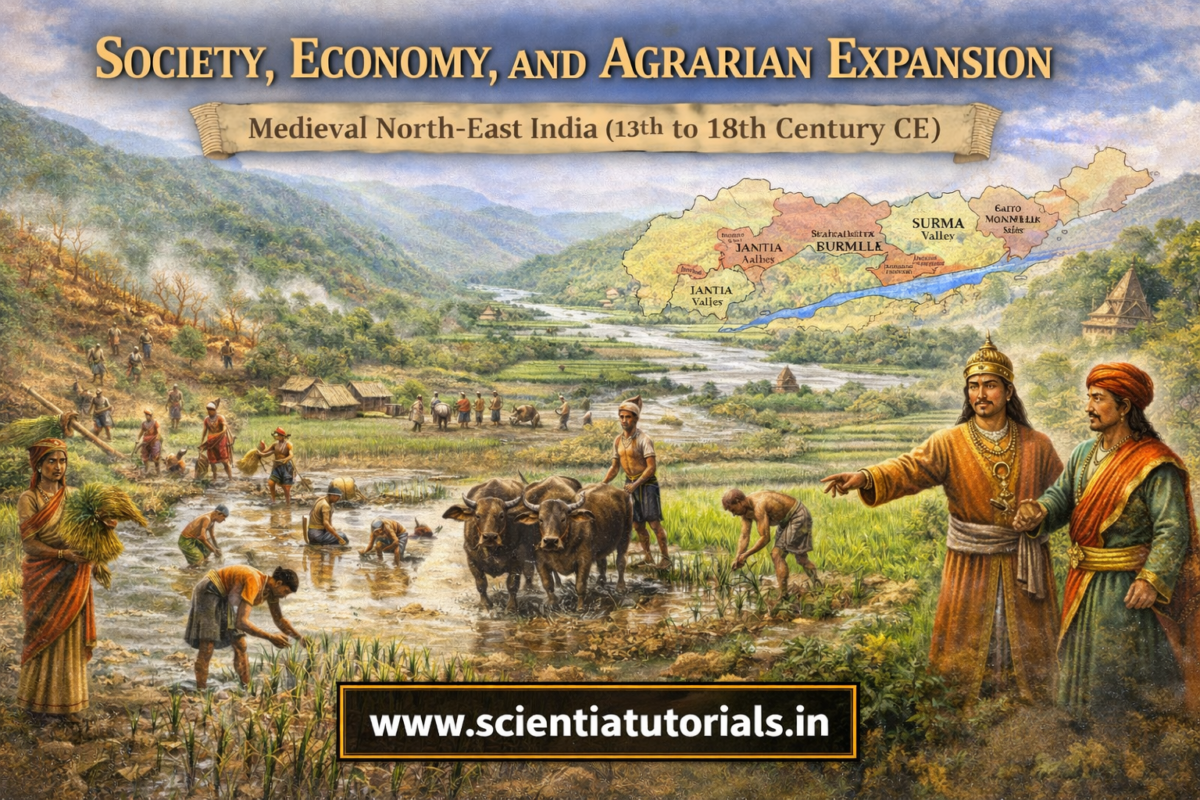

Society, Economy and Agrarian Expansion | Medieval North-East India
Course: History of North-East India: From Early Kingdoms to Modern Integration
Module IV: Late Medieval Period and the Rise of Indigenous States
Timeline / Era Covered: 13th Century CE – 18th Century CE
Lesson: Society, Economy, and Agrarian Expansion in Medieval North-East India
This lesson is systematically organized into four clearly structured sections, as detailed below:
- Chronologically Structured Study Module
- Short-Answer Type Questions
- Long-Answer Type Questions
- Multiple-Choice Questions (MCQs) with Answers and Detailed Explanations
Chronologically Structured Study Module
Introduction: Society and Economy as Foundations of Medieval State Formation
The late medieval period in North-East India (13th–18th centuries CE) was marked not only by political transformations and the rise of indigenous states but also by profound changes in society, economy, and agrarian organization. Political stability under regional powers such as the Ahoms, Koches, Kacharis, Jaintias, and Dimasas enabled systematic expansion of agriculture, consolidation of rural society, and integration of diverse communities into evolving state structures.
This lesson examines medieval North-East India from a socio-economic perspective, focusing on how agrarian expansion reshaped social relations, economic organization, and patterns of settlement. It highlights the dynamic interaction between environment, population growth, labor systems, and state policies that underpinned the region’s medieval development.
I. Geographical and Environmental Context
1. Physical Setting and Agrarian Potential
North-East India is characterized by:
- Fertile alluvial plains of the Brahmaputra and Barak valleys
- Extensive river systems and seasonal floods
- Forested hill tracts surrounding the plains
These features created both opportunities and challenges for agrarian expansion. While fertile soil supported rice cultivation, floods and dense forests required collective labor, embankments, and organized settlement planning.
2. Human Adaptation to Environment
Medieval societies adapted to the environment through:
- Development of wet rice cultivation in plains
- Shifting cultivation (jhum) in hill areas
- Mixed farming systems in foothill zones
Agricultural practices were thus closely tied to ecological conditions.
II. Social Structure in Medieval North-East India
1. Diversity of Social Groups
Medieval North-East Indian society was ethnically and culturally diverse, consisting of:
- Indigenous tribal communities
- Plains-based peasantry
- Warrior elites and ruling groups
- Priests, monks, and religious specialists
- Artisans and service groups
This diversity did not lead to rigid stratification but rather to flexible and adaptive social arrangements.
2. Clan, Kinship, and Community
Social organization was largely based on:
- Clan and lineage systems
- Village communities as basic social units
- Collective responsibility in agriculture and defense
Kinship networks played a crucial role in land clearing, cultivation, and settlement.
3. Gradual Social Stratification
Over time, agrarian expansion and state formation led to:
- Emergence of landed elites
- Differentiation between ruling groups and cultivators
- Increasing influence of Brahmanical social ideas in plains
However, medieval North-East India retained less rigid caste hierarchies compared to many other parts of India.
III. Agrarian Economy: The Core of Medieval Life
1. Expansion of Cultivable Land
From the 13th century onwards, large-scale agrarian expansion occurred due to:
- Population growth
- State-sponsored land clearance
- Settlement of forest and marshy lands
Forests were cleared, embankments constructed, and new villages established under royal supervision.
2. Wet Rice Cultivation
Wet rice cultivation became the backbone of the medieval economy, especially in the Brahmaputra and Barak valleys.
Key features included:
- Use of ploughs and irrigation channels
- Collective labor for embankment maintenance
- Seasonal agricultural cycles tied to monsoons
This form of agriculture ensured food surplus, enabling political stability and urban growth.
3. Shifting Cultivation and Its Continuity
In hill regions, shifting cultivation continued alongside agrarian expansion in plains.
- It suited hilly terrain and forest ecology
- Hill societies maintained autonomy through this system
- Plains states accommodated jhum cultivation rather than abolishing it
This coexistence reflects the plurality of economic systems in medieval North-East India.
IV. Labor Organization and Agrarian Administration
1. State-Controlled Labor Systems
Agrarian expansion required organized labor. States developed systems to mobilize manpower for:
- Land clearance
- Irrigation works
- Embankment construction
- Agricultural production
Labor was often linked with military and administrative service.
2. Village as an Administrative Unit
Villages became the basic units of:
- Agricultural production
- Revenue assessment
- Social organization
Village heads coordinated cultivation, labor duties, and state obligations.
3. Absence of Heavy Cash Taxation
Unlike many medieval Indian states, North-East Indian polities relied less on cash taxes and more on:
- Labor services
- Produce-based contributions
- Community obligations
This system reduced peasant displacement and strengthened village stability.
V. Trade, Exchange, and Market Economy
1. Internal Trade Networks
Agrarian surplus enabled the growth of internal trade:
- Exchange between plains and hills
- Weekly markets (haats)
- Movement of rice, salt, forest produce, and tools
Markets served as economic as well as social interaction zones.
2. Integration with Regional Trade Routes
Medieval North-East India was connected to:
- Bengal
- Burma
- Tibet and China (via hill routes)
Agricultural produce supported long-distance trade in elephants, silk, and forest goods.
3. Role of Peasantry in Trade
Peasants were not isolated subsistence farmers. Many participated in:
- Local trade
- Seasonal markets
- Exchange networks linking villages and towns
This reflects a semi-monetized rural economy.
VI. Urbanization and Economic Centers
1. Growth of Administrative Towns
Agrarian surplus supported the growth of towns that functioned as:
- Administrative centers
- Military headquarters
- Trade hubs
These towns depended heavily on surrounding rural production.
2. Relationship between Town and Countryside
The medieval economy was characterized by:
- Mutual dependence between towns and villages
- Flow of surplus from countryside to state centers
- Redistribution through administration and military expenditure
This relationship strengthened political authority and economic integration.
VII. Social Change through Agrarian Expansion
1. Migration and Settlement
Agrarian expansion encouraged migration:
- From hills to plains
- From older villages to new frontier zones
Migrants were often granted land and protection, promoting loyalty to the state.
2. Integration of Tribal Communities
Many tribal groups were gradually integrated into agrarian society as:
- Cultivators
- Labor groups
- Military settlers
This integration occurred without complete loss of cultural identity.
3. Religious and Cultural Influence
Agrarian settlements facilitated the spread of:
- Hindu religious institutions
- Monasteries and temples
- New rituals linked to land and fertility
However, indigenous beliefs remained influential, resulting in syncretic traditions.
VIII. Gender and Agrarian Society
1. Role of Women in Agriculture
Women played a crucial role in:
- Sowing and harvesting
- Food processing
- Market activities
In many communities, women enjoyed relatively higher social status compared to rigid patriarchal systems elsewhere.
2. Household Economy
Agriculture was organized around household units where:
- Men, women, and children contributed labor
- Production and consumption were closely linked
This strengthened family and community bonds.
IX. Challenges to Agrarian Economy
1. Environmental Constraints
Agriculture faced challenges such as:
- Floods and erosion
- Forest regrowth
- Climatic fluctuations
These required collective solutions and state intervention.
2. Pressure on Labor Systems
By the 18th century:
- Population growth increased labor burden
- Existing systems became strained
- Peasant discontent emerged
This strain contributed to social unrest and political instability in some regions.
X. Transition towards the Modern Period
By the late 18th century, agrarian society in North-East India had:
- Expanded to its ecological limits in many areas
- Become closely tied to state structures
- Developed complex social and economic relationships
Colonial intervention in the 19th century disrupted many indigenous agrarian systems but also built upon existing patterns.
XI. Comparative Perspective
Compared to other parts of India:
- Agrarian expansion was more closely linked to labor systems than cash taxation
- Social stratification was less rigid
- Tribal and agrarian societies coexisted more harmoniously
This gives medieval North-East India a distinct socio-economic character.
Historical Significance of Society and Agrarian Expansion
The study of society, economy, and agrarian expansion is crucial because it:
- Explains the material basis of medieval states
- Highlights indigenous economic organization
- Shows how environment shaped history
- Reveals patterns of social integration and change
Political power in medieval North-East India rested firmly on control over land, labor, and agricultural surplus.
Conclusion
Society, economy, and agrarian expansion formed the backbone of medieval North-East India’s historical development. Between the 13th and 18th centuries, indigenous states transformed forests into fields, communities into structured societies, and subsistence economies into surplus-producing systems. These changes supported political stability, cultural synthesis, and regional integration.
Understanding agrarian expansion and social organization allows us to see medieval North-East India not as a peripheral region, but as a dynamic historical landscape shaped by human adaptation, collective labor, and indigenous innovation.
Short Answer Type Questions with Answers
1. What period is referred to as the medieval period in North-East India in this lesson?
Answer:
The medieval period in this lesson refers to the 13th to 18th centuries CE.
2. Why is agrarian expansion considered central to medieval North-East Indian history?
Answer:
Agrarian expansion provided food surplus, supported population growth, and formed the economic base of medieval states.
3. Name the two major river valleys that supported medieval agriculture.
Answer:
The Brahmaputra Valley and the Barak Valley supported medieval agriculture.
4. What type of agriculture dominated the plains of medieval North-East India?
Answer:
Wet rice cultivation dominated the plains of medieval North-East India.
5. Why was wet rice cultivation suitable for the region?
Answer:
It was suitable due to fertile alluvial soil, abundant rainfall, and river-based irrigation.
6. What form of cultivation was practiced mainly in the hill regions?
Answer:
Shifting cultivation (jhum) was mainly practiced in hill regions.
7. Mention one reason for the continuation of shifting cultivation.
Answer:
Shifting cultivation suited the hilly terrain and forest ecology of the region.
8. What role did forests play in medieval agrarian expansion?
Answer:
Forests were cleared to create new agricultural land and settlements under state supervision.
9. How did states encourage agrarian expansion?
Answer:
States encouraged land clearance, settlement of cultivators, and construction of embankments and irrigation works.
10. What was the basic unit of agrarian society?
Answer:
The village was the basic unit of agrarian society.
11. How was labour organized for agriculture and public works?
Answer:
Labour was organized through community obligations and state-controlled service systems.
12. Why was cash taxation limited in medieval North-East India?
Answer:
The economy relied more on labour service and produce contributions than monetary exchange.
13. Name two social groups found in medieval North-East Indian society.
Answer:
Tribal communities and peasantry (cultivators).
14. What role did kinship and clan play in society?
Answer:
Kinship and clan networks organized land clearing, cultivation, and community cooperation.
15. How did agrarian expansion affect social stratification?
Answer:
It led to the emergence of landed elites and gradual social differentiation.
16. Why was social stratification less rigid in North-East India?
Answer:
Strong tribal traditions and community-based organization limited rigid caste hierarchies.
17. What role did women play in agrarian society?
Answer:
Women actively participated in cultivation, harvesting, food processing, and market activities.
18. How did agrarian surplus contribute to trade?
Answer:
Surplus agricultural production supported local markets and regional trade networks.
19. What were haats?
Answer:
Haats were weekly markets where villagers exchanged agricultural and forest products.
20. How were towns linked to the agrarian economy?
Answer:
Towns depended on rural surplus for food and resources and acted as administrative and trade centres.
21. How did agrarian expansion encourage migration?
Answer:
New agricultural lands attracted settlers from hills and older villages.
22. How were tribal communities integrated into agrarian society?
Answer:
They were incorporated as cultivators, labour groups, or military settlers while retaining cultural identity.
23. Mention one environmental challenge faced by medieval agriculture.
Answer:
Seasonal floods and soil erosion posed major challenges.
24. Why did agrarian systems come under strain by the 18th century?
Answer:
Population growth increased pressure on land and labour systems.
25. State one historical significance of agrarian expansion in medieval North-East India.
Answer:
Agrarian expansion formed the economic foundation of medieval indigenous states.
Long Answer Type Questions with Answers
(Based on: Society, Economy, and Agrarian Expansion in Medieval North-East India)
1. Discuss the importance of society and economy in understanding medieval North-East Indian history.
Answer:
Society and economy form the foundation of historical change in medieval North-East India. Political authority and state formation were deeply rooted in control over land, labour, and agricultural surplus. Social organization determined how labour was mobilized, while economic systems shaped patterns of settlement, trade, and state stability. Without understanding agrarian expansion and social structure, the rise and endurance of indigenous states cannot be fully explained.
2. Analyse the geographical factors that influenced agrarian expansion in medieval North-East India.
Answer:
The fertile alluvial plains of the Brahmaputra and Barak valleys, combined with abundant rainfall and river networks, created ideal conditions for agriculture. However, floods, dense forests, and marshy lands posed challenges. Agrarian expansion required collective labour for forest clearance, embankment construction, and irrigation. Thus, geography shaped both agricultural practices and social cooperation.
3. Explain the role of wet rice cultivation in the medieval economy of North-East India.
Answer:
Wet rice cultivation was the backbone of the medieval economy. It produced food surplus, supported population growth, and enabled the maintenance of armies and administration. The cultivation cycle was closely tied to monsoon patterns and required coordinated labour. This surplus formed the material base for political stability and economic integration.
4. Describe the expansion of cultivated land between the 13th and 18th centuries.
Answer:
From the 13th century onward, states encouraged clearing of forests and reclamation of marshlands. New villages were established, frontier zones settled, and embankments constructed. This expansion was driven by population growth, state policy, and the need for increased agricultural output. Over time, large tracts of wilderness were transformed into productive farmland.
5. Examine the coexistence of wet rice cultivation and shifting cultivation.
Answer:
While wet rice cultivation dominated the plains, shifting cultivation continued in hill regions. This coexistence reflected ecological adaptation rather than economic backwardness. Plains states generally accommodated jhum cultivation instead of abolishing it, allowing hill societies to maintain autonomy while contributing to the broader economy through trade and tribute.
6. Analyse the social structure of medieval North-East India.
Answer:
Medieval society was diverse and flexible, consisting of tribal groups, peasantry, ruling elites, priests, and artisans. Social organization was largely based on kinship and community rather than rigid caste hierarchies. Although Brahmanical influence increased over time, tribal customs and collective traditions remained strong.
7. Discuss the role of clan and kinship in agrarian society.
Answer:
Clan and kinship networks organized land clearance, cultivation, and settlement. Agricultural tasks were performed collectively, and land was often held communally. These networks ensured cooperation, social security, and continuity, especially in newly settled areas.
8. How did agrarian expansion lead to social stratification?
Answer:
As agriculture expanded, surplus production led to the emergence of landed elites and differentiation between rulers, cultivators, and labour groups. However, this stratification remained relatively fluid compared to other regions, allowing social mobility and integration of diverse communities.
9. Examine the organization of labour in medieval agrarian society.
Answer:
Labour was organized through community obligations and state-controlled service systems. People contributed labour for agriculture, embankment construction, irrigation, and public works. This system reduced dependence on cash wages and ensured availability of manpower for state projects.
10. Why was cash taxation limited in medieval North-East India?
Answer:
The economy was largely agrarian and semi-monetized. States relied more on labour service and produce-based contributions than cash taxes. This reduced peasant displacement and allowed villages to remain economically stable.
11. Describe the village as an economic and social unit.
Answer:
The village was the basic unit of production, administration, and social life. It coordinated cultivation, labour obligations, and local dispute resolution. Village communities formed the backbone of medieval agrarian society.
12. Analyse the role of trade in a predominantly agrarian economy.
Answer:
Agrarian surplus supported internal trade through weekly markets and inter-regional exchange. Rice, salt, forest produce, and tools were exchanged between hills and plains. Trade integrated rural producers into wider economic networks and supplemented agricultural income.
13. Discuss the growth of markets and towns in medieval North-East India.
Answer:
Agricultural surplus enabled the growth of markets and administrative towns. These towns functioned as centres of governance, trade, and military organization. Their survival depended on continuous rural surplus, highlighting the town–village interdependence.
14. Examine the relationship between agrarian expansion and migration.
Answer:
New agricultural lands attracted migrants from hills and older villages. States often granted land and protection to settlers, encouraging loyalty. Migration facilitated demographic growth and expansion of cultivation into frontier regions.
15. How were tribal communities integrated into agrarian society?
Answer:
Tribal groups were integrated as cultivators, labourers, and military settlers. This integration occurred gradually and without complete loss of cultural identity, reflecting accommodation rather than forced assimilation.
16. Discuss the impact of agrarian expansion on religious and cultural life.
Answer:
Agrarian settlements facilitated the spread of religious institutions, temples, and monasteries. Fertility rituals and land-related customs gained importance. At the same time, indigenous beliefs blended with new practices, producing syncretic traditions.
17. Analyse the role of women in medieval agrarian society.
Answer:
Women played a vital role in agriculture, including sowing, harvesting, and food processing. They also participated in markets and household management. In many communities, women enjoyed relatively higher social status compared to rigid patriarchal systems elsewhere.
18. What environmental challenges affected medieval agriculture?
Answer:
Floods, soil erosion, forest regrowth, and climatic fluctuations posed constant challenges. These required collective responses such as embankment maintenance and state intervention.
19. Why did agrarian systems come under strain by the 18th century?
Answer:
Population growth increased pressure on land and labour systems. Existing arrangements became overstretched, leading to peasant discontent, reduced productivity, and social unrest in some regions.
20. Examine the transition from medieval to early modern agrarian society.
Answer:
By the late 18th century, agrarian expansion had reached ecological limits in many areas. Indigenous systems became closely tied to state authority. Colonial intervention in the 19th century disrupted these systems but also built upon existing agrarian patterns.
21. Compare agrarian expansion in North-East India with other parts of India.
Answer:
Compared to many regions, agrarian expansion in North-East India relied more on labour systems than cash taxation. Social stratification was less rigid, and tribal and agrarian societies coexisted more harmoniously.
22. How did agrarian surplus support state formation?
Answer:
Agrarian surplus financed administration, supported armies, enabled urban growth, and ensured political stability. Control over land and labour was central to the power of medieval states.
23. Assess the link between economy and political authority.
Answer:
Political authority depended on effective management of agricultural resources. States that successfully organized labour, expanded cultivation, and protected rural society enjoyed long-term stability.
24. Discuss the historical significance of agrarian expansion in medieval North-East India.
Answer:
Agrarian expansion explains the material basis of medieval states, patterns of social integration, and economic resilience. It highlights indigenous innovation in adapting environment and labour to historical needs.
25. Conclude with an evaluation of medieval North-East Indian society and economy.
Answer:
Medieval North-East India was a dynamic socio-economic landscape shaped by agrarian expansion, flexible social organization, and collective labour. These features supported indigenous state formation and regional integration, making the region an active participant in India’s medieval history rather than a peripheral area.
MCQs with Answers and Explanations
(Society, Economy, and Agrarian Expansion in Medieval North-East India)
1. Agrarian expansion in medieval North-East India mainly occurred between:
A. 5th–8th centuries CE
B. 8th–10th centuries CE
C. 13th–18th centuries CE
D. 18th–20th centuries CE
Correct Answer: C
Explanation:
The lesson focuses on the late medieval period (13th–18th centuries CE), when indigenous states expanded cultivation and reorganized rural society.
2. Which river valley formed the core of agrarian expansion in medieval Assam?
A. Ganga Valley
B. Godavari Valley
C. Brahmaputra Valley
D. Narmada Valley
Correct Answer: C
Explanation:
The fertile alluvial plains of the Brahmaputra Valley provided ideal conditions for wet rice cultivation and surplus production.
3. The most important crop supporting the medieval economy of North-East India was:
A. Wheat
B. Millet
C. Rice
D. Sugarcane
Correct Answer: C
Explanation:
Rice, especially wet rice (sali), formed the backbone of the agrarian economy and ensured food security.
4. Wet rice cultivation required which of the following?
A. Nomadic herding
B. Collective labour and irrigation
C. Dry climate
D. Plantation estates
Correct Answer: B
Explanation:
Wet rice cultivation depended on irrigation, embankments, and coordinated labour, linking agriculture with social organization.
5. Which form of cultivation was mainly practiced in hill regions?
A. Terrace farming
B. Plantation farming
C. Shifting cultivation (jhum)
D. Commercial farming
Correct Answer: C
Explanation:
Shifting cultivation suited the forested hills and continued alongside plains agriculture.
6. The coexistence of wet rice cultivation and jhum reflects:
A. Economic backwardness
B. Ecological adaptation
C. Colonial influence
D. Decline of agriculture
Correct Answer: B
Explanation:
Different cultivation systems evolved in response to varied ecological conditions rather than uniform economic development.
7. Agrarian expansion in medieval North-East India was closely linked with:
A. Maritime trade
B. Industrial production
C. Population growth
D. Decline of villages
Correct Answer: C
Explanation:
Population growth increased demand for food and land, encouraging forest clearance and new settlements.
8. The basic unit of agrarian production and social life was the:
A. Town
B. Clan council
C. Kingdom
D. Village
Correct Answer: D
Explanation:
Villages organized cultivation, labour, revenue obligations, and social relations.
9. Which feature best describes medieval North-East Indian society?
A. Rigid caste hierarchy
B. Urban dominance
C. Flexible social structure
D. Absence of elites
Correct Answer: C
Explanation:
Despite growing stratification, society remained flexible due to strong tribal and community traditions.
10. Clan and kinship networks were important because they:
A. Replaced agriculture
B. Organized collective labour
C. Prevented trade
D. Eliminated state authority
Correct Answer: B
Explanation:
Kinship networks coordinated land clearance, cultivation, and settlement, ensuring cooperation.
11. Which group gradually emerged due to agrarian surplus?
A. Nomadic herders
B. Landed elites
C. Industrial workers
D. Urban proletariat
Correct Answer: B
Explanation:
Surplus production led to differentiation and the emergence of landed elites and ruling groups.
12. Cash taxation was limited in medieval North-East India mainly because:
A. Trade was absent
B. Economy was semi-monetized
C. Coins were unknown
D. States were weak
Correct Answer: B
Explanation:
States relied more on labour service and produce contributions than monetary taxes.
13. Which system replaced heavy cash taxation?
A. Zamindari system
B. Labour and service obligations
C. Jagirdari system
D. Permanent settlement
Correct Answer: B
Explanation:
Labour-based obligations ensured manpower for agriculture and public works.
14. What role did forests play in agrarian expansion?
A. Prevented settlement
B. Provided wasteland
C. Were cleared for cultivation
D. Had no economic role
Correct Answer: C
Explanation:
Large tracts of forests were cleared to create new agricultural land and villages.
15. Weekly rural markets in medieval North-East India were known as:
A. Mandis
B. Haats
C. Bazaars
D. Ports
Correct Answer: B
Explanation:
Haats served as centres of exchange for agricultural and forest products.
16. Agrarian surplus contributed directly to:
A. Decline of towns
B. Growth of administrative centres
C. End of trade
D. Isolation of villages
Correct Answer: B
Explanation:
Surplus supported towns, administration, armies, and trade networks.
17. Which of the following best describes the town–village relationship?
A. Independent
B. Hostile
C. Mutually dependent
D. Colonial
Correct Answer: C
Explanation:
Towns depended on rural surplus, while villages benefited from administrative protection and markets.
18. Migration during agrarian expansion mainly occurred:
A. From plains to deserts
B. From towns to hills
C. From hills to plains
D. From foreign lands
Correct Answer: C
Explanation:
Settlers moved from hills and older villages to newly reclaimed plains.
19. Tribal communities were integrated into agrarian society primarily as:
A. Urban merchants
B. Cultivators and labour groups
C. Colonial officials
D. Industrial workers
Correct Answer: B
Explanation:
Integration occurred through agriculture, labour service, and military settlement.
20. Which factor limited rigid caste formation in the region?
A. Colonial rule
B. Strong tribal traditions
C. Absence of religion
D. Decline of villages
Correct Answer: B
Explanation:
Tribal customs and community-based organization restricted rigid caste hierarchies.
21. Women in medieval agrarian society:
A. Had no economic role
B. Worked only in households
C. Actively participated in agriculture
D. Were excluded from markets
Correct Answer: C
Explanation:
Women contributed significantly to cultivation, harvesting, and market activities.
22. One major environmental challenge to agriculture was:
A. Volcanic eruptions
B. Desertification
C. Floods and erosion
D. Snowfall
Correct Answer: C
Explanation:
Seasonal floods and erosion frequently affected cultivation and required collective management.
23. By the 18th century, agrarian systems faced strain mainly due to:
A. Decline in rainfall
B. Population pressure
C. End of trade
D. Colonial taxation
Correct Answer: B
Explanation:
Growing population increased pressure on land and labour systems.
24. Agrarian expansion was crucial for state formation because it:
A. Eliminated villages
B. Produced agricultural surplus
C. Ended tribal society
D. Reduced labour needs
Correct Answer: B
Explanation:
Surplus financed administration, armies, and political authority.
25. Historically, agrarian expansion in medieval North-East India is significant because it:
A. Shows economic stagnation
B. Explains the material base of indigenous states
C. Indicates early industrialization
D. Proves absence of social change
Correct Answer: B
Explanation:
Control over land, labour, and surplus explains the rise and stability of medieval indigenous states.