
Revenue Systems, Land Settlements, and Plantation Economy
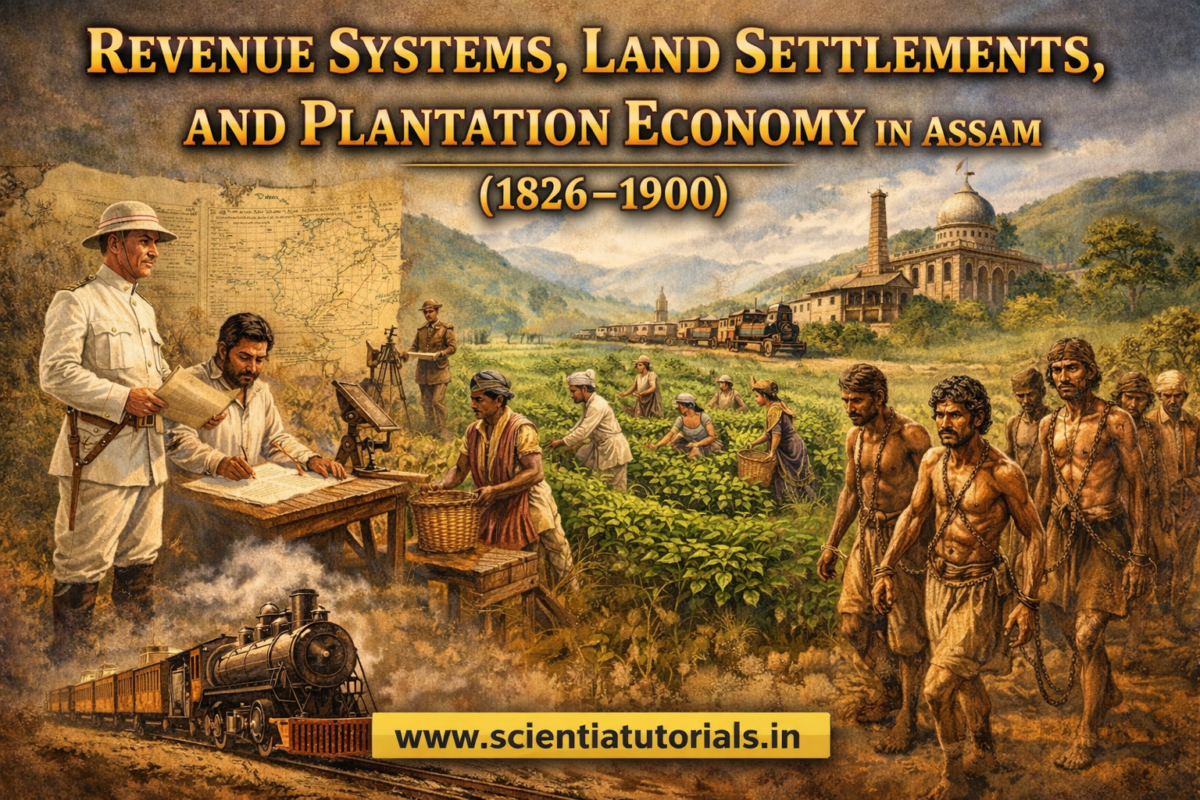

Revenue Systems and Plantation Economy in Colonial Assam (1826–1900)
Course: History of North-East India: From Early Kingdoms to Modern Integration
Module VI: Colonial Rule and Administrative Reorganisation
Timeline / Era Covered: 1826 CE – 1900 CE
Lesson: Revenue Systems, Land Settlements, and Plantation Economy
This lesson is systematically organized into four clearly structured sections, as detailed below:
- Chronologically Structured Study Module
- Short-Answer Type Questions
- Long-Answer Type Questions
- Multiple-Choice Questions (MCQs) with Answers and Detailed Explanations
Chronologically Structured Study Module
1. Introduction: Economic Reorganisation under Colonial Rule
The annexation of Assam in 1826 marked not only a political transition but also the beginning of a deep economic transformation. British colonial rule fundamentally altered traditional systems of landholding, revenue extraction, and production. The introduction of new revenue systems, systematic land settlements, and plantation-based commercial agriculture reoriented Assam’s economy from subsistence and customary practices to a market-driven colonial structure.
This lesson examines how revenue policies, land settlements, and the plantation economy developed chronologically between 1826 and 1900, and how these policies reshaped Assamese society, economy, and state–peasant relations. Understanding these processes is essential for analysing the long-term socio-economic impact of colonial rule in North-East India.
2. Pre-Colonial Agrarian and Revenue Structures in Assam
Before British rule, Assam’s agrarian system was shaped by indigenous institutions developed under the Ahom state. Land was not treated as private property in the modern sense. Instead, it was closely linked to service obligations and community use.
2.1 The Paik System and Agrarian Organisation
Under the Ahoms, the paik system formed the backbone of both administration and production. Adult males were registered as paiks and required to render state service in lieu of taxes. Cultivation was largely subsistence-oriented, and surplus extraction was limited. Land rights were customary, flexible, and closely tied to village communities.
2.2 Impact of Political Instability
By the early nineteenth century, prolonged rebellions and Burmese invasions had disrupted agrarian life. Large tracts of land were left uncultivated, population declined, and the traditional revenue base weakened. This situation profoundly influenced British approaches to revenue and land policies after annexation.
3. Early British Revenue Experiments (1826–1838)
3.1 Immediate Revenue Concerns after Annexation
Following the transfer of Assam to British control after the First Anglo-Burmese War, colonial administrators faced the challenge of restoring revenue flows in a region devastated by conflict. The British priority was to establish a stable and predictable revenue system to finance administration and military expenses.
Initially, revenue collection was tentative and experimental. British officials lacked familiarity with local agrarian conditions and relied on existing structures wherever possible.
3.2 Decline of the Paik System
The British viewed the paik system as inefficient and incompatible with colonial revenue objectives. Gradually, compulsory service obligations were dismantled, and monetised taxation was introduced. This marked a decisive shift from labour-based obligations to cash revenue, fundamentally altering the relationship between the state and cultivators.
4. Introduction of Colonial Land Settlements (1830s–1850s)
4.1 Principles of Colonial Land Revenue Policy
British land revenue policy across India was guided by the objective of maximising regular income through clearly defined land rights and assessments. In Assam, this translated into land surveys, classification, and settlement operations aimed at converting land into a taxable commodity.
The British sought to identify individual cultivators (ryots) as revenue-paying units, breaking away from communal and customary arrangements.
4.2 Ryotwari Tendencies in Assam
Unlike Bengal, where the zamindari system dominated, Assam largely followed ryotwari-like principles. Peasants were recognised as direct holders of land responsible for paying revenue to the state. While this appeared less exploitative on paper, in practice it imposed heavy burdens on cultivators unfamiliar with cash taxation.
Fixed revenue demands ignored fluctuations in production, floods, and local ecological conditions, making peasant livelihoods increasingly insecure.
5. Land Surveys and Settlement Operations
5.1 Survey and Measurement of Land
From the mid-nineteenth century, systematic land surveys were conducted to map cultivable land, forests, and wastelands. These surveys transformed land from a customary resource into a quantified and legally defined asset.
Survey operations disrupted traditional boundaries and often failed to account for shifting cultivation and common land use, especially in frontier and tribal areas.
5.2 Classification and Assessment
Land was classified based on perceived fertility and productivity, and revenue rates were fixed accordingly. This classification was often arbitrary and did not reflect local realities. As a result, many peasants struggled to meet revenue demands, leading to indebtedness and land alienation.
6. Expansion of Wasteland Policy and Its Consequences
6.1 Colonial Concept of “Wasteland”
The British classified vast tracts of uncultivated or forested land as “wasteland,” ignoring their use by local communities for grazing, shifting cultivation, and forest produce. These lands were brought under state control and made available for commercial exploitation.
6.2 Allocation of Land to European Interests
Large areas of so-called wasteland were leased or granted to European planters at concessional rates. This policy laid the foundation for plantation agriculture, particularly tea cultivation, and permanently altered land ownership patterns in Assam.
7. Emergence of the Plantation Economy (1830s onwards)
7.1 Discovery and Promotion of Tea Cultivation
The discovery of indigenous tea plants in Assam in the 1830s transformed colonial economic priorities. Recognising tea’s global market potential, the British actively promoted plantation agriculture.
The colonial state, with the support of entities like the British East India Company in the early phase, facilitated land acquisition, capital investment, and experimental plantations.
7.2 Institutional Support for Planters
European planters received extensive state support, including land grants, favourable leases, and infrastructural development. Roads, river transport, and later railways were developed primarily to serve plantation interests.
This state-backed plantation model contrasted sharply with the neglect faced by traditional peasant agriculture.
8. Labour Systems in the Plantation Economy
8.1 Labour Shortage in Assam
Assam’s sparse population and resistance of local peasants to plantation labour created a severe labour shortage. To overcome this, the British introduced organised labour recruitment from outside the region.
8.2 Indentured and Contract Labour
Indentured labourers were recruited mainly from central and eastern India under long-term contracts. These workers faced harsh conditions, low wages, high mortality rates, and limited freedom. Labour laws largely favoured planters, reflecting the exploitative nature of the colonial plantation economy.
The plantation labour system created a distinct socio-economic group that remained marginalised even after the colonial period.
9. Impact on Traditional Agriculture and Peasantry
9.1 Neglect of Subsistence Agriculture
Colonial economic policies prioritised plantation crops over food production. Investment in irrigation, flood control, and peasant welfare remained limited. Traditional agriculture suffered from rising revenue demands and lack of state support.
9.2 Peasant Distress and Resistance
High revenue assessments, ecological vulnerabilities, and market dependence led to recurring peasant distress. While large-scale revolts were rare, resistance took the form of migration, evasion of revenue, and localised protests.
10. Revenue Administration after the Creation of the Assam Province (1874)
10.1 Administrative Reorganisation and Revenue Policy
The creation of the Chief Commissioner’s Province of Assam in 1874 marked a new phase in revenue administration. While the basic framework of land settlements remained unchanged, administrative efficiency improved.
Assamese officials gained greater involvement in administration, but revenue priorities continued to favour colonial interests.
10.2 Linguistic and Administrative Adjustments
The restoration of Assamese as the language of administration facilitated communication between the state and peasants. However, this reform did not substantially reduce the economic burdens imposed by revenue policies.
11. Effects on Tribal and Hill Areas
11.1 Differentiated Land Policies
In hill and tribal areas, the British followed a policy of limited intervention. Shifting cultivation was tolerated, and revenue demands were lower. However, these regions were increasingly isolated from plains administration.
11.2 Long-Term Implications
This differential treatment institutionalised economic and administrative divisions between plains and hills, influencing later patterns of development and political integration in North-East India.
12. Socio-Economic Transformation and Class Formation
Colonial revenue and land policies contributed to new class formations in Assam. A class of revenue-paying peasants, landholders, and intermediaries emerged alongside plantation capitalists and labourers.
Traditional elites lost influence, while new groups aligned with colonial administration gained prominence. These changes reshaped Assamese society and laid the groundwork for future political mobilisation.
13. Evaluation of Colonial Economic Policies in Assam
From a colonial perspective, revenue systems and plantation economy brought fiscal stability and integrated Assam into global markets. However, these gains came at the cost of peasant welfare, ecological balance, and social equity.
The prioritisation of export-oriented plantations over local needs made Assam economically dependent and vulnerable to global market fluctuations.
14. Conclusion: Historical Significance of Revenue and Plantation Policies
Between 1826 and 1900, Assam underwent a profound economic transformation under British rule. The introduction of monetised revenue systems, formal land settlements, and plantation-based capitalism dismantled traditional agrarian structures and redefined state–society relations.
While colonial policies established administrative order and global economic links, they also generated exploitation, inequality, and long-term socio-economic challenges. The legacy of these policies continues to shape Assam’s agrarian economy and social dynamics in the post-colonial period.
15. Examination-Oriented Key Takeaways
- British revenue policy replaced customary obligations with cash taxation.
- Land settlements transformed land into a taxable and transferable commodity.
- Wasteland policy facilitated plantation expansion.
- Tea plantations became the backbone of Assam’s colonial economy.
- Plantation labour systems caused long-term demographic and social changes.
- Colonial economic policies prioritised imperial interests over local welfare.
Short Answer Type Questions with Answers
Course: History of North-East India: From Early Kingdoms to Modern Integration
Module VI: Colonial Rule and Administrative Reorganisation (1826–1900 CE)
Lesson: Revenue Systems, Land Settlements, and Plantation Economy
1. What major economic change followed the British annexation of Assam in 1826?
Answer:
British annexation led to the replacement of customary agrarian systems with monetised revenue collection, formal land settlements, and commercial plantation agriculture.
2. What was the nature of land ownership in pre-colonial Assam?
Answer:
Land ownership was customary and community-oriented, closely linked with service obligations rather than private property rights.
3. What was the paik system?
Answer:
The paik system was an Ahom administrative arrangement where adult males rendered state service instead of paying land revenue in cash.
4. Why did the British dismantle the paik system?
Answer:
The British considered it inefficient and unsuitable for regular cash revenue extraction required for colonial administration.
5. What was the main objective of British revenue policy in Assam?
Answer:
The main objective was to ensure a stable, regular, and predictable flow of revenue for the colonial state.
6. Which type of land revenue system influenced British policy in Assam?
Answer:
Ryotwari-like principles influenced British land revenue policy in Assam.
7. Who was considered the direct revenue payer under the ryotwari system?
Answer:
Individual cultivators (ryots) were considered direct revenue payers to the state.
8. How did cash revenue demands affect Assamese peasants?
Answer:
They increased economic pressure, forced peasants into the market economy, and led to indebtedness and insecurity.
9. What role did land surveys play in colonial Assam?
Answer:
Land surveys measured, mapped, and classified land to fix revenue assessments and convert land into a taxable commodity.
10. Why were colonial land assessments often unpopular?
Answer:
They ignored local conditions such as floods, soil variation, and traditional land use practices.
11. What did the British mean by the term “wasteland”?
Answer:
“Wasteland” referred to uncultivated or forested land that the British considered unproductive, ignoring its use by local communities.
12. How was wasteland policy linked to plantation expansion?
Answer:
Wastelands were leased or granted cheaply to European planters, facilitating large-scale plantation agriculture.
13. Which crop became the backbone of Assam’s plantation economy?
Answer:
Tea became the backbone of Assam’s plantation economy.
14. When did commercial tea cultivation begin in Assam?
Answer:
Commercial tea cultivation began in the 1830s.
15. Which colonial agency initially promoted tea cultivation in Assam?
Answer:
The British East India Company played a key role in the early promotion of tea cultivation.
16. Why did tea plantations face labour shortages in Assam?
Answer:
Assam had a sparse population, and local peasants were unwilling to work under harsh plantation conditions.
17. From where was plantation labour mainly recruited?
Answer:
Labour was mainly recruited from central and eastern India.
18. What type of labour system was used on tea plantations?
Answer:
Indentured and long-term contract labour systems were used.
19. What were the living and working conditions of plantation labourers?
Answer:
They faced low wages, harsh discipline, poor living conditions, and high mortality rates.
20. How did plantation economy affect traditional agriculture?
Answer:
It diverted land and state support away from subsistence farming, leading to neglect of peasant agriculture.
21. What was the impact of revenue policies on peasant livelihoods?
Answer:
Revenue policies increased peasant vulnerability to debt, land alienation, and economic distress.
22. How did peasants respond to revenue pressure?
Answer:
Responses included migration, evasion of revenue payment, and localised resistance.
23. What administrative change occurred in Assam in 1874?
Answer:
Assam was reorganised as a separate Chief Commissioner’s Province.
24. Did the creation of the Assam Province significantly reduce revenue burden?
Answer:
No, while administration improved, revenue extraction remained a colonial priority.
25. How were hill and tribal areas treated under colonial land policy?
Answer:
They were subjected to minimal revenue demands and indirect administration, allowing shifting cultivation.
26. What long-term social change resulted from plantation economy?
Answer:
It created a distinct plantation labour class and altered Assam’s demographic composition.
27. How did colonial land policies affect traditional elites?
Answer:
Traditional elites lost influence, while new classes aligned with colonial administration emerged.
28. What was the overall economic impact of colonial revenue and plantation policies?
Answer:
They integrated Assam into the global market but caused exploitation, inequality, and long-term economic dependency.
Long Answer Type Questions with Answers
Course: History of North-East India: From Early Kingdoms to Modern Integration
Module VI: Colonial Rule and Administrative Reorganisation (1826–1900 CE)
Lesson: Revenue Systems, Land Settlements, and Plantation Economy
1. Examine the nature of the agrarian and revenue system in Assam before British annexation.
Answer:
Before British annexation, Assam’s agrarian system was shaped largely by Ahom institutions. Land was not treated as private, alienable property but was linked to community use and state service. The paik system formed the backbone of revenue and administration, where adult male members rendered labour or military service instead of paying cash taxes. Agriculture was predominantly subsistence-oriented, surplus extraction was limited, and customary rights governed land use. This flexible system ensured relative agrarian stability but was vulnerable to disruption during political crises, such as the Moamoria rebellion and Burmese invasions.
2. Analyse how British annexation in 1826 altered the economic priorities of Assam.
Answer:
British annexation marked a decisive shift in Assam’s economic priorities. The colonial state aimed to generate regular cash revenue, integrate Assam into imperial markets, and exploit its natural resources. Traditional service-based obligations were dismantled, and monetised revenue systems were introduced. The focus shifted from subsistence agriculture to commercial crops, especially tea. Assam was thus transformed from a relatively self-sufficient agrarian region into a resource frontier serving colonial economic interests.
3. Discuss the reasons for the decline and abolition of the paik system under British rule.
Answer:
The British viewed the paik system as inefficient and incompatible with their revenue objectives. It did not yield predictable cash income and relied heavily on customary obligations rather than legal contracts. Additionally, the system had already weakened due to political instability and population decline. As colonial administration required monetised taxation to support governance and military expenditure, the paik system was gradually dismantled and replaced with cash-based land revenue assessments.
4. Explain the objectives of British land revenue policy in Assam.
Answer:
The primary objectives of British land revenue policy in Assam were to ensure a stable and regular flow of income, establish clear land rights, and bring land under systematic assessment. By transforming land into a taxable commodity, the colonial state sought fiscal stability and administrative control. Revenue policy was also designed to encourage commercial agriculture and integrate Assam into the wider colonial economy.
5. Describe the main features of land settlement systems introduced in Assam.
Answer:
Land settlement systems in Assam were characterised by surveys, measurement, classification, and fixed revenue assessments. Ryotwari-like principles predominated, with individual cultivators recognised as revenue payers. While this avoided the creation of powerful zamindars, it placed direct responsibility on peasants to pay cash revenue. Fixed assessments often ignored ecological conditions such as floods and soil variation, leading to widespread peasant distress.
6. Critically examine the impact of land surveys on traditional land relations.
Answer:
Land surveys redefined land from a customary resource into a legally demarcated and taxable asset. Traditional boundaries, communal land use, and flexible cultivation practices were disrupted. Survey operations failed to account for shifting cultivation and seasonal land use, especially in frontier and tribal areas. As a result, many cultivators lost customary access to land, contributing to alienation and social tension.
7. Analyse the concept of “wasteland” in colonial Assam and its implications.
Answer:
The colonial concept of “wasteland” referred to land deemed unproductive because it was not permanently cultivated. This classification ignored indigenous uses such as grazing, shifting cultivation, and collection of forest produce. By declaring such land as state property, the British appropriated vast tracts for commercial exploitation. This policy undermined community rights and facilitated large-scale land transfers to European planters.
8. Discuss how wasteland policy contributed to the expansion of plantation agriculture.
Answer:
Wasteland policy enabled the colonial state to lease or grant large areas of land to European planters at low rates. These lands formed the basis of tea plantations. The policy ensured easy access to land, reduced costs for planters, and accelerated the growth of plantation agriculture. However, it also displaced local communities and permanently altered land ownership patterns.
9. Trace the emergence and growth of the tea plantation economy in Assam.
Answer:
The discovery of indigenous tea plants in the 1830s marked the beginning of Assam’s plantation economy. Recognising tea’s global market value, the colonial state actively promoted its cultivation. Early efforts were supported by the British East India Company, followed by private European capital. Infrastructure such as roads, river transport, and railways was developed primarily to serve plantations. By the late nineteenth century, tea had become Assam’s dominant export crop.
10. Evaluate the role of the colonial state in supporting tea planters.
Answer:
The colonial state played a decisive role in supporting tea planters by granting land, providing legal backing, facilitating labour recruitment, and investing in infrastructure. Administrative and legal systems were designed to protect planter interests, often at the expense of peasants and labourers. This close alignment between the state and planters highlights the exploitative character of colonial economic policy.
11. Examine the labour problem faced by tea plantations in Assam.
Answer:
Assam’s sparse population and reluctance of local peasants to work under plantation discipline resulted in severe labour shortages. Plantation work was harsh, wages were low, and conditions were unfamiliar. To overcome this, the British organised labour recruitment from outside the region, fundamentally reshaping Assam’s demographic structure.
12. Discuss the indentured labour system in Assam’s tea plantations.
Answer:
Indentured labourers were recruited mainly from central and eastern India under long-term contracts. They faced coercive recruitment, restricted mobility, poor living conditions, and high mortality rates. Labour laws favoured planters, and workers had limited legal protection. The indenture system created a permanently marginalised labour force within Assam’s society.
13. Analyse the social and demographic impact of plantation labour migration.
Answer:
Labour migration altered Assam’s demographic composition by introducing new communities into plantation areas. It created a distinct labour class separated from both local peasants and European planters. Social segregation, economic marginalisation, and cultural isolation characterised plantation society, with long-term consequences for Assam’s social fabric.
14. Assess the impact of plantation economy on traditional agriculture.
Answer:
The plantation economy diverted land, capital, and administrative attention away from subsistence agriculture. Peasant farming received little state support, and investment in irrigation and flood control remained minimal. Rising revenue demands and ecological vulnerabilities further weakened traditional agriculture, increasing rural distress.
15. Examine peasant responses to colonial revenue and land policies.
Answer:
Peasant responses included evasion of revenue payment, migration to less controlled areas, and occasional localised protests. Large-scale revolts were rare, but everyday resistance reflected dissatisfaction with rigid revenue demands and loss of customary rights.
16. Discuss the changes in revenue administration after the creation of the Assam Province in 1874.
Answer:
The creation of the Chief Commissioner’s Province improved administrative efficiency and communication. Assamese officials gained greater involvement, and the use of Assamese language facilitated governance. However, the fundamental structure of revenue extraction remained unchanged, and colonial fiscal priorities continued to dominate.
17. Analyse British land policies in hill and tribal areas.
Answer:
In hill and tribal areas, the British followed a policy of limited intervention. Shifting cultivation was tolerated, and revenue demands were low. While this preserved some traditional practices, it also isolated these regions administratively and economically from the plains.
18. Evaluate the long-term implications of differential land policies between plains and hills.
Answer:
Differential policies institutionalised economic and administrative divisions between plains and hill regions. Plains areas became integrated into the colonial market economy, while hills remained marginalised. These divisions influenced later development patterns and political integration in North-East India.
19. Discuss the role of revenue and land policies in class formation in Assam.
Answer:
Colonial policies contributed to the emergence of new classes, including revenue-paying peasants, intermediaries, plantation capitalists, and wage labourers. Traditional elites lost authority, while groups aligned with colonial administration gained influence. This reshaping of social hierarchy had lasting political implications.
20. Critically assess the economic benefits claimed by the colonial state in Assam.
Answer:
While colonial policies brought fiscal stability, infrastructure development, and global market integration, these benefits were unevenly distributed. Economic growth primarily served imperial interests and European capital, while peasants and labourers bore the costs of exploitation and insecurity.
21. Examine the ecological consequences of colonial land and plantation policies.
Answer:
Large-scale deforestation, monoculture plantations, and neglect of traditional ecological practices disrupted Assam’s environment. These changes increased vulnerability to floods, soil exhaustion, and long-term ecological imbalance.
22. Compare pre-colonial and colonial agrarian systems in Assam.
Answer:
Pre-colonial systems were flexible, community-oriented, and service-based, whereas colonial systems were rigid, individualised, and revenue-driven. The shift altered state–society relations and increased peasant vulnerability.
23. Analyse how colonial revenue policies integrated Assam into the global economy.
Answer:
By promoting export-oriented plantation agriculture, especially tea, colonial policies linked Assam to global trade networks. This integration increased market dependence and exposure to global price fluctuations.
24. Discuss the role of infrastructure in supporting the plantation economy.
Answer:
Infrastructure such as roads, railways, and river transport was developed mainly to facilitate plantation production and export. While it improved connectivity, it did not equally benefit peasant agriculture or rural welfare.
25. Critically evaluate the overall impact of revenue systems, land settlements, and plantation economy on Assam.
Answer:
Colonial revenue and land policies fundamentally transformed Assam’s economy and society. They dismantled traditional agrarian structures, promoted plantation capitalism, and integrated the region into the colonial market. However, these changes generated exploitation, inequality, ecological damage, and long-term socio-economic challenges whose legacy continues into the post-colonial era.
Multiple Choice Questions (MCQs) with Answers and Explanations
Course: History of North-East India: From Early Kingdoms to Modern Integration
Module VI: Colonial Rule and Administrative Reorganisation (1826–1900 CE)
Lesson: Revenue Systems, Land Settlements, and Plantation Economy
MCQ 1
Which year marks the beginning of British economic reorganisation in Assam?
A. 1817
B. 1826
C. 1838
D. 1858
Correct Answer: B
Explanation:
The year 1826 marks British annexation of Assam after the First Anglo-Burmese War, initiating systematic changes in revenue, land, and economic policies.
MCQ 2
The pre-colonial agrarian system of Assam was primarily based on:
A. Zamindari ownership
B. Private land property
C. Service obligations
D. Commercial farming
Correct Answer: C
Explanation:
Under the Ahoms, land use was linked to service obligations (paik system), not private ownership or cash revenue.
MCQ 3
What was the paik system?
A. A land tax system
B. A military training scheme
C. A service-based administrative system
D. A plantation labour system
Correct Answer: C
Explanation:
The paik system required adult males to render state service instead of paying land revenue in cash.
MCQ 4
Why did the British abolish the paik system?
A. It encouraged rebellion
B. It supported zamindars
C. It did not generate regular cash revenue
D. It promoted plantation farming
Correct Answer: C
Explanation:
The colonial state required predictable cash revenue, which the service-based paik system could not provide.
MCQ 5
The main objective of British land revenue policy in Assam was to:
A. Preserve customary land rights
B. Ensure peasant welfare
C. Maximise regular revenue
D. Promote food security
Correct Answer: C
Explanation:
Revenue extraction to fund colonial administration was the primary goal of British land policies.
MCQ 6
Which land revenue principle mainly influenced Assam under British rule?
A. Zamindari
B. Mahalwari
C. Ryotwari
D. Permanent Settlement
Correct Answer: C
Explanation:
Assam followed ryotwari-like principles where individual cultivators paid revenue directly to the state.
MCQ 7
Under the ryotwari system, the direct revenue payer was the:
A. Zamindar
B. Village headman
C. European planter
D. Individual cultivator
Correct Answer: D
Explanation:
The ryot (cultivator) was directly responsible for paying land revenue to the colonial state.
MCQ 8
Colonial land surveys primarily aimed to:
A. Improve agricultural productivity
B. Protect tribal land rights
C. Measure and classify land for taxation
D. Promote irrigation projects
Correct Answer: C
Explanation:
Land surveys converted land into a measurable and taxable commodity for revenue assessment.
MCQ 9
Why were British land assessments often resented by peasants?
A. They were too flexible
B. They ignored local ecological conditions
C. They abolished agriculture
D. They reduced revenue demand
Correct Answer: B
Explanation:
Fixed revenue ignored floods, soil variation, and climatic uncertainties common in Assam.
MCQ 10
In colonial terminology, “wasteland” referred to land that was:
A. Deserted permanently
B. Used for shifting cultivation
C. Considered unproductive by the British
D. Privately owned
Correct Answer: C
Explanation:
The British labelled uncultivated or forest land as wasteland, ignoring its use by local communities.
MCQ 11
What was a major outcome of the wasteland policy in Assam?
A. Expansion of peasant farming
B. Strengthening of tribal ownership
C. Growth of plantation agriculture
D. Decline of colonial revenue
Correct Answer: C
Explanation:
Wastelands were granted cheaply to European planters, facilitating plantation expansion.
MCQ 12
Which crop transformed Assam into a plantation-based economy?
A. Rice
B. Indigo
C. Tea
D. Jute
Correct Answer: C
Explanation:
Tea cultivation became the backbone of Assam’s colonial economy and global trade integration.
MCQ 13
Commercial tea cultivation in Assam began in the:
A. 1820s
B. 1830s
C. 1850s
D. 1870s
Correct Answer: B
Explanation:
The discovery of indigenous tea plants in the 1830s led to commercial cultivation.
MCQ 14
Which organisation initially promoted tea cultivation in Assam?
A. Assam Company
B. Indian National Congress
C. British East India Company
D. Bengal Presidency
Correct Answer: C
Explanation:
The British East India Company supported early tea experiments before private European capital expanded plantations.
MCQ 15
Why did tea plantations face labour shortages in Assam?
A. High population density
B. Strict revenue policies
C. Reluctance of local peasants
D. Poor land quality
Correct Answer: C
Explanation:
Local peasants were unwilling to work under harsh plantation discipline, leading to labour shortages.
MCQ 16
Plantation labour in Assam was mainly recruited from:
A. Hill tribes of Assam
B. Burma
C. Central and eastern India
D. Nepal
Correct Answer: C
Explanation:
Indentured labourers were brought from regions like Chotanagpur, Bihar, and Bengal.
MCQ 17
The plantation labour system was characterised by:
A. High wages and mobility
B. Equal treatment of workers
C. Harsh conditions and coercion
D. Voluntary short-term contracts
Correct Answer: C
Explanation:
Labourers faced low wages, strict discipline, poor living conditions, and limited freedom.
MCQ 18
One major demographic impact of plantation economy was:
A. Decline of population
B. Creation of a plantation labour class
C. Elimination of tribal societies
D. Urbanisation of peasants
Correct Answer: B
Explanation:
Migration led to the formation of a distinct plantation labour community in Assam.
MCQ 19
How did colonial policies affect subsistence agriculture in Assam?
A. It was heavily subsidised
B. It was prioritised over plantations
C. It was largely neglected
D. It replaced plantation farming
Correct Answer: C
Explanation:
State support focused on export crops like tea, neglecting peasant food production.
MCQ 20
Which administrative change occurred in 1874 affecting revenue administration?
A. Introduction of Permanent Settlement
B. Creation of Assam Province
C. Abolition of land revenue
D. End of plantation economy
Correct Answer: B
Explanation:
Assam was separated from Bengal and made a Chief Commissioner’s Province in 1874.
MCQ 21
Did the 1874 reorganisation significantly reduce peasant revenue burden?
A. Yes, immediately
B. Yes, gradually
C. No, revenue priorities remained
D. Revenue was abolished
Correct Answer: C
Explanation:
Although administration improved, colonial revenue extraction continued unchanged.
MCQ 22
British land policy in hill areas was marked by:
A. Heavy taxation
B. Permanent settlement
C. Minimal intervention
D. Large plantations
Correct Answer: C
Explanation:
Hill areas were governed indirectly with lower revenue demands and tolerance of shifting cultivation.
MCQ 23
A major social consequence of colonial land and revenue policies was:
A. Strengthening of traditional elites
B. Formation of new social classes
C. Elimination of inequality
D. Decline of markets
Correct Answer: B
Explanation:
New classes such as revenue-paying peasants, planters, and wage labourers emerged.
MCQ 24
Colonial revenue and plantation policies integrated Assam mainly into:
A. A subsistence economy
B. A feudal economy
C. The global capitalist market
D. A socialist framework
Correct Answer: C
Explanation:
Export-oriented plantation agriculture connected Assam to global trade networks.
MCQ 25
The overall impact of colonial revenue and plantation policies on Assam was:
A. Balanced and welfare-oriented
B. Economically neutral
C. Transformative but exploitative
D. Entirely beneficial to peasants
Correct Answer: C
Explanation:
While colonial policies modernised administration and infrastructure, they caused exploitation, inequality, and long-term socio-economic challenges.
These MCQs are examination-oriented and designed to test factual accuracy, analytical understanding, and conceptual clarity related to revenue systems, land settlements, and plantation economy in colonial Assam.