
Religious Movements and Cultural Synthesis
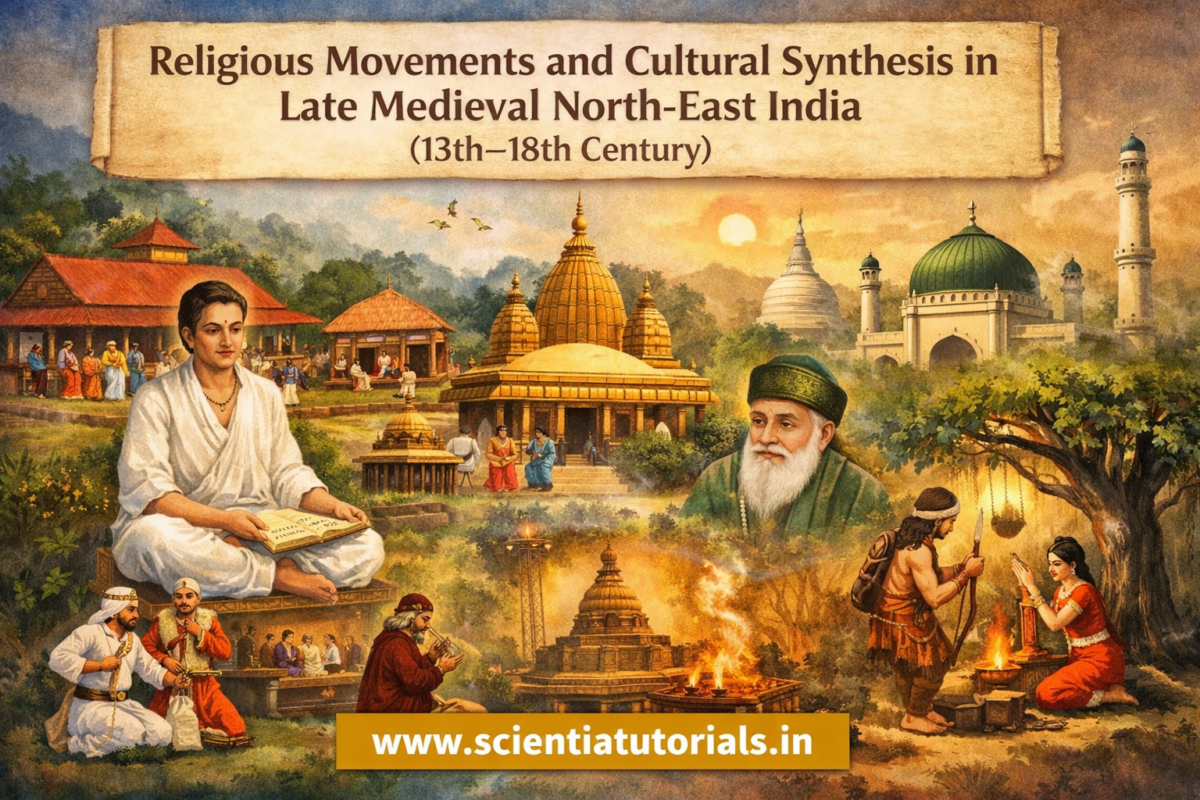

Religious Movements and Cultural Synthesis in Late Medieval North-East India (13th–18th Century)
Course: History of North-East India: From Early Kingdoms to Modern Integration
Module IV: Late Medieval Period and the Rise of Indigenous States
Timeline / Era Covered: 13th Century CE – 18th Century CE
Lesson: Religious Movements and Cultural Synthesis
This lesson is systematically organized into four clearly structured sections, as detailed below:
- Chronologically Structured Study Module
- Short-Answer Type Questions
- Long-Answer Type Questions
- Multiple-Choice Questions (MCQs) with Answers and Detailed Explanations
Chronologically Structured Study Module
Introduction: Religion as a Dynamic Force in Late Medieval North-East India
The period between the 13th and 18th centuries CE marked a transformative phase in the history of North-East India. This era witnessed the consolidation of indigenous states, increased interregional contacts, and profound religious and cultural interactions. Religion during this period did not operate in isolation; instead, it became a powerful agent of social integration, political legitimacy, and cultural synthesis.
Unlike many parts of the Indian subcontinent where religious change often followed conquest, in North-East India religious movements evolved through gradual assimilation, adaptation, and negotiation with existing tribal, animistic, and local belief systems. The result was a distinctive cultural landscape characterized by syncretism, rather than replacement. This lesson examines how Vaishnavism, Neo-Vaishnavism, Buddhism, Islam, indigenous traditions, and local cults interacted to shape the socio-cultural fabric of the region during the late medieval period.
I. Religious Landscape of North-East India on the Eve of the 13th Century
Before the 13th century, North-East India was home to a plural religious environment:
- Tribal animism and nature worship dominated among hill communities
- Hinduism, particularly Shaivism and early Vaishnavism, was present in valley regions
- Buddhism influenced areas such as Tripura and parts of the eastern Himalayan belt
Local deities, ancestor worship, fertility cults, and spirit worship formed the core of indigenous religious life. These traditions provided the foundation upon which later religious movements would build, adapt, and transform.
II. Expansion of Vaishnavism and the Bhakti Movement (13th–16th Century CE)
Arrival and Spread of Vaishnavism
From the 13th century onwards, Vaishnavism gained prominence in Assam and adjoining regions. The religion spread primarily through:
- Brahmin migration from eastern India
- Royal patronage by emerging dynasties
- Temple-centred worship and Sanskritic rituals
Vaishnavism did not replace local beliefs abruptly. Instead, it absorbed indigenous customs, rituals, and myths, enabling its acceptance among diverse social groups.
Neo-Vaishnavism and Srimanta Sankardeva
The most significant religious development of this era was the rise of Neo-Vaishnavism under Srimanta Sankardeva (15th–16th century CE). His movement transformed Assamese society in lasting ways.
Key features of Sankardeva’s Neo-Vaishnavism included:
- Devotion to Vishnu/Krishna as the supreme deity
- Rejection of caste hierarchy and ritual orthodoxy
- Emphasis on bhakti (devotion) through music, dance, and collective prayer
- Use of Assamese and Brajavali instead of Sanskrit
Institutions: Satras and Namghars
Sankardeva established Satras (monastic institutions) and Namghars (community prayer halls), which became:
- Centres of religious instruction
- Hubs of cultural production (music, drama, literature)
- Instruments of social cohesion and moral discipline
These institutions penetrated rural society deeply, fostering unity across caste and tribal divisions.
III. Cultural Contributions of the Bhakti Movement
The Neo-Vaishnavite movement reshaped Assamese culture through multiple artistic and literary forms:
- Borgeet: Devotional songs composed by Sankardeva and his disciple Madhavdeva
- Ankiya Naat: Religious plays blending music, dialogue, and dance
- Sattriya Dance: Later recognized as a classical Indian dance form
Through these cultural expressions, religion became accessible to the masses and deeply embedded in everyday life.
IV. Buddhism and Tantric Traditions in the Eastern Himalayan Region
Continuity of Buddhism
While Buddhism declined in much of mainland India, it survived and adapted in parts of North-East India, particularly in:
- Tripura
- Arunachal Pradesh
- Hill regions bordering Tibet
Tantric forms of Buddhism merged with local tribal rituals, creating hybrid religious practices.
Tripura and Buddhist-Hindu Synthesis
In the kingdom of Tripura, Buddhist influences persisted alongside emerging Hindu traditions. Royal patronage supported both faiths, leading to:
- Shared sacred spaces
- Interchange of rituals
- Coexistence of monastic and temple traditions
V. Advent and Role of Islam (13th–18th Century CE)
Entry of Islam
Islam entered North-East India through:
- Trade routes connecting Bengal with Assam
- Migration of artisans, scholars, and Sufi saints
- Political interactions with Bengal Sultanate and later Mughal authorities
Unlike regions of direct conquest, Islam spread here mainly through peaceful settlement and cultural interaction.
Sufi Influence and Cultural Adaptation
Sufi saints played a major role in the dissemination of Islam. Their message of spiritual equality and devotion resonated with local communities.
Characteristics of Islamic presence in North-East India included:
- Respect for local customs
- Adoption of regional languages
- Syncretic religious practices blending Sufi and indigenous traditions
Muslim communities became integrated into local society without disrupting existing cultural frameworks.
VI. Indigenous Beliefs and Their Transformation
Persistence of Tribal Religions
Despite the spread of organized religions, tribal belief systems remained resilient:
- Nature worship (rivers, forests, hills)
- Clan and ancestor worship
- Seasonal agricultural rituals
Rather than disappearing, these traditions coexisted and merged with Hindu, Buddhist, and Islamic practices.
Deification of Local Heroes and Spirits
Local heroes, ancestors, and spirits were gradually assimilated into Hindu pantheons as:
- Village deities
- Guardian spirits
- Manifestations of larger divine forms
This process helped maintain cultural continuity while accommodating new religious ideas.
VII. Religion and State Formation in the Late Medieval Period
Royal Patronage and Religious Legitimacy
Indigenous rulers used religion as a tool of governance and legitimacy. Kings patronized:
- Temples and monasteries
- Satras and religious institutions
- Scholars, poets, and artists
In Assam, rulers of the Ahom Kingdom gradually adopted Hindu practices while retaining elements of Tai religious traditions.
Religion as an Integrative Force
Religion helped unify diverse populations by:
- Providing shared moral codes
- Creating collective identities
- Reducing ethnic and tribal divisions
This integrative role was crucial for the stability of late medieval states.
VIII. Art, Architecture, and Sacred Spaces
Religious movements influenced artistic and architectural development:
- Temple construction in plains and valleys
- Monastic complexes in hill regions
- Painted manuscripts and illustrated texts
Namghars and Satras emerged as unique architectural forms reflecting communal participation rather than royal grandeur.
IX. Cultural Synthesis: The Defining Feature of the Period
The most distinctive outcome of religious developments in late medieval North-East India was cultural synthesis:
- Hindu rituals incorporated tribal symbols
- Buddhist practices absorbed local cosmology
- Islamic traditions adapted to regional customs
- Art and literature reflected plural identities
This synthesis ensured social harmony in a region marked by ethnic, linguistic, and cultural diversity.
X. Historical Significance and Legacy
The religious movements of the 13th–18th centuries left a lasting legacy:
- Formation of a pluralistic social order
- Emergence of regional cultural identities
- Enduring institutions like Satras and Namghars
- A tradition of tolerance and coexistence
These developments laid the cultural foundations for modern North-East India and continue to shape its social and religious life.
Conclusion
The late medieval period in North-East India was not merely an age of political consolidation but a crucial era of religious creativity and cultural integration. Through the interaction of Vaishnavism, Neo-Vaishnavism, Buddhism, Islam, and indigenous traditions, the region developed a uniquely syncretic civilization. Religious movements acted as bridges between communities, fostering unity without erasing diversity. Understanding this process is essential for appreciating the historical continuity and cultural richness of North-East India.
Short Answer Type Questions with Answers
(Late Medieval North-East India: Religious Movements and Cultural Synthesis)
1. What was the general religious character of North-East India during the late medieval period?
Answer:
The religious character was pluralistic, marked by the coexistence and interaction of Hinduism, Neo-Vaishnavism, Buddhism, Islam, and indigenous tribal belief systems, leading to cultural synthesis rather than religious replacement.
2. Which centuries are covered under the late medieval period in North-East India?
Answer:
The late medieval period in North-East India broadly covers the 13th century CE to the 18th century CE.
3. What role did religion play in the formation of indigenous states?
Answer:
Religion provided ideological legitimacy to rulers, helped integrate diverse populations, and strengthened state authority through royal patronage of religious institutions.
4. What is meant by cultural synthesis in the context of North-East India?
Answer:
Cultural synthesis refers to the blending of different religious traditions—Hindu, Buddhist, Islamic, and indigenous—into a harmonious and regionally distinct cultural pattern.
5. How did Vaishnavism spread in North-East India?
Answer:
Vaishnavism spread through Brahmin migration, royal patronage, temple institutions, and gradual adaptation to local customs and beliefs.
6. Who was Srimanta Sankardeva?
Answer:
Srimanta Sankardeva was a 15th–16th century saint-reformer who founded Neo-Vaishnavism in Assam and emphasized devotion, equality, and cultural unity.
7. What is Neo-Vaishnavism?
Answer:
Neo-Vaishnavism was a bhakti-based religious movement focusing on devotion to Krishna, rejecting caste discrimination and ritualism, and promoting social harmony.
8. What were Satras?
Answer:
Satras were Vaishnavite monastic institutions that functioned as centers of religious learning, cultural production, and social organization.
9. What is the significance of Namghars?
Answer:
Namghars were community prayer halls that promoted collective worship, moral discipline, and social cohesion among villagers.
10. Name two cultural contributions of the Neo-Vaishnavite movement.
Answer:
Two major contributions were Borgeet (devotional songs) and Ankiya Naat (religious dramas).
11. How did Buddhism survive in North-East India during this period?
Answer:
Buddhism survived mainly in the eastern Himalayan and hill regions by adapting to local tribal customs and incorporating Tantric practices.
12. Which region shows Buddhist-Hindu coexistence during the late medieval period?
Answer:
The kingdom of Tripura showed notable Buddhist-Hindu coexistence and religious tolerance.
13. How did Islam enter North-East India?
Answer:
Islam entered mainly through trade contacts, migration from Bengal, Sufi missionaries, and peaceful cultural interactions rather than military conquest.
14. What role did Sufi saints play in religious diffusion?
Answer:
Sufi saints spread Islam through spiritual teachings, social service, and adaptation to local cultural practices, encouraging harmony and inclusiveness.
15. Why did Islam not disrupt existing religious traditions in the region?
Answer:
Because it spread peacefully and adapted to local customs, Islam coexisted with indigenous and Hindu traditions rather than replacing them.
16. What were the main features of indigenous tribal religions?
Answer:
They included nature worship, ancestor worship, belief in spirits, fertility cults, and seasonal agricultural rituals.
17. How were tribal beliefs integrated into organized religions?
Answer:
Tribal deities and spirits were assimilated as village gods, guardian deities, or local manifestations of Hindu divinities.
18. How did rulers use religion to strengthen their authority?
Answer:
Rulers patronized temples, monasteries, Satras, and religious scholars to gain legitimacy and promote unity among diverse populations.
19. What was the religious policy of the Ahom Kingdom?
Answer:
The Ahom rulers gradually adopted Hindu practices while retaining Tai religious traditions, promoting religious tolerance and synthesis.
20. How did religious institutions contribute to social integration?
Answer:
They reduced social divisions, encouraged collective participation, and provided shared moral and cultural values across communities.
21. What architectural forms emerged from religious movements?
Answer:
Temples, monasteries, Satras, and Namghars emerged as important religious and cultural architectural forms.
22. How did religion influence literature in late medieval North-East India?
Answer:
Religious movements encouraged the use of local languages for devotional literature, plays, and songs, making learning accessible to common people.
23. Why is the late medieval period considered an age of syncretism?
Answer:
Because multiple religious traditions interacted, adapted, and merged without erasing each other, creating a composite cultural identity.
24. What was the long-term impact of religious movements on society?
Answer:
They fostered tolerance, cultural continuity, regional identity, and stable social institutions that influenced modern North-East India.
25. Why is the study of religious movements important for understanding North-East Indian history?
Answer:
Because religion shaped social structure, political authority, cultural expression, and inter-community relations during the late medieval period.
Long Answer Type Questions with Answers
(Late Medieval North-East India: Religious Movements and Cultural Synthesis)
1. Examine the religious landscape of North-East India during the late medieval period.
Answer:
During the late medieval period (13th–18th centuries CE), North-East India exhibited a highly plural religious landscape. Indigenous tribal beliefs based on nature and ancestor worship coexisted with Hinduism, Neo-Vaishnavism, Buddhism, and Islam. Rather than abrupt religious replacement, the region witnessed gradual accommodation and synthesis. Organized religions adapted themselves to local customs, ensuring continuity of indigenous traditions while introducing new spiritual ideas. This pluralism became a defining feature of the region’s social and cultural life.
2. Discuss the rise and spread of Vaishnavism in late medieval North-East India.
Answer:
Vaishnavism expanded steadily from the 13th century onwards through Brahmin migration, temple construction, and royal patronage. The faith gained acceptance because it absorbed local rituals and beliefs instead of rejecting them. Vaishnavism provided a unifying religious framework, particularly in Assam, helping integrate diverse communities under a shared devotional ideology while respecting regional traditions.
3. Evaluate the contribution of Srimanta Sankardeva to religious and cultural transformation.
Answer:
Srimanta Sankardeva was the most influential religious reformer of late medieval Assam. Through Neo-Vaishnavism, he challenged caste hierarchy, ritualism, and social exclusion. He popularized devotion to Krishna through local languages, music, drama, and community worship. His establishment of Satras and Namghars institutionalized religious learning and cultural expression, transforming Assamese society into a more egalitarian and culturally vibrant community.
4. What is Neo-Vaishnavism? Analyze its social and religious significance.
Answer:
Neo-Vaishnavism was a bhakti-based reform movement emphasizing devotion to a single deity (Krishna), ethical living, and social equality. It rejected elaborate rituals and caste discrimination. Socially, it integrated tribal and lower-caste groups into mainstream religious life. Religiously, it democratized spirituality by promoting congregational worship, devotional songs, and religious dramas accessible to all sections of society.
5. Examine the role of Satras in late medieval Assamese society.
Answer:
Satras functioned as monastic-cum-cultural institutions. Beyond religious teaching, they acted as centers of education, literature, art, and social organization. Satras trained disciples, preserved manuscripts, promoted music and dance, and provided moral guidance. They also served as instruments of social integration, binding communities together through shared religious and cultural practices.
6. Analyze the importance of Namghars as socio-religious institutions.
Answer:
Namghars were village prayer halls used for collective worship and community gatherings. They played a vital role in promoting egalitarian values, collective decision-making, and moral discipline. Unlike temple-centered worship, Namghars emphasized participation over priestly authority, making religion a community-centered experience.
7. Discuss the cultural contributions of the Neo-Vaishnavite movement.
Answer:
The movement enriched Assamese culture through devotional music (Borgeet), religious drama (Ankiya Naat), manuscript painting, and dance traditions. These cultural forms blended spiritual themes with artistic expression, ensuring the transmission of religious ideas in engaging and accessible ways. Over time, these contributions shaped a distinct regional cultural identity.
8. Examine the survival and transformation of Buddhism in North-East India.
Answer:
Unlike its decline elsewhere in India, Buddhism survived in North-East India, especially in hill and eastern Himalayan regions. It adapted by integrating Tantric elements and local tribal rituals. Buddhist practices coexisted with Hindu traditions, creating hybrid religious forms that reflected regional cultural realities rather than doctrinal purity.
9. Discuss religious coexistence in the kingdom of Tripura.
Answer:
Tripura presents a notable example of Buddhist-Hindu coexistence. Kings patronized both traditions, allowing monasteries and temples to flourish side by side. This policy encouraged religious tolerance and cultural exchange, preventing sectarian conflict and strengthening political stability.
10. Trace the advent of Islam in North-East India.
Answer:
Islam entered North-East India primarily through trade, migration from Bengal, and the activities of Sufi saints. Unlike regions of military conquest, Islam spread here peacefully. Muslim settlers integrated into local society, adopting regional languages and customs while contributing to economic and cultural life.
11. Assess the role of Sufi saints in promoting religious harmony.
Answer:
Sufi saints emphasized spiritual devotion, moral conduct, and social equality. Their inclusive approach resonated with indigenous communities. By respecting local customs and promoting harmony, they ensured that Islam blended smoothly into the existing cultural fabric without disrupting indigenous traditions.
12. Analyze the persistence of indigenous tribal religions during the late medieval period.
Answer:
Tribal religions remained resilient due to their deep connection with nature, community life, and agricultural cycles. Even as organized religions spread, tribal beliefs continued through rituals, festivals, and ancestor worship. Rather than disappearing, these beliefs influenced and reshaped incoming religious traditions.
13. Explain how indigenous beliefs were absorbed into Hindu practices.
Answer:
Local spirits, heroes, and deities were incorporated as village gods or regional manifestations of Hindu deities. Sacred groves, fertility cults, and seasonal rituals were reinterpreted within Hindu frameworks, ensuring continuity of indigenous traditions under new religious forms.
14. Discuss the relationship between religion and state formation in late medieval Assam.
Answer:
Religion served as a tool for political legitimacy and integration. Rulers patronized religious institutions to unify diverse populations and strengthen authority. Religious leaders often acted as intermediaries between rulers and subjects, reinforcing political stability.
15. Examine the religious policy of the Ahom Kingdom.
Answer:
The Ahom rulers initially followed Tai religious practices but gradually adopted Hinduism while retaining traditional beliefs. This flexible policy promoted tolerance and synthesis, enabling them to govern a culturally diverse population effectively.
16. Analyze the role of religion in social integration.
Answer:
Religious institutions reduced ethnic, caste, and tribal divisions by offering shared rituals and moral values. Community worship, festivals, and religious gatherings fostered collective identity and social cohesion across diverse groups.
17. Discuss the architectural impact of religious movements.
Answer:
Religious developments led to the construction of temples, monasteries, Satras, and Namghars. These structures reflected regional aesthetics and communal values, emphasizing function and participation over monumental grandeur.
18. Examine the influence of religion on literature and language.
Answer:
Religious movements promoted the use of vernacular languages for devotional literature, making religious knowledge accessible to common people. Translations, songs, and dramas enriched regional literary traditions.
19. Why is the late medieval period described as an age of cultural synthesis?
Answer:
Because multiple religious traditions interacted and blended without eliminating one another. This synthesis created a composite culture characterized by tolerance, adaptability, and regional uniqueness.
20. Assess the long-term legacy of religious movements in North-East India.
Answer:
These movements laid the foundation for pluralism, regional identity, and social harmony. Institutions like Satras and Namghars continue to influence cultural life, while syncretic traditions shape modern North-East Indian society.
MCQs with Answers and Explanations
(Religious Movements and Cultural Synthesis in Late Medieval North-East India)
1. The late medieval period in North-East India corresponds to which time span?
A. 8th–12th century CE
B. 10th–15th century CE
C. 13th–18th century CE
D. 15th–19th century CE
Correct Answer: C
Explanation:
Module IV clearly defines the late medieval phase as extending from the 13th century CE to the 18th century CE, coinciding with the rise of indigenous states and major religious transformations.
2. Which feature best characterizes the religious history of late medieval North-East India?
A. Religious uniformity
B. Forced religious conversion
C. Pluralism and cultural synthesis
D. Complete dominance of Brahmanism
Correct Answer: C
Explanation:
Unlike many regions of India, North-East India experienced coexistence and interaction among Hinduism, Buddhism, Islam, and indigenous beliefs, resulting in synthesis rather than replacement.
3. Vaishnavism in North-East India expanded mainly through:
A. Military conquest
B. Colonial intervention
C. Royal patronage and cultural adaptation
D. Missionary conversion
Correct Answer: C
Explanation:
Vaishnavism spread gradually through royal support, temple institutions, Brahmin migration, and accommodation of local customs, ensuring acceptance among diverse communities.
4. Neo-Vaishnavism in Assam is most closely associated with:
A. Ramanuja
B. Chaitanya
C. Srimanta Sankardeva
D. Madhvacharya
Correct Answer: C
Explanation:
Sankardeva (15th–16th century CE) was the founder of Neo-Vaishnavism in Assam, emphasizing devotion, social equality, and cultural unity.
5. The central religious principle of Neo-Vaishnavism was:
A. Polytheistic worship
B. Ritual sacrifice
C. Single-minded devotion (bhakti) to Krishna
D. Tantric meditation
Correct Answer: C
Explanation:
Neo-Vaishnavism focused on exclusive devotion to Krishna, rejecting complex rituals and caste hierarchy in favor of personal devotion and ethical living.
6. Which institution served as monastic and cultural centers under Neo-Vaishnavism?
A. Viharas
B. Madrasas
C. Satras
D. Mathas
Correct Answer: C
Explanation:
Satras were monastic institutions that functioned as centers of religious learning, art, literature, and social organization in Assam.
7. Namghars are best described as:
A. Royal temples
B. Fortified monasteries
C. Community prayer halls
D. Pilgrimage rest houses
Correct Answer: C
Explanation:
Namghars promoted collective worship and village-level participation, making religion accessible and community-oriented.
8. Which art form emerged directly from the Neo-Vaishnavite movement?
A. Manipuri dance
B. Yakshagana
C. Ankiya Naat
D. Kathakali
Correct Answer: C
Explanation:
Ankiya Naat were religious plays composed to spread Vaishnavite teachings through drama, music, and dialogue.
9. Buddhism survived in North-East India mainly because:
A. It was imposed by rulers
B. It resisted all change
C. It adapted to local tribal and Tantric practices
D. It replaced Hinduism
Correct Answer: C
Explanation:
Buddhism in the region survived by absorbing indigenous rituals and Tantric elements, allowing coexistence with local traditions.
10. Which region is known for Buddhist–Hindu coexistence during the late medieval period?
A. Assam plains
B. Manipur valley
C. Tripura
D. Barak valley
Correct Answer: C
Explanation:
Tripura demonstrated religious tolerance, where Buddhist and Hindu traditions flourished side by side under royal patronage.
11. Islam entered North-East India primarily through:
A. Military conquest
B. Colonial expansion
C. Trade, migration, and Sufi influence
D. Forced conversion
Correct Answer: C
Explanation:
Islam spread peacefully via trade routes from Bengal, migration, and Sufi missionaries, not through conquest.
12. The role of Sufi saints in North-East India was mainly to:
A. Establish political rule
B. Enforce Islamic law
C. Promote spiritual devotion and harmony
D. Replace tribal religions
Correct Answer: C
Explanation:
Sufi saints emphasized mysticism, tolerance, and ethical conduct, which resonated with indigenous communities.
13. Indigenous tribal religions were characterized by:
A. Scriptural orthodoxy
B. Idol worship only
C. Nature and ancestor worship
D. Monotheism
Correct Answer: C
Explanation:
Tribal belief systems centered on forests, rivers, spirits, ancestors, and agricultural cycles, forming the spiritual base of many communities.
14. How were tribal deities integrated into Hinduism?
A. Eliminated as superstition
B. Declared heretical
C. Absorbed as village or regional deities
D. Confined to forests
Correct Answer: C
Explanation:
Local gods and spirits were assimilated into Hindu frameworks, ensuring continuity and acceptance.
15. Religion helped indigenous states mainly by:
A. Creating social conflict
B. Weakening royal authority
C. Providing legitimacy and social integration
D. Encouraging isolation
Correct Answer: C
Explanation:
Rulers used religion to unify diverse populations and justify political authority.
16. Which dynasty followed a policy of religious tolerance and synthesis in Assam?
A. Palas
B. Koches
C. Ahom Kingdom
D. Senas
Correct Answer: C
Explanation:
Ahom rulers blended Tai traditions with Hindu practices, fostering religious accommodation and stability.
17. The architectural focus of Namghars and Satras reflects:
A. Royal grandeur
B. Military defense
C. Community participation and simplicity
D. Urban luxury
Correct Answer: C
Explanation:
These structures emphasized function and collective worship, not monumentality.
18. Religious movements influenced literature mainly by:
A. Promoting Persian exclusively
B. Retaining Sanskrit dominance
C. Encouraging vernacular languages
D. Rejecting written texts
Correct Answer: C
Explanation:
Devotional literature in local languages made religious ideas accessible to common people.
19. Cultural synthesis refers to:
A. Replacement of old cultures
B. Cultural conflict
C. Blending of multiple religious traditions
D. Cultural decline
Correct Answer: C
Explanation:
The defining feature of the period was interaction and blending, not conflict or suppression.
20. Which factor prevented large-scale religious conflict in the region?
A. Weak political authority
B. Geographic isolation
C. Adaptation and tolerance of religions
D. Absence of rulers
Correct Answer: C
Explanation:
Religions adapted to local contexts, promoting peaceful coexistence.
21. Which institution played both religious and socio-cultural roles?
A. Temple only
B. Mosque only
C. Satra
D. Fort
Correct Answer: C
Explanation:
Satras combined religion, education, art, and social regulation.
22. The late medieval religious environment helped create:
A. Homogeneous culture
B. Cultural isolation
C. Distinct regional identities
D. Decline of art
Correct Answer: C
Explanation:
Synthesis produced unique regional cultural identities, especially in Assam and Tripura.
23. Which aspect best explains the success of Neo-Vaishnavism?
A. State enforcement
B. Ritual complexity
C. Social inclusiveness
D. Foreign support
Correct Answer: C
Explanation:
Its rejection of caste discrimination and use of local culture ensured mass acceptance.
24. Religious pluralism in North-East India led to:
A. Political fragmentation
B. Religious violence
C. Social harmony and continuity
D. Cultural stagnation
Correct Answer: C
Explanation:
Pluralism strengthened social bonds while preserving diversity.
25. Why is the late medieval period crucial for understanding modern North-East India?
A. It marked colonial beginnings
B. It ended tribal culture
C. It laid the foundations of cultural pluralism
D. It introduced industrialization
Correct Answer: C
Explanation:
Modern North-East India’s tolerance, diversity, and regional identities are rooted in the religious synthesis of the late medieval period.