
Tripura’s Early Medieval History and Dynastic Traditions
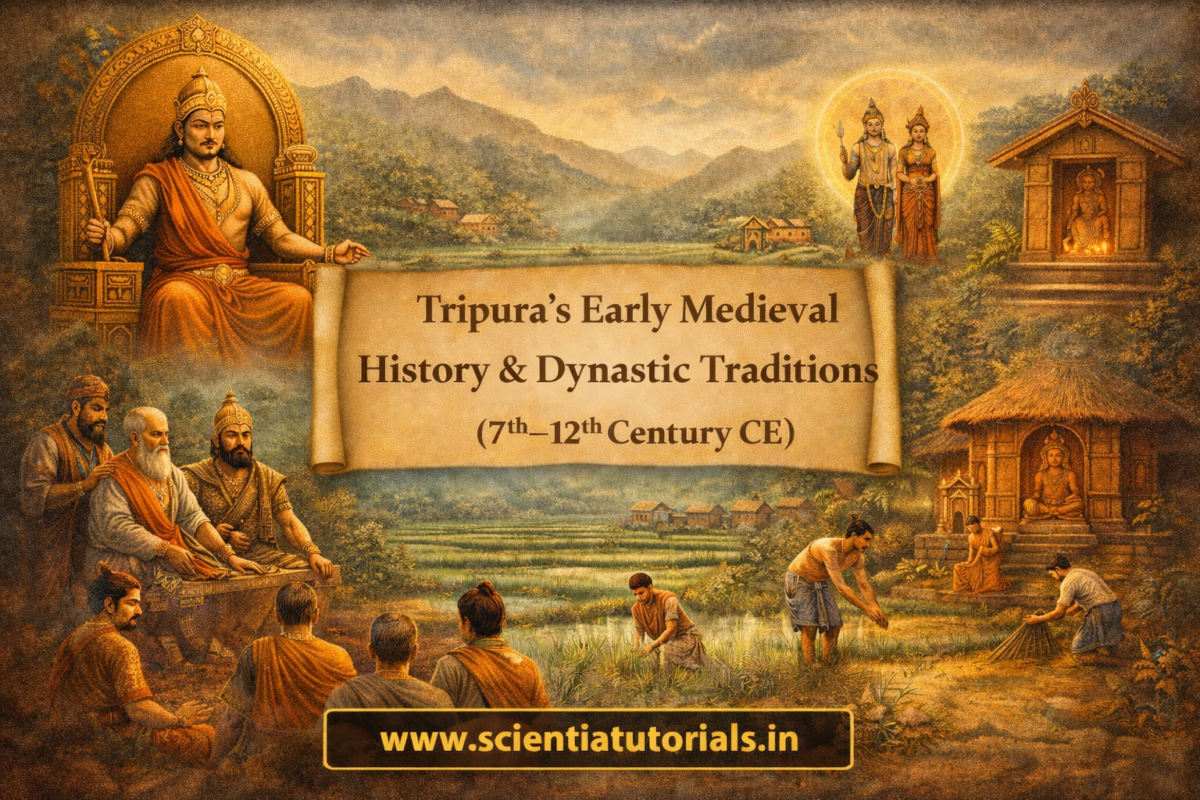

Tripura’s Early Medieval History & Dynastic Traditions (7th–12th Century CE)
History of North-East India: From Early Kingdoms to Modern Integration
Module III: Early Medieval Transformations and Regional Powers
Timeline / Era Covered: 7th Century CE – 12th Century CE
Lesson: Tripura’s Early Medieval History and Dynastic Traditions
This lesson is systematically organized into four clearly structured sections, as detailed below:
- Chronologically Structured Study Module
- Short-Answer Type Questions
- Long-Answer Type Questions
- Multiple-Choice Questions (MCQs) with Answers and Detailed Explanations
Chronologically Structured Study Module
Introduction: Tripura in the Early Medieval North-East Indian World
The early medieval history of Tripura presents a distinctive model of political evolution in North-East India. Unlike the Brahmaputra valley, where the decline of early historic kingdoms led to visible political fragmentation, Tripura experienced a gradual transformation from clan-based authority to dynastic kingship, deeply rooted in indigenous traditions, genealogy, and sacred legitimacy.
Between the 7th and 12th centuries CE, Tripura evolved as a hill-based polity where political authority was shaped by kinship networks, territorial control over forested and hilly landscapes, and dynastic continuity rather than by elaborate bureaucratic systems. The region’s early medieval history is preserved largely through royal genealogies, oral traditions, and later chronicles, which together illuminate the emergence of long-lasting dynastic traditions that continued well into the medieval and early modern periods.
Understanding Tripura’s early medieval history is essential for appreciating the diversity of state formation patterns in North-East India and the resilience of indigenous political institutions.
Geographical Context and Its Political Significance
Hill Geography and Political Organization
Tripura’s geography consists mainly of hills, forests, and narrow valleys, with limited arable land compared to the Brahmaputra valley. This geographical setting profoundly influenced its political development:
- Encouraged localized rule and clan authority
- Limited large-scale agrarian expansion
- Favoured defensive hill settlements rather than expansive kingdoms
As a result, political authority in early medieval Tripura emphasized control over people and clans rather than over vast territories.
Chronological Framework of Early Medieval Tripura
For analytical clarity, Tripura’s early medieval history can be divided into three broad phases:
- 7th–8th Century CE: Clan Polities and Sacred Kingship
- 8th–10th Century CE: Emergence of Dynastic Rule and Territorial Consolidation
- 10th–12th Century CE: Stabilization of Dynastic Traditions and Regional Identity
Each phase reflects continuity and gradual transformation rather than abrupt political change.
Phase I (7th–8th Century CE): Clan Polities and Sacred Authority
Clan-Based Political Structure
In the early phase, Tripura’s society was organized around clans and lineages, each controlling specific hill tracts and forest zones. Political authority was exercised by:
- Clan chiefs
- Ritual leaders
- Warrior heads
These leaders derived legitimacy from ancestral lineage, control over land, and ritual status, rather than formal administration.
Sacred Nature of Early Kingship
Early political authority in Tripura was deeply sacral in character. The ruler was viewed as:
- A mediator between ancestors and the living
- A protector of clan traditions
- A custodian of sacred geography
Kingship was thus not merely political but religious and symbolic, ensuring social cohesion among dispersed hill communities.
Phase II (8th–10th Century CE): Emergence of Dynastic Traditions
Formation of Hereditary Kingship
Between the 8th and 10th centuries CE, Tripura witnessed the gradual emergence of hereditary dynastic rule. Clan leadership slowly transformed into kingship through:
- Consolidation of lineage authority
- Ritual recognition of succession
- Acceptance by major clans
This marked Tripura’s transition from loosely organized clan polities to a recognized regional kingdom.
Early Dynastic Identity
Later traditions associate Tripura’s early medieval rulers with the Manikya Dynasty, whose origins are traced to this formative period. Although detailed inscriptions are scarce, genealogical traditions emphasize:
- Continuity of royal lineage
- Divine or semi-divine ancestry
- Legitimation through ritual and tradition
These narratives played a crucial role in sustaining dynastic authority.
Phase III (10th–12th Century CE): Consolidation of the Tripura Kingdom
Stabilization of Royal Authority
By the 10th century CE, kingship in Tripura had become institutionalized. Royal authority was characterized by:
- Hereditary succession
- Defined territorial domains
- Recognition by subordinate clan chiefs
Although political control remained limited in territorial scope, it was stable and enduring.
Nature of Administration
Administration in early medieval Tripura remained simple and decentralized:
- Local chiefs governed villages and clans
- The king acted as supreme arbiter
- Custom and tradition guided governance
This system suited Tripura’s social structure and avoided conflict between royal authority and clan autonomy.
Political Ideology and Kingship in Early Medieval Tripura
Kingship as Custodianship
The Tripura king was seen not as an autocrat but as:
- Guardian of land and people
- Upholder of ancestral customs
- Protector of sacred traditions
Political power was exercised through consensus and ritual authority, ensuring loyalty from clans.
Absence of Expansionist Ambitions
Unlike contemporary plains-based kingdoms, Tripura did not pursue aggressive territorial expansion. Instead, rulers focused on:
- Internal stability
- Clan integration
- Defense of hill territories
This restrained political vision contributed to long-term dynastic continuity.
Cultural Traditions and Identity Formation
Indigenous Religious Practices
Religion in early medieval Tripura was dominated by indigenous beliefs, including:
- Ancestor worship
- Nature and hill deities
- Clan rituals
These religious practices were closely tied to kingship, reinforcing the sacred status of the ruler.
Gradual External Cultural Influence
Between the 10th and 12th centuries CE, Tripura began to experience limited Brahmanical influence, especially in royal rituals and genealogical narratives. However:
- Indigenous traditions remained dominant
- External influences were selectively adopted
- Cultural synthesis occurred gradually
This balanced approach preserved Tripura’s distinct cultural identity.
Economy of Early Medieval Tripura
Agrarian and Forest-Based Economy
Tripura’s economy during the early medieval period was based on:
- Shifting cultivation (jhum)
- Limited wet-rice cultivation in valleys
- Forest resources and hill produce
Economic organization supported subsistence and stability rather than surplus extraction.
Trade and Exchange Networks
Although large-scale trade was limited, Tripura maintained:
- Local exchange between hills and plains
- Barter systems involving forest products
- Contacts with neighbouring regions
These networks supported political cohesion without creating dependency.
Tripura in the Context of Early Medieval North-East India
Comparison with Assam and Manipur
Compared to other regions:
- Assam experienced fragmentation and land-grant-based polity
- Manipur followed gradual centralization rooted in clan consensus
- Tripura emphasized dynastic continuity within a hill-based social order
Tripura thus represents a distinct model of early medieval state formation.
Sources for Early Medieval Tripura History
Genealogical Traditions and Chronicles
The early medieval history of Tripura is reconstructed mainly from:
- Royal genealogies
- Oral traditions
- Later court chronicles
Though not strictly contemporary records, these sources preserve valuable historical memory when critically examined.
Limitations of Sources
- Lack of inscriptions
- Mythological embellishment
- Chronological ambiguity
Despite these limitations, combined analysis allows historians to reconstruct Tripura’s political evolution.
Historical Interpretation: Decline or Transformation?
Earlier historians often viewed early medieval hill polities as primitive or stagnant. Modern scholarship, however, interprets Tripura’s early medieval history as:
- Adaptive political evolution
- Successful integration of clan and kingship
- Evidence of indigenous statecraft
Tripura’s stability demonstrates that complex administration was not the only path to durable statehood.
Long-Term Significance of Early Medieval Tripura
The political and cultural foundations laid between the 7th and 12th centuries CE:
- Enabled the long survival of the Tripura monarchy
- Shaped later medieval dynastic traditions
- Preserved a strong sense of regional identity
These developments ensured continuity well beyond the early medieval period.
Conclusion: Tripura’s Enduring Dynastic Legacy
Tripura’s early medieval history reflects a unique trajectory of political evolution in North-East India. From clan-based authority to stable dynastic kingship, the region developed institutions suited to its geography, economy, and society. Political legitimacy rested on ritual authority, genealogy, and consensus, rather than on coercive power or expansive administration.
Between the 7th and 12th centuries CE, Tripura emerged as a durable regional kingdom with a strong cultural identity and enduring dynastic traditions. This period forms the foundation of Tripura’s later medieval and early modern history and highlights the diversity of early medieval political experiences in North-East India.
Examination Relevance (APSC, State PSCs, UGC-NET, CUET, TETs)
- Clan-based kingship in Tripura
- Early dynastic traditions and genealogy
- Hill-based polity and administration
- Comparative study with Assam and Manipur
Short Answer Type Questions with Answers
Q1. What is meant by the term “early medieval period” in Tripura’s history?
Answer:
It refers to the phase between the 7th and 12th centuries CE, marked by clan-based authority and the emergence of dynastic kingship in Tripura.
Q2. What type of geography characterizes Tripura?
Answer:
Tripura is characterized by hills, forests, and narrow valleys, which strongly influenced its political and social organization.
Q3. How did geography affect political authority in early medieval Tripura?
Answer:
Hilly terrain encouraged localized rule, clan-based authority, and defensive settlements rather than large centralized kingdoms.
Q4. What was the basic political unit in early medieval Tripura?
Answer:
The basic political unit was the clan or lineage group, controlling specific hill tracts and forest zones.
Q5. Who exercised political authority in the earliest phase of Tripura’s medieval history?
Answer:
Political authority was exercised by clan chiefs and ritual leaders, not by centralized monarchs.
Q6. What was the nature of kingship in early medieval Tripura?
Answer:
Kingship was sacred and ritual-based, closely linked to ancestry, tradition, and clan consensus.
Q7. During which centuries did dynastic kingship begin to emerge in Tripura?
Answer:
Dynastic kingship began to emerge between the 8th and 10th centuries CE.
Q8. What factor was crucial for the acceptance of dynastic rule in Tripura?
Answer:
Acceptance by major clans and ritual legitimacy were crucial for dynastic rule.
Q9. Which dynasty is traditionally associated with Tripura’s kingship?
Answer:
Later traditions associate Tripura’s kingship with the Manikya Dynasty.
Q10. What type of sources provide information on early medieval Tripura?
Answer:
Royal genealogies, oral traditions, and later court chronicles provide information on early medieval Tripura.
Q11. Why are inscriptions scarce in early medieval Tripura?
Answer:
Because political authority relied on oral tradition and ritual legitimacy rather than written administrative records.
Q12. How was administration organized in early medieval Tripura?
Answer:
Administration was decentralized, with local chiefs governing villages and the king acting as a supreme arbiter.
Q13. What was the king’s role in Tripura’s political system?
Answer:
The king acted as guardian of land, people, and traditions, not as an autocratic ruler.
Q14. Did Tripura pursue aggressive territorial expansion during this period?
Answer:
No, Tripura focused on internal stability and defense rather than territorial expansion.
Q15. What type of economy supported early medieval Tripura?
Answer:
A forest-based and agrarian economy, including shifting cultivation and limited wet-rice farming, supported Tripura.
Q16. What agricultural practice was common in Tripura’s hills?
Answer:
Shifting cultivation (jhum) was commonly practiced in Tripura’s hill regions.
Q17. What role did forests play in Tripura’s economy?
Answer:
Forests provided resources, supported subsistence, and enabled exchange of forest products.
Q18. How did trade function in early medieval Tripura?
Answer:
Trade was mainly local and regional, involving barter and exchange between hills and nearby plains.
Q19. What religious traditions dominated early medieval Tripura?
Answer:
Indigenous religious practices such as ancestor worship and nature deities dominated early medieval Tripura.
Q20. How did Brahmanical influence enter Tripura?
Answer:
Brahmanical influence entered gradually through royal rituals and genealogical traditions, without displacing indigenous beliefs.
Q21. What distinguishes Tripura’s early medieval polity from Assam?
Answer:
Tripura emphasized dynastic continuity and clan-based rule, unlike Assam’s land-grant-based and fragmented polity.
Q22. How does Tripura’s political evolution compare with Manipur?
Answer:
Both showed gradual state formation, but Tripura emphasized dynastic lineage while Manipur stressed ritual kingship and clan consensus.
Q23. Why is Tripura considered a stable early medieval polity?
Answer:
Because dynastic continuity, ritual legitimacy, and clan cooperation ensured long-term political stability.
Q24. What long-term impact did early medieval developments have on Tripura?
Answer:
They laid the foundations for Tripura’s later medieval monarchy and enduring dynastic traditions.
Q25. Why is the study of early medieval Tripura historically important?
Answer:
It highlights an indigenous model of state formation adapted to hill geography and clan-based society.
Long Answer Type Questions with Answers
Tripura’s Early Medieval History and Dynastic Traditions (7th–12th Century CE)
Q1. Discuss the historical significance of Tripura in the early medieval history of North-East India.
Answer:
Tripura occupies a distinctive position in early medieval North-East India due to its hill-based polity and continuity of dynastic traditions. Unlike the Brahmaputra valley, which experienced political fragmentation, Tripura evolved gradually from clan-based authority to stable kingship. Its political institutions were rooted in kinship, ritual legitimacy, and genealogy, demonstrating an indigenous and adaptive model of state formation suited to its geography.
Q2. Explain how geography influenced political organization in early medieval Tripura.
Answer:
Tripura’s hilly terrain, dense forests, and narrow valleys limited large-scale agrarian expansion and centralized administration. Political authority therefore emphasized control over clans and people rather than extensive territory. Defensive hill settlements, forest resources, and localized rule shaped a decentralized yet stable political structure.
Q3. Examine the role of clan and lineage in early medieval Tripura’s polity.
Answer:
Clan and lineage formed the foundation of political authority in early medieval Tripura. Each clan controlled specific hill tracts and exercised ritual and social authority. Early kingship emerged from dominant lineages that gained acceptance among clans, ensuring political stability without dismantling traditional social structures.
Q4. How did sacred kingship develop in early medieval Tripura?
Answer:
Kingship in Tripura developed as a sacred institution. The ruler was seen as a mediator between ancestors, deities, and the people. Political authority derived from ritual legitimacy, ancestral lineage, and protection of sacred geography rather than coercive power or bureaucratic control.
Q5. Trace the transition from clan leadership to dynastic kingship in Tripura.
Answer:
Between the 8th and 10th centuries CE, clan leaders gradually transformed into hereditary kings. This transition occurred through consolidation of lineage authority, ritual recognition of succession, and acceptance by major clans. Over time, kingship became institutionalized while preserving clan autonomy.
Q6. Discuss the emergence of dynastic traditions in early medieval Tripura.
Answer:
Dynastic traditions emerged as rulers emphasized continuity of lineage, sacred ancestry, and ritual legitimacy. Later historical memory associates Tripura’s kingship with the Manikya Dynasty, whose origins are traced to this formative early medieval phase. Genealogy became a crucial source of political legitimacy.
Q7. Analyze the nature of kingship in early medieval Tripura.
Answer:
Kingship in early medieval Tripura was custodial rather than autocratic. The king functioned as guardian of land, people, and traditions. Authority was exercised through consensus, ritual obligation, and respect for clan autonomy, ensuring loyalty and long-term stability.
Q8. Examine the administrative structure of early medieval Tripura.
Answer:
Administration remained simple and decentralized. Local chiefs governed villages and clans, while the king acted as supreme arbiter in disputes. Governance was guided by custom and tradition rather than written laws or elaborate bureaucracy, which suited Tripura’s social organization.
Q9. Why did Tripura not develop a centralized bureaucratic state?
Answer:
Tripura’s geography, limited agrarian surplus, and clan-based society did not require or support centralized bureaucracy. Political stability was achieved through ritual authority, kinship networks, and consensus, making elaborate administrative machinery unnecessary.
Q10. Discuss the economic foundations of early medieval Tripura.
Answer:
The economy of early medieval Tripura was primarily forest-based and agrarian. Shifting cultivation (jhum), limited wet-rice farming in valleys, and use of forest resources sustained subsistence livelihoods. Economic practices emphasized stability rather than surplus extraction.
Q11. Examine the role of forests in Tripura’s early medieval economy and polity.
Answer:
Forests provided essential resources such as timber, forest produce, and hunting grounds. Control over forests reinforced clan authority and supported subsistence economies. Forest-based livelihoods also shaped political boundaries and limited external domination.
Q12. Discuss trade and exchange networks in early medieval Tripura.
Answer:
Trade in early medieval Tripura was local and regional, based largely on barter. Exchange occurred between hill communities and nearby plains, involving forest products and agricultural goods. These networks supported political cohesion without fostering dependence on long-distance trade.
Q13. Analyze the religious traditions of early medieval Tripura.
Answer:
Religion in early medieval Tripura was dominated by indigenous beliefs, including ancestor worship, nature spirits, and clan rituals. These traditions were deeply intertwined with kingship and social organization, reinforcing sacred legitimacy of political authority.
Q14. How did Brahmanical influence enter Tripura during the early medieval period?
Answer:
Brahmanical influence entered Tripura gradually through royal rituals, genealogical narratives, and symbolic adoption of Hindu concepts. However, it did not replace indigenous traditions; instead, a selective cultural synthesis emerged.
Q15. Compare Tripura’s early medieval polity with that of Assam.
Answer:
While Assam experienced political fragmentation and land-grant-based administration, Tripura emphasized dynastic continuity and clan-based governance. Assam relied more on Brahmanical institutions, whereas Tripura retained stronger indigenous political traditions.
Q16. Compare the political evolution of Tripura and Manipur in the early medieval period.
Answer:
Both Tripura and Manipur followed gradual state formation rooted in clan structures. However, Tripura emphasized dynastic genealogy and hill-based authority, while Manipur focused more on ritual kingship and valley-based consolidation.
Q17. Discuss the sources for reconstructing early medieval Tripura’s history.
Answer:
The history of early medieval Tripura is reconstructed mainly from royal genealogies, oral traditions, and later court chronicles. Although these sources contain mythological elements, critical analysis allows historians to extract historical patterns.
Q18. What are the limitations of the sources for early medieval Tripura?
Answer:
Major limitations include scarcity of inscriptions, lack of contemporary records, and mythological embellishment in genealogies. Chronological ambiguities require cautious interpretation and comparative analysis.
Q19. Was early medieval Tripura a stagnant or dynamic polity? Discuss.
Answer:
Early medieval Tripura was dynamic rather than stagnant. It adapted political institutions to geography and society, ensured dynastic continuity, and maintained cultural identity. Stability resulted from effective integration of clan authority and kingship.
Q20. Assess the long-term historical significance of early medieval Tripura.
Answer:
The political and cultural foundations laid between the 7th and 12th centuries CE enabled the long survival of the Tripura monarchy. Dynastic traditions, ritual kingship, and indigenous governance shaped Tripura’s later medieval and early modern history, making this period crucial for understanding the region’s past.
MCQs with Answers and Explanations
Tripura’s Early Medieval History and Dynastic Traditions (7th–12th Century CE)
Q1. The early medieval phase of Tripura broadly covers which centuries?
A. 5th–7th centuries CE
B. 6th–9th centuries CE
C. 7th–12th centuries CE
D. 9th–14th centuries CE
Correct Answer: C
Explanation:
In Module III, the early medieval period for Tripura is defined as the 7th to 12th centuries CE, marked by the transition from clan authority to dynastic kingship.
Q2. The political evolution of early medieval Tripura is best described as:
A. Sudden imperial expansion
B. Complete political fragmentation
C. Gradual transformation from clan rule to dynastic kingship
D. Foreign conquest and domination
Correct Answer: C
Explanation:
Tripura followed a slow, indigenous process of state formation rooted in clan traditions and ritual legitimacy rather than abrupt change.
Q3. Which geographical feature most influenced Tripura’s early medieval polity?
A. Wide riverine plains
B. Coastal belts
C. Hills, forests, and narrow valleys
D. Desert tracts
Correct Answer: C
Explanation:
Tripura’s hilly and forested terrain encouraged localized rule, defensive settlements, and clan-based political organization.
Q4. The basic political and social unit in early medieval Tripura was the:
A. Guild
B. Village republic
C. Clan or lineage group
D. Temple corporation
Correct Answer: C
Explanation:
Political authority initially rested with clans and lineages, each controlling specific hill tracts and forest zones.
Q5. In the earliest phase, political authority in Tripura was exercised mainly by:
A. Bureaucratic officials
B. Foreign governors
C. Clan chiefs and ritual leaders
D. Urban elites
Correct Answer: C
Explanation:
Before dynastic kingship emerged, power lay with clan chiefs who combined ritual, social, and political authority.
Q6. Early medieval kingship in Tripura was primarily:
A. Militaristic and expansionist
B. Bureaucratic and centralized
C. Sacred and ritual-based
D. Mercantile in character
Correct Answer: C
Explanation:
Kingship in Tripura was sacral in nature, with rulers viewed as custodians of tradition and mediators between ancestors and people.
Q7. Dynastic kingship in Tripura began to emerge mainly during:
A. 6th–7th centuries CE
B. 7th–8th centuries CE
C. 8th–10th centuries CE
D. 11th–13th centuries CE
Correct Answer: C
Explanation:
Between the 8th and 10th centuries CE, clan leadership gradually transformed into hereditary dynastic rule.
Q8. Acceptance of dynastic rule in early medieval Tripura depended largely on:
A. Foreign recognition
B. Military conquest
C. Clan consent and ritual legitimacy
D. Written law codes
Correct Answer: C
Explanation:
Dynastic authority was sustained through ritual sanction and acceptance by major clans rather than force.
Q9. Later traditions associate Tripura’s royal lineage with the:
A. Varman dynasty
B. Pala dynasty
C. Ahom dynasty
D. Manikya Dynasty
Correct Answer: D
Explanation:
The Manikya Dynasty, according to later genealogies, traces its origins to Tripura’s early medieval dynastic phase.
Q10. Which type of sources is most important for reconstructing early medieval Tripura’s history?
A. Rock edicts
B. Foreign travel accounts
C. Royal genealogies and oral traditions
D. Archaeological inscriptions
Correct Answer: C
Explanation:
Tripura’s early history is preserved mainly through genealogies, oral traditions, and later chronicles, rather than inscriptions.
Q11. Inscriptions are scarce in early medieval Tripura primarily because:
A. Writing was unknown
B. Stone was unavailable
C. Authority relied on oral tradition and ritual
D. Foreign rule discouraged records
Correct Answer: C
Explanation:
Political legitimacy was maintained through genealogy and ritual, reducing the need for written administrative records.
Q12. Administration in early medieval Tripura can best be described as:
A. Highly centralized bureaucracy
B. Temple-controlled governance
C. Decentralized and custom-based
D. Republican
Correct Answer: C
Explanation:
Governance operated through local chiefs and customary practices, with the king as the supreme arbiter.
Q13. The role of the king in early medieval Tripura was mainly that of:
A. Absolute autocrat
B. Military conqueror
C. Custodian of land and traditions
D. Commercial regulator
Correct Answer: C
Explanation:
The king was seen as a guardian of people, land, and ancestral customs rather than an autocratic ruler.
Q14. Early medieval Tripura generally avoided aggressive territorial expansion because:
A. It lacked population
B. It lacked military strength
C. Political ideology emphasized internal stability
D. Foreign powers restricted expansion
Correct Answer: C
Explanation:
Tripura’s polity focused on internal cohesion, clan integration, and defense, not conquest.
Q15. The economic base of early medieval Tripura was primarily:
A. Overseas maritime trade
B. Mining and metallurgy
C. Forest-based and agrarian economy
D. Urban craft production
Correct Answer: C
Explanation:
The economy relied on shifting cultivation, limited wet-rice farming, and forest resources.
Q16. Which agricultural practice was common in Tripura’s hill regions?
A. Plantation farming
B. Intensive wet-rice cultivation
C. Shifting cultivation (jhum)
D. Terrace farming
Correct Answer: C
Explanation:
Jhum (shifting cultivation) suited the hilly terrain and forest ecology of Tripura.
Q17. Trade in early medieval Tripura was mainly:
A. Long-distance and maritime
B. Controlled by foreign merchants
C. Local and regional barter
D. Entirely absent
Correct Answer: C
Explanation:
Trade consisted of local exchange between hills and plains, often through barter of forest and agrarian products.
Q18. Religious life in early medieval Tripura was dominated by:
A. Buddhism
B. Jainism
C. Indigenous beliefs and ancestor worship
D. Islam
Correct Answer: C
Explanation:
Indigenous religious practices shaped social and political life, reinforcing sacred kingship.
Q19. Brahmanical influence in Tripura during this period was:
A. Immediate and overwhelming
B. Completely absent
C. Gradual and selective
D. Imposed by conquest
Correct Answer: C
Explanation:
Brahmanical ideas entered slowly through royal rituals and genealogy, without displacing indigenous traditions.
Q20. Compared to Assam, Tripura’s early medieval polity emphasized:
A. Land grants and temples
B. Dynastic continuity and clan authority
C. Urban administration
D. Imperial expansion
Correct Answer: B
Explanation:
Assam experienced fragmentation and land-grant polity, while Tripura stressed lineage continuity and clan-based rule.
Q21. In comparison with Manipur, Tripura’s political evolution placed greater emphasis on:
A. Valley-based agriculture
B. Ritual kingship alone
C. Dynastic genealogy
D. Military conquest
Correct Answer: C
Explanation:
Tripura highlighted dynastic lineage, whereas Manipur emphasized ritual kingship and clan consensus.
Q22. Early medieval Tripura is best described historiographically as:
A. A stagnant hill polity
B. A failed state
C. An adaptive indigenous kingdom
D. A foreign-controlled region
Correct Answer: C
Explanation:
Modern historians view Tripura as an adaptive polity that developed stable institutions suited to its environment.
Q23. Which factor most contributed to political stability in early medieval Tripura?
A. Large standing armies
B. Bureaucratic centralization
C. Clan cooperation and ritual legitimacy
D. Extensive trade networks
Correct Answer: C
Explanation:
Consensus among clans and sacred legitimacy of kingship ensured long-term stability.
Q24. The long-term significance of early medieval Tripura lies in:
A. Early colonial contact
B. Maritime dominance
C. Survival of its monarchy into later periods
D. Industrial development
Correct Answer: C
Explanation:
Institutions formed during this period enabled the long survival of Tripura’s monarchy into medieval and modern times.
Q25. Which statement best summarizes Tripura’s early medieval political development?
A. Abrupt political collapse
B. Foreign conquest-led transformation
C. Gradual dynastic consolidation rooted in clans
D. Rapid imperial expansion
Correct Answer: C
Explanation:
Tripura’s evolution was gradual, indigenous, and clan-based, resulting in durable dynastic traditions.