
North-East India in 21st Century India
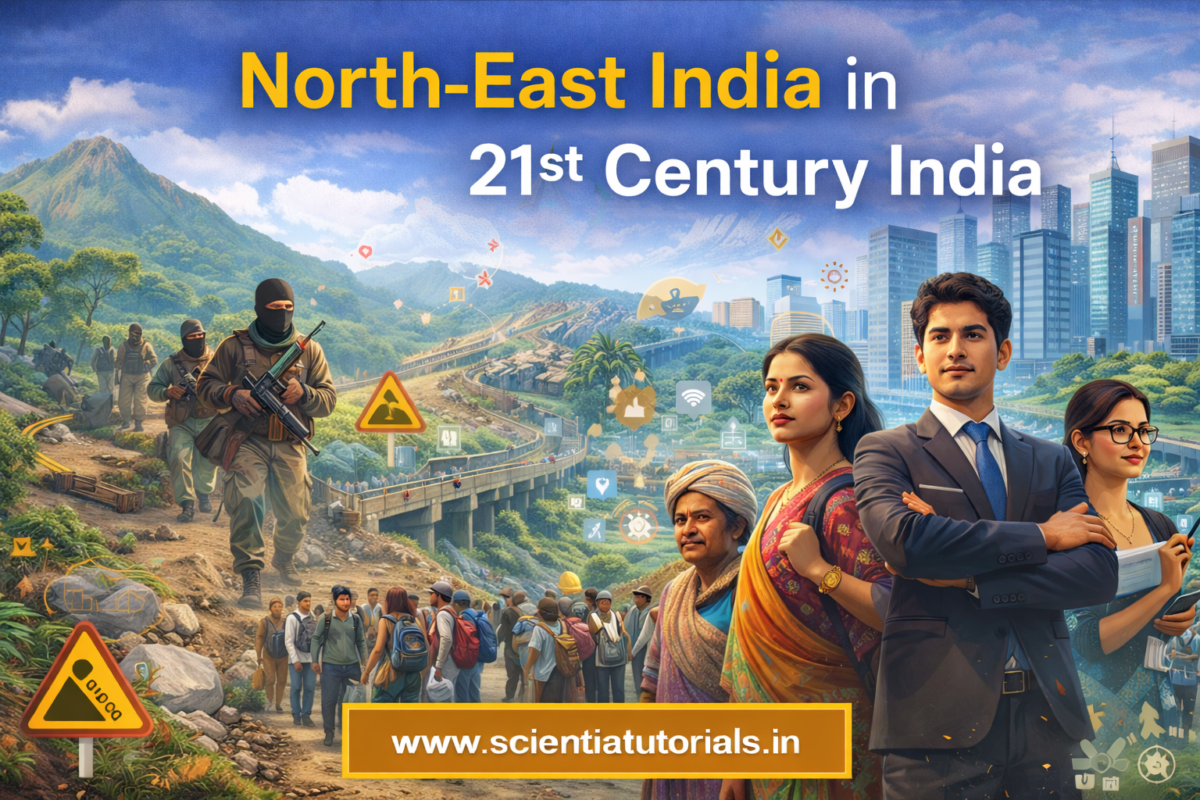

North-East India in 21st Century India | Development and Integration
Course: History of North-East India: From Early Kingdoms to Modern Integration
Module X: Contemporary North-East India – Development and Integration
Timeline / Era Covered: 2000 CE – Present
Lesson: North-East India in 21st Century India
This lesson is systematically organized into four clearly structured sections, as detailed below:
- Chronologically Structured Study Module
- Short-Answer Type Questions
- Long-Answer Type Questions
- Multiple-Choice Questions (MCQs) with Answers and Detailed Explanations
Chronologically Structured Study Module
1. Introduction
The 21st century marks a decisive phase in the historical trajectory of North-East India. From a region long perceived through the prisms of remoteness, conflict, and marginalisation, North-East India has gradually emerged as a strategic, cultural, and developmental frontier within modern India. Since 2000 CE, shifts in national policy, geopolitical priorities, infrastructure development, and socio-cultural assertion have significantly reshaped the region’s position in the Indian Union.
This lesson examines how North-East India has been reimagined and re-integrated in 21st century India. It analyses political, economic, strategic, social, and cultural dimensions, tracing the region’s evolving role from the early 2000s to the present. The study adopts a chronological and thematic approach essential for historical understanding and competitive examination preparation.
2. North-East India at the Turn of the 21st Century
At the beginning of the 2000s, North-East India was transitioning from decades marked by:
- Political instability and insurgency
- Limited physical connectivity
- Economic underdevelopment
- Identity-based movements
While the 1990s had initiated economic liberalisation at the national level, its impact on the North-East remained limited. The region was still largely dependent on central assistance, with weak private investment and restricted market access. However, the early 21st century also brought new possibilities, as peace processes, policy attention, and technological change began altering the developmental landscape.
3. Changing National Perception of the North-East
3.1 From Periphery to Strategic Region
One of the most significant changes in the 21st century has been the shift in national perception of the North-East:
- From a distant borderland to a strategic gateway
- From a security burden to a development priority
- From isolation to integration
This perceptual shift has influenced policy-making, resource allocation, and public discourse at the national level.
3.2 Integration without Assimilation
Unlike earlier integration efforts that often emphasised administrative control, the 21st century approach increasingly recognises:
- Cultural diversity
- Ethnic plurality
- Indigenous rights
Integration is now understood as inclusion within diversity, rather than cultural homogenisation.
4. Political Developments in the 21st Century
4.1 Decline of Insurgency and Peace Processes
Since the early 2000s, the intensity of insurgency in many parts of North-East India has declined due to:
- Ceasefire agreements
- Peace negotiations
- Improved governance and development focus
Although challenges remain, political stability has improved relative to the late 20th century, enabling developmental initiatives.
4.2 Democratic Participation and Governance
The region has witnessed:
- Strengthening of democratic institutions
- Increased political participation
- Greater representation in national politics
Decentralisation and local governance have gained importance in managing diversity and development.
5. Economic Transformation in the 21st Century
5.1 Infrastructure and Connectivity
Infrastructure development has been the backbone of economic integration:
- Expansion of road and rail networks
- Improved air connectivity
- Growth of digital infrastructure
These developments have reduced physical isolation and integrated the region with national markets.
5.2 Emerging Economic Sectors
The 21st century has highlighted new economic possibilities:
- Agriculture diversification and horticulture
- Handloom and handicrafts
- Tourism and eco-tourism
- Renewable energy
While industrialisation remains limited, these sectors offer region-specific growth opportunities.
5.3 Challenges of Employment and Migration
Despite progress, economic challenges persist:
- Limited local employment opportunities
- Educated youth unemployment
- Out-migration to metropolitan centres
These issues underline the need for inclusive and sustainable economic planning.
6. Strategic and Geopolitical Importance
6.1 Gateway to Southeast Asia
In the 21st century, North-East India has assumed heightened strategic significance due to:
- Its geographical proximity to Southeast Asia
- Its role in India’s eastern outreach
- Its importance in regional connectivity and security
This has elevated the region’s importance in India’s foreign and strategic policy framework.
6.2 Border Management and National Security
North-East India shares international borders with multiple countries, making it crucial for:
- Border security
- Regional stability
- National defence preparedness
Improved infrastructure and governance have strengthened strategic oversight.
7. Social Change and Demographic Transformation
7.1 Migration and Urbanisation
The 21st century has witnessed:
- Increased rural-to-urban migration
- Expansion of urban centres
- Greater inter-state mobility
Urban spaces have become sites of cultural interaction, social change, and economic opportunity.
7.2 Changing Social Structures
Education, migration, and media exposure have transformed:
- Family structures
- Gender roles
- Community relations
Traditional institutions coexist with modern social practices, reflecting a transitional society.
8. Cultural Renaissance and Identity Assertion
8.1 Revival and Global Visibility
One of the most striking features of North-East India in the 21st century is its cultural renaissance:
- Growth of regional literature, music, fashion, and cinema
- Increased national and global recognition
- Digital platforms enabling self-representation
Culture has become a source of pride, identity, and economic opportunity.
8.2 Identity in a Globalised India
Identity in the 21st century is:
- Dynamic and negotiated
- Rooted in indigenous heritage
- Engaged with national and global influences
North-East India’s cultural assertion strengthens pluralism within the Indian nation.
9. Environmental Concerns and Sustainable Development
9.1 Ecological Sensitivity
North-East India remains one of the most ecologically fragile regions:
- Rich biodiversity
- High rainfall and seismic vulnerability
- Susceptibility to climate change
Unplanned development risks long-term ecological damage.
9.2 Sustainability as a Core Principle
The 21st century has underscored the need for:
- Environmentally sensitive infrastructure
- Community-based resource management
- Sustainable tourism and energy practices
Balancing development and conservation is essential for the region’s future.
10. Role of Youth and Education
10.1 Expansion of Education
Since 2000 CE:
- Universities and technical institutions have expanded
- Access to higher education has increased
- Digital learning has widened opportunities
Education has emerged as a key driver of social mobility.
10.2 Youth as Agents of Change
Educated youth play a critical role in:
- Innovation and entrepreneurship
- Cultural production
- Social and political engagement
Harnessing youth potential is central to the region’s long-term integration.
11. Governance and Policy Framework
11.1 Increased Policy Attention
The 21st century has seen:
- Greater central investment
- Region-specific development policies
- Emphasis on connectivity and inclusion
However, effective implementation remains uneven.
11.2 Participatory and Inclusive Governance
Future progress depends on:
- Community participation
- Respect for indigenous rights
- Transparent and accountable governance
Development must be locally rooted to be sustainable.
12. North-East India and National Integration
In 21st century India, integration is marked by:
- Improved physical and emotional connectivity
- Greater cultural visibility in national media
- Recognition of diversity within unity
North-East India is no longer viewed merely as a frontier, but as an integral contributor to India’s national life.
13. Contemporary Challenges in the 21st Century
Despite progress, challenges remain:
- Economic disparities
- Identity-based tensions
- Environmental vulnerability
- Governance capacity gaps
These challenges highlight the unfinished agenda of integration and development.
14. Opportunities for the Future
The future of North-East India in 21st century India lies in:
- Leveraging strategic location
- Investing in human capital
- Promoting sustainable development
- Strengthening cultural industries
With inclusive planning, the region can become a model of balanced development.
15. Conclusion
North-East India’s journey in the 21st century reflects a profound transformation from marginalisation toward integration, visibility, and strategic importance. Since 2000 CE, the region has experienced political stabilisation, infrastructural expansion, cultural renaissance, and growing national attention. While challenges related to economy, identity, environment, and governance persist, the opportunities are equally significant.
Understanding North-East India in 21st century India is essential to appreciating the evolving nature of the Indian nation itself—diverse, dynamic, and interconnected. For students and aspirants, this lesson provides a holistic framework to analyse contemporary regional history within the broader narrative of modern India.
Short Answer Type Questions with Answers
1. What does the lesson “North-East India in 21st Century India” primarily examine?
Answer:
It examines the changing political, economic, strategic, social, and cultural role of North-East India since 2000 CE within modern India.
2. Which period is covered under this lesson?
Answer:
The period from 2000 CE to the present.
3. How was North-East India commonly perceived before the 21st century?
Answer:
As a remote, conflict-prone, and economically marginalised border region.
4. What major shift in perception occurred in the 21st century?
Answer:
The region began to be viewed as a strategic and developmental gateway rather than a peripheral frontier.
5. Name one political change visible in the region since 2000 CE.
Answer:
Decline in the intensity of insurgency due to peace talks and ceasefire agreements.
6. How has democratic participation evolved in North-East India?
Answer:
Democratic institutions have strengthened with greater political participation and representation.
7. Why is infrastructure development crucial for North-East India in the 21st century?
Answer:
It reduces isolation, improves connectivity, and integrates the region with national markets.
8. Mention two areas where connectivity has improved since 2000 CE.
Answer:
Road and rail networks, and digital connectivity.
9. What economic sectors show potential growth in the 21st century?
Answer:
Agriculture diversification, tourism, handloom and handicrafts, and renewable energy.
10. Why does unemployment remain a challenge despite development efforts?
Answer:
Due to limited industrialisation and insufficient private investment.
11. How has youth migration shaped the region in the 21st century?
Answer:
It has increased educational and professional exposure but also caused brain drain from the region.
12. Why is North-East India strategically important in the 21st century?
Answer:
Because of its location as a gateway to Southeast Asia and its role in border security.
13. What role does border management play in national security?
Answer:
It ensures territorial integrity and regional stability.
14. How has migration influenced social change in North-East India?
Answer:
It has increased urbanisation, cultural interaction, and demographic diversity.
15. What changes are visible in traditional social structures?
Answer:
Shifts in family patterns, gender roles, and community relations.
16. What is meant by cultural renaissance in the 21st century context?
Answer:
Renewed expression and wider recognition of indigenous culture, arts, and identity.
17. How have digital platforms contributed to cultural visibility?
Answer:
They enable self-representation, global outreach, and preservation of cultural expressions.
18. Why is identity described as dynamic in 21st century India?
Answer:
Because it is shaped by interaction between indigenous traditions, national belonging, and global influences.
19. What environmental challenge is most critical in the region today?
Answer:
Ecological fragility and vulnerability to climate change.
20. Why is sustainable development essential for North-East India?
Answer:
To balance economic growth with environmental protection and indigenous rights.
21. How has education expanded since 2000 CE?
Answer:
Through growth of universities, technical institutions, and digital learning platforms.
22. What role do youth play in regional transformation?
Answer:
Youth act as agents of innovation, entrepreneurship, and cultural change.
23. How has governance changed in the contemporary period?
Answer:
There is greater policy attention, though implementation challenges remain.
24. What does integration mean in the 21st century Indian context?
Answer:
Inclusion within diversity rather than cultural assimilation.
25. Why is this lesson important for competitive examinations?
Answer:
It links history with contemporary issues of development, identity, strategy, and national integration.
Long Answer Type Questions with Answers
1. Analyse the changing position of North-East India in 21st century India.
Answer:
In the 21st century, North-East India has moved from the margins of national attention to a region of strategic, developmental, and cultural significance. Improved connectivity, policy focus, and geopolitical considerations have reshaped its role within India. While challenges persist, the region is increasingly viewed as a gateway to Southeast Asia, a hub of cultural diversity, and a key component of national integration.
2. Discuss North-East India’s condition at the turn of the 21st century and the factors that shaped its early trajectory.
Answer:
At the start of the 2000s, the region faced insurgency, weak infrastructure, limited industrialisation, and economic dependence on central assistance. However, peace initiatives, expanding education, and early connectivity projects began altering this trajectory, laying the groundwork for gradual integration and development.
3. Examine how national perception of North-East India has changed since 2000 CE.
Answer:
National perception has shifted from viewing the region as a distant frontier to recognising it as a strategic and developmental priority. This change has influenced policy-making, investment decisions, and public discourse, integrating the North-East more firmly into the national narrative.
4. Evaluate the political developments in North-East India in the 21st century.
Answer:
Political developments include a decline in insurgency intensity, peace processes, and strengthened democratic participation. Greater representation and decentralised governance have improved stability, although unresolved political demands and sporadic tensions remain.
5. Analyse the impact of peace processes on development in North-East India.
Answer:
Peace processes and ceasefires have reduced violence, improved security, and enabled development initiatives. Enhanced stability has facilitated infrastructure projects, governance outreach, and economic activities, though lasting peace requires inclusive political settlements.
6. Discuss the role of infrastructure and connectivity in integrating North-East India with the national economy.
Answer:
Infrastructure expansion—roads, railways, air connectivity, and digital networks—has reduced isolation and improved market access. Connectivity has strengthened trade, mobility, service delivery, and emotional integration with the national mainstream.
7. Examine the economic transformation of North-East India in the 21st century.
Answer:
Economic transformation has been uneven. While industrialisation remains limited, sectors such as agriculture diversification, tourism, handloom, handicrafts, and renewable energy show promise. Persistent unemployment highlights the need for region-specific growth strategies.
8. Analyse the problem of employment and youth migration in contemporary North-East India.
Answer:
Limited local job creation has driven educated youth to migrate to metropolitan centres. While migration enhances skills and exposure, it also causes regional brain drain, underscoring the importance of local entrepreneurship and value-added industries.
9. Discuss the strategic and geopolitical importance of North-East India in the 21st century.
Answer:
The region’s location along international borders and proximity to Southeast Asia enhances its strategic value. It plays a critical role in border management, regional security, and India’s eastern outreach, increasing national focus on stability and development.
10. Examine the role of North-East India in India’s eastern and regional engagement.
Answer:
North-East India functions as a land bridge to Southeast Asia, supporting connectivity, trade, and diplomatic engagement. This role has elevated its importance in regional geopolitics and development planning.
11. Analyse social and demographic changes in North-East India since 2000 CE.
Answer:
Migration, urbanisation, education, and media exposure have transformed social structures. Cities have become multicultural spaces, while traditional institutions adapt to changing lifestyles, reflecting a society in transition.
12. Discuss the impact of migration and urbanisation on social relations in the region.
Answer:
Migration has increased inter-community interaction and cultural exchange but also generated demographic anxieties. Urbanisation reshapes livelihoods and identities, creating both opportunities and social challenges.
13. Examine the cultural renaissance of North-East India in the 21st century.
Answer:
The region has experienced a revival of literature, music, fashion, and cinema with national and global recognition. Digital platforms have enabled self-representation, strengthening identity and contributing to creative economies.
14. Analyse identity assertion and its role in national integration.
Answer:
Identity assertion in the 21st century emphasises dignity and recognition within diversity. Rather than opposing integration, it enriches pluralism and strengthens inclusive nationhood when supported by sensitive governance.
15. Discuss environmental challenges facing North-East India in the contemporary period.
Answer:
Ecological fragility, climate change, floods, landslides, and deforestation threaten sustainable development. Infrastructure expansion must be environmentally sensitive to prevent long-term damage.
16. Evaluate the importance of sustainable development for the region’s future.
Answer:
Sustainable development balances growth with ecological protection and indigenous rights. Community participation, climate resilience, and responsible resource use are essential for lasting progress.
17. Analyse the role of education in transforming North-East India in the 21st century.
Answer:
Expansion of higher and technical education has improved mobility, skills, and awareness. Education empowers youth, fosters innovation, and supports social transformation.
18. Discuss the contribution of youth to contemporary change in North-East India.
Answer:
Youth act as agents of innovation, entrepreneurship, cultural production, and civic engagement. Harnessing youth potential is vital for economic diversification and integration.
19. Examine governance and policy approaches towards North-East India since 2000 CE.
Answer:
There has been increased policy attention, investment, and region-specific planning. However, implementation gaps and coordination challenges persist, highlighting the need for participatory governance.
20. Conclude by evaluating North-East India’s overall role in 21st century India.
Answer:
North-East India in the 21st century stands transformed—more connected, visible, and strategically significant. While challenges of economy, identity, environment, and governance remain, emerging opportunities in connectivity, culture, youth potential, and regional engagement position the region as a vital contributor to India’s future. Its trajectory reflects the broader evolution of a diverse, inclusive, and interconnected Indian nation.
MCQs with Answers and Explanations
1. The lesson “North-East India in 21st Century India” primarily covers which time period?
A. 1947–1962
B. 1962–1990
C. 1991–1999
D. 2000 CE–Present
✅ Correct Answer: D. 2000 CE–Present
Explanation:
The lesson analyses political, economic, social, and strategic changes affecting North-East India since the beginning of the 21st century.
2. Which perception best describes how North-East India was viewed before the 21st century?
A. Cultural hub of India
B. Economic powerhouse
C. Remote and conflict-prone frontier
D. Industrial core region
✅ Correct Answer: C. Remote and conflict-prone frontier
Explanation:
Historically, the region was seen as peripheral, underdeveloped, and affected by insurgency and poor connectivity.
3. A major shift in the 21st century perception of North-East India is its recognition as:
A. Agricultural surplus zone
B. Strategic and developmental region
C. Cultural isolate
D. Industrial belt
✅ Correct Answer: B. Strategic and developmental region
Explanation:
National policy increasingly views the North-East as strategically vital and economically promising.
4. Which political development has marked the early decades of the 21st century in the region?
A. Expansion of colonial administration
B. Increase in insurgency
C. Decline in insurgency intensity
D. Complete political isolation
✅ Correct Answer: C. Decline in insurgency intensity
Explanation:
Peace talks, ceasefires, and governance reforms have reduced large-scale violence, though challenges remain.
5. Infrastructure development is crucial for North-East India because it:
A. Encourages cultural isolation
B. Increases dependence on agriculture
C. Reduces physical and economic isolation
D. Limits migration
✅ Correct Answer: C. Reduces physical and economic isolation
Explanation:
Improved roads, railways, air links, and digital networks connect the region to national markets.
6. Which form of connectivity has expanded significantly since 2000 CE?
A. Maritime connectivity
B. Digital and air connectivity
C. Colonial trade routes
D. River navigation only
✅ Correct Answer: B. Digital and air connectivity
Explanation:
Airports, internet access, and mobile connectivity have transformed mobility and communication.
7. Despite development initiatives, unemployment persists mainly due to:
A. Over-industrialisation
B. Limited private sector growth
C. Excess agricultural output
D. Declining education
✅ Correct Answer: B. Limited private sector growth
Explanation:
Lack of industrial clusters and private investment restricts large-scale job creation.
8. Youth migration from North-East India is largely driven by:
A. Cultural festivals
B. Educational and employment opportunities
C. Climate conditions
D. Tourism growth
✅ Correct Answer: B. Educational and employment opportunities
Explanation:
Educated youth migrate to metropolitan centres seeking better prospects.
9. North-East India’s strategic importance in the 21st century is linked to its:
A. Mineral wealth
B. Population size
C. Location near Southeast Asia
D. Industrial capacity
✅ Correct Answer: C. Location near Southeast Asia
Explanation:
Its geographical position makes the region crucial for eastern connectivity and regional engagement.
10. Border management in North-East India is significant primarily for:
A. Agricultural growth
B. National security and stability
C. Cultural exchange only
D. Tourism promotion
✅ Correct Answer: B. National security and stability
Explanation:
International borders make the region vital for security and strategic preparedness.
11. Which economic sector shows strong potential for region-specific development?
A. Heavy manufacturing
B. Defence production
C. Tourism and cultural industries
D. Large-scale mining
✅ Correct Answer: C. Tourism and cultural industries
Explanation:
Eco-tourism, cultural tourism, and creative industries suit the region’s ecology and heritage.
12. Urbanisation in the 21st century has led to:
A. Decline of cities
B. Cultural stagnation
C. Multicultural urban centres
D. Reduction in migration
✅ Correct Answer: C. Multicultural urban centres
Explanation:
Migration and education have turned cities into hubs of social and cultural interaction.
13. Social change in North-East India since 2000 CE includes:
A. Rigid traditional structures
B. Changing family and gender roles
C. Cultural isolation
D. Decline in education
✅ Correct Answer: B. Changing family and gender roles
Explanation:
Education and mobility have transformed social relations and institutions.
14. The term “cultural renaissance” in the 21st century refers to:
A. Decline of indigenous culture
B. Revival and global recognition of local culture
C. Cultural homogenisation
D. Cultural withdrawal
✅ Correct Answer: B. Revival and global recognition of local culture
Explanation:
Music, literature, fashion, and cinema from the region have gained national and global visibility.
15. Digital platforms have contributed to cultural change by:
A. Limiting cultural expression
B. Enabling self-representation
C. Replacing tradition
D. Promoting isolation
✅ Correct Answer: B. Enabling self-representation
Explanation:
Communities now narrate their own identities and preserve traditions online.
16. Identity in 21st century North-East India is best described as:
A. Fixed and static
B. Entirely western
C. Dynamic and negotiated
D. Uniform across communities
✅ Correct Answer: C. Dynamic and negotiated
Explanation:
Identity evolves through interaction between indigenous traditions, national belonging, and global influences.
17. Environmental vulnerability of the region is mainly due to:
A. Desertification
B. Ecological fragility and climate change
C. Industrial pollution alone
D. Low rainfall
✅ Correct Answer: B. Ecological fragility and climate change
Explanation:
Floods, landslides, deforestation, and seismic risks threaten sustainability.
18. Sustainable development is crucial because it:
A. Slows economic growth
B. Balances growth with ecology and identity
C. Promotes cultural erasure
D. Ignores community needs
✅ Correct Answer: B. Balances growth with ecology and identity
Explanation:
Unsustainable growth can damage fragile ecosystems and social harmony.
19. Education has transformed the region mainly by:
A. Reducing mobility
B. Limiting awareness
C. Expanding skills and opportunities
D. Preventing migration
✅ Correct Answer: C. Expanding skills and opportunities
Explanation:
Higher education and digital learning have empowered youth and enhanced social mobility.
20. Youth are considered agents of change because they:
A. Depend only on government jobs
B. Drive innovation and entrepreneurship
C. Resist modernisation
D. Avoid regional development
✅ Correct Answer: B. Drive innovation and entrepreneurship
Explanation:
Educated youth contribute to economic diversification and cultural production.
21. Governance in the 21st century shows:
A. Complete neglect of the region
B. Increased policy attention with implementation gaps
C. No institutional change
D. Total decentralisation
✅ Correct Answer: B. Increased policy attention with implementation gaps
Explanation:
While investment has grown, administrative and coordination challenges persist.
22. Integration of North-East India in the 21st century emphasises:
A. Cultural assimilation
B. Political isolation
C. Inclusion within diversity
D. Uniform identity
✅ Correct Answer: C. Inclusion within diversity
Explanation:
Integration today respects pluralism rather than enforcing homogeneity.
23. Cultural visibility of the North-East has increased mainly through:
A. Colonial literature
B. National media and digital platforms
C. Industrial exhibitions
D. Agricultural fairs
✅ Correct Answer: B. National media and digital platforms
Explanation:
Media exposure has brought regional culture into national consciousness.
24. Which challenge continues to affect the region despite progress?
A. Complete lack of education
B. Economic disparity and unemployment
C. Total political instability
D. Absence of cultural identity
✅ Correct Answer: B. Economic disparity and unemployment
Explanation:
Development remains uneven, with limited job creation in some areas.
25. Why is “North-East India in 21st Century India” an important examination topic?
A. It is purely descriptive
B. It links history with contemporary development and integration
C. It focuses only on geography
D. It is outdated
✅ Correct Answer: B. It links history with contemporary development and integration
Explanation:
The topic integrates politics, economy, culture, strategy, and environment within modern India.