
Contemporary Challenges and Opportunities
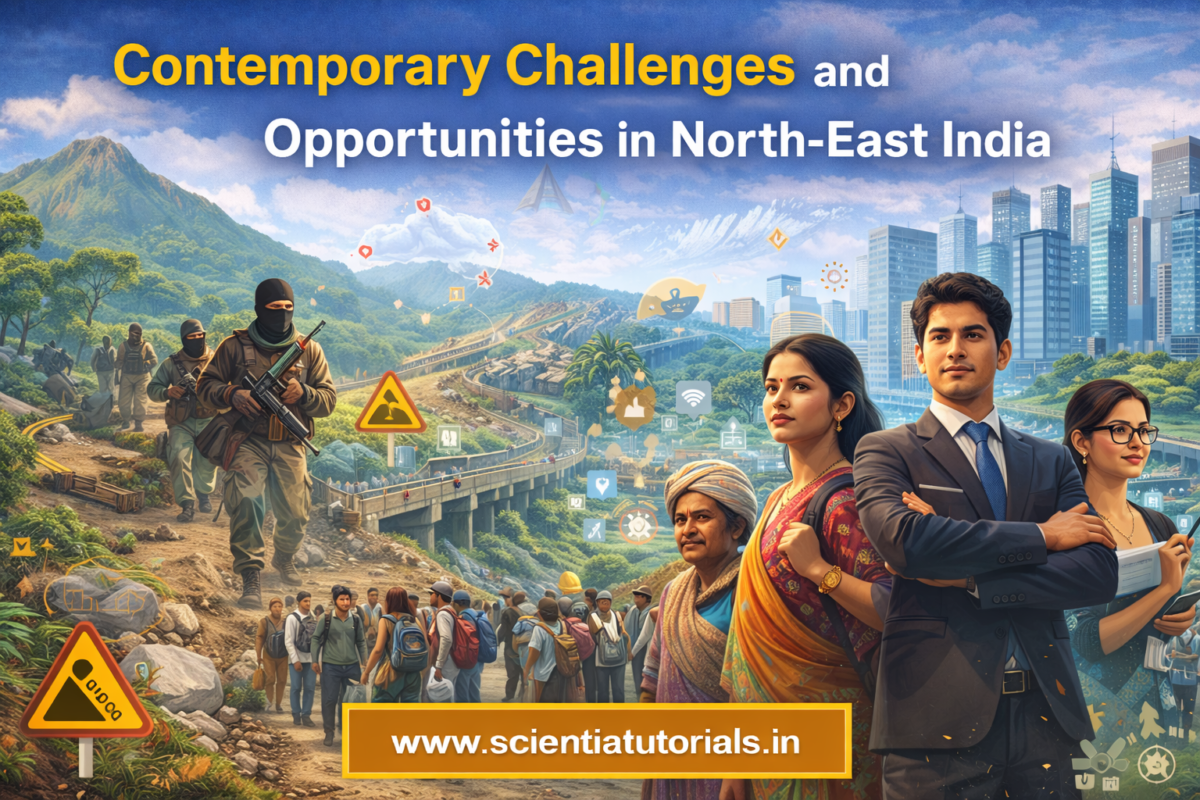

Contemporary Challenges and Opportunities in North-East India
Course: History of North-East India: From Early Kingdoms to Modern Integration
Module X: Contemporary North-East India – Development and Integration
Timeline / Era Covered: 2000 CE – Present
Lesson: Contemporary Challenges and Opportunities
This lesson is systematically organized into four clearly structured sections, as detailed below:
- Chronologically Structured Study Module
- Short-Answer Type Questions
- Long-Answer Type Questions
- Multiple-Choice Questions (MCQs) with Answers and Detailed Explanations
Chronologically Structured Study Module
1. Introduction
Since the beginning of the 21st century, North-East India has entered a critical phase marked by rapid transformation, increased national attention, and deeper integration with regional and global processes. Once perceived primarily through the lenses of remoteness, insurgency, and underdevelopment, the region today occupies a central position in debates on development, security, identity, connectivity, and sustainability.
However, this transformation has not been linear or uniform. Alongside emerging opportunities in infrastructure, education, trade, and cultural assertion, the region continues to face persistent challenges related to geography, ecology, identity politics, governance, and economic inclusion. This lesson examines the major contemporary challenges and opportunities confronting North-East India since 2000 CE, adopting a chronological and thematic approach essential for historical understanding and examination analysis.
2. Contextual Background: North-East India at the Turn of the 21st Century
At the dawn of the 2000s, North-East India was undergoing a transition from decades of political instability and limited connectivity toward gradual normalisation and development. Key features of this period included:
- Declining intensity of armed conflicts in several areas
- Growing emphasis on development-oriented governance
- Increased engagement of the central government
- Expansion of education and communication networks
These changes laid the foundation for both new opportunities and complex challenges that would define the contemporary era.
3. Major Contemporary Challenges
3.1 Geographical and Infrastructural Constraints
One of the most persistent challenges in North-East India is its difficult terrain and fragile ecology. Mountainous landscapes, dense forests, and high rainfall complicate infrastructure development.
Key issues include:
- High cost of road and railway construction
- Frequent disruptions due to landslides and floods
- Limited last-mile connectivity in remote areas
Despite improvements since 2000 CE, infrastructure gaps continue to hinder economic growth and service delivery.
3.2 Economic Underdevelopment and Employment Challenges
Although rich in natural and human resources, North-East India faces:
- Limited industrialisation
- Dependence on agriculture and government employment
- High educated youth unemployment
The lack of large-scale private investment and industrial clusters has constrained job creation, leading to out-migration of youth to other parts of India.
3.3 Insurgency, Conflict, and Security Concerns
While the intensity of insurgency has declined since the early 2000s, security challenges persist:
- Sporadic violence in certain pockets
- Border management issues
- Presence of ceasefire arrangements without final settlements
These factors affect investor confidence and slow down development initiatives.
3.4 Identity Politics and Ethnic Assertion
North-East India is characterised by extraordinary ethnic, linguistic, and cultural diversity. In the contemporary period:
- Identity-based movements continue to influence politics
- Demands for autonomy and recognition persist
- Ethnic tensions occasionally disrupt social harmony
Balancing identity assertion with inclusive development remains a major challenge.
3.5 Migration, Demography, and Social Tensions
Migration and demographic change have intensified debates over:
- Indigenous rights
- Citizenship and belonging
- Resource sharing
Demographic anxieties among indigenous communities often translate into political mobilisation, complicating social integration.
3.6 Environmental Degradation and Climate Vulnerability
North-East India is one of the most ecologically sensitive regions of India. Contemporary challenges include:
- Deforestation and land degradation
- Impact of large infrastructure projects
- Increasing frequency of floods and landslides due to climate change
Development without ecological safeguards threatens long-term sustainability.
3.7 Governance and Administrative Challenges
Despite increased funding and policy attention, governance issues persist:
- Implementation delays
- Coordination gaps between central and state agencies
- Limited administrative capacity in remote areas
Effective governance remains crucial for translating opportunities into outcomes.
4. Emerging Opportunities in Contemporary North-East India
Despite these challenges, the post-2000 period has also opened significant avenues of opportunity.
4.1 Infrastructure Expansion and Connectivity
The contemporary era has witnessed unprecedented investment in:
- Roads, railways, and bridges
- Airports and digital connectivity
- Border infrastructure
Improved connectivity has reduced physical isolation and integrated the region more closely with national markets.
4.2 Strategic and Geopolitical Importance
North-East India occupies a vital strategic position:
- Gateway to Southeast Asia
- Crucial for India’s eastern and Indo-Pacific engagements
- Strategic depth along international borders
This has increased national and international focus on the region’s development.
4.3 Economic Potential and Resource Utilisation
The region holds immense economic potential in:
- Agriculture and horticulture
- Hydropower and renewable energy
- Tourism and eco-tourism
- Handloom, handicrafts, and cultural industries
With proper investment and planning, these sectors can generate sustainable livelihoods.
4.4 Youth, Education, and Human Capital
Since 2000 CE:
- Expansion of universities and technical institutions
- Increased educational mobility
- Growing exposure to national and global opportunities
Educated youth represent one of the greatest opportunities for innovation, entrepreneurship, and social transformation.
4.5 Cultural Renaissance and Soft Power
North-East India has experienced a cultural resurgence:
- Growth of literature, music, fashion, and cinema
- Increased national and global recognition of artists
- Strong assertion of indigenous identities
Culture has become both an economic asset and a tool of social integration.
4.6 Digital Transformation
Digital connectivity has created new opportunities:
- E-governance and service delivery
- Online education and skill development
- Cultural self-representation through social media
Digital platforms help overcome geographical isolation.
4.7 Tourism and Heritage Economy
Tourism has emerged as a major opportunity:
- Eco-tourism and adventure tourism
- Cultural and heritage tourism
- Community-based tourism models
If sustainably managed, tourism can balance development with conservation.
5. Chronological Phases of Contemporary Change
5.1 Early 2000s: Stabilisation and Development Focus
- Decline in conflict intensity
- Emphasis on peace talks and ceasefires
- Renewed focus on infrastructure and governance
5.2 2010s: Integration and Strategic Engagement
- Acceleration of connectivity projects
- Greater national attention to the region
- Integration with broader development and foreign policy goals
5.3 Post-2020: Sustainability and Resilience
- Focus on climate resilience
- Digital governance
- Inclusive and sustainable development models
6. Balancing Challenges and Opportunities
The central question in contemporary North-East India is how to balance development with identity, security with democracy, and growth with sustainability.
Key requirements include:
- Participatory governance
- Respect for indigenous rights
- Environmentally sensitive development
- Youth-centric economic planning
7. Role of Policy and Institutions
Government policies since 2000 CE have increasingly recognised:
- The unique needs of the region
- The importance of decentralised planning
- The role of local communities
However, policy success depends on effective implementation and local participation.
8. North-East India and National Integration
Contemporary developments have strengthened:
- Emotional and economic integration with the Indian mainland
- Visibility of the region in national discourse
- Recognition of diversity within unity
Integration today is not about assimilation, but inclusive pluralism.
9. Future Prospects
The future of North-East India depends on:
- Harnessing its strategic location
- Investing in human capital
- Protecting ecological balance
- Transforming identity into strength rather than conflict
With sustained attention, the region can emerge as a model of inclusive, sustainable development.
10. Conclusion
Since 2000 CE, North-East India has stood at the crossroads of profound challenges and transformative opportunities. While geographical constraints, identity politics, economic limitations, and environmental vulnerabilities continue to pose difficulties, unprecedented investments in connectivity, education, culture, and strategic integration offer new possibilities.
Understanding contemporary challenges and opportunities is essential to grasp the region’s evolving place within India’s national history and future trajectory. For students and aspirants, this lesson provides a holistic framework to analyse North-East India not as a problem region, but as a region of potential, resilience, and strategic importance.
Short Answer Type Questions with Answers
1. What is meant by “contemporary challenges” in North-East India?
Answer:
Contemporary challenges refer to ongoing issues such as infrastructure gaps, unemployment, identity politics, environmental vulnerability, and governance problems faced since 2000 CE.
2. Which time period is covered in this lesson?
Answer:
The lesson covers the period from 2000 CE to the present.
3. Why is geography considered a major challenge for North-East India?
Answer:
Mountainous terrain, heavy rainfall, and fragile ecology make infrastructure development costly and difficult.
4. Mention one major infrastructure-related challenge in the region.
Answer:
Poor last-mile connectivity in remote and hill areas.
5. Why is unemployment a serious concern in North-East India?
Answer:
Limited industrialisation and private investment restrict job creation, especially for educated youth.
6. What impact has youth unemployment had on the region?
Answer:
It has led to large-scale out-migration to other parts of India.
7. How has insurgency changed since the early 2000s?
Answer:
The intensity of insurgency has declined, though sporadic violence and unresolved conflicts remain.
8. What is meant by identity politics in the North-East?
Answer:
Political mobilisation based on ethnic, linguistic, or cultural identity to seek recognition, autonomy, or rights.
9. Why does migration create social tension in the region?
Answer:
Migration raises concerns about demographic change, cultural survival, and access to resources.
10. What is demographic anxiety?
Answer:
Fear among indigenous communities of becoming minorities due to population changes.
11. Why is North-East India environmentally vulnerable?
Answer:
It is ecologically fragile and prone to floods, landslides, deforestation, and climate change impacts.
12. How does climate change affect development in the region?
Answer:
It increases natural disasters and threatens sustainable infrastructure and livelihoods.
13. Mention one governance-related challenge in North-East India.
Answer:
Delays in implementation of development projects due to administrative and coordination issues.
14. What is one major opportunity created by infrastructure expansion since 2000 CE?
Answer:
Improved connectivity and integration with national markets.
15. Why is North-East India strategically important?
Answer:
It serves as a gateway to Southeast Asia and holds significance in India’s eastern security and diplomacy.
16. Name two economic sectors with high potential in the North-East.
Answer:
Tourism and agriculture-based industries.
17. How does tourism act as an opportunity for development?
Answer:
It generates employment, promotes cultural heritage, and supports local economies.
18. What role does youth play in contemporary opportunities?
Answer:
Educated youth contribute to innovation, entrepreneurship, and social transformation.
19. How has education expanded since 2000 CE?
Answer:
Through the growth of universities, technical institutions, and access to higher education.
20. What is meant by cultural renaissance in the contemporary period?
Answer:
Renewed expression and global recognition of indigenous culture, arts, literature, and identity.
21. How has digital connectivity benefited the region?
Answer:
It improved governance, education access, entrepreneurship, and cultural self-representation.
22. Why is sustainable development important for North-East India?
Answer:
To balance economic growth with environmental protection and indigenous rights.
23. What does inclusive development mean in the regional context?
Answer:
Development that benefits all communities while respecting diversity and local participation.
24. How has national integration improved in the contemporary era?
Answer:
Through better connectivity, cultural visibility, and economic participation.
25. Why is this lesson important for competitive examinations?
Answer:
It links development, identity, environment, governance, and security in contemporary North-East India.
Long Answer Type Questions with Answers
1. Examine the major contemporary challenges faced by North-East India since 2000 CE.
Answer:
Since 2000 CE, North-East India has faced multiple interconnected challenges. These include geographical isolation due to difficult terrain, inadequate infrastructure, limited industrial development, and high unemployment. Identity politics, migration-related demographic anxieties, environmental degradation, and governance constraints further complicate development. Although conflict intensity has declined, unresolved insurgency-related issues still affect stability. Together, these challenges hinder inclusive and sustainable growth.
2. Discuss how geographical factors continue to influence development challenges in North-East India.
Answer:
The mountainous terrain, dense forests, heavy rainfall, and seismic vulnerability of North-East India significantly raise the cost of infrastructure development. Frequent floods and landslides disrupt transport, communication, and livelihoods. These geographical constraints limit industrial expansion, slow project execution, and restrict market access, making geography a persistent development challenge.
3. Analyse the problem of economic underdevelopment and unemployment in the region.
Answer:
Despite rich natural resources, North-East India remains economically underdeveloped due to limited industrialisation, low private investment, and overdependence on agriculture and government employment. Educated unemployment is widespread, leading to large-scale youth migration. The lack of value-added industries and entrepreneurial ecosystems has constrained job creation, making economic diversification a key necessity.
4. Examine the changing nature of insurgency and security challenges since the early 2000s.
Answer:
Since the early 2000s, insurgency in North-East India has declined in intensity due to peace talks, ceasefire agreements, and improved governance. However, sporadic violence, unresolved political demands, and border-related issues persist. These security concerns continue to influence development planning and investor confidence, even as the overall situation improves.
5. Discuss the role of identity politics as a contemporary challenge in North-East India.
Answer:
Identity politics remains a major challenge due to the region’s ethnic, linguistic, and cultural diversity. Movements demanding autonomy, recognition, and protection of indigenous rights influence political mobilisation. While identity assertion strengthens cultural confidence, it can also generate social tensions and complicate inclusive governance if not addressed sensitively.
6. Analyse how migration and demographic change contribute to social tensions in the region.
Answer:
Migration alters demographic composition, often creating fears among indigenous communities about cultural marginalisation and loss of political representation. These demographic anxieties fuel social tensions and identity-based movements. While migration also brings economic and cultural exchange, managing its social impact remains a critical challenge.
7. Examine environmental challenges and their implications for development in North-East India.
Answer:
North-East India is ecologically fragile, facing deforestation, biodiversity loss, floods, landslides, and climate change impacts. Large infrastructure projects sometimes threaten environmental balance. Unsustainable development risks long-term ecological damage, making environmental protection central to the region’s future development strategy.
8. Discuss governance and administrative challenges in implementing development policies.
Answer:
Governance challenges include weak institutional capacity, delays in project execution, coordination gaps between central and state agencies, and limited reach in remote areas. Effective governance is essential to convert policy initiatives into tangible outcomes and ensure that development benefits reach local communities.
9. Evaluate the opportunities created by infrastructure expansion since 2000 CE.
Answer:
Infrastructure expansion has significantly reduced isolation by improving road, rail, air, and digital connectivity. These developments have enhanced market access, mobility, service delivery, and national integration. Improved connectivity also strengthens strategic preparedness and economic potential.
10. Analyse the strategic and geopolitical importance of North-East India in the contemporary period.
Answer:
North-East India holds strategic importance as a border region and gateway to Southeast Asia. It plays a crucial role in India’s eastern security architecture and regional engagement. This strategic relevance has increased national focus on the region’s stability and development within India’s broader geopolitical vision.
11. Discuss the economic opportunities available in agriculture and allied sectors.
Answer:
The region’s fertile land, biodiversity, and favourable climate offer strong potential for agriculture, horticulture, organic farming, and agro-processing. Value addition, improved market linkages, and sustainable practices can generate livelihoods while preserving ecological balance.
12. Examine the role of tourism as an opportunity for sustainable development.
Answer:
Tourism, particularly eco-tourism, cultural tourism, and adventure tourism, has emerged as a major opportunity. It generates employment, promotes cultural heritage, and encourages community participation. Sustainable tourism models are essential to prevent environmental and cultural degradation.
13. Analyse the significance of youth and human capital in shaping future opportunities.
Answer:
The expanding educated youth population represents a major asset. Access to education, skill development, and entrepreneurship can transform the region’s economy. Youth engagement is crucial for innovation, leadership, and long-term social transformation.
14. Discuss how education has expanded opportunities in the contemporary era.
Answer:
Since 2000 CE, expansion of universities, technical institutes, and digital learning has improved access to higher education. Education has enhanced mobility, awareness, and employability, empowering youth to participate in regional and national development.
15. Examine the role of cultural renaissance as an opportunity for integration and development.
Answer:
The cultural renaissance has increased national and global recognition of North-East India’s arts, literature, music, and fashion. Culture functions as soft power, strengthens identity, and supports creative industries, contributing to both economic growth and social integration.
16. Analyse the impact of digital transformation on development opportunities.
Answer:
Digital connectivity has improved governance, education, entrepreneurship, and cultural expression. E-governance, online education, and digital markets help overcome geographical isolation and integrate the region into national and global networks.
17. Discuss the importance of sustainable development in addressing both challenges and opportunities.
Answer:
Sustainable development ensures that economic growth does not compromise ecological balance or indigenous rights. Environmentally sensitive planning, community participation, and long-term vision are essential to convert opportunities into lasting benefits.
18. Examine how contemporary developments have strengthened national integration.
Answer:
Improved connectivity, cultural visibility, and economic participation have strengthened emotional and economic integration with the Indian mainland. Integration today respects diversity and promotes pluralism rather than assimilation.
19. Analyse the balance between development and identity in contemporary North-East India.
Answer:
Balancing development with identity requires inclusive policies that respect cultural diversity while promoting economic growth. Participatory governance and recognition of indigenous rights help ensure that development does not become a source of conflict.
20. Conclude by evaluating the overall significance of contemporary challenges and opportunities in shaping North-East India’s future.
Answer:
Contemporary North-East India stands at a crossroads of persistent challenges and emerging opportunities. While geography, identity politics, environmental vulnerability, and governance issues continue to pose obstacles, infrastructure expansion, strategic importance, youth potential, and cultural resurgence offer transformative possibilities. The region’s future depends on inclusive, sustainable, and participatory development that turns challenges into opportunities for long-term integration and prosperity.
MCQs with Answers and Explanations
1. The term “contemporary” in the context of this lesson refers to the period:
A. 1947–1962
B. 1962–1990
C. 1991–2000
D. 2000 CE–Present
✅ Correct Answer: D. 2000 CE–Present
Explanation:
Module X focuses on developments, challenges, and opportunities in North-East India from 2000 CE onwards, reflecting present-day realities.
2. Which factor most strongly contributes to infrastructural challenges in North-East India?
A. High population density
B. Difficult terrain and fragile ecology
C. Industrial congestion
D. Over-urbanisation
✅ Correct Answer: B. Difficult terrain and fragile ecology
Explanation:
Mountainous landscapes, heavy rainfall, and ecological sensitivity increase construction costs and disrupt connectivity.
3. Economic underdevelopment in North-East India is mainly characterised by:
A. Excess industrialisation
B. Overdependence on agriculture and government jobs
C. High private investment
D. Industrial labour surplus
✅ Correct Answer: B. Overdependence on agriculture and government jobs
Explanation:
Limited industrial growth and private sector participation restrict employment diversification.
4. Educated youth unemployment in the region has led to:
A. Decline in education
B. Large-scale out-migration
C. Cultural isolation
D. Reduced aspirations
✅ Correct Answer: B. Large-scale out-migration
Explanation:
Lack of local employment pushes educated youth to migrate to other parts of India.
5. Which trend best describes insurgency in North-East India since the early 2000s?
A. Continuous escalation
B. Complete elimination
C. Decline in intensity with unresolved issues
D. Expansion to urban centres
✅ Correct Answer: C. Decline in intensity with unresolved issues
Explanation:
Peace talks and ceasefires reduced violence, but political settlements remain incomplete.
6. Identity politics in North-East India mainly revolves around:
A. Industrial class conflict
B. Ethnic, linguistic, and cultural assertion
C. Religious fundamentalism alone
D. Urban–rural divide
✅ Correct Answer: B. Ethnic, linguistic, and cultural assertion
Explanation:
Identity-based movements seek recognition, autonomy, and protection of indigenous rights.
7. Migration-related demographic anxiety refers to:
A. Fear of economic recession
B. Fear of cultural and political marginalisation
C. Fear of climate change
D. Fear of urbanisation
✅ Correct Answer: B. Fear of cultural and political marginalisation
Explanation:
Indigenous communities worry about becoming minorities due to population changes.
8. North-East India is considered environmentally vulnerable mainly because of:
A. Desertification
B. Industrial pollution
C. Ecological fragility and climate change
D. Low rainfall
✅ Correct Answer: C. Ecological fragility and climate change
Explanation:
Floods, landslides, deforestation, and climate impacts threaten sustainability.
9. One major governance challenge in the region is:
A. Excess decentralisation
B. Implementation delays and coordination gaps
C. Overstaffing
D. Absence of policies
✅ Correct Answer: B. Implementation delays and coordination gaps
Explanation:
Administrative capacity and inter-agency coordination remain uneven.
10. Which development since 2000 CE has most reduced regional isolation?
A. Cultural festivals
B. Infrastructure and connectivity expansion
C. Population growth
D. Traditional agriculture
✅ Correct Answer: B. Infrastructure and connectivity expansion
Explanation:
Roads, railways, air links, and digital networks improved integration.
11. The strategic importance of North-East India lies primarily in its:
A. Mineral wealth
B. Population size
C. Gateway position to Southeast Asia
D. Industrial output
✅ Correct Answer: C. Gateway position to Southeast Asia
Explanation:
Its location enhances India’s eastern security and regional engagement.
12. Which sector has high potential for sustainable livelihoods in the region?
A. Heavy manufacturing
B. Eco-tourism
C. Defence production
D. Large-scale mining
✅ Correct Answer: B. Eco-tourism
Explanation:
Eco-tourism balances employment generation with environmental conservation.
13. Tourism as an opportunity is significant because it:
A. Replaces agriculture
B. Promotes culture and local employment
C. Causes urban congestion
D. Reduces cultural diversity
✅ Correct Answer: B. Promotes culture and local employment
Explanation:
Cultural and nature-based tourism supports community-based development.
14. The expansion of higher education since 2000 CE has mainly resulted in:
A. Decline in mobility
B. Increased skill and awareness
C. Cultural stagnation
D. Reduced migration
✅ Correct Answer: B. Increased skill and awareness
Explanation:
Education has expanded aspirations and participation in wider opportunities.
15. Youth are considered a major opportunity because they:
A. Depend entirely on government jobs
B. Drive innovation and entrepreneurship
C. Avoid regional development
D. Resist modernisation
✅ Correct Answer: B. Drive innovation and entrepreneurship
Explanation:
Educated youth can transform the region’s economy and society.
16. Cultural renaissance in the contemporary period refers to:
A. Decline of indigenous culture
B. Revival and global recognition of local cultures
C. Cultural homogenisation
D. Cultural isolation
✅ Correct Answer: B. Revival and global recognition of local cultures
Explanation:
Arts, literature, music, and fashion from the region have gained visibility.
17. Digital transformation has benefited North-East India mainly by:
A. Increasing isolation
B. Improving governance and access to services
C. Reducing education
D. Limiting entrepreneurship
✅ Correct Answer: B. Improving governance and access to services
Explanation:
E-governance, online education, and digital markets reduce geographical barriers.
18. Sustainable development is crucial because it:
A. Slows economic growth
B. Balances growth with ecology and identity
C. Promotes cultural erasure
D. Focuses only on environment
✅ Correct Answer: B. Balances growth with ecology and identity
Explanation:
Unsustainable growth can damage fragile ecosystems and social harmony.
19. Inclusive development in the North-East implies:
A. Uniform policies for all regions
B. Ignoring local diversity
C. Development with community participation
D. Centralised decision-making only
✅ Correct Answer: C. Development with community participation
Explanation:
Local involvement ensures equitable and culturally sensitive outcomes.
20. Contemporary national integration differs from earlier phases because it emphasises:
A. Assimilation
B. Cultural homogenisation
C. Pluralism and diversity
D. Political isolation
✅ Correct Answer: C. Pluralism and diversity
Explanation:
Integration today respects regional identities within national unity.
21. Which period saw greater strategic and policy attention to the North-East?
A. Pre-1991
B. Early colonial period
C. Post-2010
D. 1950s
✅ Correct Answer: C. Post-2010
Explanation:
Connectivity, security, and regional engagement increased after 2010.
22. One major opportunity of digital connectivity is:
A. Decline in traditional skills
B. Cultural self-representation
C. Increased unemployment
D. Reduced education access
✅ Correct Answer: B. Cultural self-representation
Explanation:
Digital platforms allow communities to present their own narratives.
23. Balancing development and identity requires:
A. Suppression of identity
B. Participatory and sensitive governance
C. Economic growth alone
D. Centralisation of power
✅ Correct Answer: B. Participatory and sensitive governance
Explanation:
Inclusive policies reduce conflict and strengthen trust.
24. Which factor best converts challenges into opportunities?
A. Military presence
B. Short-term policies
C. Long-term sustainable planning
D. Ignoring local needs
✅ Correct Answer: C. Long-term sustainable planning
Explanation:
Strategic planning aligns development with environmental and social realities.
25. Why is “Contemporary Challenges and Opportunities” important for competitive exams?
A. It is purely descriptive
B. It links development, identity, environment, and governance
C. It focuses only on geography
D. It is outdated
✅ Correct Answer: B. It links development, identity, environment, and governance
Explanation:
The topic is interdisciplinary and highly relevant for analytical questions.