
Linguistic Diversity: Tibeto-Burman, Indo-Aryan, and Austroasiatic Traditions
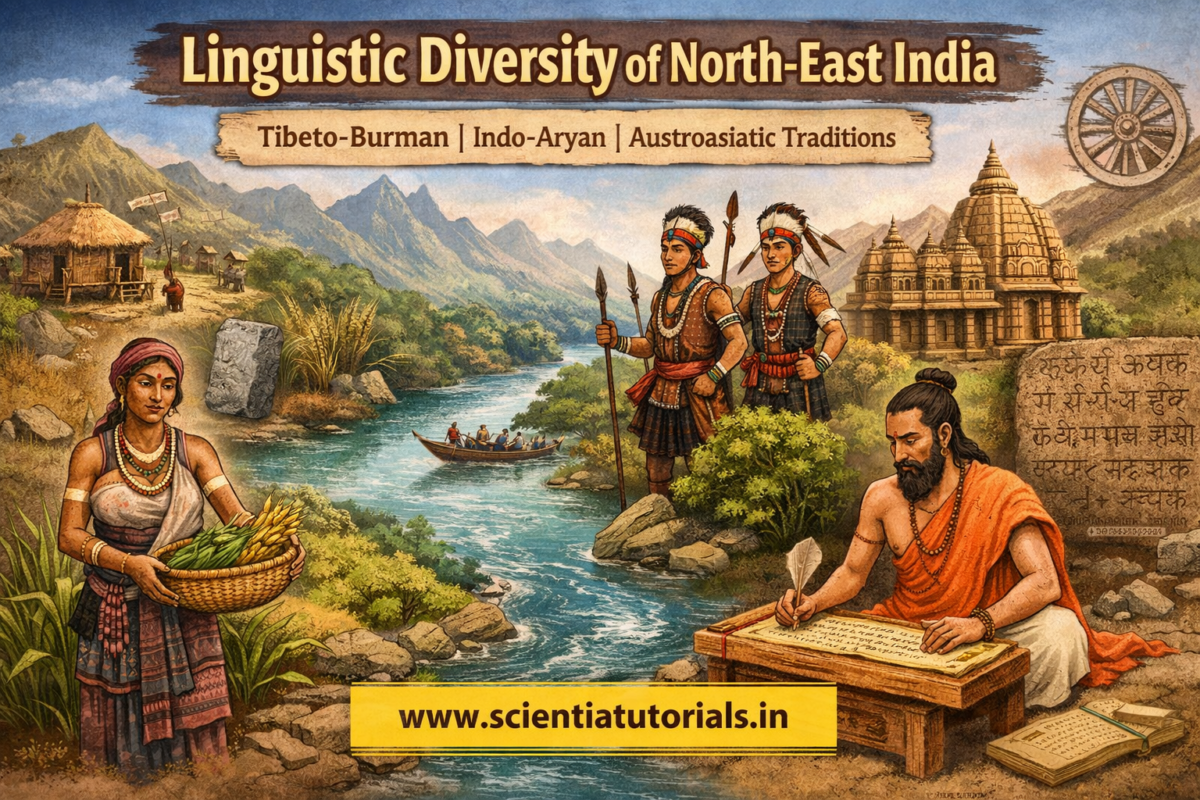

Linguistic Diversity of North-East India: Tibeto-Burman, Indo-Aryan & Austroasiatic Traditions
Course: History of North-East India: From Early Kingdoms to Modern Integration
Module I: Geographical, Ethnic, and Cultural Foundations of North-East India
Timeline / Era Covered: Prehistory – Early Historic Background (Before 4th Century CE)
Lesson: Linguistic Diversity – Tibeto-Burman, Indo-Aryan, and Austroasiatic Traditions
This lesson is systematically organized into four clearly structured sections, as detailed below:
- Chronologically Structured Study Module
- Short-Answer Type Questions
- Long-Answer Type Questions
- Multiple-Choice Questions (MCQs) with Answers and Detailed Explanations
Chronologically Structured Study Module
Introduction: Language as a Historical Source in North-East India
The linguistic diversity of North-East India represents one of the most complex and historically layered cultural landscapes in the Indian subcontinent. From the prehistoric era to the early historic period (before the 4th century CE), language functioned not merely as a medium of communication but as a crucial marker of migration, ethnic identity, social organization, and cultural exchange. The region’s position at the crossroads of South Asia, Southeast Asia, and East Asia ensured continuous human movement, resulting in the coexistence and interaction of multiple linguistic traditions.
This lesson focuses on three major linguistic families that shaped the early history of North-East India: Tibeto-Burman, Indo-Aryan, and Austroasiatic. A chronological and examination-oriented approach is adopted to help learners understand how these linguistic traditions emerged, spread, interacted, and laid the foundations for later political and cultural developments.
Chronological Framework of Linguistic Development (Prehistory – Early Historic Period)
For analytical clarity, the linguistic history of North-East India can be divided into three overlapping chronological phases:
- Prehistoric Phase (Before 2000 BCE) – Dominance of Austroasiatic and early Tibeto-Burman speakers
- Proto-Historic Phase (c. 2000 BCE – 500 BCE) – Expansion and consolidation of Tibeto-Burman groups
- Early Historic Phase (c. 500 BCE – 4th Century CE) – Arrival and establishment of Indo-Aryan linguistic traditions
This periodization is not rigid but helps in understanding linguistic evolution alongside archaeological and cultural changes.
Linguistic Geography of North-East India
The physical geography of the region—river valleys, hills, plateaus, and mountain corridors—played a decisive role in shaping linguistic distribution. The Brahmaputra and Barak valleys acted as corridors for movement and cultural interaction, while hill ranges provided relative isolation, preserving linguistic diversity.
I. Austroasiatic Linguistic Tradition: The Earliest Layer
1. Chronological Background
The Austroasiatic linguistic tradition is widely regarded as the earliest linguistic stratum in parts of eastern and north-eastern India. Linguistic and archaeological correlations suggest that Austroasiatic speakers may have entered the region during the Neolithic phase, bringing with them early agricultural practices.
2. Geographical Spread
In the context of North-East India, Austroasiatic languages were historically present in the western fringes of the region, particularly in areas bordering present-day Assam, Meghalaya, and adjoining eastern India. These languages are closely associated with early forest-based and agrarian communities.
3. Cultural and Economic Significance
Austroasiatic-speaking groups are often linked with:
- Early slash-and-burn agriculture
- Domestication of plants
- Development of forest-based economies
- Clan-based social organization
These features are important for understanding the prehistoric cultural foundations of the region.
4. Historical Importance
Although later linguistic expansions marginalized Austroasiatic languages in much of North-East India, their influence survives in:
- Place names
- Agricultural vocabulary
- Substratum elements in later languages
For examination purposes, Austroasiatic languages are crucial as evidence of prehistoric migrations and early cultural diffusion.
II. Tibeto-Burman Linguistic Tradition: The Dominant Indigenous Layer
1. Origins and Migration
The Tibeto-Burman linguistic family constitutes the most widespread and influential linguistic tradition in North-East India. Linguistic evidence points toward migrations from regions north and east of the Himalayas into the hills and valleys of North-East India between c. 2000 BCE and 500 BCE.
2. Areas of Dominance
By the proto-historic period, Tibeto-Burman languages became dominant in:
- Hill regions of Arunachal Pradesh, Nagaland, Manipur, Mizoram, and Meghalaya
- Parts of the Brahmaputra valley before Indo-Aryan expansion
3. Social and Political Organization
Tibeto-Burman-speaking societies were characterized by:
- Strong kinship and clan systems
- Village republics and chieftainships
- Oral traditions, folk epics, and ritual languages
These features later influenced early political formations and resistance to external control.
4. Linguistic Characteristics
From a historical-linguistic perspective, Tibeto-Burman languages show:
- Tonal variations
- Agglutinative structures
- Rich oral traditions rather than early scripts
This explains the absence of early inscriptions in Tibeto-Burman languages despite their wide usage.
5. Historical Significance
The Tibeto-Burman tradition is central to understanding:
- Indigenous identity formation
- Continuity of tribal institutions
- Cultural resilience against later political centralization
For competitive exams, this linguistic family is often linked with ethno-cultural continuity and hill-based autonomy.
III. Indo-Aryan Linguistic Tradition: Early Historic Transformation
1. Chronological Entry
Indo-Aryan languages entered North-East India during the early historic period (c. 500 BCE onwards), primarily through the Brahmaputra valley. This expansion was gradual and closely associated with trade, state formation, and religious dissemination.
2. Geographical Focus
The Indo-Aryan linguistic influence was strongest in:
- The Brahmaputra valley
- Lower Assam plains
- Trade-linked riverine settlements
These areas later became centers of political power.
3. Role of Sanskrit and Prakrit
Early Indo-Aryan influence was mediated through:
- Sanskrit as a liturgical and elite language
- Prakrits as languages of administration and commerce
This linguistic shift marked the transition from proto-history to recorded history.
4. Cultural and Religious Impact
The spread of Indo-Aryan languages coincided with:
- Introduction of Brahmanical rituals
- Growth of early Hindu traditions
- Emergence of early state systems
This period laid the linguistic foundation for the rise of the Kamarupa kingdom in the subsequent centuries.
5. Examination Relevance
Indo-Aryan linguistic expansion is often examined in relation to:
- State formation
- Sanskritization
- Integration of North-East India into the broader Indian cultural sphere
Linguistic Interaction and Cultural Synthesis
Rather than replacing earlier languages, Indo-Aryan traditions interacted with Tibeto-Burman and Austroasiatic languages. This resulted in:
- Borrowing of vocabulary
- Hybrid cultural practices
- Multilingual societies
Such interaction is evident in early Assamese, which absorbed Tibeto-Burman phonetic and lexical elements.
Language, Identity, and Early Society
Language functioned as:
- A marker of ethnic identity
- A tool of political authority
- A medium of cultural transmission
Hill societies retained linguistic autonomy, while plains witnessed linguistic standardization due to political centralization.
Historiographical Perspectives
Modern historians and linguists use:
- Comparative linguistics
- Archaeological correlations
- Ethnographic studies
to reconstruct early linguistic history. Linguistic evidence is especially valuable in periods lacking written records.
Examination-Oriented Key Points
- Austroasiatic languages represent the earliest linguistic layer
- Tibeto-Burman languages form the core indigenous tradition
- Indo-Aryan languages mark the early historic transition
- Linguistic diversity reflects migration, adaptation, and interaction
- Language is a crucial tool for reconstructing pre-literate history
Practice Questions for Competitive Exams
Short Answer:
- Explain the significance of Tibeto-Burman languages in the cultural history of North-East India.
Descriptive:
2. Discuss the role of linguistic diversity in shaping the early historical identity of North-East India.
Analytical:
3. Examine how Indo-Aryan linguistic expansion contributed to early state formation in the Brahmaputra valley.
Conclusion
The linguistic diversity of North-East India during the prehistoric and early historic periods provides deep insights into the region’s migration patterns, cultural evolution, and social structures. The coexistence of Austroasiatic, Tibeto-Burman, and Indo-Aryan traditions highlights a long history of interaction rather than isolation. Understanding these linguistic foundations is essential for comprehending the later political integration and cultural synthesis of North-East India, making this topic indispensable for academic study and competitive examinations alike.
Short Answer Type Questions (With Answers)
1. What is meant by linguistic diversity in North-East India?
Answer:
Linguistic diversity in North-East India refers to the coexistence of multiple language families—primarily Tibeto-Burman, Indo-Aryan, and Austroasiatic—shaped by prehistoric migrations, geographical isolation, and long-term cultural interaction.
2. Name the three major linguistic families found in early North-East India.
Answer:
The three major linguistic families are Austroasiatic, Tibeto-Burman, and Indo-Aryan.
3. Which linguistic group is considered the earliest in North-East India?
Answer:
The Austroasiatic linguistic group is considered the earliest linguistic layer in parts of North-East India.
4. During which period did Austroasiatic languages likely enter the region?
Answer:
Austroasiatic languages likely entered the region during the Neolithic or prehistoric period, before 2000 BCE.
5. What economic activities are associated with early Austroasiatic-speaking communities?
Answer:
They are associated with early agriculture, forest-based subsistence, slash-and-burn cultivation, and plant domestication.
6. Which linguistic family dominates the hill regions of North-East India?
Answer:
The Tibeto-Burman linguistic family dominates the hill regions of North-East India.
7. From which direction did Tibeto-Burman languages spread into North-East India?
Answer:
Tibeto-Burman languages spread from regions north and east of the Himalayas into North-East India.
8. Mention one key social feature of Tibeto-Burman-speaking societies.
Answer:
A key social feature is the presence of strong clan and kinship-based social organization.
9. Why are early written records absent in Tibeto-Burman languages?
Answer:
Because Tibeto-Burman societies relied heavily on oral traditions and did not develop early scripts.
10. How did geography influence linguistic diversity in North-East India?
Answer:
Hills promoted linguistic isolation and diversity, while river valleys like the Brahmaputra facilitated migration, interaction, and linguistic change.
11. When did Indo-Aryan languages enter North-East India?
Answer:
Indo-Aryan languages entered during the early historic period, around 500 BCE onwards.
12. Which region first experienced Indo-Aryan linguistic influence?
Answer:
The Brahmaputra valley was the first region to experience Indo-Aryan linguistic influence.
13. Name two languages through which Indo-Aryan influence spread.
Answer:
Sanskrit and Prakrit.
14. What role did Sanskrit play in early North-East India?
Answer:
Sanskrit functioned as a religious, literary, and elite language, linked with administration and ritual practices.
15. How is linguistic change linked with state formation in the region?
Answer:
Indo-Aryan languages supported administration, trade, and religious institutions, which contributed to early state formation in the plains.
16. Did Indo-Aryan languages completely replace earlier languages?
Answer:
No, they interacted and coexisted with Tibeto-Burman and Austroasiatic languages, leading to cultural synthesis.
17. What is meant by linguistic substratum?
Answer:
Linguistic substratum refers to features of earlier languages that survive within later dominant languages.
18. Give one example of linguistic interaction in North-East India.
Answer:
Early Assamese absorbed phonetic and lexical elements from Tibeto-Burman languages.
19. Why is language an important source for reconstructing early history?
Answer:
Because linguistic evidence helps trace migration, cultural interaction, and social organization in periods lacking written records.
20. Which linguistic group is associated with village republics and chieftainships?
Answer:
The Tibeto-Burman linguistic group.
21. How did linguistic identity differ between hills and plains?
Answer:
Hill societies preserved linguistic autonomy, while plains experienced standardization due to political centralization.
22. What does linguistic diversity indicate about migration patterns?
Answer:
It indicates multiple waves of migration and long-term human settlement from different cultural zones.
23. Which linguistic family is most closely linked with early historic records?
Answer:
The Indo-Aryan linguistic family.
24. Mention one historiographical method used to study early languages.
Answer:
Comparative linguistics.
25. Why is the study of linguistic diversity important for competitive exams?
Answer:
Because it explains ethnic origins, cultural continuity, and historical integration of North-East India, frequently asked in prelims and mains.
Long Answer Type Questions with Answers
1. Discuss the significance of linguistic diversity in understanding the early history of North-East India.
Answer:
Linguistic diversity is one of the most important tools for reconstructing the early history of North-East India, especially for periods where written sources are absent. The coexistence of Austroasiatic, Tibeto-Burman, and Indo-Aryan language families reflects successive waves of migration, settlement patterns, and long-term cultural interaction. Language provides evidence of prehistoric human movement, social organization, and cultural continuity. The diversity also explains why North-East India developed distinct identities while remaining connected to the broader Indian and Southeast Asian cultural worlds.
2. Examine the role of Austroasiatic languages in the prehistoric cultural foundations of North-East India.
Answer:
Austroasiatic languages represent the earliest linguistic layer in parts of eastern and north-eastern India. Their speakers are associated with Neolithic cultures, early agriculture, and forest-based economies. Though later linguistic expansions reduced their dominance, Austroasiatic influences survived in agricultural terminology, place names, and cultural practices. Their presence highlights the prehistoric roots of human settlement and demonstrates that North-East India was inhabited long before the emergence of recorded history.
3. Trace the origins and migration of Tibeto-Burman language speakers into North-East India.
Answer:
Tibeto-Burman speakers are believed to have migrated from regions north and east of the Himalayas between c. 2000 BCE and 500 BCE. They gradually settled in the hill regions and river valleys of North-East India. Over time, they became the dominant linguistic group, especially in hilly terrains. These migrations shaped the ethnic composition of the region and laid the foundation for indigenous social and political institutions.
4. Analyze the geographical factors that contributed to linguistic diversity in North-East India.
Answer:
The region’s geography—characterized by hills, valleys, rivers, and dense forests—played a crucial role in linguistic diversification. Hill ranges encouraged isolation and preservation of distinct languages, while river valleys such as the Brahmaputra facilitated migration, trade, and linguistic interaction. Geography thus ensured both diversity and contact, producing a complex linguistic mosaic.
5. Discuss the social organization of Tibeto-Burman-speaking communities in early North-East India.
Answer:
Tibeto-Burman-speaking societies were organized around clans, kinship networks, and village communities. Political authority often rested with chiefs or councils rather than centralized states. Oral traditions, customary laws, and ritual practices governed social life. This structure ensured cultural continuity and resistance to external domination.
6. Why are Tibeto-Burman languages considered central to indigenous identity in North-East India?
Answer:
Tibeto-Burman languages are central to indigenous identity because they are closely linked with traditional institutions, customs, and belief systems. The continued use of these languages reflects cultural resilience and historical continuity. They serve as markers of ethnic identity and social autonomy.
7. Explain the absence of early written records in Tibeto-Burman linguistic traditions.
Answer:
The absence of early written records is due to the reliance on oral traditions rather than script-based communication. Knowledge, history, and rituals were transmitted orally through folklore, myths, and songs. This does not indicate cultural inferiority but reflects a different mode of historical transmission.
8. Examine the entry of Indo-Aryan languages into North-East India during the early historic period.
Answer:
Indo-Aryan languages entered North-East India around 500 BCE, primarily through the Brahmaputra valley. Their spread was gradual and linked with trade, religious activities, and administrative needs. This marked the transition from proto-history to recorded history in the region.
9. Discuss the role of Sanskrit in the linguistic transformation of early North-East India.
Answer:
Sanskrit played a key role as a language of religion, learning, and administration. Its introduction facilitated the spread of Brahmanical traditions and formal political institutions. Sanskrit inscriptions and texts provide the earliest written records of the region’s history.
10. How did Prakrits contribute to early administration and trade in North-East India?
Answer:
Prakrits functioned as practical languages of communication among traders and administrators. They bridged elite Sanskrit culture and local linguistic traditions, enabling broader participation in economic and political processes.
11. Analyze the relationship between Indo-Aryan linguistic expansion and early state formation.
Answer:
Indo-Aryan languages supported the development of administrative systems, taxation, and legal frameworks. This linguistic shift facilitated political centralization and the emergence of early states in the plains, especially in the Brahmaputra valley.
12. Discuss linguistic interaction and cultural synthesis in early North-East India.
Answer:
Rather than replacing earlier languages, Indo-Aryan traditions interacted with Tibeto-Burman and Austroasiatic languages. This resulted in shared vocabulary, cultural practices, and hybrid social systems. Such synthesis enriched the region’s cultural heritage.
13. Explain the concept of linguistic substratum with reference to North-East India.
Answer:
A linguistic substratum refers to features of earlier languages that survive within later dominant languages. In North-East India, Tibeto-Burman phonetic and lexical elements influenced emerging Indo-Aryan languages, particularly early Assamese.
14. How did language function as a marker of ethnic identity in early North-East India?
Answer:
Language distinguished communities, preserved traditions, and reinforced group identity. It defined social boundaries and played a key role in maintaining cultural autonomy, especially in hill societies.
15. Compare linguistic developments in the hills and plains of North-East India.
Answer:
Hill regions retained linguistic diversity due to isolation and clan-based societies, while plains experienced linguistic standardization due to political centralization and administrative needs. This contrast shaped distinct cultural trajectories.
16. Evaluate the importance of linguistic evidence in reconstructing pre-literate history.
Answer:
In the absence of written records, linguistic evidence helps trace migration routes, cultural contacts, and social structures. Comparative linguistics is therefore essential for understanding early North-East Indian history.
17. Discuss the role of migration in shaping linguistic patterns in North-East India.
Answer:
Multiple waves of migration introduced new languages and cultures. Interaction among migrants and indigenous populations created layered linguistic traditions, reflecting continuous human movement.
18. Explain how linguistic diversity reflects cultural continuity rather than fragmentation.
Answer:
Despite diversity, shared cultural practices and long-term interaction created unity. Linguistic plurality coexisted with cultural exchange, producing a composite regional identity.
19. Assess the contribution of language to the integration of North-East India into the Indian cultural sphere.
Answer:
Indo-Aryan languages facilitated administrative integration and religious exchange, linking the region with the broader subcontinental culture while preserving local identities.
20. Discuss the historiographical approaches used to study early linguistic traditions.
Answer:
Historians use comparative linguistics, archaeology, and ethnography to reconstruct early linguistic history. These interdisciplinary methods compensate for the lack of written sources.
21. Analyze the long-term impact of early linguistic traditions on later historical developments.
Answer:
Early linguistic foundations influenced political structures, cultural identity, and resistance to external control. They shaped later kingdoms and modern ethnic identities.
22. Explain why linguistic diversity is a recurring theme in competitive examinations on North-East India.
Answer:
It explains migration, ethnicity, state formation, and cultural integration—key themes in both prelims and mains examinations.
23. Discuss language as a tool of political authority in early North-East India.
Answer:
Control over administrative and ritual languages strengthened political authority in plains, while local languages preserved autonomy in hills.
24. Examine the continuity of indigenous linguistic traditions despite external influences.
Answer:
Indigenous languages survived through oral traditions and social institutions, demonstrating resilience and adaptability.
25. Conclude by evaluating the overall historical importance of linguistic diversity in North-East India.
Answer:
Linguistic diversity is central to understanding the region’s early history, revealing patterns of migration, interaction, and cultural synthesis. It provides the foundation for interpreting later political integration and regional identity.
MCQs with Answers and Explanations
1. Which linguistic group is considered the earliest linguistic layer in parts of North-East India?
A. Indo-Aryan
B. Tibeto-Burman
C. Austroasiatic
D. Dravidian
Correct Answer: C. Austroasiatic
Explanation:
Austroasiatic languages are regarded as the earliest linguistic stratum in eastern and north-eastern India. They are associated with Neolithic communities, early agriculture, and forest-based economies, predating Tibeto-Burman and Indo-Aryan expansions.
2. The Tibeto-Burman linguistic family is primarily associated with which geographical region of North-East India?
A. Coastal plains
B. Hill and mountainous regions
C. Deltaic regions
D. Desert tracts
Correct Answer: B. Hill and mountainous regions
Explanation:
Tibeto-Burman languages dominate the hill regions of North-East India. The rugged terrain encouraged isolation, allowing these languages to survive with minimal external influence.
3. From which direction did Tibeto-Burman speakers migrate into North-East India?
A. Western India
B. Central India
C. North and East of the Himalayas
D. Southern India
Correct Answer: C. North and East of the Himalayas
Explanation:
Linguistic and anthropological evidence suggests Tibeto-Burman speakers migrated from regions north and east of the Himalayas into North-East India between c. 2000 BCE and 500 BCE.
4. Which factor most strongly contributed to linguistic diversity in North-East India?
A. Uniform political administration
B. Industrialization
C. Geographical isolation and varied terrain
D. Colonial education
Correct Answer: C. Geographical isolation and varied terrain
Explanation:
Hills, forests, and river valleys created natural barriers and corridors, promoting both linguistic isolation and interaction, leading to exceptional diversity.
5. Austroasiatic-speaking communities are closely associated with which economic activity?
A. Nomadic pastoralism
B. Maritime trade
C. Early agriculture and forest-based economy
D. Industrial production
Correct Answer: C. Early agriculture and forest-based economy
Explanation:
Austroasiatic speakers practiced early forms of agriculture, plant domestication, and forest-based subsistence, reflecting their prehistoric origins.
6. Which linguistic tradition relied primarily on oral transmission rather than written records?
A. Indo-Aryan
B. Tibeto-Burman
C. Persian
D. Latin
Correct Answer: B. Tibeto-Burman
Explanation:
Tibeto-Burman societies preserved history and culture through oral traditions, folklore, myths, and ritual narratives rather than scripts.
7. Indo-Aryan languages entered North-East India mainly during which period?
A. Paleolithic period
B. Mesolithic period
C. Early historic period
D. Medieval period
Correct Answer: C. Early historic period
Explanation:
Indo-Aryan languages entered the region around 500 BCE, marking the transition from proto-history to recorded history.
8. The spread of Indo-Aryan languages in North-East India was closely linked with:
A. Nomadic invasions
B. Maritime colonization
C. Trade, religion, and administration
D. Industrial expansion
Correct Answer: C. Trade, religion, and administration
Explanation:
Indo-Aryan languages spread gradually through trade networks, religious institutions, and administrative systems rather than sudden conquest.
9. Which language functioned as the elite and religious language in early North-East India?
A. Prakrit
B. Pali
C. Sanskrit
D. Persian
Correct Answer: C. Sanskrit
Explanation:
Sanskrit was used for rituals, learning, and royal patronage, playing a major role in cultural and political integration.
10. Prakrits were mainly used in early North-East India for:
A. Ritual worship only
B. Everyday administration and trade
C. Scientific literature
D. Military commands
Correct Answer: B. Everyday administration and trade
Explanation:
Prakrits served as practical languages that connected elite Sanskrit culture with local populations.
11. The earliest region to experience Indo-Aryan linguistic influence was the:
A. Naga Hills
B. Patkai range
C. Brahmaputra Valley
D. Lushai Hills
Correct Answer: C. Brahmaputra Valley
Explanation:
The Brahmaputra valley acted as a corridor for migration, trade, and cultural exchange, making it the earliest zone of Indo-Aryan influence.
12. Which linguistic family is most closely associated with early historic inscriptions?
A. Austroasiatic
B. Tibeto-Burman
C. Indo-Aryan
D. Sino-Tibetan
Correct Answer: C. Indo-Aryan
Explanation:
Early inscriptions and written records in the region are in Sanskrit and Prakrit, both Indo-Aryan languages.
13. What does the term “linguistic substratum” mean?
A. A dominant language replacing others
B. Survival of features of older languages in newer ones
C. Creation of new scripts
D. Complete linguistic isolation
Correct Answer: B. Survival of features of older languages in newer ones
Explanation:
Substratum features include vocabulary, phonetics, or syntax from earlier languages persisting in later dominant languages.
14. Early Assamese shows substratum influence primarily from which language family?
A. Dravidian
B. Austroasiatic
C. Tibeto-Burman
D. Persian
Correct Answer: C. Tibeto-Burman
Explanation:
Early Assamese absorbed phonetic and lexical elements from Tibeto-Burman languages due to prolonged interaction.
15. Which linguistic group is most closely linked with clan-based and village republic systems?
A. Indo-Aryan
B. Austroasiatic
C. Tibeto-Burman
D. Persian
Correct Answer: C. Tibeto-Burman
Explanation:
Tibeto-Burman societies emphasized kinship, clans, and local governance rather than centralized states.
16. Linguistic standardization in North-East India was strongest in the:
A. Hill regions
B. Forest interiors
C. River valleys and plains
D. Border highlands
Correct Answer: C. River valleys and plains
Explanation:
Plains supported centralized administration and state formation, encouraging linguistic uniformity.
17. Which factor best explains the survival of indigenous languages in hill areas?
A. Colonial protection
B. Religious reform
C. Geographical isolation
D. Urbanization
Correct Answer: C. Geographical isolation
Explanation:
Isolation limited external influence, allowing indigenous languages to survive with continuity.
18. Linguistic diversity in North-East India primarily reflects:
A. Cultural fragmentation only
B. Continuous migration and interaction
C. Colonial imposition
D. Modern globalization
Correct Answer: B. Continuous migration and interaction
Explanation:
Diversity is the result of multiple migrations and long-term coexistence, not isolation alone.
19. Which methodological approach is most useful for studying pre-literate linguistic history?
A. Numismatics
B. Epigraphy
C. Comparative linguistics
D. Archival research
Correct Answer: C. Comparative linguistics
Explanation:
Comparative linguistics helps reconstruct language histories where written records are absent.
20. Language in early North-East India functioned primarily as a marker of:
A. Economic class only
B. Ethnic and cultural identity
C. Colonial loyalty
D. Industrial skill
Correct Answer: B. Ethnic and cultural identity
Explanation:
Language defined group identity, social boundaries, and cultural continuity.
21. Indo-Aryan linguistic expansion is most closely linked with which historical process?
A. Decline of tribal institutions
B. Early state formation
C. Maritime colonization
D. Industrialization
Correct Answer: B. Early state formation
Explanation:
Administrative and ritual use of Indo-Aryan languages supported political centralization.
22. Which statement best describes linguistic interaction in early North-East India?
A. Complete replacement of older languages
B. Mutual borrowing and coexistence
C. Linguistic extinction
D. Forced homogenization
Correct Answer: B. Mutual borrowing and coexistence
Explanation:
Languages interacted through trade, marriage, and governance, creating hybrid cultural forms.
23. Austroasiatic influence survives today mainly in:
A. Court chronicles
B. Place names and agricultural terms
C. Royal inscriptions
D. Urban slang
Correct Answer: B. Place names and agricultural terms
Explanation:
Though marginalized, Austroasiatic elements persist as linguistic substrata.
24. The linguistic diversity of North-East India best supports which historical conclusion?
A. Cultural isolation of the region
B. Early integration with Southeast Asia and India
C. Absence of migration
D. Uniform ethnic origin
Correct Answer: B. Early integration with Southeast Asia and India
Explanation:
Multiple language families indicate long-standing regional and trans-regional interaction.
25. Why is linguistic diversity a recurring theme in competitive examinations on North-East India?
A. It is easy to memorize
B. It explains migration, identity, and integration
C. It replaces political history
D. It is unrelated to culture
Correct Answer: B. It explains migration, identity, and integration
Explanation:
Linguistic diversity connects geography, ethnicity, culture, and state formation—core analytical themes in exams.