
Tribal Polities and Chieftainships in Hills and Frontier Regions
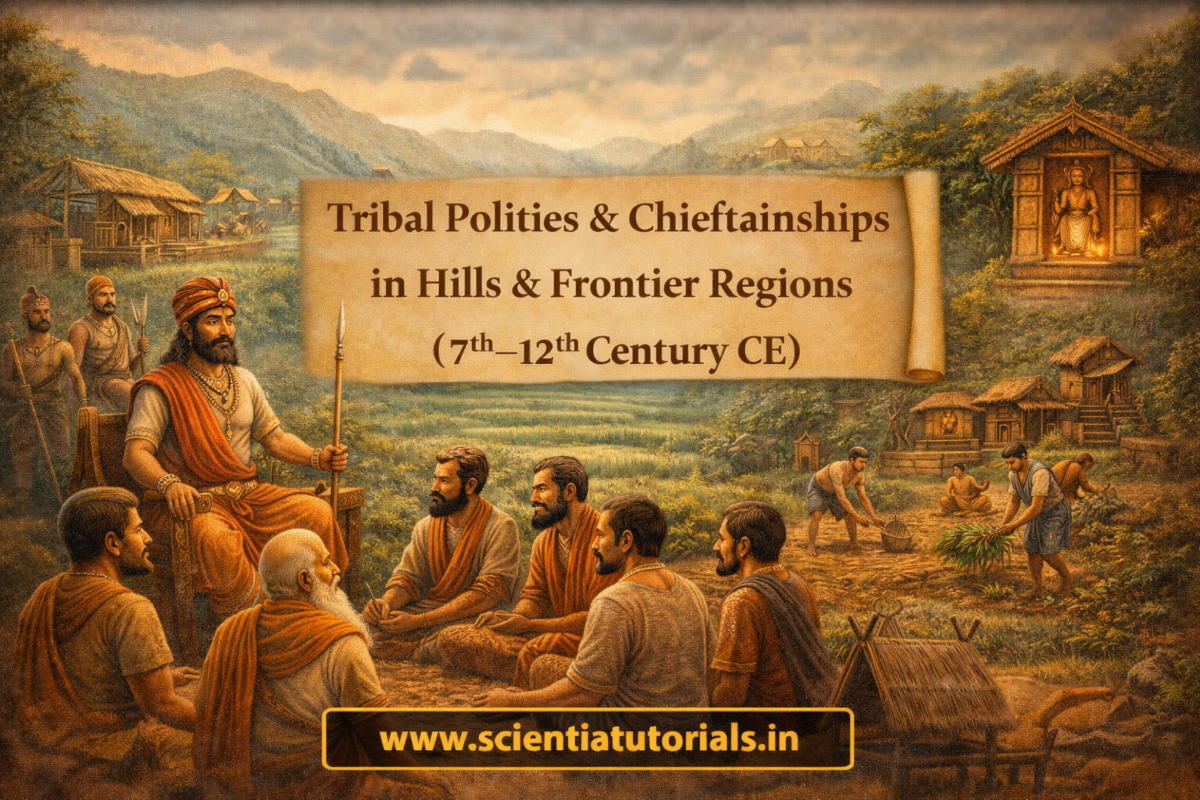

Tribal Polities and Chieftainships in Hills & Frontier Regions (7th–12th CE)
History of North-East India: From Early Kingdoms to Modern Integration
Module III: Early Medieval Transformations and Regional Powers
Timeline / Era Covered: 7th Century CE – 12th Century CE
Lesson: Tribal Polities and Chieftainships in Hills and Frontier Regions
This lesson is systematically organized into four clearly structured sections, as detailed below:
- Chronologically Structured Study Module
- Short-Answer Type Questions
- Long-Answer Type Questions
- Multiple-Choice Questions (MCQs) with Answers and Detailed Explanations
Chronologically Structured Study Module
Introduction: Understanding Tribal Polities in Early Medieval North-East India
The early medieval period (7th–12th centuries CE) in North-East India was marked not only by the rise and transformation of regional kingdoms but also by the persistence and evolution of tribal polities and chieftainships, especially in the hills and frontier regions. These political formations represented indigenous systems of governance, deeply rooted in kinship, clan organization, customary law, and control over land and people rather than formal territorial boundaries.
While plains-based regions such as the Brahmaputra valley witnessed processes of political fragmentation and consolidation, the hills and frontier zones retained distinct political traditions. Tribal polities did not remain static; instead, they adapted to changing circumstances, interacted with neighbouring kingdoms, and in some cases laid the foundations for later state formation. Understanding these tribal political systems is essential for appreciating the plurality of early medieval political experiences in North-East India.
Geographical Context: Hills and Frontier Regions
Physical Environment and Its Political Impact
The hills and frontier regions of North-East India include areas surrounding the Brahmaputra valley, extending into forested uplands, mountain ranges, and borderlands adjoining South-East Asia. This geography had a decisive influence on political organization:
- Difficult terrain limited centralized administration
- Dense forests supported shifting cultivation and hunting
- Isolation encouraged political autonomy
As a result, political authority in these regions developed in small, localized units, centered on villages, clans, and chieftainships rather than large kingdoms.
Chronological Framework of Tribal Polities (7th–12th Century CE)
For analytical clarity, the evolution of tribal polities and chieftainships may be divided into three broad phases:
- 7th–8th Century CE: Persistence of Clan-Based Political Systems
- 8th–10th Century CE: Consolidation of Chieftainships and Frontier Authority
- 10th–12th Century CE: Interaction with Regional Kingdoms and Early State Formation
Each phase reflects adaptation and continuity rather than abrupt political change.
Phase I (7th–8th Century CE): Clan-Based Political Organization
Foundations of Tribal Polity
In the early medieval period, most hill societies were organized around clans and kinship groups. Political authority was:
- Collective rather than centralized
- Based on lineage seniority
- Closely linked with ritual and customary practices
Leadership often rested with a chief or headman, whose authority derived from ancestry, control over land, and recognition by the community.
Nature of Chieftainship
Chieftainship was not absolute. Chiefs functioned as:
- Coordinators of communal activities
- Leaders in warfare and defense
- Custodians of customary law
Decision-making involved councils of elders, reinforcing consensual governance rather than autocratic rule.
Phase II (8th–10th Century CE): Consolidation of Chieftainships
Emergence of Stronger Local Chiefs
Between the 8th and 10th centuries CE, some chieftainships became more prominent due to:
- Control over strategic hill passes and routes
- Ability to mobilize warriors
- Management of surplus resources
These chiefs exercised authority over multiple villages or clans, marking a shift from simple clan leadership to proto-political structures.
Territoriality without Fixed Boundaries
Unlike plains kingdoms, tribal polities did not define rigid territorial borders. Authority was expressed through:
- Allegiance of villages
- Control of cultivation zones
- Seasonal use of forest and hill resources
This flexible notion of territory suited shifting cultivation and mobile lifestyles.
Phase III (10th–12th Century CE): Interaction and Transformation
Frontier Zones as Contact Regions
By the 10th century CE, hill chieftainships increasingly interacted with neighbouring plains kingdoms such as those in Assam, Tripura, and Manipur. These interactions included:
- Tribute relations
- Military alliances or conflicts
- Cultural and religious exchanges
Frontier regions thus became zones of negotiation rather than isolation.
Gradual Political Transformation
Some chieftainships began adopting features associated with kingship:
- Hereditary succession
- Ritual elevation of chiefs
- Greater centralization of authority
However, these changes remained partial and gradual, preserving the core of tribal political culture.
Administrative and Political Structure of Tribal Polities
Absence of Bureaucracy
Tribal polities lacked formal bureaucracy. Governance was carried out through:
- Village councils
- Clan elders
- Chiefs exercising limited authority
Administrative functions were embedded in customary practices, making governance flexible and locally responsive.
Customary Law and Justice
Justice was administered through customary law, emphasizing:
- Restitution rather than punishment
- Collective responsibility
- Maintenance of social harmony
The chief and elders played key roles in dispute resolution.
Military Organization and Defense
Warrior Culture
Hill societies maintained a strong warrior tradition. Military organization was:
- Clan-based
- Mobilized during conflict
- Centered on defense of territory and resources
There were no standing armies; instead, warriors were drawn from the community as needed.
Strategic Importance of Hills
Control of hills and passes gave tribal polities strategic leverage. Plains rulers often depended on hill chiefs for:
- Securing trade routes
- Defense against external threats
- Buffer zones along frontiers
This enhanced the political significance of tribal chieftainships.
Economic Foundations of Tribal Polities
Subsistence Economy
The economy of hill and frontier regions was primarily subsistence-oriented:
- Shifting cultivation (jhum)
- Hunting and gathering
- Limited animal husbandry
Agricultural surplus was modest, discouraging heavy taxation or centralized extraction.
Exchange Networks
Despite subsistence orientation, tribal polities participated in:
- Exchange of forest products
- Barter with plains communities
- Limited long-distance trade
These interactions integrated tribal regions into wider economic networks without undermining autonomy.
Cultural and Religious Dimensions
Indigenous Belief Systems
Religion in tribal societies centered on:
- Ancestor worship
- Nature spirits
- Clan deities
Political authority was closely tied to ritual roles, reinforcing the sacred character of leadership.
Cultural Resilience
Even as external influences reached frontier regions, indigenous traditions remained resilient. Cultural change occurred through:
- Selective adoption
- Gradual synthesis
- Preservation of core beliefs
This ensured continuity of tribal identity.
Tribal Polities and Early Medieval State Formation
Alternative Paths to Political Organization
Tribal polities demonstrate that early medieval political development was not uniform. They represent:
- Non-bureaucratic governance
- Kinship-based authority
- Flexible territoriality
These systems were effective adaptations to ecological and social conditions.
Contribution to Later Political Developments
Some tribal chieftainships later evolved into more centralized states, while others maintained autonomy well into the medieval and early modern periods. Their political traditions influenced:
- Regional power structures
- Military alliances
- Cultural identities
Historiographical Perspectives
Earlier historians often viewed tribal polities as primitive or stagnant. Modern scholarship emphasizes:
- Their adaptive nature
- Political sophistication
- Long-term resilience
Tribal polities are now recognized as integral components of early medieval history, not peripheral survivals.
Comparative Perspective: Hills versus Plains
| Aspect | Hill & Frontier Polities | Plains Kingdoms |
|---|---|---|
| Political structure | Clan-based, decentralized | Centralized, dynastic |
| Economy | Subsistence-oriented | Agrarian surplus-based |
| Administration | Customary | Bureaucratic elements |
| Territoriality | Flexible | Defined |
This comparison highlights the diversity of political systems in early medieval North-East India.
Long-Term Significance of Tribal Polities
The persistence of tribal chieftainships:
- Preserved indigenous governance models
- Shaped later regional politics
- Contributed to cultural diversity
Understanding these polities is essential for explaining the continuity of tribal identities in modern North-East India.
Conclusion: Tribal Polities as Dynamic Political Systems
Between the 7th and 12th centuries CE, tribal polities and chieftainships in the hills and frontier regions of North-East India played a crucial role in shaping the region’s political landscape. Far from being static or isolated, these systems were dynamic, adaptive, and resilient, responding creatively to geographical constraints and external interactions.
They represent alternative traditions of governance that coexisted alongside kingdoms and empires, enriching the political diversity of early medieval North-East India. Any comprehensive understanding of the region’s history must therefore place tribal polities at the center of analysis rather than at its margins.
Examination Relevance (APSC, State PSCs, UGC-NET, CUET, TETs)
- Features of tribal polities
- Nature of chieftainship
- Hills versus plains political systems
- Role of frontier regions
Short Answer Type Questions with Answers
Q1. What is meant by ‘tribal polity’ in early medieval North-East India?
Answer:
A tribal polity refers to a kinship- and clan-based political system governed by customary law and chieftainship rather than centralized bureaucracy.
Q2. Which period is covered under the study of tribal polities in this lesson?
Answer:
The lesson covers the 7th to 12th centuries CE, corresponding to the early medieval period.
Q3. Why did hill and frontier regions retain autonomous political systems?
Answer:
Difficult terrain, forests, and isolation limited centralized control, enabling localized and autonomous clan-based governance.
Q4. What was the basic unit of political organization in hill societies?
Answer:
The clan or lineage group was the basic political and social unit in hill societies.
Q5. Who usually exercised authority in tribal chieftainships?
Answer:
Authority was exercised by a chief or headman, supported by councils of elders.
Q6. What was the source of a chief’s legitimacy in tribal polities?
Answer:
Legitimacy derived from ancestry, ritual authority, control over land, and community recognition.
Q7. How was decision-making carried out in tribal polities?
Answer:
Decision-making was consensual, involving chiefs and councils of elders rather than autocratic rule.
Q8. What is meant by ‘flexible territoriality’ in tribal polities?
Answer:
Authority was based on allegiance of villages and use of resources, not fixed or surveyed boundaries.
Q9. How did chieftainships consolidate between the 8th and 10th centuries CE?
Answer:
By controlling multiple villages, strategic passes, and mobilizing warriors, some chiefs expanded their influence.
Q10. Did tribal polities possess a formal administrative bureaucracy?
Answer:
No, governance relied on customary practices, elders’ councils, and personal authority.
Q11. How was justice administered in tribal societies?
Answer:
Through customary law, emphasizing restitution, reconciliation, and social harmony.
Q12. What role did warfare play in tribal polities?
Answer:
Warfare was defensive and clan-based, mobilized when necessary rather than through standing armies.
Q13. Why were hills strategically important in early medieval politics?
Answer:
Hills controlled passes and routes, serving as buffers and strategic zones between plains and frontiers.
Q14. What was the primary economic base of tribal polities?
Answer:
A subsistence economy based on shifting cultivation, hunting-gathering, and limited animal husbandry.
Q15. What is ‘jhum’ cultivation?
Answer:
Jhum is shifting cultivation involving clearing forest patches for temporary agriculture.
Q16. Did tribal regions participate in trade?
Answer:
Yes, through local and regional exchange, especially forest products traded with plains communities.
Q17. Name one plains region that interacted with hill chieftainships.
Answer:
Hill chieftainships interacted with plains regions such as Assam.
Q18. What types of interactions existed between tribal polities and plains kingdoms?
Answer:
Interactions included tribute, alliances, conflicts, and cultural exchanges.
Q19. Did tribal chiefs adopt features of kingship over time?
Answer:
Some chiefs gradually adopted hereditary succession and enhanced ritual status, but changes were partial.
Q20. What religious beliefs dominated tribal polities?
Answer:
Indigenous beliefs such as ancestor worship, nature spirits, and clan deities dominated.
Q21. How did religion reinforce political authority in tribal societies?
Answer:
Chiefs often held ritual roles, linking sacred authority with political leadership.
Q22. Were tribal polities isolated from external cultural influences?
Answer:
No, they selectively adopted external influences while preserving core indigenous traditions.
Q23. How do modern historians view tribal polities?
Answer:
As adaptive, resilient, and politically sophisticated, not primitive or stagnant.
Q24. In what way did tribal polities contribute to later state formation?
Answer:
Some chieftainships evolved into regional states, influencing later political and cultural developments.
Q25. Why are tribal polities important for understanding North-East Indian history?
Answer:
They reveal alternative paths of governance, cultural continuity, and political diversity in the region.
Long Answer Type Questions with Answers
Tribal Polities and Chieftainships in Hills and Frontier Regions (7th–12th Century CE)
Q1. Explain the concept of tribal polities in early medieval North-East India.
Answer:
Tribal polities in early medieval North-East India were political systems based on kinship, clan organization, and customary law. Authority was exercised by chiefs or headmen whose legitimacy derived from ancestry, ritual status, and community recognition rather than bureaucracy or written law. These polities were adaptive systems suited to hill and frontier environments, emphasizing consensus, flexibility, and social cohesion.
Q2. Discuss the role of geography in shaping tribal polities and chieftainships.
Answer:
The hills, forests, and frontier landscapes of North-East India limited centralized administration and encouraged localized political units. Difficult terrain, dispersed settlements, and forest-based livelihoods made clan-based governance more effective than territorial states. Geography thus reinforced political autonomy, flexible territoriality, and the persistence of chieftainships.
Q3. Describe the basic political structure of tribal societies in the early medieval period.
Answer:
Tribal societies were organized around clans and lineages. Each clan controlled land and resources and was led by a chief supported by councils of elders. Authority was collective and consensual, with chiefs coordinating warfare, rituals, and dispute resolution rather than exercising absolute power.
Q4. Examine the nature and functions of chieftainship in hill societies.
Answer:
Chieftainship combined political, military, and ritual roles. Chiefs led communities in war, oversaw resource use, and acted as custodians of customary law. Their authority depended on personal ability, lineage, and community consent, making chieftainship a flexible and accountable form of leadership.
Q5. How did legitimacy operate in tribal polities?
Answer:
Legitimacy in tribal polities was rooted in ancestry, ritual authority, and social acceptance. Chiefs were often believed to possess sacred qualities or ancestral blessings. Political authority was reinforced through rituals, festivals, and adherence to customary norms rather than coercion.
Q6. Trace the evolution of tribal polities from the 7th to the 12th centuries CE.
Answer:
From the 7th to the 12th centuries CE, tribal polities evolved gradually. Early clan-based systems persisted, but some chieftainships consolidated control over multiple villages. By the later period, a few chiefs adopted hereditary succession and enhanced ritual status, indicating early stages of state formation without abandoning tribal foundations.
Q7. Discuss the concept of flexible territoriality in tribal polities.
Answer:
Unlike plains kingdoms with fixed boundaries, tribal polities operated with flexible territoriality. Authority depended on allegiance of people, access to cultivation zones, and seasonal use of forests. This flexibility suited shifting cultivation and mobile livelihoods, reducing conflict over rigid borders.
Q8. Analyze the administrative system of tribal polities.
Answer:
Tribal polities lacked formal bureaucracy. Administration was embedded in social practices, with village councils, clan elders, and chiefs managing governance. Decision-making was participatory and guided by custom, making administration efficient and locally responsive.
Q9. Examine the role of customary law in tribal societies.
Answer:
Customary law regulated social relations, land use, and conflict resolution. Justice emphasized restitution, reconciliation, and maintenance of harmony rather than punishment. Chiefs and elders interpreted customary law, ensuring continuity and social balance.
Q10. Discuss the military organization of tribal polities.
Answer:
Military organization was clan-based and mobilized only during conflict. There were no standing armies; warriors were drawn from the community. Warfare was usually defensive, aimed at protecting resources, villages, and territory rather than expansion.
Q11. Why were hill and frontier regions strategically important in early medieval politics?
Answer:
Hill regions controlled passes, routes, and buffer zones between plains and external regions. Plains rulers often relied on hill chiefs for security and access to trade routes. This strategic importance enhanced the political leverage of tribal chieftainships.
Q12. Examine the economic foundations of tribal polities.
Answer:
Tribal economies were primarily subsistence-based, relying on shifting cultivation (jhum), hunting-gathering, and limited animal husbandry. Agricultural surplus was modest, discouraging centralized extraction and supporting egalitarian social relations.
Q13. Discuss trade and exchange networks involving tribal polities.
Answer:
Despite subsistence orientation, tribal polities participated in local and regional exchange. Forest products, hill produce, and artisanal goods were exchanged with plains communities, integrating tribal regions into wider economic networks without undermining autonomy.
Q14. Analyze the religious beliefs and practices of tribal polities.
Answer:
Religion centered on ancestor worship, nature spirits, and clan deities. Chiefs often held ritual roles, linking sacred authority with political leadership. Religious practices reinforced social cohesion and legitimized governance.
Q15. How did interactions with plains kingdoms influence tribal polities?
Answer:
Interactions included tribute relations, alliances, conflicts, and cultural exchange with plains regions such as Assam. These contacts encouraged selective adoption of new practices while preserving indigenous political culture.
Q16. Did tribal polities remain isolated from external influences? Discuss.
Answer:
Tribal polities were not isolated. They selectively engaged with neighbouring kingdoms, adopting certain cultural or political elements when beneficial. However, core institutions based on kinship and custom remained resilient.
Q17. Compare tribal polities of hills with plains-based kingdoms.
Answer:
Hill polities were decentralized, kinship-based, and flexible, while plains kingdoms were more centralized, agrarian, and bureaucratic. Both systems were effective adaptations to their respective environments, reflecting political diversity.
Q18. How do tribal polities challenge the idea of political ‘backwardness’?
Answer:
Tribal polities demonstrate political sophistication through adaptive governance, social cohesion, and resilience. Modern historians recognize them as dynamic systems rather than primitive survivals, challenging earlier biased interpretations.
Q19. Discuss the contribution of tribal polities to later state formation.
Answer:
Some tribal chieftainships evolved into more centralized states, while others influenced regional politics through alliances and military support. Their institutions shaped later political and cultural developments in North-East India.
Q20. Assess the overall historical significance of tribal polities in early medieval North-East India.
Answer:
Tribal polities were integral to early medieval history, preserving indigenous governance models and cultural identities. They highlight alternative paths of political organization and explain the persistence of tribal traditions in the modern North-East.
MCQs with Answers and Explanations
Tribal Polities and Chieftainships in Hills and Frontier Regions (7th–12th Century CE)
Q1. The term “tribal polity” in early medieval North-East India primarily refers to:
A. Urban republican systems
B. Kinship-based political organization
C. Bureaucratic imperial administration
D. Foreign-controlled frontier rule
Correct Answer: B
Explanation:
Tribal polities were based on clan and kinship systems, governed by chiefs and customary law rather than centralized bureaucracy.
Q2. The period covered by the study of tribal polities in this lesson is:
A. 5th–7th centuries CE
B. 6th–9th centuries CE
C. 7th–12th centuries CE
D. 9th–14th centuries CE
Correct Answer: C
Explanation:
Module III defines the early medieval period for tribal polities as 7th–12th centuries CE.
Q3. Which geographical feature most influenced the political autonomy of tribal polities?
A. Riverine plains
B. Coastal areas
C. Hills and dense forests
D. Urban centers
Correct Answer: C
Explanation:
Hills and forests limited centralized control and encouraged localized, autonomous political units.
Q4. The basic political and social unit of tribal societies was the:
A. Guild
B. Village republic
C. Clan or lineage
D. Temple corporation
Correct Answer: C
Explanation:
Political authority rested with clans and lineages, each managing land, resources, and social relations.
Q5. Political authority in tribal chieftainships was usually exercised by:
A. Appointed officials
B. Foreign governors
C. Chiefs supported by elders
D. Standing armies
Correct Answer: C
Explanation:
Chiefs exercised authority with the support of councils of elders, ensuring consensual governance.
Q6. The legitimacy of tribal chiefs was primarily derived from:
A. Written constitutions
B. Military conquest alone
C. Ancestry and ritual authority
D. Urban economic power
Correct Answer: C
Explanation:
Chiefs derived legitimacy from lineage, ritual roles, and community recognition.
Q7. Decision-making in tribal polities was generally:
A. Autocratic
B. Bureaucratic
C. Consensual
D. Arbitrary
Correct Answer: C
Explanation:
Decisions were made through consensus involving chiefs and elders rather than unilateral authority.
Q8. What is meant by ‘flexible territoriality’ in tribal polities?
A. Fixed surveyed borders
B. Territorial expansion by conquest
C. Authority based on people and resource use
D. Absence of territorial control
Correct Answer: C
Explanation:
Territory was defined by allegiance of villages and use of resources, not rigid boundaries.
Q9. Consolidation of some chieftainships between the 8th and 10th centuries CE occurred due to:
A. Foreign invasions
B. Control of strategic routes and resources
C. Introduction of bureaucracy
D. Urbanization
Correct Answer: B
Explanation:
Chiefs who controlled strategic hill passes and resources expanded their authority.
Q10. Tribal polities generally lacked:
A. Military leaders
B. Ritual practices
C. Formal administrative bureaucracy
D. Political organization
Correct Answer: C
Explanation:
Governance relied on custom and personal authority rather than formal bureaucratic structures.
Q11. Justice in tribal societies was administered mainly through:
A. Royal courts
B. Codified law books
C. Customary law
D. Foreign judges
Correct Answer: C
Explanation:
Customary law emphasized reconciliation and social harmony over punitive justice.
Q12. Military organization in tribal polities was characterized by:
A. Standing professional armies
B. Clan-based mobilization
C. Mercenary forces
D. Naval fleets
Correct Answer: B
Explanation:
Warriors were mobilized from clans during conflict; no permanent armies existed.
Q13. Hill regions were strategically important because they:
A. Supported large urban centers
B. Controlled key passes and buffer zones
C. Generated agricultural surplus
D. Hosted imperial capitals
Correct Answer: B
Explanation:
Hills controlled passes, routes, and frontier zones, making them strategically significant.
Q14. The economic base of tribal polities was primarily:
A. Industrial production
B. Plantation agriculture
C. Subsistence economy
D. Overseas trade
Correct Answer: C
Explanation:
Economies were subsistence-oriented, based on shifting cultivation, hunting, and gathering.
Q15. ‘Jhum’ cultivation refers to:
A. Irrigated wet-rice farming
B. Terrace agriculture
C. Shifting cultivation
D. Plantation farming
Correct Answer: C
Explanation:
Jhum is shifting cultivation, suited to forested hill regions.
Q16. Tribal polities engaged in trade mainly through:
A. Long-distance maritime networks
B. State-controlled markets
C. Local and regional exchange
D. Foreign merchant guilds
Correct Answer: C
Explanation:
Trade consisted mainly of local and regional barter, especially forest products.
Q17. Interactions between tribal polities and plains kingdoms included:
A. Only warfare
B. Only trade
C. Tribute, alliance, and conflict
D. Complete isolation
Correct Answer: C
Explanation:
Interactions were multifaceted, involving tribute, alliances, conflicts, and cultural exchange with regions like Assam.
Q18. Some tribal chiefs gradually adopted features of kingship such as:
A. Republican governance
B. Foreign administration
C. Hereditary succession
D. Urban bureaucracy
Correct Answer: C
Explanation:
Hereditary succession and enhanced ritual status marked early stages of political transformation.
Q19. Religious beliefs in tribal polities mainly centered on:
A. Buddhism
B. Jainism
C. Indigenous ancestor and nature worship
D. Islam
Correct Answer: C
Explanation:
Religion revolved around ancestor worship, nature spirits, and clan deities.
Q20. The role of religion in tribal polities was to:
A. Separate politics and belief
B. Undermine political authority
C. Legitimize leadership
D. Promote foreign rule
Correct Answer: C
Explanation:
Religious roles reinforced the sacred legitimacy of chiefs and leadership.
Q21. Earlier historiography often viewed tribal polities as:
A. Highly advanced
B. Centralized states
C. Primitive and stagnant
D. Foreign creations
Correct Answer: C
Explanation:
Earlier scholars underestimated tribal polities, labeling them primitive.
Q22. Modern historians interpret tribal polities as:
A. Failed states
B. Static societies
C. Adaptive and resilient systems
D. Peripheral to history
Correct Answer: C
Explanation:
Modern scholarship emphasizes their adaptability, resilience, and political sophistication.
Q23. Tribal polities contributed to later political developments by:
A. Remaining isolated
B. Influencing state formation and alliances
C. Rejecting all external contact
D. Eliminating dynastic traditions
Correct Answer: B
Explanation:
Some chieftainships evolved into states or shaped regional power relations.
Q24. Which feature distinguishes tribal polities from plains kingdoms?
A. Use of ritual
B. Clan-based governance
C. Agriculture
D. Warfare
Correct Answer: B
Explanation:
Clan-based governance and kinship authority distinguish tribal polities from centralized plains kingdoms.
Q25. Which statement best summarizes tribal polities in early medieval North-East India?
A. Politically insignificant groups
B. Static and isolated systems
C. Dynamic, adaptive political formations
D. Temporary wartime alliances
Correct Answer: C
Explanation:
Tribal polities were dynamic and adaptive, responding creatively to geography and external interactions.