
Role of Assam in the Indian National Movement
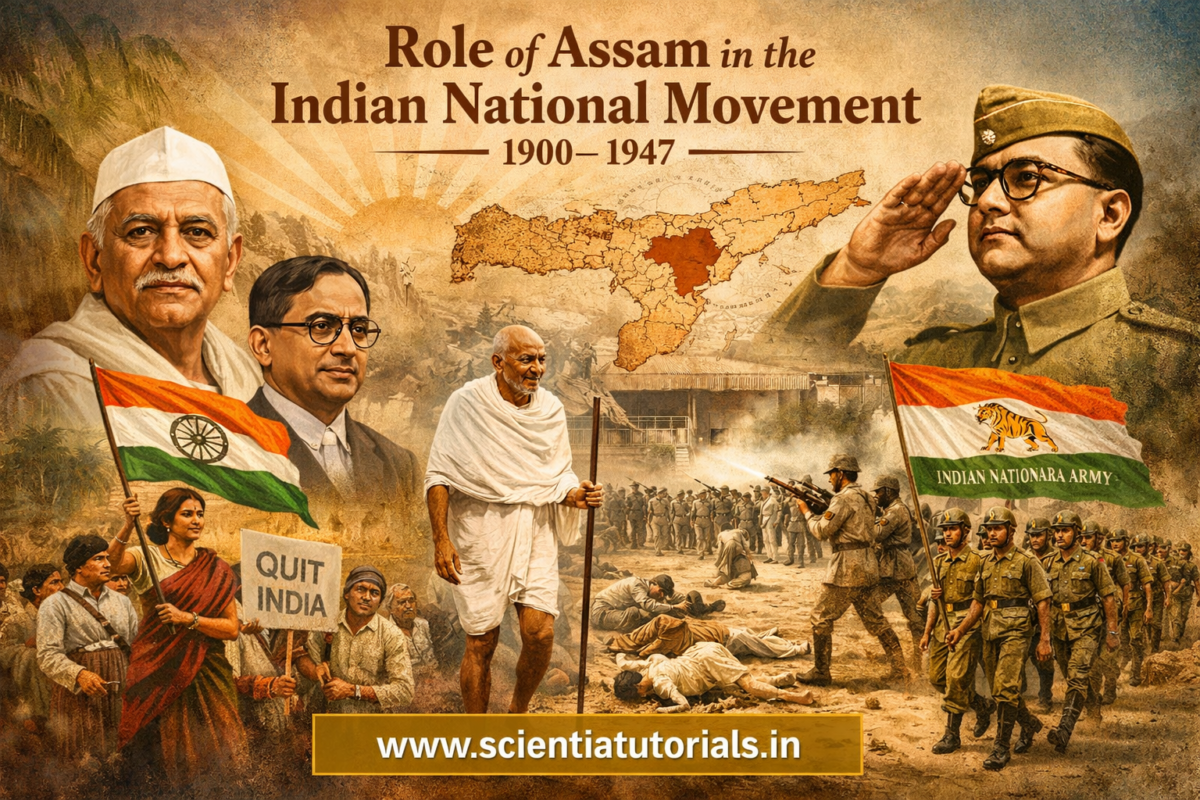

Role of Assam in the Indian National Movement (1900–1947) | History of North-East India
Course: History of North-East India: From Early Kingdoms to Modern Integration
Module VII: National Movement and Political Awakening
Timeline / Era Covered: 1900 CE – 1947 CE
Lesson: Role of Assam in the Indian National Movement
This lesson is systematically organized into four clearly structured sections, as detailed below:
- Chronologically Structured Study Module
- Short-Answer Type Questions
- Long-Answer Type Questions
- Multiple-Choice Questions (MCQs) with Answers and Detailed Explanations
Chronologically Structured Study Module
Introduction: Assam and the National Movement – A Peripheral Region with Central Significance
At the dawn of the twentieth century, Assam occupied a unique position within British India. Administratively governed as a Chief Commissioner’s Province, economically important due to tea, oil, and timber, and socially diverse with multiple ethnic, linguistic, and tribal communities, Assam was often perceived by colonial rulers as a peripheral frontier. However, the period between 1900 CE and 1947 CE witnessed Assam’s gradual but decisive integration into the mainstream of the Indian National Movement.
The role of Assam in India’s freedom struggle evolved through distinct chronological phases—from early political awakening and resistance to colonial policies, through mass participation during Gandhian movements, to decisive involvement in the final phase of independence and Partition. This lesson examines Assam’s contribution in a chronological and thematic manner, highlighting regional leaders, organizations, popular movements, and the interaction between national politics and local realities.
I. Background to Political Awakening in Assam (Late 19th Century – 1905 CE)
Before 1900 CE, political consciousness in Assam developed slowly due to geographical isolation, weak communication networks, and colonial economic exploitation. The British annexation of Assam (1826) and the subsequent imposition of colonial administrative and revenue systems disrupted traditional structures.
Key early developments included:
- Growth of Western education and emergence of an educated Assamese middle class
- Linguistic movements for recognition of Assamese language
- Economic grievances related to land revenue, tea plantation labour, and forest laws
Organizations like the Assam Association (1903) marked the first organized expression of political aspirations, laying the groundwork for future nationalist mobilization.
II. Partition of Bengal (1905) and the Rise of Organized Nationalism in Assam
The Partition of Bengal (1905) acted as a catalyst for political mobilization in Assam. The inclusion of Assam in the new province of Eastern Bengal and Assam created apprehensions regarding Assamese identity, economic marginalization, and administrative neglect.
Impact of Partition on Assam
- Strengthening of anti-colonial sentiment
- Growth of Swadeshi ideas, boycott of foreign goods
- Expansion of political debate through newspapers, literary societies, and public meetings
Although Assam did not witness violent protests on the scale of Bengal, the period saw increased political awareness and participation among students, professionals, and urban elites.
III. Formation of the Assam Provincial Congress Committee (1921)
The integration of Assam into all-India nationalist politics became institutionalized with the formation of the Assam Provincial Congress Committee (APCC) in 1921 under the umbrella of the Indian National Congress.
The APCC served as the primary organizational platform for:
- Mobilizing public opinion
- Coordinating protests and mass movements
- Linking Assam’s regional concerns with national objectives
This marked a decisive shift from elite petition politics to mass-based nationalism.
IV. Non-Cooperation Movement (1920–1922): Assam Joins Mass National Politics
Under the leadership of Mahatma Gandhi, the Non-Cooperation Movement transformed the Indian National Movement into a mass struggle. Assam actively participated in this phase.
Key Features in Assam
- Boycott of government schools, courts, and foreign goods
- Spread of Khadi and Swadeshi practices
- Active role of students, teachers, and lawyers
Notable Assamese leaders such as Tarun Ram Phukan, popularly known as Deshbhakta, played a central role in mobilizing the masses. Despite limited industrialization, the movement penetrated urban centers and rural areas alike.
V. Civil Disobedience Movement (1930–1934): Intensification of Popular Participation
The launch of the Civil Disobedience Movement following the Salt Satyagraha marked a new phase of resistance. In Assam, the movement gained momentum with widespread participation.
Major Developments
- Defiance of colonial laws
- Boycott of salt tax and liquor shops
- Arrests of Congress leaders and volunteers
The movement strengthened nationalist consciousness among peasants and small traders. Women’s participation also increased, reflecting the deepening social base of the freedom struggle in Assam.
VI. Tribal Movements and Nationalism: The Case of the Patharughat Incident (1894) and Its Legacy
Although preceding the main Gandhian phase, the Patharughat peasant uprising (1894) assumed symbolic importance during later nationalist mobilization. British repression of peasants protesting land revenue hikes was remembered as the “Jallianwala Bagh of Assam.”
During the national movement period:
- Tribal grievances related to land alienation and forest policies were increasingly linked with anti-colonial politics
- Congress leaders attempted (with mixed success) to incorporate tribal interests
This highlights the complex relationship between mainstream nationalism and regional socio-economic issues.
VII. Government of India Act, 1935 and Provincial Autonomy in Assam
The Government of India Act, 1935 introduced provincial autonomy and expanded electoral politics. Assam became a full-fledged province with a legislative assembly.
Political Developments
- Emergence of coalition politics
- Formation of ministries involving Congress and regional parties
- Debates over land rights, immigration, and provincial identity
The period exposed ideological differences but also trained Assamese leaders in parliamentary governance, preparing them for post-independence administration.
VIII. Quit India Movement (1942): Peak of Mass Resistance in Assam
The Quit India Movement represented the most intense phase of anti-colonial struggle. Assam witnessed widespread protests, particularly among students and rural populations.
Features of the Movement in Assam
- Underground activities following the arrest of national leaders
- Sabotage of communication lines
- Parallel administrations in some areas
The movement demonstrated the maturity of political consciousness in Assam and the willingness of ordinary people to challenge colonial authority despite severe repression.
IX. Role of Students, Women, and Cultural Organizations
Student Participation
Educational institutions became centers of nationalist activity. Students participated in strikes, picketing, and dissemination of nationalist literature.
Women in the Freedom Struggle
Women emerged as active participants rather than passive supporters. They:
- Joined picketing and protests
- Promoted Swadeshi practices
- Played leadership roles in local Congress committees
Cultural Nationalism
Literary and cultural organizations used language, literature, and history to foster nationalist sentiment and assert Assamese identity within the Indian framework.
X. Assam during the Second World War and the INA Phase
World War II directly affected Assam due to its strategic location. The construction of military infrastructure and the presence of Allied forces intensified political activity.
The activities of the Indian National Army and the leadership of Subhas Chandra Bose inspired nationalist enthusiasm, particularly among youth, though direct INA operations were limited in Assam.
XI. Partition, Sylhet Referendum (1947), and the End of Colonial Rule
The final phase of the national movement in Assam was shaped by the politics of Partition.
Sylhet Referendum (1947)
- Conducted to determine whether Sylhet district would remain in Assam or join East Pakistan
- Resulted in the transfer of most of Sylhet to East Pakistan
- Created demographic, political, and emotional challenges for Assam
Despite the trauma of Partition, Assam emerged as an integral part of independent India on 15 August 1947, having played a sustained and significant role in the freedom struggle.
Conclusion: Historical Significance of Assam’s Contribution
The role of Assam in the Indian National Movement was neither marginal nor episodic. From early political associations to mass movements, from elite leadership to grassroots participation, Assam’s journey mirrored—and enriched—the broader narrative of Indian nationalism.
Key Takeaways for Examination
- Assam’s nationalism developed gradually but matured decisively after 1920
- Regional leaders played a crucial role in adapting national movements to local contexts
- The freedom struggle strengthened Assamese identity within a united India
- The period laid the foundation for post-independence political integration and challenges
Assam’s experience underscores the diversity of India’s freedom struggle and highlights how frontier regions contributed meaningfully to the making of modern India.
Short Answer Type Questions
Lesson: Role of Assam in the Indian National Movement
Module VII: National Movement and Political Awakening (1900–1947 CE)
Q1. Why was Assam considered politically backward in the early 20th century?
Answer:
Assam was geographically isolated, economically underdeveloped, and lacked early political organizations, delaying mass political consciousness.
Q2. What role did Western education play in Assam’s political awakening?
Answer:
Western education created an educated middle class that questioned colonial policies and promoted nationalist ideas.
Q3. Name the first major political organization that represented Assamese interests.
Answer:
The Assam Association, founded in 1903, was the first major political organization representing Assamese interests.
Q4. How did the Partition of Bengal (1905) affect Assam?
Answer:
It stimulated political awareness, strengthened regional identity, and encouraged participation in nationalist activities.
Q5. When was the Assam Provincial Congress Committee (APCC) formed?
Answer:
The Assam Provincial Congress Committee was formed in 1921.
Q6. Which national organization did the APCC function under?
Answer:
The APCC functioned under the Indian National Congress.
Q7. What was the significance of the Non-Cooperation Movement in Assam?
Answer:
It marked Assam’s first large-scale participation in mass nationalist politics.
Q8. Name one prominent Assamese leader of the Non-Cooperation Movement.
Answer:
Tarun Ram Phukan was a prominent leader during the Non-Cooperation Movement.
Q9. Mention two forms of protest used during the Non-Cooperation Movement in Assam.
Answer:
Boycott of foreign goods and withdrawal from government institutions.
Q10. What was the main objective of the Civil Disobedience Movement in Assam?
Answer:
To openly defy colonial laws and challenge British authority through mass participation.
Q11. How did peasants participate in the Civil Disobedience Movement in Assam?
Answer:
Peasants joined protests against taxes, liquor shops, and colonial economic policies.
Q12. What is the historical importance of the Patharughat incident?
Answer:
It symbolized early peasant resistance against British land revenue policies in Assam.
Q13. Why is Patharughat called the “Jallianwala Bagh of Assam”?
Answer:
Because British forces fired on unarmed peasants protesting revenue hikes, causing heavy casualties.
Q14. Which Act introduced provincial autonomy in Assam?
Answer:
The Government of India Act, 1935.
Q15. What political change occurred in Assam after the Act of 1935?
Answer:
Assam gained an elected legislative assembly and responsible provincial government.
Q16. What was the Quit India Movement?
Answer:
A mass movement launched in 1942 demanding immediate end of British rule in India.
Q17. How did the Quit India Movement impact Assam?
Answer:
It led to widespread protests, underground activities, and strong British repression.
Q18. What role did students play in Assam’s freedom struggle?
Answer:
Students organized strikes, spread nationalist ideas, and actively participated in protests.
Q19. How did women contribute to the national movement in Assam?
Answer:
Women participated in picketing, promoted Swadeshi, and worked in Congress organizations.
Q20. Why was Assam strategically important during World War II?
Answer:
Its location made it a military base for Allied forces in the eastern frontier of India.
Q21. Name the revolutionary army that inspired nationalist youth during World War II.
Answer:
The Indian National Army.
Q22. Who was the leader associated with the Indian National Army?
Answer:
Subhas Chandra Bose.
Q23. What was the Sylhet Referendum of 1947?
Answer:
A plebiscite to decide whether Sylhet would remain in Assam or join East Pakistan.
Q24. What was the outcome of the Sylhet Referendum?
Answer:
Most of Sylhet was merged with East Pakistan, reducing Assam’s territorial area.
Q25. Mention one long-term impact of the freedom struggle on Assam.
Answer:
It strengthened political consciousness and integrated Assam firmly into independent India.
Long Answer Type Questions
Lesson: Role of Assam in the Indian National Movement (1900–1947 CE)
Q1. Examine the socio-economic background of Assam on the eve of the Indian National Movement.
Answer:
At the beginning of the twentieth century, Assam was a peripheral province under British rule with a weak industrial base and a predominantly agrarian economy. Colonial economic policies focused on tea plantations, oil extraction, and timber exploitation, which benefited European interests rather than the local population. Peasants suffered from high land revenue demands, while tribal communities faced land alienation due to forest laws. Socially, the spread of Western education created a small educated middle class that became the carrier of political ideas. These socio-economic conditions generated grievances that later merged with nationalist politics.
Q2. Discuss the growth of political consciousness in Assam before 1905.
Answer:
Political consciousness in Assam before 1905 developed gradually through linguistic movements, educational reforms, and socio-cultural organizations. The demand for recognition of the Assamese language and protection of regional interests laid the foundation for political awareness. Educated elites began petitioning colonial authorities on administrative and economic issues. Though limited in mass participation, these early efforts created a platform for organized politics and prepared the ground for Assam’s involvement in the national movement.
Q3. Analyze the impact of the Partition of Bengal (1905) on Assam.
Answer:
The Partition of Bengal in 1905 significantly influenced Assam’s political trajectory. The creation of the province of Eastern Bengal and Assam raised concerns about Assamese identity, economic marginalization, and administrative neglect. This led to increased political debate and mobilization, especially among students and intellectuals. Swadeshi ideas, boycott of foreign goods, and nationalist discussions spread across urban centers. Though Assam did not witness violent protests, the partition marked a turning point by linking regional concerns with all-India nationalism.
Q4. Trace the role of early political organizations in Assam’s nationalist awakening.
Answer:
Early political organizations played a crucial role in shaping Assam’s nationalist consciousness. The Assam Association provided a forum for articulating regional demands and engaging with colonial authorities. These organizations emphasized constitutional methods such as petitions and memoranda but gradually adopted nationalist rhetoric. Their activities fostered leadership, political debate, and organizational skills, which later facilitated Assam’s integration into mass movements led by national organizations.
Q5. Explain the significance of the formation of the Assam Provincial Congress Committee (1921).
Answer:
The formation of the Assam Provincial Congress Committee (APCC) in 1921 marked Assam’s formal integration into the all-India nationalist movement under the Indian National Congress. The APCC transformed political activity from elite representation to mass mobilization. It coordinated protests, spread nationalist ideology, and linked local grievances with national objectives. This institutional connection enabled Assam to actively participate in major freedom movements.
Q6. Assess Assam’s participation in the Non-Cooperation Movement (1920–1922).
Answer:
Assam’s participation in the Non-Cooperation Movement represented its first major involvement in mass politics inspired by Mahatma Gandhi. Students boycotted educational institutions, lawyers withdrew from courts, and people rejected foreign goods. Although the movement remained largely peaceful, it successfully spread nationalist ideas to rural areas. Leaders like Tarun Ram Phukan played a vital role in mobilizing public support.
Q7. Evaluate the limitations and achievements of the Non-Cooperation Movement in Assam.
Answer:
The movement achieved significant political awakening and expanded popular participation, especially among students and urban residents. However, its limitations included weak rural penetration and limited involvement of tribal communities. Despite these constraints, the movement succeeded in establishing a tradition of mass resistance and prepared Assam for future phases of the national struggle.
Q8. Discuss the Civil Disobedience Movement (1930–1934) in Assam.
Answer:
The Civil Disobedience Movement marked a deeper phase of resistance in Assam. People openly defied colonial laws, boycotted taxes, and protested against liquor shops. Peasants, small traders, and women increasingly participated. The movement strengthened the link between economic grievances and nationalist politics, making the freedom struggle more inclusive and socially rooted.
Q9. Examine the role of peasants and agrarian unrest in Assam’s national movement.
Answer:
Peasant participation in Assam’s freedom struggle was shaped by land revenue issues, tenancy problems, and colonial exploitation. The memory of the Patharughat uprising symbolized agrarian resistance. During the national movement, Congress leaders attempted to incorporate peasant demands, though tensions remained. Agrarian unrest added a socio-economic dimension to Assam’s nationalism.
Q10. Explain the historical significance of the Patharughat incident in the context of nationalism.
Answer:
The Patharughat incident became a symbol of colonial repression and peasant resistance in Assam. Although it occurred earlier, its memory inspired later nationalist mobilization. It highlighted the exploitative nature of British land policies and strengthened the moral legitimacy of anti-colonial resistance among the masses.
Q11. Analyze the impact of the Government of India Act, 1935 on Assam.
Answer:
The Government of India Act, 1935 introduced provincial autonomy and expanded electoral politics in Assam. The establishment of an elected legislative assembly encouraged political participation and debate. Leaders gained administrative experience, while issues such as land rights and immigration entered mainstream politics. This phase trained Assamese leaders for governance after independence.
Q12. Discuss the nature of coalition politics in Assam during the late 1930s.
Answer:
Assam witnessed coalition governments involving Congress and regional parties. These coalitions reflected the province’s social diversity and political complexity. While they enabled broader representation, they also exposed ideological differences. Nevertheless, coalition politics strengthened democratic practices and political awareness.
Q13. Evaluate Assam’s response to the Quit India Movement (1942).
Answer:
The Quit India Movement represented the most intense phase of mass resistance in Assam. Despite the arrest of leaders, students and youth continued underground activities, sabotaged communication lines, and organized protests. British repression was severe, but the movement demonstrated Assam’s firm commitment to independence.
Q14. Assess the role of students in Assam’s freedom struggle.
Answer:
Students were among the most dynamic participants in Assam’s national movement. They organized strikes, boycotted institutions, and acted as carriers of nationalist ideology. Their activism ensured continuity of resistance during periods of repression and contributed significantly to political mobilization.
Q15. Examine the contribution of women to the national movement in Assam.
Answer:
Women in Assam participated actively in picketing, Swadeshi campaigns, and Congress activities. They challenged traditional gender roles and expanded the social base of the movement. Their involvement symbolized the transformation of nationalism into a truly mass movement.
Q16. Discuss the role of cultural and literary organizations in promoting nationalism in Assam.
Answer:
Cultural and literary organizations used language, history, and literature to promote nationalist sentiment. By asserting Assamese identity within the broader Indian framework, they strengthened emotional attachment to the freedom struggle and countered colonial cultural domination.
Q17. Analyze the impact of World War II on Assam’s political situation.
Answer:
World War II transformed Assam into a strategic military zone, leading to infrastructural development and social disruption. Wartime policies intensified economic hardships, fueling anti-colonial sentiment. The war years accelerated political radicalization and mass mobilization.
Q18. Examine the influence of the Indian National Army on Assam.
Answer:
The activities of the Indian National Army, led by Subhas Chandra Bose, inspired nationalist enthusiasm, particularly among youth. Although direct military impact in Assam was limited, the INA strengthened revolutionary sentiment and challenged British authority.
Q19. Discuss the Sylhet Referendum of 1947 and its consequences for Assam.
Answer:
The Sylhet Referendum was conducted to decide the district’s political future during Partition. Its merger with East Pakistan resulted in territorial loss for Assam and created demographic and administrative challenges. The event highlighted the complex impact of Partition on the region.
Q20. Critically evaluate the overall contribution of Assam to the Indian National Movement.
Answer:
Assam’s contribution evolved from cautious political awakening to active mass participation. Despite geographical and social challenges, the province integrated itself into the national struggle through movements, organizations, and leadership. Assam’s experience enriched Indian nationalism by highlighting regional diversity and collective resistance.
MCQs with Answers and Explanations
Lesson: Role of Assam in the Indian National Movement (1900–1947 CE)
Q1. Which factor most delayed the growth of mass nationalism in Assam during the early 20th century?
A. Lack of nationalist ideology
B. Geographical isolation and weak communication
C. Absence of colonial exploitation
D. Excessive industrialization
Correct Answer: B
Explanation:
Assam’s difficult terrain, poor transport networks, and frontier location limited the spread of political ideas and mass mobilization, delaying nationalist awakening compared to other regions.
Q2. Which organization marked the beginning of organized political activity in Assam?
A. Assam Provincial Congress Committee
B. Indian National Congress
C. Assam Association
D. Swaraj Party
Correct Answer: C
Explanation:
The Assam Association (1903) was the first organized political body articulating regional interests and laid the foundation for later nationalist politics.
Q3. The Partition of Bengal (1905) influenced Assam mainly by:
A. Creating communal violence
B. Ending British rule in Assam
C. Stimulating political awareness and identity consciousness
D. Introducing universal adult franchise
Correct Answer: C
Explanation:
The partition heightened concerns over Assamese identity and administrative neglect, thereby stimulating political debate and nationalist awareness.
Q4. The Assam Provincial Congress Committee (APCC) was formed in:
A. 1905
B. 1915
C. 1921
D. 1930
Correct Answer: C
Explanation:
The APCC was formed in 1921, formally integrating Assam into the organizational framework of the Indian National Congress.
Q5. Which movement marked Assam’s first major participation in mass nationalist politics?
A. Swadeshi Movement
B. Civil Disobedience Movement
C. Non-Cooperation Movement
D. Quit India Movement
Correct Answer: C
Explanation:
The Non-Cooperation Movement (1920–22) marked the first widespread mass participation of Assam in the national struggle.
Q6. Who among the following was popularly known as “Deshbhakta” in Assam?
A. Bishnu Ram Medhi
B. Tarun Ram Phukan
C. Gopinath Bordoloi
D. Ambikagiri Raichoudhury
Correct Answer: B
Explanation:
Tarun Ram Phukan earned the title “Deshbhakta” for his dedication to the freedom struggle.
Q7. Which section played the most prominent role during the Non-Cooperation Movement in Assam?
A. Zamindars
B. Industrial workers
C. Students and educated youth
D. European planters
Correct Answer: C
Explanation:
Students and educated youth led boycotts, strikes, and the spread of nationalist ideas across Assam.
Q8. The Civil Disobedience Movement in Assam is best characterized by:
A. Exclusive elite participation
B. Armed revolutionary activities
C. Open defiance of colonial laws
D. Complete absence of women
Correct Answer: C
Explanation:
Civil Disobedience involved deliberate violation of laws, tax refusal, and boycotts, reflecting intensified resistance.
Q9. The Patharughat incident is associated with:
A. Indigo revolt
B. Peasant resistance against land revenue
C. Tribal uprising against missionaries
D. Labour movement in tea gardens
Correct Answer: B
Explanation:
The incident symbolized peasant resistance to British land revenue hikes and colonial repression.
Q10. Why is Patharughat referred to as the “Jallianwala Bagh of Assam”?
A. Similar scale of casualties
B. Protest against communal policies
C. British firing on unarmed peasants
D. Involvement of revolutionaries
Correct Answer: C
Explanation:
British forces opened fire on peaceful peasants protesting revenue policies, making it a symbol of colonial brutality.
Q11. The Government of India Act, 1935 was significant for Assam because it:
A. Granted complete independence
B. Introduced provincial autonomy
C. Ended British administration
D. Created princely states
Correct Answer: B
Explanation:
The Act introduced provincial autonomy and an elected legislative assembly in Assam.
Q12. One major outcome of provincial autonomy in Assam was:
A. Decline of political participation
B. Training of leaders in governance
C. Abolition of elections
D. End of nationalist politics
Correct Answer: B
Explanation:
Electoral politics trained Assamese leaders in administration and parliamentary procedures.
Q13. The Quit India Movement (1942) in Assam was marked by:
A. Peaceful constitutional protests only
B. Strong underground activities
C. Support for British war efforts
D. Absence of student participation
Correct Answer: B
Explanation:
After mass arrests, underground resistance, sabotage, and student activism intensified.
Q14. Which group emerged as the backbone of resistance during the Quit India Movement in Assam?
A. European planters
B. Princes
C. Students and rural youth
D. Colonial officials
Correct Answer: C
Explanation:
Students and rural youth maintained resistance despite heavy repression.
Q15. Women’s participation in Assam’s freedom struggle primarily included:
A. Armed rebellion
B. Picketing and Swadeshi campaigns
C. Exclusive legislative roles
D. Military leadership
Correct Answer: B
Explanation:
Women actively joined picketing, boycotts, and promotion of Swadeshi, broadening the social base.
Q16. Cultural and literary organizations in Assam contributed to nationalism by:
A. Supporting colonial education
B. Promoting regional identity and history
C. Rejecting Indian unity
D. Encouraging separatism
Correct Answer: B
Explanation:
They used language, literature, and history to foster nationalist consciousness and Assamese identity.
Q17. Why did World War II significantly affect Assam?
A. Assam was a princely state
B. It became a strategic military region
C. It remained isolated
D. It was outside British India
Correct Answer: B
Explanation:
Assam’s strategic location made it a key military base, intensifying political and economic pressures.
Q18. Which organization inspired revolutionary nationalist enthusiasm during World War II?
A. Swaraj Party
B. Forward Bloc
C. Indian National Army
D. Hindu Mahasabha
Correct Answer: C
Explanation:
The Indian National Army challenged British authority and inspired youth.
Q19. The Indian National Army was led by:
A. Jawaharlal Nehru
B. Mahatma Gandhi
C. Subhas Chandra Bose
D. Rajendra Prasad
Correct Answer: C
Explanation:
Subhas Chandra Bose provided militant leadership to the INA.
Q20. The Sylhet Referendum was held in:
A. 1942
B. 1945
C. 1946
D. 1947
Correct Answer: D
Explanation:
The referendum was held in 1947 as part of the Partition process.
Q21. The Sylhet Referendum resulted in:
A. Complete merger with Assam
B. Creation of a new state
C. Merger with East Pakistan
D. Merger with West Bengal
Correct Answer: C
Explanation:
Most of Sylhet district joined East Pakistan, reducing Assam’s territory.
Q22. Which issue became prominent in Assam politics during the late colonial period?
A. Industrial strikes
B. Immigration and land rights
C. Naval mutiny
D. Railway nationalization
Correct Answer: B
Explanation:
Immigration, land rights, and demographic change became major political concerns.
Q23. Assam’s freedom struggle can best be described as:
A. Entirely violent
B. Purely constitutional
C. Gradual integration into mass nationalism
D. Isolated from Indian nationalism
Correct Answer: C
Explanation:
Assam moved from elite politics to mass participation, integrating steadily with national movements.
Q24. Which phase marked the highest level of mass mobilization in Assam?
A. Swadeshi Movement
B. Non-Cooperation Movement
C. Quit India Movement
D. Home Rule Movement
Correct Answer: C
Explanation:
Quit India (1942) witnessed the widest participation and strongest repression.
Q25. One long-term outcome of Assam’s participation in the national movement was:
A. Political isolation
B. Weak regional identity
C. Integration into independent India
D. Decline of political awareness
Correct Answer: C
Explanation:
The freedom struggle firmly integrated Assam into the political framework of independent India.