
Early Kingdoms in Manipur, Tripura, and the Eastern Himalayan Region
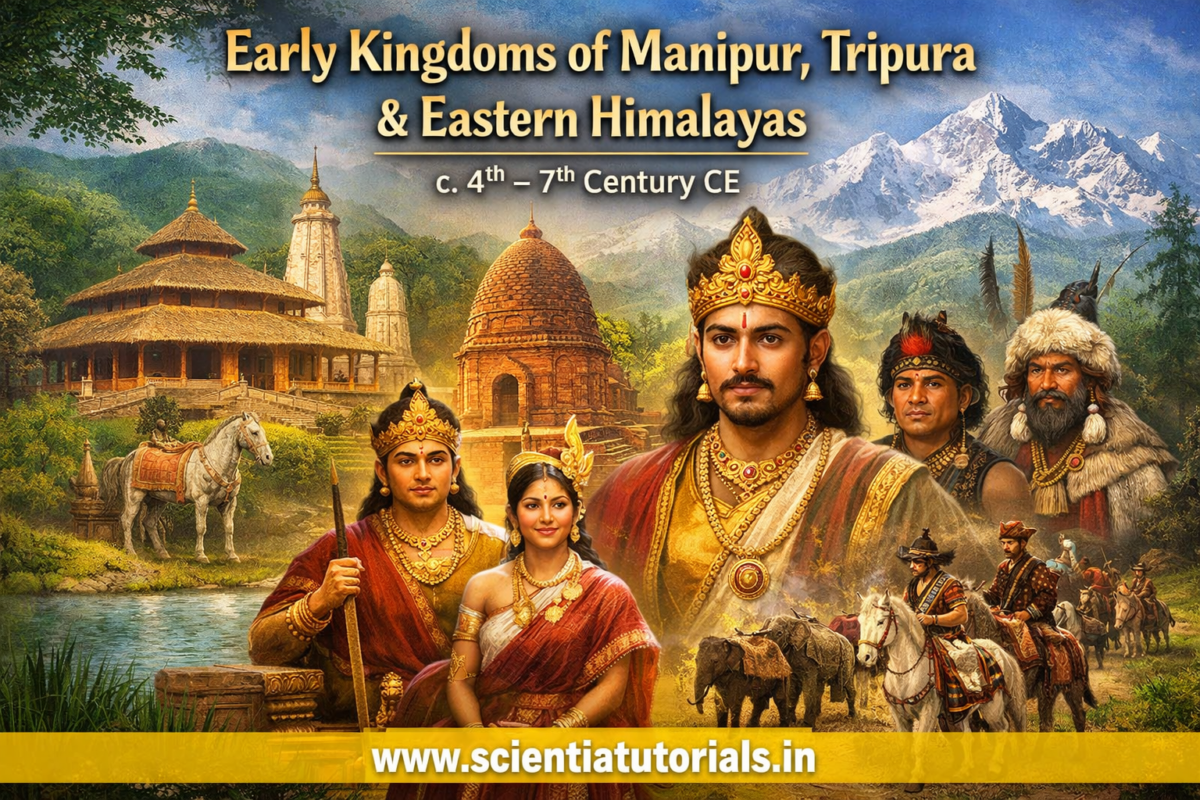

Early Kingdoms of Manipur, Tripura & Eastern Himalayas (4th–7th Century CE)
Course: History of North-East India: From Early Kingdoms to Modern Integration
Module II: Early Historic Period and the Emergence of Kingdoms
Timeline / Era Covered: c. 4th Century CE – 7th Century CE
Lesson: Early Kingdoms in Manipur, Tripura, and the Eastern Himalayan Region
This lesson is systematically organized into four clearly structured sections, as detailed below:
- Chronologically Structured Study Module
- Short-Answer Type Questions
- Long-Answer Type Questions
- Multiple-Choice Questions (MCQs) with Answers and Detailed Explanations
Chronologically Structured Study Module
(Prepared for Competitive, University, and State-Level Examinations)
Introduction: Early Historic Transformations in North-East India (c. 4th–7th Century CE)
The period between the 4th and 7th centuries CE marks a decisive phase in the historical evolution of North-East India. This era witnessed the emergence of early kingdoms, consolidation of political authority, institutionalization of monarchy, and growing integration with the wider Indian subcontinent. Unlike the Gangetic plains, where urbanization and imperial states appeared earlier, the political formations in North-East India evolved gradually, shaped by geography, tribal polities, clan-based leadership, and external cultural influences.
This lesson focuses on three important regional zones:
- The Manipur Valley,
- The Tripura region, and
- The Eastern Himalayan Region (including present-day Arunachal Pradesh and adjoining hill tracts).
Together, these regions illustrate how local traditions, legends, and early state structures interacted with Sanskritic political ideas, trade routes, and religious networks during the early historic period.
I. Early Kingdoms in Manipur (c. 4th–7th Century CE)
1. Geographical and Cultural Background
The Manipur Valley, surrounded by hill ranges, provided a fertile and strategically secure environment for early political consolidation. Its wetlands, rivers (especially the Imphal River system), and central valley plains supported wet-rice cultivation, enabling population growth and surplus production—critical prerequisites for state formation.
The valley was inhabited primarily by the Meitei people, while surrounding hills were home to various Naga and Kuki-Chin groups. This hill–valley interaction played a crucial role in shaping Manipur’s early political and economic systems.
2. Legendary Origins and Early Kingship
Manipur’s early history is preserved in indigenous chronicles such as the Cheitharol Kumbaba, one of the oldest court chronicles in India. Although parts of it blend myth and history, it provides valuable insight into early kingship traditions.
- Pakhangba (c. 33 CE, traditional date) is regarded as the first historical ruler of Manipur.
- By the 4th–6th centuries CE, kingship had become hereditary, with ritual legitimacy and centralized authority.
The king was viewed as both political leader and ritual head, responsible for maintaining cosmic order, agricultural prosperity, and social harmony.
3. Political Structure and Administration
During the early historic period:
- Manipur functioned as a centralized monarchy.
- Authority radiated from the royal seat at Kangla, which later evolved into a fortified political centre.
- The king relied on clan chiefs and local elites for governance, indicating a hybrid system combining monarchy with clan institutions.
4. Religious Developments
Before Vaishnavism (which spread later), early Manipur practiced:
- Indigenous animistic and ancestor worship,
- Cults centred on natural forces and local deities.
From around the 6th–7th centuries CE, early contacts with Brahmanical traditions began, laying the foundation for later Hindu influences.
5. External Contacts and Trade
Manipur occupied a crucial position linking:
- The Brahmaputra Valley,
- Upper Myanmar, and
- South-East Asia.
Trade in forest products, salt, and textiles fostered early diplomatic and commercial contacts, contributing to state consolidation.
II. Early Kingdoms in Tripura (c. 4th–7th Century CE)
1. Geographical Setting
The region of Tripura consists of hill ranges interspersed with fertile valleys. Its proximity to the Bengal plains significantly influenced its political evolution, more so than in Manipur.
2. Legendary Genealogy and the Manikya Line
Tripura’s early history is recorded in the Rajmala, a court chronicle composed in Sanskrit and Bengali. Though compiled later, it preserves memories of early kingship.
- The Manikya dynasty traces its origins to mythological ancestors linked to the Lunar dynasty.
- By the 5th–6th centuries CE, kingship in Tripura had become firmly established.
The adoption of Sanskrit titles such as Maharaja reflects increasing Sanskritization of political culture.
3. Political Organization
Early Tripura was:
- A hill-based monarchy with shifting capitals,
- Supported by tribal chiefs and warrior elites.
Unlike the rigid bureaucratic states of northern India, Tripura’s polity remained flexible, adapting to terrain and tribal dynamics.
4. Religious and Cultural Influences
Tripura experienced earlier and stronger Brahmanical influences than Manipur:
- Worship of Shiva, Vishnu, and local deities coexisted.
- Sanskrit language and Hindu rituals enhanced royal legitimacy.
This period laid the groundwork for Tripura’s later emergence as a powerful medieval kingdom.
5. Economic Base and Trade
Tripura benefited from:
- Trade links with Bengal,
- Exchange of forest products, elephants, and cotton textiles.
Its location allowed it to act as a cultural and economic intermediary between the hills and plains.
III. Early Political Formations in the Eastern Himalayan Region (c. 4th–7th Century CE)
1. Defining the Eastern Himalayan Region
The Eastern Himalayan Region broadly includes present-day Arunachal Pradesh and adjoining hill tracts. This region was characterized by:
- Rugged terrain,
- River valleys of the Subansiri, Siang, and Lohit,
- Predominantly tribal societies.
2. Nature of Early Political Organization
Unlike Manipur and Tripura, the Eastern Himalayan region did not witness fully centralized kingdoms during this period. Instead, political organization took the form of:
- Chiefdoms and clan-based polities,
- Leadership based on kinship, warrior status, and ritual authority.
These formations represent an early stage of state development, sometimes described as proto-states.
3. Interaction with the Brahmaputra Valley
The Eastern Himalayan tribes maintained contact with the emerging kingdom of Kamarupa:
- Through trade routes and tribute relationships,
- Via exchange of forest products, horses, and medicinal plants.
Such interactions gradually introduced concepts of kingship, hierarchy, and tribute without dismantling tribal autonomy.
4. Religious and Cultural Life
Religious practices remained predominantly:
- Animistic and nature-centric,
- Focused on spirits, mountains, rivers, and ancestors.
However, Buddhist and Brahmanical ideas filtered in through trans-Himalayan routes, especially toward the later part of this period.
5. Historical Significance
The Eastern Himalayan region illustrates:
- A distinct path of political evolution,
- Gradual transition from tribal chiefdoms to more complex political systems in the early medieval period.
IV. Comparative Analysis: Manipur, Tripura, and the Eastern Himalayan Region
| Aspect | Manipur | Tripura | Eastern Himalayan Region |
|---|---|---|---|
| Political Form | Centralized monarchy | Hill-based monarchy | Chiefdoms |
| Historical Sources | Cheitharol Kumbaba | Rajmala | Archaeology & oral traditions |
| Religious Pattern | Indigenous → early Hindu | Early Hindu influence | Animism |
| External Contact | Myanmar & Brahmaputra | Bengal plains | Kamarupa |
V. Historical Importance for Examinations
This lesson is particularly important for:
- APSC & State PSC examinations,
- UGC-NET (History / Regional Studies),
- TET, CTET, CUET, and
- State-level recruitment exams in North-East India.
Key themes frequently tested include:
- Early state formation models,
- Indigenous vs Sanskritic political traditions,
- Regional diversity in early historic India.
Conclusion: Regional Diversity and Early State Formation
Between the 4th and 7th centuries CE, Manipur, Tripura, and the Eastern Himalayan region followed distinct yet interconnected paths toward political organization. While Manipur and Tripura developed early monarchies with growing cultural integration, the Eastern Himalayan region retained tribal political systems that interacted selectively with emerging states.
Together, these regions highlight the plurality of early historic experiences in North-East India, enriching our understanding of how geography, culture, and external contacts shaped early kingdoms beyond the Gangetic heartland.
🔎 Exam Tip
Always correlate political developments with geography and cultural traditions when answering descriptive or analytical questions on early North-East Indian history.
Short Answer Type Questions with Answers
(Early Historic Period: c. 4th–7th Century CE)
1. What is the chronological scope of the early historic kingdoms discussed in this lesson?
Answer:
The lesson covers the period from approximately the 4th century CE to the 7th century CE, marking early state formation in North-East India.
2. Which valley region formed the political core of early Manipur?
Answer:
The Manipur Valley, surrounded by hills, served as the political and agricultural heartland of early Manipur.
3. Name the primary ethnic group associated with early Manipur’s state formation.
Answer:
The Meitei community was the principal ethnic group involved in the formation of early Manipur’s monarchy.
4. What is the Cheitharol Kumbaba?
Answer:
The Cheitharol Kumbaba is the royal chronicle of Manipur, recording genealogies and reigns of its early kings.
5. Who is traditionally regarded as the first ruler of Manipur?
Answer:
Pakhangba is traditionally regarded as the earliest historical ruler of Manipur.
6. What was the nature of kingship in early Manipur?
Answer:
Early Manipur had a hereditary monarchy combining political authority with ritual and religious leadership.
7. Name the political centre of early Manipur.
Answer:
Kangla functioned as the main political and ceremonial centre of early Manipur.
8. What type of religious practices existed in Manipur during the early historic period?
Answer:
Manipur practiced indigenous animistic and ancestor worship, with limited early Brahmanical influence.
9. Which geographical factor helped Manipur maintain political stability?
Answer:
Its hill-surrounded valley geography provided natural protection and agricultural sustainability.
10. Which text serves as the main historical source for early Tripura?
Answer:
The Rajmala is the primary historical chronicle documenting the early history of Tripura.
11. Which dynasty ruled early Tripura?
Answer:
The Manikya dynasty ruled Tripura and traced its lineage to mythological origins.
12. How did Tripura’s geography influence its political structure?
Answer:
Tripura’s hill-based terrain encouraged a flexible monarchy supported by tribal chiefs rather than rigid administration.
13. Which cultural influence was stronger in early Tripura compared to Manipur?
Answer:
Brahmanical and Sanskritic influences were stronger in early Tripura due to proximity to the Bengal plains.
14. What titles were adopted by Tripura’s early rulers to legitimize authority?
Answer:
Tripura’s rulers adopted Sanskrit titles such as Maharaja to enhance royal legitimacy.
15. What was the economic base of early Tripura?
Answer:
Its economy depended on forest products, elephants, cotton textiles, and trade with Bengal.
16. Which present-day region broadly represents the Eastern Himalayan political zone?
Answer:
The Eastern Himalayan region broadly corresponds to present-day Arunachal Pradesh and adjoining hill areas.
17. What type of political organization existed in the Eastern Himalayan region?
Answer:
The region was dominated by tribal chiefdoms and clan-based polities, not centralized kingdoms.
18. Why are Eastern Himalayan polities described as proto-states?
Answer:
They showed early features of political authority without full administrative centralization.
19. Which major kingdom influenced the Eastern Himalayan region politically and economically?
Answer:
The kingdom of Kamarupa influenced the region through trade and tribute relations.
20. What goods were exchanged between the Eastern Himalayan tribes and the plains?
Answer:
Forest products, medicinal plants, horses, and artisanal goods were commonly exchanged.
21. What was the dominant religious belief system in the Eastern Himalayan region?
Answer:
The region followed animistic and nature-based religious traditions centered on spirits and ancestors.
22. How did trade contribute to early state formation in North-East India?
Answer:
Trade networks encouraged economic surplus, political interaction, and cultural exchange, aiding state formation.
23. Mention one key difference between Manipur and Tripura’s early political systems.
Answer:
Manipur developed a centralized valley monarchy, while Tripura maintained a hill-based flexible monarchy.
24. Why is geography crucial in understanding early North-East Indian kingdoms?
Answer:
Geography shaped defence, agriculture, communication, and political organization in the region.
25. Why is this lesson important for competitive examinations?
Answer:
It explains early state formation models, regional diversity, and indigenous political traditions of North-East India.
Long Answer Type Questions with Answers
(Early Historic Period: c. 4th–7th Century CE)
1. Discuss the historical significance of the early historic period (c. 4th–7th century CE) in the political evolution of North-East India.
Answer:
The early historic period marks a transformative phase in North-East Indian history, characterized by the emergence of organized political authority. Between the 4th and 7th centuries CE, regions such as Manipur and Tripura witnessed the consolidation of monarchy, while the Eastern Himalayan region developed complex tribal chiefdoms. This period laid the foundation for hereditary kingship, ritual legitimacy, territorial control, and early administrative practices. It also marked the region’s gradual integration into broader Indian cultural and economic networks without erasing indigenous traditions.
2. Examine the role of geography in the emergence of early kingdoms in Manipur.
Answer:
Geography played a decisive role in Manipur’s early state formation. The Manipur Valley, surrounded by hill ranges, provided natural defence and fertile land for wet-rice cultivation. This agricultural surplus supported population growth and centralized authority. The surrounding hills acted as both a protective barrier and a zone of interaction with tribal communities, allowing the valley-based monarchy to maintain dominance while engaging in trade and diplomacy with neighbouring regions.
3. Analyse the political structure and nature of kingship in early Manipur.
Answer:
Early Manipur developed a centralized hereditary monarchy by the early historic period. The king was both a political ruler and a ritual authority, responsible for maintaining cosmic and social order. Governance was conducted from Kangla, supported by clan chiefs and nobles, indicating a blend of centralized monarchy and clan-based administration. This system allowed stability while accommodating indigenous social structures, making Manipur one of the earliest enduring political entities in North-East India.
4. Assess the historical importance of the Cheitharol Kumbaba as a source for Manipur’s early history.
Answer:
The Cheitharol Kumbaba is one of the oldest court chronicles in India and a crucial source for reconstructing Manipur’s early history. Although it contains legendary elements, it provides valuable chronological records of kings, political events, and cultural practices. For historians, it illustrates how indigenous societies preserved historical memory and legitimized monarchy through recorded genealogy and ritual continuity.
5. Trace the evolution of religious practices in early Manipur during the early historic period.
Answer:
Religious life in early Manipur was predominantly indigenous, centered on animism, ancestor worship, and nature spirits. The king acted as a mediator between the human and spiritual worlds. From the 6th–7th centuries CE, early Brahmanical ideas began to influence court rituals, though they did not replace native beliefs. This gradual religious transition later facilitated the adoption of Vaishnavism in the medieval period.
6. Discuss the origin and development of kingship in early Tripura.
Answer:
Early Tripura’s kingship is traced through the Rajmala, which links the ruling dynasty to mythological origins. By the 5th–6th centuries CE, the Manikya dynasty had established a stable monarchy. Kings adopted Sanskrit titles and rituals to enhance legitimacy, while maintaining tribal alliances. This synthesis of indigenous authority and Sanskritic political culture enabled Tripura to evolve into a durable hill kingdom.
7. How did Tripura’s proximity to the Bengal plains influence its political and cultural development?
Answer:
Tripura’s close contact with the Bengal plains facilitated early exposure to Brahmanical religion, Sanskrit language, and political ideology. Trade and cultural exchange encouraged the adoption of Hindu rituals and royal titles. As a result, Tripura experienced stronger Sanskritization than many other hill regions, helping it integrate into subcontinental political traditions while retaining its regional identity.
8. Examine the administrative nature of early Tripura’s polity.
Answer:
Early Tripura did not develop a rigid bureaucratic administration. Instead, it functioned as a hill-based monarchy supported by tribal chiefs and warrior elites. Authority was flexible and adaptable to terrain and social structure. This decentralized system allowed the monarchy to maintain control over difficult terrain while ensuring loyalty from local power holders.
9. Analyse the economic foundations of early Tripura.
Answer:
The economy of early Tripura was based on forest resources, elephant capture, cotton textiles, and agriculture in fertile valleys. Trade with Bengal enhanced royal wealth and political stability. Economic surplus strengthened the monarchy and facilitated cultural exchange, reinforcing Tripura’s political development during the early historic period.
10. Describe the political characteristics of the Eastern Himalayan region during the early historic period.
Answer:
The Eastern Himalayan region did not witness centralized kingdoms during this period. Instead, it was dominated by clan-based chiefdoms where authority rested on kinship, ritual leadership, and warrior status. These political formations represent proto-state structures, reflecting an early stage of political evolution shaped by rugged terrain and dispersed settlements.
11. Why is the Eastern Himalayan region considered distinct from Manipur and Tripura in political development?
Answer:
Unlike Manipur and Tripura, the Eastern Himalayan region lacked fertile valleys conducive to centralized agriculture and administration. Difficult terrain limited large-scale political integration. Consequently, political authority remained localized, and tribal autonomy persisted longer, demonstrating a distinct evolutionary path in state formation.
12. Examine the interaction between the Eastern Himalayan region and the kingdom of Kamarupa.
Answer:
The Eastern Himalayan region maintained economic and political contact with Kamarupa through trade, tribute, and cultural exchange. Hill tribes supplied forest products and horses, while receiving goods and ideas from the plains. These interactions introduced hierarchical political concepts without dismantling tribal structures.
13. Discuss the religious beliefs prevalent in the Eastern Himalayan region.
Answer:
Religious life in the Eastern Himalayan region was predominantly animistic, focusing on nature spirits, mountains, rivers, and ancestral worship. Religious authority was closely linked to social and political leadership. External influences such as Buddhism and Brahmanism remained limited and selective during this period.
14. Compare the political systems of Manipur and Tripura during the early historic period.
Answer:
Manipur developed a centralized valley-based monarchy with strong ritual kingship, while Tripura evolved as a hill-based monarchy with flexible administrative arrangements. Both adopted hereditary kingship, but Tripura experienced stronger Sanskritic influence due to proximity to Bengal, whereas Manipur retained stronger indigenous traditions.
15. Evaluate the role of trade in early state formation in North-East India.
Answer:
Trade was instrumental in early state formation by generating economic surplus, enabling diplomatic relations, and encouraging cultural exchange. Routes connecting the Brahmaputra Valley, Manipur, Tripura, and the Eastern Himalayas integrated the region into wider networks, strengthening political institutions.
16. How did indigenous traditions shape early kingship in North-East India?
Answer:
Indigenous traditions shaped kingship through clan legitimacy, ritual authority, and ancestral worship. Kings derived power not merely from force but from spiritual and social acceptance, ensuring stability and continuity in early political systems.
17. Discuss the concept of proto-states with reference to the Eastern Himalayan region.
Answer:
Proto-states refer to political formations exhibiting early features of authority without full centralization. In the Eastern Himalayan region, chiefdoms exercised territorial control and social regulation but lacked bureaucratic institutions, representing an intermediate stage between tribal society and statehood.
18. Assess the importance of historical chronicles in reconstructing early North-East Indian history.
Answer:
Chronicles such as the Cheitharol Kumbaba and Rajmala provide invaluable insights into early political systems, despite their legendary elements. They reflect indigenous historical consciousness and offer frameworks for understanding early state formation.
19. Analyse the relationship between hill and valley societies in early North-East India.
Answer:
Hill–valley interactions were characterized by trade, tribute, and cultural exchange. Valleys provided agricultural surplus and political centres, while hills supplied forest products and manpower. This interdependence shaped regional political stability.
20. Critically examine the significance of studying early kingdoms of Manipur, Tripura, and the Eastern Himalayan region for competitive examinations.
Answer:
This topic highlights regional diversity, alternative models of state formation, and the interaction between indigenous and Sanskritic traditions. It is essential for understanding North-East India’s distinct historical trajectory, a key focus in modern competitive and academic examinations.
MCQs with Answers and Explanations
(Early Historic Period: c. 4th–7th Century CE)
1. The early historic period discussed in this lesson broadly corresponds to which time frame?
A. 1st century BCE – 3rd century CE
B. 3rd century CE – 5th century CE
C. 4th century CE – 7th century CE
D. 7th century CE – 10th century CE
✅ Correct Answer: C
Explanation:
The lesson focuses on the 4th–7th centuries CE, a phase marked by early state formation and consolidation of political authority in North-East India.
2. Which geographical feature played the most crucial role in the emergence of early Manipur?
A. Coastal plains
B. Desert terrain
C. Fertile valley surrounded by hills
D. Plateau region
✅ Correct Answer: C
Explanation:
The Manipur Valley, encircled by hills, provided fertile land, natural defence, and a stable environment for centralized kingship.
3. The primary ethnic group associated with early state formation in Manipur was the:
A. Bodo
B. Kuki
C. Naga
D. Meitei
✅ Correct Answer: D
Explanation:
The Meitei people formed the core population of the Manipur Valley and were central to the development of early monarchy.
4. Which historical source is considered the royal chronicle of Manipur?
A. Rajmala
B. Kalika Purana
C. Cheitharol Kumbaba
D. Harshacharita
✅ Correct Answer: C
Explanation:
The Cheitharol Kumbaba records genealogies, reigns, and events of Manipur’s kings and is a vital indigenous historical source.
5. Who is traditionally regarded as the earliest ruler of Manipur?
A. Nongda Lairen Pakhangba
B. Bhaskaravarman
C. Mahamanikya
D. Samudragupta
✅ Correct Answer: A
Explanation:
Pakhangba is regarded in Manipuri tradition as the first historical ruler, symbolizing the origin of kingship.
6. The political centre of early Manipur was located at:
A. Imphal
B. Moirang
C. Kangla
D. Bishnupur
✅ Correct Answer: C
Explanation:
Kangla functioned as the royal seat and ceremonial centre of early Manipur.
7. Which of the following best describes the nature of kingship in early Manipur?
A. Tribal republic
B. Oligarchy
C. Hereditary monarchy with ritual authority
D. Military dictatorship
✅ Correct Answer: C
Explanation:
The king combined political power with ritual and religious functions, ensuring legitimacy and social order.
8. Prior to the spread of Vaishnavism, religious practices in Manipur were mainly:
A. Buddhist
B. Jain
C. Shaivite
D. Animistic and ancestor-based
✅ Correct Answer: D
Explanation:
Early Manipuri religion centered on nature spirits, ancestor worship, and indigenous deities.
9. Which historical text serves as the main source for early Tripura’s history?
A. Cheitharol Kumbaba
B. Harshacharita
C. Rajmala
D. Kalhana’s Rajatarangini
✅ Correct Answer: C
Explanation:
The Rajmala chronicles the genealogy and political history of Tripura’s rulers.
10. The ruling dynasty of early Tripura was known as the:
A. Varman dynasty
B. Pal dynasty
C. Koch dynasty
D. Manikya dynasty
✅ Correct Answer: D
Explanation:
The Manikya dynasty established hereditary rule and shaped Tripura’s early political identity.
11. Which factor most strongly influenced Tripura’s early political culture?
A. Tibetan Buddhism
B. Proximity to the Bengal plains
C. Roman trade
D. Arab merchants
✅ Correct Answer: B
Explanation:
Tripura’s closeness to Bengal facilitated Sanskritization, Hindu rituals, and political ideas.
12. Early Tripura is best described as a:
A. Highly centralized bureaucratic state
B. Tribal republic
C. Hill-based monarchy with flexible administration
D. Nomadic confederation
✅ Correct Answer: C
Explanation:
Tripura’s polity adapted to hilly terrain through decentralized control and tribal alliances.
13. Adoption of Sanskrit titles like “Maharaja” in Tripura indicates:
A. Militarization
B. Decline of tribal authority
C. Sanskritization of kingship
D. Buddhist influence
✅ Correct Answer: C
Explanation:
Sanskrit titles enhanced royal legitimacy by aligning rulers with pan-Indian political traditions.
14. Which of the following formed a major component of Tripura’s economy?
A. Maritime trade
B. Pastoral nomadism
C. Mining
D. Forest products and elephants
✅ Correct Answer: D
Explanation:
Forest resources and elephant capture were economically significant and linked Tripura to Bengal trade networks.
15. The Eastern Himalayan region largely corresponds to present-day:
A. Meghalaya
B. Nagaland
C. Arunachal Pradesh
D. Mizoram
✅ Correct Answer: C
Explanation:
The Eastern Himalayan political zone broadly covers modern Arunachal Pradesh and adjacent hill tracts.
16. Political organization in the Eastern Himalayan region during this period was characterized by:
A. Imperial administration
B. City-states
C. Clan-based chiefdoms
D. Theocratic states
✅ Correct Answer: C
Explanation:
Authority rested with chiefs and clan leaders, not centralized monarchs.
17. Why are Eastern Himalayan political formations often termed “proto-states”?
A. They were short-lived
B. They lacked warfare
C. They showed early authority without full state institutions
D. They were influenced by Rome
✅ Correct Answer: C
Explanation:
Proto-states had territorial control and leadership but lacked bureaucracy and centralized administration.
18. Which major kingdom influenced the Eastern Himalayan region through trade and tribute?
A. Magadha
B. Gupta Empire
C. Kamarupa
D. Pala Empire
✅ Correct Answer: C
Explanation:
The kingdom of Kamarupa interacted with hill regions economically and politically.
19. The dominant religious belief system in the Eastern Himalayan region was:
A. Buddhism
B. Jainism
C. Vaishnavism
D. Animism
✅ Correct Answer: D
Explanation:
Religion centered on nature spirits, rivers, mountains, and ancestor worship.
20. Which of the following best explains the absence of centralized kingdoms in the Eastern Himalayas?
A. Lack of rulers
B. Foreign invasions
C. Rugged terrain and dispersed settlements
D. Strong Buddhist opposition
✅ Correct Answer: C
Explanation:
Difficult geography limited agricultural surplus and administrative integration.
21. Hill–valley interactions in early North-East India were primarily based on:
A. Continuous warfare
B. Isolation
C. Trade and mutual dependence
D. Colonial intervention
✅ Correct Answer: C
Explanation:
Valleys supplied food and political centres, while hills provided forest goods and manpower.
22. Which factor most directly contributed to early state formation in Manipur and Tripura?
A. Roman trade
B. Agricultural surplus
C. Nomadic migrations
D. Coinage economy
✅ Correct Answer: B
Explanation:
Agricultural surplus sustained population growth and centralized authority.
23. Compared to Manipur, Tripura experienced earlier influence of:
A. Buddhism
B. Jainism
C. Brahmanical Hinduism
D. Islam
✅ Correct Answer: C
Explanation:
Tripura’s proximity to Bengal accelerated Hindu religious and cultural influence.
24. Which statement best reflects the nature of early North-East Indian state formation?
A. Uniform and centralized
B. Imported directly from North India
C. Regionally diverse and locally adapted
D. Entirely tribal
✅ Correct Answer: C
Explanation:
State formation varied according to geography, culture, and external contact, producing diverse political models.
25. From an examination perspective, this lesson is important mainly because it highlights:
A. Mughal administration
B. Colonial policies
C. Indigenous models of early kingship and regional diversity
D. Modern political movements
✅ Correct Answer: C
Explanation:
The lesson emphasizes alternative pathways to state formation beyond the Gangetic plains—a key analytical theme in competitive exams.
✅ Final Exam Tip
In MCQs, carefully note keywords like valley, hill, chiefdom, Sanskritization, proto-state, and trade networks—they often determine the correct option.