
Formation of Assam, Manipur, Tripura, and Sikkim
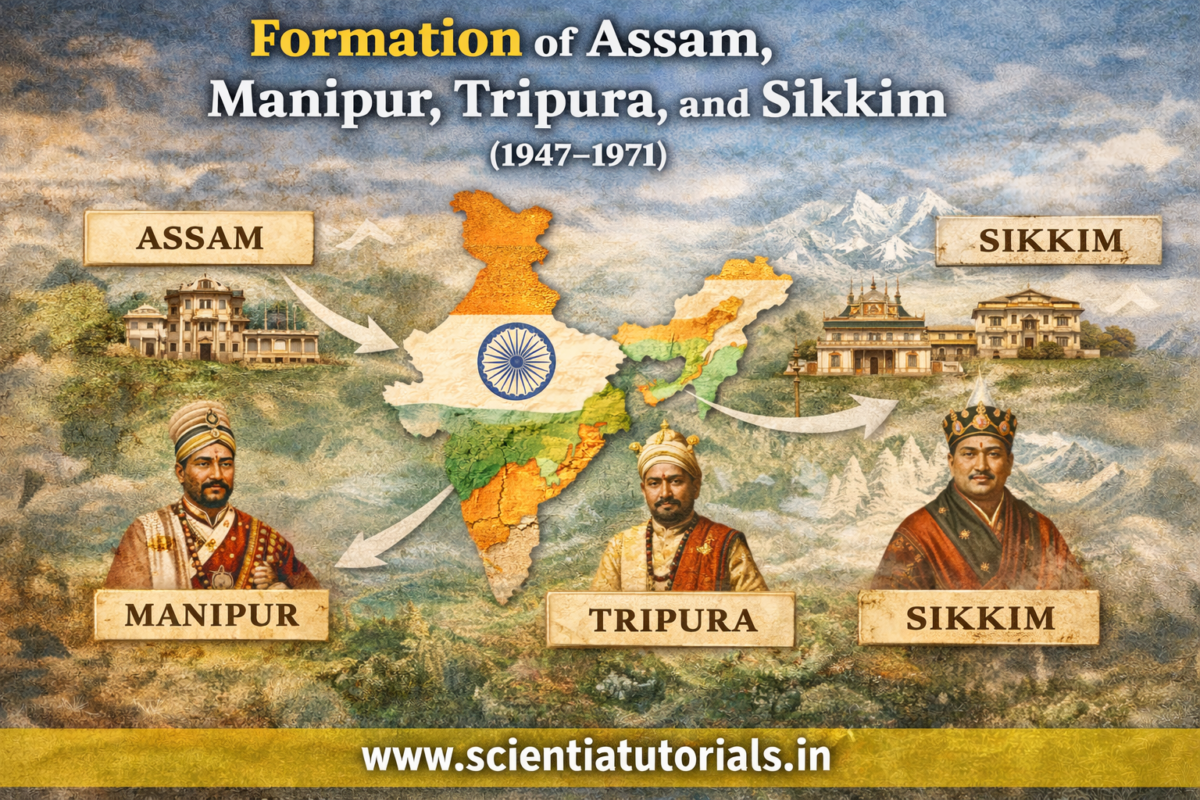

Formation of Assam, Manipur, Tripura and Sikkim (1947–1971) | State Formation
Module VIII: Post-Independence Integration and State Formation
Lesson: Formation of Assam, Manipur, Tripura, and Sikkim (1947–1971 CE)
This lesson is systematically organized into four clearly structured sections, as detailed below:
- Chronologically Structured Study Module
- Short-Answer Type Questions
- Long-Answer Type Questions
- Multiple-Choice Questions (MCQs) with Answers and Detailed Explanations
Chronologically Structured Study Module
1. Introduction: State Formation in Post-Independence North-East India
The formation of Assam, Manipur, Tripura, and Sikkim in the post-independence period represents a crucial phase in the political integration of North-East India into the Indian Union. Between 1947 and 1971, the Indian state faced the dual challenge of preserving national unity while accommodating regional diversity, ethnic identity, and historical particularities.
Unlike many regions of mainland India, where linguistic reorganisation was the dominant principle, state formation in the North-East followed a complex, multi-layered trajectory shaped by colonial legacies, princely rule, tribal autonomy, strategic concerns, and political movements. The evolution of Assam, Manipur, Tripura, and Sikkim illustrates how integration was not a single event but a gradual and negotiated process.
2. Colonial Legacy and the Situation in 1947
2.1 Administrative Inheritance
At independence in 1947, the political map of North-East India was uneven:
- Assam was a former British province with an elected legislature
- Manipur and Tripura were princely states
- Sikkim was a protectorate under British paramountcy, not directly part of British India
This diversity of political status meant that each region followed a distinct path toward integration and state formation.
2.2 Implications for State Formation
The Indian government could not apply a uniform model of integration. Instead, it relied on:
- Merger agreements
- Constitutional safeguards
- Gradual expansion of democratic institutions
This flexibility became a defining feature of state formation in the North-East.
3. Formation and Evolution of Assam after Independence
3.1 Assam at Independence
At independence, Assam emerged as a Part A state within the Indian Union. It inherited a large and diverse territory that included present-day Assam, Meghalaya, Nagaland, Mizoram, and Arunachal Pradesh (then NEFA). Assam thus functioned as the administrative core of the North-East.
3.2 Assam’s Role as the Core State
In the early post-independence period, Assam played a central role in administering the surrounding hill regions. This arrangement was initially intended to ensure administrative efficiency and integration. However, it also generated tensions:
- Hill communities feared domination by the Assamese plains
- Language and cultural policies intensified political mobilisation
3.3 Assam and the Question of Reorganisation
Although Assam retained its statehood throughout the period, its territorial boundaries were repeatedly questioned. The formation of Nagaland (1963) and the emergence of Meghalaya as an autonomous state (1970) marked the gradual reduction of Assam’s territorial expanse. These developments demonstrate that Assam’s formation as a state was stable, but its internal composition was not static.
4. Formation of Manipur: From Princely State to Statehood
4.1 Manipur as a Princely State
Before independence, Manipur was a princely state with its own monarchy and administrative system. Unlike many princely states, Manipur took early steps toward democratic governance.
4.2 Constitutional Experiment of 1947
In 1947, Manipur adopted a constitution and established an elected legislative assembly. This made Manipur one of the earliest regions in India to experiment with constitutional democracy outside British India.
4.3 Merger with the Indian Union (1949)
Despite its democratic institutions, Manipur merged with India in 1949 through a Merger Agreement. It became a Part C state, administered by the Centre.
This merger was controversial:
- Many Manipuris felt that their autonomy was curtailed
- The dissolution of the elected assembly generated political resentment
4.4 Union Territory Phase (1956)
Under the States Reorganisation Act 1956, Manipur was converted into a Union Territory. This status allowed limited political participation while keeping strong central control.
4.5 Towards Statehood (Up to 1971)
During the 1960s, political consciousness in Manipur grew steadily. Demands for full statehood intensified, based on:
- Democratic aspirations
- Administrative equality with other states
Although Manipur formally became a state in 1972, the political foundations of its statehood were firmly laid during the 1947–1971 period.
5. Formation of Tripura: Integration and Political Transformation
5.1 Tripura as a Princely State
Tripura was a princely state ruled by the Manikya dynasty. At independence, it faced significant socio-economic challenges, including demographic changes caused by migration.
5.2 Merger with India (1949)
Tripura merged with the Indian Union in 1949 and became a Part C state. Unlike Manipur, Tripura’s merger generated relatively less immediate political resistance.
5.3 Union Territory Status (1956)
Following the States Reorganisation Act, Tripura became a Union Territory. This phase witnessed:
- Expansion of administrative institutions
- Growth of political parties and mass politics
5.4 Political Mobilisation and Statehood Demands
By the 1960s, Tripura experienced increasing political mobilisation, particularly among peasants and tribal communities. Union Territory status came to be seen as inadequate, and demands for statehood gained momentum.
As with Manipur, Tripura’s full statehood was achieved in 1972, but the process of political formation and integration occurred largely between 1947 and 1971.
6. Sikkim: A Special Case in North-East State Formation
6.1 Sikkim’s Unique Political Status
Sikkim occupied a unique position in the North-East. It was neither a British province nor a princely state integrated in 1947. Instead, Sikkim functioned as a protectorate, ruled by the Chogyal under British—and later Indian—supervision.
6.2 Indo-Sikkim Treaty of 1950
In 1950, India and Sikkim signed a treaty that made Sikkim an Indian protectorate. India assumed responsibility for defence, foreign affairs, and communications, while internal administration remained with the Chogyal.
This arrangement ensured strategic security while postponing full integration.
6.3 Political Developments within Sikkim
During the 1950s and 1960s, political consciousness in Sikkim increased. Democratic movements demanded:
- Responsible government
- Reduction of monarchical power
- Closer integration with India
6.4 Sikkim by 1971
By 1971, Sikkim remained outside the Indian Union as a state, but the political trajectory toward integration was clear. Democratic pressures and India’s strategic concerns set the stage for later developments, culminating in Sikkim’s statehood in 1975.
7. Comparative Perspective: Assam, Manipur, Tripura, and Sikkim
7.1 Different Paths, Common Goal
Although each region followed a different path, certain common features can be identified:
- Gradual integration rather than abrupt incorporation
- Use of constitutional and administrative mechanisms
- Emphasis on stability and national security
7.2 Role of the Indian State
The Indian government adopted a flexible and pragmatic approach, recognising that uniform solutions would not work in the North-East. This adaptability became a hallmark of Indian federalism.
8. Political and Constitutional Significance
The formation of Assam, Manipur, Tripura, and Sikkim highlights several broader themes:
- The transformation of colonial and princely territories into democratic units
- The evolution of Indian federalism beyond linguistic principles
- The balance between autonomy and integration
These developments shaped the long-term political landscape of the North-East.
9. Assessment of the Period (1947–1971)
By 1971:
- Assam remained a state but with a changing territorial composition
- Manipur and Tripura had well-established political institutions and strong statehood movements
- Sikkim was closely aligned with India, moving steadily toward integration
The period thus represents a foundational phase in the modern political history of the region.
10. Conclusion: Formation as a Continuing Historical Process
The formation of Assam, Manipur, Tripura, and Sikkim between 1947 and 1971 demonstrates that state formation in the North-East was neither uniform nor instantaneous. It was a gradual, negotiated, and historically conditioned process, shaped by local aspirations and national priorities.
Rather than viewing state formation as a completed task by 1971, it is more accurate to see this period as laying the institutional and political foundations of contemporary North-East India. The experiences of these four regions continue to influence debates on federalism, autonomy, and integration in India.
Short Answer Type Questions with Answers
Q1. What was the political status of Assam at the time of Indian independence?
Answer:
At independence in 1947, Assam was a former British province and became a Part A state within the Indian Union.
Q2. Why is Assam described as the “core state” of North-East India after 1947?
Answer:
Because Assam administered most surrounding hill regions and served as the political and administrative centre of the North-East.
Q3. How did Assam’s role as a core state create political tensions?
Answer:
Hill communities feared cultural and political domination by the Assamese plains, leading to demands for separation and reorganisation.
Q4. What was Manipur’s political status before independence?
Answer:
Manipur was a princely state ruled by a Maharaja with its own administrative system.
Q5. What was unique about Manipur’s political development in 1947?
Answer:
Manipur adopted a constitution and established an elected legislative assembly in 1947.
Q6. When did Manipur merge with the Indian Union?
Answer:
Manipur merged with India in 1949 through a Merger Agreement.
Q7. Why did Manipur’s merger generate political resentment?
Answer:
Because its elected assembly was dissolved and autonomy was reduced after the merger.
Q8. What administrative status did Manipur receive after the States Reorganisation Act of 1956?
Answer:
Manipur became a Union Territory under central administration.
Q9. Why did demands for Manipur’s statehood grow during the 1960s?
Answer:
Due to rising political consciousness and the desire for democratic equality with other Indian states.
Q10. What was Tripura’s political status before independence?
Answer:
Tripura was a princely state ruled by the Manikya dynasty.
Q11. When did Tripura merge with India?
Answer:
Tripura merged with the Indian Union in 1949.
Q12. How was Tripura administered after 1956?
Answer:
Tripura was made a Union Territory following the States Reorganisation Act, 1956.
Q13. Why did Tripura’s Union Territory status lead to demands for statehood?
Answer:
Because UT status was seen as politically unequal and inadequate for democratic self-governance.
Q14. What role did mass politics play in Tripura during the 1960s?
Answer:
Peasant and tribal movements expanded political participation and strengthened demands for statehood.
Q15. How did Sikkim’s political status differ from Assam, Manipur, and Tripura?
Answer:
Sikkim was a protectorate, not a British province or princely state integrated in 1947.
Q16. What was the Indo-Sikkim Treaty of 1950?
Answer:
It made Sikkim an Indian protectorate, with India controlling defence, foreign affairs, and communications.
Q17. Who ruled Sikkim during the protectorate period?
Answer:
Sikkim was ruled by the Chogyal (monarch).
Q18. What political changes occurred in Sikkim during the 1950s and 1960s?
Answer:
Democratic movements demanded responsible government and reduced monarchical authority.
Q19. Why did India adopt a cautious approach toward Sikkim’s integration?
Answer:
Due to strategic concerns related to international borders and regional security.
Q20. By 1971, what was Sikkim’s position in relation to India?
Answer:
Sikkim remained a protectorate but was moving steadily toward closer political integration.
Q21. How did Union Territory status function in Manipur and Tripura?
Answer:
It acted as a transitional phase allowing administrative control while political institutions developed.
Q22. What common feature can be seen in the formation of Manipur and Tripura?
Answer:
Both followed a gradual path from princely states to Union Territories and later to statehood.
Q23. Why did state formation in the North-East differ from mainland India?
Answer:
Because it was shaped by ethnic diversity, colonial legacies, and strategic considerations rather than language alone.
Q24. What was the significance of the period 1947–1971 for these four regions?
Answer:
It laid the political and institutional foundations for their eventual statehood and integration.
Q25. Why is state formation in the North-East described as a continuous process?
Answer:
Because political integration and reorganisation evolved gradually through negotiation and reform rather than a single event.
Long Answer Type Questions with Answers
Lesson: Formation of Assam, Manipur, Tripura, and Sikkim (1947–1971)
Q1. Examine the historical background of state formation in North-East India after 1947.
Answer:
At independence, North-East India inherited a fragmented political structure shaped by colonial frontier policies, princely rule, and protectorate arrangements. Assam was a British province, Manipur and Tripura were princely states, and Sikkim functioned as a protectorate. The Indian government faced the challenge of integrating these diverse units while ensuring national unity, security, and democratic legitimacy. State formation thus evolved gradually through merger agreements, constitutional safeguards, and administrative restructuring rather than a uniform or immediate process.
Q2. Why did state formation in the North-East follow a different trajectory from mainland India?
Answer:
Unlike mainland India, where linguistic reorganisation dominated, the North-East followed a trajectory shaped by ethnic diversity, tribal autonomy, colonial isolation, and strategic border concerns. Language alone could not serve as a basis for reorganisation. Consequently, the Indian state adopted a flexible, negotiated approach emphasising gradual integration, autonomy, and political accommodation.
Q3. Analyse Assam’s position at the time of independence and its role in the North-East.
Answer:
Assam emerged as a Part A state in 1947 and became the administrative core of the North-East. It governed surrounding hill areas such as the Naga Hills and Lushai Hills. While this arrangement ensured administrative efficiency, it also generated tensions as hill communities feared domination by the Assamese plains. Assam’s role significantly influenced later reorganisation and state formation in the region.
Q4. Discuss how Assam’s internal composition changed between 1947 and 1971.
Answer:
Although Assam retained its statehood throughout this period, its territorial composition was altered significantly. The creation of Nagaland in 1963 and the emergence of Meghalaya as an autonomous state in 1970 reduced Assam’s territorial extent. These changes reflected growing ethnic assertion and demonstrated that Assam’s formation was stable but its boundaries were not static.
Q5. Trace the political evolution of Manipur from princely state to Union Territory.
Answer:
Manipur was a princely state that adopted a constitution and elected assembly in 1947, marking an early democratic experiment. In 1949, it merged with India through a Merger Agreement and became a Part C state. Under the States Reorganisation Act 1956, Manipur was converted into a Union Territory, bringing it under stronger central control while retaining limited political institutions.
Q6. Why was Manipur’s merger with India controversial?
Answer:
Manipur’s merger was controversial because it involved the dissolution of its elected assembly and reduced autonomy. Many Manipuris felt that a democratically functioning polity was absorbed without adequate consultation. This resentment later influenced political mobilisation and demands for full statehood.
Q7. Examine the growth of statehood demands in Manipur during the 1960s.
Answer:
During the 1960s, political awareness in Manipur increased due to expanded education, political participation, and comparisons with full-fledged states. Union Territory status was increasingly seen as inadequate and unequal. Democratic aspirations and administrative grievances combined to strengthen the movement for statehood, which was achieved shortly after this period.
Q8. Discuss Tripura’s integration into the Indian Union.
Answer:
Tripura, ruled by the Manikya dynasty, merged with India in 1949 and became a Part C state. Unlike Manipur, its merger faced less immediate resistance. However, demographic changes and socio-economic pressures shaped its post-merger politics, influencing the evolution of mass political movements.
Q9. Analyse the significance of Union Territory status for Tripura.
Answer:
After 1956, Tripura functioned as a Union Territory. This status allowed administrative consolidation and growth of political institutions but limited autonomy. Over time, UT status was perceived as politically inferior, leading to stronger demands for statehood during the 1960s.
Q10. Compare the political trajectories of Manipur and Tripura between 1947 and 1971.
Answer:
Both Manipur and Tripura transitioned from princely states to Union Territories and eventually to statehood. However, Manipur’s early democratic experience made its merger more contentious, while Tripura’s integration was relatively smoother. Despite these differences, both regions experienced growing political mobilisation and similar demands for equality within the Indian federal system.
Q11. Examine Sikkim’s unique political status after Indian independence.
Answer:
Sikkim was neither a British province nor a princely state integrated in 1947. It functioned as a protectorate ruled by the Chogyal. This unique status meant that Sikkim followed a distinct path toward integration, shaped by treaties rather than merger agreements.
Q12. Discuss the significance of the Indo-Sikkim Treaty of 1950.
Answer:
The Indo-Sikkim Treaty of 1950 made Sikkim an Indian protectorate. India assumed control over defence, foreign affairs, and communications, while internal administration remained with the Chogyal. This arrangement ensured strategic security while postponing full political integration.
Q13. Analyse political developments within Sikkim during the 1950s and 1960s.
Answer:
During this period, political consciousness in Sikkim increased. Democratic movements challenged monarchical authority and demanded responsible government. These developments weakened the traditional power structure and pushed Sikkim closer toward integration with India.
Q14. Why did India adopt a cautious approach toward Sikkim’s integration?
Answer:
Sikkim’s strategic location along sensitive international borders required careful handling. India prioritised stability and security, choosing gradual political influence over immediate incorporation. This cautious approach balanced regional geopolitics with internal political developments.
Q15. Compare Assam’s integration with that of Sikkim.
Answer:
Assam was directly integrated as a state in 1947, inheriting colonial administrative structures. Sikkim, by contrast, remained a protectorate governed through treaty arrangements. While Assam’s challenges were internal reorganisation, Sikkim’s integration involved redefining sovereignty and monarchical authority.
Q16. How did colonial legacies shape the formation of these four regions?
Answer:
Colonial policies created administrative fragmentation and preserved princely and protectorate systems. These legacies required differentiated approaches to integration, explaining why Assam, Manipur, Tripura, and Sikkim followed distinct yet interconnected paths of state formation.
Q17. Assess the role of the Indian state in managing diversity during state formation.
Answer:
The Indian state adopted a pragmatic and flexible strategy, using merger agreements, constitutional safeguards, and transitional arrangements such as Union Territories. This approach aimed to integrate diversity without provoking instability, highlighting adaptability within Indian federalism.
Q18. Evaluate the importance of Union Territories as transitional political units.
Answer:
Union Territories served as intermediate stages between princely integration and full statehood. They allowed the Centre to maintain control while political institutions developed locally. However, they also generated demands for equality and statehood, revealing their temporary nature.
Q19. How did democratic aspirations influence state formation in Manipur and Tripura?
Answer:
In both regions, expanding political participation and democratic awareness made limited autonomy unacceptable. Democratic aspirations transformed administrative grievances into organised statehood movements, shaping the political evolution of both regions.
Q20. “State formation in the North-East was a process, not an event.” Explain with reference to Assam, Manipur, Tripura, and Sikkim.
Answer:
State formation unfolded gradually through multiple stages—provincial integration, princely merger, Union Territory status, protectorate arrangements, and democratic movements. The experiences of these four regions show that integration and statehood evolved through negotiation, reform, and adaptation rather than a single decisive act.
MCQs with Answers and Detailed Explanations
Q1. At the time of Indian independence in 1947, which among the following was a British province?
A. Manipur
B. Tripura
C. Assam
D. Sikkim
Correct Answer: C
Explanation:
Assam was a British province and became a Part A state in 1947. Manipur and Tripura were princely states, while Sikkim was a protectorate.
Q2. Why is Assam described as the “core state” of North-East India after independence?
A. It was the most industrialised region
B. It administered surrounding hill areas
C. It had the largest population
D. It was a princely state
Correct Answer: B
Explanation:
Assam functioned as the administrative centre for many hill regions, making it the core state of the North-East.
Q3. Which factor most contributed to tensions between Assam and hill regions?
A. Religious differences
B. Trade policies
C. Language and administrative dominance
D. Taxation systems
Correct Answer: C
Explanation:
Promotion of Assamese language and Assam-based administration generated fears of domination among hill communities.
Q4. Manipur before independence was:
A. A British district
B. A Union Territory
C. A princely state
D. A protectorate
Correct Answer: C
Explanation:
Manipur was a princely state ruled by a Maharaja with its own administration.
Q5. What made Manipur’s political development in 1947 unique?
A. It joined Pakistan
B. It had no monarchy
C. It adopted a constitution and elected assembly
D. It was directly ruled by the British
Correct Answer: C
Explanation:
Manipur adopted a constitution and formed an elected legislative assembly in 1947, an early democratic experiment.
Q6. Manipur merged with the Indian Union in:
A. 1947
B. 1948
C. 1949
D. 1950
Correct Answer: C
Explanation:
Manipur merged with India in 1949 through a Merger Agreement.
Q7. Why did Manipur’s merger generate political resentment?
A. Economic decline
B. Religious interference
C. Dissolution of its elected assembly
D. Language imposition
Correct Answer: C
Explanation:
The merger dissolved Manipur’s elected institutions, leading to perceptions of reduced autonomy.
Q8. Under the States Reorganisation Act 1956, Manipur became a:
A. Full-fledged state
B. Protectorate
C. Union Territory
D. Autonomous region
Correct Answer: C
Explanation:
The Act converted Manipur into a Union Territory under central administration.
Q9. Why did demands for Manipur’s statehood grow during the 1960s?
A. Decline of monarchy
B. Military rule
C. Democratic aspirations and equality
D. Linguistic movements
Correct Answer: C
Explanation:
Political awareness and democratic expectations made Union Territory status seem inadequate.
Q10. Tripura before independence was ruled by:
A. British officials
B. A Governor
C. The Manikya dynasty
D. Tribal councils
Correct Answer: C
Explanation:
Tripura was a princely state ruled by the Manikya dynasty.
Q11. Tripura merged with the Indian Union in:
A. 1947
B. 1948
C. 1949
D. 1951
Correct Answer: C
Explanation:
Tripura merged with India in 1949.
Q12. After 1956, Tripura was administered as a:
A. Part A state
B. Autonomous district
C. Union Territory
D. Protectorate
Correct Answer: C
Explanation:
Like Manipur, Tripura became a Union Territory after the States Reorganisation Act, 1956.
Q13. Which factor strengthened statehood demands in Tripura during the 1960s?
A. Decline in population
B. Expansion of mass politics
C. Linguistic unity
D. British influence
Correct Answer: B
Explanation:
Peasant and tribal political mobilisation expanded democratic participation and demands for statehood.
Q14. How did Sikkim’s status differ from Assam, Manipur, and Tripura in 1947?
A. It was a British province
B. It was a princely state
C. It was a protectorate
D. It was a Union Territory
Correct Answer: C
Explanation:
Sikkim was a protectorate under British, and later Indian, influence—not part of British India.
Q15. The ruler of Sikkim during the protectorate period was known as the:
A. Maharaja
B. Raja
C. Chogyal
D. Dalai Lama
Correct Answer: C
Explanation:
Sikkim was ruled by the Chogyal, the traditional monarch.
Q16. The Indo-Sikkim Treaty of 1950 made India responsible for:
A. Internal administration only
B. Defence, foreign affairs, and communications
C. Religious affairs
D. Tax collection
Correct Answer: B
Explanation:
The treaty placed defence, foreign affairs, and communications under Indian control.
Q17. Political movements in Sikkim during the 1950s–60s demanded:
A. Complete independence
B. Expansion of monarchical power
C. Responsible government and democracy
D. Linguistic reorganisation
Correct Answer: C
Explanation:
Democratic movements sought to reduce monarchical authority and establish responsible government.
Q18. Why did India adopt a cautious approach toward Sikkim’s integration?
A. Economic weakness
B. Cultural differences
C. Strategic and international border concerns
D. Public opposition in India
Correct Answer: C
Explanation:
Sikkim’s sensitive geopolitical location required gradual and cautious integration.
Q19. Which of the following best describes Union Territory status for Manipur and Tripura?
A. Permanent political arrangement
B. Transitional administrative phase
C. Colonial legacy
D. Military administration
Correct Answer: B
Explanation:
Union Territory status served as a transitional phase toward eventual statehood.
Q20. Which state experienced the earliest democratic experiment before merger?
A. Tripura
B. Assam
C. Manipur
D. Sikkim
Correct Answer: C
Explanation:
Manipur had an elected assembly and constitution in 1947.
Q21. Which common feature characterises the formation of Manipur and Tripura?
A. Immediate statehood
B. Protectorate status
C. Transition from princely state to Union Territory
D. Direct British rule
Correct Answer: C
Explanation:
Both regions followed a path from princely state to Union Territory and later statehood.
Q22. State formation in the North-East differed from mainland India mainly because it was based on:
A. Religion
B. Language
C. Ethnic diversity and history
D. Economic planning
Correct Answer: C
Explanation:
Ethnic identity, colonial legacies, and strategic concerns shaped state formation in the North-East.
Q23. By 1971, which of the following was still not a full-fledged Indian state?
A. Assam
B. Manipur
C. Tripura
D. Sikkim
Correct Answer: D
Explanation:
Sikkim remained a protectorate until becoming a state in 1975.
Q24. The period 1947–1971 is significant because it:
A. Ended all political conflicts
B. Laid foundations of statehood in the region
C. Eliminated ethnic identities
D. Completed linguistic reorganisation
Correct Answer: B
Explanation:
This period established political institutions and integration pathways for later statehood.
Q25. The formation of Assam, Manipur, Tripura, and Sikkim can best be described as:
A. Sudden and uniform
B. Militarily enforced
C. Gradual and negotiated
D. Purely linguistic
Correct Answer: C
Explanation:
State formation evolved gradually through negotiation, constitutional measures, and political movements.