
Partition of India and Its Impact on North-East India
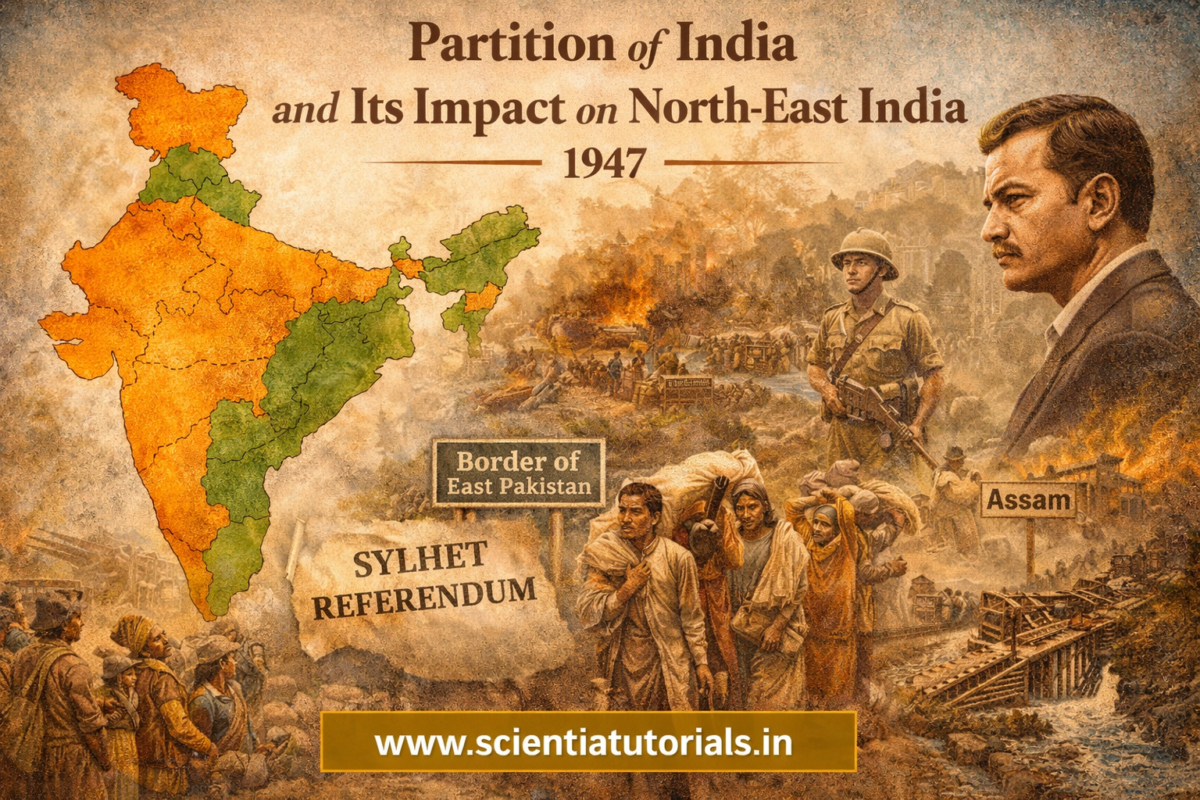

Partition of India and Its Impact on North-East India (1947) | Modern History
Course: History of North-East India: From Early Kingdoms to Modern Integration
Module VII: National Movement and Political Awakening
Timeline / Era Covered: 1900 CE – 1947 CE
Lesson: Partition of India and Its Impact on North-East India
This lesson is systematically organized into four clearly structured sections, as detailed below:
- Chronologically Structured Study Module
- Short-Answer Type Questions
- Long-Answer Type Questions
- Multiple-Choice Questions (MCQs) with Answers and Detailed Explanations
Chronologically Structured Study Module
Introduction: Partition as a Transformative Moment for North-East India
The Partition of India in 1947 was one of the most momentous and traumatic events in South Asian history. While the Partition is often studied primarily through its impact on Punjab and Bengal, its consequences for North-East India were equally profound, long-lasting, and structurally complex.
For the North-Eastern region, Partition did not merely redraw international boundaries; it reconfigured political geography, disrupted economic networks, altered demographic patterns, and reshaped questions of identity, security, and integration. Assam and its adjoining hill and frontier areas, which had been administratively and economically linked to Bengal during colonial rule, suddenly found themselves bordering a new sovereign state—Pakistan (specifically East Pakistan, later Bangladesh).
This lesson examines the Partition of India and its impact on North-East India in a chronological and analytical manner, tracing developments from the late colonial background to the immediate and long-term consequences of 1947.
I. Background: North-East India on the Eve of Partition
1. Colonial Administrative Structure
Before 1947, North-East India—particularly Assam—was closely connected to Bengal in terms of administration, trade, transport, and education. Key features included:
- Dependence on Calcutta port for tea, oil, and timber exports
- Rail and river networks passing through Bengal districts like Sylhet
- Mixed populations with Assamese, Bengali, tribal, and immigrant communities
The colonial economy integrated Assam with eastern Bengal rather than with mainland India.
2. Growth of Political Consciousness and Communal Politics
During the 1930s and 1940s, political developments in British India increasingly revolved around constitutional reforms, provincial autonomy, and communal representation. The rise of Muslim political organizations in Bengal and Assam influenced debates on political future, especially in districts with mixed populations.
II. Road to Partition (1940–1947): National and Regional Developments
1. All-India Context
The demand for Pakistan by the Muslim League, constitutional deadlock between major political parties, and British urgency to transfer power shaped the final phase of colonial rule. Decisions taken at the all-India level had direct repercussions for frontier regions like North-East India.
2. North-East India’s Strategic Position
North-East India acquired strategic importance due to:
- Its frontier location bordering Burma (Myanmar), China, and Tibet
- Wartime infrastructure developed during World War II
- Its role as a buffer region for the Indian subcontinent
These factors influenced British and Indian policymakers when drawing boundaries.
III. The Sylhet Referendum (1947): A Defining Moment
1. Background of Sylhet
Sylhet district, historically part of Assam, had a Muslim-majority population and strong economic and cultural links with Bengal. Its political future became a contentious issue during Partition negotiations.
2. The Referendum
The Sylhet Referendum was held in July 1947 to decide whether Sylhet would remain with Assam (and India) or join East Pakistan.
- The referendum was conducted under British supervision
- Voters were asked to choose between India and Pakistan
- Most of Sylhet voted in favour of joining East Pakistan
3. Immediate Outcome
As a result:
- Most of Sylhet district was transferred to East Pakistan
- Assam lost a large territory and population
- Only the Karimganj subdivision remained with India
The Sylhet Referendum marked the most direct territorial impact of Partition on Assam.
IV. Political Impact of Partition on North-East India
1. Redrawing of Boundaries
Partition left Assam with:
- A long and sensitive international border
- Reduced access to traditional trade and communication routes
- New security challenges
The political geography of the region changed permanently.
2. Leadership and Decision-Making
Assamese political leadership, including figures like Gopinath Bordoloi, strongly opposed further territorial losses and worked to ensure that the hill areas and remaining districts stayed within India.
V. Economic Consequences of Partition
1. Disruption of Trade and Transport
Partition cut Assam off from:
- Calcutta port
- Rail and river routes passing through East Bengal
- Traditional markets for tea and other commodities
This caused immediate economic dislocation.
2. Long-Term Economic Isolation
Assam and other North-Eastern regions became connected to mainland India only through a narrow corridor. This isolation:
- Increased transportation costs
- Slowed industrial development
- Deepened regional economic imbalance
Partition thus laid the foundation for persistent economic challenges in North-East India.
VI. Demographic Changes and Migration
1. Refugee Movement
Unlike Punjab, North-East India did not experience mass violence, but Partition triggered steady migration flows.
- Hindu refugees moved from East Pakistan into Assam and Tripura
- Muslim populations migrated in the opposite direction
2. Impact on Social Composition
These migrations:
- Altered demographic balances
- Intensified competition over land and resources
- Contributed to ethnic and linguistic tensions
Over time, migration became a major political issue in Assam.
VII. Partition and Tribal Areas of North-East India
1. Tribal Concerns and Isolation
Most tribal areas were not directly divided by Partition, but they were deeply affected by its consequences.
- Increased militarization of borders
- Administrative reorganization
- Fear of cultural and political marginalization
2. Strengthening of Autonomy Demands
Partition reinforced tribal demands for:
- Protection of land and customary rights
- Autonomous administrative arrangements
- Safeguards against demographic change
These concerns later influenced post-independence policies.
VIII. Security and Strategic Implications
1. International Borders
Partition transformed North-East India into a frontier zone with international boundaries with Pakistan and later Bangladesh.
- Border management became a major challenge
- Smuggling and cross-border movement increased
- Military and paramilitary presence expanded
2. Long-Term Strategic Significance
The region’s security concerns shaped India’s foreign and internal policies in the decades following independence.
IX. Psychological and Cultural Impact of Partition
1. Sense of Loss and Uncertainty
For many in Assam, the loss of Sylhet was experienced as:
- A cultural and emotional rupture
- The breaking of historical ties
- A reminder of vulnerability within national politics
2. Reorientation of Identity
Partition accelerated the process of redefining Assamese and North-Eastern identity within the Indian Union, balancing regional distinctiveness with national belonging.
X. Partition and Integration into Independent India
1. Administrative Reorganization
After 1947, the Indian government undertook steps to integrate North-East India:
- Strengthening central administration
- Building alternative transport links
- Introducing constitutional safeguards for tribal areas
2. Political Integration
Partition made it clear that North-East India’s stability was crucial for India’s unity. This realization influenced later policies on state reorganization, autonomy, and federalism.
XI. Long-Term Consequences of Partition for North-East India
1. Persistent Economic Challenges
Economic isolation and underdevelopment remained enduring reminders of Partition.
2. Migration and Identity Politics
Issues of migration, citizenship, and identity—especially in Assam—can be traced back to demographic shifts initiated during Partition.
3. Centre–Region Relations
Partition strengthened the role of the central government in North-East India, shaping patterns of governance and political negotiation.
Conclusion: Partition as a Turning Point in North-East Indian History
The Partition of India was not merely a national event; for North-East India, it was a transformative historical rupture. It reshaped boundaries, economies, demographics, and political priorities. While the region avoided the catastrophic violence seen elsewhere, it bore structural and long-term consequences that continue to influence its development and politics.
Understanding the impact of Partition on North-East India is essential to grasp the region’s post-independence challenges—economic isolation, identity debates, security concerns, and demands for autonomy. The events of 1947 thus stand as a crucial bridge between the colonial past and the complex realities of modern North-East India.
Short Answer Type Questions
Lesson: Partition of India and Its Impact on North-East India
Module VII: National Movement and Political Awakening (1900–1947 CE)
Q1. What is meant by the Partition of India?
Answer:
The Partition of India refers to the division of British India in 1947 into two independent states—India and Pakistan—based largely on religious lines.
Q2. Why was the Partition of India significant for North-East India?
Answer:
Partition reshaped political boundaries, disrupted economic links, caused migration, and isolated North-East India from its traditional communication and trade routes.
Q3. Which region of Pakistan bordered Assam after Partition?
Answer:
East Pakistan (present-day Bangladesh) bordered Assam after Partition.
Q4. Name the district of Assam most directly affected by Partition.
Answer:
Sylhet district was the most directly affected by Partition.
Q5. What was the Sylhet Referendum?
Answer:
The Sylhet Referendum was a vote held in 1947 to decide whether Sylhet would remain in Assam or join East Pakistan.
Q6. What was the outcome of the Sylhet Referendum?
Answer:
Most of Sylhet voted to join East Pakistan, while the Karimganj subdivision remained with India.
Q7. How did Partition alter Assam’s territorial boundaries?
Answer:
Assam lost most of Sylhet district, reducing its territory and changing its administrative and political geography.
Q8. Mention one political leader who opposed the division of Assam during Partition.
Answer:
Gopinath Bordoloi strongly opposed further territorial loss of Assam.
Q9. How did Partition affect Assam’s economy?
Answer:
Partition disrupted trade routes, cut off access to Calcutta port, and increased economic isolation and transportation costs.
Q10. Why did Assam become economically isolated after 1947?
Answer:
Because traditional rail, river, and road links passed through East Pakistan, leaving Assam connected to mainland India only by a narrow corridor.
Q11. What was the impact of Partition on transport and communication in North-East India?
Answer:
It disrupted railways and river routes, forcing India to develop alternative and longer communication links.
Q12. Did North-East India witness large-scale communal violence during Partition?
Answer:
No, the region largely avoided mass communal violence unlike Punjab and Bengal.
Q13. What kind of migration occurred in North-East India after Partition?
Answer:
There was a steady influx of Hindu refugees from East Pakistan and migration of Muslims in the opposite direction.
Q14. How did Partition affect the demographic composition of Assam?
Answer:
Migration altered population balance, increased pressure on land, and intensified ethnic and linguistic tensions.
Q15. Why did migration become a major political issue in Assam after Partition?
Answer:
Because demographic changes affected land, employment, and cultural identity, leading to long-term political debates.
Q16. How were tribal areas of North-East India affected by Partition?
Answer:
Though not directly divided, tribal areas faced increased security presence, administrative changes, and fears of marginalization.
Q17. What new security challenges emerged for North-East India after Partition?
Answer:
The creation of international borders led to concerns about border management, infiltration, and regional security.
Q18. How did Partition change the strategic importance of North-East India?
Answer:
The region became a frontier zone with international borders, increasing its military and strategic significance.
Q19. What psychological impact did the loss of Sylhet have on Assam?
Answer:
It created a sense of cultural loss, emotional rupture, and political insecurity among the Assamese population.
Q20. How did Partition influence centre–region relations in North-East India?
Answer:
It increased the role of the central government in administration, security, and integration of the region.
Q21. What role did World War II play in shaping Partition’s impact on North-East India?
Answer:
Wartime infrastructure and strategic concerns influenced boundary decisions and post-Partition security policies.
Q22. How did Partition affect Assam’s cultural links with Bengal?
Answer:
It severed long-standing cultural, educational, and economic ties with Bengal, especially Sylhet.
Q23. What long-term economic problem of North-East India can be traced to Partition?
Answer:
Chronic economic isolation and underdevelopment can be traced partly to Partition.
Q24. How did Partition contribute to identity politics in Assam?
Answer:
Demographic changes and migration intensified debates over identity, citizenship, and cultural protection.
Q25. Why is Partition considered a turning point in the history of North-East India?
Answer:
Because it permanently altered boundaries, economy, demographics, security concerns, and political integration with India.
Long Answer Type Questions
Lesson: Partition of India and Its Impact on North-East India
Q1. Explain the historical background of North-East India on the eve of the Partition of India.
Answer:
On the eve of Partition, North-East India—particularly Assam—was economically, administratively, and culturally linked with Bengal. Colonial trade routes, railways, and river transport connected Assam to Calcutta port through eastern Bengal districts like Sylhet. Politically, the region had begun participating in constitutional politics, but its frontier location, ethnic diversity, and dependence on Bengal made it especially vulnerable to decisions taken during the hurried transfer of power in 1947.
Q2. Discuss the causes that led to the Partition of India and their relevance for North-East India.
Answer:
The Partition resulted from communal politics, constitutional deadlock, and British urgency to quit India. While these causes originated at the all-India level, their relevance for North-East India lay in boundary-making. Decisions influenced by religious majorities, strategic concerns, and administrative convenience reshaped Assam’s borders, despite limited local consensus.
Q3. Analyze why the Partition of India was a turning point in the history of North-East India.
Answer:
Partition transformed North-East India from a connected frontier of eastern India into a geographically isolated region. It altered boundaries, disrupted economic networks, and introduced international borders. The loss of Sylhet, refugee movements, and new security challenges made Partition a decisive break from the colonial past and a foundation for many post-independence issues.
Q4. Examine the significance of the Sylhet Referendum in the context of Partition.
Answer:
The Sylhet Referendum was the only plebiscite conducted in Assam during Partition. Held in 1947, it decided whether Sylhet would remain in India or join East Pakistan. The vote resulted in the transfer of most of Sylhet to Pakistan, causing territorial loss to Assam and symbolizing how regional interests were subordinated to communal and geopolitical calculations.
Q5. Assess the political consequences of the loss of Sylhet for Assam.
Answer:
Politically, Assam lost a historically, culturally, and economically significant district. The loss weakened Assam’s administrative reach, altered its demographic composition, and created a sense of insecurity. It also strengthened regional leadership’s resolve to prevent further territorial disintegration.
Q6. Evaluate the role of Assamese leadership during the Partition process.
Answer:
Assamese leaders played a crucial role in safeguarding the region’s interests. Leaders like Gopinath Bordoloi opposed further division and worked to ensure that the hill districts and tribal areas remained within India. Their efforts were vital in preserving Assam’s territorial integrity after Sylhet’s loss.
Q7. Discuss the economic impact of Partition on North-East India.
Answer:
Partition severed Assam’s access to Calcutta port and disrupted rail and river routes passing through East Pakistan. Trade in tea, oil, and timber suffered. Increased transportation costs and isolation slowed industrial growth. These economic disruptions had long-term effects, contributing to underdevelopment and regional imbalance.
Q8. Explain how Partition led to the geographical isolation of North-East India.
Answer:
After 1947, North-East India became connected to mainland India only through a narrow corridor. Traditional communication routes lay across East Pakistan, now an international boundary. This geographical isolation intensified economic hardship and complicated governance and development planning.
Q9. Analyze the demographic consequences of Partition for Assam and Tripura.
Answer:
Partition triggered refugee inflows, particularly Hindu migrants from East Pakistan, while some Muslim populations moved in the opposite direction. Though not as violent as Punjab, these demographic changes altered population balances, increased pressure on land, and later contributed to ethnic and political tensions in Assam and Tripura.
Q10. Why did migration become a long-term political issue in Assam after Partition?
Answer:
Migration affected land ownership, employment, and cultural identity. Over time, fears of demographic change led to political mobilization and demands for citizenship regulation. Thus, migration emerged as a central issue in Assam’s post-Partition politics.
Q11. Examine the impact of Partition on tribal areas of North-East India.
Answer:
Although tribal areas were not directly divided, Partition increased militarization and administrative control. Fears of marginalization and demographic change strengthened demands for autonomy and protection of customary rights. These concerns influenced later constitutional safeguards for tribal regions.
Q12. Discuss the security implications of Partition for North-East India.
Answer:
Partition converted the region into a frontier zone with international borders. Border management, cross-border movement, and strategic defense became major concerns. This led to a permanent security presence and shaped India’s internal and external policies in the region.
Q13. Analyze the psychological and cultural impact of Partition on Assamese society.
Answer:
The loss of Sylhet caused emotional trauma and a sense of cultural rupture. Long-standing educational, linguistic, and familial ties were broken. Partition also reinforced feelings of political vulnerability and sharpened regional consciousness within the Indian Union.
Q14. How did World War II influence the impact of Partition on North-East India?
Answer:
World War II had already militarized the region and enhanced its strategic importance. Infrastructure built during the war influenced post-Partition security planning. Wartime experiences also prepared the region for its new role as a sensitive frontier after 1947.
Q15. Compare the experience of Partition in North-East India with that of Punjab and Bengal.
Answer:
Unlike Punjab and Bengal, North-East India witnessed limited communal violence. However, its experience was marked by territorial loss, economic disruption, and long-term isolation. The impact was less immediate but more structural and enduring.
Q16. Examine how Partition reshaped centre–region relations in North-East India.
Answer:
Partition heightened the central government’s involvement in administration, security, and development. North-East India became strategically crucial, leading to stronger central control and shaping patterns of federal negotiation in independent India.
Q17. Discuss the role of Partition in shaping identity politics in Assam.
Answer:
Demographic changes and the memory of territorial loss intensified debates over identity, language, and citizenship. Partition laid the foundation for later movements centered on cultural protection and political recognition.
Q18. Analyze the long-term economic consequences of Partition for North-East India.
Answer:
Economic isolation, higher transport costs, and limited industrialization persisted long after independence. Many of these structural challenges can be traced to the disruption caused by Partition and the loss of traditional economic linkages.
Q19. Evaluate Partition as both a national and a regional event in Indian history.
Answer:
Nationally, Partition marked the end of colonial rule and birth of two nations. Regionally, in North-East India, it reshaped geography, economy, and politics. Its regional consequences highlight the uneven impact of national decisions.
Q20. Critically assess the argument that North-East India was marginalized during Partition negotiations.
Answer:
Decisions regarding borders and referendums were largely taken without extensive regional consultation. The hurried process and focus on communal majorities suggest that North-East India’s specific concerns were secondary to all-India political imperatives.
Q21. How did Partition influence post-independence integration policies in North-East India?
Answer:
Partition underscored the need for political integration, infrastructure development, and security. It influenced policies on state reorganization, tribal autonomy, and economic planning aimed at stabilizing the region.
Q22. Conclude by assessing the overall historical significance of Partition for North-East India.
Answer:
Partition was a transformative rupture that redefined North-East India’s place within India. It reshaped boundaries, economies, and identities, creating challenges that extended far beyond 1947. Understanding its impact is essential to explaining the region’s post-independence political and social trajectory.
MCQs with Answers and Explanations
Lesson: Partition of India and Its Impact on North-East India (1900–1947 CE)
Q1. The Partition of India primarily resulted in the creation of which two sovereign states?
A. India and Ceylon
B. India and Pakistan
C. India and Burma
D. India and Bangladesh
Correct Answer: B
Explanation:
In 1947, British India was divided into two independent dominions—India and Pakistan—marking the end of colonial rule.
Q2. Why was the impact of Partition on North-East India distinct from that on Punjab?
A. Absence of political change
B. Limited communal violence but deep structural consequences
C. Complete economic continuity
D. No territorial changes
Correct Answer: B
Explanation:
North-East India avoided large-scale violence but suffered long-term effects such as territorial loss, isolation, and economic disruption.
Q3. Which region became the immediate international neighbour of Assam after Partition?
A. West Pakistan
B. Burma
C. East Pakistan
D. Tibet
Correct Answer: C
Explanation:
East Pakistan (present-day Bangladesh) bordered Assam after 1947, creating new international boundaries.
Q4. Which district of Assam was directly affected by Partition through a plebiscite?
A. Cachar
B. Goalpara
C. Sylhet
D. Kamrup
Correct Answer: C
Explanation:
Sylhet’s political future was decided through a referendum, making it the most directly affected district.
Q5. The 1947 plebiscite that decided Sylhet’s fate is known as the:
A. Bengal Referendum
B. Assam Resolution
C. Sylhet Referendum
D. Radcliffe Award
Correct Answer: C
Explanation:
The Sylhet Referendum determined whether the district would remain with India or join East Pakistan.
Q6. What was the outcome of the Sylhet Referendum?
A. Sylhet remained entirely with Assam
B. Sylhet was divided equally
C. Most of Sylhet joined East Pakistan
D. Sylhet became an autonomous region
Correct Answer: C
Explanation:
A majority voted to join East Pakistan; only Karimganj subdivision stayed with India.
Q7. The loss of Sylhet primarily affected Assam in which way?
A. Military strength
B. Cultural and territorial integrity
C. Industrial output
D. Electoral representation only
Correct Answer: B
Explanation:
Sylhet’s loss caused territorial reduction and emotional-cultural rupture for Assam.
Q8. Which Assamese leader played a key role in opposing further division of Assam introduces here?
A. Tarun Ram Phukan
B. Bishnu Ram Medhi
C. Gopinath Bordoloi
D. Ambikagiri Raichoudhury
Correct Answer: C
Explanation:
Gopinath Bordoloi worked to ensure that Assam’s hill areas and remaining territories stayed within India.
Q9. Partition disrupted Assam’s economy mainly because it:
A. Destroyed tea plantations
B. Cut off access to Calcutta port
C. Ended agricultural production
D. Eliminated local markets
Correct Answer: B
Explanation:
Most trade routes and river transport linked Assam to Calcutta through East Bengal, now East Pakistan.
Q10. After 1947, North-East India became geographically isolated because it was connected to mainland India by:
A. Sea routes
B. Multiple rail corridors
C. A narrow land corridor
D. Air routes only
Correct Answer: C
Explanation:
The Siliguri Corridor became the sole land link, increasing isolation and transport costs.
Q11. Which sector of Assam’s economy was most affected by Partition-related transport disruption?
A. Handicrafts
B. Tea and oil
C. Fisheries
D. Cottage industries
Correct Answer: B
Explanation:
Tea and oil exports depended heavily on routes through Bengal to Calcutta port.
Q12. How did Partition influence migration patterns in North-East India?
A. No migration occurred
B. Only Muslim migration into Assam
C. Steady inflow of Hindu refugees from East Pakistan
D. Complete population exchange
Correct Answer: C
Explanation:
Refugee inflows were gradual but persistent, especially into Assam and Tripura.
Q13. Why did migration become a long-term political issue in Assam?
A. Due to industrial decline
B. Because it altered demographic balance and land use
C. Because it ended tribal autonomy
D. Due to military rule
Correct Answer: B
Explanation:
Demographic change raised concerns over identity, land, and political representation.
Q14. Compared to Punjab and Bengal, Partition violence in North-East India was:
A. More intense
B. Equally severe
C. Largely limited
D. Completely absent across the region
Correct Answer: C
Explanation:
Large-scale communal violence was limited, though social and economic effects were significant.
Q15. How were tribal areas of North-East India affected by Partition?
A. Direct territorial division
B. Complete political autonomy
C. Increased security and administrative control
D. Immediate industrial growth
Correct Answer: C
Explanation:
Though not divided, tribal areas experienced militarization and administrative reorganization.
Q16. Partition increased the strategic importance of North-East India because it:
A. Became an industrial hub
B. Shared borders with foreign countries
C. Had high population density
D. Controlled coastal trade
Correct Answer: B
Explanation:
New international borders made the region strategically sensitive.
Q17. Which war-time factor influenced the post-Partition strategic outlook of North-East India?
A. Home Rule Movement
B. World War II infrastructure and militarization
C. Non-Cooperation Movement
D. Civil Disobedience Movement
Correct Answer: B
Explanation:
World War II had already turned the region into a strategic military zone.
Q18. The psychological impact of losing Sylhet on Assam can best be described as:
A. Temporary political setback
B. Cultural and emotional rupture
C. Economic advantage
D. Administrative convenience
Correct Answer: B
Explanation:
Sylhet’s separation broke long-standing cultural, linguistic, and familial ties.
Q19. Partition reshaped centre–region relations in North-East India by:
A. Weakening central authority
B. Increasing state autonomy
C. Expanding central involvement in security and governance
D. Ending federalism
Correct Answer: C
Explanation:
The centre assumed a stronger role due to strategic and security concerns.
Q20. Which long-term economic problem of North-East India is linked to Partition?
A. Over-industrialization
B. Chronic transport and connectivity issues
C. Excess labour supply
D. Agricultural surplus
Correct Answer: B
Explanation:
Loss of traditional routes created lasting connectivity and cost disadvantages.
Q21. Partition led to a redefinition of Assamese identity mainly because of:
A. Industrialization
B. Educational reforms
C. Territorial loss and migration
D. Linguistic unification
Correct Answer: C
Explanation:
Demographic shifts and the memory of Sylhet’s loss intensified identity debates.
Q22. Which administrative challenge intensified after Partition in North-East India?
A. Urban planning
B. Border management
C. Tax collection
D. Education policy
Correct Answer: B
Explanation:
International borders required new mechanisms for security and administration.
Q23. The experience of Partition in North-East India highlights which broader historical theme?
A. Uniform impact of nationalism
B. Peripheral regions shaping national history
C. Economic self-sufficiency
D. Decline of regional identities
Correct Answer: B
Explanation:
Partition shows how decisions taken at the centre profoundly affected frontier regions.
Q24. Which statement best describes Partition as a regional event in North-East India?
A. Short-lived disturbance
B. Primarily violent episode
C. Structural transformation with long-term consequences
D. Minor administrative adjustment
Correct Answer: C
Explanation:
Its effects persisted in economy, politics, security, and identity long after 1947.
Q25. Overall, the Partition of India for North-East India can be seen as:
A. A purely political transition
B. An economic opportunity
C. A transformative rupture in regional history
D. An event without lasting impact
Correct Answer: C
Explanation:
Partition fundamentally reshaped North-East India’s geography, economy, and political trajectory.