
Hill–Plain Interactions and Political Negotiations
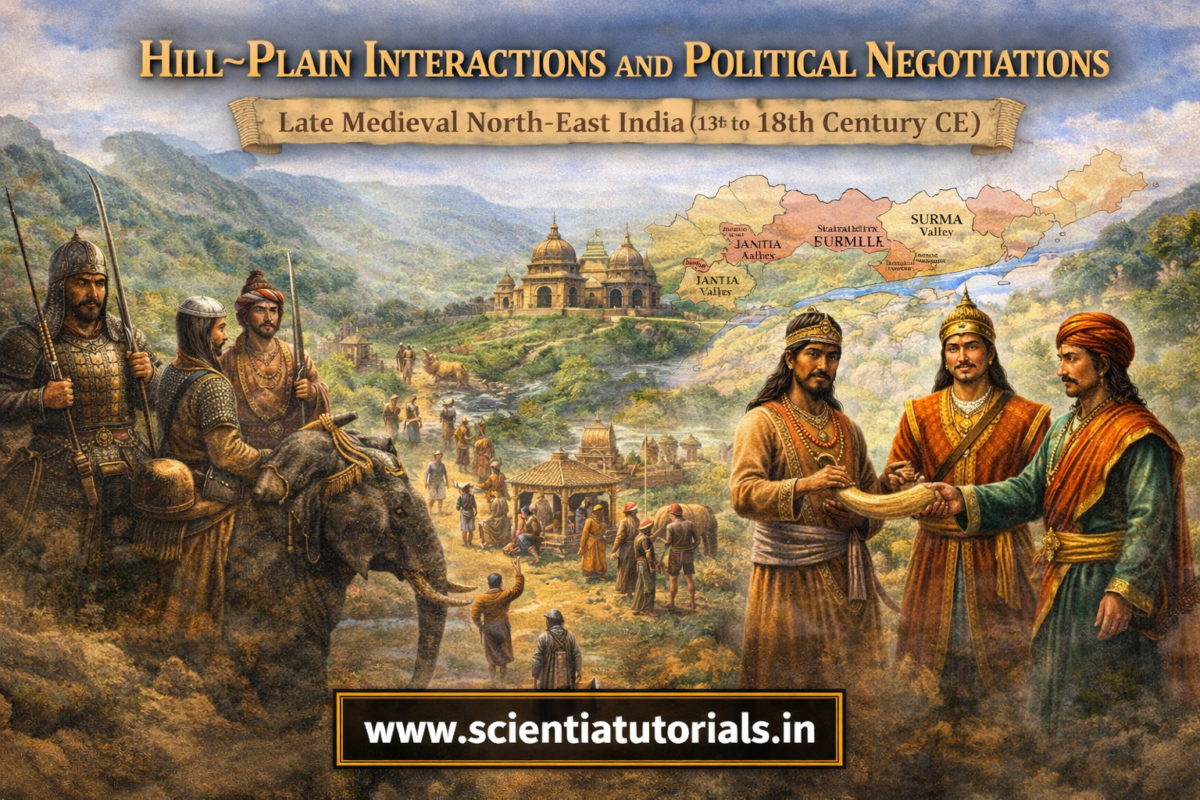

Hill–Plain Interactions and Political Negotiations | Medieval North-East India
Course: History of North-East India: From Early Kingdoms to Modern Integration
Module IV: Late Medieval Period and the Rise of Indigenous States
Timeline / Era Covered: 13th Century CE – 18th Century CE
Lesson: Hill–Plain Interactions and Political Negotiations
This lesson is systematically organized into four clearly structured sections, as detailed below:
- Chronologically Structured Study Module
- Short-Answer Type Questions
- Long-Answer Type Questions
Multiple-Choice Questions (MCQs) with Answers and Detailed Explanations
Chronologically Structured Study Module
Introduction: Understanding Hill–Plain Dynamics in Late Medieval North-East India
One of the most distinctive features of North-East Indian history is the continuous interaction between hill societies and plain-based states. During the late medieval period (13th–18th centuries CE), these interactions became more structured, politically significant, and historically transformative. Rather than existing in isolation, hill tribes and plains kingdoms were bound together through trade, diplomacy, warfare, tribute, migration, and cultural exchange.
This lesson examines hill–plain interactions as a historical process, not merely as conflict but as negotiation and mutual adaptation. States such as the Ahom, Koch, Jaintia, Kachari, and Dimasa polities developed strategies to manage relations with hill communities, while hill groups actively shaped regional politics. Understanding these interactions is essential to appreciating the integrated yet diverse political landscape of late medieval North-East India.
I. Conceptual Framework: Hill–Plain Interaction as a Historical Process
1. Defining Hill and Plain Societies
- Hill societies: Predominantly tribal communities practicing shifting cultivation (jhum), clan-based political organization, and customary law.
- Plain societies: Agrarian states with settled cultivation, surplus extraction, centralized administration, and territorial authority.
Despite these differences, the boundary between hills and plains was porous rather than rigid.
2. Nature of Interaction
Hill–plain interaction involved multiple dimensions:
- Economic (trade and exchange)
- Political (alliances, tribute, warfare)
- Cultural (religion, language, rituals)
- Strategic (defense, frontier management)
These interactions were shaped by geography, ecology, and historical necessity.
II. Geographical Context of Hill–Plain Relations
The geography of North-East India played a decisive role in shaping interactions.
Key geographical features:
- Brahmaputra Valley (plains)
- Barak–Surma Valley
- Patkai, Naga, Jaintia, and Garo Hills
Rivers acted as connectors, not barriers, enabling movement of goods, people, and armies between hills and plains.
III. Early Patterns of Hill–Plain Interaction (13th–15th Century CE)
1. Migration and Settlement
From the 13th century onwards:
- Hill groups migrated into plains due to population pressure and ecological change.
- Plains rulers encouraged selective settlement to cultivate frontier regions.
This migration often resulted in political incorporation rather than displacement.
2. Tribute and Exchange Relationships
Early hill–plain relations were often based on:
- Annual tribute (forest produce, elephants, salt)
- Exchange of protection for autonomy
- Recognition of ritual superiority of plains rulers
These arrangements laid the foundation for later political negotiations.
IV. Hill–Plain Interaction under the Ahom State (13th–18th Century CE)
1. Frontier Management and Diplomacy
The Ahom rulers developed a sophisticated frontier policy:
- Hills were treated as buffer zones against external invasion.
- Hill chiefs were granted autonomy in return for loyalty.
Rather than annexation, the Ahoms preferred negotiated subordination.
2. Incorporation of Hill Communities
Several hill groups were incorporated into the Ahom polity as:
- Paiks (state labor and military service)
- Border guardians
- Tributary allies
This integration strengthened state capacity while preserving local identities.
3. Military Cooperation and Conflict
Hill communities provided:
- Intelligence and guerrilla support
- Soldiers familiar with terrain
At times, conflicts arose due to tribute disputes or encroachment, but these were usually followed by renewed negotiations.
V. Koch, Kachari, and Dimasa Strategies of Hill–Plain Negotiation
1. Koch Kingdom and Hill Chiefs
The Koch rulers:
- Formed alliances with hill chiefs of Bhutan, Garo Hills, and eastern Assam
- Used marriage alliances and military cooperation
- Balanced force with diplomacy
This strategy allowed rapid territorial expansion without prolonged conflict.
2. Kachari and Dimasa Polities
The Kachari and Dimasa states represented intermediate hill–plain societies:
- Capitals shifted between hills and plains
- Rulers maintained close ties with clan chiefs
- Political authority was shared rather than imposed
Their governance reflected a hybrid political culture.
VI. Jaintia Kingdom: A Model of Hill–Plain Integration
1. Dual Control over Hills and Plains
The Jaintia rulers controlled:
- Hill territories (Jaintia Hills)
- Plains of the Surma Valley
This dual control enabled:
- Regulation of trade routes
- Cultural exchange between hill and plain populations
2. Economic Interdependence
Hill communities supplied:
- Limestone
- Forest produce
- Elephants
Plains provided:
- Rice
- Salt
- Manufactured goods
This economic interdependence reinforced political stability.
VII. Trade Networks and Economic Interaction
Trade was the most stable form of hill–plain interaction.
Major trade items:
- Elephants (used in warfare and diplomacy)
- Forest products (timber, medicinal plants)
- Salt and iron tools
Markets located at foothills became zones of cultural contact.
VIII. Political Negotiation as a Strategy of Governance
1. Negotiation over Annexation
Late medieval North-East Indian states preferred:
- Tribute arrangements
- Recognition of chiefs
- Ritual submission
This avoided costly warfare in difficult terrain.
2. Use of Symbolic Authority
Plains rulers asserted authority through:
- Granting titles to hill chiefs
- Hosting ceremonial exchanges
- Religious patronage
Such symbolic acts reinforced loyalty without administrative overreach.
IX. Conflict and Resistance in Hill–Plain Relations
Despite cooperation, conflicts did occur due to:
- Increased state demands
- Population pressure on land
- Disruption of customary practices
However, rebellion was often followed by renegotiation, not extermination or displacement.
X. Cultural Impact of Hill–Plain Interactions
1. Religious and Cultural Exchange
- Spread of Hindu practices into hills
- Survival of indigenous rituals in plains
- Syncretic traditions emerged
2. Linguistic and Social Integration
- Adoption of Assamese as a link language
- Intermarriage between hill and plain elites
- Formation of mixed communities
XI. Comparison with Other Regions of India
Unlike many parts of mainland India where tribal groups were marginalized, North-East India witnessed:
- Greater accommodation
- Mutual dependence
- Flexible political boundaries
This makes the region’s medieval history distinctive and region-specific.
XII. Role of Hill–Plain Interaction in State Formation
Hill–plain relations contributed directly to:
- Territorial expansion
- Military resilience
- Economic sustainability
- Cultural pluralism
States that managed these relations successfully, such as the Ahoms and Jaintias, enjoyed long-term stability.
XIII. Transition towards the Modern Period (18th Century CE)
By the 18th century:
- Increased state centralization strained traditional negotiations
- Rebellions and instability increased
- Colonial intervention disrupted indigenous systems
Yet, earlier hill–plain frameworks influenced later administrative arrangements under colonial rule.
XIV. Historical Significance of Hill–Plain Interactions
Hill–plain interactions are historically significant because they:
- Challenge narratives of isolation of hill tribes
- Reveal indigenous diplomatic traditions
- Highlight negotiated state formation
- Explain regional integration in North-East India
Conclusion
Hill–plain interactions during the late medieval period were not marginal phenomena, but central to the political evolution of North-East India. Through negotiation, trade, cultural exchange, and selective conflict, hill societies and plain states shaped one another. These interactions produced a distinct model of regional state formation, characterized by flexibility, accommodation, and mutual dependence.
Understanding these dynamics is essential for grasping the historical roots of North-East India’s cultural diversity and political integration.
Short Answer Type Questions with Answers
1. What is meant by hill–plain interaction in North-East Indian history?
Answer:
Hill–plain interaction refers to the economic, political, cultural, and social relationships between hill tribes and plains-based states in North-East India.
2. During which period did hill–plain interactions become more politically organized?
Answer:
Hill–plain interactions became more structured and politically significant during the late medieval period (13th–18th centuries CE).
3. Name two major river valleys that facilitated hill–plain interaction.
Answer:
The Brahmaputra Valley and the Barak–Surma Valley facilitated hill–plain interaction.
4. How did geography influence hill–plain relations?
Answer:
Rivers, hills, and forest corridors enabled trade, migration, and military movement, making interaction inevitable rather than isolating communities.
5. What type of economy was practiced by most hill societies?
Answer:
Most hill societies practiced shifting cultivation (jhum) along with forest-based activities.
6. What was the main economic base of plain-based states?
Answer:
Plain-based states relied mainly on settled agriculture and surplus extraction.
7. Mention one reason for migration from hills to plains.
Answer:
Population pressure and ecological stress in hill regions often led to migration into the plains.
8. What role did tribute play in hill–plain relations?
Answer:
Tribute acted as a negotiated mechanism through which hill chiefs acknowledged plains rulers in exchange for autonomy and protection.
9. Name two items commonly paid as tribute by hill communities.
Answer:
Elephants and forest products were commonly paid as tribute.
10. How did plains rulers generally manage hill territories?
Answer:
Plains rulers preferred negotiated subordination and indirect control rather than direct annexation.
11. Why were hills treated as buffer zones by plains states?
Answer:
Hills served as defensive buffers against external invasions and provided strategic security.
12. How were hill communities integrated into plain-based states?
Answer:
Hill communities were integrated as military allies, frontier guards, or labor groups while retaining local autonomy.
13. What role did trade play in hill–plain interaction?
Answer:
Trade was the most stable and continuous form of interaction, creating mutual economic dependence.
14. Name two important trade items exchanged between hills and plains.
Answer:
Salt and rice from the plains; forest products and limestone from the hills.
15. What were foothill markets?
Answer:
Foothill markets were exchange zones where hill and plain communities traded goods and interacted culturally.
16. How did political negotiation differ from conquest in this region?
Answer:
Political negotiation relied on alliances, tribute, and symbolic authority rather than military occupation.
17. What symbolic methods were used by plains rulers to assert authority?
Answer:
Granting titles, ceremonial exchanges, and religious patronage were used to assert symbolic authority.
18. Why did conflicts arise in hill–plain relations?
Answer:
Conflicts arose due to increased state demands, land pressure, and interference with customary practices.
19. How were conflicts usually resolved?
Answer:
Conflicts were often followed by renegotiation and restoration of earlier arrangements, not extermination.
20. What cultural impact resulted from hill–plain interaction?
Answer:
Cultural exchange led to syncretic religious practices, shared languages, and mixed communities.
21. How did religion spread from plains to hills?
Answer:
Religion spread through trade contacts, political patronage, and interaction with Brahmins and monks.
22. Name one linguistic impact of hill–plain interaction.
Answer:
The spread of Assamese as a link language across diverse communities.
23. How did hill–plain interaction contribute to state formation?
Answer:
It provided manpower, trade revenue, military support, and frontier stability, strengthening state structures.
24. How was the North-East Indian experience different from other regions of India?
Answer:
Unlike many regions, hill societies were accommodated rather than marginalized, through negotiation and mutual dependence.
25. State one historical significance of hill–plain interaction.
Answer:
It explains the integrated yet diverse political and cultural development of North-East India.
Long Answer Type Questions with Answers
(Based on: Hill–Plain Interactions and Political Negotiations)
1. Explain the concept of hill–plain interaction in the context of late medieval North-East India.
Answer:
Hill–plain interaction refers to the continuous and dynamic relationship between hill-based tribal societies and plains-based agrarian states in North-East India. During the late medieval period, these interactions involved trade, political negotiation, military cooperation, tribute, migration, and cultural exchange. Rather than isolation, hill and plain societies were interdependent. Plains states depended on hill regions for defense, forest resources, and manpower, while hill communities relied on plains for agricultural produce, salt, and manufactured goods. This interaction shaped a distinctive regional model of political integration.
2. Analyse how geography influenced hill–plain interactions in North-East India.
Answer:
The geography of North-East India—with its river valleys, hills, forests, and passes—played a crucial role in shaping hill–plain relations. The Brahmaputra and Barak–Surma valleys acted as economic and political cores, while surrounding hills served as corridors of movement rather than barriers. Rivers facilitated trade and military movement, and hill passes connected Assam with Burma, Bengal, and Tibet. This geography made interaction inevitable and encouraged negotiated relationships instead of rigid territorial control.
3. Discuss the nature of hill societies and plain societies in the late medieval period.
Answer:
Hill societies were generally organized around clans and tribes, practiced shifting cultivation (jhum), and followed customary laws. Political authority was decentralized and closely linked to kinship. In contrast, plain societies were agrarian, practiced settled agriculture, produced surplus, and developed centralized political authority. Despite these differences, both societies influenced each other through long-term interaction, resulting in gradual cultural and political convergence.
4. Examine the early patterns of hill–plain interaction from the 13th to the 15th centuries.
Answer:
In the early phase, hill–plain interaction was largely informal and based on exchange and migration. Hill groups migrated into plains due to ecological pressure, while plains rulers encouraged settlement to expand cultivation. Tribute relationships emerged, wherein hill chiefs offered forest produce or elephants in return for autonomy and protection. These early arrangements laid the groundwork for more formal political negotiations in later centuries.
5. How did tribute function as a mechanism of political negotiation?
Answer:
Tribute acted as a negotiated symbol of subordination rather than outright submission. Hill chiefs paid tribute in kind—such as elephants, timber, and forest produce—to plains rulers. In return, they retained internal autonomy and protection from external threats. This system allowed plains states to extend influence without costly military campaigns and preserved the political independence of hill societies.
6. Discuss the frontier policy of plains-based states in managing hill regions.
Answer:
Plains-based states adopted flexible frontier policies. Instead of direct annexation, hill areas were treated as buffer zones. Local chiefs were recognized and incorporated as allies or tributaries. This indirect rule minimized resistance and ensured frontier stability. Such policies demonstrate the preference for negotiation and accommodation over coercion in late medieval North-East India.
7. Analyse the role of hill communities in the military systems of plains states.
Answer:
Hill communities played a vital military role by providing soldiers skilled in guerrilla warfare and knowledge of difficult terrain. They also acted as scouts and border guards. In many cases, hill groups were integrated into state military systems while retaining their distinct identity. This cooperation strengthened plains states, especially during conflicts with external powers.
8. Examine the economic basis of hill–plain interactions.
Answer:
Economic exchange formed the backbone of hill–plain relations. Hill regions supplied forest products, elephants, limestone, medicinal plants, and timber. Plains regions provided rice, salt, iron tools, and textiles. This mutual dependence created stable trade networks and reduced the likelihood of sustained conflict. Foothill markets emerged as important contact zones facilitating economic and cultural exchange.
9. Discuss the significance of elephants in hill–plain relations.
Answer:
Elephants were among the most valuable resources supplied by hill communities. They were crucial for warfare, transportation, and royal prestige in plains states. Control over elephant routes and supply enhanced the political importance of hill chiefs, making them indispensable partners in political negotiation.
10. How did political negotiation differ from conquest in North-East India?
Answer:
Political negotiation emphasized alliances, tribute, symbolic submission, and recognition of local authority, whereas conquest involved direct military control. Due to difficult terrain and strong tribal resistance, plains states preferred negotiation. This approach reduced administrative costs and ensured long-term stability, making it a defining feature of regional statecraft.
11. Analyse the cultural impact of hill–plain interactions.
Answer:
Cultural exchange led to the spread of religious practices, languages, and social customs. Hindu rituals and institutions gradually entered hill regions, while indigenous traditions influenced plains society. Syncretic religious practices emerged, reflecting accommodation rather than cultural domination. Intermarriage between elites further strengthened cultural integration.
12. Discuss the linguistic consequences of hill–plain interaction.
Answer:
Hill–plain interaction encouraged the spread of Assamese and other plains languages as link languages for trade and administration. At the same time, hill languages influenced local dialects. This multilingual environment reflects the inclusive nature of regional interaction.
13. Examine the causes of conflict in hill–plain relations.
Answer:
Conflicts arose due to increased tribute demands, encroachment on customary lands, population pressure, and attempts at greater state control. However, these conflicts were usually localized and temporary, rarely leading to complete subjugation or displacement of hill communities.
14. How were conflicts between hills and plains generally resolved?
Answer:
Conflicts were typically resolved through renegotiation, restoration of earlier agreements, and symbolic reconciliation. Plains rulers often reduced demands or reaffirmed autonomy, demonstrating a preference for compromise over prolonged warfare.
15. Discuss the role of ritual and symbolism in political negotiations.
Answer:
Rituals such as ceremonial tribute, title grants, and religious patronage played a crucial role in legitimizing authority. These symbolic acts reinforced hierarchical relationships without direct administrative control, strengthening negotiated sovereignty.
16. Compare hill–plain interactions in North-East India with tribal–state relations in mainland India.
Answer:
Unlike many parts of mainland India, where tribal groups were often marginalized, North-East India witnessed greater accommodation and mutual dependence. Negotiation, not assimilation or displacement, defined the relationship, making the region’s historical experience distinct.
17. How did hill–plain interaction contribute to state formation?
Answer:
Hill–plain interaction provided manpower, resources, military support, and frontier security, all essential for state formation. Successful management of these relations enabled states to expand territory, stabilize borders, and sustain economies.
18. Examine the role of trade routes in sustaining hill–plain relations.
Answer:
Trade routes linking hills and plains facilitated the regular exchange of goods and ideas. Control over these routes enhanced political authority and economic prosperity, making them central to regional politics.
19. Discuss how hill–plain relations changed by the 18th century.
Answer:
By the 18th century, increasing centralization and population pressure strained traditional negotiations. Rebellions and instability increased, and colonial intervention disrupted indigenous systems. Nevertheless, earlier interaction patterns influenced later administrative arrangements.
20. Evaluate the historical significance of hill–plain interactions in North-East India.
Answer:
Hill–plain interactions are historically significant because they reveal a model of political integration based on negotiation, accommodation, and mutual dependence. They challenge narratives of isolation and highlight indigenous diplomatic traditions that shaped the region’s long-term political and cultural development.
MCQs with Answers and Explanations
(Hill–Plain Interactions and Political Negotiations)
1. Hill–plain interaction in North-East India primarily refers to:
A. Constant warfare between hills and plains
B. Isolation of hill tribes
C. Economic, political, and cultural exchanges
D. Colonial administrative control
Correct Answer: C
Explanation:
Hill–plain interaction involved trade, diplomacy, tribute, migration, military cooperation, and cultural exchange rather than isolation or constant conflict.
2. The most significant period of organized hill–plain interaction was:
A. Prehistoric period
B. Early historic period
C. Late medieval period
D. Colonial period
Correct Answer: C
Explanation:
From the 13th to 18th centuries CE, hill–plain relations became structured through political negotiations and state policies.
3. Which geographical feature most facilitated hill–plain interaction?
A. Deserts
B. River valleys
C. Coastal plains
D. Plateaus
Correct Answer: B
Explanation:
River valleys like the Brahmaputra and Barak–Surma acted as connectors, enabling movement of goods, people, and armies.
4. The Brahmaputra Valley mainly represented:
A. Hill-based economy
B. Pastoral society
C. Plains-based agrarian state
D. Nomadic zone
Correct Answer: C
Explanation:
The Brahmaputra Valley supported settled agriculture, surplus production, and centralized political authority.
5. Most hill societies practiced which type of cultivation?
A. Plantation farming
B. Terrace farming
C. Shifting cultivation
D. Commercial farming
Correct Answer: C
Explanation:
Hill communities largely practiced shifting cultivation (jhum), suited to forested and hilly terrain.
6. What was the main political structure of hill societies?
A. Bureaucratic administration
B. Clan-based authority
C. Mughal-style mansabdari
D. Republican councils
Correct Answer: B
Explanation:
Hill societies were organized around clans and kinship with decentralized political authority.
7. Why did plains states prefer negotiation over conquest in hill regions?
A. Lack of military power
B. Religious reasons
C. Difficult terrain and strong resistance
D. Colonial restrictions
Correct Answer: C
Explanation:
The rugged terrain and strong tribal resistance made direct conquest costly, encouraging negotiated control.
8. Hills were often treated by plains states as:
A. Core administrative regions
B. Agricultural heartlands
C. Buffer zones
D. Religious centers
Correct Answer: C
Explanation:
Hill regions acted as buffer zones protecting plains states from external invasions.
9. Tribute in hill–plain relations mainly symbolized:
A. Complete political subjugation
B. Economic exploitation
C. Negotiated subordination
D. Religious dominance
Correct Answer: C
Explanation:
Tribute represented a negotiated relationship where hill chiefs retained autonomy while acknowledging plains authority.
10. Which of the following was a common tribute item from hills?
A. Rice
B. Salt
C. Elephants
D. Textiles
Correct Answer: C
Explanation:
Elephants were highly valued for warfare, transport, and royal prestige, making them a key tribute item.
11. Plains regions usually supplied which item to hill communities?
A. Timber
B. Medicinal plants
C. Rice
D. Limestone
Correct Answer: C
Explanation:
Plains provided agricultural products like rice, which hill regions lacked in surplus.
12. Foothill markets were important because they:
A. Served as military camps
B. Acted as colonial centers
C. Facilitated exchange and cultural contact
D. Replaced village economies
Correct Answer: C
Explanation:
Foothill markets became zones of trade and interaction between hill and plain societies.
13. Which activity provided the most stable form of hill–plain interaction?
A. Warfare
B. Migration
C. Trade
D. Religious conversion
Correct Answer: C
Explanation:
Trade created long-term economic interdependence and reduced sustained conflict.
14. Hill communities contributed to plains states militarily by:
A. Providing artillery
B. Supplying naval forces
C. Offering terrain-based warfare skills
D. Acting as administrators
Correct Answer: C
Explanation:
Hill warriors were skilled in guerrilla tactics and familiar with difficult terrain.
15. Political negotiation in North-East India often involved:
A. Forced taxation
B. Ritual submission and title grants
C. Permanent military occupation
D. Complete assimilation
Correct Answer: B
Explanation:
Symbolic acts such as ceremonies, titles, and tribute reinforced authority without direct rule.
16. Which factor most often caused conflict in hill–plain relations?
A. Religious differences alone
B. Excessive state demands
C. Foreign invasions
D. Maritime trade decline
Correct Answer: B
Explanation:
Conflicts arose when plains states increased tribute demands or interfered with customary practices.
17. How were hill–plain conflicts generally resolved?
A. Total destruction of hill societies
B. Permanent annexation
C. Renegotiation of agreements
D. Colonial arbitration
Correct Answer: C
Explanation:
Conflicts were usually followed by renegotiation and restoration of earlier arrangements.
18. Cultural interaction between hills and plains resulted in:
A. Cultural isolation
B. Complete homogenization
C. Syncretic traditions
D. Cultural decline
Correct Answer: C
Explanation:
Interaction produced blended religious practices, customs, and social traditions.
19. One major linguistic impact of hill–plain interaction was:
A. Decline of local languages
B. Spread of Sanskrit only
C. Emergence of link languages
D. Imposition of English
Correct Answer: C
Explanation:
Languages like Assamese spread as link languages for trade and administration.
20. How did hill–plain relations contribute to state formation?
A. By eliminating tribal societies
B. By providing manpower and resources
C. By ending local autonomy
D. By enforcing uniform administration
Correct Answer: B
Explanation:
Hill–plain interaction strengthened states through military support, trade, and frontier stability.
21. Compared to mainland India, tribal–state relations in North-East India were:
A. More violent
B. More exploitative
C. More accommodative
D. Completely absent
Correct Answer: C
Explanation:
North-East India showed greater accommodation and negotiation rather than marginalization.
22. Which concept best explains hill–plain political relations?
A. Centralized absolutism
B. Negotiated sovereignty
C. Colonial domination
D. Feudal hierarchy
Correct Answer: B
Explanation:
Authority was shared through negotiation, tribute, and symbolic recognition.
23. By the 18th century, hill–plain relations began to strain mainly due to:
A. Decline in trade
B. Increased centralization
C. Religious conflicts
D. Climatic change
Correct Answer: B
Explanation:
Growing state centralization disrupted traditional negotiated arrangements.
24. Colonial intervention affected hill–plain systems by:
A. Strengthening indigenous negotiation
B. Preserving autonomy
C. Disrupting traditional relations
D. Ending trade
Correct Answer: C
Explanation:
Colonial rule undermined indigenous diplomatic and negotiated systems.
25. Historically, hill–plain interaction is important because it:
A. Shows isolation of North-East India
B. Explains indigenous diplomatic traditions
C. Proves absence of state formation
D. Highlights only military conflict
Correct Answer: B
Explanation:
Hill–plain interaction reveals a distinctive regional model of governance based on negotiation and mutual dependence.