
Kingdom of Manipur: Political Evolution and Cultural Identity
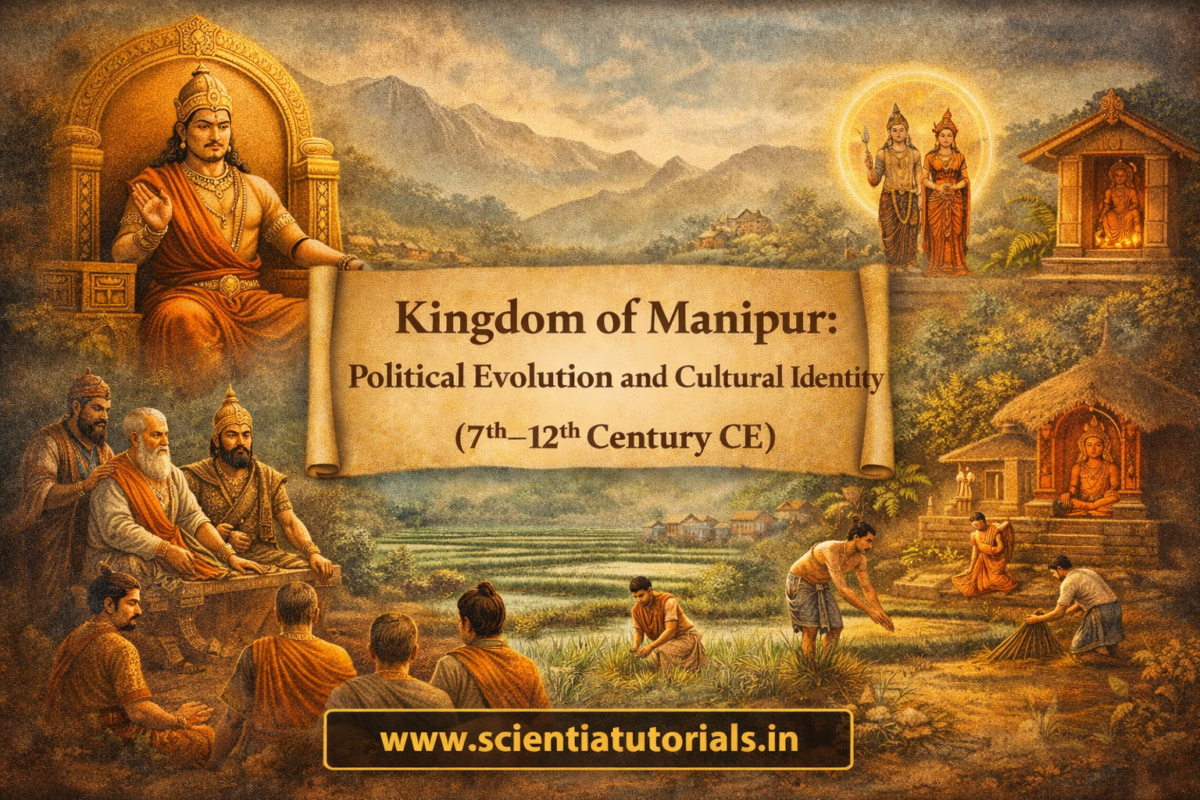

Kingdom of Manipur: Political Evolution & Cultural Identity (7th–12th Century CE)
History of North-East India: From Early Kingdoms to Modern Integration
Module III: Early Medieval Transformations and Regional Powers
Timeline / Era Covered: 7th Century CE – 12th Century CE
Lesson: Kingdom of Manipur: Political Evolution and Cultural Identity
This lesson is systematically organized into four clearly structured sections, as detailed below:
- Chronologically Structured Study Module
- Short-Answer Type Questions
- Long-Answer Type Questions
Multiple-Choice Questions (MCQs) with Answers and Detailed Explanations
Chronologically Structured Study Module
Introduction: Manipur in the Early Medieval North-East Indian Context
The Kingdom of Manipur, historically known as Kangleipak, occupies a distinctive place in the early medieval history of North-East India. Unlike the Brahmaputra valley kingdoms that experienced sharp political fragmentation after the decline of early historic states, Manipur followed a gradual and continuous trajectory of political evolution, rooted deeply in clan organization, lineage-based kingship, and indigenous cultural traditions.
Between the 7th and 12th centuries CE, Manipur developed from a cluster of clan-based chiefdoms into a recognizable regional kingdom. This evolution was accompanied by the formation of stable political institutions, codification of royal traditions, and the emergence of a strong cultural identity that balanced indigenous practices with selective external influences. Understanding Manipur’s political and cultural development is essential for appreciating the diversity of early medieval state formation in North-East India.
Geographical Setting and Its Historical Significance
The Manipur Valley and Surrounding Hills
Manipur is characterized by a central fertile valley surrounded by hills inhabited by various tribal communities. This geography had profound political consequences:
- The valley supported wet-rice cultivation, enabling population growth
- Hills provided natural defense but limited large-scale expansion
- Valley-hill interaction shaped political authority and cultural exchange
Unlike riverine empires, Manipur developed as a compact, regionally focused polity, emphasizing internal consolidation rather than territorial conquest.
Chronological Framework of Manipur’s Early Medieval History
For analytical clarity, the political evolution of Manipur between the 7th and 12th centuries CE can be divided into three major phases:
- 7th–8th Century CE: Clan Polities and Early Kingship
- 8th–10th Century CE: Consolidation of the Meitei Kingdom
- 10th–12th Century CE: Institutionalization of Kingship and Cultural Identity
Each phase reflects gradual transformation rather than abrupt change.
Phase I (7th–8th Century CE): Clan Polities and Early Political Formation
Clan-Based Social Organization
In the early medieval period, Manipur’s society was organized around clans (salais). Each clan:
- Controlled specific territories in the valley
- Maintained its own lineage traditions
- Recognized ritual and political leaders
Political authority was initially diffused, with clan chiefs exercising control over land, labor, and ritual life.
Emergence of Early Kingship
Gradually, one clan—the Meitei—rose to political prominence. Early kingship in Manipur was characterized by:
- Leadership rooted in clan seniority
- Ritual legitimacy rather than conquest
- Consensus-building among powerful clans
Kings were viewed not merely as rulers but as custodians of cosmic and social order.
Phase II (8th–10th Century CE): Consolidation of the Meitei Kingdom
Strengthening of Central Authority
Between the 8th and 10th centuries CE, Manipur witnessed a gradual consolidation of royal authority. Kings increasingly:
- Asserted control over the entire valley
- Integrated rival clans into a centralized structure
- Regulated land distribution and agricultural production
This process reduced inter-clan conflict and promoted political stability.
Role of the Royal Court
The royal court became the center of:
- Political decision-making
- Ritual and religious ceremonies
- Preservation of genealogies and traditions
Unlike bureaucratic states, governance relied on custom, precedent, and oral traditions rather than written law codes.
Phase III (10th–12th Century CE): Institutionalization of Kingship
Hereditary Monarchy and Succession
By the 10th century CE, kingship in Manipur had become hereditary. Succession rules, though flexible, emphasized:
- Continuity of the ruling lineage
- Acceptance by major clans
- Ritual confirmation of royal authority
This marked Manipur’s transition into a mature regional kingdom.
Administrative Structure
Administration remained relatively simple but effective:
- Village chiefs managed local affairs
- Clan leaders advised the king
- Royal authority was reinforced through ritual obligations
This decentralized yet integrated system suited Manipur’s geography and social structure.
Political Culture and Ideology of Kingship
Sacred Nature of Kingship
Manipur’s kingship was deeply ritualistic. The king was believed to:
- Maintain harmony between humans and nature
- Protect ancestral traditions
- Ensure agricultural prosperity
Political legitimacy was thus moral and spiritual, not purely military.
Absence of Aggressive Expansionism
Unlike many contemporary kingdoms, Manipur did not pursue large-scale territorial expansion. Instead, rulers focused on:
- Internal cohesion
- Valley-hill balance
- Defense rather than conquest
This restrained political vision contributed to long-term stability.
Cultural Identity of Medieval Manipur
Indigenous Religious Traditions
Religion in early medieval Manipur revolved around Sanamahi worship, ancestor veneration, and nature spirits. Key features included:
- Household deities
- Clan rituals
- Seasonal festivals linked to agriculture
Religion was inseparable from political life, reinforcing social unity.
Language, Oral Tradition, and Memory
The Meitei language developed as a vehicle of:
- Royal genealogy
- Mythological narratives
- Cultural transmission
Oral traditions preserved historical memory long before written chronicles became prominent.
Interaction with Surrounding Regions
Limited External Influence
During the 7th–12th centuries CE, Manipur maintained selective interaction with neighboring regions such as Assam and Myanmar. These interactions involved:
- Exchange of ritual ideas
- Limited trade
- Diplomatic contacts
However, Manipur remained largely culturally autonomous, resisting deep external domination.
Comparison with Contemporary North-East Polities
Compared to Kamarupa or Tripura:
- Manipur showed greater continuity of indigenous institutions
- State formation was slower but more stable
- Cultural identity remained strongly localized
This highlights the plurality of early medieval political experiences in North-East India.
Economy and Agrarian Foundations
Wet-Rice Cultivation
The economic base of Manipur was agriculture, especially wet-rice cultivation in the valley. This enabled:
- Stable food supply
- Support for royal institutions
- Growth of population
Agrarian surplus reinforced political authority without heavy taxation.
Resource Management
Kings regulated land use, water management, and seasonal labor through customary norms rather than formal revenue systems.
Manipur: Fragmentation or Gradual State Formation?
Historiographically, Manipur challenges the notion that early medieval North-East India was defined only by fragmentation. Instead, it demonstrates:
- Gradual centralization without collapse
- Continuity of indigenous governance
- Cultural resilience
Modern historians view Manipur as an example of organic state formation rooted in local society.
Long-Term Significance of Early Medieval Manipur
The political and cultural foundations laid between the 7th and 12th centuries CE:
- Shaped later medieval Manipuri monarchy
- Enabled adaptation to later Hindu influences
- Preserved a strong sense of regional identity
Even in later centuries, Manipur’s kingship retained early medieval characteristics.
Conclusion: Manipur’s Distinct Path in Early Medieval North-East India
The Kingdom of Manipur followed a distinct historical trajectory during the early medieval period. Rather than experiencing abrupt political fragmentation, it evolved gradually from clan-based polities into a stable regional kingdom. Kingship was deeply intertwined with ritual, culture, and social harmony, while political authority rested on consensus rather than coercion.
Between the 7th and 12th centuries CE, Manipur developed a durable political structure and a strong cultural identity that differentiated it from other North-East Indian kingdoms. This period forms the bedrock of Manipuri historical consciousness and remains essential for understanding the region’s later political developments.
Examination Relevance (APSC, State PSCs, UGC-NET, CUET, TETs)
- Clan-based state formation in Manipur
- Nature of early medieval kingship
- Cultural identity and indigenous traditions
- Comparison with Assam and Tripura
Short Answer Type Questions with Answers
Q1. What was the early medieval name of the Kingdom of Manipur?
Answer:
The early medieval Kingdom of Manipur was historically known as Kangleipak.
Q2. Which centuries are covered in the early medieval political evolution of Manipur?
Answer:
The early medieval political evolution of Manipur covers the 7th to 12th centuries CE.
Q3. What geographical feature played a central role in Manipur’s political development?
Answer:
The central Manipur valley, surrounded by hills, played a crucial role by supporting agriculture and political consolidation.
Q4. What was the basic social unit of early medieval Manipur?
Answer:
The basic social unit was the clan (salai), which controlled territory, land, and ritual life.
Q5. How was political authority structured in early Manipur society?
Answer:
Political authority was clan-based and decentralized, with chiefs exercising power before the emergence of centralized kingship.
Q6. Which clan emerged as the dominant political group in Manipur?
Answer:
The Meitei clan emerged as the dominant political group in Manipur.
Q7. What was the nature of early kingship in Manipur?
Answer:
Early kingship was ritual-based, consensual, and rooted in clan seniority rather than military conquest.
Q8. How did kingship in Manipur differ from Brahmaputra valley kingdoms?
Answer:
Manipur’s kingship emphasized ritual legitimacy and clan consensus, unlike the more land-grant-based and Brahmanical polities of Assam.
Q9. During which period did royal authority begin to consolidate in Manipur?
Answer:
Royal authority began consolidating between the 8th and 10th centuries CE.
Q10. What role did the royal court play in medieval Manipur?
Answer:
The royal court served as the center of political decision-making, ritual ceremonies, and preservation of genealogical traditions.
Q11. When did kingship in Manipur become hereditary?
Answer:
Kingship in Manipur became largely hereditary by the 10th century CE.
Q12. How was succession determined in medieval Manipur?
Answer:
Succession depended on lineage continuity, approval of major clans, and ritual confirmation of royal authority.
Q13. Describe the administrative system of early medieval Manipur.
Answer:
Administration was decentralized, involving village chiefs, clan leaders, and the king, based on custom and oral tradition.
Q14. What was the ideological basis of kingship in Manipur?
Answer:
Kingship was sacred and moral, emphasizing harmony between society, ancestors, and nature.
Q15. Did Manipur pursue aggressive territorial expansion during this period?
Answer:
No, Manipur focused on internal consolidation and defense rather than territorial expansion.
Q16. Which indigenous religious tradition shaped Manipur’s cultural identity?
Answer:
Sanamahi worship and ancestor veneration shaped Manipur’s indigenous cultural identity.
Q17. How did religion influence political authority in Manipur?
Answer:
Religion legitimized kingship through rituals, festivals, and belief in the king’s sacred role.
Q18. What role did oral traditions play in Manipur’s history?
Answer:
Oral traditions preserved genealogies, myths, and historical memory before the use of written chronicles.
Q19. How did Manipur interact with neighboring regions during the early medieval period?
Answer:
Manipur maintained limited diplomatic, ritual, and trade contacts while preserving cultural autonomy.
Q20. What was the economic base of early medieval Manipur?
Answer:
The economy was primarily agrarian, based on wet-rice cultivation in the valley.
Q21. How did agriculture support political stability in Manipur?
Answer:
Stable agricultural surplus supported population growth and royal institutions without heavy taxation.
Q22. Why is Manipur considered an example of gradual state formation?
Answer:
State formation evolved organically from clan structures without abrupt political collapse or fragmentation.
Q23. How did Manipur’s political evolution differ from post-Kamarupa Assam?
Answer:
Unlike Assam’s fragmentation, Manipur showed continuity and gradual centralization rooted in indigenous institutions.
Q24. What long-term impact did early medieval developments have on Manipur?
Answer:
They laid the foundations of later Manipuri monarchy and sustained a strong regional cultural identity.
Q25. Why is the early medieval history of Manipur significant?
Answer:
It illustrates a distinct path of political evolution and cultural resilience within North-East India.
Long Answer Type Questions with Answers
Kingdom of Manipur: Political Evolution and Cultural Identity (7th–12th Century CE)
Q1. Discuss the historical importance of the Kingdom of Manipur in early medieval North-East India.
Answer:
The Kingdom of Manipur holds a distinctive position in early medieval North-East Indian history due to its gradual and organic political evolution. Unlike many contemporary regions that experienced fragmentation, Manipur developed continuity in kingship, governance, and cultural traditions. Its evolution from clan-based chiefdoms to a stable regional kingdom illustrates an indigenous model of state formation rooted in local society and geography.
Q2. Explain the significance of Manipur’s geographical setting in shaping its political evolution.
Answer:
Manipur’s geography, consisting of a fertile central valley surrounded by hills, shaped its political development profoundly. The valley supported wet-rice cultivation, ensuring economic stability, while the surrounding hills provided natural defense. This geography encouraged internal consolidation rather than territorial expansion, leading to a compact and stable polity.
Q3. Examine the role of clan (salai) organization in early Manipur society.
Answer:
Clan organization formed the foundation of early Manipuri society. Each clan controlled specific territories and maintained ritual authority. Political power was initially decentralized, resting with clan chiefs. Over time, inter-clan cooperation enabled the emergence of centralized kingship without dismantling traditional social structures.
Q4. How did kingship emerge in early medieval Manipur?
Answer:
Kingship in Manipur emerged gradually from clan leadership. Early kings were selected based on seniority, ritual legitimacy, and acceptance by powerful clans. Unlike conquest-based monarchies, Manipuri kingship emphasized consensus and moral authority, ensuring stability and continuity.
Q5. Discuss the rise of the Meitei clan and its political significance.
Answer:
The Meitei clan gradually emerged as the dominant political group in Manipur. Through ritual leadership, control over fertile lands, and successful mediation among clans, the Meiteis consolidated power. Their dominance laid the foundation for centralized kingship and the formation of the Manipuri state.
Q6. Analyze the process of political consolidation in Manipur between the 8th and 10th centuries CE.
Answer:
Between the 8th and 10th centuries CE, Manipur witnessed gradual consolidation of royal authority. Kings extended control over the entire valley, integrated rival clans into governance, and regulated land use. This process reduced internal conflicts and transformed Manipur into a cohesive regional kingdom.
Q7. Describe the nature of kingship in medieval Manipur.
Answer:
Kingship in medieval Manipur was sacred, hereditary, and ritual-centered. The king was seen as the guardian of social harmony and cosmic balance. Authority rested on moral legitimacy and religious sanction rather than military dominance, distinguishing Manipur from many contemporary states.
Q8. How was succession to the throne determined in medieval Manipur?
Answer:
Succession in medieval Manipur was hereditary but flexible. While lineage continuity was important, acceptance by major clans and ritual confirmation were equally essential. This system prevented frequent dynastic conflicts and ensured political stability.
Q9. Examine the administrative structure of early medieval Manipur.
Answer:
Administration in Manipur was decentralized and custom-based. Village chiefs managed local affairs, clan leaders advised the king, and royal authority was exercised through tradition rather than written bureaucracy. This system suited the social and geographical context of Manipur.
Q10. Discuss the ideological basis of political authority in Manipur.
Answer:
Political authority in Manipur was grounded in religious and moral ideology. The king was believed to ensure harmony between humans, ancestors, and nature. This sacred conception of kingship reinforced loyalty and social cohesion.
Q11. How did Manipur differ from Brahmaputra valley kingdoms in political organization?
Answer:
Unlike Brahmaputra valley kingdoms that relied on land grants and Brahmanical bureaucracy, Manipur’s polity was rooted in clan consensus and ritual authority. Its governance emphasized continuity of indigenous institutions rather than rapid Sanskritization.
Q12. Evaluate the role of indigenous religion in shaping Manipur’s cultural identity.
Answer:
Indigenous religious traditions, especially Sanamahi worship and ancestor veneration, shaped Manipur’s cultural identity. These beliefs were deeply integrated into political authority, social organization, and daily life, reinforcing a strong sense of regional identity.
Q13. Discuss the relationship between religion and kingship in medieval Manipur.
Answer:
Religion legitimized kingship through rituals, festivals, and sacred duties. The king’s authority was inseparable from religious obligations, ensuring that political power was perceived as divinely sanctioned and morally guided.
Q14. Analyze the role of oral traditions in preserving Manipur’s history.
Answer:
Oral traditions played a crucial role in preserving Manipur’s history, genealogies, and cultural memory. Before written chronicles, myths and narratives transmitted historical knowledge, reinforcing continuity of political and cultural traditions.
Q15. Examine the economic foundations of the medieval Manipuri state.
Answer:
The medieval Manipuri economy was primarily agrarian, centered on wet-rice cultivation in the valley. Agricultural surplus supported population growth, royal institutions, and ritual activities without the need for heavy taxation.
Q16. How did agriculture contribute to political stability in Manipur?
Answer:
Stable agricultural production ensured food security and sustained royal authority. By regulating land use through customary norms, rulers maintained social balance and avoided economic exploitation, strengthening political legitimacy.
Q17. Discuss Manipur’s interaction with neighboring regions during the early medieval period.
Answer:
Manipur maintained limited diplomatic, ritual, and trade interactions with neighboring regions such as Assam and Myanmar. These contacts were selective and did not undermine Manipur’s cultural autonomy or political independence.
Q18. Why did Manipur not pursue aggressive territorial expansion?
Answer:
Manipur prioritized internal consolidation and valley-hill balance over expansion. Geographic constraints, ritual ideology, and emphasis on social harmony discouraged aggressive conquest, contributing to long-term stability.
Q19. How does Manipur challenge the idea of widespread fragmentation in early medieval North-East India?
Answer:
Manipur demonstrates that early medieval North-East India was not uniformly fragmented. Its gradual centralization and continuity of indigenous institutions highlight alternative paths of state formation distinct from regions like post-Kamarupa Assam.
Q20. Examine the process of institutionalization of kingship in Manipur by the 12th century CE.
Answer:
By the 12th century CE, kingship in Manipur had become institutionalized through hereditary succession, established rituals, and recognized authority over the valley. These institutions ensured durability of the Manipuri state.
Q21. Discuss the concept of cultural identity in medieval Manipur.
Answer:
Cultural identity in medieval Manipur was shaped by indigenous religion, language, oral traditions, and clan organization. This identity remained resilient despite external influences, fostering a strong sense of historical continuity.
Q22. Compare Manipur’s political evolution with post-Kamarupa Assam.
Answer:
While post-Kamarupa Assam experienced fragmentation and regional polities, Manipur followed a continuous and gradual path of state formation. Assam relied on land grants and Brahmanical institutions, whereas Manipur emphasized clan-based governance.
Q23. Analyze the long-term significance of early medieval developments in Manipur.
Answer:
Early medieval developments laid the foundations of later Manipuri monarchy. Political institutions, ritual kingship, and cultural traditions formed during this period shaped Manipur’s historical trajectory well into the modern era.
Q24. Why is the study of early medieval Manipur essential for understanding North-East Indian history?
Answer:
Studying early medieval Manipur highlights the diversity of political experiences in North-East India. It demonstrates that indigenous models of governance could produce stable states without imperial structures.
Q25. Conclude by assessing the overall nature of Manipur’s political evolution between the 7th and 12th centuries CE.
Answer:
Between the 7th and 12th centuries CE, Manipur evolved gradually from clan-based polities into a stable regional kingdom. Its political evolution emphasized continuity, ritual legitimacy, and cultural resilience, offering a distinct model of early medieval state formation.
MCQs with Answers and Explanations
Kingdom of Manipur: Political Evolution and Cultural Identity (7th–12th Century CE)
Q1. The early medieval Kingdom of Manipur was historically known as:
A. Pragjyotisha
B. Kamarupa
C. Kangleipak
D. Tripura
Correct Answer: C
Explanation:
Kangleipak is the traditional historical name of Manipur used in early sources and oral traditions.
Q2. The early medieval phase of Manipur’s political evolution covers which centuries?
A. 5th–7th centuries CE
B. 6th–9th centuries CE
C. 7th–12th centuries CE
D. 9th–14th centuries CE
Correct Answer: C
Explanation:
Module III defines the early medieval period in Manipur from the 7th to the 12th century CE.
Q3. Which geographical feature most influenced Manipur’s political development?
A. Coastal plains
B. Desert region
C. Central fertile valley surrounded by hills
D. Plateau region
Correct Answer: C
Explanation:
The Manipur valley supported agriculture and population, while surrounding hills provided natural defense and limited expansion.
Q4. The basic social and political unit of early medieval Manipur was:
A. Village republic
B. Guild
C. Clan (Salai)
D. Temple community
Correct Answer: C
Explanation:
Manipuri society was organized around clans (salais), each with territorial and ritual authority.
Q5. Early political authority in Manipur was initially:
A. Highly centralized
B. Bureaucratic
C. Clan-based and decentralized
D. Military-dominated
Correct Answer: C
Explanation:
Before centralized kingship, authority rested with clan chiefs and lineage leaders.
Q6. Which clan gradually emerged as the dominant political group in Manipur?
A. Kachari
B. Naga
C. Meitei
D. Chutiya
Correct Answer: C
Explanation:
The Meitei clan rose to dominance and laid the foundation of the Manipuri kingdom.
Q7. Early kingship in Manipur was primarily based on:
A. Military conquest
B. Foreign support
C. Ritual legitimacy and clan consensus
D. Written law codes
Correct Answer: C
Explanation:
Manipuri kingship emphasized ritual authority, seniority, and acceptance by clans rather than conquest.
Q8. Compared to Brahmaputra valley kingdoms, Manipur’s kingship emphasized:
A. Land grants and bureaucracy
B. Aggressive territorial expansion
C. Ritual and moral authority
D. Maritime control
Correct Answer: C
Explanation:
Manipur’s polity relied on sacred kingship and consensus, unlike land-grant-based systems in Assam.
Q9. Consolidation of royal authority in Manipur became noticeable during:
A. 6th–7th centuries CE
B. 7th–8th centuries CE
C. 8th–10th centuries CE
D. 11th–13th centuries CE
Correct Answer: C
Explanation:
Between the 8th and 10th centuries CE, royal authority expanded over the valley and rival clans.
Q10. By which century did kingship in Manipur become largely hereditary?
A. 7th century CE
B. 8th century CE
C. 10th century CE
D. 12th century CE
Correct Answer: C
Explanation:
Hereditary monarchy became established around the 10th century CE.
Q11. Succession to the throne in medieval Manipur depended on:
A. Primogeniture alone
B. Military strength
C. Lineage, clan approval, and ritual sanction
D. Appointment by priests
Correct Answer: C
Explanation:
Succession required acceptance by major clans and ritual confirmation, ensuring stability.
Q12. The administrative system of early medieval Manipur can best be described as:
A. Highly centralized bureaucracy
B. Decentralized and custom-based
C. Republican
D. Temple-controlled
Correct Answer: B
Explanation:
Administration functioned through village chiefs, clan leaders, and customary practices.
Q13. The ideological basis of kingship in Manipur emphasized:
A. Divine conquest
B. Economic control
C. Sacred responsibility and moral authority
D. Written constitutional law
Correct Answer: C
Explanation:
The king was viewed as a guardian of harmony between society, ancestors, and nature.
Q14. Which religious tradition most strongly shaped Manipur’s early cultural identity?
A. Buddhism
B. Shaivism
C. Sanamahi worship
D. Jainism
Correct Answer: C
Explanation:
Sanamahi worship and ancestor veneration formed the core of indigenous Manipuri religion.
Q15. Religion influenced politics in medieval Manipur mainly by:
A. Replacing indigenous beliefs
B. Supporting military campaigns
C. Legitimizing kingship through rituals
D. Introducing foreign rule
Correct Answer: C
Explanation:
Rituals and festivals reinforced the sacred nature of kingship and political authority.
Q16. Oral traditions in Manipur were important because they:
A. Replaced agriculture
B. Preserved genealogies and historical memory
C. Promoted foreign trade
D. Created written law codes
Correct Answer: B
Explanation:
Oral narratives preserved history, myths, and royal genealogies before written records.
Q17. During the early medieval period, Manipur’s interaction with neighboring regions was:
A. Completely isolated
B. Militarily aggressive
C. Limited and selective
D. Dominated by foreign powers
Correct Answer: C
Explanation:
Manipur maintained limited trade, ritual, and diplomatic contacts while retaining autonomy.
Q18. The economic base of medieval Manipur was primarily:
A. Mining
B. Pastoralism
C. Wet-rice agriculture
D. Overseas trade
Correct Answer: C
Explanation:
Wet-rice cultivation in the valley sustained population and royal institutions.
Q19. Agricultural stability contributed to Manipur’s polity by:
A. Encouraging heavy taxation
B. Supporting political continuity
C. Promoting urbanization
D. Reducing ritual authority
Correct Answer: B
Explanation:
Stable agrarian surplus enabled political stability without coercive extraction.
Q20. Manipur did not pursue aggressive territorial expansion mainly because:
A. Military weakness
B. Lack of population
C. Emphasis on internal cohesion and ritual ideology
D. Foreign restrictions
Correct Answer: C
Explanation:
Kings prioritized social harmony and valley stability over conquest.
Q21. Manipur’s early medieval history challenges the idea that the period was marked only by:
A. Cultural synthesis
B. Gradual state formation
C. Political fragmentation
D. Indigenous continuity
Correct Answer: C
Explanation:
Manipur shows continuity and gradual centralization rather than fragmentation.
Q22. Compared to post-Kamarupa Assam, Manipur displayed:
A. Greater political instability
B. Stronger dependence on land grants
C. More continuity of indigenous institutions
D. Faster imperial expansion
Correct Answer: C
Explanation:
Manipur retained clan-based governance and cultural continuity unlike fragmented Assam.
Q23. By the 12th century CE, Manipur can best be described as:
A. A tribal confederation
B. A mature regional kingdom
C. A declining polity
D. A foreign-controlled state
Correct Answer: B
Explanation:
Institutionalized kingship and stable authority marked Manipur as a mature regional state.
Q24. The long-term significance of early medieval Manipur lies in its:
A. Early colonial contact
B. Maritime dominance
C. Foundations of later Manipuri monarchy
D. Early industrial growth
Correct Answer: C
Explanation:
Political and cultural institutions formed in this period shaped later Manipuri history.
Q25. Which statement best summarizes Manipur’s political evolution (7th–12th centuries CE)?
A. Sudden imperial expansion
B. Abrupt political collapse
C. Gradual, indigenous state formation
D. Continuous foreign domination
Correct Answer: C
Explanation:
Manipur evolved organically from clan society to a stable kingdom without abrupt disruption.