
North-East India: Physical Geography, Strategic Location, and Historical Significance
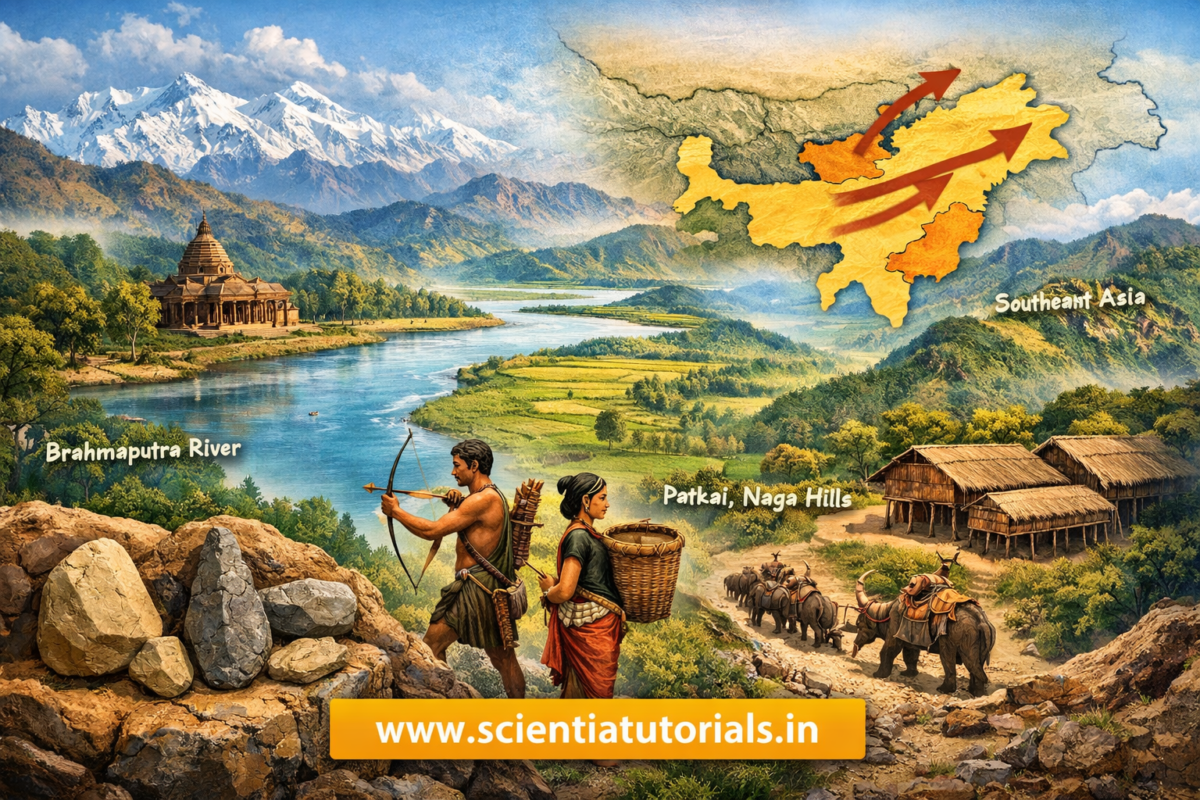

Physical Geography of North-East India: Strategic Location & Early History
Course: History of North-East India: From Early Kingdoms to Modern Integration
Module I: Geographical, Ethnic, and Cultural Foundations of North-East India
Timeline / Era Covered: Prehistory – Early Historic Background (Before 4th Century CE)
Lesson: North-East India – Physical Geography, Strategic Location, and Historical Significance
This lesson is systematically organized into four clearly structured sections, as detailed below:
- Chronologically Structured Study Module
- Short-Answer Type Questions
- Long-Answer Type Questions
- Multiple-Choice Questions (MCQs) with Answers and Detailed Explanations
Chronologically Structured Study Module
Introduction: Geography as the Foundation of History
The history of North-East India cannot be meaningfully understood without a clear appreciation of its physical geography and strategic location. Long before the emergence of early kingdoms or recorded political history, the region’s mountains, river systems, forests, and valleys shaped patterns of human settlement, migration, economy, and cultural interaction. During the prehistoric and early historic periods (before the 4th century CE), geography acted not merely as a backdrop but as an active force determining social organisation, ethnic diversity, and early political formations.
This chronologically structured study module examines how the geographical features of North-East India laid the foundations for its historical development. It also explains why the region emerged as a cultural bridge between the Indian subcontinent, Tibet, and Southeast Asia. The lesson is designed to meet the analytical and factual requirements of competitive examinations, teacher eligibility tests, university-level history courses, and regional studies papers.
I. Spatial Location and Regional Extent of North-East India
North-East India occupies a unique position in the easternmost part of the Indian subcontinent. Geographically, it is connected to mainland India by a narrow corridor, popularly known as the Siliguri Corridor, while the rest of the region extends eastward and southward into the hills and valleys bordering international frontiers.
The region comprises the present-day states of Assam, Arunachal Pradesh, Meghalaya, Manipur, Mizoram, Nagaland, and Tripura. Historically, this area was not isolated but formed a transitional zone linking South Asia with East and Southeast Asia. Its location facilitated early human movements, trade exchanges, and cultural diffusion during prehistoric and protohistoric times.
From a historical perspective, North-East India functioned as:
- A corridor of migration from East and Southeast Asia into the Indian subcontinent
- A buffer zone between powerful cultural regions such as the Indo-Gangetic plains and the Tibetan plateau
- A frontier zone where multiple ethnic groups interacted, often retaining autonomy due to difficult terrain
This strategic location explains both the region’s cultural diversity and its relatively late integration into large imperial systems.
II. Major Physiographic Divisions of North-East India
The physical geography of North-East India can be broadly divided into four major physiographic units, each of which played a crucial role in shaping early historical processes.
1. The Eastern Himalayan Region
The northern part of the region is dominated by the Eastern Himalayas, particularly in Arunachal Pradesh. These mountain ranges are characterized by high altitudes, deep river gorges, and dense forests.
Historical significance:
- Acted as a natural barrier limiting large-scale political expansion from the north
- Encouraged the survival of small, clan-based societies
- Served as routes for limited trans-Himalayan contacts with Tibet
Archaeological evidence suggests prehistoric habitation in river valleys, though large urban centres did not emerge due to rugged terrain.
2. The Brahmaputra Valley
The Brahmaputra Valley, centred around the mighty Brahmaputra River, forms the heartland of North-East India. This vast alluvial plain provided fertile soil, abundant water, and favourable climatic conditions.
Historical significance:
- Supported early agricultural practices and permanent settlements
- Enabled population concentration and social stratification
- Laid the foundation for early state formation, later exemplified by Kamarupa
The valley became the principal zone where prehistoric communities gradually transitioned into early historic societies.
3. The Barak Valley
Located in southern Assam, the Barak Valley is smaller but historically important.
Historical significance:
- Linked North-East India with eastern Bengal
- Facilitated cultural exchanges with the Gangetic delta
- Acted as a secondary corridor of migration and trade
The Barak Valley’s geography contributed to early agrarian development and cultural interaction.
4. The Hill Ranges of Patkai, Naga, Lushai, and Garo-Khasi-Jaintia
The hill systems, including the Patkai Hills, Naga Hills, and Shillong Plateau, dominate much of the region.
Historical significance:
- Encouraged shifting cultivation (jhum)
- Sustained tribal autonomy and strong kinship systems
- Limited political centralisation
These hills preserved cultural continuity and ethnic diversity well into the historic period.
III. Climate, Rivers, and Natural Resources
North-East India experiences a monsoon-dominated climate with heavy rainfall. This climatic pattern deeply influenced prehistoric and early historic life.
River Systems
The Brahmaputra and Barak rivers, along with their tributaries, played a decisive role in:
- Agricultural productivity
- Communication and transport
- Cultural integration across valleys
Riverine routes functioned as early highways connecting settlements.
Forests and Biodiversity
Dense forests supplied:
- Timber and forest produce
- Natural protection from invasions
- Economic resources for subsistence societies
The abundance of natural resources reduced the need for external conquest and supported self-sufficient communities.
IV. Prehistoric Human Settlement Patterns
Archaeological evidence indicates human presence in North-East India from prehistoric times. Stone tools, cave shelters, and early habitation sites suggest that the region was part of broader prehistoric migration networks.
Key features of prehistoric settlement:
- Preference for river valleys and foothills
- Use of stone tools and later metal implements
- Gradual shift from hunting-gathering to agriculture
The difficult terrain slowed urbanisation but ensured cultural continuity.
V. Ethnic Diversity and Migration Routes
North-East India is one of the most ethnically diverse regions of South Asia. This diversity is directly linked to its geographical position.
Major Migration Streams
- Tibeto-Burman groups entered through the eastern Himalayan corridors
- Austroasiatic groups moved into the hills and valleys from Southeast Asia
- Later Indo-Aryan influences entered primarily through the Brahmaputra Valley
Geography allowed these groups to coexist rather than assimilate completely, resulting in cultural plurality.
VI. Strategic Location and External Contacts
Despite its rugged terrain, North-East India was never completely isolated.
Links with Southeast Asia
Hill passes and river routes connected the region to Myanmar and beyond, facilitating:
- Cultural diffusion
- Technological exchanges
- Early trade networks
Links with the Indian Subcontinent
The Brahmaputra Valley acted as the main channel for interaction with eastern India, enabling:
- Spread of early religious ideas
- Introduction of writing and statecraft
- Gradual political consolidation
This dual connectivity shaped the region’s hybrid cultural character.
VII. Geography and Early Political Developments
Before the 4th century CE, political organisation in North-East India remained largely decentralised.
Key characteristics:
- Clan-based and chiefdom-level societies in hills
- Emerging territorial states in river valleys
- Limited imperial control due to terrain
Geography ensured that early states developed independently and retained distinct cultural identities.
VIII. Historical Significance of Geographical Foundations
The geographical foundations established during prehistoric and early historic periods had long-term consequences:
- Persistent ethnic diversity
- Strong regional identities
- Delayed but resilient political integration
Later historical developments, including the rise of early kingdoms and medieval polities, were deeply rooted in these early geographical and cultural conditions.
Conclusion: Geography as the Key to Understanding Early North-East Indian History
The physical geography and strategic location of North-East India decisively shaped its early historical trajectory. Mountains fostered isolation and diversity, river valleys encouraged settlement and political development, and strategic corridors enabled cultural exchange. Understanding these foundational elements is essential for analysing the region’s later historical evolution.
For competitive examinations and academic studies, this lesson provides a critical framework to interpret historical events not as isolated occurrences but as outcomes shaped by geography, environment, and long-term human interaction with the landscape.
Short Answer Type Questions (with Answers)
Lesson: North-East India – Physical Geography, Strategic Location, and Historical Significance
Module I | Timeline: Prehistory – Early Historic Background (Before 4th Century CE)
1. What is meant by the strategic location of North-East India?
Answer: North-East India occupies a frontier position connecting the Indian subcontinent with Tibet, China, and Southeast Asia, making it a natural corridor for migration, trade, and cultural interaction.
2. Why is geography considered the foundation of North-East Indian history?
Answer: Geography determined settlement patterns, modes of livelihood, ethnic diversity, political organisation, and the pace of historical development in the region.
3. Name the major physiographic divisions of North-East India.
Answer: The Eastern Himalayas, the Brahmaputra Valley, the Barak Valley, and the hill ranges including Patkai, Naga, Lushai, and the Garo–Khasi–Jaintia Hills.
4. Which river system played the most important role in early settlement in North-East India?
Answer: The Brahmaputra River system played the most significant role in early settlement and agriculture.
5. Why did the Brahmaputra Valley become a centre of early political development?
Answer: Its fertile alluvial soil, abundant water supply, and ease of communication supported dense settlements and early state formation.
6. How did the Eastern Himalayas influence historical development?
Answer: They acted as natural barriers, limiting large-scale invasions and encouraging the survival of small, independent tribal societies.
7. What type of economy was common in the hill regions of North-East India?
Answer: Shifting cultivation (jhum) combined with hunting, gathering, and forest-based subsistence economy.
8. Name one state largely covered by the Eastern Himalayan region.
Answer: Arunachal Pradesh.
9. What historical role did the Barak Valley play?
Answer: It acted as a link between North-East India and eastern Bengal, facilitating cultural and economic exchanges.
10. How did heavy rainfall influence early life in North-East India?
Answer: It supported dense forests, river systems, and agriculture but also limited large-scale urbanisation.
11. What evidence suggests prehistoric human habitation in North-East India?
Answer: Discovery of stone tools, cave shelters, and early habitation sites in river valleys and foothills.
12. Why did urban centres develop slowly in North-East India during early times?
Answer: Rugged terrain, dense forests, and dispersed settlements restricted large-scale urban growth.
13. Which major ethnic groups migrated into North-East India in prehistoric times?
Answer: Tibeto-Burman and Austroasiatic groups.
14. How did geography contribute to ethnic diversity in the region?
Answer: Mountains and valleys isolated communities, allowing distinct languages and cultures to develop independently.
15. What role did river valleys play in cultural integration?
Answer: They acted as natural routes for movement, trade, and exchange of ideas among different communities.
16. Why is North-East India described as a cultural bridge?
Answer: Because it connected South Asia with East and Southeast Asia, enabling cultural diffusion in multiple directions.
17. How did forests influence early societies of North-East India?
Answer: Forests provided food, timber, and protection, supporting self-sufficient tribal communities.
18. What type of political organisation existed before the 4th century CE?
Answer: Clan-based societies and small chiefdoms, especially in the hill regions.
19. Why was imperial control weak in early North-East India?
Answer: Difficult terrain, poor accessibility, and strong local identities limited external political domination.
20. How did geography shape the military history of the region?
Answer: Mountains and forests acted as natural defences, reducing the frequency of large-scale invasions.
21. What was the significance of migration routes through the hills?
Answer: They enabled the movement of peoples, languages, and technologies from East and Southeast Asia.
22. How did climate affect agricultural practices?
Answer: Monsoon rains supported wet rice cultivation in valleys and shifting cultivation in hills.
23. What explains the persistence of tribal autonomy in North-East India?
Answer: Geographical isolation and self-sufficient economies helped tribes maintain independence.
24. Why is the study of physical geography essential for competitive exams on North-East history?
Answer: Many historical developments are directly linked to geography, making it crucial for analytical answers.
25. How did early geography influence later kingdom formation in North-East India?
Answer: Fertile valleys enabled state formation, while hills preserved autonomous tribal regions.
26. What long-term impact did early geographical foundations have on the region?
Answer: They resulted in lasting ethnic diversity, strong regional identities, and delayed political integration.
27. In what way did North-East India differ from the Indo-Gangetic plains historically?
Answer: It had dispersed settlements, limited urbanisation, and greater ethnic diversity due to terrain.
28. How does this lesson help in understanding later historical periods?
Answer: It explains the environmental and geographical roots of political, cultural, and social developments in later eras.
These short answer questions are fully aligned with the lesson objectives, module structure, and course framework, and are suitable for APSC, State PSCs, TETs, CTET, UGC-NET, CUET, SSC, and university examinations focusing on North-East Indian history.
Long Answer Type Questions (with Answers)
Lesson: North-East India – Physical Geography, Strategic Location, and Historical Significance
Module I: Geographical, Ethnic, and Cultural Foundations of North-East India
Timeline: Prehistory – Early Historic Background (Before 4th Century CE)
1. Examine how the physical geography of North-East India shaped its early historical development.
Answer:
The physical geography of North-East India played a decisive role in shaping its early historical trajectory. The region is characterised by high mountain ranges, deep river valleys, dense forests, and heavy rainfall. These features influenced settlement patterns, economic activities, and political organisation. Fertile river valleys such as the Brahmaputra and Barak supported early agriculture and permanent settlements, while the hill regions encouraged shifting cultivation and clan-based societies. Mountains and forests acted as natural barriers, limiting large-scale invasions and imperial expansion, thereby allowing diverse ethnic groups to preserve their cultural identities. As a result, early history in North-East India developed in a decentralised and region-specific manner.
2. Discuss the historical significance of the Brahmaputra Valley in the early history of North-East India.
Answer:
The Brahmaputra Valley emerged as the most important historical zone in early North-East India. Its vast alluvial plains, formed by the Brahmaputra River, provided fertile soil suitable for wet rice cultivation and sustained agrarian settlements. The river system also served as a natural route for communication and trade, facilitating cultural interaction with eastern India. Due to favourable geographical conditions, population density increased, social stratification developed, and early political formations emerged. In later periods, this valley became the nucleus of organised kingdoms, demonstrating how geography directly influenced political evolution.
3. Analyse the role of the Eastern Himalayas in preserving tribal societies in North-East India.
Answer:
The Eastern Himalayas, particularly in Arunachal Pradesh, created an environment of relative isolation due to rugged terrain, high altitudes, and dense forests. These geographical features restricted large-scale migration and external political control. As a result, small tribal communities organised around clans and kinship networks were able to survive with minimal outside interference. The mountains also limited agricultural expansion, preventing urbanisation and centralised state formation. Consequently, the Eastern Himalayas played a crucial role in preserving tribal autonomy, cultural traditions, and linguistic diversity well into the historic period.
4. Explain why North-East India is described as a ‘cultural bridge’ between South Asia and Southeast Asia.
Answer:
North-East India is described as a cultural bridge because of its strategic geographical location between the Indian subcontinent, Tibet, China, and Southeast Asia. Migration routes through mountain passes and river valleys enabled the movement of peoples, languages, and technologies from East and Southeast Asia into the region. Simultaneously, cultural influences from the Indian subcontinent entered through the Brahmaputra and Barak valleys. This two-way interaction resulted in a unique blend of cultural traits, religious practices, and social institutions, making North-East India a zone of cultural synthesis rather than isolation.
5. Discuss the impact of climate and rainfall on early settlement patterns in North-East India.
Answer:
The monsoon-dominated climate of North-East India, characterised by heavy rainfall, had a profound impact on early settlement patterns. Abundant rainfall supported dense forests and perennial rivers, enabling agriculture in river valleys. However, excessive rainfall and rugged terrain limited large-scale urban development. In hill regions, heavy rainfall combined with steep slopes encouraged shifting cultivation rather than permanent farming. Thus, climate played a dual role—supporting subsistence economies while restricting urbanisation and political centralisation.
6. Describe the major physiographic divisions of North-East India and their historical relevance.
Answer:
North-East India can be divided into four major physiographic units: the Eastern Himalayas, the Brahmaputra Valley, the Barak Valley, and the surrounding hill ranges such as the Patkai and Naga Hills. Each division influenced historical development differently. The valleys promoted agriculture and political organisation, while the hills supported tribal societies and cultural isolation. Together, these divisions explain the region’s contrasting patterns of settlement, economy, and governance during early times.
7. How did river systems contribute to cultural integration in early North-East India?
Answer:
River systems acted as natural corridors connecting different parts of North-East India. The Brahmaputra and Barak rivers facilitated movement of people, goods, and ideas across valleys. These waterways enabled trade, cultural exchange, and the spread of agricultural techniques. Over time, river-based interaction promoted cultural integration within valleys, even though hill regions remained relatively isolated.
8. Evaluate the role of forests in shaping early societies of North-East India.
Answer:
Forests played a central role in the early societies of North-East India by providing food, timber, medicinal plants, and protection. Forest-based economies supported hunting, gathering, and shifting cultivation. Dense forests also acted as defensive barriers, reducing the impact of invasions and external domination. This ecological setting helped sustain self-sufficient communities and reinforced local autonomy.
9. Discuss prehistoric human habitation in North-East India with reference to archaeological evidence.
Answer:
Archaeological findings such as stone tools, cave shelters, and early habitation sites indicate prehistoric human presence in North-East India. Most settlements were located near river valleys and foothills, where resources were abundant. These communities gradually transitioned from hunting-gathering to early agricultural practices. Although urban centres did not emerge, these prehistoric societies laid the foundations for later cultural and social developments.
10. Analyse how geography influenced migration patterns into North-East India.
Answer:
Geography determined the routes and nature of migration into North-East India. Mountain passes in the east and north allowed Tibeto-Burman groups to enter, while river valleys facilitated the movement of Indo-Aryan influences from eastern India. The region’s fragmented terrain prevented complete assimilation, allowing multiple ethnic groups to coexist and maintain distinct identities.
11. Explain the reasons for the slow growth of urban centres in early North-East India.
Answer:
Urbanisation was slow due to rugged terrain, dense forests, heavy rainfall, and dispersed settlements. Agricultural surplus remained limited outside river valleys, and communication between regions was difficult. These factors discouraged large-scale urban growth and centralised administration during early periods.
12. Examine the relationship between geography and political organisation before the 4th century CE.
Answer:
Before the 4th century CE, political organisation in North-East India was largely decentralised. Fertile valleys witnessed the emergence of early territorial states, while hill regions remained dominated by clan-based chiefdoms. Geography thus created contrasting political systems within the same region.
13. Discuss the historical importance of the Barak Valley in early times.
Answer:
The Barak Valley functioned as an important link between North-East India and eastern Bengal. Its river system supported agriculture and facilitated cultural interaction with the Gangetic delta. This made the valley a secondary but significant zone of early historical development.
14. How did geographical isolation contribute to ethnic diversity in North-East India?
Answer:
Geographical isolation caused by mountains and forests limited interaction between communities. As a result, languages, customs, and social practices developed independently. This isolation explains the remarkable ethnic and cultural diversity of the region.
15. Assess the strategic importance of North-East India in ancient migration networks.
Answer:
North-East India lay along ancient migration networks connecting South Asia with East and Southeast Asia. Its strategic location enabled the movement of people and ideas across regions, making it historically significant despite its difficult terrain.
16. Discuss the influence of terrain on military and defensive aspects of early North-East India.
Answer:
Mountains, forests, and rivers acted as natural defensive features. These geographical barriers reduced the frequency and success of invasions, allowing local societies to maintain autonomy and resist external control.
17. How did environmental factors shape economic activities in early North-East India?
Answer:
Environmental conditions determined economic practices such as wet rice cultivation in valleys and shifting cultivation in hills. Forest resources supplemented subsistence economies, while river systems supported trade and fishing.
18. Explain the long-term historical impact of early geographical foundations.
Answer:
Early geographical foundations resulted in lasting ethnic diversity, strong regional identities, and delayed political integration. These characteristics continued to influence the region’s history in medieval and modern periods.
19. Compare the historical development of North-East India with the Indo-Gangetic plains.
Answer:
Unlike the Indo-Gangetic plains, which experienced early urbanisation and empire-building, North-East India developed through dispersed settlements and decentralised political systems due to its challenging geography.
20. Why is the study of physical geography essential for understanding the history of North-East India?
Answer:
Physical geography explains why historical developments in North-East India differed from other parts of India. It provides the analytical framework necessary to understand settlement patterns, cultural diversity, and political evolution, making it essential for both academic study and competitive examinations.
These long answer questions and answers are fully aligned with the lesson, module objectives, and course framework, and are suitable for APSC, State PSCs, UGC-NET, CUET, TETs, CTET, and university-level examinations focusing on the history of North-East India.
Multiple Choice Questions (MCQs) with Answers & Explanations
Lesson: North-East India – Physical Geography, Strategic Location, and Historical Significance
Module I: Geographical, Ethnic, and Cultural Foundations of North-East India
Timeline: Prehistory – Early Historic Background (Before 4th Century CE)
1. Which geographical factor most strongly influenced the isolation of many communities in early North-East India?
A. Extensive coastline
B. Dense urban centres
C. Mountain ranges and forests
D. Desert conditions
Correct Answer: C
Explanation:
Mountain ranges such as the Eastern Himalayas, Patkai, and Naga Hills, along with dense forests, restricted movement and communication. This isolation preserved tribal autonomy and cultural diversity.
2. The Brahmaputra Valley became the centre of early settlement mainly because of:
A. Dry climate
B. Fertile alluvial soil and water availability
C. Coastal trade
D. Mineral wealth
Correct Answer: B
Explanation:
The Brahmaputra River deposited fertile alluvial soil and provided perennial water, supporting agriculture and dense settlements.
3. Which physiographic division is most closely associated with early political development in North-East India?
A. Eastern Himalayan region
B. Hill ranges of Patkai and Naga Hills
C. Brahmaputra Valley
D. Shillong Plateau
Correct Answer: C
Explanation:
River valleys encouraged surplus agriculture, population growth, and administrative organisation, unlike hill regions where decentralised societies prevailed.
4. Why did large urban centres not develop in early North-East India?
A. Lack of agriculture
B. Continuous warfare
C. Rugged terrain and heavy rainfall
D. Absence of trade routes
Correct Answer: C
Explanation:
Rugged topography, dense forests, and heavy monsoon rainfall limited surplus production and urbanisation.
5. North-East India is often described as a ‘cultural bridge’ because it:
A. Was completely isolated
B. Linked South Asia with East and Southeast Asia
C. Was ruled by foreign empires
D. Had uniform culture
Correct Answer: B
Explanation:
Its strategic location enabled cultural exchange between the Indian subcontinent, Tibet, and Southeast Asia through migration routes.
6. Which type of cultivation was dominant in the hill regions?
A. Plantation farming
B. Terrace farming
C. Shifting cultivation (jhum)
D. Commercial farming
Correct Answer: C
Explanation:
Steep slopes and forested terrain favoured shifting cultivation rather than permanent agriculture.
7. The Eastern Himalayas mainly contributed to:
A. Rapid urbanisation
B. Imperial expansion
C. Preservation of tribal societies
D. Growth of maritime trade
Correct Answer: C
Explanation:
The mountains restricted access and political control, allowing tribal cultures to survive with minimal external influence.
8. Which valley acted as a link between North-East India and eastern Bengal?
A. Brahmaputra Valley
B. Barak Valley
C. Dibang Valley
D. Subansiri Valley
Correct Answer: B
Explanation:
The Barak Valley connected the region with the Gangetic delta, facilitating cultural and economic interaction.
9. Heavy rainfall in North-East India primarily resulted in:
A. Desertification
B. Sparse river systems
C. Dense forests and perennial rivers
D. Snowfall throughout the year
Correct Answer: C
Explanation:
Monsoon rains supported dense vegetation and strong river systems, shaping early subsistence economies.
10. Prehistoric human settlements were mainly located near:
A. Hilltops
B. Coastal areas
C. River valleys and foothills
D. Desert margins
Correct Answer: C
Explanation:
Water availability, fertile soil, and easier movement made river valleys and foothills suitable for early habitation.
11. Which ethnic groups are considered among the earliest migrants into North-East India?
A. Indo-Greeks
B. Tibeto-Burman groups
C. Scythians
D. Persians
Correct Answer: B
Explanation:
Tibeto-Burman groups entered through eastern and northern corridors during prehistoric times.
12. Geography encouraged decentralised political systems mainly because:
A. Resources were scarce
B. Communication was difficult
C. Population was uniform
D. Trade was absent
Correct Answer: B
Explanation:
Mountains and forests hindered communication, preventing strong centralised states.
13. Which natural feature acted as early communication routes?
A. Deserts
B. River systems
C. Glaciers
D. Plateaus
Correct Answer: B
Explanation:
Rivers functioned as natural highways for movement, trade, and cultural exchange.
14. Forest resources supported early societies by providing:
A. Only timber
B. Gold and silver
C. Food, medicine, and protection
D. Industrial raw materials
Correct Answer: C
Explanation:
Forests ensured self-sufficiency through hunting, gathering, and natural defence.
15. Which factor best explains ethnic diversity in North-East India?
A. Continuous foreign invasions
B. Uniform climate
C. Geographical isolation of communities
D. Early empire-building
Correct Answer: C
Explanation:
Isolation due to terrain allowed multiple cultures and languages to evolve independently.
16. Migration routes into North-East India mainly followed:
A. Coastal paths
B. Desert corridors
C. Mountain passes and river valleys
D. Underground routes
Correct Answer: C
Explanation:
Passes and valleys provided the only feasible routes through rugged terrain.
17. The Shillong Plateau is primarily associated with:
A. Desert farming
B. Hill-based tribal societies
C. Early urban centres
D. Coastal trade
Correct Answer: B
Explanation:
The plateau supported tribal societies with subsistence economies and limited political centralisation.
18. Why was imperial control weak in early North-East India?
A. Strong naval power
B. Natural defensive geography
C. Lack of population
D. Absence of culture
Correct Answer: B
Explanation:
Mountains and forests acted as natural defences against external domination.
19. Compared to the Indo-Gangetic plains, North-East India had:
A. Earlier urbanisation
B. Larger empires
C. More decentralised societies
D. Uniform culture
Correct Answer: C
Explanation:
Challenging geography prevented large empires and encouraged local autonomy.
20. Which economic activity was common to both hills and valleys?
A. Industrial production
B. Mining
C. Agriculture-based subsistence
D. Maritime trade
Correct Answer: C
Explanation:
Agriculture, though practiced differently, remained the economic base across regions.
21. Geography influenced military history mainly by:
A. Encouraging invasions
B. Preventing defence
C. Acting as natural fortification
D. Creating standing armies
Correct Answer: C
Explanation:
Terrain reduced invasion frequency and enhanced defensive capacity.
22. Early political formations were most likely to emerge in:
A. Dense forests
B. Hilltops
C. River valleys
D. High mountains
Correct Answer: C
Explanation:
Agricultural surplus and population concentration favoured political organisation.
23. Which long-term impact resulted from early geographical foundations?
A. Cultural uniformity
B. Strong regional identities
C. Early industrialisation
D. Decline of agriculture
Correct Answer: B
Explanation:
Geography sustained diversity and local identities over centuries.
24. The study of physical geography is essential because it:
A. Replaces political history
B. Explains causes behind historical developments
C. Is limited to maps only
D. Focuses only on climate
Correct Answer: B
Explanation:
Geography provides the analytical base to understand why historical events unfolded as they did.
25. Which statement best summarises early North-East Indian history?
A. Rapid empire-building and urbanisation
B. Decentralised development shaped by geography
C. Complete isolation from Asia
D. Uniform political structure
Correct Answer: B
Explanation:
Early North-East Indian history was shaped by physical geography, resulting in decentralised societies, cultural diversity, and gradual political evolution.
These MCQs with detailed explanations are fully aligned with the lesson, module structure, and course objectives, and are highly suitable for APSC, State PSCs, TETs, CTET, UGC-NET, CUET, SSC, and university-level examinations focusing on the history of North-East India.