
Socio-Cultural Impact of Colonialism in North-East India
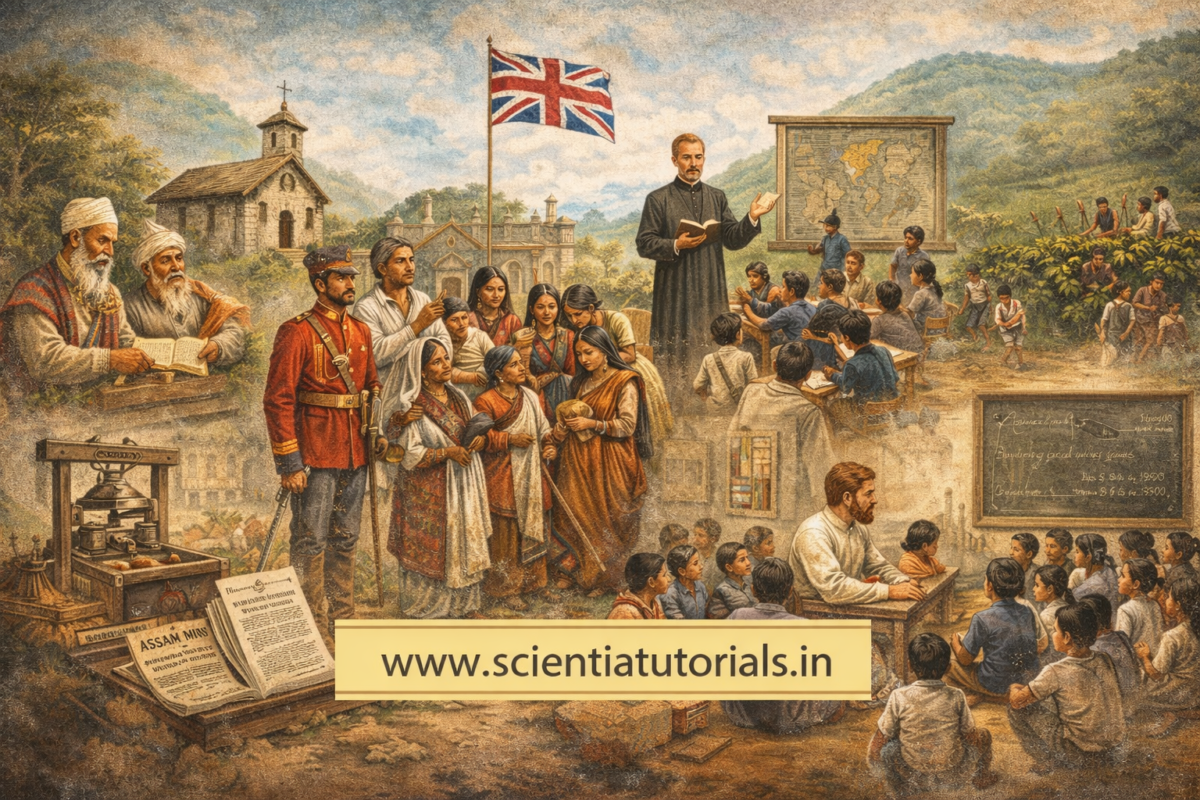

Socio-Cultural Impact of Colonialism in North-East India (1826–1900)
Course: History of North-East India: From Early Kingdoms to Modern Integration
Module VI: Colonial Rule and Administrative Reorganisation
Timeline / Era Covered: 1826 CE – 1900 CE
Lesson: Socio-Cultural Impact of Colonialism in North-East India
This lesson is systematically organized into four clearly structured sections, as detailed below:
- Chronologically Structured Study Module
- Short-Answer Type Questions
- Long-Answer Type Questions
- Multiple-Choice Questions (MCQs) with Answers and Detailed Explanations
Chronologically Structured Study Module
I. Introduction: Colonial Rule and Socio-Cultural Transformation
The establishment of British colonial rule in North-East India after 1826 CE marked a profound rupture in the region’s socio-cultural history. While political annexation and administrative reorganisation transformed governance structures, colonialism also deeply affected society, culture, religion, language, education, and everyday life. The colonial encounter introduced new institutions, ideologies, and values, while simultaneously undermining or reshaping indigenous systems.
Unlike many other parts of India, North-East India possessed distinct ethnic diversity, tribal social structures, customary laws, and cultural traditions. The socio-cultural impact of colonialism in this region was therefore uneven, region-specific, and complex, producing both disruption and adaptation.
This lesson examines these changes chronologically and thematically, highlighting how colonial policies reshaped social hierarchies, religious life, education, language, identity, and cultural practices between 1826 and 1900 CE.
II. Pre-Colonial Socio-Cultural Landscape: A Brief Overview
Before British rule, North-East India was characterised by:
- Strong community-based social organisation
- Prevalence of customary laws and oral traditions
- Village councils, clan systems, and tribal chieftainships
- Limited caste rigidity compared to mainland India
- Syncretic religious practices combining animism, Vaishnavism, and local beliefs
The Ahom state in Assam and tribal polities in hill regions maintained social cohesion through custom, ritual, and kinship rather than codified law.
III. Early Colonial Phase (1826–1850): Disruption of Traditional Social Structures
1. Decline of Indigenous Elites
The British dismantling of traditional political systems had direct socio-cultural consequences. Ahom nobles, priests, and officials lost patronage, resulting in:
- Decline of court-supported cultural institutions
- Marginalisation of traditional elites
- Loss of social authority and prestige
This weakened indigenous mechanisms that had previously preserved social norms and cultural continuity.
2. Introduction of Colonial Law and Administration
British legal systems replaced customary dispute-resolution mechanisms, particularly in the plains. Written laws and formal courts altered social relations by:
- Reducing the authority of village elders
- Undermining collective responsibility
- Promoting individual legal identity
In hill areas, however, the British selectively preserved customary practices to avoid resistance, leading to dual systems of governance.
IV. Impact of Christian Missionaries (1830s onwards)
1. Arrival and Expansion of Missionary Activities
Christian missionaries entered North-East India primarily after the 1830s, focusing on:
- Hill tribes and marginalised communities
- Education and literacy
- Translation of religious texts
Missionary activities had far-reaching socio-cultural consequences.
2. Religious Transformation and Conversion
Missionary work led to significant religious change, especially among tribal societies:
- Gradual decline of animistic beliefs
- Introduction of Christianity as an organised religion
- Emergence of new religious identities
While conversion often provided access to education and protection from exploitation, it also disrupted traditional rituals, festivals, and belief systems.
3. Social Reform and Cultural Conflict
Missionaries opposed practices they considered “primitive,” such as:
- Certain customary rituals
- Polygamy and alcohol consumption
- Indigenous healing traditions
This created cultural tension between converts and non-converts, sometimes fragmenting communities.
V. Introduction of Modern Education and Its Socio-Cultural Effects
1. Western Education System
Colonial education introduced:
- English language instruction
- Missionary schools
- Textbook-based learning
Education was initially limited in reach but gradually expanded.
2. Emergence of a New Educated Class
Modern education produced a small but influential group:
- Clerks, teachers, interpreters
- Early social reformers
- Cultural intermediaries between colonial state and society
This group played a key role in shaping new social consciousness.
3. Decline of Traditional Learning Systems
Indigenous systems such as:
- Pathshalas
- Monastic learning (satras)
- Oral transmission of knowledge
lost official support, reducing their influence in society.
VI. Language, Literature, and Cultural Reorientation
1. Language Policy and Cultural Change
Colonial administration promoted certain languages for governance and education, leading to:
- Standardisation of Assamese language
- Introduction of Roman script for tribal languages
- Decline of Persian and Tai-Ahom usage
Language became a tool of both control and cultural redefinition.
2. Print Culture and Identity Formation
The printing press enabled:
- Publication of textbooks
- Emergence of newspapers
- Spread of reformist ideas
Print culture contributed to regional identity formation, particularly among educated Assamese society.
VII. Social Stratification and Economic-Cultural Linkages
1. Changing Class Structures
Colonial economic policies indirectly reshaped society:
- Rise of tea plantation labour force
- Emergence of wage labour
- Decline of subsistence village economy
These changes altered family structures, migration patterns, and community life.
2. Impact on Tribal Societies
For tribal communities:
- Land alienation weakened clan solidarity
- Introduction of money economy altered social relations
- Cultural practices adapted to new economic realities
However, many tribal groups preserved cultural autonomy longer than plains societies.
VIII. Gender and Family under Colonial Influence
1. Women and Social Change
Colonialism had contradictory effects on women:
- Missionary education enabled limited female literacy
- Social reform challenged some restrictive practices
- Economic hardship increased women’s labour burden
Despite these changes, patriarchal norms largely persisted.
2. Family and Kinship Transformation
Colonial legal frameworks redefined:
- Inheritance rules
- Marriage norms
- Individual rights
This weakened collective kinship systems over time.
IX. Cultural Resistance and Preservation
Not all socio-cultural change was passive. Indigenous communities actively resisted cultural domination through:
- Preservation of festivals and rituals
- Defence of customary law
- Revival of local traditions
Satras in Assam, village councils in hill areas, and oral traditions became centres of cultural resilience.
X. Late 19th Century Developments (1870–1900)
By the late 19th century:
- Christianity had taken firm roots in many hill areas
- Western education expanded slowly
- Cultural hybridity emerged, blending indigenous and colonial elements
New identities—tribal, regional, religious—became more defined, shaping future political movements.
XI. Limitations and Contradictions of Colonial Socio-Cultural Policies
Limitations:
- Education remained limited in scope
- Cultural change benefited select groups
- Deep inequalities persisted
Contradictions:
- Colonialism claimed “civilising mission” yet disrupted indigenous harmony
- Cultural preservation was encouraged selectively to maintain control
XII. Historical Significance of Socio-Cultural Impact
The socio-cultural impact of colonialism in North-East India:
- Reshaped identity and social organisation
- Introduced modern education and literacy
- Altered religious and cultural landscapes
- Created foundations for later social and political movements
These changes were neither entirely destructive nor wholly progressive but deeply transformative.
XIII. Conclusion
Between 1826 and 1900, colonial rule profoundly transformed the socio-cultural fabric of North-East India. Traditional institutions were weakened, new religious and educational systems emerged, and society adapted to unprecedented change. While colonialism disrupted indigenous culture, it also generated new forms of identity, consciousness, and resistance.
Understanding these socio-cultural impacts is essential for appreciating the distinct historical trajectory of North-East India reported in modern times and its integration into the broader narrative of Indian history.
Short Answer Type Questions
Module VI: Colonial Rule and Administrative Reorganisation
Lesson: Socio-Cultural Impact of Colonialism in North-East India
Timeline: 1826 CE – 1900 CE
Q1. Why is 1826 considered a turning point in the socio-cultural history of North-East India?
Answer:
The year 1826 marked the beginning of British colonial rule, which introduced new administrative, educational, religious, and cultural systems that transformed traditional society.
Q2. What were the main features of pre-colonial social organisation in North-East India?
Answer:
Pre-colonial society was community-based, governed by customary laws, clan systems, village councils, and traditional chieftainships with limited caste rigidity.
Q3. How did colonial rule affect traditional elites in Assam?
Answer:
Traditional elites lost political authority, economic patronage, and social status due to the dismantling of indigenous institutions by the British.
Q4. What impact did colonial legal systems have on customary laws?
Answer:
Colonial laws reduced the authority of customary practices by introducing written laws, formal courts, and individual legal identity.
Q5. Why did the British follow different socio-cultural policies in hill and plain areas?
Answer:
To avoid resistance in hill regions, the British preserved customary institutions there, while imposing direct administrative and cultural control in the plains.
Q6. When did Christian missionary activities expand significantly in North-East India?
Answer:
Missionary activities expanded mainly from the 1830s onwards, especially in hill and tribal areas.
Q7. How did Christianity influence tribal societies?
Answer:
Christianity transformed religious beliefs, introduced new moral values, encouraged literacy, and created new community identities.
Q8. What cultural tensions arose due to missionary activities?
Answer:
Missionary opposition to traditional rituals and customs created divisions between converts and non-converts within communities.
Q9. How did colonial education differ from traditional education systems?
Answer:
Colonial education was classroom-based, text-oriented, and English-medium, unlike traditional oral and religious forms of learning.
Q10. What was the social impact of modern education in North-East India?
Answer:
It created a small educated middle class that acted as cultural intermediaries and promoted new social ideas.
Q11. Why did traditional learning institutions decline under colonial rule?
Answer:
They lost state patronage and official recognition as colonial authorities promoted Western education systems.
Q12. How did colonial language policies affect Assamese society?
Answer:
They led to standardisation of Assamese, decline of older languages like Tai-Ahom, and increased importance of English.
Q13. What role did print culture play in socio-cultural change?
Answer:
Print culture spread literacy, reformist ideas, and regional consciousness through books, textbooks, and newspapers.
Q14. How did colonial economic changes influence social structure?
Answer:
The introduction of wage labour, plantations, and monetised economy altered class relations and village life.
Q15. What was the socio-cultural impact of tea plantation economy?
Answer:
It encouraged labour migration, weakened traditional communities, and introduced new social hierarchies.
Q16. How did colonialism affect tribal land ownership?
Answer:
Land alienation and monetisation weakened clan control and altered traditional land relations.
Q17. What changes occurred in gender roles under colonial influence?
Answer:
Missionary education promoted limited female literacy, but economic pressures increased women’s labour responsibilities.
Q18. How did colonial laws affect family and kinship systems?
Answer:
They promoted individual rights over collective kinship, gradually weakening traditional family structures.
Q19. What forms of cultural resistance emerged during colonial rule?
Answer:
Communities preserved festivals, rituals, customary laws, and oral traditions to resist cultural domination.
Q20. Why did socio-cultural change vary across regions in North-East India?
Answer:
Diversity in geography, ethnicity, tribal autonomy, and colonial administrative strategies caused uneven impact.
Q21. How did Christianity contribute to identity formation in hill regions?
Answer:
It provided a shared religious identity that transcended clan divisions and shaped modern tribal consciousness.
Q22. What contradictions existed in colonial socio-cultural policies?
Answer:
Colonialism claimed cultural reform but disrupted indigenous harmony and selectively preserved traditions for control.
Q23. How did colonialism influence cultural hybridity?
Answer:
It blended indigenous traditions with Western education, religion, and administrative practices.
Q24. What long-term socio-cultural changes emerged by the late 19th century?
Answer:
New religious identities, educated elites, print culture, and redefined social structures became prominent.
Q25. Why is the study of socio-cultural impact important for understanding modern North-East India?
Answer:
It explains the roots of present-day identities, cultural diversity, and regional social dynamics.
Long Answer Type Questions
Module VI: Colonial Rule and Administrative Reorganisation
Lesson: Socio-Cultural Impact of Colonialism in North-East India
Timeline: 1826 CE – 1900 CE
Q1. Examine the socio-cultural condition of North-East India on the eve of British colonial rule.
Answer:
Before 1826, North-East India was characterised by strong community-based social organisation, customary laws, clan and kinship systems, and relatively flexible social hierarchies. Social life was regulated through village councils, tribal chiefs, satras, and religious institutions rather than codified law. Cultural practices were deeply rooted in oral traditions, rituals, and festivals. This pre-colonial structure provided social cohesion but was vulnerable to disruption once colonial rule dismantled indigenous political authority.
Q2. Discuss how the introduction of British colonial rule altered the socio-cultural fabric of North-East India.
Answer:
British rule brought new administrative systems, legal codes, education, and religious influences that reshaped society. Traditional elites lost patronage, customary laws were weakened, and Western norms began influencing social behaviour. While colonialism disrupted indigenous systems, it also introduced literacy, print culture, and new social ideas, leading to a complex process of cultural transformation rather than complete replacement.
Q3. Analyse the impact of colonial legal and administrative systems on customary social institutions.
Answer:
Colonial law replaced customary dispute-resolution mechanisms with formal courts and written regulations. This reduced the authority of village elders and tribal councils, encouraged individual legal identity, and weakened collective responsibility. In hill areas, however, the British selectively preserved customary institutions to maintain order, resulting in a dual system of governance.
Q4. How did the decline of indigenous elites affect cultural life in Assam and adjoining regions?
Answer:
The loss of political power and patronage among indigenous elites led to the decline of court-sponsored cultural activities, rituals, and learning traditions. Priests, nobles, and scholars who once preserved cultural continuity were marginalised, causing cultural dislocation and loss of traditional authority in society.
Q5. Examine the role of Christian missionaries in socio-cultural change in North-East India.
Answer:
Christian missionaries played a major role in introducing Western education, literacy, and new religious values. They translated texts into local languages, established schools, and promoted social reform. While missionary activities expanded education and new opportunities, they also challenged traditional beliefs, rituals, and social practices, creating cultural tensions and divisions within communities.
Q6. Discuss the religious impact of colonialism with special reference to tribal societies.
Answer:
Colonialism facilitated the spread of Christianity, especially among tribal societies. Conversion often led to the decline of animistic beliefs and ritual practices. Christianity provided a new collective identity and access to education but disrupted traditional religious authority and cultural continuity, reshaping tribal social life.
Q7. Analyse the introduction of modern education and its socio-cultural consequences.
Answer:
Modern education introduced English language instruction, textbooks, and classroom learning. It created a small educated class that served as clerks, teachers, and intermediaries between the colonial state and society. However, education remained limited in reach and often alienated learners from traditional knowledge systems.
Q8. How did colonial education contribute to the decline of indigenous learning systems?
Answer:
Traditional institutions such as pathshalas, satras, and oral teaching systems lost state patronage and recognition. Colonial emphasis on Western curricula reduced the social prestige of indigenous knowledge, leading to gradual marginalisation of traditional learning practices.
Q9. Discuss the impact of colonial language policies on culture and identity.
Answer:
Colonial language policies promoted certain languages for administration and education, leading to standardisation of Assamese and introduction of Roman script for tribal languages. While note-worthy for literacy and print culture, these policies also contributed to the decline of languages like Tai-Ahom and reshaped cultural identities.
Q10. Examine the role of print culture in socio-cultural transformation.
Answer:
The printing press facilitated the spread of literacy, textbooks, newspapers, and reformist ideas. Print culture helped articulate regional identity, particularly among educated Assamese society, and contributed to social awareness and cultural reorientation.
Q11. Analyse the socio-cultural impact of colonial economic changes.
Answer:
Colonial economic policies introduced monetisation, wage labour, and plantation economies. These changes altered class relations, weakened subsistence village economies, encouraged migration, and reshaped family and community life.
Q12. Discuss the socio-cultural consequences of the tea plantation economy.
Answer:
The tea plantation system introduced migrant labour, disrupted traditional communities, and created new social hierarchies. Plantation life altered cultural practices, family structures, and social interactions, often leading to exploitation and cultural dislocation.
Q13. How did colonial land policies affect tribal social organisation?
Answer:
Colonial land policies encouraged individual ownership and monetisation, undermining communal land systems. This weakened clan solidarity and altered traditional relationships between land, culture, and identity among tribal societies.
Q14. Examine the impact of colonialism on women and gender relations.
Answer:
Colonialism produced mixed outcomes for women. Missionary education enabled limited female literacy and social reform, but economic pressures increased women’s labour burden. Patriarchal norms largely persisted, and women’s social position changed slowly and unevenly.
Q15. Discuss changes in family and kinship systems under colonial influence.
Answer:
Colonial legal frameworks redefined inheritance, marriage, and property rights, promoting individualism over collective kinship. Over time, this weakened extended family systems and altered traditional social relations.
Q16. Analyse the cultural resistance to colonial socio-cultural domination.
Answer:
Indigenous communities resisted cultural domination by preserving rituals, festivals, customary laws, and oral traditions. Institutions such as satras, village councils, and clan organisations acted as centres of cultural resilience.
Q17. Why did the socio-cultural impact of colonialism vary between hill and plain regions?
Answer:
Differences in geography, tribal autonomy, and colonial administrative strategies led to uneven impact. Plains experienced greater direct control and cultural intervention, while hills retained greater cultural autonomy through indirect rule.
Q18. Examine the emergence of cultural hybridity in the late 19th century.
Answer:
By the late 19th century, indigenous traditions blended with Western education, religion, and administrative practices. This cultural hybridity reshaped identity and social life without completely erasing traditional values.
Q19. Discuss the contradictions in colonial socio-cultural policies.
Answer:
Colonialism claimed a civilising mission but often disrupted indigenous harmony. While education and reform were promoted, cultural preservation was selectively allowed to maintain political control, revealing inherent contradictions.
Q20. Evaluate the long-term socio-cultural significance of colonial rule in North-East India.
Answer:
Colonial rule transformed social organisation, education, religion, language, and identity. Though disruptive, it laid foundations for modern social consciousness, regional identity, and later political movements. The socio-cultural impact was thus deeply transformative and enduring.
MCQs with Answers and Explanations
Module VI: Colonial Rule and Administrative Reorganisation
Lesson: Socio-Cultural Impact of Colonialism in North-East India
Timeline: 1826 CE – 1900 CE
Q1. The year 1826 is significant in the socio-cultural history of North-East India because it:
A. Marked the beginning of tea cultivation
B. Introduced Christianity into the region
C. Initiated British colonial rule
D. Ended tribal autonomy
Correct Answer: C
Explanation:
British colonial rule began in 1826 after the Treaty of Yandabo, initiating wide-ranging socio-cultural changes through new administration, education, and religion.
Q2. Which feature best describes pre-colonial society in North-East India?
A. Rigid caste hierarchy
B. Community-based organisation and customary laws
C. Complete absence of religious institutions
D. Centralised bureaucratic governance
Correct Answer: B
Explanation:
Pre-colonial society was organised around clans, village councils, and customary laws rather than rigid caste structures or centralised bureaucracy.
Q3. The decline of indigenous elites under colonial rule primarily resulted from:
A. Popular revolts
B. Industrialisation
C. Loss of political power and patronage
D. Religious conversion
Correct Answer: C
Explanation:
British dismantling of traditional political institutions deprived indigenous elites of authority and patronage, leading to their social marginalisation.
Q4. Colonial legal systems differed from customary laws mainly because they were:
A. Oral and flexible
B. Clan-based
C. Written and formal
D. Ritual-oriented
Correct Answer: C
Explanation:
Colonial laws relied on written codes and formal courts, unlike customary systems based on tradition and collective decision-making.
Q5. Why did the British preserve customary institutions in many hill areas?
A. Lack of interest in hills
B. Missionary pressure
C. Fear of resistance and administrative difficulty
D. Cultural admiration
Correct Answer: C
Explanation:
Indirect rule and preservation of customs in hill regions helped the British minimise resistance and govern difficult terrain effectively.
Q6. Christian missionary activities in North-East India expanded mainly after:
A. 1757
B. 1800
C. 1830
D. 1900
Correct Answer: C
Explanation:
Missionary activities expanded significantly from the 1830s, especially in tribal and hill regions.
Q7. One major socio-cultural impact of Christianity on tribal societies was:
A. Reinforcement of animism
B. Decline of traditional rituals and beliefs
C. Complete cultural isolation
D. End of education
Correct Answer: B
Explanation:
Christianity introduced new religious values that often replaced or transformed indigenous ritual practices.
Q8. Missionary activities often created social tensions because they:
A. Encouraged traditional rituals
B. Opposed certain indigenous customs
C. Avoided education
D. Supported tribal chiefs
Correct Answer: B
Explanation:
Missionaries opposed practices they considered unscientific or immoral, leading to conflicts between converts and non-converts.
Q9. Colonial education differed from traditional systems mainly due to its emphasis on:
A. Oral transmission
B. Religious instruction only
C. English language and textbooks
D. Clan-based learning
Correct Answer: C
Explanation:
Colonial education was classroom-based, text-oriented, and often English-medium, contrasting with oral and religious traditional systems.
Q10. The immediate social outcome of modern education was the emergence of:
A. A large industrial workforce
B. A small educated middle class
C. A peasant elite
D. Complete literacy
Correct Answer: B
Explanation:
Modern education produced a limited but influential educated class that mediated between colonial administration and society.
Q11. Indigenous learning institutions declined mainly because:
A. They were outlawed
B. People rejected them voluntarily
C. They lost state patronage
D. They opposed education
Correct Answer: C
Explanation:
Colonial authorities promoted Western education, withdrawing official support from traditional institutions.
Q12. Colonial language policies led to which of the following outcomes?
A. Complete disappearance of local languages
B. Standardisation of certain regional languages
C. Total dominance of Persian
D. End of oral traditions
Correct Answer: B
Explanation:
Languages like Assamese were standardised for administration and education, while some older languages declined.
Q13. The introduction of print culture contributed most directly to:
A. Religious conversion
B. Cultural isolation
C. Spread of literacy and regional identity
D. Decline of education
Correct Answer: C
Explanation:
Print culture enabled dissemination of ideas, textbooks, and newspapers, fostering literacy and regional consciousness.
Q14. Colonial economic changes influenced society mainly through:
A. Abolition of agriculture
B. Introduction of plantation and wage labour
C. Complete urbanisation
D. End of trade
Correct Answer: B
Explanation:
Plantation economy and wage labour altered class relations, migration patterns, and community life.
Q15. The tea plantation economy affected society by:
A. Strengthening traditional villages
B. Encouraging labour migration
C. Eliminating social hierarchies
D. Ending exploitation
Correct Answer: B
Explanation:
Tea plantations relied on migrant labour, disrupting traditional communities and creating new social hierarchies.
Q16. Tribal land alienation under colonialism resulted mainly in:
A. Strengthened clan solidarity
B. Increased communal ownership
C. Weakening of traditional social organisation
D. Complete cultural isolation
Correct Answer: C
Explanation:
Monetisation and new land laws undermined communal landholding and clan-based social systems.
Q17. Colonialism’s impact on women in North-East India can best be described as:
A. Entirely progressive
B. Entirely regressive
C. Mixed and uneven
D. Insignificant
Correct Answer: C
Explanation:
While missionary education improved literacy for some women, economic hardship increased their labour burden.
Q18. Colonial laws affected family systems by promoting:
A. Extended kinship networks
B. Collective ownership
C. Individual legal rights
D. Clan authority
Correct Answer: C
Explanation:
Colonial legal frameworks prioritised individual rights, gradually weakening collective kinship structures.
Q19. Cultural resistance during colonial rule primarily involved:
A. Adoption of Western culture
B. Preservation of rituals and customs
C. Industrial strikes
D. Urban migration
Correct Answer: B
Explanation:
Communities defended their identity by preserving festivals, rituals, and customary practices.
Q20. Why was socio-cultural change uneven across North-East India?
A. Uniform British policy
B. Differences in geography and tribal autonomy
C. Lack of colonial interest
D. Absence of resistance
Correct Answer: B
Explanation:
Geographical diversity and varying administrative strategies caused different degrees of socio-cultural change.
Q21. The late 19th century witnessed the emergence of:
A. Complete Westernisation
B. Cultural hybridity
C. Cultural stagnation
D. Total isolation
Correct Answer: B
Explanation:
Indigenous traditions blended with Western education and religion, creating hybrid cultural forms.
Q22. Which claim best reflects a contradiction in colonial socio-cultural policy?
A. Education for all
B. Cultural preservation with political control
C. Respect for autonomy
D. Economic equality
Correct Answer: B
Explanation:
The British selectively preserved culture to maintain control, contradicting their civilising claims.
Q23. One long-term effect of colonial socio-cultural change was:
A. Loss of all traditions
B. Formation of modern regional identities
C. Complete social equality
D. Cultural uniformity
Correct Answer: B
Explanation:
Colonial changes contributed to new forms of identity and social consciousness.
Q24. Which group acted as cultural intermediaries under colonial rule?
A. Plantation labourers
B. Tribal chiefs only
C. Educated middle class
D. British officials
Correct Answer: C
Explanation:
Educated locals mediated between colonial authorities and indigenous society.
Q25. The overall socio-cultural impact of colonialism in North-East India can be best described as:
A. Entirely destructive
B. Entirely beneficial
C. Complex and transformative
D. Superficial
Correct Answer: C
Explanation:
Colonialism disrupted traditional systems while introducing new institutions, resulting in deep and lasting transformation.