
Socio-Economic Conditions before Colonial Intervention
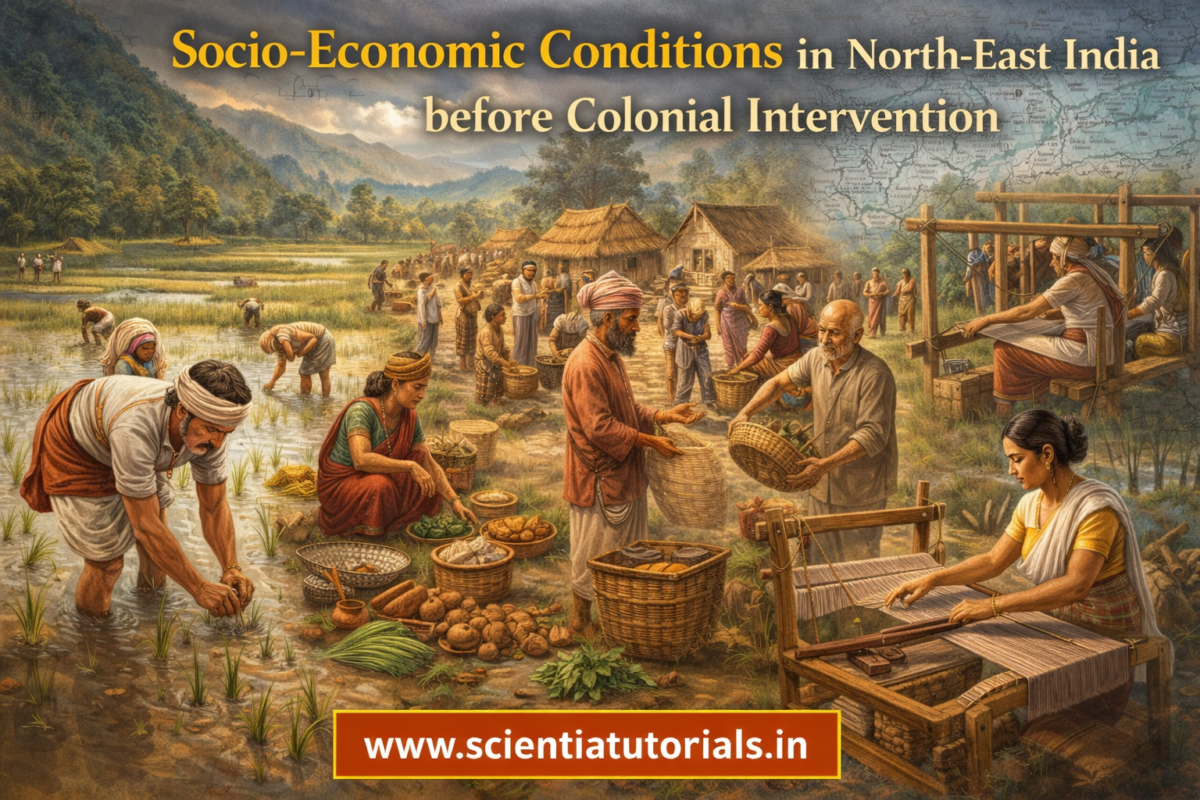

Socio-Economic Conditions before Colonial Intervention in North-East India
Course: History of North-East India: From Early Kingdoms to Modern Integration
Module V: North-East India on the Eve of Colonial Rule
Timeline / Era Covered: 18th Century CE – Early 19th Century CE
Lesson: Socio-Economic Conditions before Colonial Intervention
This lesson is systematically organized into four clearly structured sections, as detailed below:
- Chronologically Structured Study Module
- Short-Answer Type Questions
- Long-Answer Type Questions
- Multiple-Choice Questions (MCQs) with Answers and Detailed Explanations
Chronologically Structured Study Module
Introduction: Understanding the Pre-Colonial Socio-Economic Order
Before the advent of British colonial rule in the early nineteenth century, North-East India possessed a distinctive socio-economic structure shaped by geography, indigenous political systems, customary institutions, and regional trade networks. Unlike the plains of northern India, the region developed a diversified and locally rooted economy, combining agriculture, artisanal production, forest-based livelihoods, and long-distance trade.
This lesson explores the socio-economic conditions of North-East India during the 18th and early 19th centuries, immediately prior to colonial intervention. It adopts a chronological and thematic approach to examine agrarian systems, land relations, trade, social organization, and economic stresses that existed under indigenous regimes such as the Ahom kingdom and regional principalities. Understanding this background is essential for evaluating the transformative impact of colonial rule that followed.
I. Political Context and Its Economic Implications (18th Century)
1. Indigenous Political Systems and Economy
Socio-economic life in North-East India was closely tied to indigenous political structures. Kingdoms such as the Ahom state in Assam and the Manipuri monarchy functioned not merely as political authorities but as regulators of land, labor, and production. The state exercised control through customary institutions rather than centralized bureaucracies.
Economic obligations were often linked to political allegiance, and production systems were designed to sustain the ruling structure, the military, and religious establishments.
2. Decentralization and Regional Autonomy
Beyond major valleys, hill societies and frontier regions retained significant autonomy. These communities practiced subsistence economies and maintained limited interaction with centralized authorities. This decentralization resulted in economic diversity but also uneven development, with valley regions being more integrated into trade networks than hill areas.
II. Agrarian Structure and Land Relations
1. Agriculture as the Economic Base
Agriculture formed the backbone of the pre-colonial economy. Wet rice cultivation dominated the fertile river valleys of Assam and Manipur, supported by abundant rainfall and alluvial soil. Shifting cultivation (jhum) was prevalent in hill regions, adapted to local ecological conditions.
Agricultural production was primarily subsistence-oriented, though surplus was extracted by the ruling elite for state maintenance and military needs.
2. Land Ownership and Control
Land was generally not privately owned in the modern sense. Instead, land rights were vested in the state, the village community, or clan groups. In the Ahom system, land was closely linked to service obligations rather than market transactions.
This system ensured access to land for cultivators but limited the emergence of a commercial land market before colonial intervention.
III. Labour Systems and Economic Obligations
1. State-Controlled Labour
Pre-colonial economies relied heavily on obligatory labour systems. Adult male populations were required to provide labor for agriculture, public works, military service, and state-sponsored activities. These obligations were rotational and designed to distribute the burden across society.
While such systems ensured state stability, they also imposed heavy demands on the peasantry, particularly during periods of political instability.
2. Impact on Productivity
Although labour systems supported large-scale projects such as embankments and irrigation, they discouraged innovation and surplus production. Economic activity remained tied to customary obligations rather than profit-driven incentives.
IV. Trade and Commercial Networks
1. Internal and External Trade
North-East India was not economically isolated. Internal trade connected villages, towns, and valleys, facilitating exchange of rice, salt, textiles, forest products, and metal goods. Externally, the region maintained trade links with Bengal, Burma, Tibet, and South-East Asia.
The Brahmaputra and Barak river systems functioned as major commercial arteries, enabling movement of goods and people.
2. Role of Market Centers
Periodic markets (haats) served as hubs of economic exchange. These markets were not only commercial spaces but also social and cultural meeting points. Trade remained largely localized, with limited monetization compared to colonial-period economies.
V. Artisanal Production and Cottage Industries
1. Household-Based Production
Artisanal production was primarily organized at the household or village level. Weaving, pottery, metalwork, and bamboo crafts were widespread. In many communities, weaving was a domestic activity closely associated with women.
These cottage industries met local needs and contributed to regional trade but were not oriented toward mass production.
2. Integration with Agrarian Economy
Artisan activity complemented agriculture rather than replacing it. Many producers were part-time artisans who combined craft production with farming, reflecting a non-specialized economic structure.
VI. Social Structure and Economic Hierarchies
1. Stratification and Status
Pre-colonial society in North-East India exhibited social differentiation based on lineage, occupation, and proximity to political power. Ruling elites, priests, and military officials occupied privileged positions, while peasants and laboring groups bore economic burdens.
However, social hierarchies were generally less rigid than caste-based systems in mainland India, allowing greater mobility in some regions.
2. Community and Clan-Based Organization
Clan and kinship networks played a crucial role in regulating economic life. Collective ownership, shared labor, and customary redistribution of resources were common, particularly among hill societies.
VII. Role of Religion and Cultural Institutions
1. Religious Establishments and Economy
Temples, monasteries, and religious institutions held land and received economic patronage from rulers and communities. These institutions functioned as centers of education, cultural transmission, and redistribution.
2. Festivals and Economic Cycles
Agricultural calendars were closely tied to religious festivals, which stimulated economic activity through feasting, exchange, and ceremonial obligations.
VIII. Economic Stress and Decline in the Late 18th Century
1. Political Instability and Economic Disruption
From the late eighteenth century, prolonged political instability—especially in Assam—severely disrupted economic life. Civil wars, succession disputes, and external invasions undermined agricultural productivity and trade networks.
2. Impact of Burmese Invasions
Burmese incursions caused widespread devastation, depopulation, and breakdown of agrarian systems. Villages were abandoned, fields left uncultivated, and traditional labor systems collapsed under military pressure.
IX. Socio-Economic Conditions on the Eve of Colonial Entry
1. Economic Exhaustion
By the early nineteenth century, much of North-East India was economically exhausted. Repeated warfare, forced migrations, and administrative collapse weakened indigenous economic structures and reduced state capacity.
2. Vulnerability to Colonial Intervention
This socio-economic crisis created conditions conducive to colonial intervention. British authorities justified their entry by claiming to restore order, revive agriculture, and stabilize trade—arguments that found some acceptance among war-weary populations.
X. Comparative Perspective: Pre-Colonial vs Early Colonial Economy
1. Structural Differences
Pre-colonial economies were subsistence-oriented, community-based, and obligation-driven, while colonial economies introduced monetization, commercialization, and centralized administration.
2. Continuities and Disruptions
While some traditional practices survived into the colonial period, many indigenous institutions were dismantled or reshaped to serve colonial interests, fundamentally altering socio-economic relations.
XI. Historical Evaluation
The socio-economic conditions of North-East India before colonial intervention were neither stagnant nor backward. They represented adaptive systems suited to local ecology and political contexts. However, prolonged instability and external aggression weakened these systems, making them vulnerable to colonial takeover.
Understanding these pre-colonial conditions allows historians to critically assess colonial claims of economic improvement and to recognize the depth of transformation imposed upon indigenous societies.
Conclusion
Chronologically examined, the socio-economic conditions of North-East India in the 18th and early 19th centuries reveal a complex and regionally diverse society rooted in agriculture, customary labor systems, and localized trade. While these structures sustained society for centuries, political instability and external invasions precipitated economic decline. This context explains both the ease of British entry and the profound impact of colonial rule that followed.
Examination-Oriented Key Points
- Pre-colonial economy was agrarian and subsistence-based
- Land and labour were regulated by customary and state systems
- Trade networks connected North-East India with Bengal and South-East Asia
- Political instability led to socio-economic decline before colonial rule
Short Answer Type Questions
Module V: North-East India on the Eve of Colonial Rule
Lesson: Socio-Economic Conditions before Colonial Intervention
Below is a well-structured set of 25 Short Answer Type Questions with clear, concise, and examination-ready answers, fully aligned with the lesson, module, and course objectives.
1. What was the economic base of North-East India before colonial intervention?
Answer:
Agriculture was the primary economic base, supported by forest resources, artisanal production, and local trade.
2. Which type of agriculture dominated the river valleys of North-East India?
Answer:
Wet rice cultivation dominated the fertile river valleys, especially in Assam and Manipur.
3. What form of cultivation was common in the hill regions?
Answer:
Shifting cultivation (jhum) was commonly practiced in the hill regions.
4. How was land ownership structured in the pre-colonial period?
Answer:
Land was generally held by the state, village, or clan rather than as private property.
5. What was the nature of the pre-colonial agrarian economy?
Answer:
It was largely subsistence-oriented with limited surplus extraction by the ruling authority.
6. How were labour obligations organized in pre-colonial North-East India?
Answer:
Labour was organized through compulsory service systems tied to state and community obligations.
7. What kinds of work were performed under compulsory labour systems?
Answer:
Agriculture, military service, construction of embankments, roads, and public works.
8. How did labour obligations affect economic productivity?
Answer:
They ensured state stability but discouraged innovation and surplus-oriented production.
9. Name two major river systems important for trade.
Answer:
The Brahmaputra and Barak river systems.
10. Was North-East India economically isolated before colonial rule?
Answer:
No, it maintained internal and external trade links with Bengal, Burma, Tibet, and South-East Asia.
11. What role did periodic markets play in the economy?
Answer:
They facilitated exchange of goods and served as social and cultural meeting points.
12. Mention two important traded items in pre-colonial North-East India.
Answer:
Rice and forest products (such as timber and bamboo goods).
13. How was artisanal production organized?
Answer:
It was mostly household-based and integrated with agricultural activities.
14. Which craft activity was closely associated with women?
Answer:
Weaving was largely a domestic activity performed by women.
15. What was the relationship between agriculture and cottage industries?
Answer:
Cottage industries supplemented agriculture rather than replacing it.
16. How rigid was social hierarchy in pre-colonial North-East India?
Answer:
Social hierarchy existed but was generally less rigid than caste systems in mainland India.
17. What role did clan and kinship networks play in economic life?
Answer:
They regulated land use, labour sharing, and redistribution of resources.
18. How did religious institutions contribute to the economy?
Answer:
They held land, received patronage, and acted as centers of redistribution and learning.
19. How were economic activities linked with religious festivals?
Answer:
Festivals were tied to agricultural cycles and encouraged exchange, feasting, and collective labour.
20. What caused economic stress in the late 18th century?
Answer:
Political instability, succession disputes, and frequent warfare.
21. How did invasions affect the agrarian economy?
Answer:
They led to depopulation, abandoned fields, and collapse of cultivation systems.
22. What was the impact of prolonged instability on trade?
Answer:
Trade networks weakened due to insecurity and breakdown of administrative control.
23. Describe the economic condition of the region by the early 19th century.
Answer:
The region was economically exhausted and administratively weakened.
24. Why was North-East India vulnerable to colonial intervention?
Answer:
Economic decline, political fragmentation, and social disruption reduced resistance capacity.
25. How did British authorities justify their intervention economically?
Answer:
By claiming they would restore order, revive agriculture, and stabilize trade.
Long Answer Type Questions
Module V: North-East India on the Eve of Colonial Rule
Lesson: Socio-Economic Conditions before Colonial Intervention
Presented below is a set of 25 well-structured Long Answer Type Questions with clear, analytical, and examination-oriented answers. Each answer is suitable for 10–20 mark questions and follows a chronological and thematic approach, fully aligned with the course History of North-East India: From Early Kingdoms to Modern Integration.
1. Examine the overall socio-economic structure of North-East India before colonial intervention.
Answer:
Before colonial intervention, North-East India possessed a socio-economic structure rooted in indigenous political systems, ecological adaptation, and customary practices. The economy was largely agrarian and subsistence-based, supplemented by forest resources, artisanal production, and regional trade. Social organization revolved around kinship, clan, and community institutions rather than rigid caste hierarchies. Economic life was regulated through customary obligations to the state and community, ensuring survival and stability but limiting large-scale commercialization.
2. Discuss the relationship between political authority and economic organization in pre-colonial North-East India.
Answer:
Political authority played a central role in shaping economic organization. Indigenous states regulated land use, labour obligations, and surplus extraction through customary institutions rather than formal bureaucracy. Economic duties were often linked to political allegiance and service to the state. This close relationship ensured political stability but also placed heavy burdens on the peasantry, particularly during periods of political decline.
3. Analyse the agrarian structure of North-East India in the 18th century.
Answer:
Agriculture formed the backbone of the pre-colonial economy. Wet rice cultivation dominated fertile river valleys, while shifting cultivation was practiced in hill regions. Farming was primarily subsistence-oriented, with limited surplus extraction by the ruling elite. Agricultural practices were adapted to local ecological conditions, emphasizing sustainability rather than market production.
4. Examine land ownership and land-use patterns before colonial rule.
Answer:
Land was not privately owned in the modern sense. Rights over land were vested in the state, village, or clan. Cultivators enjoyed usufruct rights linked to service obligations rather than market transactions. This system ensured access to land for most households but prevented the development of a commercial land market.
5. Discuss the role of compulsory labour systems in the pre-colonial economy.
Answer:
Compulsory labour systems required adult male populations to contribute labour for agriculture, military service, and public works. These obligations were rotational and community-based. While they supported infrastructure development and state functions, they also restricted economic freedom and discouraged innovation.
6. How did labour obligations affect economic productivity and social relations?
Answer:
Labour obligations ensured collective participation in state and community projects but reduced incentives for surplus production. Social relations were shaped by shared responsibilities, yet prolonged labour demands often strained peasant households, especially during political instability.
7. Examine the nature of trade and commercial activity in pre-colonial North-East India.
Answer:
Trade existed at both local and regional levels. Internal trade connected villages and towns through periodic markets, while external trade linked the region with Bengal, Burma, Tibet, and South-East Asia. Trade remained limited in scale and monetization, functioning mainly as an extension of subsistence production.
8. Discuss the significance of river systems in the pre-colonial economy.
Answer:
River systems such as the Brahmaputra and Barak were vital economic arteries. They facilitated transport, trade, and communication in a region with limited road networks. Riverine trade enabled exchange of agricultural produce, forest goods, and crafts across regions.
9. Analyse the role of periodic markets (haats) in socio-economic life.
Answer:
Periodic markets served as centers of exchange and social interaction. They enabled villagers to trade surplus goods, acquire necessities, and maintain regional networks. These markets also functioned as spaces for cultural exchange and information sharing.
10. Examine artisanal production and cottage industries before colonial intervention.
Answer:
Artisanal production was largely household-based and integrated with agriculture. Weaving, pottery, metalwork, and bamboo crafts were common. These activities met local needs and supported limited trade but were not oriented toward large-scale specialization or profit.
11. Discuss the role of women in the pre-colonial economy.
Answer:
Women played a significant role in economic life, particularly in weaving, food processing, and household production. Their contributions were essential to both subsistence and artisanal activities, though often undervalued in formal economic records.
12. Examine social stratification and economic hierarchy in pre-colonial North-East India.
Answer:
Society was stratified based on lineage, occupation, and proximity to political power. Ruling elites and officials enjoyed privileges, while peasants bore economic burdens. However, social hierarchies were less rigid than caste systems elsewhere in India, allowing some mobility.
13. Discuss the role of clan and kinship networks in regulating economic life.
Answer:
Clan and kinship networks governed land use, labour sharing, and resource distribution. Collective ownership and mutual assistance were common, especially in hill societies, fostering social cohesion and economic resilience.
14. Analyse the economic role of religious institutions.
Answer:
Religious institutions held land and received patronage from rulers and communities. They acted as centers of learning, redistribution, and cultural continuity, integrating economic and spiritual life.
15. How were agricultural cycles linked with cultural and religious practices?
Answer:
Agricultural activities were closely tied to religious festivals and rituals. These events reinforced social bonds, coordinated labour, and stimulated economic exchange through feasting and ceremonial obligations.
16. Examine the causes of economic stress in the late 18th century.
Answer:
Economic stress arose from prolonged political instability, succession disputes, and internal conflicts. These disruptions weakened administrative control, reduced agricultural productivity, and undermined trade networks.
17. Assess the impact of warfare and invasions on the pre-colonial economy.
Answer:
Warfare caused depopulation, abandonment of cultivated land, and breakdown of labour systems. Repeated invasions severely damaged agrarian and commercial activity, pushing the economy toward collapse.
18. Discuss the socio-economic condition of North-East India on the eve of colonial entry.
Answer:
By the early 19th century, the region was economically exhausted and politically fragmented. Traditional institutions were weakened, and large sections of the population faced insecurity and decline in livelihoods.
19. Why was North-East India vulnerable to colonial intervention from a socio-economic perspective?
Answer:
Economic decline, social disruption, and political instability reduced the region’s capacity to resist external control. Colonial intervention was justified as a means to restore order and revive the economy.
20. Compare subsistence-oriented pre-colonial economy with early colonial economic policies.
Answer:
The pre-colonial economy emphasized subsistence, community obligations, and ecological balance, while colonial policies promoted commercialization, monetization, and revenue extraction, fundamentally altering economic relations.
21. Examine continuities and changes between pre-colonial and colonial economic systems.
Answer:
While some agricultural practices and social customs continued, colonial rule dismantled customary institutions and reoriented the economy toward imperial interests, leading to structural transformation.
22. Critically evaluate the claim that colonial rule “revived” the economy of North-East India.
Answer:
Although colonial rule introduced infrastructure and commercial crops, it disrupted indigenous systems and prioritized extraction. Economic “revival” often benefited colonial interests more than local communities.
23. Discuss regional diversity in socio-economic conditions within North-East India.
Answer:
Valley regions were more agrarian and trade-oriented, while hill areas practiced subsistence economies with greater autonomy. This diversity shaped varied responses to colonial intervention.
24. How does understanding pre-colonial socio-economic conditions help in interpreting colonial policies?
Answer:
It reveals that colonial changes were not improvements over stagnation but transformations imposed on functioning indigenous systems, helping historians critically assess colonial narratives.
25. Conclude by assessing the historical significance of pre-colonial socio-economic conditions.
Answer:
Pre-colonial socio-economic systems in North-East India were adaptive, community-based, and ecologically suited. Their weakening due to instability made colonial takeover possible, but their legacy continues to shape regional identity and resistance to external control.
Multiple Choice Questions (MCQs) with Answers and Explanations
Module V: North-East India on the Eve of Colonial Rule
Lesson: Socio-Economic Conditions before Colonial Intervention
Below is a well-structured set of 25 MCQs, each followed by the correct answer and an elaborate, concept-clearing explanation. The questions are aligned with University examinations, State PSC, UPSC (Prelims foundation), and NET/SET preparation, strictly based on the lesson and module framework.
1. The pre-colonial economy of North-East India was primarily
A. industrial and export-oriented
B. plantation-based
C. agrarian and subsistence-oriented
D. urban-commercial
Correct Answer: C
Explanation:
Before colonial rule, North-East India’s economy was predominantly agrarian and subsistence-based, with agriculture supported by forest resources, crafts, and limited trade.
2. Which type of cultivation dominated the river valleys of North-East India?
A. Plantation farming
B. Dry farming
C. Wet rice cultivation
D. Terrace farming
Correct Answer: C
Explanation:
The fertile alluvial valleys of Assam and Manipur supported wet rice cultivation, which formed the backbone of the agrarian economy.
3. Shifting cultivation (jhum) was mainly practiced in
A. river valleys
B. coastal areas
C. hill regions
D. urban centers
Correct Answer: C
Explanation:
Hill communities practiced jhum cultivation, a system adapted to forested and mountainous terrain.
4. Which statement best describes land ownership before colonial intervention?
A. Land was privately owned
B. Land was owned by European traders
C. Land was controlled by state, village, or clan
D. Land was freely bought and sold
Correct Answer: C
Explanation:
Land rights were communal or state-controlled, with cultivators enjoying usufruct rights rather than private ownership.
5. The primary objective of pre-colonial agriculture was
A. export surplus
B. profit maximization
C. subsistence and local needs
D. industrial supply
Correct Answer: C
Explanation:
Agriculture focused on subsistence, with limited surplus extraction to support the state and elites.
6. Labour in the pre-colonial economy was mainly organized through
A. wage contracts
B. slavery
C. compulsory service obligations
D. capitalist employment
Correct Answer: C
Explanation:
Labour was mobilized through customary and compulsory service systems, linking economic activity with political obligations.
7. Compulsory labour was commonly used for
A. factory work
B. overseas trade
C. public works and military service
D. mining
Correct Answer: C
Explanation:
Labour obligations included agriculture, military service, embankment building, and road construction.
8. Which river system was most important for trade and communication?
A. Ganga
B. Godavari
C. Brahmaputra
D. Narmada
Correct Answer: C
Explanation:
The Brahmaputra River served as a major artery for transport, trade, and communication.
9. North-East India before colonial rule was
A. completely isolated
B. economically backward and disconnected
C. connected through regional and long-distance trade
D. dependent only on European trade
Correct Answer: C
Explanation:
The region maintained trade links with Bengal, Burma, Tibet, and South-East Asia, disproving the idea of isolation.
10. Periodic markets (haats) primarily functioned as
A. industrial zones
B. tax collection centers
C. exchange and social interaction points
D. colonial administrative centers
Correct Answer: C
Explanation:
Haats facilitated local trade and served as social and cultural meeting spaces.
11. Which product was commonly traded in pre-colonial North-East India?
A. Cotton textiles
B. Forest products
C. Petroleum
D. Coal
Correct Answer: B
Explanation:
Forest products such as timber, bamboo, and resin formed an important part of regional trade.
12. Artisanal production before colonial rule was
A. factory-based
B. export-oriented
C. household-based
D. monopolized by the state
Correct Answer: C
Explanation:
Craft production was largely household-based, integrated with agriculture.
13. Weaving in pre-colonial society was mainly
A. an urban occupation
B. state-controlled
C. performed by women
D. export-oriented
Correct Answer: C
Explanation:
Weaving was predominantly a domestic activity carried out by women, especially in Assam and Manipur.
14. The relationship between agriculture and cottage industries was
A. competitive
B. independent
C. complementary
D. conflicting
Correct Answer: C
Explanation:
Cottage industries supplemented agriculture and did not replace farming as the primary livelihood.
15. Social hierarchy in pre-colonial North-East India was
A. extremely rigid and caste-based
B. entirely absent
C. present but relatively flexible
D. identical to mainland India
Correct Answer: C
Explanation:
While hierarchy existed, it was less rigid than caste systems in other parts of India.
16. Clan and kinship networks primarily regulated
A. foreign trade
B. land use and labour sharing
C. taxation policy
D. military expansion
Correct Answer: B
Explanation:
Clan-based organization governed land distribution, labour cooperation, and resource sharing.
17. Religious institutions contributed to the economy by
A. enforcing taxation
B. holding land and redistributing resources
C. promoting overseas trade
D. controlling markets
Correct Answer: B
Explanation:
Temples and monasteries received patronage, owned land, and acted as centers of redistribution.
18. Agricultural cycles were closely linked with
A. industrial output
B. colonial revenue demands
C. religious festivals and rituals
D. foreign trade schedules
Correct Answer: C
Explanation:
Festivals coincided with agricultural seasons, reinforcing social cohesion and economic activity.
19. The late 18th century witnessed economic stress mainly due to
A. overpopulation
B. industrial decline
C. political instability and warfare
D. excessive trade
Correct Answer: C
Explanation:
Succession disputes, internal conflicts, and invasions disrupted economic life.
20. Warfare and invasions led to
A. expansion of agriculture
B. urban growth
C. depopulation and abandoned fields
D. increased productivity
Correct Answer: C
Explanation:
Conflict caused displacement, reduced cultivation, and breakdown of agrarian systems.
21. Trade networks during periods of instability
A. expanded rapidly
B. remained unaffected
C. weakened significantly
D. became global
Correct Answer: C
Explanation:
Insecurity and administrative collapse disrupted trade routes and markets.
22. By the early 19th century, the region was
A. economically prosperous
B. politically unified
C. economically exhausted and weakened
D. fully industrialized
Correct Answer: C
Explanation:
Repeated conflicts left the region economically drained and politically fragmented.
23. Socio-economic weakness made North-East India
A. immune to external control
B. vulnerable to colonial intervention
C. resistant to change
D. economically dominant
Correct Answer: B
Explanation:
Economic decline and instability reduced resistance to British intervention.
24. British authorities justified intervention mainly by claiming
A. religious reform
B. economic exploitation
C. restoration of order and stability
D. cultural superiority
Correct Answer: C
Explanation:
Colonial entry was justified as a means to restore peace, agriculture, and trade.
25. The pre-colonial economy of North-East India can best be described as
A. stagnant and backward
B. adaptive and community-based
C. industrially advanced
D. globally integrated
Correct Answer: B
Explanation:
Pre-colonial socio-economic systems were adaptive to local ecology and community needs, though later weakened by instability.