
Migration Theories and Settlement Patterns in the Eastern Himalayas and Brahmaputra Valley
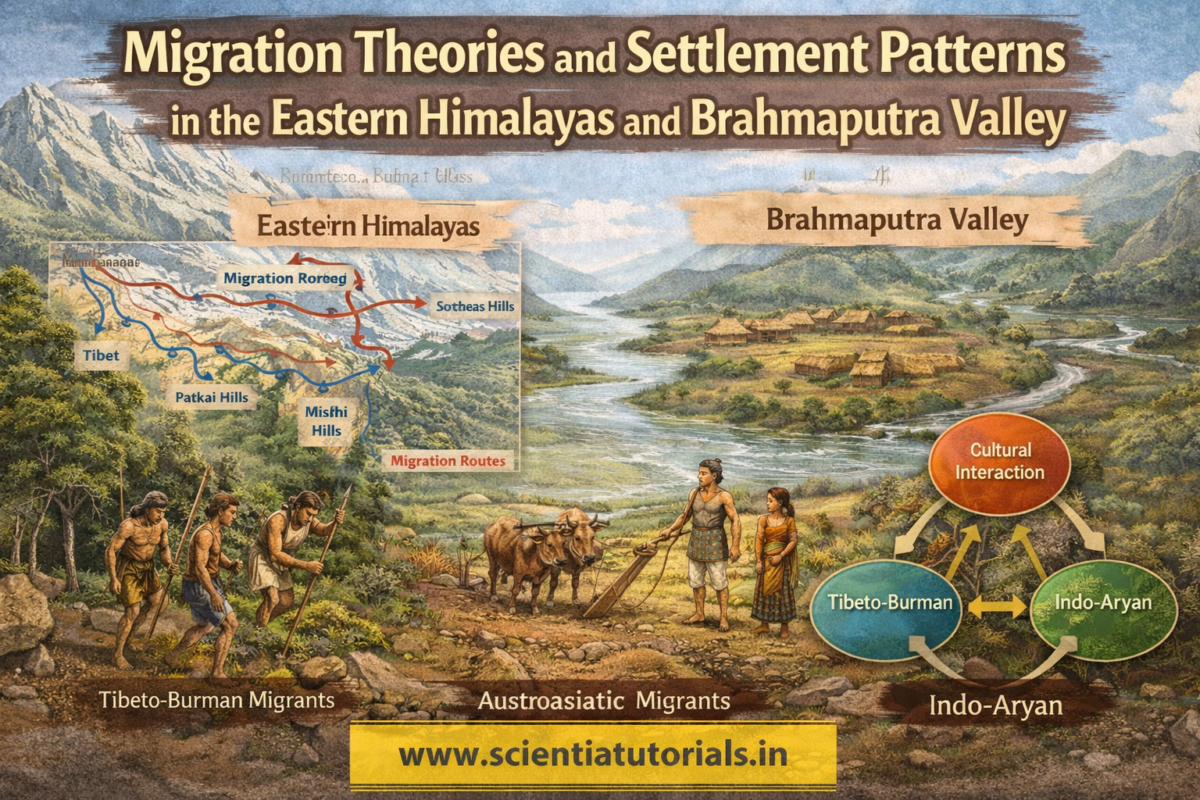

Migration Theories of North-East India: Eastern Himalayas & Brahmaputra Valley Settlements
Course: History of North-East India: From Early Kingdoms to Modern Integration
Module I: Geographical, Ethnic, and Cultural Foundations of North-East India
Timeline / Era Covered: Prehistory – Early Historic Background (Before 4th Century CE)
Lesson: Migration Theories and Settlement Patterns in the Eastern Himalayas and Brahmaputra Valley
This lesson is systematically organized into four clearly structured sections, as detailed below:
- Chronologically Structured Study Module
- Short-Answer Type Questions
- Long-Answer Type Questions
- Multiple-Choice Questions (MCQs) with Answers and Detailed Explanations
Chronologically Structured Study Module
Introduction: Migration as a Key to Early History of North-East India
Migration and settlement form the most crucial explanatory framework for understanding the early history of North-East India. Owing to the absence of indigenous written records before the early historic period, historians rely heavily on migration theories, archaeological evidence, linguistics, anthropology, and geography to reconstruct the region’s past.
Situated at the junction of the Indian subcontinent, Central Asia, China, and Southeast Asia, North-East India served as a natural corridor for human movement from prehistoric times. The Eastern Himalayas and the Brahmaputra Valley acted as both barriers and gateways, shaping distinctive settlement patterns that continue to influence the region’s ethnic and cultural diversity.
This lesson examines major migration theories, routes, chronological phases of migration, and the resulting settlement patterns from prehistoric times to the early historic period (before the 4th century CE).
Chronological Framework of Migration and Settlement
For clarity and examination relevance, migration and settlement in North-East India can be studied across four broad chronological phases:
- Prehistoric Migrations (Before 2000 BCE)
- Protohistoric Migrations (c. 2000 BCE – 500 BCE)
- Early Historic Migrations (c. 500 BCE – 4th Century CE)
- Stabilization of Settlement Patterns (Towards Early State Formation)
This framework highlights continuity, interaction, and adaptation, rather than abrupt population replacement.
Geographical Setting: Eastern Himalayas and Brahmaputra Valley
1. Eastern Himalayas
The Eastern Himalayas consist of rugged mountains, narrow passes, and forested valleys. While these features restricted mass movement, they also preserved distinct ethnic and linguistic identities by encouraging small-group migrations and isolated settlements.
2. Brahmaputra Valley
The Brahmaputra Valley functioned as a major migration corridor, offering fertile alluvial plains, navigable river systems, and favorable climatic conditions. It attracted settlers from multiple directions and became a zone of cultural interaction and eventual political consolidation.
I. Prehistoric Migration Theories
1. Early Hunter-Gatherer Movements
The earliest migrations into North-East India likely occurred during the Paleolithic and Mesolithic periods. Small groups of hunter-gatherers moved along river valleys and forest routes in search of food and shelter.
Key characteristics:
- Seasonal and nomadic movement
- Use of stone tools
- Temporary settlements near rivers and caves
These early migrations laid the foundation for later population expansion.
2. Austroasiatic Migration Theory
One of the earliest identifiable linguistic and cultural migration waves is associated with Austroasiatic-speaking communities.
Origin and Route:
- Likely migrated from Southeast Asia and eastern India
- Entered the region through forest corridors and river valleys
Settlement Pattern:
- Early agrarian and forest-based settlements
- Preference for fertile land and shifting cultivation
Historical Significance:
Austroasiatic migrants represent the earliest agricultural communities, influencing subsistence patterns and place names in parts of the region.
II. Protohistoric Migration Theories
1. Tibeto-Burman Migration Theory
The most dominant migration into North-East India is associated with Tibeto-Burman-speaking groups.
Origin:
- Regions north and east of the Himalayas (Tibet, Yunnan, and adjoining areas)
Routes of Migration:
- Eastern Himalayan passes
- Patkai and Mishmi hill corridors
Chronology:
- c. 2000 BCE – 500 BCE
Settlement Pattern:
- Hill-based settlements
- Clan and village-centric organization
- Defensive locations on slopes and ridges
These migrations explain the ethnic composition of most hill tribes of North-East India.
2. Mongoloid Migration Hypothesis (Anthropological View)
Early anthropologists grouped many North-East Indian populations under a broader “Mongoloid” racial category. While outdated as a racial theory, it remains relevant for understanding physical anthropology and migration direction.
Key Contribution:
- Emphasized trans-Himalayan connections
- Highlighted links with East and Southeast Asia
III. Early Historic Migration and Indo-Aryan Expansion
1. Indo-Aryan Migration into the Brahmaputra Valley
From around 500 BCE onwards, Indo-Aryan-speaking groups entered the Brahmaputra Valley.
Routes:
- From the Gangetic plains through riverine corridors
Nature of Migration:
- Gradual and non-disruptive
- Linked with trade, agriculture, and religious institutions
Settlement Pattern:
- Permanent agrarian villages
- Riverbank settlements
- Emergence of surplus economy
2. Cultural Impact of Indo-Aryan Settlers
Indo-Aryan migration led to:
- Introduction of plough agriculture
- Use of Sanskrit and Prakrit
- Growth of social stratification
- Emergence of early political authority
This phase marks the transition from protohistory to early recorded history.
IV. Settlement Patterns in Hill and Valley Regions
1. Hill Settlements (Eastern Himalayas)
Characteristics:
- Dispersed villages
- Shifting cultivation (jhum)
- Clan-based societies
- Linguistic and cultural continuity
Advantages:
- Protection from invasions
- Preservation of indigenous traditions
2. Valley Settlements (Brahmaputra Valley)
Characteristics:
- Dense population
- Permanent agriculture
- Trade and craft specialization
- Political centralization
Historical Outcome:
Valley settlements became centers of early state formation.
V. Interaction Between Migrant Groups
Migration did not result in complete displacement. Instead, interaction and assimilation were dominant features.
Forms of Interaction:
- Intermarriage
- Cultural borrowing
- Linguistic exchange
- Shared economic practices
This interaction produced a composite cultural landscape.
VI. Archaeological Evidence of Migration and Settlement
1. Material Remains
- Stone tools
- Pottery styles
- Settlement patterns
2. Agricultural Evidence
- Shifting cultivation remains
- Irrigation traces in valleys
3. Trade Indicators
- Non-local materials
- River-based exchange networks
Archaeology supports the theory of multiple migration waves rather than a single influx.
VII. Historiographical Perspectives on Migration
1. Linguistic Approach
Language families help trace migration routes and chronology.
2. Anthropological Approach
Studies physical features, customs, and social structures.
3. Archaeological Approach
Provides material confirmation of settlement continuity.
Modern historians emphasize multi-disciplinary integration rather than single-cause explanations.
VIII. Importance of Migration Studies for Understanding North-East India
Migration theories explain:
- Ethnic diversity
- Linguistic plurality
- Regional identities
- Cultural resilience
They also help contextualize later developments such as:
- Formation of early kingdoms
- Resistance to political centralization
- Cultural autonomy of hill societies
Examination-Oriented Key Points
- North-East India experienced multiple migration waves
- Eastern Himalayas acted as filters, not barriers
- Brahmaputra Valley functioned as a migration corridor
- Hill and valley settlements evolved differently
- Interaction and assimilation were dominant processes
Practice Questions for Competitive Examinations
Short Answer:
- Explain the role of geography in shaping migration into North-East India.
Descriptive:
2. Discuss the Tibeto-Burman migration theory and its impact on settlement patterns.
Analytical:
3. Examine how migration shaped the cultural diversity of the Brahmaputra Valley.
Conclusion
Migration theories and settlement patterns provide the most reliable framework for understanding the early history of North-East India. From prehistoric hunter-gatherers to early agrarian settlers, each migration wave contributed to the region’s complex demographic and cultural fabric. The interaction between migrants and indigenous populations created enduring settlement patterns in the Eastern Himalayas and the Brahmaputra Valley. This lesson thus forms a vital foundation for understanding later political integration and cultural continuity in North-East India, making it indispensable for both academic study and competitive examinations.
Short Answer Type Questions with Answers
(Prehistory – Early Historic Background, Before 4th Century CE)
1. Why is migration considered a key theme in the early history of North-East India?
Answer:
Because early North-East India lacks indigenous written records, migration theories help explain human settlement, ethnic diversity, and cultural formation using archaeological and linguistic evidence.
2. Name the two major geographical regions discussed in migration studies of North-East India.
Answer:
The Eastern Himalayas and the Brahmaputra Valley.
3. How did the Eastern Himalayas influence migration patterns?
Answer:
They acted as natural filters, allowing small-group migrations while preserving distinct cultural and linguistic identities.
4. Why is the Brahmaputra Valley described as a migration corridor?
Answer:
Because its fertile plains, navigable river system, and favorable climate attracted settlers from multiple directions.
5. What type of migration is associated with the prehistoric phase?
Answer:
Small-scale hunter-gatherer migrations, often seasonal and nomadic.
6. Which tools are associated with prehistoric migrants?
Answer:
Stone tools such as hand axes, choppers, and microliths.
7. What is the Austroasiatic migration theory?
Answer:
It suggests early migration of Austroasiatic-speaking communities from Southeast Asia and eastern India into North-East India.
8. What subsistence pattern is linked with Austroasiatic migrants?
Answer:
Early agriculture and forest-based subsistence, including shifting cultivation.
9. Which migration group is considered the most dominant in North-East India?
Answer:
The Tibeto-Burman-speaking groups.
10. From which regions did Tibeto-Burman migrants originate?
Answer:
From areas north and east of the Himalayas, including Tibet and Yunnan.
11. What routes were used by Tibeto-Burman migrants?
Answer:
Eastern Himalayan passes and hill corridors such as the Patkai and Mishmi ranges.
12. What type of settlements did Tibeto-Burman groups establish?
Answer:
Hill-based, clan-oriented village settlements, often in defensible locations.
13. What is meant by the Mongoloid migration hypothesis?
Answer:
An early anthropological theory emphasizing trans-Himalayan migration based on physical features, now used cautiously.
14. When did Indo-Aryan migration into North-East India begin?
Answer:
Around 500 BCE, during the early historic period.
15. Which region was primarily affected by Indo-Aryan migration?
Answer:
The Brahmaputra Valley.
16. What was the nature of Indo-Aryan migration?
Answer:
Gradual and peaceful, linked with agriculture, trade, and religion.
17. Name two cultural impacts of Indo-Aryan settlers.
Answer:
Introduction of plough agriculture and use of Sanskrit and Prakrit.
18. How did hill and valley settlement patterns differ?
Answer:
Hills had dispersed, shifting settlements, while valleys developed permanent agrarian villages.
19. Why did hill societies preserve indigenous traditions longer?
Answer:
Due to geographical isolation and limited external influence.
20. What role did interaction play between migrant groups?
Answer:
Interaction led to cultural assimilation, linguistic exchange, and social integration rather than displacement.
21. Which type of evidence supports migration theories in North-East India?
Answer:
Archaeological, linguistic, and anthropological evidence.
22. How does language help in understanding migration?
Answer:
Language families trace migration routes, origins, and cultural interaction.
23. What economic factor encouraged settlement in river valleys?
Answer:
Availability of fertile alluvial soil and water resources.
24. How did migration contribute to ethnic diversity in North-East India?
Answer:
Multiple migration waves created a multi-ethnic and multi-linguistic population.
25. Why is the study of migration theories important for competitive exams?
Answer:
It explains ethnic origins, settlement patterns, and cultural diversity, frequently tested in prelims and mains.
Long Answer Type Questions with Answers
(Prehistory – Early Historic Background, Before 4th Century CE)
1. Discuss the importance of migration theories in reconstructing the early history of North-East India.
Answer:
Migration theories are central to reconstructing the early history of North-East India because the region lacks indigenous written records before the early historic period. Archaeological, linguistic, and anthropological evidence helps historians trace population movements, cultural origins, and settlement patterns. Migration theories explain how diverse ethnic groups entered the region at different times and adapted to its varied geography. They also help in understanding the emergence of linguistic diversity, social institutions, and early political structures.
2. Explain how geography shaped migration and settlement in North-East India.
Answer:
The geography of North-East India strongly influenced migration and settlement. The Eastern Himalayas acted as both barriers and gateways, allowing selective movement through mountain passes while preserving isolation. River valleys, especially the Brahmaputra Valley, offered fertile land, water resources, and natural routes for migration. This contrast produced dispersed hill settlements and dense valley populations, shaping long-term cultural patterns.
3. Examine the role of the Eastern Himalayas in prehistoric and protohistoric migrations.
Answer:
The Eastern Himalayas filtered rather than blocked migration. Small groups moved through passes over long periods, resulting in gradual settlement rather than sudden population replacement. The difficult terrain encouraged clan-based societies, shifting cultivation, and cultural continuity. These conditions helped preserve indigenous languages and customs in hill regions.
4. Why is the Brahmaputra Valley described as a major migration corridor?
Answer:
The Brahmaputra Valley provided fertile alluvial plains, abundant water, and navigable routes, making it attractive for settlement. Migrants from eastern India, the Himalayan foothills, and later the Gangetic plains entered the region through this valley. Continuous migration turned it into a zone of interaction, economic surplus, and early political organization.
5. Describe the nature of prehistoric migrations into North-East India.
Answer:
Prehistoric migrations involved small groups of hunter-gatherers during the Paleolithic and Mesolithic periods. These migrations were seasonal, nomadic, and closely linked to ecological resources. Early settlers used stone tools and preferred riverine and forested environments for survival.
6. Discuss the Austroasiatic migration theory and its historical significance.
Answer:
The Austroasiatic migration theory suggests that some of the earliest agricultural communities entered North-East India from Southeast Asia and eastern India. These groups practiced forest-based subsistence and shifting cultivation. Though later migrations reduced their dominance, Austroasiatic influences remain visible in place names, agricultural vocabulary, and cultural practices, highlighting their foundational role.
7. Examine the origins and routes of Tibeto-Burman migration into North-East India.
Answer:
Tibeto-Burman-speaking groups originated from regions north and east of the Himalayas, including Tibet and Yunnan. They migrated through the Patkai, Mishmi, and other hill corridors between c. 2000 BCE and 500 BCE. These migrations account for the ethnic composition of most hill communities in North-East India.
8. Analyze the settlement patterns established by Tibeto-Burman migrants.
Answer:
Tibeto-Burman migrants preferred hill slopes and ridges for settlement, leading to dispersed villages. Their societies were clan-based, practicing shifting cultivation and maintaining strong kinship ties. This settlement pattern promoted autonomy, cultural resilience, and resistance to centralized authority.
9. Explain the Mongoloid migration hypothesis and its relevance today.
Answer:
The Mongoloid migration hypothesis was an early anthropological attempt to explain the physical features of North-East Indian populations by linking them to trans-Himalayan migration. While outdated as a racial theory, it remains useful for understanding migration directions and cultural connections with East and Southeast Asia.
10. Discuss the timing and nature of Indo-Aryan migration into North-East India.
Answer:
Indo-Aryan migration began around 500 BCE and was largely confined to the Brahmaputra Valley. It was gradual and peaceful, associated with agriculture, trade, and religious institutions rather than conquest. This migration marked the transition from protohistory to early recorded history.
11. Assess the cultural impact of Indo-Aryan migration in the Brahmaputra Valley.
Answer:
Indo-Aryan migration introduced plough agriculture, Sanskrit and Prakrit languages, social stratification, and religious institutions. These developments supported surplus production and political centralization, laying the foundation for early state formation in the valley.
12. Compare hill and valley settlement patterns in North-East India.
Answer:
Hill regions featured dispersed settlements, shifting cultivation, and clan-based societies, while valley regions developed permanent villages, intensive agriculture, and trade networks. This contrast explains the persistence of indigenous traditions in hills and early political organization in plains.
13. Discuss the role of interaction and assimilation among migrant groups.
Answer:
Migration in North-East India did not lead to large-scale displacement. Instead, interaction through trade, intermarriage, and cultural exchange created a composite society. Linguistic borrowing and shared practices demonstrate assimilation rather than exclusion.
14. How does archaeological evidence support migration theories in North-East India?
Answer:
Archaeological findings such as stone tools, pottery styles, and settlement remains reveal continuity and variation across regions. Differences in material culture support the idea of multiple migration waves and region-specific adaptation.
15. Explain how linguistic evidence helps trace migration routes.
Answer:
Language families reveal historical connections between communities. Similarities between Tibeto-Burman languages across hill regions indicate common origins and migration paths, while Indo-Aryan linguistic presence in valleys reflects later settlement.
16. Analyze the economic factors influencing settlement in river valleys.
Answer:
Fertile soil, water availability, and trade opportunities encouraged dense settlement in river valleys. Agricultural surplus supported population growth, craft specialization, and political authority.
17. Discuss the relationship between migration and ethnic diversity in North-East India.
Answer:
Successive migration waves introduced diverse ethnic groups with distinct languages and customs. Interaction among these groups produced the region’s rich ethnic mosaic, which continues to define its cultural identity.
18. Evaluate the role of shifting cultivation in hill settlements.
Answer:
Shifting cultivation suited the hilly terrain and forest ecology. It supported dispersed settlements and reinforced clan-based social structures, contributing to cultural continuity.
19. How did migration patterns influence early political development?
Answer:
Valley settlements supported political centralization due to surplus production, while hill settlements favored decentralized governance. These patterns shaped later state formation and resistance to external control.
20. Discuss the historiographical approaches used to study migration in North-East India.
Answer:
Historians employ archaeological, linguistic, anthropological, and geographical approaches. Modern scholarship emphasizes interdisciplinary analysis over single-theory explanations.
21. Examine the role of environmental adaptation in migration and settlement.
Answer:
Migrants adapted their subsistence and settlement strategies to local environments. This adaptability ensured survival and cultural continuity in diverse ecological zones.
22. Why is migration described as a continuous process rather than a single event?
Answer:
Evidence shows multiple waves of migration over thousands of years. Continuous interaction and adaptation shaped long-term settlement patterns rather than abrupt demographic change.
23. Discuss the importance of migration studies for understanding cultural resilience in hill societies.
Answer:
Migration studies explain how isolation and adaptation enabled hill societies to preserve language, customs, and social institutions despite external influences.
24. Why are migration theories frequently asked in competitive examinations on North-East India?
Answer:
They explain ethnic origins, settlement patterns, linguistic diversity, and early political development—core analytical themes in both prelims and mains.
25. Conclude by assessing the overall historical significance of migration and settlement patterns in North-East India.
Answer:
Migration and settlement patterns form the backbone of North-East India’s early history. They explain the region’s ethnic diversity, cultural plurality, and contrasting hill–valley societies. Understanding these processes is essential for interpreting later historical developments and modern regional identities.
MCQs with Answers and Explanations
(Prehistory – Early Historic Background, Before 4th Century CE)
1. Why are migration theories central to the early history of North-East India?
A. Availability of abundant inscriptions
B. Presence of early dynastic records
C. Absence of indigenous written sources
D. Dominance of medieval chronicles
Correct Answer: C. Absence of indigenous written sources
Explanation:
Before the early historic period, North-East India lacks indigenous written records. Hence, historians depend on migration theories supported by archaeology, linguistics, and anthropology to reconstruct early history.
2. Which two geographical zones are most important for studying migration in North-East India?
A. Indo-Gangetic Plain and Deccan Plateau
B. Thar Desert and Aravalli Range
C. Eastern Himalayas and Brahmaputra Valley
D. Western Ghats and Coastal Plains
Correct Answer: C. Eastern Himalayas and Brahmaputra Valley
Explanation:
The Eastern Himalayas influenced hill settlements, while the Brahmaputra Valley acted as a major migration corridor and settlement zone.
3. The Eastern Himalayas influenced migration mainly by:
A. Allowing unrestricted mass migration
B. Completely blocking population movement
C. Acting as selective filters for small groups
D. Encouraging urban settlement
Correct Answer: C. Acting as selective filters for small groups
Explanation:
The rugged terrain allowed slow, small-group migrations, preserving linguistic and cultural diversity rather than encouraging mass movement.
4. Why is the Brahmaputra Valley considered a migration corridor?
A. Presence of deserts
B. Fertile plains and navigable river routes
C. Dense forests only
D. Lack of human habitation
Correct Answer: B. Fertile plains and navigable river routes
Explanation:
The valley offered fertile alluvial soil, water, and transport routes, attracting settlers from different directions.
5. Prehistoric migrations into North-East India were primarily:
A. Large-scale military invasions
B. Seasonal and nomadic movements
C. Urban colonization drives
D. State-sponsored settlements
Correct Answer: B. Seasonal and nomadic movements
Explanation:
Early migrations involved small groups of hunter-gatherers moving seasonally in search of food and shelter.
6. Which material evidence is most closely linked with prehistoric migrants?
A. Coins and inscriptions
B. Stone tools
C. Iron weapons
D. Written manuscripts
Correct Answer: B. Stone tools
Explanation:
Stone tools such as hand axes, choppers, and microliths are key archaeological indicators of prehistoric migration.
7. The Austroasiatic migration theory is associated with:
A. Iron-using nomads
B. Early agrarian and forest-based communities
C. Urban traders
D. Pastoral tribes of Central Asia
Correct Answer: B. Early agrarian and forest-based communities
Explanation:
Austroasiatic-speaking groups are linked with early agriculture, forest subsistence, and shifting cultivation.
8. From which broad region did Austroasiatic-speaking groups likely migrate?
A. Central Asia
B. Southeast Asia and eastern India
C. Western Asia
D. Southern India
Correct Answer: B. Southeast Asia and eastern India
Explanation:
Linguistic and cultural evidence suggests Austroasiatic migrants entered from Southeast Asia and adjoining eastern India.
9. Which migration group is considered numerically and culturally dominant in North-East India?
A. Indo-Aryan
B. Austroasiatic
C. Tibeto-Burman
D. Dravidian
Correct Answer: C. Tibeto-Burman
Explanation:
Most hill tribes of North-East India belong to the Tibeto-Burman linguistic family.
10. Tibeto-Burman migrants originated mainly from:
A. Gangetic plains
B. Deccan plateau
C. Regions north and east of the Himalayas
D. Arabian Peninsula
Correct Answer: C. Regions north and east of the Himalayas
Explanation:
They migrated from areas such as Tibet and Yunnan through Himalayan and hill corridors.
11. Which routes were commonly used by Tibeto-Burman migrants?
A. Thar Desert routes
B. Coastal sea routes
C. Patkai and Mishmi hill corridors
D. Vindhya passes
Correct Answer: C. Patkai and Mishmi hill corridors
Explanation:
Hill passes and corridors facilitated gradual movement into North-East India.
12. Tibeto-Burman settlement patterns were characterized by:
A. Urban centers and cities
B. Hill-based, clan-oriented villages
C. Desert nomadism
D. Coastal trading towns
Correct Answer: B. Hill-based, clan-oriented villages
Explanation:
These groups preferred defensible hill locations and kinship-based social organization.
13. The Mongoloid migration hypothesis primarily emphasized:
A. Linguistic similarity
B. Racial hierarchy
C. Trans-Himalayan population movement
D. Maritime migration
Correct Answer: C. Trans-Himalayan population movement
Explanation:
Though outdated as a racial theory, it highlighted migration links with East and Southeast Asia.
14. Indo-Aryan migration into North-East India began around:
A. 2000 BCE
B. 1500 BCE
C. 500 BCE
D. 200 CE
Correct Answer: C. 500 BCE
Explanation:
Indo-Aryan migration marks the early historic phase and the beginning of recorded history in the region.
15. Indo-Aryan settlement was largely confined to which region?
A. Eastern Himalayas
B. Naga Hills
C. Brahmaputra Valley
D. Patkai Range
Correct Answer: C. Brahmaputra Valley
Explanation:
The fertile plains of the Brahmaputra Valley supported permanent agrarian settlements.
16. The nature of Indo-Aryan migration was mostly:
A. Violent and destructive
B. Sudden and large-scale
C. Gradual and non-disruptive
D. Nomadic and pastoral
Correct Answer: C. Gradual and non-disruptive
Explanation:
It was linked with agriculture, trade, and religion rather than conquest.
17. One major cultural impact of Indo-Aryan migration was:
A. Decline of agriculture
B. Introduction of plough agriculture
C. End of tribal institutions
D. Spread of iron weapons
Correct Answer: B. Introduction of plough agriculture
Explanation:
Plough-based farming increased surplus and supported early political organization.
18. Which factor best explains differences between hill and valley settlements?
A. Uniform culture
B. Diverse geography
C. Colonial influence
D. Religious uniformity
Correct Answer: B. Diverse geography
Explanation:
Hills encouraged dispersed settlements; valleys supported dense, permanent habitation.
19. Hill settlements were typically associated with:
A. Intensive wet-rice cultivation
B. Shifting cultivation and dispersal
C. Urban craft specialization
D. Port-based trade
Correct Answer: B. Shifting cultivation and dispersal
Explanation:
Shifting cultivation suited hilly terrain and reinforced clan-based societies.
20. Valley settlements encouraged early state formation mainly because of:
A. Isolation
B. Agricultural surplus
C. Nomadic economy
D. Lack of interaction
Correct Answer: B. Agricultural surplus
Explanation:
Surplus production supported population growth, administration, and political authority.
21. Migration in North-East India generally resulted in:
A. Complete displacement of earlier populations
B. Cultural isolation
C. Interaction and assimilation
D. Ethnic extinction
Correct Answer: C. Interaction and assimilation
Explanation:
Evidence shows coexistence, intermarriage, and cultural exchange rather than total replacement.
22. Which type of evidence is most useful for tracing migration routes?
A. Numismatics
B. Linguistic evidence
C. Medieval chronicles
D. Colonial surveys
Correct Answer: B. Linguistic evidence
Explanation:
Language families help identify origins, routes, and interaction among migrant groups.
23. Archaeological evidence supports which conclusion about migration?
A. Single migration wave
B. No migration occurred
C. Multiple migration waves over time
D. Sudden demographic replacement
Correct Answer: C. Multiple migration waves over time
Explanation:
Variation in material culture indicates continuous and layered migration.
24. Migration studies help explain which key feature of North-East India?
A. Uniform ethnic identity
B. Cultural homogeneity
C. Ethnic and linguistic diversity
D. Absence of tribal societies
Correct Answer: C. Ethnic and linguistic diversity
Explanation:
Successive migrations created a multi-ethnic, multi-linguistic region.
25. Why are migration theories important for competitive examinations?
A. They are purely theoretical
B. They explain tools and pottery only
C. They link geography, culture, and history
D. They replace political history
Correct Answer: C. They link geography, culture, and history
Explanation:
Migration theories integrate geography, archaeology, linguistics, and social history—core analytical themes in exams.