
Impact of Militancy on Society and Economy
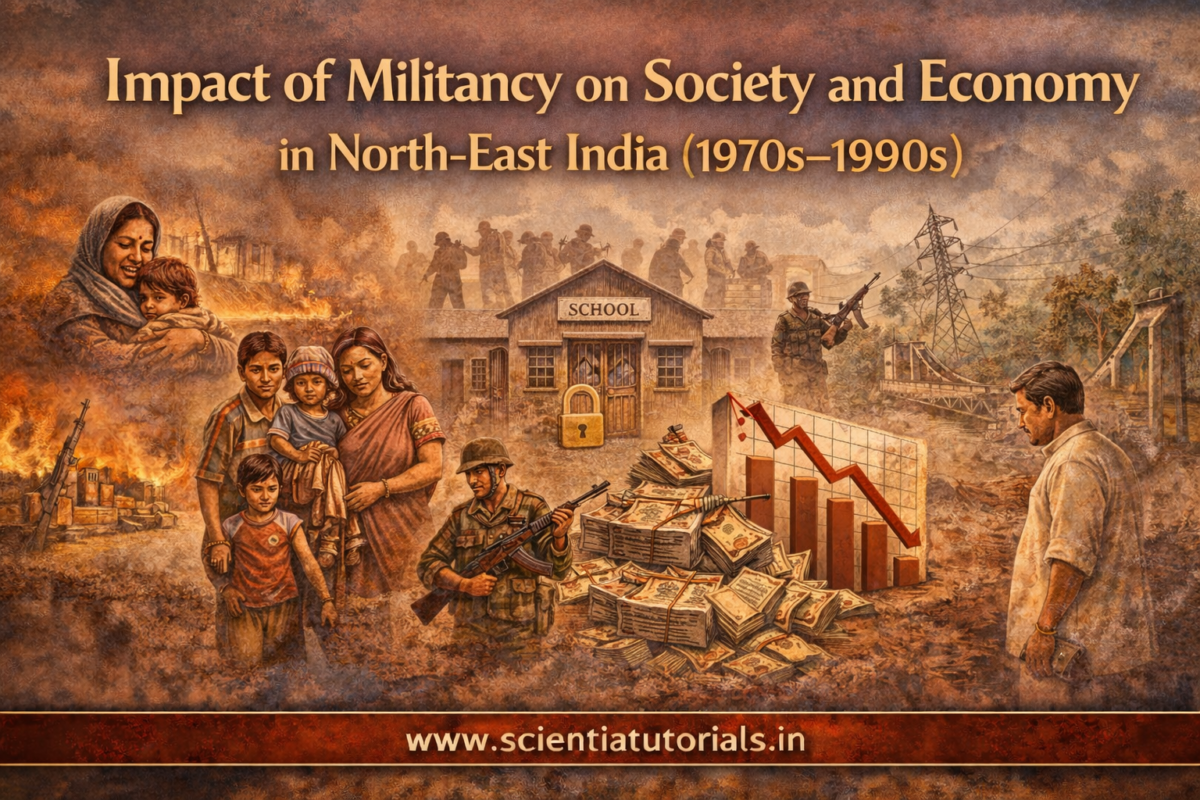

Impact of Militancy on Society and Economy in North-East India | History Notes
Course: History of North-East India: From Early Kingdoms to Modern Integration
Module IX: Insurgency, Identity, and Political Movements
Timeline / Era Covered: 1970s – 1990s
Lesson: Impact of Militancy on Society and Economy
This lesson is systematically organized into four clearly structured sections, as detailed below:
- Chronologically Structured Study Module
- Short-Answer Type Questions
- Long-Answer Type Questions
- Multiple-Choice Questions (MCQs) with Answers and Detailed Explanations
Chronologically Structured Study Module
Introduction
The decades from the 1970s to the 1990s constitute one of the most turbulent periods in the history of North-East India, marked by the widespread growth of militant movements, armed insurgency, and prolonged internal conflict. While militancy in the region emerged from political grievances, identity anxieties, and demands for autonomy or sovereignty, its consequences went far beyond politics. Militancy profoundly transformed the social fabric, economic structures, demographic patterns, and everyday life of the region.
This lesson focuses not on the causes of militancy, but on its multi-dimensional impact on society and economy. The effects of prolonged violence were cumulative and long-lasting, reshaping institutions, livelihoods, and social relationships. Militancy disrupted development, altered state–society relations, normalised violence, and left deep psychological and economic scars that continued well beyond the formal decline of insurgent activities.
Understanding these impacts is essential for evaluating the broader costs of conflict and for appreciating why peace-building, rehabilitation, and inclusive development became central concerns in the post-1990s period.
Conceptual Framework: Militancy, Society, and Economy
Militancy
Militancy refers to organised armed political activity carried out by non-state groups to challenge the authority of the state. In North-East India, militancy was:
- Identity-driven
- Region-specific
- Prolonged and uneven in intensity
Militant groups exercised varying degrees of control over territory and population, directly affecting social and economic life.
Social Impact
The social impact of militancy includes:
- Disruption of community life
- Breakdown of trust and social cohesion
- Psychological trauma and fear
- Transformation of social values and norms
Economic Impact
The economic impact refers to:
- Decline in production and investment
- Damage to infrastructure
- Rise in informal and illegal economies
- Increased dependency on state support
Historical Context: Rise of Militancy and Its Spread (1970s–1990s)
By the 1970s, unresolved political grievances, ethnic competition, and identity-based movements had evolved into armed militancy in several parts of the North-East. Over the next two decades:
- Militancy expanded geographically
- Violence became prolonged rather than episodic
- Civilian populations were increasingly affected
The long duration of conflict magnified its impact on society and economy, making militancy a defining feature of everyday life in many areas.
Social Impact of Militancy
1. Breakdown of Social Cohesion
One of the most severe consequences of militancy was the erosion of social harmony.
- Communities became divided along ethnic, political, and ideological lines
- Inter-community trust weakened
- Traditional mechanisms of conflict resolution lost authority
Fear and suspicion became embedded in social interactions, fragmenting society.
2. Normalisation of Violence
Prolonged militancy led to the normalisation of violence:
- Armed encounters, curfews, and raids became routine
- Younger generations grew up in an atmosphere of fear and instability
- Violence increasingly replaced dialogue as a mode of political expression
This normalisation had long-term implications for democratic culture and civic behaviour.
3. Impact on Education
Education was severely disrupted during periods of militancy:
- Schools and colleges frequently closed due to strikes and violence
- Teachers and students were threatened or targeted
- Educational institutions were used as shelters or camps
As a result:
- Dropout rates increased
- Educational attainment declined
- A generation experienced interrupted schooling
The long-term human capital deficit became a major developmental challenge.
4. Psychological Trauma and Mental Health
Militancy inflicted deep psychological trauma on civilian populations:
- Constant fear of violence
- Exposure to killings, disappearances, and displacement
- Loss of family members
Symptoms included:
- Anxiety and depression
- Post-traumatic stress
- Social withdrawal
Mental health issues remained largely unaddressed due to limited institutional capacity.
5. Displacement and Migration
Militancy led to both internal displacement and out-migration:
- Villages were abandoned due to insecurity
- People migrated to urban centres or outside the region
- Traditional livelihoods were disrupted
Displacement altered demographic patterns and weakened community networks.
6. Changing Role of Youth
Youth were among the most affected groups:
- Many were drawn into militant organisations
- Others faced unemployment and uncertainty
- Youth politics became radicalised
Militancy transformed youth from agents of social change into participants or victims of violence, with lasting consequences for social development.
Impact on State–Society Relations
1. Militarisation of Civil Life
The presence of armed forces and security operations transformed everyday life:
- Checkpoints, identity verification, and curfews became common
- Civilian spaces were securitised
- Trust between citizens and state institutions weakened
This militarisation reshaped perceptions of the state from a provider of welfare to an enforcer of order.
2. Erosion of Democratic Participation
Frequent violence and intimidation led to:
- Decline in voter participation in conflict zones
- Weak functioning of local institutions
- Reduced political engagement
Democracy survived formally but was weakened substantively in many areas.
Economic Impact of Militancy
1. Disruption of Economic Activity
Militancy severely disrupted normal economic life:
- Markets shut down during strikes and curfews
- Transportation and trade were frequently blocked
- Agricultural cycles were interrupted
This resulted in:
- Loss of income
- Decline in productivity
- Increased poverty
2. Decline in Investment and Industrial Growth
The climate of insecurity discouraged:
- Private investment
- Industrial development
- Entrepreneurial activity
Industries either:
- Failed to develop
- Shut down operations
- Relocated to safer regions
This reinforced the region’s economic marginalisation.
3. Damage to Infrastructure
Militancy caused extensive damage to:
- Roads and bridges
- Power and communication networks
- Public buildings
Frequent attacks and sabotage increased the cost of infrastructure development and maintenance.
4. Rise of Informal and Illegal Economies
Prolonged conflict fostered the growth of:
- Informal trade networks
- Extortion and “taxation” by militant groups
- Smuggling and black markets
These parallel economies:
- Undermined state revenue
- Distorted local economies
- Normalised illegality as survival strategy
5. Impact on Agriculture and Rural Economy
Agriculture, the backbone of the region, was deeply affected:
- Farmers avoided fields due to fear
- Land was abandoned or left uncultivated
- Traditional practices declined
Rural poverty and food insecurity increased, accelerating migration.
6. Fiscal Burden on the State
Militancy imposed a heavy fiscal burden:
- Increased security expenditure
- Reduced funds for development
- Rising cost of governance
Developmental priorities were subordinated to security concerns, creating a vicious cycle of underdevelopment and unrest.
Social Inequality and Marginalisation
Militancy disproportionately affected:
- Poor households
- Women and children
- Marginalised ethnic groups
Women faced:
- Loss of livelihoods
- Increased domestic responsibilities
- Vulnerability to violence
Social inequalities deepened, complicating post-conflict recovery.
Long-Term Consequences of Militancy
1. Developmental Lag
Decades of instability left the region:
- Economically behind national averages
- Dependent on central assistance
- Lacking robust private sector growth
This developmental lag persisted even after reduction in violence.
2. Cultural Impact
Militancy altered cultural life:
- Decline of public festivals and gatherings
- Suppression of artistic expression during conflict
- Loss of traditional community spaces
Cultural revival became an important aspect of post-conflict healing.
3. Inter-Generational Effects
Children growing up during conflict inherited:
- Trauma
- Educational deficits
- Limited economic opportunities
The inter-generational transmission of disadvantage remains a critical concern.
Transition Towards Peace and Reconstruction (1990s)
By the 1990s:
- Conflict fatigue set in
- Peace accords and negotiations gained momentum
- Rehabilitation and development became policy priorities
The recognition of the social and economic costs of militancy played a crucial role in shifting state policy from force to dialogue and reconstruction.
Critical Evaluation
Militancy in North-East India cannot be understood solely as a political or security issue. Its deep social and economic impacts reveal the true cost of prolonged conflict. While militancy emerged from legitimate grievances, its consequences often harmed the very communities it claimed to represent.
The lesson underscores that:
- Violence erodes social capital
- Conflict undermines economic potential
- Recovery requires more than peace accords
Sustainable peace depends on healing social wounds, restoring livelihoods, and rebuilding trust.
Conclusion
The period between the 1970s and 1990s witnessed the far-reaching impact of militancy on the society and economy of North-East India. Militancy disrupted everyday life, weakened social cohesion, damaged economic structures, and imposed long-term developmental costs. Its legacy continues to shape the region’s challenges even after the decline of large-scale violence.
Understanding these impacts is essential for crafting informed policies of peace-building, rehabilitation, inclusive development, and social reconciliation. The experience of North-East India serves as a powerful reminder that the cost of conflict is borne not only on battlefields, but in the everyday lives of ordinary people.
Short Answer Type Questions
Lesson: Impact of Militancy on Society and Economy (1970s–1990s)
1. What is meant by militancy in the context of North-East India?
Answer:
Militancy refers to organised armed political activity by non-state groups aimed at challenging the authority of the Indian state.
2. During which decades did militancy most strongly affect North-East India?
Answer:
Militancy had its strongest impact from the 1970s to the 1990s.
3. Name two major social consequences of prolonged militancy.
Answer:
Breakdown of social cohesion and normalisation of violence.
4. How did militancy affect social harmony in the region?
Answer:
It created fear, mistrust, and divisions along ethnic and political lines, weakening community relationships.
5. What is meant by the “normalisation of violence”?
Answer:
It refers to violence becoming a routine and accepted part of everyday life due to prolonged conflict.
6. How did militancy disrupt the education system?
Answer:
Schools and colleges frequently closed due to strikes, violence, and insecurity, increasing dropout rates.
7. What impact did militancy have on youth?
Answer:
Youth faced unemployment, radicalisation, disrupted education, and in some cases recruitment into militant groups.
8. How did militancy affect mental health in society?
Answer:
It caused widespread psychological trauma, including anxiety, depression, and post-traumatic stress.
9. Why did militancy lead to population displacement?
Answer:
Fear, insecurity, and destruction of livelihoods forced people to migrate within or outside the region.
10. How did militancy change state–society relations?
Answer:
It increased militarisation of civilian life and reduced trust between citizens and state institutions.
11. What was the effect of militancy on democratic participation?
Answer:
Political participation declined due to fear, intimidation, and disruption of electoral processes.
12. How did militancy disrupt everyday economic activities?
Answer:
Strikes, curfews, and violence frequently shut down markets, transport, and trade.
13. Why did private investment decline during militant phases?
Answer:
Persistent insecurity and instability discouraged investors and industrial development.
14. What kind of damage did militancy cause to infrastructure?
Answer:
Roads, bridges, power lines, and public buildings were often destroyed or sabotaged.
15. How did militancy contribute to the growth of informal economies?
Answer:
Extortion, smuggling, and illegal trade expanded as formal economic activities declined.
16. What was the impact of militancy on agriculture?
Answer:
Farmers avoided fields due to insecurity, leading to reduced production and rural poverty.
17. How did militancy affect employment opportunities?
Answer:
Job opportunities declined due to closure of industries and reduced economic activity.
18. Why did militancy increase the fiscal burden on the state?
Answer:
Large funds were diverted to security operations, reducing resources for development.
19. Which social groups were most vulnerable to the effects of militancy?
Answer:
Women, children, the poor, and marginalised communities were most affected.
20. How did militancy affect women’s social roles?
Answer:
Women faced loss of livelihoods, increased household responsibilities, and greater vulnerability to violence.
21. What is meant by developmental lag caused by militancy?
Answer:
Long-term economic backwardness due to prolonged disruption of growth and infrastructure.
22. How did militancy influence cultural life in the region?
Answer:
Public gatherings, festivals, and cultural expressions declined due to fear and instability.
23. What are inter-generational effects of militancy?
Answer:
Children inherited trauma, educational deficits, and limited economic opportunities.
24. Why did awareness of social and economic costs encourage peace initiatives?
Answer:
The heavy human and economic losses highlighted the need for negotiation and reconstruction.
25. Why is the study of militancy’s impact important for policy-making?
Answer:
It helps design effective peace-building, rehabilitation, and inclusive development strategies.
Long Answer Type Questions
Lesson: Impact of Militancy on Society and Economy (1970s–1990s)
1. Examine the historical context in which militancy affected society and economy in North-East India.
Answer:
From the 1970s onward, unresolved political grievances, identity assertions, and demands for autonomy escalated into armed militancy across parts of North-East India. Prolonged conflict coincided with weak infrastructure and limited industrialisation, amplifying its social and economic effects. Militancy thus became a defining condition of everyday life, shaping institutions, livelihoods, and state–society relations.
2. Analyse how prolonged militancy disrupted social cohesion in North-East India.
Answer:
Militancy fractured communities along ethnic, political, and ideological lines. Fear, suspicion, and forced loyalties weakened traditional bonds and local conflict-resolution mechanisms. Inter-community trust eroded, leading to social fragmentation that persisted even after violence declined.
3. Discuss the process and consequences of the normalisation of violence.
Answer:
With frequent encounters, curfews, and armed presence, violence became routine. This normalisation altered social norms, reduced the stigma attached to coercion, and undermined democratic dialogue. Over time, it desensitised society to conflict and weakened civic culture.
4. Examine the impact of militancy on education and human capital formation.
Answer:
Educational institutions faced closures, intimidation, and disruption. Student dropout rates rose, academic calendars collapsed, and teacher shortages intensified. The resulting loss of human capital constrained long-term development and perpetuated cycles of underemployment.
5. Analyse the psychological impact of militancy on civilian populations.
Answer:
Continuous exposure to violence produced widespread trauma, anxiety, and depression. Families experienced loss, displacement, and uncertainty. Limited access to mental health services meant psychological scars remained unaddressed, affecting productivity and social wellbeing.
6. How did militancy affect youth and shape generational outcomes?
Answer:
Youth were particularly vulnerable—many faced disrupted education, unemployment, or recruitment into armed groups. Radicalisation and lost opportunities produced long-term generational disadvantages, influencing political attitudes and labour outcomes.
7. Examine the relationship between militancy and displacement/migration.
Answer:
Insecurity forced internal displacement and out-migration. Villages were abandoned, urban areas strained, and traditional livelihoods disrupted. Migration altered demographic patterns and weakened community networks, complicating post-conflict recovery.
8. Discuss the militarisation of civil life and its implications for state–society relations.
Answer:
Security checkpoints, raids, and curfews became common, reshaping daily life. The state was increasingly perceived as an enforcer rather than a welfare provider, reducing trust and participation while entrenching alienation.
9. Analyse how militancy undermined democratic participation and institutions.
Answer:
Fear and intimidation reduced voter turnout and weakened local governance. Political processes continued formally but lacked substance in conflict zones, diminishing accountability and representation.
10. Examine the impact of militancy on everyday economic activity.
Answer:
Strikes, curfews, and violence disrupted markets, transport, and trade. Income losses mounted, productivity fell, and poverty increased, particularly among informal workers and small producers.
11. Why did militancy discourage private investment and industrial growth?
Answer:
Persistent insecurity raised risks and costs, deterring investors. Industries stagnated or relocated, reinforcing dependence on public spending and limiting job creation.
12. Assess the damage caused by militancy to infrastructure and public assets.
Answer:
Roads, bridges, power lines, and public buildings suffered repeated damage. Repair costs escalated, delaying development and constraining connectivity crucial for growth.
13. Analyse the rise of informal and illegal economies during militant phases.
Answer:
As formal activity declined, extortion, smuggling, and black markets expanded. These parallel economies distorted incentives, reduced tax revenues, and normalised illegality as a survival strategy.
14. Examine the impact of militancy on agriculture and the rural economy.
Answer:
Fear limited access to fields, disrupted cropping cycles, and led to land abandonment. Reduced output and income deepened rural poverty and accelerated migration.
15. Discuss the fiscal burden of militancy on the state.
Answer:
Rising security expenditures diverted funds from development, education, and health. Governance costs increased while revenues declined, creating a vicious cycle of underdevelopment.
16. Analyse the gendered impact of militancy on women.
Answer:
Women faced livelihood loss, increased care burdens, and heightened vulnerability to violence. While some assumed new economic roles, insecurity constrained empowerment and wellbeing.
17. How did militancy exacerbate social inequality and marginalisation?
Answer:
The poor and marginalised bore disproportionate costs—loss of income, displacement, and limited access to services—widening inequalities and complicating recovery.
18. Examine the cultural consequences of prolonged militancy.
Answer:
Public festivals, artistic expression, and community gatherings declined. Cultural spaces contracted, weakening social cohesion and collective identity, though revival efforts later aided healing.
19. Analyse the inter-generational effects of militancy on development.
Answer:
Children growing up amid conflict inherited trauma, educational deficits, and constrained opportunities, perpetuating disadvantage across generations.
20. Conclude by evaluating the overall social and economic legacy of militancy in North-East India.
Answer:
Militancy imposed deep and lasting social and economic costs—fragmented communities, weakened institutions, and stalled development. Its legacy underscores that sustainable peace requires not only ending violence but also rebuilding trust, restoring livelihoods, and investing in inclusive development.
MCQs with Answers and Explanations
Lesson: Impact of Militancy on Society and Economy (1970s–1990s)
1. Militancy in North-East India primarily refers to
A. Peaceful political mobilisation
B. Organised armed political activity
C. Spontaneous social unrest
D. Electoral protest movements
Correct Answer: B
Explanation:
Militancy involves organised armed actions by non-state groups to challenge state authority, often driven by political or identity-based goals.
2. Which period witnessed the most intense social and economic impact of militancy in the North-East?
A. 1950s–1960s
B. 1960s–1970s
C. 1970s–1990s
D. Post-2000 period
Correct Answer: C
Explanation:
The 1970s–1990s saw prolonged insurgency, making militancy a sustained condition affecting daily life and development.
3. One major social consequence of prolonged militancy was
A. Strengthening of traditional institutions
B. Increased social cohesion
C. Breakdown of trust and community relations
D. Decline in ethnic identity
Correct Answer: C
Explanation:
Fear, suspicion, and political divisions weakened social bonds and traditional conflict-resolution mechanisms.
4. The “normalisation of violence” implies that
A. Violence declined sharply
B. Violence became an accepted routine
C. Violence was legally sanctioned
D. Violence affected only militants
Correct Answer: B
Explanation:
Prolonged conflict made violence a routine part of life, reducing social sensitivity to coercion.
5. How did militancy most directly affect the education sector?
A. Increased enrolment
B. Improved infrastructure
C. Frequent closures and dropouts
D. Expansion of private schools
Correct Answer: C
Explanation:
Strikes, insecurity, and intimidation disrupted schooling, leading to higher dropout rates and learning losses.
6. Psychological trauma resulting from militancy included
A. Improved resilience only
B. Anxiety and depression
C. Enhanced productivity
D. Social harmony
Correct Answer: B
Explanation:
Continuous exposure to violence caused stress-related disorders that affected social wellbeing and productivity.
7. Militancy contributed to displacement mainly due to
A. Urbanisation policies
B. Development projects
C. Insecurity and livelihood loss
D. Educational migration
Correct Answer: C
Explanation:
Fear, violence, and economic disruption forced people to migrate internally or leave the region.
8. The militarisation of civil life refers to
A. Expansion of civil services
B. Growth of military industries
C. Increased presence of security forces in daily life
D. Training civilians in defence
Correct Answer: C
Explanation:
Checkpoints, curfews, and raids became routine, reshaping everyday civilian experiences.
9. Militancy weakened democratic participation mainly by
A. Increasing voter turnout
B. Strengthening local governance
C. Creating fear and intimidation
D. Expanding political parties
Correct Answer: C
Explanation:
Fear reduced electoral participation and undermined the functioning of democratic institutions.
10. Which economic activity was most immediately disrupted by militancy?
A. International trade
B. Everyday markets and transport
C. Banking services
D. Tourism alone
Correct Answer: B
Explanation:
Curfews, strikes, and violence frequently halted local markets and transportation networks.
11. Why did private investment decline during militant phases?
A. Lack of natural resources
B. Excessive taxation
C. High insecurity and risk
D. Labour surplus
Correct Answer: C
Explanation:
Uncertainty and violence discouraged investors and industrial expansion.
12. Militancy caused damage to infrastructure such as
A. Only residential buildings
B. Roads, bridges, and power networks
C. Agricultural fields only
D. Religious structures alone
Correct Answer: B
Explanation:
Sabotage and conflict damaged critical infrastructure, raising development costs.
13. The growth of informal and illegal economies during militancy was due to
A. Strong state regulation
B. Expansion of formal employment
C. Decline of legal economic activities
D. Industrialisation
Correct Answer: C
Explanation:
As formal sectors declined, extortion, smuggling, and black markets expanded.
14. Militancy affected agriculture mainly by
A. Increasing productivity
B. Encouraging mechanisation
C. Disrupting farming cycles
D. Expanding export markets
Correct Answer: C
Explanation:
Fear and insecurity prevented farmers from accessing fields regularly, reducing output.
15. Which group bore the heaviest social costs of militancy?
A. Industrialists
B. Tourists
C. Poor and marginalised communities
D. Bureaucrats
Correct Answer: C
Explanation:
The poor lacked coping mechanisms, making them more vulnerable to income loss and displacement.
16. Women were particularly affected by militancy because they
A. Benefited economically
B. Faced increased domestic and security burdens
C. Controlled militant groups
D. Were unaffected by conflict
Correct Answer: B
Explanation:
Women faced livelihood loss, caregiving burdens, and vulnerability to violence.
17. The fiscal burden of militancy on the state resulted from
A. Reduced security spending
B. Increased welfare allocation
C. High security expenditure and low revenue
D. Foreign aid inflows
Correct Answer: C
Explanation:
Large security costs diverted funds from development while revenues declined.
18. Developmental lag caused by militancy refers to
A. Short-term slowdown only
B. Temporary unemployment
C. Long-term economic backwardness
D. Increased industrialisation
Correct Answer: C
Explanation:
Years of conflict delayed infrastructure, investment, and human capital formation.
19. Cultural life during militant phases was marked by
A. Expansion of festivals
B. Decline of public gatherings
C. Growth of tourism
D. Increased artistic funding
Correct Answer: B
Explanation:
Fear and instability reduced festivals, cultural events, and collective celebrations.
20. Inter-generational effects of militancy include
A. Automatic economic recovery
B. Educational deficits passed to children
C. Elimination of poverty
D. Political stability
Correct Answer: B
Explanation:
Children growing up during conflict inherited disrupted education and limited opportunities.
21. Which factor most strongly encouraged a shift towards peace initiatives in the 1990s?
A. External intervention
B. Military victory
C. Awareness of social and economic costs
D. Media influence
Correct Answer: C
Explanation:
The heavy human and economic toll highlighted the need for dialogue and reconstruction.
22. Militancy transformed state–society relations by
A. Increasing welfare delivery
B. Building trust
C. Prioritising security over welfare
D. Eliminating governance
Correct Answer: C
Explanation:
Security concerns dominated governance, weakening welfare orientation and trust.
23. Why is the economic impact of militancy considered cumulative?
A. It ends quickly
B. Losses compound over time
C. It affects only one sector
D. It is easily reversible
Correct Answer: B
Explanation:
Repeated disruptions over years magnified losses and slowed recovery.
24. Which of the following best summarises the overall impact of militancy?
A. Strengthened economy and society
B. Short-term disruption with no legacy
C. Deep social and economic scars
D. Complete political stability
Correct Answer: C
Explanation:
Militancy left lasting damage to institutions, livelihoods, and social cohesion.
25. The study of militancy’s impact is important mainly to
A. Justify armed movements
B. Design peace-building and development policies
C. Promote militarisation
D. Ignore historical grievances
Correct Answer: B
Explanation:
Understanding costs of conflict informs rehabilitation, reconciliation, and inclusive development strategies.