
Refugee Crisis, Demographic Changes, and Boundary Issues
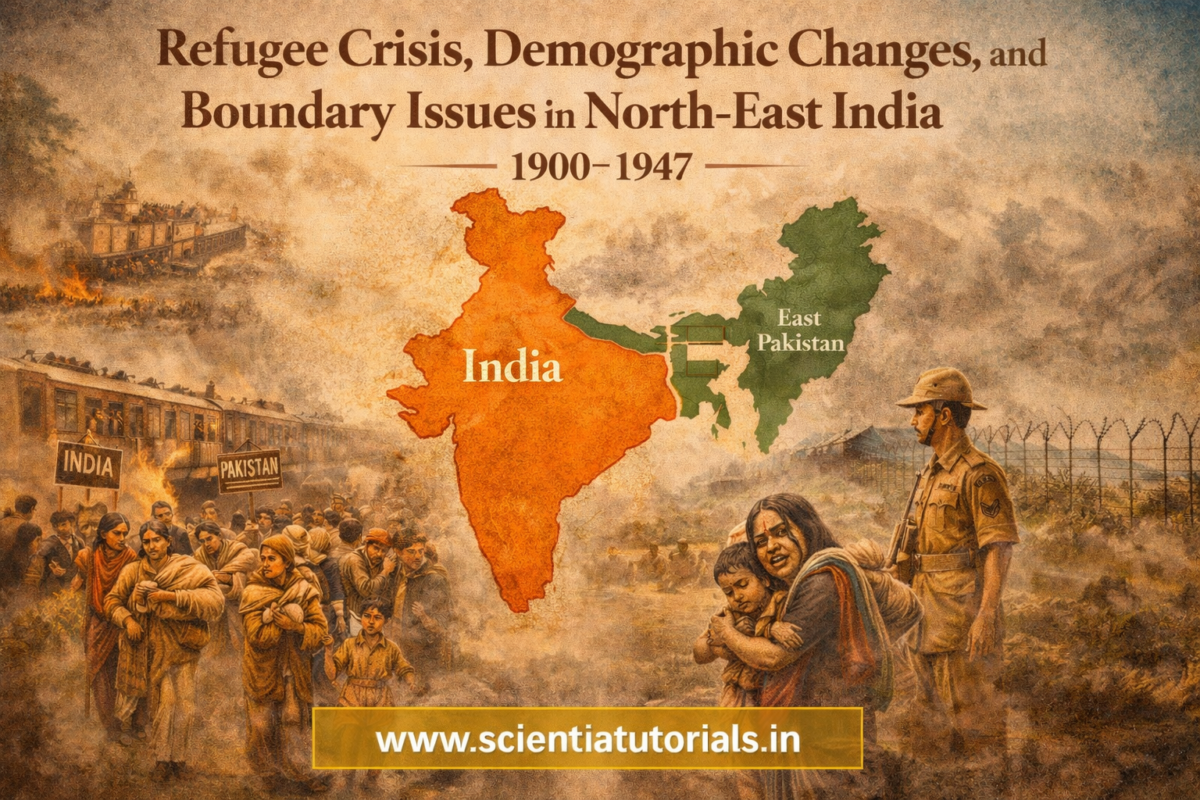

Refugee Crisis, Demographic Changes & Boundary Issues in North-East India (1900–1947)
Course: History of North-East India: From Early Kingdoms to Modern Integration
Module VII: National Movement and Political Awakening
Timeline / Era Covered: 1900 CE – 1947 CE
Lesson: Refugee Crisis, Demographic Changes, and Boundary Issues
This lesson is systematically organized into four clearly structured sections, as detailed below:
- Chronologically Structured Study Module
- Short-Answer Type Questions
- Long-Answer Type Questions
- Multiple-Choice Questions (MCQs) with Answers and Detailed Explanations
Chronologically Structured Study Module
Introduction: A Region Transformed by Migration and Boundaries
The period between 1900 CE and 1947 CE marked one of the most transformative phases in the history of North-East India. While the Indian National Movement provided the overarching political framework, the region experienced a parallel and deeply consequential process shaped by migration, refugee flows, demographic shifts, and boundary reconfigurations.
Unlike many other regions of India, North-East India—especially Assam, Tripura, and adjoining hill areas—was profoundly affected by population movements both before and after 1947. These movements were not sudden or isolated; rather, they evolved gradually under colonial rule and culminated dramatically during the Partition of India.
This lesson examines the refugee crisis, demographic changes, and boundary issues in a chronological and analytical manner, showing how these interconnected processes reshaped society, economy, politics, and identity in North-East India.
I. Background: Colonial Policies and Early Migration (1900–1918)
1. Colonial Economic Expansion and Labour Migration
At the turn of the twentieth century, British colonial expansion in Assam created new economic opportunities that encouraged migration. The development of:
- Tea plantations
- Oil fields
- Railways and river transport
generated a sustained demand for labour. Workers from central India and eastern Bengal were brought into Assam under colonial supervision.
2. Peasant Migration from Eastern Bengal
In addition to labour migration, peasant settlers from eastern Bengal migrated into Assam’s fertile riverine areas. Encouraged by colonial officials, this migration aimed to:
- Increase agricultural revenue
- Bring uncultivated land under the plough
Though economically beneficial in the short term, this policy laid the foundation for long-term demographic transformation.
II. Demographic Changes in Assam during the Early 20th Century
1. Population Growth and Settlement Patterns
Between 1900 and 1930, Assam witnessed rapid population growth due to migration. New settlements emerged in:
- Riverine tracts
- Char (sandbar) areas
- Forest clearings
These changes altered traditional land-use patterns and social relations.
2. Social and Cultural Impact
The demographic changes led to:
- Linguistic and cultural diversity
- Competition over land and resources
- Emerging anxieties among indigenous communities
While coexistence was often peaceful, tensions gradually surfaced, especially during economic stress.
III. Political Responses to Demographic Change (1920s–1930s)
1. Emergence of Identity Consciousness
As migration continued, sections of Assamese society began expressing concern over:
- Cultural dilution
- Political marginalization
- Loss of land
These concerns found expression in literary debates, political organizations, and legislative discussions.
2. Role of Provincial Politics
Under provincial autonomy after the Government of India Act, 1935, demographic questions became central to Assam’s politics. Issues of land settlement, immigration control, and political representation dominated public discourse.
IV. Boundary Issues before Partition
1. Administrative Boundaries under Colonial Rule
Colonial boundaries in North-East India were often drawn for administrative convenience rather than cultural or historical coherence. Assam’s boundaries included plains districts and hill areas with diverse populations.
2. Sylhet and Its Strategic Importance
Sylhet district, though part of Assam, was culturally and economically linked to Bengal. Its Muslim-majority population and location made it central to debates on political future as Partition approached.
V. The Refugee Crisis and Partition (1946–1947)
1. Partition and Mass Displacement
The Partition of India in 1947 triggered one of the largest population movements in world history. While North-East India did not witness the extreme violence seen in Punjab, it experienced continuous and large-scale refugee inflows, especially from East Pakistan.
2. The Sylhet Referendum and Boundary Change
The Sylhet Referendum was conducted to decide Sylhet’s future. The result led to:
- Transfer of most of Sylhet to East Pakistan
- Retention of Karimganj with India
This boundary change directly contributed to refugee movements into Assam and Tripura.
VI. Nature of the Refugee Crisis in North-East India
1. Characteristics of Refugee Movement
Unlike sudden population exchanges elsewhere, refugee movement into North-East India was:
- Gradual and prolonged
- Spread over several years
- Influenced by political uncertainty, communal fear, and economic hardship
Refugees included peasants, artisans, traders, and professionals.
2. Areas Most Affected
- Assam: Faced steady inflow into urban and rural areas
- Tripura: Experienced dramatic demographic transformation
- Barak Valley: Became a major refugee-receiving region
VII. Demographic Transformation after 1947
1. Changes in Population Composition
Refugee inflows significantly altered the demographic profile of several regions. In some areas, migrants became a substantial proportion of the population.
2. Impact on Indigenous Communities
The demographic changes created fears among indigenous and tribal populations regarding:
- Loss of land
- Cultural marginalization
- Political displacement
These fears would later influence movements for autonomy and protection.
VIII. Economic Consequences of Refugee Settlement
1. Pressure on Land and Resources
Refugee settlement increased pressure on:
- Agricultural land
- Forest areas
- Urban infrastructure
Competition for livelihoods intensified, especially in rural Assam.
2. Mixed Economic Outcomes
While refugees contributed labour, skills, and entrepreneurship, the lack of adequate planning resulted in uneven development and social stress.
IX. Boundary Issues and the Creation of International Borders
1. New International Boundaries
Partition transformed internal provincial boundaries into international borders. Assam and other North-Eastern regions now bordered East Pakistan.
2. Administrative and Security Challenges
New borders created challenges such as:
- Border management
- Cross-border movement
- Smuggling and infiltration
The region’s frontier character became more pronounced.
X. Psychological and Cultural Impact
1. Trauma and Displacement
For refugees, displacement involved:
- Loss of homeland
- Economic insecurity
- Cultural dislocation
For host communities, rapid demographic change generated anxiety and resentment.
2. Cultural Reorientation
Partition and migration accelerated debates on identity, language, and belonging in North-East India.
XI. Political Implications of Refugee Crisis and Demographic Change
1. Rise of Identity-Based Politics
Demographic changes contributed to the rise of political movements demanding:
- Protection of indigenous rights
- Regulation of migration
- Safeguards for culture and language
2. Centre–Region Relations
The refugee crisis increased the role of the central government in:
- Rehabilitation
- Security
- Administrative integration
XII. Boundary Issues and Long-Term Regional Instability
1. Legacy of Unresolved Boundaries
Colonial-era boundary decisions and Partition-related changes left behind unresolved issues that later contributed to:
- Territorial disputes
- Insurgency and unrest
- Demands for state reorganization
2. Seeds of Post-Independence Challenges
Many post-1947 challenges—migration debates, identity movements, and demands for autonomy—can be traced back to this period.
XIII. Comparative Perspective: North-East India and the Rest of India
Unlike Punjab and Bengal, North-East India experienced:
- Less immediate violence
- More prolonged refugee settlement
- Deeper long-term demographic impact
This makes the region’s experience unique within the broader history of Partition.
Conclusion: Refugees, Demography, and Boundaries as Forces of Change
Between 1900 and 1947, North-East India underwent profound transformation due to migration, refugee movements, demographic change, and boundary reconfiguration. These processes were not accidental but deeply rooted in colonial economic policies, administrative decisions, and the political logic of Partition.
The refugee crisis reshaped society and economy; demographic changes redefined identity and politics; boundary issues altered the region’s strategic and administrative position. Together, they form a crucial chapter in understanding both the end of colonial rule and the complex post-independence trajectory of North-East India.
🔍 Examination-Oriented Key Takeaways
- Migration began before 1947 under colonial policies
- Partition intensified refugee flows and boundary changes
- Demographic transformation reshaped politics and identity
- Boundary issues increased strategic and administrative challenges
- Many post-independence problems have roots in this period
Short Answer Type Questions
Lesson: Refugee Crisis, Demographic Changes, and Boundary Issues
Module VII: National Movement and Political Awakening (1900–1947 CE)
Q1. What is meant by the refugee crisis in the context of North-East India?
Answer:
It refers to large-scale displacement and settlement of people, mainly from eastern Bengal/East Pakistan, especially around the time of the Partition of India.
Q2. Why did North-East India experience significant migration even before 1947?
Answer:
Colonial economic expansion, availability of cultivable land, and encouragement by British officials promoted labour and peasant migration.
Q3. Which colonial economic activities encouraged migration into Assam?
Answer:
Tea plantations, oil exploration, railway construction, and expansion of agriculture encouraged inward migration.
Q4. From which region did large numbers of peasant migrants come to Assam?
Answer:
Eastern Bengal.
Q5. How did colonial land policies contribute to demographic change in Assam?
Answer:
They encouraged settlement of migrants on uncultivated land, altering population composition and land-use patterns.
Q6. What were “char areas” and why are they important in demographic history?
Answer:
Char areas are riverine sandbars where many migrants settled, playing a key role in population growth and land disputes.
Q7. Mention one social impact of demographic change in early 20th-century Assam.
Answer:
Growing competition over land and resources between indigenous communities and migrants.
Q8. How did demographic change influence political consciousness in Assam?
Answer:
It led to concerns over cultural identity, political representation, and land rights, shaping regional politics.
Q9. What role did provincial autonomy (1935) play in demographic debates?
Answer:
It brought issues of migration, land settlement, and representation into legislative and political discussions.
Q10. Why was Sylhet important in boundary discussions before Partition?
Answer:
Sylhet was economically linked to Bengal, had a Muslim-majority population, and lay at a strategic frontier of Assam.
Q11. What was the Sylhet Referendum?
Answer:
A plebiscite held in 1947 to decide whether Sylhet would remain with Assam (India) or join East Pakistan.
Q12. What was the outcome of the Sylhet Referendum?
Answer:
Most of Sylhet joined East Pakistan, while the Karimganj subdivision remained with India.
Q13. How did Partition intensify the refugee crisis in North-East India?
Answer:
Partition triggered sustained inflows of refugees from East Pakistan due to political uncertainty and communal fear.
Q14. How was the refugee movement in North-East India different from Punjab?
Answer:
It was gradual and prolonged rather than sudden and violent.
Q15. Name two regions of North-East India most affected by refugee settlement.
Answer:
Assam and Tripura.
Q16. What demographic change occurred in Tripura after Partition?
Answer:
Refugees eventually formed a large proportion of the population, drastically altering demographic balance.
Q17. How did refugee settlement affect land and forests?
Answer:
It increased pressure on agricultural land and forest resources, often causing environmental and social stress.
Q18. Mention one economic contribution of refugees to North-East India.
Answer:
They provided skilled labour, entrepreneurship, and contributed to agricultural expansion.
Q19. What new boundary problem emerged after 1947 in North-East India?
Answer:
Internal provincial boundaries became international borders with East Pakistan.
Q20. How did new international borders affect administration?
Answer:
They created challenges related to border security, regulation of movement, and governance.
Q21. What psychological impact did refugee inflow have on host communities?
Answer:
It caused anxiety over identity, land security, and cultural preservation.
Q22. How did demographic change influence identity politics in Assam?
Answer:
It intensified debates on language, culture, citizenship, and political rights.
Q23. Why did boundary issues remain unresolved after independence?
Answer:
Colonial boundaries were drawn for convenience, not cultural or ethnic coherence, leaving disputes unresolved.
Q24. How are post-independence autonomy movements linked to this period?
Answer:
They arose partly from fears of marginalization caused by demographic and boundary changes.
Q25. Why is the refugee crisis a key theme in modern North-East Indian history?
Answer:
Because it reshaped population structure, politics, economy, and identity with long-term consequences.
Long Answer Type Questions
Lesson: Refugee Crisis, Demographic Changes, and Boundary Issues (1900–1947 CE)
Q1. Examine the colonial background that led to large-scale migration into North-East India before 1947.
Answer:
Large-scale migration into North-East India before 1947 was closely linked to colonial economic policies. The British expanded tea plantations, oil fields, railways, and commercial agriculture in Assam, creating demand for labour and cultivators. Colonial officials actively encouraged peasant migration from eastern Bengal to bring uncultivated land under revenue settlement. While this policy boosted agricultural output, it fundamentally altered demographic patterns and laid the groundwork for future social and political tensions.
Q2. Analyze the nature of peasant migration from eastern Bengal into Assam in the early twentieth century.
Answer:
Peasant migration from eastern Bengal was gradual, continuous, and state-facilitated. Migrants settled mainly in riverine and char areas, practicing wet rice cultivation. Initially viewed as economically beneficial, this migration gradually transformed settlement patterns, increased population density, and created competition over land. Over time, it generated anxieties among indigenous communities regarding cultural and political marginalization.
Q3. Discuss the demographic changes witnessed in Assam between 1900 and 1930.
Answer:
Between 1900 and 1930, Assam experienced rapid population growth due to migration rather than natural increase alone. New villages emerged in forest clearings and floodplains, changing traditional land use. The demographic shift increased ethnic, linguistic, and religious diversity. While coexistence was common, growing pressure on land and resources sowed the seeds of later political mobilization around identity and rights.
Q4. How did demographic change influence political consciousness in Assam during the inter-war period?
Answer:
Demographic change sharpened political awareness among Assamese elites and middle classes. Concerns over land alienation, cultural dilution, and electoral marginalization became prominent. These anxieties were expressed through literature, public debates, and legislative discussions. By the 1930s, migration and demographic balance emerged as central political issues within provincial politics.
Q5. Examine the role of colonial administrative boundaries in creating later boundary problems in North-East India.
Answer:
Colonial boundaries in North-East India were drawn for administrative convenience rather than cultural or ethnic coherence. Plains and hill areas with diverse populations were grouped together under Assam. These artificial boundaries ignored local identities and historical linkages. As political consciousness grew, these arrangements became contested, contributing to boundary disputes and demands for reorganization during and after Partition.
Q6. Why was Sylhet central to debates on boundaries and demography before Partition?
Answer:
Sylhet occupied a strategic position within Assam. Economically and culturally linked to Bengal and possessing a Muslim-majority population, Sylhet became central to debates on political future as communal politics intensified. Its demographic composition and location made it a focal point in negotiations leading to Partition.
Q7. Analyze the significance of the Sylhet Referendum in the context of refugee crisis and boundary change.
Answer:
The Sylhet Referendum was a decisive moment for Assam. Held in 1947, it determined whether Sylhet would remain with India or join East Pakistan. The decision to transfer most of Sylhet to Pakistan altered Assam’s boundaries and triggered refugee flows into Assam and Tripura. It symbolized how demographic logic shaped territorial decisions during Partition.
Q8. Discuss the nature of the refugee crisis in North-East India after 1947.
Answer:
The refugee crisis in North-East India differed from the sudden violence of Punjab. Refugee inflows were gradual and prolonged, continuing for years after 1947. Refugees included peasants, artisans, professionals, and traders fleeing political uncertainty, communal fear, and economic insecurity in East Pakistan. This sustained movement placed long-term pressure on local resources and administration.
Q9. Compare the refugee experience of North-East India with that of Punjab.
Answer:
Punjab experienced rapid, violent, and near-total population exchange. In contrast, North-East India saw limited communal violence but prolonged refugee settlement. The impact in the North-East was structural and long-term, affecting demography, land relations, and politics rather than producing immediate humanitarian catastrophe alone.
Q10. Examine the demographic impact of refugee settlement on Tripura.
Answer:
Tripura witnessed one of the most dramatic demographic transformations in India. Refugees from East Pakistan eventually formed a majority of the population. This shift altered land ownership patterns, weakened indigenous political dominance, and reshaped social relations. The demographic change had enduring political and cultural consequences.
Q11. Analyze the economic consequences of refugee settlement in Assam.
Answer:
Refugee settlement increased pressure on agricultural land, forests, and urban infrastructure. While refugees contributed labour, skills, and entrepreneurship, inadequate planning led to competition for resources. Economic benefits were uneven, and social tensions often accompanied economic integration.
Q12. Discuss the impact of refugee influx on indigenous and tribal communities.
Answer:
Indigenous and tribal communities feared loss of land, cultural erosion, and political marginalization due to refugee influx. These anxieties strengthened demands for land protection, autonomy, and constitutional safeguards. The refugee crisis thus influenced later movements for identity and self-rule.
Q13. How did Partition convert internal boundaries into international borders in North-East India?
Answer:
Partition transformed provincial boundaries between Assam and eastern Bengal into international borders with East Pakistan. This sudden change created new administrative, legal, and security challenges, redefining the region’s geopolitical position.
Q14. Examine the administrative and security challenges created by new international borders.
Answer:
New borders required mechanisms for border policing, regulation of movement, and prevention of smuggling. Administrative systems had to adapt to frontier governance. These challenges increased the role of the central government in North-East India.
Q15. Analyze the psychological impact of refugee crisis on both refugees and host communities.
Answer:
Refugees experienced trauma, loss of homeland, and cultural dislocation. Host communities faced anxiety over demographic change, identity, and access to resources. Mutual suspicion sometimes developed, shaping social and political relations in the region.
Q16. Discuss how refugee crisis and demographic change contributed to identity politics in Assam.
Answer:
Demographic transformation intensified debates over language, culture, and citizenship. Political movements increasingly focused on protecting indigenous identity and regulating migration. Identity politics thus became a defining feature of Assam’s post-colonial political landscape.
Q17. Examine the relationship between boundary issues and post-independence instability in North-East India.
Answer:
Unresolved colonial boundaries and Partition-era changes contributed to disputes, demands for reorganization, and insurgent movements. Boundary issues became intertwined with ethnic identity and political autonomy claims.
Q18. How did the refugee crisis influence centre–region relations in independent India?
Answer:
The scale of displacement and strategic sensitivity of borders increased central intervention in administration, rehabilitation, and security. This shaped a pattern of strong centre–region interaction in North-East India.
Q19. Assess the role of colonial migration policies in creating long-term demographic challenges.
Answer:
Colonial encouragement of migration for economic gain ignored social consequences. These policies created demographic imbalances that later became politically sensitive. The long-term challenges of integration and identity can be traced back to these colonial decisions.
Q20. Critically analyze the argument that demographic change was inevitable in colonial Assam.
Answer:
While economic expansion made migration likely, its scale and management were shaped by colonial policy choices. Alternative land and settlement strategies might have reduced later conflict. Thus, demographic change was not entirely inevitable but policy-driven.
Q21. Evaluate the long-term historical significance of refugee crisis in North-East India.
Answer:
The refugee crisis reshaped society, economy, and politics in lasting ways. It influenced identity movements, land relations, and governance structures. Understanding this crisis is essential to explaining many contemporary issues in the region.
Q22. Conclude by assessing refugee crisis, demographic change, and boundary issues as interconnected historical processes.
Answer:
Refugee crisis, demographic change, and boundary issues were deeply interconnected outcomes of colonial rule and Partition. Together, they transformed North-East India’s historical trajectory, linking the end of colonialism to enduring challenges of integration, identity, and stability.
MCQs with Answers and Explanations
Lesson: Refugee Crisis, Demographic Changes, and Boundary Issues (1900–1947 CE)
Q1. Migration into Assam in the early 20th century was primarily encouraged by the British to:
A. Promote cultural integration
B. Increase agricultural revenue
C. Reduce population pressure in Bengal
D. Support nationalist politics
Correct Answer: B
Explanation:
Colonial officials encouraged settlement of migrants on uncultivated land to expand cultivation and enhance land revenue.
Q2. Which economic sector most strongly encouraged labour migration into Assam under colonial rule?
A. Handloom industry
B. Tea plantations
C. Shipbuilding
D. Mining of coal only
Correct Answer: B
Explanation:
Tea plantations required large numbers of labourers, leading to organized migration into Assam.
Q3. Peasant migration into Assam before 1947 largely originated from:
A. Central Provinces
B. Punjab
C. Eastern Bengal
D. Burma
Correct Answer: C
Explanation:
Large numbers of peasants migrated from eastern Bengal to Assam’s fertile riverine tracts.
Q4. The term “char areas” refers to:
A. Forest reserves
B. Hill tracts
C. Riverine sandbars
D. Urban settlements
Correct Answer: C
Explanation:
Char areas are sandbars formed by rivers, which became important sites of migrant settlement.
Q5. One major social consequence of early demographic change in Assam was:
A. Decline of agriculture
B. Reduced cultural diversity
C. Increased competition over land
D. Immediate communal violence
Correct Answer: C
Explanation:
Population growth and settlement intensified competition over land and resources.
Q6. Why did demographic change become a political issue in Assam by the 1930s?
A. It reduced literacy
B. It threatened cultural and political representation
C. It ended colonial rule
D. It caused industrial decline
Correct Answer: B
Explanation:
Concerns over identity, land rights, and electoral marginalization made demography politically sensitive.
Q7. Which Act allowed provincial governments to debate migration and land issues more openly?
A. Indian Councils Act, 1909
B. Government of India Act, 1919
C. Government of India Act, 1935
D. Indian Independence Act, 1947
Correct Answer: C
Explanation:
The 1935 Act introduced provincial autonomy, bringing demographic issues into legislative politics.
Q8. Sylhet was significant in boundary debates because it:
A. Was Assam’s capital
B. Had major tea plantations
C. Was culturally and economically linked to Bengal
D. Had no migrant population
Correct Answer: C
Explanation:
Sylhet’s location, economy, and Muslim-majority population made it central to Partition discussions.
Q9. The 1947 plebiscite that decided Sylhet’s future is known as the:
A. Bengal Resolution
B. Assam Accord
C. Sylhet Referendum
D. Radcliffe Award
Correct Answer: C
Explanation:
The Sylhet Referendum determined whether the district would remain with India or join East Pakistan.
Q10. The immediate outcome of the Sylhet Referendum was that:
A. Sylhet remained entirely with India
B. Sylhet became an autonomous region
C. Most of Sylhet joined East Pakistan
D. Sylhet was divided equally
Correct Answer: C
Explanation:
A majority voted to join East Pakistan; only Karimganj subdivision remained with India.
Q11. The refugee movement into North-East India after 1947 was mainly:
A. Sudden and violent
B. Short-lived
C. Gradual and prolonged
D. Entirely voluntary
Correct Answer: C
Explanation:
Unlike Punjab, refugee inflow into North-East India continued gradually over several years.
Q12. Which region of North-East India experienced the most dramatic demographic transformation due to refugees?
A. Manipur
B. Nagaland
C. Tripura
D. Mizoram
Correct Answer: C
Explanation:
Refugees eventually formed a large majority in Tripura, altering its demographic balance.
Q13. One major economic effect of refugee settlement was:
A. Decline in skilled labour
B. Reduced agricultural activity
C. Increased pressure on land and forests
D. Immediate industrial growth
Correct Answer: C
Explanation:
Settlement strained land, forest resources, and infrastructure, especially in rural areas.
Q14. Despite challenges, refugees also contributed positively by:
A. Ending colonial administration
B. Providing labour and entrepreneurial skills
C. Reducing population growth
D. Eliminating land disputes
Correct Answer: B
Explanation:
Refugees added labour, skills, and enterprise to the regional economy.
Q15. Partition transformed which type of boundaries into international borders in North-East India?
A. Village boundaries
B. District boundaries
C. Provincial boundaries
D. Municipal boundaries
Correct Answer: C
Explanation:
Internal provincial boundaries with eastern Bengal became international borders with East Pakistan.
Q16. One major administrative challenge after new borders emerged was:
A. Electoral reform
B. Border management and security
C. Educational expansion
D. Industrial planning
Correct Answer: B
Explanation:
International borders required new systems of policing, regulation, and surveillance.
Q17. How did refugee inflow affect indigenous and tribal communities?
A. It strengthened their political dominance
B. It caused fears of land and cultural loss
C. It ended autonomy demands
D. It reduced identity concerns
Correct Answer: B
Explanation:
Demographic change raised anxieties about marginalization and loss of customary rights.
Q18. The psychological impact of refugee influx on host communities included:
A. Complete acceptance
B. Indifference
C. Anxiety over identity and resources
D. Decline in political awareness
Correct Answer: C
Explanation:
Rapid population change generated insecurity regarding land, culture, and political influence.
Q19. Boundary issues in North-East India remained unresolved mainly because:
A. Boundaries were based on cultural unity
B. Colonial boundaries ignored ethnic realities
C. Refugees opposed borders
D. Boundaries were frequently redrawn after 1947
Correct Answer: B
Explanation:
Colonial administrative boundaries often disregarded cultural and ethnic coherence.
Q20. Refugee crisis and demographic change contributed directly to:
A. Decline of nationalism
B. Identity-based political movements
C. Complete social harmony
D. Abolition of tribal institutions
Correct Answer: B
Explanation:
Identity politics emerged as communities sought protection of culture, land, and rights.
Q21. Which factor most clearly links refugee crisis with later autonomy movements?
A. Industrial decline
B. Demographic anxiety and marginalization fears
C. Foreign policy disputes
D. Educational reforms
Correct Answer: B
Explanation:
Perceived marginalization due to demographic change fueled demands for autonomy and safeguards.
Q22. The refugee crisis increased the role of the central government mainly in:
A. Cultural affairs
B. Sports and youth programs
C. Rehabilitation, security, and administration
D. Agricultural marketing
Correct Answer: C
Explanation:
Large-scale displacement and border sensitivity required central intervention.
Q23. Compared to Punjab, North-East India’s refugee experience was:
A. More violent
B. Less significant
C. More prolonged and structural
D. Entirely urban
Correct Answer: C
Explanation:
Its impact unfolded slowly but reshaped demography, politics, and economy in lasting ways.
Q24. The long-term historical significance of demographic change in North-East India lies in its role in:
A. Ending colonialism
B. Shaping post-independence politics
C. Promoting industrialization
D. Eliminating migration
Correct Answer: B
Explanation:
Demographic shifts influenced identity politics, governance, and centre–region relations after independence.
Q25. Overall, refugee crisis, demographic change, and boundary issues in North-East India can best be described as:
A. Isolated wartime problems
B. Temporary colonial disruptions
C. Interconnected forces reshaping regional history
D. Minor administrative adjustments
Correct Answer: C
Explanation:
These processes were interlinked outcomes of colonial rule and Partition, shaping the region’s modern trajectory.