
Tribal Responses to Colonial Rule
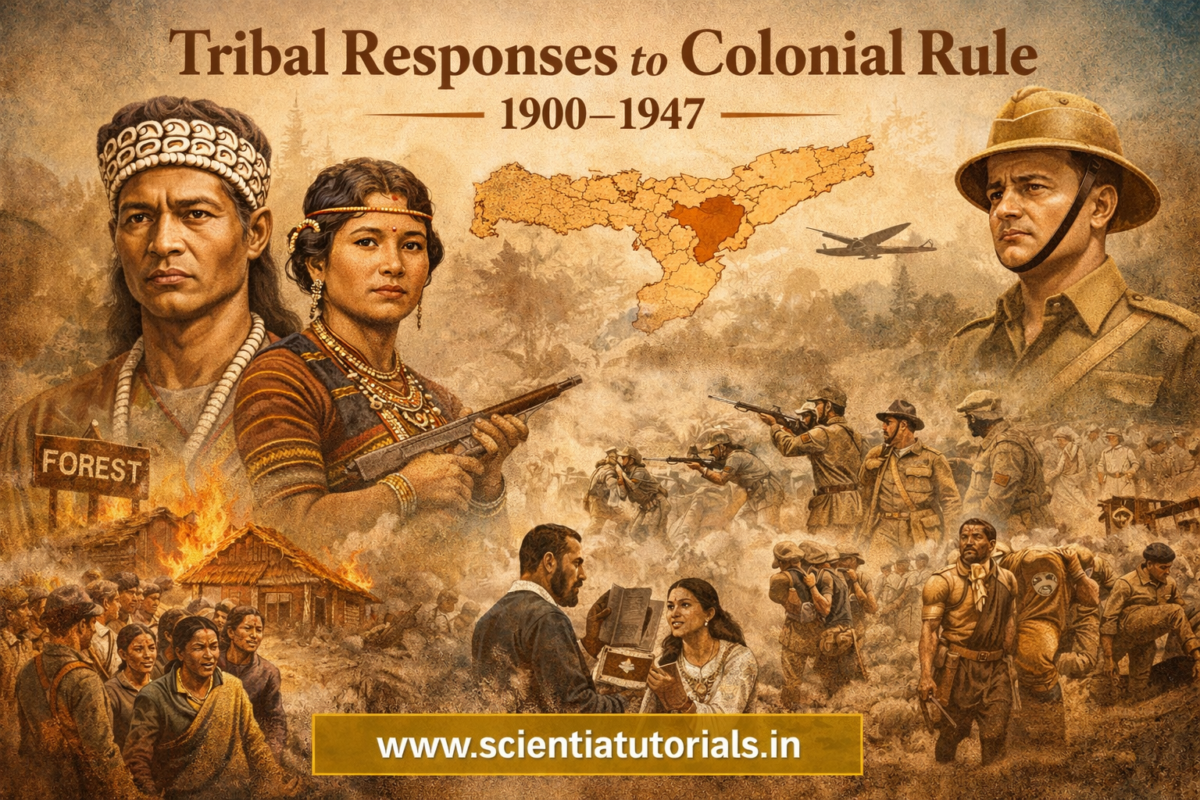

Tribal Responses to Colonial Rule (1900–1947) | North-East India History
Course: History of North-East India: From Early Kingdoms to Modern Integration
Module VII: National Movement and Political Awakening
Timeline / Era Covered: 1900 CE – 1947 CE
Lesson: Tribal Responses to Colonial Rule
This lesson is systematically organized into four clearly structured sections, as detailed below:
- Chronologically Structured Study Module
- Short-Answer Type Questions
- Long-Answer Type Questions
- Multiple-Choice Questions (MCQs) with Answers and Detailed Explanations
Chronologically Structured Study Module
Introduction: Tribes and Colonialism in North-East India
The experience of colonial rule in North-East India differed significantly from that of the Indian plains. The region was home to a vast number of tribal communities with distinct social systems, customary laws, landholding patterns, and cultural traditions. British expansion into these frontier regions during the nineteenth century brought radical changes that deeply affected tribal life.
Between 1900 CE and 1947 CE, tribal responses to colonial rule formed a crucial yet often underrepresented dimension of the Indian National Movement. Unlike mainstream nationalist politics led largely by educated elites, tribal resistance emerged from direct encounters with colonial exploitation, particularly in the form of land alienation, forest regulations, forced labour, missionary intervention, and administrative intrusion into traditional authority structures.
This lesson examines tribal responses chronologically, highlighting how tribal resistance evolved from localized uprisings to movements that gradually intersected with wider nationalist currents.
I. Nature of Colonial Intervention in Tribal Areas
1. Administrative Penetration
The British initially followed a policy of limited interference in tribal regions. However, by the late nineteenth century, administrative penetration intensified through:
- Introduction of formal revenue systems
- Establishment of police posts and courts
- Replacement of customary chiefs with colonial officials
This disrupted indigenous governance and weakened traditional institutions.
2. Forest Laws and Land Alienation
Colonial forest policies declared vast tracts of tribal land as Reserved and Protected Forests, restricting shifting cultivation, hunting, and collection of forest produce. Tribal communities were often reduced to tenants or labourers on their own ancestral lands.
3. Missionary Activities and Cultural Change
Christian missionaries introduced education and healthcare but also challenged traditional belief systems. While some tribes adopted new religious identities, others perceived missionary activity as a threat to cultural autonomy.
II. Early Tribal Resistance before 1900: Background and Legacy
Although this lesson focuses on 1900–1947, earlier tribal uprisings shaped later resistance movements. Revolts such as the Kuki uprisings and Naga resistance in the nineteenth century established a tradition of armed defiance.
These early struggles left behind:
- Collective memory of resistance
- Leadership traditions
- Suspicion of external authority
This legacy influenced tribal responses in the twentieth century.
III. Tribal Resistance in the Early 20th Century (1900–1918)
1. Localized and Defensive Nature
In the early twentieth century, tribal resistance remained localized and defensive, aimed at protecting land, customary rights, and social practices rather than overthrowing colonial rule.
Common features included:
- Attacks on colonial officials
- Refusal to pay taxes or perform forced labour
- Desertion of villages to avoid state control
These movements lacked centralized organization but demonstrated strong community solidarity.
2. Limited Interaction with Mainstream Nationalism
During this phase, tribal movements operated largely independent of the Indian National Congress. Geographic isolation, linguistic diversity, and different socio-economic realities limited interaction with urban nationalist politics.
IV. Impact of World War I on Tribal Regions
World War I intensified colonial exploitation in tribal areas. Recruitment drives, forced labour for road construction, and increased taxation created widespread resentment.
Consequences:
- Heightened economic distress
- Greater exposure to colonial reminders of global politics
- Emergence of new leaders with broader political awareness
The war acted as a catalyst for more organized tribal movements in the inter-war period.
V. Inter-War Period (1919–1939): Organized Tribal Movements
The inter-war years marked a turning point as tribal resistance became more structured and ideological.
A. The Zeliangrong Movement
One of the most significant tribal movements in North-East India during this period was the Zeliangrong movement among the Zeme, Liangmai, and Rongmei tribes.
Leadership and Ideology
The movement initially emerged under Jadonang, a charismatic spiritual leader who combined religious reform with political resistance. He opposed British authority, missionary influence, and forced labour.
After his execution by the British in 1931, leadership passed to Rani Gaidinliu, who transformed the movement into a powerful symbol of tribal resistance.
Objectives
- Restoration of traditional religious practices
- Rejection of colonial administration
- Establishment of self-rule (Naga Raj)
Significance
The movement demonstrated how tribal resistance could blend religious revivalism with political aspirations, challenging colonial authority in innovative ways.
B. Kuki Resistance and Political Assertion
The Kukis, who had earlier revolted against British policies, continued to resist colonial authority through non-cooperation, desertion, and sporadic violence. Their opposition was rooted in land dispossession and erosion of chieftainship.
VI. Tribal Responses to Gandhian Movements
1. Non-Cooperation and Civil Disobedience
Mainstream nationalist movements such as Non-Cooperation and Civil Disobedience had limited direct impact on most tribal areas. However, indirect influences were visible:
- Spread of anti-colonial sentiment
- Adoption of boycott practices
- Emergence of tribal leaders sympathetic to Congress ideals
The Congress increasingly recognized the importance of tribal participation, though communication gaps remained.
2. Congress Tribal Policy
The Indian National Congress attempted to address tribal issues through:
- Advocacy of land rights
- Opposition to forced labour
- Promotion of cultural autonomy
While these efforts improved dialogue, many tribes remained cautious due to fears of domination by plains-based elites.
VII. Government of India Act, 1935 and Tribal Administration
The Government of India Act, 1935 introduced provincial autonomy and reinforced the concept of “Excluded” and “Partially Excluded Areas” for tribal regions.
Impact on Tribal Communities
- Limited political representation
- Continued administrative control by colonial officials
- Protection of tribal customs, but isolation from democratic processes
While intended as a safeguard, this policy also kept tribal areas politically marginal.
VIII. World War II and Tribal Regions
World War II deeply affected tribal areas of North-East India, especially due to their strategic location.
Effects
- Military occupation and infrastructure development
- Forced labour and requisitioning
- Exposure to new political ideas through soldiers and war propaganda
The war weakened colonial authority and strengthened tribal demands for autonomy and dignity.
IX. Quit India Movement (1942) and Tribal Participation
The Quit India Movement marked the peak of anti-colonial resistance across India. Tribal participation varied across regions.
Forms of Participation
- Disruption of communication lines
- Support to underground activists
- Local rebellions against colonial officials
Although not always coordinated with Congress leadership, tribal actions reflected a shared desire to end colonial rule.
X. Tribal Identity, Autonomy, and the End of Colonial Rule
1. Emergence of Political Consciousness
By the 1940s, tribal movements increasingly articulated political demands:
- Protection of land and forests
- Recognition of customary laws
- Autonomy within or alongside the Indian nation
2. Debates on Integration vs. Autonomy
As independence approached, tribal leaders debated their future:
- Some supported integration with India
- Others sought autonomous or separate administrative arrangements
These debates shaped post-colonial policies in North-East India.
XI. Role of Tribal Movements in the Freedom Struggle: An Assessment
Tribal responses to colonial rule were not peripheral but integral to India’s freedom struggle.
Key Characteristics
- Rooted in socio-economic grievances
- Often religious and cultural in expression
- Community-based rather than elite-led
Historical Importance
- Challenged colonial authority in frontier regions
- Preserved indigenous identity under imperial pressure
- Expanded the meaning of nationalism beyond urban centers
Conclusion: Tribal Resistance and the Making of Modern North-East India
Between 1900 and 1947, tribal responses to colonial rule in North-East India evolved from localized resistance to politically conscious movements that engaged with the broader anti-colonial struggle. Though different in form and ideology from mainstream nationalism, tribal movements shared a common objective—the defense of dignity, autonomy, and freedom.
Their experiences underline the plural nature of the Indian National Movement, reminding us that independence was not achieved solely through urban politics but also through the sacrifices and struggles of tribal communities guarding their land, culture, and way of life.
Short Answer Type Questions
Lesson: Tribal Responses to Colonial Rule
Module VII: National Movement and Political Awakening (1900–1947 CE)
Q1. What is meant by “tribal responses to colonial rule”?
Answer:
It refers to the ways tribal communities resisted, adapted to, or negotiated British colonial policies affecting land, forests, and culture.
Q2. Why did colonial rule affect tribal societies differently from plains societies?
Answer:
Because tribal societies depended on customary land rights, forest resources, and autonomous governance, which colonial policies directly disrupted.
Q3. Name two colonial policies that deeply affected tribal life.
Answer:
Forest laws and land revenue systems.
Q4. What was the British policy towards tribal areas in the early colonial period?
Answer:
Initial non-interference, followed later by administrative penetration and control.
Q5. How did forest laws impact tribal communities?
Answer:
They restricted shifting cultivation, hunting, and forest use, leading to loss of livelihood and autonomy.
Q6. Why did tribal resistance in the early 20th century remain localized?
Answer:
Due to geographical isolation, lack of centralized leadership, and limited communication with nationalist organizations.
Q7. What role did customary chiefs play in tribal resistance?
Answer:
They acted as traditional leaders defending tribal autonomy and land rights against colonial intrusion.
Q8. How did World War I affect tribal regions of North-East India?
Answer:
It increased forced labour, taxation, and recruitment, intensifying resentment against colonial rule.
Q9. What was the Zeliangrong movement?
Answer:
A tribal movement combining religious revival and political resistance against British rule among the Zeliangrong tribes.
Q10. Who was Jadonang?
Answer:
A spiritual and political leader who initiated the Zeliangrong movement against colonial rule and missionary influence.
Q11. Why was Jadonang executed by the British?
Answer:
Because he was seen as a threat to colonial authority and accused of inciting rebellion.
Q12. Who succeeded Jadonang as leader of the Zeliangrong movement?
Answer:
Rani Gaidinliu.
Q13. What were the main objectives of the Zeliangrong movement?
Answer:
Revival of traditional religion, rejection of British authority, and establishment of self-rule.
Q14. How did Rani Gaidinliu contribute to tribal resistance?
Answer:
She organized armed resistance, mobilized tribal unity, and opposed colonial administration.
Q15. Why did Gandhian movements have limited impact on tribal areas?
Answer:
Due to cultural differences, isolation, and focus of tribal movements on local grievances rather than all-India politics.
Q16. What was the Congress policy towards tribal areas?
Answer:
Protection of tribal land, respect for culture, and opposition to forced labour and exploitation.
Q17. What were “Excluded and Partially Excluded Areas”?
Answer:
Tribal regions kept outside normal provincial administration under the Government of India Act, 1935.
Q18. How did the Government of India Act, 1935 affect tribal administration?
Answer:
It preserved tribal customs but limited political representation and democratic participation.
Q19. How did World War II intensify tribal discontent?
Answer:
Through military occupation, forced labour, and requisitioning of resources.
Q20. In what ways did tribal communities respond to the Quit India Movement?
Answer:
By disrupting communication, aiding underground activists, and resisting colonial officials.
Q21. Why did tribal movements often combine religion and politics?
Answer:
Religion provided a unifying force and legitimacy for resistance against colonial domination.
Q22. What was the primary aim of tribal resistance movements?
Answer:
Protection of land, culture, and traditional autonomy rather than direct political power.
Q23. How did tribal resistance contribute to the Indian National Movement?
Answer:
By challenging colonial authority in frontier regions and expanding the scope of anti-colonial struggle.
Q24. What dilemma did tribal leaders face at the time of independence?
Answer:
Whether to integrate with India or seek autonomous administrative arrangements.
Q25. Mention one long-term impact of tribal resistance on post-independence India.
Answer:
It influenced policies on tribal autonomy, scheduled areas, and protection of indigenous rights.
Long Answer Type Questions
Lesson: Tribal Responses to Colonial Rule (1900–1947 CE)
Q1. Examine the nature of colonial intervention in tribal areas of North-East India.
Answer:
Colonial intervention in tribal areas of North-East India was fundamentally disruptive. Initially, the British followed a policy of non-interference, but by the late nineteenth and early twentieth centuries, they expanded administrative control through revenue settlements, forest laws, police posts, and courts. These measures undermined customary land ownership, restricted shifting cultivation, and weakened traditional institutions such as village councils and chieftainship. The imposition of alien administrative systems generated widespread resentment and became the root cause of tribal resistance during the colonial period.
Q2. Why did tribal societies respond differently to colonial rule compared to plains societies?
Answer:
Tribal societies were organized around kinship, customary law, and community ownership of land and forests. Colonial rule threatened these foundations through individual land rights, commercial exploitation of forests, and external governance. Unlike plains societies, tribal communities had limited exposure to Western education and nationalist politics. Consequently, their resistance was often localized, cultural, and defensive rather than ideologically nationalist, focusing on protecting autonomy rather than capturing state power.
Q3. Analyze the role of forest laws in shaping tribal resistance movements.
Answer:
Forest laws were among the most oppressive colonial policies for tribal communities. By declaring forests as state property, the British restricted access to resources essential for tribal livelihoods. Shifting cultivation, hunting, and collection of forest produce were criminalized. These policies not only caused economic distress but also symbolized loss of freedom. Resistance to forest laws became a central reminder of colonial exploitation and contributed significantly to repeated tribal uprisings.
Q4. Discuss the legacy of pre-1900 tribal uprisings in shaping twentieth-century resistance.
Answer:
Earlier uprisings created a tradition of resistance that deeply influenced twentieth-century tribal movements. These struggles preserved collective memories of defiance, heroism, and sacrifice. Leadership patterns, community mobilization methods, and distrust of external authority continued into the twentieth century. Thus, later tribal movements were not spontaneous but rooted in a long history of resistance to intrusion and domination.
Q5. Describe the characteristics of early twentieth-century tribal resistance (1900–1918).
Answer:
Early twentieth-century tribal resistance was largely localized, spontaneous, and defensive. Movements focused on protecting land, forests, and customary practices rather than overthrowing colonial rule. Tactics included refusal to pay taxes, desertion of villages, attacks on colonial symbols, and passive non-cooperation. Lack of centralized leadership and communication limited their scale, but they demonstrated strong community solidarity.
Q6. Examine the impact of World War I on tribal regions of North-East India.
Answer:
World War I intensified colonial exploitation in tribal areas through forced labour, recruitment drives, and increased taxation. Tribal communities were compelled to construct roads and supply materials for military use. These pressures worsened economic hardship and exposed tribes to the realities of imperial power. The war acted as a catalyst, transforming scattered resistance into more organized movements in the inter-war period.
Q7. Analyze the causes and objectives of the Zeliangrong movement.
Answer:
The Zeliangrong movement arose from opposition to British administration, missionary influence, and economic exploitation. Its objectives included revival of indigenous religious practices, rejection of forced labour, and establishment of self-rule. The movement combined spiritual reform with political resistance, making it distinct from purely secular nationalist movements.
Q8. Evaluate the leadership and contribution of Jadonang.
Answer:
Jadonang emerged as a charismatic spiritual and political leader who mobilized tribal resistance through religious revivalism. He preached the restoration of traditional faith and foretold the end of British rule. His leadership unified dispersed tribal groups and challenged both colonial authority and missionary dominance. His execution in 1931 transformed him into a martyr and intensified resistance.
Q9. Assess the role of Rani Gaidinliu in continuing tribal resistance.
Answer:
Rani Gaidinliu assumed leadership at a young age and transformed the movement into a powerful symbol of anti-colonial struggle. She organized armed resistance, mobilized tribal unity, and upheld cultural autonomy. Her arrest and long imprisonment reflected colonial anxiety over tribal mobilization and later earned her recognition as a freedom fighter.
Q10. Compare tribal movements with mainstream nationalist movements in India.
Answer:
Tribal movements were primarily anti-exploitation and cultural in nature, while mainstream nationalism focused on political sovereignty. Tribal resistance emphasized land, forests, and autonomy, whereas nationalist movements emphasized constitutional reforms and mass politics. Despite differences, both shared opposition to colonial rule and contributed to its eventual collapse.
Q11. Why did Gandhian movements have limited direct influence in tribal areas?
Answer:
Gandhian movements relied on mass political consciousness, print culture, and urban networks, which were limited in tribal regions. Cultural differences, geographical isolation, and focus on local grievances reduced direct participation. However, Gandhian ideas indirectly reminded tribes that British authority was neither permanent nor invincible.
Q12. Examine the Indian National Congress’s approach to tribal issues.
Answer:
The Congress gradually recognized tribal grievances and advocated protection of land, culture, and customary rights. It opposed forced labour and excessive forest controls. However, tribal leaders often remained cautious, fearing domination by plains-based elites. This created a relationship marked by dialogue but also mutual suspicion.
Q13. Analyze the impact of the Government of India Act, 1935 on tribal administration.
Answer:
The Act classified many tribal areas as Excluded or Partially Excluded Areas. While this protected tribal customs from provincial interference, it also limited political participation and democratic rights. Tribal regions remained under bureaucratic control, reinforcing political marginalization even as nationalist politics expanded elsewhere.
Q14. Discuss the effects of World War II on tribal societies.
Answer:
World War II militarized large parts of North-East India. Tribal areas witnessed forced labour, requisitioning of food, and displacement. Military presence disrupted traditional life but also exposed tribes to new political ideas. The weakening of British authority during the war emboldened tribal demands for autonomy and dignity.
Q15. Evaluate tribal participation in the Quit India Movement.
Answer:
Tribal participation in Quit India varied regionally. In some areas, tribes disrupted communication lines, attacked colonial installations, and supported underground activists. Although not always coordinated with Congress leadership, these actions reflected a shared desire to end colonial domination.
Q16. Examine the role of religion in tribal resistance movements.
Answer:
Religion served as a unifying force, legitimizing resistance and preserving cultural identity. Religious revivalism strengthened community cohesion and challenged missionary influence. By blending faith with politics, tribal leaders mobilized mass support in societies where spiritual authority carried deep significance.
Q17. Discuss the relationship between tribal identity and political consciousness during the freedom struggle.
Answer:
Colonial intrusion heightened awareness of tribal identity as something under threat. Resistance movements transformed cultural identity into political consciousness. By the 1940s, tribes increasingly articulated political demands for rights, autonomy, and recognition within the emerging nation-state.
Q18. Analyze debates on integration versus autonomy among tribal leaders at independence.
Answer:
As independence approached, tribal leaders debated whether to integrate with India or seek autonomous arrangements. Some feared cultural assimilation, while others believed constitutional safeguards could protect tribal interests. These debates shaped post-independence policies on Scheduled Areas and autonomy.
Q19. Assess the overall contribution of tribal movements to the Indian freedom struggle.
Answer:
Tribal movements challenged colonial authority in frontier regions, expanded the geographical and social scope of resistance, and preserved indigenous dignity. Though different from mainstream nationalism, they were integral to the weakening of imperial control and enriched the plural character of India’s freedom struggle.
Q20. Critically evaluate the historical significance of tribal responses to colonial rule.
Answer:
Tribal responses reveal that India’s freedom struggle was not monolithic but diverse. These movements highlighted issues of land, culture, and autonomy often ignored in elite politics. Their legacy influenced post-colonial governance, constitutional safeguards, and debates on federalism and identity in North-East India.
MCQs with Answers and Explanations
Lesson: Tribal Responses to Colonial Rule (1900–1947 CE)
Q1. Colonial rule affected tribal societies more severely because they were primarily dependent on:
A. Trade and commerce
B. Industrial employment
C. Customary land and forest resources
D. Urban administration
Correct Answer: C
Explanation:
Tribal societies relied on collective land ownership, forests, and shifting cultivation. Colonial forest laws and land settlements directly undermined these foundations, causing severe disruption.
Q2. Which colonial policy most directly restricted tribal livelihood practices?
A. Permanent Settlement
B. Forest Acts
C. Subsidiary Alliance
D. Ryotwari System
Correct Answer: B
Explanation:
Forest Acts declared large tracts as state property, criminalizing shifting cultivation, hunting, and forest produce collection—core tribal livelihood activities.
Q3. Early tribal resistance movements were generally characterized by:
A. Centralized leadership
B. Ideological nationalism
C. Localized and defensive actions
D. Urban mass participation
Correct Answer: C
Explanation:
Tribal resistance aimed at defending land, culture, and autonomy rather than overthrowing colonial rule at a national level.
Q4. Why did early 20th-century tribal movements remain largely isolated from mainstream nationalism?
A. Lack of interest in politics
B. Linguistic and cultural differences
C. British support for tribal leaders
D. Strong industrial base
Correct Answer: B
Explanation:
Geographical isolation, linguistic diversity, and different socio-economic concerns limited interaction with Congress-led nationalism.
Q5. Which factor intensified tribal resentment during World War I?
A. Expansion of railways
B. Forced labour and recruitment
C. Spread of nationalism
D. Reduction in taxation
Correct Answer: B
Explanation:
War-time demands for labour, supplies, and recruitment placed heavy burdens on tribal communities, intensifying resistance.
Q6. The Zeliangrong movement was primarily a response to:
A. Zamindari exploitation
B. British administration and missionary influence
C. Industrial labour conditions
D. Communal tensions
Correct Answer: B
Explanation:
The movement opposed colonial authority, forced labour, and missionary interference in tribal religious life.
Q7. The Zeliangrong movement was initially led by:
A. Subhas Chandra Bose
B. Rani Gaidinliu
C. Jadonang
D. Gopinath Bordoloi
Correct Answer: C
Explanation:
Jadonang combined religious revivalism with political resistance and emerged as a charismatic leader among the Zeliangrong tribes.
Q8. Why did the British execute Jadonang in 1931?
A. For opposing taxation
B. For leading armed rebellion
C. For promoting revolutionary nationalism
D. For threatening colonial authority through mass mobilization
Correct Answer: D
Explanation:
The British perceived Jadonang’s spiritual-political leadership as a serious threat to colonial control.
Q9. After Jadonang’s execution, leadership of the Zeliangrong movement passed to:
A. Jawaharlal Nehru
B. Rani Gaidinliu
C. Ambikagiri Raichoudhury
D. Tarun Ram Phukan
Correct Answer: B
Explanation:
Rani Gaidinliu reorganized the movement and became a symbol of tribal resistance and anti-colonial struggle.
Q10. A distinctive feature of many tribal movements was the blending of:
A. Capitalism and socialism
B. Religion and politics
C. Urban and rural interests
D. Violence and constitutionalism
Correct Answer: B
Explanation:
Religious revivalism provided unity, legitimacy, and motivation for resistance in tribal societies.
Q11. The primary objective of most tribal resistance movements was to:
A. Capture political power
B. Establish a modern state
C. Protect land and cultural autonomy
D. Support the British administration
Correct Answer: C
Explanation:
Tribal resistance focused on safeguarding customary rights, land, forests, and traditional governance systems.
Q12. Which Act classified many tribal regions as “Excluded” or “Partially Excluded Areas”?
A. Indian Councils Act, 1909
B. Government of India Act, 1919
C. Government of India Act, 1935
D. Indian Independence Act, 1947
Correct Answer: C
Explanation:
The 1935 Act aimed to protect tribal customs but also limited political participation by keeping areas under bureaucratic control.
Q13. One major consequence of the “Excluded Areas” policy was:
A. Full democratic representation
B. Greater industrial development
C. Political marginalization of tribes
D. Immediate self-rule
Correct Answer: C
Explanation:
While customs were protected, tribes remained outside democratic processes, reinforcing marginalization.
Q14. Gandhian movements had limited direct impact on tribal areas mainly due to:
A. British suppression
B. Focus on industrial workers
C. Cultural and geographical distance
D. Tribal support for colonial rule
Correct Answer: C
Explanation:
Gandhian methods relied on mass political communication, which was less effective in isolated tribal regions.
Q15. How did tribal communities participate in the Quit India Movement (1942)?
A. Through constitutional petitions
B. By supporting British war efforts
C. Through localized resistance and sabotage
D. By joining legislative councils
Correct Answer: C
Explanation:
Tribal participation included disrupting communication lines and resisting colonial officials, often independently of Congress leadership.
Q16. Which factor transformed tribal identity into political consciousness during the freedom struggle?
A. Missionary education
B. Industrialization
C. Colonial intrusion into land and culture
D. Electoral reforms
Correct Answer: C
Explanation:
Colonial interference heightened awareness of identity under threat, turning cultural defense into political action.
Q17. During World War II, tribal regions gained political awareness mainly due to:
A. Isolation from war
B. Military presence and requisitioning
C. Decline in taxation
D. Spread of urban nationalism
Correct Answer: B
Explanation:
Military occupation exposed tribes to global politics and weakened colonial authority.
Q18. Tribal movements differed from mainstream nationalism primarily because they were:
A. Violent in nature
B. Based on ethnic separatism
C. Rooted in socio-economic and cultural grievances
D. Led by industrial workers
Correct Answer: C
Explanation:
Tribal movements emphasized land, forests, and autonomy rather than constitutional or electoral politics.
Q19. Which of the following best describes the political aim of the Zeliangrong movement?
A. Dominion status
B. Complete separation from India
C. Establishment of self-rule rooted in tradition
D. Parliamentary democracy
Correct Answer: C
Explanation:
The movement envisioned self-rule grounded in indigenous customs and religious values.
Q20. Tribal resistance movements contributed to the national struggle by:
A. Remaining completely isolated
B. Supporting British rule
C. Challenging colonial authority in frontier regions
D. Promoting communalism
Correct Answer: C
Explanation:
By resisting colonial control in remote areas, tribal movements weakened imperial authority.
Q21. Which challenge did tribal leaders face at the time of independence?
A. Lack of education
B. Decision between integration and autonomy
C. Absence of leadership
D. Decline in cultural identity
Correct Answer: B
Explanation:
Leaders debated whether to integrate with India or seek autonomous arrangements to protect tribal interests.
Q22. Post-independence tribal policies in India were influenced mainly by:
A. Industrial requirements
B. Colonial forest laws
C. Experiences of tribal resistance
D. Urban nationalist movements
Correct Answer: C
Explanation:
The history of resistance shaped constitutional safeguards like Scheduled Areas and autonomy provisions.
Q23. Tribal movements highlight which important aspect of India’s freedom struggle?
A. Uniformity of resistance
B. Exclusively urban leadership
C. Plural and diverse nature of nationalism
D. Absence of regional identities
Correct Answer: C
Explanation:
They show that India’s freedom struggle was diverse, involving multiple social groups and regions.
Q24. Which of the following best describes tribal nationalism during colonial rule?
A. Separatist nationalism
B. Cultural-political resistance
C. Industrial nationalism
D. Communal nationalism
Correct Answer: B
Explanation:
Tribal nationalism focused on defending culture, land, and dignity against colonial intrusion.
Q25. The long-term historical significance of tribal responses to colonial rule lies in their role in:
A. Ending industrial exploitation
B. Shaping debates on autonomy and federalism
C. Promoting urban democracy
D. Strengthening colonial administration
Correct Answer: B
Explanation:
Tribal movements influenced post-colonial discussions on autonomy, identity, and regional governance in North-East India.