
Colonial Policies towards Tribal and Hill Areas
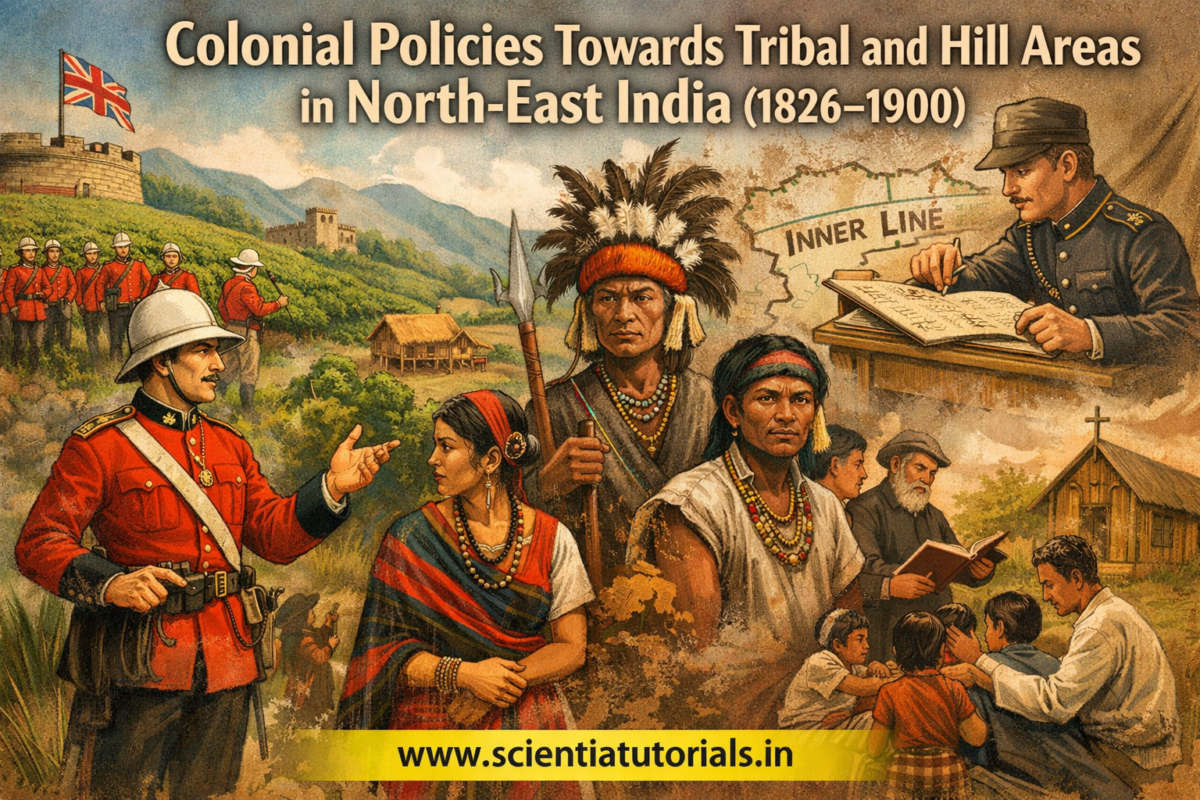

Colonial Policies Towards Tribal and Hill Areas in North-East India (1826–1900)
Course: History of North-East India: From Early Kingdoms to Modern Integration
Module VI: Colonial Rule and Administrative Reorganisation
Timeline / Era Covered: 1826 CE – 1900 CE
Lesson: Colonial Policies towards Tribal and Hill Areas
This lesson is systematically organized into four clearly structured sections, as detailed below:
- Chronologically Structured Study Module
- Short-Answer Type Questions
- Long-Answer Type Questions
- Multiple-Choice Questions (MCQs) with Answers and Detailed Explanations
Chronologically Structured Study Module
1. Introduction: Hills, Tribes, and the Colonial Frontier
The incorporation of Assam into the British Empire after 1826 brought the colonial state into direct contact with a wide range of tribal societies inhabiting the hill and frontier regions of North-East India. Unlike the plains of the Brahmaputra valley, these areas were characterised by difficult terrain, sparse population, shifting cultivation, and strong kinship-based political systems.
British colonial policies towards tribal and hill areas developed gradually and pragmatically. They were shaped less by ideological commitment to uniform administration and more by strategic, military, and economic considerations. This lesson examines the evolution of colonial frontier policy in Assam between 1826 and 1900, focusing on administrative practices, land and revenue policies, military intervention, and their long-term consequences.
2. Pre-Colonial Relations between Plains and Hills
Before colonial rule, interactions between the plains and hill societies of Assam were fluid and negotiated. Hill tribes such as the Nagas, Khasis, and various frontier groups maintained autonomy while engaging in trade, tribute, and occasional conflict with plains-based states.
The Ahom rulers did not attempt direct territorial control over hill regions. Instead, they followed a policy of coexistence, seasonal trade, tribute arrangements, and defensive expeditions when necessary. This flexible frontier relationship was fundamentally altered by the British drive to define boundaries and impose administrative order.
3. Early British Perceptions of Hill and Tribal Areas (1826–1840s)
3.1 The Hills as a “Frontier Problem”
To British administrators, the hill regions represented a “frontier problem” rather than a potential revenue base. These areas were seen as economically unproductive, difficult to access, and politically unstable. Colonial officials often described tribal societies as “warlike” and “unsettled,” reflecting both cultural misunderstanding and imperial anxiety.
The primary British concern in the early decades was to secure the plains of Assam from raids and disturbances originating in the hills, rather than to integrate hill societies into mainstream administration.
3.2 Limited Administrative Reach
In the initial phase, British authority extended only marginally beyond the plains. Hill regions remained largely outside direct colonial control. The state relied on military patrols, occasional punitive expeditions, and negotiated agreements to maintain order along the frontier.
4. Principles of Colonial Tribal Policy
Colonial policies towards tribal and hill areas in Assam were guided by a few broad principles:
- Non-interference: Avoiding deep involvement in tribal social and political institutions.
- Cost minimisation: Reducing administrative expenditure in regions with low revenue potential.
- Security: Preventing raids, protecting tea plantations, and securing communication routes.
- Segregation: Maintaining a clear distinction between plains administration and hill governance.
These principles resulted in a differentiated administrative structure that treated hill regions as exceptional spaces within the colonial state.
5. Gradual Extension of Political Control (1840s–1870s)
5.1 Military Expeditions and Frontier Policing
As tea plantations expanded and trade routes developed, British interest in hill regions increased. Raids on plantations and villages prompted military responses. The colonial state organised frontier policing and conducted punitive expeditions to demonstrate authority.
These expeditions were not intended to annex territory immediately but to compel compliance and deter resistance. Over time, they expanded British influence deeper into the hills.
5.2 Establishment of Frontier Outposts
To maintain surveillance and control, the British established frontier outposts and administrative stations. These posts acted as centres of military power and political negotiation, gradually integrating hill areas into the colonial sphere.
6. The Inner Line System and Frontier Regulation
6.1 Concept and Objectives
One of the most distinctive features of British tribal policy was the introduction of the Inner Line system. This administrative boundary restricted the movement of plains people, traders, and settlers into tribal areas without official permission.
The Inner Line was designed to:
- Protect tribal societies from exploitation by outsiders.
- Prevent land alienation and social disruption.
- Reduce conflict along the frontier.
This policy was later formalised through measures such as the Inner Line Regulation.
6.2 Consequences of the Inner Line
While the Inner Line offered a degree of protection to tribal communities, it also institutionalised segregation. Hill areas were isolated from economic development and political participation, reinforcing their peripheral status within colonial Assam.
7. Administrative Classification of Hill Areas
7.1 Excluded and Partially Controlled Regions
British administrators classified hill regions as areas requiring special treatment. These regions were excluded from normal civil administration and governed through political officers rather than regular bureaucrats.
Examples included:
- The Naga Hills
- The Khasi Hills
In these areas, customary laws were respected, and minimal interference was the guiding principle.
7.2 Role of Political Officers
Political officers combined administrative, judicial, and military roles. They acted as intermediaries between the colonial state and tribal communities, resolving disputes and maintaining order through negotiation rather than codified law.
8. Land and Revenue Policies in Hill Areas
8.1 Absence of Regular Land Revenue
Unlike the plains, hill areas were largely excluded from systematic land revenue settlements. The British recognised that imposing cash taxation would disrupt subsistence economies based on shifting cultivation (jhum).
As a result:
- No regular land surveys were conducted.
- Community land ownership was largely preserved.
- Revenue demands, if any, were nominal.
8.2 Shifting Cultivation and Colonial Attitudes
Shifting cultivation was viewed with suspicion by colonial officials, who often considered it wasteful and destructive. However, due to limited administrative capacity, the British tolerated the practice while occasionally attempting to regulate it.
9. Impact of Tea Plantations on Tribal Policy
9.1 Plantation Expansion and Frontier Tensions
The expansion of tea plantations in the foothills brought tribal and colonial interests into closer contact. Plantations required secure land, labour, and transport routes, increasing British involvement in frontier management.
Conflicts over land and labour recruitment intensified, prompting stronger administrative measures in adjoining hill areas.
9.2 Labour Recruitment from Tribal Areas
While most plantation labour came from outside Assam, some hill communities were drawn into wage labour networks. This exposure altered traditional economic patterns and introduced new dependencies.
10. Missionaries and Cultural Intervention
Christian missionaries played a significant role in hill areas, particularly among the Nagas and Khasis. Missionary activity was often encouraged by colonial officials as a means of “pacification” and social transformation.
Missionaries:
- Introduced Western education and literacy.
- Developed written scripts for tribal languages.
- Influenced social customs and belief systems.
While education created new opportunities, it also disrupted indigenous cultural practices.
11. Resistance and Accommodation
11.1 Tribal Resistance
Colonial intrusion was not universally accepted. Many tribal communities resisted British authority through armed resistance, refusal to cooperate, and periodic raids. The British responded with a combination of military force and negotiated settlements.
11.2 Strategies of Accommodation
Over time, some tribal leaders adapted to colonial rule by engaging with administrative structures, accepting subsidies, or serving as intermediaries. This pragmatic accommodation helped stabilise colonial control but altered traditional power relations.
12. Long-Term Consequences of Colonial Tribal Policy
12.1 Political Isolation
Colonial policies preserved tribal autonomy in the short term but politically isolated hill regions from mainstream developments. This separation limited access to education, infrastructure, and political representation.
12.2 Creation of Distinct Administrative Identities
By treating hill areas as exceptional, the British laid the foundation for separate administrative identities. These distinctions later influenced post-colonial state formation and demands for autonomy.
13. Evaluation of Colonial Policy towards Tribal and Hill Areas
From a colonial perspective, policies of minimal intervention and segregation were cost-effective and reduced conflict. However, they also:
- Reinforced stereotypes of tribal “backwardness.”
- Prevented balanced economic development.
- Institutionalised regional inequalities.
Colonial tribal policy was thus conservative rather than transformative, aiming to manage rather than integrate.
14. Conclusion: Historical Significance of Colonial Frontier Policy
Between 1826 and 1900, British policies towards tribal and hill areas in Assam evolved from cautious non-interference to structured administrative segregation. The Inner Line system, indirect administration, and limited economic intervention defined the colonial approach to the hills.
While these policies preserved certain indigenous institutions, they also marginalised hill societies and entrenched their peripheral status within the colonial state. Understanding this legacy is essential for interpreting later political movements, demands for autonomy, and the complex integration of North-East India into the modern Indian state.
15. Examination-Oriented Key Takeaways
- Colonial tribal policy was driven by security and cost considerations, not revenue.
- Hill areas were governed through indirect and exceptional administrative arrangements.
- The Inner Line system institutionalised segregation between plains and hills.
- Missionary activity played a major role in cultural change.
- Colonial policies created long-term political and developmental disparities.
Short Answer Type Questions
Lesson: Colonial Policies towards Tribal and Hill Areas
Module VI: Colonial Rule and Administrative Reorganisation (1826–1900 CE)
1. What marked the beginning of British colonial rule in North-East India?
Answer:
British rule in North-East India began after the Treaty of Yandabo (1826), which ended the First Anglo-Burmese War and brought Assam under the control of the British Raj.
2. Why were tribal and hill areas treated differently from the plains by the British?
Answer:
The British considered tribal and hill areas geographically difficult, culturally distinct, and politically sensitive, requiring special administrative arrangements to maintain control with minimal interference.
3. What was the primary objective of British policies toward hill tribes?
Answer:
The main objective was to ensure political stability, secure frontiers, and prevent tribal resistance while facilitating colonial economic interests in the plains.
4. What was the policy of ‘non-interference’ in hill areas?
Answer:
The policy of non-interference meant minimal administrative intervention in tribal customs and governance, allowing traditional institutions to function under British supervision.
5. What is meant by the ‘Excluded Areas’ approach?
Answer:
It refers to regions kept outside normal provincial administration, where special laws applied and British officials exercised direct control over tribal populations.
6. How did the Inner Line Regulation affect tribal areas?
Answer:
The Inner Line Regulation restricted the entry of outsiders into tribal areas, aiming to protect tribal societies from exploitation and reduce conflict.
7. In which year was the Inner Line Regulation introduced?
Answer:
The Inner Line Regulation was introduced in 1873.
8. How did colonial administrators view tribal societies?
Answer:
Tribal societies were viewed as “primitive” and “backward,” justifying paternalistic governance and administrative segregation.
9. What role did political officers play in hill administration?
Answer:
Political officers acted as intermediaries, maintaining law and order, collecting tribute, and managing relations between tribes and the colonial state.
10. How did British policies affect traditional tribal leadership?
Answer:
Traditional leaders were retained but subordinated to colonial authority, often transformed into revenue collectors or agents of the British.
11. What economic interests shaped colonial policy in tribal regions?
Answer:
Tea cultivation, timber extraction, oil exploration, and trade routes significantly influenced British engagement with nearby tribal areas.
12. How were tribal customary laws treated under colonial rule?
Answer:
Customary laws were generally respected as long as they did not challenge colonial authority or disrupt administrative order.
13. What was the impact of colonial rule on shifting cultivation?
Answer:
The British viewed shifting cultivation as wasteful and attempted to regulate or restrict it, often causing tension with tribal communities.
14. Why were hill areas excluded from regular revenue systems?
Answer:
Due to difficult terrain, subsistence economies, and fear of rebellion, the British avoided imposing standard revenue systems in hill regions.
15. How did frontier security influence colonial policies?
Answer:
Fear of foreign invasion and tribal uprisings led the British to adopt buffer-zone strategies and military surveillance in hill areas.
16. What was the significance of indirect rule in tribal regions?
Answer:
Indirect rule allowed the British to govern through local chiefs, reducing administrative costs and minimizing resistance.
17. How did colonial policies contribute to tribal isolation?
Answer:
Administrative segregation, restricted movement, and limited infrastructure development increased the isolation of tribal areas.
18. What role did missionaries play in hill areas?
Answer:
Missionaries introduced Western education and Christianity, indirectly supporting colonial administration and cultural transformation.
19. How did British policies differ between plains tribes and hill tribes?
Answer:
Plains tribes faced greater administrative integration, while hill tribes were governed through special regulations and indirect control.
20. What administrative changes occurred in Assam under colonial rule?
Answer:
Assam was reorganised into districts with special frontier tracts, separating hill areas from mainstream administration.
21. How did colonial policies affect tribal resistance movements?
Answer:
Restrictive policies, land alienation, and cultural interference often led to periodic tribal uprisings against British authority.
22. What was the role of customary tribute in hill administration?
Answer:
Instead of formal taxation, tribes often paid tribute, symbolising submission while retaining autonomy.
23. How did colonial ethnography influence governance?
Answer:
British ethnographic studies classified tribes, reinforcing stereotypes and shaping administrative policies.
24. What long-term impact did colonial tribal policies have?
Answer:
They institutionalised administrative isolation, influencing post-colonial governance and identity politics in North-East India.
25. Why is the study of colonial tribal policy important?
Answer:
It helps explain contemporary issues of autonomy, underdevelopment, and centre–periphery relations in the region.
Long Answer Type Questions
Lesson: Colonial Policies towards Tribal and Hill Areas
Module VI: Colonial Rule and Administrative Reorganisation (1826–1900 CE)
1. Examine the background and objectives of British colonial policy towards tribal and hill areas of North-East India.
Answer:
British colonial policy towards tribal and hill areas emerged after the Treaty of Yandabo (1826), which brought Assam and adjoining regions under the authority of the British Raj. The primary objectives were political control, frontier security, and economic exploitation of the plains while avoiding costly administration in inaccessible hill regions. The British aimed to maintain peace by minimising interference, securing borders against Burma and China, and preventing tribal uprisings. These policies were shaped by racial perceptions, geographical constraints, and imperial strategic concerns rather than any genuine interest in tribal welfare.
2. Discuss the policy of non-interference adopted by the British in hill areas.
Answer:
The policy of non-interference was a cornerstone of British governance in tribal regions. It involved allowing tribal communities to follow their traditional customs, laws, and leadership structures without direct administrative intrusion. The British believed that interference would provoke resistance and increase administrative costs. However, this policy was selective and pragmatic; intervention occurred whenever colonial interests such as trade routes, plantation expansion, or frontier security were threatened. Thus, non-interference was less about cultural respect and more about political convenience.
3. Analyse the Inner Line Regulation and its significance for tribal administration.
Answer:
Introduced in 1873, the Inner Line Regulation restricted the movement of non-tribals into designated hill and frontier areas. Its primary purpose was to protect tribal societies from exploitation by traders, planters, and moneylenders while ensuring political stability. The regulation created a clear boundary between administered plains and excluded hill areas. Although it helped preserve tribal land rights to some extent, it also reinforced isolation and prevented socio-economic integration, effects that continue to influence the region today.
4. Explain the administrative segregation of hill areas under colonial rule.
Answer:
Administrative segregation meant separating hill areas from mainstream provincial administration. These regions were governed through special regulations, political officers, and frontier tracts rather than regular civil institutions. This system allowed flexibility in governance but denied tribal populations political representation and access to modern administrative benefits. Segregation institutionalised the idea that tribal societies were fundamentally different and incapable of self-governance within a modern administrative framework.
5. Evaluate the role of political officers in the governance of hill areas.
Answer:
Political officers functioned as intermediaries between tribal communities and the colonial state. They were responsible for maintaining peace, collecting tribute, settling disputes, and monitoring frontier security. While they exercised considerable discretionary power, their authority often undermined traditional leadership structures. Political officers symbolised indirect rule, combining paternalism with coercion, and played a crucial role in enforcing colonial interests with minimal administrative expenditure.
6. Discuss British perceptions of tribal society and how these shaped policy.
Answer:
British administrators viewed tribal societies as primitive, backward, and static. Such perceptions justified policies of isolation, indirect rule, and administrative exceptionalism. Ethnographic studies categorised tribes into rigid identities, reinforcing stereotypes and shaping governance strategies. These perceptions ignored the dynamic nature of tribal societies and legitimised colonial dominance under the guise of protection and civilisation.
7. Examine the impact of colonial policies on traditional tribal institutions.
Answer:
Colonial rule weakened traditional institutions by subordinating chiefs and councils to British authority. While local leaders were retained, they were transformed into agents of colonial administration, responsible for tribute collection and order maintenance. This altered the legitimacy of traditional leadership and disrupted indigenous systems of governance, creating long-term challenges for post-colonial political structures.
8. Analyse the economic motives behind British engagement with tribal regions.
Answer:
Economic interests played a decisive role in shaping colonial policies. The expansion of tea plantations, extraction of timber, exploration of oil, and control of trade routes motivated British involvement in tribal areas. Although hill regions themselves were often economically marginal, their proximity to resource-rich plains made them strategically important. Economic motives frequently overrode professed commitments to tribal autonomy.
9. Discuss the British attitude towards shifting cultivation in hill areas.
Answer:
The British regarded shifting cultivation as wasteful and environmentally destructive. Efforts were made to restrict or regulate it through forest laws and settlement policies. However, these measures ignored the ecological balance and subsistence needs of tribal communities. Restrictions on shifting cultivation disrupted traditional livelihoods and contributed to resentment and resistance.
10. Evaluate the role of customary law in colonial tribal administration.
Answer:
Customary laws were generally respected under colonial rule, provided they did not conflict with imperial interests. The British codified certain customs to simplify governance, but this often froze dynamic practices into rigid forms. While recognition of customary law allowed limited autonomy, it also subjected indigenous legal systems to colonial interpretation and control.
11. Examine the strategic importance of frontier security in shaping colonial policies.
Answer:
Frontier security was a central concern due to fears of Burmese aggression, Chinese influence, and tribal raids. Hill areas were treated as buffer zones, with military outposts and surveillance systems established to monitor movement. Policies of limited engagement aimed to maintain stability without provoking unrest, highlighting the strategic rather than humanitarian nature of colonial governance.
12. Discuss indirect rule as a method of governing tribal areas.
Answer:
Indirect rule involved governing through existing tribal leadership structures while retaining ultimate colonial authority. This reduced administrative costs and resistance but compromised indigenous autonomy. Chiefs became accountable to colonial officials rather than their communities, leading to erosion of traditional legitimacy and increased social stratification.
13. Analyse the impact of missionary activities in hill areas.
Answer:
Missionaries played a significant role in introducing Western education, Christianity, and new cultural practices. While they contributed to literacy and social reform, missionary activity also facilitated colonial control by reshaping tribal identities and values. Conversion and education often created new social divisions within tribal societies.
14. Examine the differences in British policy towards plains tribes and hill tribes.
Answer:
Plains tribes were gradually integrated into the regular administrative framework, subjected to revenue systems and legal institutions. In contrast, hill tribes were governed through exceptional policies, indirect rule, and exclusion. This differential treatment reflected geographical accessibility and strategic priorities rather than cultural considerations alone.
15. Discuss the relationship between colonial policies and tribal resistance.
Answer:
Despite policies of non-interference, colonial intervention in land use, taxation, and leadership often provoked resistance. Tribal uprisings reflected opposition to cultural intrusion, economic exploitation, and loss of autonomy. British responses combined military suppression with administrative reforms, reinforcing control while maintaining the appearance of minimal interference.
16. Evaluate the role of tribute in colonial hill administration.
Answer:
Tribute replaced formal taxation in many hill areas, symbolising submission without full administrative integration. This system preserved a degree of autonomy but reinforced unequal power relations. Tribute served as a political tool to assert colonial authority while avoiding direct governance.
17. Discuss the use of ethnography in colonial governance of tribal areas.
Answer:
Ethnographic surveys classified tribes based on race, culture, and customs. These classifications influenced policy decisions and administrative boundaries. While ethnography provided valuable documentation, it also reinforced colonial stereotypes and justified segregationist policies.
18. Analyse the long-term consequences of administrative segregation of hill areas.
Answer:
Administrative segregation institutionalised political isolation and underdevelopment. It limited access to education, infrastructure, and political participation. Post-independence governance inherited these colonial frameworks, contributing to ongoing demands for autonomy and special constitutional provisions.
19. Examine the impact of forest laws on tribal communities.
Answer:
Forest laws restricted access to traditional resources, undermining subsistence economies. Tribes lost customary rights to land and forest produce, leading to economic hardship and social unrest. These policies highlighted the conflict between colonial conservation ideals and indigenous livelihood systems.
20. Critically assess colonial claims of protecting tribal interests.
Answer:
While the British claimed to protect tribal societies from exploitation, their policies primarily served imperial interests. Protection often meant isolation and control rather than empowerment. The contradiction between rhetoric and reality exposes the exploitative nature of colonial governance.
21. Discuss the administrative reorganisation of Assam and its implications for hill areas.
Answer:
Assam was reorganised into districts and frontier tracts, separating hill areas from mainstream administration. This facilitated colonial control but marginalised tribal regions politically and economically. The reorganisation reflected strategic priorities rather than developmental concerns.
22. Analyse how colonial tribal policies influenced post-colonial governance in North-East India.
Answer:
Post-colonial India inherited colonial administrative categories such as excluded and frontier areas. These influenced constitutional safeguards, autonomous councils, and special provisions. Colonial legacies continue to shape identity politics and centre–periphery relations.
23. Examine the role of military expeditions in enforcing colonial authority in hill areas.
Answer:
Military expeditions were used selectively to suppress resistance and assert dominance. They served as deterrents rather than instruments of regular governance. Such expeditions revealed the limits of non-interference and the coercive foundations of colonial rule.
24. Discuss the socio-cultural impact of colonial isolation on tribal societies.
Answer:
Isolation preserved certain cultural practices but also limited social mobility and interaction. Colonial boundaries disrupted traditional networks and exchange systems. The resulting cultural stagnation was a product of policy rather than inherent tribal conservatism.
25. Why is the study of colonial policies towards tribal and hill areas crucial for understanding North-East India today?
Answer:
Colonial policies shaped administrative boundaries, political identities, and development patterns. Understanding these policies explains contemporary issues of autonomy, underdevelopment, ethnic assertion, and governance challenges in North-East India.
MCQs with Answers and Explanations
Lesson: Colonial Policies towards Tribal and Hill Areas
Module VI: Colonial Rule and Administrative Reorganisation (1826–1900 CE)
1. British colonial rule in North-East India began formally after which event?
A. Annexation of Assam
B. Treaty of Yandabo
C. Inner Line Regulation
D. First Anglo-Ahom War
Correct Answer: B
Explanation:
The Treaty of Yandabo (1826) ended the First Anglo-Burmese War and marked the formal beginning of British authority in Assam and adjoining regions under the British Raj.
2. Which was the primary objective of British policy towards tribal and hill areas?
A. Rapid industrialisation
B. Complete political integration
C. Frontier security and political stability
D. Cultural assimilation
Correct Answer: C
Explanation:
British policies were shaped mainly by strategic concerns—securing frontiers, preventing uprisings, and maintaining peace with minimal administrative cost.
3. The policy of ‘non-interference’ in hill areas primarily aimed to:
A. Promote tribal self-rule
B. Reduce administrative expenditure and resistance
C. Encourage missionary activities
D. Introduce modern education
Correct Answer: B
Explanation:
Non-interference was a pragmatic policy intended to avoid costly administration and potential tribal resistance, not a genuine respect for autonomy.
4. Which regulation restricted the entry of outsiders into tribal areas?
A. Forest Regulation
B. Permanent Settlement
C. Inner Line Regulation
D. Bengal Frontier Act
Correct Answer: C
Explanation:
The Inner Line Regulation created a boundary restricting non-tribal movement into hill areas to protect tribal societies and maintain order.
5. The Inner Line Regulation was introduced in which year?
A. 1826
B. 1857
C. 1873
D. 1890
Correct Answer: C
Explanation:
The regulation was introduced in 1873 to separate administered plains from frontier and hill regions.
6. How did the British generally perceive tribal societies?
A. Economically advanced
B. Politically modern
C. Primitive and backward
D. Fully autonomous
Correct Answer: C
Explanation:
Colonial administrators viewed tribal societies as primitive, which justified paternalistic and segregationist policies.
7. Which administrative method was commonly used in hill areas?
A. Direct rule through civil courts
B. Zamindari system
C. Indirect rule through chiefs
D. Municipal administration
Correct Answer: C
Explanation:
The British governed hill areas indirectly through traditional chiefs to reduce resistance and administrative costs.
8. Who acted as intermediaries between the British administration and tribal communities?
A. District collectors
B. Zamindars
C. Political officers
D. Missionaries
Correct Answer: C
Explanation:
Political officers managed relations, collected tribute, and ensured frontier security in tribal regions.
9. Why were hill areas excluded from regular revenue administration?
A. Lack of population
B. Subsistence economy and difficult terrain
C. Absence of agriculture
D. British disinterest
Correct Answer: B
Explanation:
The subsistence nature of tribal economies and challenging geography made regular revenue collection impractical and risky.
10. Which economic interest significantly influenced British engagement with nearby tribal areas?
A. Cotton cultivation
B. Tea plantations
C. Textile industries
D. Shipbuilding
Correct Answer: B
Explanation:
The expansion of tea plantations in Assam increased British interest in securing surrounding hill regions.
11. How did the British view shifting cultivation?
A. Sustainable and scientific
B. Economically productive
C. Wasteful and destructive
D. Necessary for forest growth
Correct Answer: C
Explanation:
Colonial officials considered shifting cultivation inefficient and sought to regulate or restrict it.
12. What was the British attitude towards tribal customary laws?
A. Completely abolished
B. Fully ignored
C. Respected with limitations
D. Replaced by English law
Correct Answer: C
Explanation:
Customary laws were allowed to function as long as they did not conflict with colonial interests.
13. Frontier security policies were mainly influenced by fear of:
A. European rivals
B. Burmese and Chinese expansion
C. Internal trade competition
D. Missionary resistance
Correct Answer: B
Explanation:
The proximity of Burma and China made frontier stability a key concern for British administrators.
14. What was the purpose of treating hill areas as buffer zones?
A. Encourage migration
B. Promote agriculture
C. Prevent external invasion and unrest
D. Increase taxation
Correct Answer: C
Explanation:
Hill areas acted as buffer zones to protect the British-controlled plains from external threats.
15. Which system symbolised submission without full administrative integration?
A. Land revenue system
B. Permanent settlement
C. Tribute system
D. Ryotwari system
Correct Answer: C
Explanation:
Tribute payments acknowledged British authority while allowing tribes limited autonomy.
16. How did colonial ethnography influence tribal administration?
A. By eliminating tribal identities
B. By promoting equality
C. By classifying and stereotyping tribes
D. By integrating tribes into modern society
Correct Answer: C
Explanation:
Ethnographic studies categorised tribes rigidly, reinforcing stereotypes and shaping segregationist policies.
17. What role did missionaries play in hill areas?
A. Military enforcement
B. Revenue collection
C. Cultural and educational transformation
D. Judicial administration
Correct Answer: C
Explanation:
Missionaries introduced education and Christianity, influencing social change and indirectly supporting colonial control.
18. How did British policy differ between plains tribes and hill tribes?
A. Both were treated identically
B. Plains tribes faced greater integration
C. Hill tribes were taxed more heavily
D. Plains tribes were isolated
Correct Answer: B
Explanation:
Plains tribes were gradually integrated into regular administration, unlike hill tribes governed through exceptional measures.
19. Which factor often triggered tribal resistance?
A. Missionary education
B. Restriction on shifting cultivation
C. Trade expansion
D. Linguistic change
Correct Answer: B
Explanation:
Restrictions on land use and forest access disrupted livelihoods and provoked resistance.
20. What was a major consequence of administrative segregation?
A. Rapid development
B. Political empowerment
C. Long-term isolation and underdevelopment
D. Industrial growth
Correct Answer: C
Explanation:
Segregation limited access to infrastructure, education, and political participation.
21. The reorganisation of Assam under colonial rule aimed mainly at:
A. Cultural integration
B. Administrative efficiency and control
C. Tribal self-rule
D. Economic equality
Correct Answer: B
Explanation:
Administrative reorganisation prioritised effective control rather than balanced development.
22. Forest laws affected tribal communities primarily by:
A. Increasing agricultural output
B. Granting land ownership
C. Restricting access to traditional resources
D. Encouraging migration
Correct Answer: C
Explanation:
Forest regulations curtailed customary rights, undermining subsistence economies.
23. Why did the British prefer indirect rule in hill areas?
A. Ideological commitment to democracy
B. Lack of interest
C. Reduced costs and resistance
D. Missionary pressure
Correct Answer: C
Explanation:
Indirect rule was economical and minimised the risk of rebellion.
24. Colonial claims of protecting tribal interests were:
A. Fully genuine
B. Partially symbolic
C. Mainly rhetorical and strategic
D. Completely absent
Correct Answer: C
Explanation:
Protection often meant control and isolation rather than empowerment.
25. Why is the study of colonial tribal policy important today?
A. It has no contemporary relevance
B. It explains present administrative boundaries and autonomy issues
C. It focuses only on economic history
D. It applies only to colonial times
Correct Answer: B
Explanation:
Colonial policies shaped governance patterns, identity politics, and autonomy movements in post-colonial North-East India.