
Prehistoric and Protohistoric Cultures of North-East India
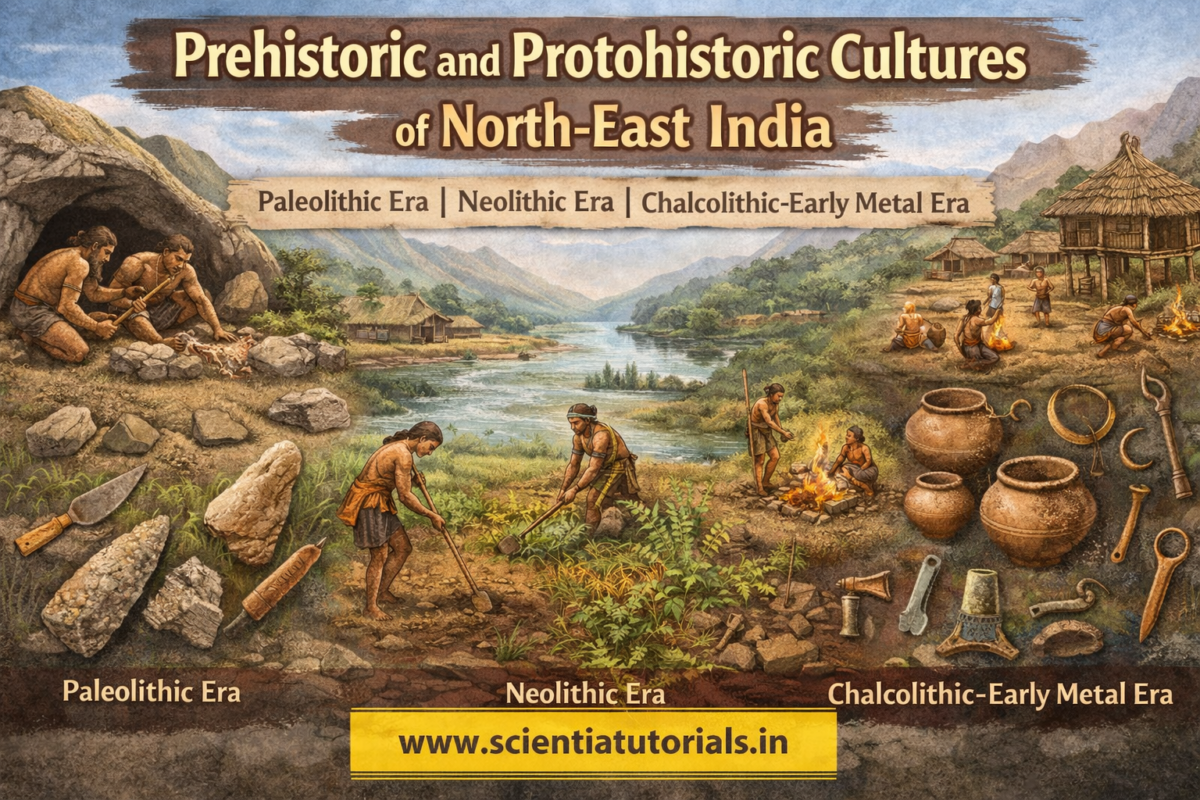

Prehistoric and Protohistoric Cultures of North-East India: Paleolithic to Chalcolithic Era
Course: History of North-East India: From Early Kingdoms to Modern Integration
Module I: Geographical, Ethnic, and Cultural Foundations of North-East India
Timeline / Era Covered: Prehistory – Early Historic Background (Before 4th Century CE)
Lesson: Prehistoric and Protohistoric Cultures of North-East India
This lesson is systematically organized into four clearly structured sections, as detailed below:
- Chronologically Structured Study Module
- Short-Answer Type Questions
- Long-Answer Type Questions
- Multiple-Choice Questions (MCQs) with Answers and Detailed Explanations
Chronologically Structured Study Module
Introduction: Understanding Prehistory and Protohistory in North-East India
The study of prehistoric and protohistoric cultures of North-East India forms the foundation for understanding the region’s later historical, cultural, and political developments. Unlike the early historic period, where written sources become available, prehistory and protohistory rely primarily on archaeological evidence, material culture, and comparative anthropology.
North-East India, due to its strategic location between the Indian subcontinent, Southeast Asia, and East Asia, witnessed early human settlement and cultural interaction. The region’s hills, river valleys, caves, and forested landscapes provided favorable conditions for human habitation from the earliest times. This lesson examines the chronological evolution of human cultures in North-East India from the Paleolithic to the protohistoric phase, highlighting technological progress, subsistence patterns, and cultural continuity.
Chronological Framework of Prehistoric and Protohistoric Cultures
For analytical and examination clarity, the prehistoric and protohistoric development of North-East India can be divided into the following broad phases:
- Paleolithic Phase (Early Prehistory)
- Mesolithic Phase (Transitional Phase)
- Neolithic Phase (Food Production Stage)
- Chalcolithic and Protohistoric Phase (Early Metal Use and Social Complexity)
This chronological framework helps students understand gradual cultural transformation rather than abrupt historical change.
I. Paleolithic Culture in North-East India
1. Chronological Position
The Paleolithic phase represents the earliest stage of human cultural development, marked by stone tool technology and hunting-gathering subsistence. In North-East India, this phase is relatively less documented compared to other parts of India, primarily due to dense vegetation and limited systematic excavation.
2. Archaeological Evidence
Paleolithic tools discovered in the region include:
- Hand axes
- Choppers
- Flakes and scrapers
These tools suggest the presence of early human groups who depended on hunting, scavenging, and gathering.
3. Lifestyle and Subsistence
Paleolithic communities lived a nomadic lifestyle, moving in small groups in search of food and shelter. Natural caves, rock shelters, and open riverine landscapes served as temporary habitation sites.
4. Historical Significance
The Paleolithic phase establishes:
- The antiquity of human presence in North-East India
- The region’s integration into broader prehistoric developments of South and Southeast Asia
II. Mesolithic Culture: Transition and Adaptation
1. Nature of the Mesolithic Phase
The Mesolithic phase represents a transitional stage between hunting-gathering and early agriculture. It is characterized by microlithic tools and improved adaptation to diverse ecological zones.
2. Tool Technology
Mesolithic tools were:
- Smaller and more refined
- Often used as composite tools
- Suitable for hunting small animals and fishing
3. Subsistence Pattern
Communities practiced:
- Hunting and gathering
- Fishing and seasonal food collection
This indicates growing knowledge of local ecology.
4. Cultural Importance
The Mesolithic phase demonstrates:
- Increased human adaptation to the challenging terrain of North-East India
- Foundations for sedentary life in later periods
III. Neolithic Culture: Beginning of Food Production
1. Chronological Context
The Neolithic phase marks a major cultural transformation, characterized by the shift from food gathering to food production. In North-East India, Neolithic cultures appeared relatively early due to proximity to Southeast Asia.
2. Neolithic Settlements
Neolithic sites in the region reveal:
- Polished stone tools
- Pottery
- Evidence of domesticated plants and animals
Settlements were often located near river valleys and fertile land.
3. Agricultural Practices
Early agriculture included:
- Shifting cultivation (slash-and-burn or jhum)
- Domestication of plants
- Dependence on forest resources
This agricultural tradition continues in modified forms even today.
4. Social Organization
Neolithic communities developed:
- Semi-sedentary settlements
- Kinship-based social structures
- Cooperative labor systems
5. Cultural Significance
The Neolithic phase laid the foundation for:
- Permanent settlements
- Population growth
- Cultural differentiation
IV. Chalcolithic and Protohistoric Phase
1. Meaning of Protohistory
Protohistory refers to a phase where societies had developed complex material culture but lacked indigenous written records. Knowledge of this phase comes from archaeology and later textual references.
2. Introduction of Metal
Evidence suggests limited use of:
- Copper and early metal objects
- Continued dominance of stone tools
Metal use was gradual and uneven across the region.
3. Pottery and Material Culture
Protohistoric communities produced:
- Improved pottery styles
- Household tools
- Ornaments
This reflects growing craftsmanship and specialization.
4. Trade and Interaction
The protohistoric phase witnessed:
- Exchange of goods
- Cultural contact with neighboring regions
- Early trade routes along river valleys
These interactions contributed to cultural integration.
V. Regional Variations in Prehistoric Cultures
1. Hill Regions
- Dominance of stone tools
- Slow adoption of metallurgy
- Strong continuity of traditional lifestyles
2. River Valleys
- Earlier transition to settled life
- Agricultural surplus
- Greater cultural interaction
This contrast explains later historical developments in hills and plains.
VI. Cultural Continuity and Survival
Many prehistoric practices survived into historic times:
- Shifting cultivation
- Clan-based social organization
- Use of traditional tools
This continuity highlights the resilience of indigenous cultures.
VII. Sources for Studying Prehistoric and Protohistoric Cultures
1. Archaeological Sources
- Stone tools
- Pottery
- Settlement remains
2. Anthropological Evidence
- Study of living tribal societies
- Comparative cultural practices
3. Environmental Studies
- Pollen analysis
- Geological surveys
These interdisciplinary approaches compensate for the absence of written records.
VIII. Importance of Prehistoric Studies in North-East India
Studying prehistoric and protohistoric cultures helps in:
- Understanding early human adaptation
- Tracing migration and settlement patterns
- Explaining cultural diversity
For competitive exams, this topic connects archaeology, anthropology, and history.
Examination-Oriented Key Points
- Prehistory relies on material evidence, not texts
- Neolithic phase marks food production
- Protohistory shows early social complexity
- Geography shaped cultural development
- Continuity is as important as change
Practice Questions for Competitive Examinations
Short Answer:
- Define protohistory and its relevance to North-East India.
Descriptive:
2. Discuss the significance of the Neolithic phase in North-East India.
Analytical:
3. Examine how geography influenced prehistoric cultural development in the region.
Conclusion
The prehistoric and protohistoric cultures of North-East India reveal a long and continuous history of human settlement, adaptation, and cultural innovation. From early stone tool users to semi-sedentary agricultural communities, the region witnessed gradual but significant transformations. Understanding these early cultural stages is essential for appreciating the later emergence of linguistic diversity, political systems, and regional identities. This lesson thus forms a crucial foundation for the systematic study of the history of North-East India, particularly for academic and competitive examination purposes.
Short Answer Type Questions with Answers
(Prehistory – Early Historic Background, Before 4th Century CE)
1. What is meant by prehistory?
Answer:
Prehistory refers to the period of human history before the invention of writing, reconstructed mainly through archaeological evidence such as tools and habitation remains.
2. Define protohistory.
Answer:
Protohistory is the transitional phase between prehistory and history, where societies lacked indigenous written records but are known through archaeology and later textual references.
3. Why is the study of prehistory important for North-East India?
Answer:
It helps trace early human settlement, cultural adaptation, migration patterns, and technological development in a region with limited early written sources.
4. Which geographical factors supported early human habitation in North-East India?
Answer:
River valleys, caves, forest resources, fertile land, and a favorable climate supported early human habitation.
5. Which is the earliest cultural phase identified in North-East India?
Answer:
The Paleolithic phase is the earliest cultural phase.
6. What type of tools are associated with the Paleolithic culture?
Answer:
Crude stone tools such as hand axes, choppers, flakes, and scrapers.
7. What was the main subsistence pattern of Paleolithic communities?
Answer:
They followed a hunting-gathering and scavenging subsistence pattern.
8. Describe the lifestyle of Paleolithic people in North-East India.
Answer:
They lived a nomadic life, moving in small groups and using caves or open landscapes as temporary shelters.
9. What marks the Mesolithic phase in prehistoric development?
Answer:
The Mesolithic phase marks a transitional stage characterized by microlithic tools and better ecological adaptation.
10. What are microliths?
Answer:
Microliths are small, finely made stone tools often used as parts of composite tools.
11. How did Mesolithic people adapt to their environment?
Answer:
They adapted through seasonal movement, fishing, hunting small animals, and gathering forest produce.
12. Why is the Mesolithic phase considered a transitional phase?
Answer:
Because it bridges the gap between food-gathering and early food production.
13. What major change defines the Neolithic phase?
Answer:
The beginning of agriculture and domestication of plants and animals.
14. Name two key features of Neolithic culture in North-East India.
Answer:
Polished stone tools and early pottery.
15. Which agricultural practice became prominent during the Neolithic phase?
Answer:
Shifting cultivation (jhum agriculture).
16. What type of settlements developed during the Neolithic phase?
Answer:
Semi-sedentary to settled villages, often near river valleys.
17. How did the Neolithic phase influence social organization?
Answer:
It led to kinship-based communities, cooperative labor, and population growth.
18. What is meant by Chalcolithic culture?
Answer:
It refers to a phase marked by limited use of copper along with stone tools.
19. Why is the Chalcolithic phase less prominent in North-East India?
Answer:
Because stone tools continued to dominate, and metal use spread slowly and unevenly.
20. What types of material culture are found in the protohistoric phase?
Answer:
Improved pottery, household tools, ornaments, and limited metal objects.
21. How did river valleys influence protohistoric development?
Answer:
They encouraged settled life, agricultural surplus, and early trade contacts.
22. What role did trade play during the protohistoric phase?
Answer:
Trade facilitated cultural interaction and exchange of goods with neighboring regions.
23. Mention one example of cultural continuity from prehistoric times.
Answer:
The continued practice of shifting cultivation.
24. What are the main sources for studying prehistoric cultures of North-East India?
Answer:
Archaeological remains, anthropological studies, and environmental evidence.
25. How is the prehistoric study relevant for competitive examinations?
Answer:
It explains early human adaptation, cultural roots, and regional diversity, frequently tested in prelims and mains.
Long Answer Type Questions with Answers
(Prehistory – Early Historic Background, Before 4th Century CE)
1. Discuss the importance of studying prehistoric and protohistoric cultures for understanding the early history of North-East India.
Answer:
The study of prehistoric and protohistoric cultures is fundamental to understanding the early history of North-East India because written records are largely absent before the early historic period. Archaeological remains such as stone tools, pottery, and habitation sites provide crucial evidence about early human settlement, subsistence patterns, and technological development. These studies reveal how human communities adapted to the region’s challenging geography and laid the foundations for later cultural, linguistic, and social developments.
2. Explain the geographical factors that influenced prehistoric human settlement in North-East India.
Answer:
North-East India’s geography—marked by river valleys, hills, forests, and fertile plains—strongly influenced prehistoric settlement. River systems like the Brahmaputra Valley offered water, food resources, and natural routes for movement, while hills and forests provided shelter and raw materials. This varied landscape encouraged both human adaptation and cultural diversity from prehistoric times.
3. Describe the main characteristics of Paleolithic culture in North-East India.
Answer:
The Paleolithic culture represents the earliest phase of human activity in North-East India. It is characterized by crude stone tools such as hand axes, choppers, and flakes. Paleolithic communities followed a hunting-gathering subsistence pattern and lived a nomadic life, moving in small groups in search of food and shelter. Though archaeological evidence is limited, this phase establishes the antiquity of human presence in the region.
4. Evaluate the limitations and challenges in studying Paleolithic culture in North-East India.
Answer:
Studying Paleolithic culture in North-East India is challenging due to dense forests, heavy rainfall, and limited systematic excavations. Organic materials rarely survive, and stone tools are often scattered or poorly preserved. Despite these challenges, available evidence still indicates early human activity and adaptation.
5. Explain the transition from Paleolithic to Mesolithic culture in North-East India.
Answer:
The transition from Paleolithic to Mesolithic culture marks a gradual shift rather than a sudden break. Mesolithic communities continued hunting and gathering but developed smaller, more refined microlithic tools. This transition reflects improved adaptation to local environments and growing knowledge of seasonal resources.
6. Discuss the significance of microlithic tools in the Mesolithic phase.
Answer:
Microlithic tools were small, sharp stone implements often used as components of composite tools. Their development signifies technological advancement, efficiency in hunting small animals, and adaptation to diverse ecological conditions. These tools reflect greater planning and innovation among Mesolithic communities.
7. Analyze the subsistence patterns of Mesolithic communities in North-East India.
Answer:
Mesolithic communities depended on hunting, fishing, and gathering forest produce. Seasonal movement allowed them to exploit different ecological zones. This flexible subsistence strategy enabled survival in a region with varied terrain and climate.
8. Why is the Mesolithic phase considered a transitional stage in cultural development?
Answer:
The Mesolithic phase is considered transitional because it bridges the gap between food gathering and food production. While hunting and gathering continued, new technologies and settlement patterns emerged, preparing the ground for Neolithic agriculture.
9. Examine the major features of Neolithic culture in North-East India.
Answer:
The Neolithic culture introduced agriculture, domestication of plants and animals, polished stone tools, and pottery. Communities became semi-sedentary, living in villages near fertile land and water sources. This phase marks a major cultural transformation in the region.
10. Discuss the role of shifting cultivation (jhum) during the Neolithic period.
Answer:
Shifting cultivation became a dominant agricultural practice during the Neolithic period. It involved clearing forest patches, cultivating crops, and moving after soil fertility declined. This method suited the hilly terrain and continues in modified forms among many communities today.
11. Analyze the impact of the Neolithic revolution on social organization.
Answer:
The Neolithic revolution led to settled life, population growth, and kinship-based communities. Cooperative labor, shared resources, and emerging social roles strengthened social cohesion and laid the groundwork for more complex societies.
12. Explain the concept of protohistory with reference to North-East India.
Answer:
Protohistory refers to a phase where societies developed complex material culture but lacked indigenous written records. In North-East India, protohistory is reconstructed through archaeology and later historical references, reflecting early social complexity.
13. Discuss the nature of Chalcolithic culture in North-East India.
Answer:
The Chalcolithic phase in North-East India saw limited use of copper alongside stone tools. Metal use was uneven and did not completely replace stone technology. This indicates gradual technological change rather than a sudden transformation.
14. Why did stone tools continue to dominate despite the introduction of metal?
Answer:
Stone tools remained dominant because metal resources were scarce, metallurgy spread slowly, and traditional technologies were well-suited to local needs. This continuity reflects adaptation rather than technological backwardness.
15. Describe the material culture of protohistoric communities.
Answer:
Protohistoric material culture includes improved pottery, household tools, ornaments, and limited metal objects. These artifacts indicate growing craftsmanship, specialization, and social differentiation.
16. Examine the role of trade and interaction during the protohistoric phase.
Answer:
Trade and interaction increased during the protohistoric phase, especially along river valleys. Exchange of goods and ideas connected North-East India with neighboring regions, contributing to cultural integration.
17. Compare prehistoric cultural developments in hill regions and river valleys.
Answer:
Hill regions retained stone-based technologies and traditional lifestyles longer due to isolation, while river valleys experienced earlier agricultural development and cultural interaction. This contrast influenced later historical trajectories.
18. Discuss cultural continuity from prehistoric to historic times in North-East India.
Answer:
Many prehistoric practices such as shifting cultivation, clan-based social organization, and use of traditional tools continued into historic times. This continuity highlights cultural resilience and adaptation.
19. Explain the importance of archaeology in reconstructing prehistoric history.
Answer:
Archaeology provides the primary evidence for prehistoric history through tools, settlements, and material remains. It compensates for the absence of written sources and helps reconstruct early human life.
20. Discuss the role of anthropology in understanding prehistoric cultures.
Answer:
Anthropological studies of living communities help interpret prehistoric practices through comparative analysis. They offer insights into social organization, subsistence, and cultural continuity.
21. Analyze how environmental factors shaped prehistoric lifestyles.
Answer:
Climate, vegetation, and terrain influenced subsistence strategies, settlement patterns, and technology. Human communities adapted creatively to their environment for survival.
22. Evaluate the significance of prehistoric studies for understanding later historical developments.
Answer:
Prehistoric studies explain the roots of later cultural, linguistic, and social patterns. They provide context for understanding early state formation and regional identities.
23. Discuss the interdisciplinary approaches used to study prehistory in North-East India.
Answer:
Historians use archaeology, anthropology, environmental studies, and comparative analysis to reconstruct prehistoric history. This interdisciplinary approach ensures a comprehensive understanding.
24. Why is the topic of prehistoric culture important for competitive examinations?
Answer:
It connects geography, culture, archaeology, and history, making it a frequently tested area in both prelims and mains examinations.
25. Conclude by assessing the overall importance of prehistoric and protohistoric cultures in the history of North-East India.
Answer:
Prehistoric and protohistoric cultures reveal a long history of human adaptation, innovation, and continuity in North-East India. They form the cultural bedrock upon which later linguistic diversity, social systems, and political structures developed, making them essential for a comprehensive understanding of the region’s history.
MCQs with Answers and Explanations
(Prehistory – Early Historic Background, Before 4th Century CE)
1. What is the primary basis for studying prehistoric cultures in North-East India?
A. Literary texts
B. Epigraphic records
C. Archaeological evidence
D. Foreign accounts
Correct Answer: C. Archaeological evidence
Explanation:
Prehistory refers to the period before the invention of writing. Therefore, tools, pottery, habitation sites, and other material remains form the primary source for reconstructing prehistoric cultures.
2. Which phase represents the earliest stage of human cultural development in North-East India?
A. Mesolithic
B. Neolithic
C. Chalcolithic
D. Paleolithic
Correct Answer: D. Paleolithic
Explanation:
The Paleolithic phase is the earliest stage, marked by crude stone tools and a hunting-gathering way of life.
3. Paleolithic communities mainly depended on which subsistence pattern?
A. Agriculture
B. Pastoralism
C. Hunting and gathering
D. Trade and exchange
Correct Answer: C. Hunting and gathering
Explanation:
Paleolithic people survived by hunting animals, gathering wild plants, and scavenging, as agriculture had not yet developed.
4. Which type of tools are commonly associated with the Paleolithic phase?
A. Polished stone tools
B. Copper tools
C. Hand axes and choppers
D. Iron implements
Correct Answer: C. Hand axes and choppers
Explanation:
Paleolithic tools were crude stone implements such as hand axes, choppers, flakes, and scrapers.
5. Why is Paleolithic evidence relatively limited in North-East India?
A. Absence of human settlement
B. Lack of stone resources
C. Dense forests and limited excavations
D. Complete cultural discontinuity
Correct Answer: C. Dense forests and limited excavations
Explanation:
Heavy vegetation, high rainfall, and fewer systematic excavations make Paleolithic evidence difficult to locate and preserve.
6. The Mesolithic phase is best described as:
A. A period of advanced metallurgy
B. A transitional stage in cultural development
C. A fully agricultural phase
D. A historical period with written records
Correct Answer: B. A transitional stage in cultural development
Explanation:
The Mesolithic phase bridges the gap between hunting-gathering and early agriculture.
7. Which tool type is a defining feature of the Mesolithic culture?
A. Hand axes
B. Iron ploughshares
C. Microliths
D. Polished celts
Correct Answer: C. Microliths
Explanation:
Microliths are small, sharp stone tools used often as parts of composite tools, reflecting technological refinement.
8. Mesolithic communities adapted to their environment primarily through:
A. Permanent urban settlements
B. Seasonal movement and fishing
C. Large-scale agriculture
D. Industrial production
Correct Answer: B. Seasonal movement and fishing
Explanation:
Mesolithic people exploited seasonal resources, hunted small animals, and fished, showing greater ecological adaptation.
9. Which major transformation defines the Neolithic phase?
A. Development of writing
B. Beginning of agriculture
C. Use of iron
D. Rise of urban centers
Correct Answer: B. Beginning of agriculture
Explanation:
The Neolithic phase marks the shift from food gathering to food production through agriculture and domestication.
10. Neolithic tools in North-East India are mainly characterized by:
A. Crude stone flakes
B. Polished stone tools
C. Copper implements
D. Iron weapons
Correct Answer: B. Polished stone tools
Explanation:
Neolithic tools were polished, sharper, and more efficient than earlier stone tools.
11. Which agricultural practice became prominent during the Neolithic period in North-East India?
A. Terrace farming
B. Plantation agriculture
C. Shifting cultivation (jhum)
D. Irrigated wet farming
Correct Answer: C. Shifting cultivation (jhum)
Explanation:
Jhum cultivation suited the hilly terrain and forest environment of North-East India and continues in modified forms today.
12. Neolithic settlements were generally located near:
A. Deserts
B. Coastal areas
C. River valleys and fertile land
D. High mountain peaks
Correct Answer: C. River valleys and fertile land
Explanation:
Access to water and fertile soil encouraged semi-sedentary and settled village life.
13. What social change resulted from Neolithic agriculture?
A. Decline in population
B. Increased nomadism
C. Growth of settled communities
D. Complete social equality
Correct Answer: C. Growth of settled communities
Explanation:
Agriculture led to permanent settlements, population growth, and stronger kinship structures.
14. What does the term “protohistory” signify?
A. Period after written history
B. Period before human settlement
C. Phase without indigenous writing but known through archaeology
D. Period of complete urbanization
Correct Answer: C. Phase without indigenous writing but known through archaeology
Explanation:
Protohistory lies between prehistory and history and is reconstructed using archaeological data and later textual references.
15. Which metal was introduced during the Chalcolithic phase?
A. Iron
B. Gold
C. Copper
D. Silver
Correct Answer: C. Copper
Explanation:
The Chalcolithic phase is marked by limited use of copper along with continued use of stone tools.
16. Why did stone tools continue to dominate despite the introduction of metal?
A. Cultural resistance to metal
B. Scarcity of metal resources and suitability of stone tools
C. Absence of trade
D. Religious prohibition
Correct Answer: B. Scarcity of metal resources and suitability of stone tools
Explanation:
Stone tools were easily available, effective, and well-adapted to local needs, while metal use spread slowly.
17. Protohistoric material culture includes:
A. Written manuscripts
B. Coins and inscriptions only
C. Pottery, ornaments, and tools
D. Industrial artifacts
Correct Answer: C. Pottery, ornaments, and tools
Explanation:
Protohistoric communities produced improved pottery, tools, and ornaments, indicating growing craftsmanship.
18. Which region experienced earlier cultural interaction and settled life?
A. Dense forest interiors
B. Hill regions
C. River valleys
D. High plateaus
Correct Answer: C. River valleys
Explanation:
River valleys supported agriculture, surplus production, and early trade contacts.
19. The protohistoric phase witnessed an increase in:
A. Isolation
B. Trade and exchange
C. Nomadic hunting
D. Tool simplicity
Correct Answer: B. Trade and exchange
Explanation:
Exchange of goods along river routes led to greater cultural interaction.
20. Which factor best explains regional variation in prehistoric cultures?
A. Uniform climate
B. Identical resources
C. Diverse geography
D. Centralized authority
Correct Answer: C. Diverse geography
Explanation:
Hills, valleys, forests, and rivers created different ecological conditions, shaping varied cultural responses.
21. Which river system played a major role in prehistoric settlement and interaction?
A. Indus
B. Ganga
C. Brahmaputra Valley
D. Godavari
Correct Answer: C. Brahmaputra Valley
Explanation:
The Brahmaputra valley provided water, fertile land, and natural routes for movement and interaction.
22. Which prehistoric practice shows cultural continuity into modern times?
A. Use of iron tools
B. Urban living
C. Shifting cultivation
D. Coin minting
Correct Answer: C. Shifting cultivation
Explanation:
Jhum cultivation continues among many communities, reflecting strong cultural continuity.
23. Which discipline is most important for reconstructing prehistoric history?
A. Political science
B. Archaeology
C. Epigraphy
D. Numismatics
Correct Answer: B. Archaeology
Explanation:
Archaeology provides direct material evidence for periods without written records.
24. Anthropology helps in prehistoric studies mainly through:
A. Study of ancient inscriptions
B. Comparison with living tribal societies
C. Analysis of coins
D. Examination of royal chronicles
Correct Answer: B. Comparison with living tribal societies
Explanation:
Anthropological studies help interpret prehistoric practices through cultural comparison.
25. Why are prehistoric and protohistoric cultures important for competitive examinations?
A. They are easy topics
B. They explain early cultural roots and continuity
C. They replace political history
D. They focus only on tools
Correct Answer: B. They explain early cultural roots and continuity
Explanation:
These topics link geography, archaeology, culture, and later historical developments—core analytical themes in exams.