
Koch, Kachari, Jaintia, and Dimasa Kingdoms
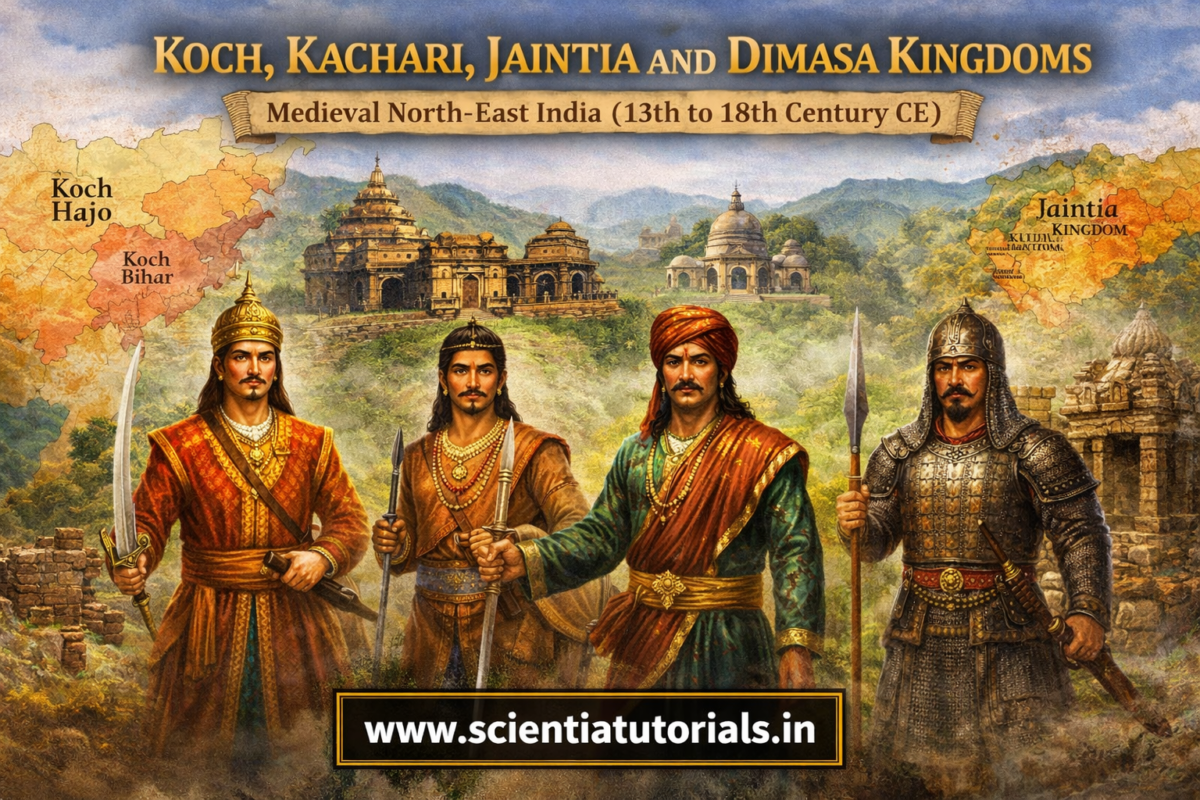

Koch, Kachari, Jaintia and Dimasa Kingdoms | Medieval North-East India
Course: History of North-East India: From Early Kingdoms to Modern Integration
Module IV: Late Medieval Period and the Rise of Indigenous States
Timeline / Era Covered: 13th Century CE – 18th Century CE
Lesson: Koch, Kachari, Jaintia, and Dimasa Kingdoms
This lesson is systematically organized into four clearly structured sections, as detailed below:
- Chronologically Structured Study Module
- Short-Answer Type Questions
- Long-Answer Type Questions
- Multiple-Choice Questions (MCQs) with Answers and Detailed Explanations
Chronologically Structured Study Module
Introduction: Indigenous State Formation in Late Medieval North-East India
The late medieval period in North-East India (13th–18th centuries CE) witnessed the rise of several powerful indigenous kingdoms that shaped the political, cultural, and economic history of the region. Alongside the Ahom State, kingdoms such as the Koch, Kachari, Jaintia, and Dimasa emerged from local socio-political traditions and adapted creatively to changing historical conditions.
These states were not peripheral or isolated entities. Instead, they actively interacted with neighboring powers such as the Ahoms, the Mughals, the Bengal Sultanate, and later the British. Their political systems reflected a synthesis of tribal roots, Hindu political culture, and regional adaptations, making them crucial for understanding state formation in North-East India.
This chronologically structured module examines these four kingdoms in a comparative and era-wise manner, focusing on their origins, expansion, administration, economy, culture, and historical significance.
I. Historical Background: Political Conditions in the Brahmaputra–Barak–Surma Region
Following the decline of early medieval powers like Kamarupa, the region fragmented into multiple tribal chiefdoms. Key features of this background included:
- Absence of a pan-regional centralized authority
- Dominance of tribal lineages with shifting cultivation
- Strategic river valleys facilitating mobility and trade
- Cultural interaction between hill and plain societies
From this milieu emerged indigenous kingdoms that gradually transformed tribal authority into territorial states.
II. The Koch Kingdom
1. Origins and Foundation (Early 16th Century CE)
The Koch Kingdom emerged in western Assam and northern Bengal during the early 16th century. Its foundation is closely associated with Biswa Singha, a leader of Koch tribal origin.
Biswa Singha rose to power by:
- Uniting Koch and allied tribes
- Defeating local Bhuyan chiefs
- Establishing a centralized monarchy
His coronation marked the transformation of a tribal confederacy into a powerful kingdom.
2. Expansion under Naranarayan and Chilarai
The Koch Kingdom reached its zenith under Naranarayan, assisted by his brilliant general Chilarai.
Key features of Koch expansion:
- Control over Kamrup, Goalpara, and parts of North Bengal
- Military expeditions against neighboring states
- Temporary dominance over large parts of the Brahmaputra Valley
The Koch State became a major regional power in the 16th century.
3. Administration and Culture
- Strong centralized monarchy
- Adoption of Hindu kingship and Brahmanical rituals
- Land grants to Brahmins and temples
- Patronage of Vaishnavism
Over time, the kingdom split into Koch Bihar and Koch Hajo, weakening its political strength.
4. Historical Significance
The Koch Kingdom acted as a bridge between tribal and classical Hindu polity, facilitating cultural integration and political consolidation in western Assam.
III. The Kachari Kingdom
1. Early History and Origins
The Kachari Kingdom was established by the Bodo-Kachari people, one of the oldest ethnic groups of Assam. Their early centers of power were located in:
- Dimapur
- Maibong (later capital)
The Kacharis represent continuity from ancient tribal chiefdoms to medieval statehood.
2. Political Development (13th–16th Century CE)
Initially practicing animistic traditions, the Kachari rulers gradually adopted Hindu customs due to contact with neighboring states.
Key developments:
- Construction of forts and capitals
- Expansion along the Dhansiri and Kopili river valleys
- Assertion of independence from Ahom pressure
3. Administration and Society
- King supported by nobles and clan chiefs
- Village-based administration
- Agrarian economy with shifting and settled cultivation
Despite military resilience, the Kachari State faced repeated conflicts with the Ahoms.
4. Decline
By the 18th century, Ahom expansion and internal weaknesses led to the absorption of Kachari territories into the Ahom State.
IV. The Dimasa Kingdom (Dimasa Kachari State)
1. Distinct Identity of the Dimasas
The Dimasas were a branch of the Kachari people who developed a distinct political identity. Their kingdom flourished mainly in:
- Central Assam
- Barak Valley
- North Cachar Hills
Their capitals shifted over time from Dimapur to Maibong and later Khaspur.
2. Political Organization
The Dimasa polity combined:
- Clan-based authority
- Hereditary kingship
- Strong ritual legitimacy
The king was supported by a council of elders representing major clans.
3. Relations with Other Powers
- Frequent conflicts with Ahoms
- Strategic alliances with hill tribes
- Control over trade routes between plains and hills
4. End of Dimasa Rule
The Dimasa Kingdom declined due to:
- Internal factionalism
- Ahom military pressure
- British intervention in the 19th century
However, Dimasa cultural identity survived beyond political decline.
V. The Jaintia Kingdom
1. Geographical and Cultural Setting
The Jaintia Kingdom emerged in the Jaintia Hills and Surma Valley (present-day Meghalaya and Bangladesh). Its strategic location enabled control over trade routes between Bengal and Assam.
2. Political Structure
The Jaintia rulers maintained:
- A monarchy supported by clan chiefs
- Strong religious authority linked to local deities
- Control over both hill and plain territories
The kingdom practiced a blend of indigenous beliefs and Hindu traditions.
3. Economic and Cultural Life
- Trade in limestone, forest products, and agricultural goods
- Cultural synthesis of hill and plain societies
- Use of customary laws and clan institutions
4. Decline and British Annexation
The Jaintia Kingdom weakened due to internal conflicts and British interference, leading to its annexation in the 19th century.
VI. Comparative Analysis of the Four Kingdoms
| Aspect | Koch | Kachari | Dimasa | Jaintia |
|---|---|---|---|---|
| Origin | Tribal → Hindu monarchy | Tribal polity | Clan-based monarchy | Hill–plain polity |
| Economy | Agrarian, trade | Agrarian | Trade & agriculture | Trade-oriented |
| Religion | Vaishnavism | Animism → Hinduism | Indigenous traditions | Indigenous + Hindu |
| Fate | Fragmentation | Absorbed by Ahoms | Decline & annexation | British annexation |
VII. Interaction with Larger Historical Forces
These kingdoms interacted with:
- Ahom expansion
- Mughal incursions
- Bengal Sultanate
- British colonial power
Such interactions shaped their military strategies, diplomacy, and administrative reforms.
VIII. Historical Significance of Indigenous Kingdoms
The Koch, Kachari, Jaintia, and Dimasa kingdoms are historically significant because they:
- Represent indigenous state formation
- Preserved ethnic and cultural identities
- Acted as intermediaries between hills and plains
- Laid foundations for modern regional identities
They demonstrate that North-East India had dynamic political systems, not static tribal societies.
Conclusion
The Koch, Kachari, Jaintia, and Dimasa kingdoms collectively illustrate the rich and complex history of late medieval North-East India. Emerging from tribal roots, these states developed sophisticated political structures adapted to regional geography and cultural diversity. Their histories challenge simplistic narratives of marginality and highlight indigenous agency in state formation.
Understanding these kingdoms is essential for appreciating the broader process of regional integration, cultural synthesis, and political evolution in North-East India from the 13th to the 18th centuries.
Examination-Oriented Key Takeaways
- Indigenous kingdoms emerged from tribal societies
- Koch Kingdom became a major 16th-century power
- Kachari and Dimasa states show continuity of Bodo polity
- Jaintia Kingdom linked hill–plain trade networks
- These states shaped Assam’s medieval political landscape
Short Answer Type Questions with Answers
1. In which period did the Koch, Kachari, Jaintia, and Dimasa kingdoms flourish?
Answer:
These kingdoms flourished during the late medieval period, roughly between the 13th and 18th centuries CE.
2. Who founded the Koch Kingdom?
Answer:
The Koch Kingdom was founded by Biswa Singha in the early 16th century CE.
3. Which region did the Koch Kingdom mainly control?
Answer:
The Koch Kingdom mainly controlled western Assam and parts of northern Bengal.
4. Name the Koch ruler under whom the kingdom reached its peak.
Answer:
The Koch Kingdom reached its peak under Naranarayan, assisted by his general Chilarai.
5. Who was Chilarai?
Answer:
Chilarai was the famous military general of the Koch Kingdom known for rapid and successful campaigns.
6. What caused the decline of the Koch Kingdom?
Answer:
The Koch Kingdom declined mainly due to internal division into Koch Bihar and Koch Hajo and external pressures.
7. Which ethnic group founded the Kachari Kingdom?
Answer:
The Kachari Kingdom was founded by the Bodo-Kachari ethnic group.
8. Name one early capital of the Kachari Kingdom.
Answer:
Dimapur was one of the early capitals of the Kachari Kingdom.
9. What was the main economic base of the Kachari Kingdom?
Answer:
The Kachari economy was mainly agrarian, based on both shifting and settled cultivation.
10. Who were the Dimasas?
Answer:
The Dimasas were a branch of the Kachari people who established a distinct kingdom in central Assam and the Barak Valley.
11. Name one capital of the Dimasa Kingdom.
Answer:
Maibong was one of the important capitals of the Dimasa Kingdom.
12. What type of political system existed in the Dimasa Kingdom?
Answer:
The Dimasa Kingdom followed a hereditary monarchy supported by clan councils.
13. Which areas were ruled by the Dimasa Kingdom?
Answer:
The Dimasa Kingdom ruled parts of central Assam, the Barak Valley, and the North Cachar Hills.
14. Where was the Jaintia Kingdom located?
Answer:
The Jaintia Kingdom was located in the Jaintia Hills and Surma Valley region.
15. Why was the location of the Jaintia Kingdom strategically important?
Answer:
Its location allowed control over trade routes between Bengal and Assam.
16. What was the main economic activity of the Jaintia Kingdom?
Answer:
Trade in limestone, forest products, and agricultural goods formed the main economic activity.
17. What type of religion was followed in the Jaintia Kingdom?
Answer:
The Jaintia Kingdom followed a blend of indigenous religious practices and Hindu traditions.
18. How did Hindu influence spread among these indigenous kingdoms?
Answer:
Hindu influence spread through contact with neighboring plains kingdoms, Brahmins, and Vaishnavite movements.
19. Which kingdom acted as a bridge between tribal and Hindu political culture?
Answer:
The Koch Kingdom acted as a bridge between tribal traditions and Hindu monarchy.
20. How were these kingdoms different from early tribal chiefdoms?
Answer:
They had centralized authority, defined territories, and structured administration, unlike loosely organized tribal chiefdoms.
21. Which kingdom maintained strong hill–plain interactions?
Answer:
The Jaintia Kingdom maintained strong hill–plain interactions through trade and political control.
22. What led to the decline of the Kachari and Dimasa kingdoms?
Answer:
Their decline was caused by Ahom expansion, internal conflicts, and later British intervention.
23. Which major power influenced the politics of all these kingdoms?
Answer:
The Ahom State significantly influenced the politics of the Koch, Kachari, Dimasa, and Jaintia kingdoms.
24. Why are these kingdoms considered indigenous states?
Answer:
They emerged from local tribal societies and developed their own political systems without foreign origin.
25. State one historical significance of these kingdoms.
Answer:
They demonstrate indigenous state formation and cultural continuity in late medieval North-East India.
Long Answer Type Questions with Answers
(Based on: Koch, Kachari, Jaintia, and Dimasa Kingdoms)
1. Analyse the historical conditions that led to the rise of indigenous kingdoms in late medieval North-East India.
Answer:
The decline of early medieval powers such as Kamarupa created a political vacuum in the Brahmaputra, Barak, and Surma valleys. This vacuum was filled by tribal chiefdoms that gradually evolved into organized states. Factors such as fertile river valleys, strategic hill–plain interaction zones, and expanding agrarian economies contributed to state formation. The Koch, Kachari, Jaintia, and Dimasa kingdoms emerged from indigenous societies that adapted tribal authority into centralized political systems while responding to regional and external pressures.
2. Discuss the origin and foundation of the Koch Kingdom.
Answer:
The Koch Kingdom emerged in the early 16th century in western Assam and northern Bengal. It was founded by Biswa Singha, who unified scattered Koch tribes and defeated local Bhuyan chiefs. His coronation symbolized the transition from tribal leadership to kingship. The foundation of the Koch State represents a classic example of tribal polity transforming into a territorial kingdom under centralized authority.
3. Examine the expansion of the Koch Kingdom under Naranarayan and Chilarai.
Answer:
The Koch Kingdom reached its political and military zenith under Naranarayan, aided by his general Chilarai. Chilarai’s swift military campaigns expanded Koch control over Kamrup, Goalpara, and parts of North Bengal. The Koch State briefly emerged as a dominant power in the Brahmaputra Valley, influencing regional politics and culture during the 16th century.
4. Describe the administrative structure of the Koch Kingdom.
Answer:
The Koch administration was highly centralized, with the king as the supreme authority. Hindu political ideals were adopted, and Brahmins played an important role in legitimizing kingship. Land grants to temples and officials strengthened administrative control. However, over-centralization and succession disputes later weakened the kingdom, leading to its division into Koch Bihar and Koch Hajo.
5. Evaluate the historical significance of the Koch Kingdom.
Answer:
The Koch Kingdom is historically significant for bridging tribal political traditions with Hindu monarchy. It facilitated cultural integration in western Assam and acted as a transitional power between tribal societies and structured state systems. Its military and administrative achievements left a lasting imprint on regional history.
6. Trace the origin and early development of the Kachari Kingdom.
Answer:
The Kachari Kingdom was founded by the Bodo-Kachari people, one of the earliest inhabitants of Assam. Initially centered at Dimapur, the kingdom developed from clan-based authority into a territorial polity. The Kacharis practiced indigenous religion but gradually adopted Hindu customs through interaction with neighboring states, reflecting cultural assimilation without complete loss of identity.
7. Analyse the political organization of the Kachari Kingdom.
Answer:
The Kachari king ruled with the support of nobles and clan chiefs. Administration remained decentralized at the village level, reflecting tribal roots. Fortified capitals and control over river valleys strengthened political authority. Despite these features, frequent conflicts with the Ahoms constrained long-term expansion.
8. Discuss the causes for the decline of the Kachari Kingdom.
Answer:
The Kachari Kingdom declined due to sustained Ahom military pressure, internal political instability, and limited administrative centralization. By the 18th century, much of Kachari territory was absorbed into the Ahom State, ending its independent existence.
9. Examine the emergence of the Dimasa Kingdom as a distinct political entity.
Answer:
The Dimasa Kingdom emerged as a branch of the Kachari polity, developing a separate identity in central Assam, the Barak Valley, and the North Cachar Hills. Capitals shifted from Dimapur to Maibong and later Khaspur, reflecting adaptability to political and geographical conditions. The Dimasas maintained strong clan traditions alongside monarchy.
10. Describe the administrative system of the Dimasa Kingdom.
Answer:
The Dimasa administration was based on hereditary kingship supported by councils representing major clans. Authority was both political and ritual in nature. This system ensured internal cohesion but also limited administrative flexibility during periods of external pressure.
11. Analyse the economic base of the Dimasa Kingdom.
Answer:
The Dimasa economy relied on agriculture, forest resources, and control of trade routes linking hills and plains. Their strategic location enabled economic interaction with neighboring regions, strengthening state resources.
12. Discuss the relationship between the Dimasa Kingdom and the Ahom State.
Answer:
Relations between the Dimasa and Ahom states were marked by conflict and competition over territory. Ahom expansion gradually weakened Dimasa power, leading to political decline by the late 18th century.
13. Trace the origin and geographical setting of the Jaintia Kingdom.
Answer:
The Jaintia Kingdom emerged in the Jaintia Hills and Surma Valley region. Its geography enabled control over important trade routes between Bengal and Assam, making it a key intermediary power between hill and plain societies.
14. Explain the political structure of the Jaintia Kingdom.
Answer:
The Jaintia polity consisted of a monarchy supported by clan chiefs. Religious authority was closely linked with kingship, reinforcing legitimacy. The state controlled both hill territories and plains, ensuring economic and strategic advantage.
15. Discuss the economic activities of the Jaintia Kingdom.
Answer:
Trade formed the backbone of the Jaintia economy. Limestone, forest products, and agricultural goods were exchanged with neighboring regions. This trade-oriented economy strengthened hill–plain interaction.
16. Examine the religious practices of the Jaintia Kingdom.
Answer:
The Jaintia Kingdom practiced a synthesis of indigenous beliefs and Hindu traditions. Local deities were worshipped alongside Hindu rituals, reflecting cultural continuity and adaptation.
17. Compare the Koch and Kachari kingdoms in terms of political development.
Answer:
While the Koch Kingdom rapidly adopted Hindu kingship and centralized administration, the Kachari Kingdom retained stronger tribal features. The Koch State achieved greater territorial expansion, whereas the Kachari polity emphasized continuity and localized authority.
18. Compare the Dimasa and Jaintia kingdoms.
Answer:
Both kingdoms balanced indigenous traditions with external influences. The Dimasa Kingdom focused more on clan-based governance, while the Jaintia Kingdom emphasized trade and hill–plain integration. Their political evolution reflects regional diversity in state formation.
19. Assess the impact of Ahom expansion on these indigenous kingdoms.
Answer:
Ahom expansion reshaped the political landscape by absorbing or weakening neighboring states. While it limited the independence of Koch, Kachari, and Dimasa polities, it also facilitated administrative integration and regional stability.
20. Evaluate the overall historical significance of the Koch, Kachari, Jaintia, and Dimasa kingdoms.
Answer:
These kingdoms demonstrate that late medieval North-East India was marked by indigenous state formation rather than political stagnation. They preserved ethnic identities, facilitated cultural synthesis, and laid the foundations for regional political traditions. Their histories challenge marginal narratives and highlight indigenous agency in Indian history.
Multiple Choice Questions (MCQs) with Answers and Explanations
1. The Koch Kingdom emerged prominently during which century?
A. 13th century CE
B. 14th century CE
C. 15th century CE
D. 16th century CE
Correct Answer: D
Explanation:
The Koch Kingdom rose to prominence in the early 16th century CE, particularly under Biswa Singha and later Naranarayan, marking a major phase of indigenous state formation in western Assam.
2. Who founded the Koch Kingdom?
A. Naranarayan
B. Chilarai
C. Biswa Singha
D. Sukaphaa
Correct Answer: C
Explanation:
Biswa Singha unified Koch tribes and defeated Bhuyan chiefs, transforming a tribal confederacy into a centralized kingdom.
3. The Koch Kingdom reached its greatest expansion under:
A. Biswa Singha
B. Naranarayan
C. Pratap Singha
D. Rudra Singha
Correct Answer: B
Explanation:
Under Naranarayan, with military support from Chilarai, the Koch Kingdom expanded across western Assam, Kamrup, and parts of North Bengal.
4. Chilarai is best known in history as:
A. A religious reformer
B. A Koch administrator
C. A Bhuyan chief
D. Chilarai
Correct Answer: D
Explanation:
Chilarai was the celebrated general of the Koch Kingdom, famous for swift military campaigns that greatly expanded Koch territory.
5. The Koch Kingdom declined mainly due to:
A. Mughal invasions
B. Natural disasters
C. Internal division
D. Trade decline
Correct Answer: C
Explanation:
The division of the Koch Kingdom into Koch Bihar and Koch Hajo weakened central authority and hastened political decline.
6. The Kachari Kingdom was founded by which ethnic group?
A. Tai-Ahoms
B. Koch
C. Khasi
D. Bodo-Kachari
Correct Answer: D
Explanation:
The Kachari Kingdom was founded by the Bodo-Kachari people, one of the earliest inhabitants of the Brahmaputra Valley.
7. Which of the following was an early capital of the Kachari Kingdom?
A. Khaspur
B. Garhgaon
C. Dimapur
D. Rangpur
Correct Answer: C
Explanation:
Dimapur served as an early capital of the Kachari Kingdom and remains an important archaeological site today.
8. The Kachari economy was primarily based on:
A. Maritime trade
B. Mining
C. Pastoralism
D. Agriculture
Correct Answer: D
Explanation:
Agriculture, including both shifting and settled cultivation, formed the backbone of the Kachari economy.
9. Which factor most contributed to the decline of the Kachari Kingdom?
A. Mughal expansion
B. Ahom military pressure
C. British annexation
D. Religious conflict
Correct Answer: B
Explanation:
Sustained military pressure and territorial expansion by the Ahoms gradually absorbed Kachari territories.
10. The Dimasa Kingdom originated as:
A. A Mughal province
B. A Koch offshoot
C. A branch of the Kachari polity
D. A Jaintia colony
Correct Answer: C
Explanation:
The Dimasa Kingdom emerged as a distinct branch of the Kachari people, developing an independent political identity.
11. Which of the following was a capital of the Dimasa Kingdom?
A. Dimapur
B. Maibong
C. Rangpur
D. Goalpara
Correct Answer: B
Explanation:
Maibong served as a major capital of the Dimasa Kingdom before the capital later shifted to Khaspur.
12. Dimasa political organization was characterized by:
A. Mughal-style mansabdari
B. Clan-based monarchy
C. Republican councils
D. Feudal zamindars
Correct Answer: B
Explanation:
Dimasa administration combined hereditary kingship with clan councils, reflecting strong tribal traditions.
13. The Dimasa Kingdom controlled which regions?
A. Western Assam and Bengal
B. Jaintia Hills only
C. Central Assam, Barak Valley, and North Cachar Hills
D. Entire Brahmaputra Valley
Correct Answer: C
Explanation:
The Dimasa Kingdom extended across central Assam, the Barak Valley, and hill regions, enabling control over hill–plain trade routes.
14. The Jaintia Kingdom was located mainly in:
A. Upper Brahmaputra Valley
B. Jaintia Hills and Surma Valley
C. Barak Valley only
D. North Bengal
Correct Answer: B
Explanation:
The Jaintia Kingdom was centered in the Jaintia Hills with control over parts of the Surma Valley, facilitating trade.
15. The strategic importance of the Jaintia Kingdom lay in its control over:
A. Coastal trade
B. Himalayan passes
C. Riverine warfare
D. Hill–plain trade routes
Correct Answer: D
Explanation:
The Jaintia Kingdom acted as a crucial intermediary between hill societies and the plains of Bengal and Assam.
16. Which product was an important trade item of the Jaintia Kingdom?
A. Salt
B. Limestone
C. Cotton textiles
D. Spices
Correct Answer: B
Explanation:
Limestone, along with forest products and agricultural goods, formed a major component of Jaintia trade.
17. Religious life in the Jaintia Kingdom was characterized by:
A. Strict Buddhism
B. Islamization
C. Indigenous beliefs mixed with Hinduism
D. Complete Brahmanization
Correct Answer: C
Explanation:
The Jaintia Kingdom practiced a syncretic religion, combining indigenous traditions with Hindu rituals.
18. Which of the following kingdoms best illustrates the transition from tribal polity to Hindu monarchy?
A. Jaintia
B. Dimasa
C. Kachari
D. Koch
Correct Answer: D
Explanation:
The Koch Kingdom clearly demonstrates the transformation from tribal leadership to centralized Hindu kingship.
19. The political systems of these kingdoms show continuity from:
A. Mauryan administration
B. Gupta feudalism
C. Indigenous tribal institutions
D. Mughal bureaucracy
Correct Answer: C
Explanation:
All four kingdoms evolved from indigenous tribal institutions, adapting them into state structures.
20. Which major power most influenced the politics of the Kachari and Dimasa kingdoms?
A. Bengal Sultanate
B. Mughal Empire
C. Ahom State
D. British East India Company
Correct Answer: C
Explanation:
Ahom expansion significantly reshaped the political boundaries and fortunes of both the Kachari and Dimasa states.
21. The decline of the Jaintia Kingdom was closely linked with:
A. Ahom conquest
B. Mughal invasion
C. British intervention
D. Koch expansion
Correct Answer: C
Explanation:
British interference in the 19th century led to the eventual annexation of the Jaintia Kingdom.
22. Which kingdom had the strongest hill–plain interaction?
A. Koch
B. Kachari
C. Dimasa
D. Jaintia
Correct Answer: D
Explanation:
The Jaintia Kingdom controlled both hill regions and plains, making hill–plain interaction central to its economy and politics.
23. These kingdoms are termed “indigenous” because they:
A. Rejected Hindu culture
B. Had no foreign contact
C. Emerged from local societies
D. Were isolated from India
Correct Answer: C
Explanation:
They arose from local tribal societies and developed region-specific political systems.
24. Which feature is common to all four kingdoms?
A. Mughal-style administration
B. Maritime economy
C. Tribal origins
D. Buddhist religious dominance
Correct Answer: C
Explanation:
All four kingdoms originated from tribal societies and later evolved into structured states.
25. Historically, these kingdoms are important because they:
A. Remained politically static
B. Show indigenous state formation
C. Rejected external influences
D. Were colonial creations
Correct Answer: B
Explanation:
The Koch, Kachari, Dimasa, and Jaintia kingdoms collectively demonstrate indigenous political innovation and state formation in late medieval North-East India.