
Centre–State Relations in North-East India
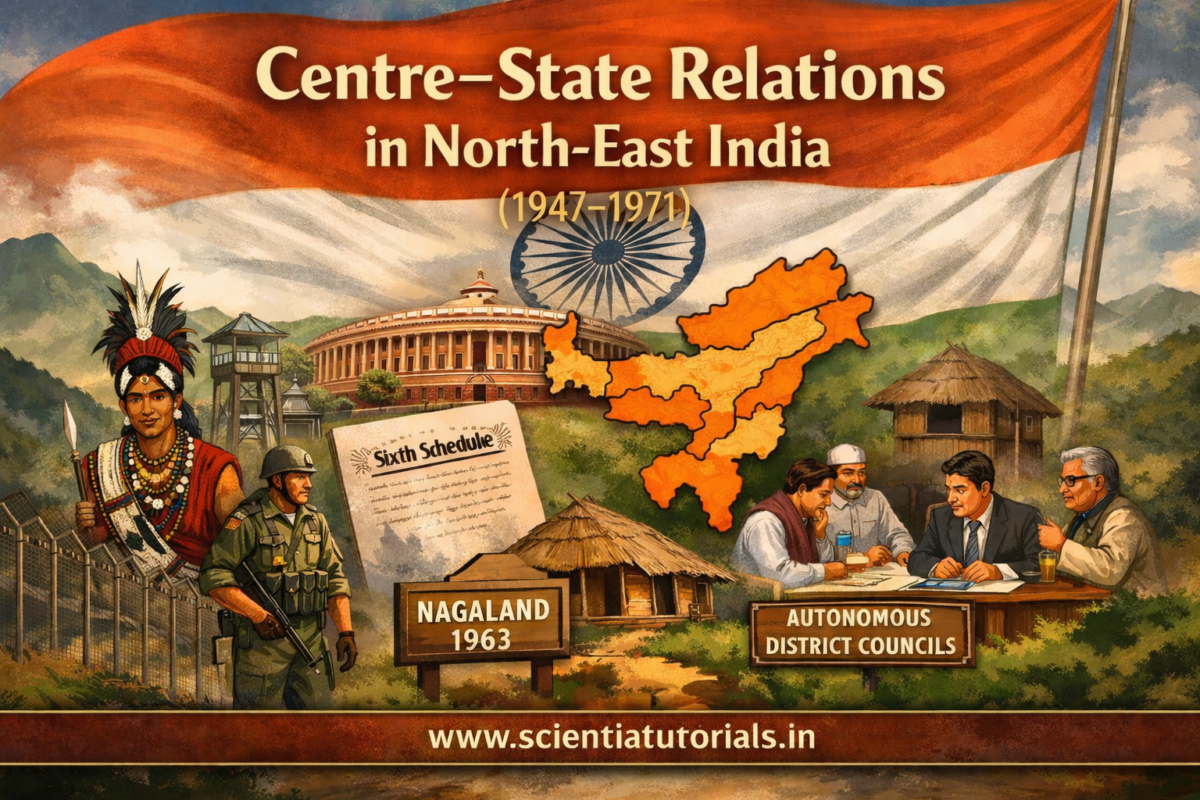

Centre–State Relations in North-East India (1947–1971) | History Notes
Course: History of North-East India: From Early Kingdoms to Modern Integration
Module VIII: Post-Independence Integration and State Formation
Timeline / Era Covered: 1947 CE – 1971 CE
Lesson: Centre–State Relations in North-East India
This lesson is systematically organized into four clearly structured sections, as detailed below:
- Chronologically Structured Study Module
- Short-Answer Type Questions
- Long-Answer Type Questions
- Multiple-Choice Questions (MCQs) with Answers and Detailed Explanations
Chronologically Structured Study Module
Introduction
The period between 1947 CE and 1971 CE marks one of the most critical phases in the political and constitutional history of North-East India. The end of British colonial rule and the emergence of independent India created new challenges of territorial integration, administrative reorganisation, and political accommodation. The North-East, characterised by ethnic diversity, difficult terrain, colonial administrative legacies, and limited integration with the nationalist movement, required special constitutional, administrative, and political arrangements.
Centre–State relations in the North-East during this period were shaped by the Indian Union’s dual objectives:
- Preserving national unity and sovereignty, and
- Accommodating regional aspirations, tribal autonomy, and cultural distinctiveness.
This lesson examines how the Indian state managed Centre–State relations in the North-East through constitutional provisions, administrative practices, political negotiations, and security measures between 1947 and 1971, culminating in the reorganisation of the region into multiple states.
Historical Background: Colonial Legacy and the North-East (Pre-1947 Context)
Before independence, the North-East was governed under exceptional colonial administrative frameworks. Areas such as the Naga Hills, Lushai Hills, and North-East Frontier Tracts were treated as “Excluded” or “Partially Excluded Areas”, with minimal political participation and limited integration with mainstream Indian administration.
Key features of the colonial legacy included:
- Indirect rule through tribal chiefs and councils
- Limited infrastructure and political institutions
- Artificial boundaries separating ethnic groups
- Administrative isolation from the rest of India
As a result, at independence, the Indian leadership faced the challenge of integrating a region that had little experience of representative governance and strong traditions of local autonomy.
Constitutional Framework and the Foundations of Centre–State Relations
Adoption of the Constitution of India
The adoption of the Constitution in 1950 laid the legal foundation for Centre–State relations in the North-East. Unlike other regions, the Constitution recognised the unique socio-cultural and political conditions of tribal areas.
Key constitutional features affecting Centre–State relations included:
- A strong Union government with extensive powers
- Special provisions for tribal and frontier regions
- Flexibility for asymmetric federalism
The Sixth Schedule and Autonomous Governance
One of the most significant constitutional innovations for the North-East was the Sixth Schedule, applicable to tribal areas of Assam (later extended to other states).
Key features:
- Creation of Autonomous District Councils (ADCs)
- Legislative, executive, and judicial powers over land, customs, forests, and local governance
- Limited interference by state legislatures
Impact on Centre–State Relations:
- Strengthened the Centre’s role as the guarantor of tribal autonomy
- Reduced the authority of state governments in scheduled areas
- Created a three-tier power structure: Centre – State – Autonomous Councils
While intended to protect tribal interests, this arrangement sometimes generated tensions between state governments and local institutions, indirectly increasing the Centre’s influence.
Early Post-Independence Phase (1947–1956): Integration and Control
Administrative Continuity and Central Oversight
In the immediate post-independence years, the Indian government adopted a cautious and centralised approach toward the North-East. Concerns over:
- Border security (China and Myanmar frontiers)
- Ethnic movements
- Weak administrative capacity
led to greater central intervention.
Key characteristics:
- Retention of colonial administrative practices
- Direct control over frontier areas through centrally appointed officials
- Limited role of elected state governments
Naga National Movement and Central Intervention
The Naga issue became the first major test of Centre–State relations in the region.
Developments:
- Demand for sovereignty by Naga leaders
- Breakdown of negotiations with the Assam government
- Imposition of security measures by the Centre
The Centre increasingly bypassed the Assam government, dealing directly with Naga leaders. This marked a shift where the Centre emerged as the principal negotiator and authority in sensitive political matters.
States Reorganisation and Its Impact (1956)
The States Reorganisation Act, 1956, based primarily on linguistic principles, had limited applicability in the North-East.
Consequences for Centre–State relations:
- Assam remained a large composite state
- Tribal aspirations were not fully addressed
- Dissatisfaction grew among hill tribes
As a result, the Centre retained extraordinary powers to manage political discontent, reinforcing central dominance over regional administration.
The Era of Political Negotiation and State Formation (1957–1963)
Emergence of New Political Demands
During this period, political consciousness expanded rapidly due to:
- Spread of education
- Missionary influence
- Exposure to democratic institutions
Various groups demanded:
- Separate states
- Greater autonomy
- Protection of ethnic identity
Formation of Nagaland (1963)
The creation of Nagaland marked a turning point in Centre–State relations.
Key features:
- Direct negotiations between the Centre and Naga leaders
- Minimal role of Assam in decision-making
- Special constitutional protections under Article 371A
Significance:
- Established the Centre as the decisive authority in state formation
- Set a precedent for bilateral Centre–region negotiations
- Reduced the authority of parent states
Security, Development, and Centralisation (1960s)
Law and Order and the Armed Forces Special Powers Act
Persistent insurgency led to the deployment of central armed forces and the enforcement of special security laws.
Implications for Centre–State relations:
- State governments had limited control over security policy
- Central agencies dominated law and order in disturbed areas
- Civil administration operated under security constraints
This reinforced the perception of the Centre as both protector and controller.
Developmental Planning and Central Assistance
The Centre increasingly used economic planning as a tool of integration.
Key aspects:
- Central grants and centrally sponsored schemes
- Special development packages for hill areas
- Establishment of regional institutions
While development funding strengthened infrastructure, it also:
- Increased fiscal dependence on the Centre
- Limited state autonomy in economic planning
Creation of Meghalaya, Manipur, and Tripura (1970–1972)
Meghalaya (1972)
Originally an autonomous state within Assam, Meghalaya’s elevation to full statehood resulted from:
- Persistent ethnic demands
- Failure of Assam to accommodate hill aspirations
The Centre again played the decisive role, highlighting:
- Weak inter-state negotiation mechanisms
- Strong central arbitration
Manipur and Tripura
Manipur and Tripura transitioned from Union Territories to full states.
Key characteristics:
- Direct administrative control by the Centre prior to statehood
- Gradual introduction of representative institutions
- Continued central influence after state formation
Centre–State Relations: Key Features and Trends (1947–1971)
1. Asymmetric Federalism
The North-East experienced a non-uniform federal structure, with varying degrees of autonomy.
2. Centralised Decision-Making
Major political decisions were taken by the Centre, often bypassing state governments.
3. Security-Driven Governance
Law and order considerations frequently overrode democratic processes.
4. Negotiated State Formation
Statehood emerged through political negotiation rather than linguistic reorganisation.
5. Fiscal Dependence
Heavy reliance on central grants limited state-level economic autonomy.
Critical Evaluation
While the Centre’s approach succeeded in territorial integration, it also generated long-term challenges:
Positive Outcomes:
- Preservation of India’s territorial integrity
- Recognition of tribal identities
- Creation of multiple states for better governance
Limitations:
- Weak federal culture
- Alienation caused by excessive central control
- Over-securitisation of political issues
These contradictions continue to influence Centre–State relations in the region even today.
Conclusion
Between 1947 and 1971, Centre–State relations in North-East India evolved through a complex interplay of constitutional innovation, political negotiation, security management, and administrative centralisation. The Indian state adopted a pragmatic but centralised strategy to integrate a historically distinct and politically sensitive region.
The creation of new states, special constitutional provisions, and autonomous institutions reflected an attempt to balance unity with diversity. However, the dominance of the Centre in decision-making limited the development of a genuinely cooperative federal structure.
Understanding this phase is essential for comprehending contemporary political dynamics in the North-East and the continuing debates over autonomy, identity, and federalism in India.
Short Answer Type Questions
Lesson: Centre–State Relations in North-East India (1947–1971)
1. What was the main challenge in Centre–State relations in North-East India after 1947?
Answer:
The main challenge was integrating a politically distinct, ethnically diverse, and administratively isolated region into the Indian Union while respecting tribal autonomy and maintaining national unity.
2. How did colonial administrative policies affect post-independence Centre–State relations in the North-East?
Answer:
Colonial policies created isolated tribal areas with limited political institutions, forcing independent India to adopt special constitutional and administrative arrangements to integrate the region.
3. What role did the Constitution of India play in shaping Centre–State relations in the North-East?
Answer:
The Constitution provided special provisions such as the Sixth Schedule and asymmetric federal arrangements to accommodate the unique political and cultural conditions of the North-East.
4. What is the Sixth Schedule of the Constitution?
Answer:
The Sixth Schedule provides for Autonomous District Councils in tribal areas, granting them legislative, executive, and judicial powers over local governance, land, and customs.
5. Why did the Sixth Schedule strengthen the role of the Centre?
Answer:
It reduced the authority of state governments in tribal areas and positioned the Centre as the protector and guarantor of tribal autonomy.
6. How did security concerns influence Centre–State relations in the early post-independence period?
Answer:
Border threats, insurgency, and internal unrest led to increased central control over administration, policing, and law and order in the North-East.
7. Why was Assam’s role weakened in Centre–State relations after independence?
Answer:
The Centre often bypassed Assam while dealing directly with hill tribes and insurgent groups, reducing the state’s authority in regional political matters.
8. How did the Naga political movement affect Centre–State relations?
Answer:
The Naga movement led the Centre to directly negotiate with Naga leaders, establishing a precedent for central intervention over state authority.
9. What was the significance of the creation of Nagaland in 1963?
Answer:
Nagaland’s creation marked a shift toward negotiated state formation and reinforced the Centre’s dominant role in resolving regional political demands.
10. Why did the States Reorganisation Act, 1956 have limited impact in the North-East?
Answer:
The Act focused on linguistic reorganisation, while North-East demands were primarily ethnic, tribal, and political rather than linguistic.
11. What is meant by “asymmetric federalism” in the North-East?
Answer:
It refers to unequal distribution of powers among states, where North-Eastern states enjoyed special constitutional provisions not available to other states.
12. How did development planning affect Centre–State relations in the region?
Answer:
Central grants and sponsored schemes increased development but also made states financially dependent on the Centre.
13. Why did the Centre retain strong control over law and order in the North-East?
Answer:
Persistent insurgency and border sensitivity required central forces and security laws, limiting state control over internal security.
14. What role did Union Territories play in Centre–State relations?
Answer:
Union Territories like Manipur and Tripura were administered directly by the Centre, strengthening central authority before their elevation to statehood.
15. Why was Meghalaya initially created as an autonomous state within Assam?
Answer:
It was an interim arrangement to accommodate hill tribal aspirations without immediate full statehood.
16. How did the creation of Meghalaya reflect Centre–State dynamics?
Answer:
It showed the Centre acting as an arbitrator between ethnic demands and state resistance, reinforcing central dominance.
17. What was the impact of central intervention on democratic processes in the North-East?
Answer:
Excessive central control sometimes weakened local democratic institutions and political participation.
18. How did fiscal dependence shape Centre–State relations?
Answer:
Limited local revenue sources forced states to rely heavily on central funds, reducing economic autonomy.
19. What was the Centre’s approach towards state formation in the North-East?
Answer:
The Centre adopted a negotiated and case-by-case approach rather than uniform reorganisation.
20. Why did Centre–State relations remain tense during this period?
Answer:
Conflicting priorities of national security, ethnic autonomy, and democratic governance created persistent tensions.
21. How did tribal identity influence Centre–State relations?
Answer:
Protection of tribal customs and land rights required special constitutional safeguards, reshaping federal relations.
22. What role did central administrators play in frontier areas?
Answer:
They exercised direct authority on behalf of the Centre, often limiting state-level decision-making.
23. How did Centre–State relations differ in the North-East compared to mainland India?
Answer:
The North-East experienced stronger central control and special provisions, unlike the relatively uniform federal structure elsewhere.
24. What was the long-term consequence of centralised governance in the region?
Answer:
While ensuring integration, it also contributed to political alienation and prolonged conflicts.
25. Why is the study of Centre–State relations in the North-East important?
Answer:
It helps explain contemporary issues of autonomy, federalism, and political instability in the region.
MCQs with Answers and Explanations
Lesson: Centre–State Relations in North-East India (1947–1971)
1. The primary objective of Centre–State relations in North-East India after 1947 was to
A. Promote linguistic uniformity
B. Ensure rapid industrialisation
C. Integrate the region while preserving tribal autonomy
D. Abolish traditional institutions
Correct Answer: C
Explanation:
Post-independence policy focused on integrating the North-East into the Indian Union while protecting tribal identity, customs, and land rights, rather than imposing uniform political or cultural models.
2. Which colonial administrative feature most influenced post-independence Centre–State relations in the North-East?
A. Permanent Settlement
B. Indirect rule through princely states
C. Excluded and Partially Excluded Areas
D. Ryotwari system
Correct Answer: C
Explanation:
Large parts of the North-East were governed as Excluded or Partially Excluded Areas, creating administrative isolation and weak political institutions that required special post-independence arrangements.
3. The Sixth Schedule of the Constitution of India primarily aims to
A. Strengthen state legislatures
B. Protect tribal self-governance
C. Promote linguistic reorganisation
D. Centralise administration
Correct Answer: B
Explanation:
The Sixth Schedule provides autonomy to tribal areas through Autonomous District Councils, safeguarding tribal customs, land, and local governance.
4. The introduction of the Sixth Schedule resulted in
A. Complete withdrawal of the Centre
B. Strengthening of state governments
C. A three-tier governance structure
D. Abolition of customary laws
Correct Answer: C
Explanation:
Governance operated at three levels—Centre, State, and Autonomous District Councils—making Centre–State relations more complex.
5. Why did the Centre exercise greater control over the North-East in the early post-independence period?
A. Economic prosperity
B. Border sensitivity and insurgency
C. Linguistic diversity
D. Strong state governments
Correct Answer: B
Explanation:
Strategic borders with China and Myanmar and emerging insurgent movements compelled the Centre to retain strong administrative and security control.
6. Which movement first compelled the Centre to bypass a state government and negotiate directly with regional leaders?
A. Mizo movement
B. Khasi movement
C. Naga movement
D. Assamese language movement
Correct Answer: C
Explanation:
The Naga movement led the Centre to negotiate directly with Naga leaders, reducing Assam’s role and setting a precedent for central intervention.
7. The role of Assam in Centre–State relations after 1947 can best be described as
A. Dominant and decisive
B. Completely autonomous
C. Gradually marginalised
D. Constitutionally strengthened
Correct Answer: C
Explanation:
Although Assam initially administered much of the region, its authority declined as the Centre directly managed hill areas and political negotiations.
8. The States Reorganisation Act, 1956 had limited impact in the North-East because
A. It ignored administrative efficiency
B. It focused mainly on linguistic criteria
C. The region was already fully integrated
D. States opposed reorganisation
Correct Answer: B
Explanation:
North-Eastern demands were ethnic and tribal rather than linguistic, making the Act less relevant to regional aspirations.
9. The creation of Nagaland in 1963 signified
A. Linguistic reorganisation
B. Centralised annexation
C. Negotiated state formation
D. Judicial intervention
Correct Answer: C
Explanation:
Nagaland was formed through political negotiations between the Centre and regional leaders, not through uniform reorganisation principles.
10. Which concept best explains the unequal distribution of powers in the North-East?
A. Cooperative federalism
B. Competitive federalism
C. Asymmetric federalism
D. Dual federalism
Correct Answer: C
Explanation:
Asymmetric federalism allows special provisions and varying degrees of autonomy for certain regions based on historical and cultural factors.
11. Why did security laws increase central dominance in the North-East during the 1960s?
A. State governments demanded it
B. Economic reforms failed
C. Insurgency threatened national unity
D. Judiciary intervened
Correct Answer: C
Explanation:
Insurgency and secessionist movements led to the deployment of central forces and special laws, limiting state control over law and order.
12. Development planning in the North-East primarily resulted in
A. Complete state autonomy
B. Fiscal independence
C. Increased dependence on the Centre
D. Decline of infrastructure
Correct Answer: C
Explanation:
Heavy reliance on central grants and schemes increased fiscal dependence, strengthening the Centre’s influence.
13. Union Territories like Manipur and Tripura were initially created to
A. Weaken regional identity
B. Enable direct central administration
C. Promote linguistic unity
D. Abolish tribal councils
Correct Answer: B
Explanation:
Union Territory status allowed the Centre to directly administer politically sensitive regions before granting statehood.
14. Meghalaya was initially created as
A. A Union Territory
B. A linguistic state
C. An autonomous state within Assam
D. A centrally administered area
Correct Answer: C
Explanation:
Meghalaya began as an autonomous state to address hill tribal aspirations without immediate separation from Assam.
15. The Centre’s role in the formation of Meghalaya shows
A. State dominance
B. Judicial supremacy
C. Central arbitration
D. Linguistic compromise
Correct Answer: C
Explanation:
The Centre acted as an arbitrator between Assam and hill leaders, reinforcing central authority.
16. Which factor most limited cooperative federalism in the North-East?
A. Strong local governments
B. Excessive decentralisation
C. Centralised decision-making
D. Economic self-sufficiency
Correct Answer: C
Explanation:
Major decisions were taken by the Centre, leaving little room for equal Centre–State partnership.
17. Tribal identity influenced Centre–State relations mainly through
A. Industrial policy
B. Electoral reforms
C. Constitutional safeguards
D. Linguistic movements
Correct Answer: C
Explanation:
Special constitutional provisions protected tribal customs and land, reshaping federal relations.
18. Which of the following best describes Centre–State relations in the North-East (1947–1971)?
A. Uniform and decentralised
B. Cooperative and equal
C. Centralised and negotiated
D. Judicially controlled
Correct Answer: C
Explanation:
Relations combined strong central control with negotiated autonomy for specific regions.
19. Fiscal dependence of North-Eastern states resulted mainly from
A. Industrial overgrowth
B. Limited revenue base
C. High population density
D. Excessive taxation
Correct Answer: B
Explanation:
Underdeveloped economies and infrastructure forced states to rely on central financial assistance.
20. Which outcome best reflects the success of Centre–State relations during this period?
A. Complete political harmony
B. Preservation of territorial integrity
C. Economic self-sufficiency
D. Elimination of insurgency
Correct Answer: B
Explanation:
Despite tensions, the Centre succeeded in maintaining India’s territorial unity.
21. A major limitation of centralised governance was
A. Administrative efficiency
B. Rapid democratisation
C. Political alienation
D. Cultural integration
Correct Answer: C
Explanation:
Excessive central control often alienated local populations and weakened democratic participation.
22. The Centre’s approach to state formation in the North-East can be described as
A. Uniform
B. Judicial
C. Negotiated and case-specific
D. Linguistic
Correct Answer: C
Explanation:
Each state was formed through separate negotiations rather than a single reorganisation formula.
23. Compared to mainland India, Centre–State relations in the North-East were
A. More decentralised
B. More centralised
C. Economically autonomous
D. Linguistically driven
Correct Answer: B
Explanation:
Strategic concerns and historical factors led to stronger central control in the North-East.
24. The long-term effect of Centre–State relations (1947–1971) was
A. Complete resolution of conflicts
B. Institutionalisation of asymmetric federalism
C. Decline of state governments
D. Uniform political culture
Correct Answer: B
Explanation:
Special provisions and negotiated autonomy became permanent features of governance.
25. Why is this topic important for understanding contemporary North-East politics?
A. It explains colonial economy
B. It highlights linguistic movements
C. It reveals the roots of autonomy and federal debates
D. It focuses on industrial policy
Correct Answer: C
Explanation:
Current demands for autonomy and federal restructuring are rooted in post-independence Centre–State relations.