
Religion, Art, Architecture, and Cultural Continuity
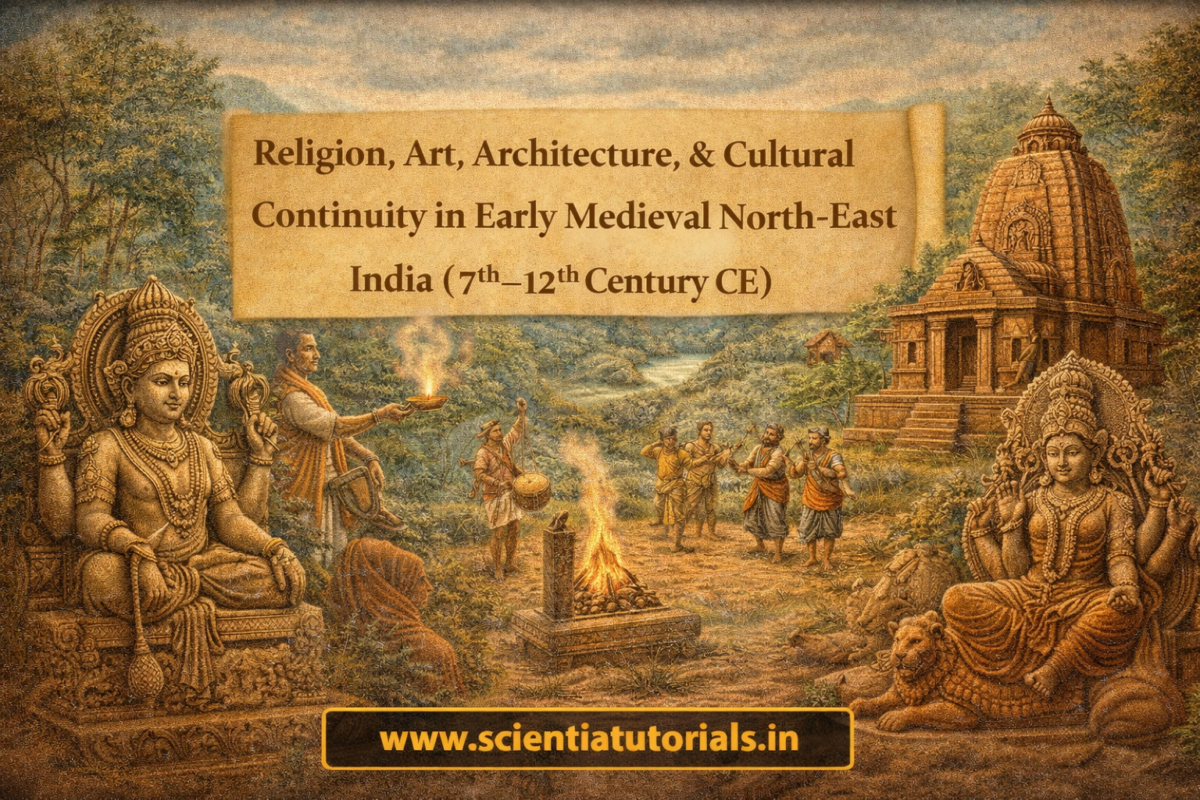

Religion, Art & Architecture in Early Medieval North-East India (7th–12th CE)
History of North-East India: From Early Kingdoms to Modern Integration
Module III: Early Medieval Transformations and Regional Powers
Timeline / Era Covered: 7th Century CE – 12th Century CE
Lesson: Religion, Art, Architecture, and Cultural Continuity
This lesson is systematically organized into four clearly structured sections, as detailed below:
- Chronologically Structured Study Module
- Short-Answer Type Questions
- Long-Answer Type Questions
- Multiple-Choice Questions (MCQs) with Answers and Detailed Explanations
Chronologically Structured Study Module
Introduction: Culture as a Unifying Thread in Early Medieval North-East India
The early medieval period (7th–12th centuries CE) in North-East India represents a crucial phase of religious transformation, artistic expression, architectural development, and cultural continuity. While political history during this era is often described in terms of fragmentation and regionalization, cultural history reveals a striking degree of continuity and synthesis. Religious traditions, artistic styles, and architectural forms evolved gradually, adapting to local conditions while maintaining links with earlier historical phases and wider Indian cultural currents.
Across regions such as Assam, Manipur, and Tripura, religion played a central role in shaping political legitimacy, social organization, and cultural identity. Art and architecture served not only aesthetic purposes but also functioned as instruments of religious devotion, royal authority, and collective memory. This lesson explores how religious practices, artistic traditions, and architectural forms ensured cultural continuity amid political change.
Chronological Framework of Cultural Developments (7th–12th Century CE)
For analytical clarity, the cultural history of early medieval North-East India can be divided into three overlapping phases:
- 7th–8th Century CE: Continuity of Early Historic Religious Traditions
- 8th–10th Century CE: Regionalization of Art, Architecture, and Religious Practice
- 10th–12th Century CE: Cultural Synthesis and Institutionalization
Each phase reflects gradual transformation rather than abrupt cultural rupture.
Phase I (7th–8th Century CE): Continuity of Early Historic Religious Traditions
Religious Landscape after the Early Historic Period
In the 7th century CE, religious life in North-East India was characterized by pluralism. Hindu traditions—particularly Shaivism and Vaishnavism—coexisted with indigenous belief systems and residual Buddhist influences. Rather than replacing older traditions, emerging religious forms absorbed and adapted local practices.
In regions like Assam, temples and sacred sites continued traditions associated with early historic polities such as Kamarupa. Kingship was closely linked with religious patronage, and rulers derived legitimacy through association with deities and sacred rituals.
Indigenous Beliefs and Cultural Persistence
Alongside Brahmanical traditions, indigenous religions based on ancestor worship, nature spirits, and clan deities remained strong, especially in hill and frontier regions. These belief systems:
- Emphasized harmony between humans and nature
- Integrated ritual authority with political leadership
- Reinforced community identity
This coexistence ensured cultural continuity even as external religious influences expanded.
Phase II (8th–10th Century CE): Regionalization of Religion, Art, and Architecture
Rise of Regional Religious Practices
Between the 8th and 10th centuries CE, religious practice became increasingly regionalized. While pan-Indian Hindu deities were worshipped, their representation and rituals reflected local aesthetics and social structures. Temples functioned not only as places of worship but also as centers of learning, land management, and cultural transmission.
Royal patronage played a decisive role in shaping religious life. Kings and chiefs supported temples, priests, and rituals to consolidate authority and demonstrate piety.
Art as an Expression of Devotion and Identity
Art in early medieval North-East India was primarily religious in character. Sculptures, icons, and reliefs depicted Hindu deities, local divinities, and mythological themes. Key features of this artistic tradition included:
- Use of stone and terracotta
- Emphasis on symbolic representation rather than naturalism
- Regional stylistic variations
These artistic forms reveal continuity with early historic traditions while also reflecting local creativity.
Architectural Developments
Architecture during this phase was dominated by temple construction. Temples were generally modest in scale compared to those of northern or southern India but were deeply integrated into local landscapes. Architectural characteristics included:
- Simple ground plans
- Use of locally available materials
- Integration with natural surroundings
Rather than monumental grandeur, early medieval architecture emphasized ritual functionality and symbolic presence.
Phase III (10th–12th Century CE): Cultural Synthesis and Institutionalization
Expansion of Brahmanical Institutions
From the 10th century onwards, Brahmanical institutions became more firmly established, particularly in plains regions. Land grants to temples and Brahmanas strengthened religious establishments, enabling them to play a central role in social and cultural life.
However, this expansion did not erase indigenous traditions. Instead, a process of cultural synthesis occurred, blending Sanskritic rituals with local customs.
Institutionalization of Religious Practices
By the 11th–12th centuries CE, religious practices had become increasingly institutionalized. Temples served as:
- Centers of worship
- Repositories of art and sculpture
- Symbols of royal patronage
Religious festivals, rituals, and pilgrimages reinforced shared cultural identities across generations.
Art and Sculpture: Styles and Symbolism
Themes and Motifs
Early medieval art in North-East India focused largely on religious themes. Common motifs included:
- Hindu deities such as Shiva and Vishnu
- Local goddesses and fertility symbols
- Mythological narratives
Artworks were imbued with symbolic meaning, conveying spiritual ideas rather than realistic representation.
Regional Artistic Identity
Although influenced by broader Indian traditions, the art of North-East India developed distinct regional styles. Sculptures often displayed:
- Simplified forms
- Emphasis on spiritual expression
- Integration of local iconographic elements
These features highlight the region’s cultural autonomy within the Indian cultural sphere.
Architecture: Temples, Sacred Spaces, and Cultural Memory
Role of Temples in Society
Temples were more than architectural structures; they were centers of cultural life. Their functions included:
- Hosting rituals and festivals
- Acting as social gathering points
- Preserving artistic and religious traditions
Temple spaces thus became repositories of collective memory and cultural continuity.
Sacred Geography
Natural features such as hills, rivers, and forests were often incorporated into religious practice. Sacred geography reinforced the idea that land itself was imbued with spiritual significance, strengthening emotional bonds between communities and their environment.
Cultural Continuity amid Political Change
Impact of Political Fragmentation
Although the early medieval period witnessed political fragmentation and the rise of regional powers, cultural life showed remarkable stability. Religious institutions and artistic traditions provided continuity across dynastic changes, ensuring that cultural identity outlasted political instability.
Role of Religion in Social Integration
Religion acted as a unifying force, integrating diverse communities through shared rituals, festivals, and beliefs. Even where political authority was weak or localized, religious practices fostered social cohesion.
Interaction with Indigenous and Tribal Traditions
Mutual Influence
Rather than a one-way process of cultural imposition, interaction between Brahmanical and indigenous traditions was reciprocal. Indigenous practices influenced temple rituals, iconography, and festival calendars, while Brahmanical ideas provided new symbolic frameworks.
Cultural Resilience
The persistence of indigenous elements demonstrates the resilience of local cultures. Cultural continuity was maintained not by resistance alone but through adaptation and selective integration.
Historiographical Perspectives on Cultural Continuity
Earlier historians often emphasized political decline in the early medieval period, overlooking cultural vitality. Modern scholarship, however, highlights:
- Continuity of religious traditions
- Regional creativity in art and architecture
- Adaptive cultural synthesis
This shift in interpretation underscores the importance of cultural history for understanding the era.
Comparative Perspective: North-East India and the Wider Indian World
While sharing broad religious and artistic traditions with the rest of India, North-East India retained distinctive features:
| Aspect | North-East India | Other Regions of India |
|---|---|---|
| Temple scale | Modest | Often monumental |
| Artistic style | Regional, symbolic | More standardized |
| Cultural change | Gradual synthesis | Sometimes abrupt |
This comparison emphasizes diversity within Indian civilization.
Long-Term Significance of Early Medieval Cultural Developments
The cultural patterns established between the 7th and 12th centuries CE:
- Shaped later medieval religious life
- Influenced regional identities
- Provided continuity into the modern period
Many contemporary festivals, rituals, and sacred sites trace their origins to this era.
Conclusion: Culture as the Backbone of Continuity
Religion, art, architecture, and cultural practices formed the backbone of continuity in early medieval North-East India. While political authority shifted and regional powers rose and fell, cultural traditions persisted, evolved, and adapted. Through temples, rituals, artistic expression, and sacred landscapes, communities preserved their identities and values across centuries.
Between the 7th and 12th centuries CE, North-East India demonstrates that cultural continuity can coexist with political change. This lesson highlights the importance of viewing early medieval history not merely as an age of transition but as a period of creative cultural resilience and synthesis.
Examination Relevance (APSC, State PSCs, UGC-NET, CUET, TETs)
- Religious developments in early medieval North-East India
- Art and architectural traditions
- Cultural continuity and synthesis
- Comparison between political change and cultural stability
Short Answer Type Questions with Answers
Q1. What is meant by cultural continuity in early medieval North-East India?
Answer:
Cultural continuity refers to the persistence and gradual evolution of religious, artistic, and architectural traditions despite political changes between the 7th–12th centuries CE.
Q2. Which centuries are covered under early medieval cultural developments in North-East India?
Answer:
The early medieval cultural phase covers the 7th to 12th centuries CE.
Q3. Name two major religious traditions prevalent in early medieval North-East India.
Answer:
Shaivism and Vaishnavism were major Hindu traditions prevalent during this period.
Q4. Did Buddhism completely disappear from North-East India in the early medieval period?
Answer:
No, Buddhist influences survived in limited forms alongside Hindu and indigenous religious traditions.
Q5. What role did religion play in legitimizing political authority?
Answer:
Religion legitimized kingship through ritual patronage, temple construction, and association of rulers with sacred traditions.
Q6. How did indigenous belief systems survive during this period?
Answer:
Indigenous beliefs survived through adaptation, coexistence with Brahmanical traditions, and integration into local rituals and festivals.
Q7. Name one plains region where Brahmanical religion gained prominence.
Answer:
Brahmanical religion gained prominence in regions such as Assam.
Q8. What was the primary purpose of temples in early medieval North-East India?
Answer:
Temples served as centers of worship, cultural activity, learning, and symbols of royal patronage.
Q9. How did early medieval temples differ from those in northern or southern India?
Answer:
They were generally smaller, simpler, and built using local materials rather than monumental architectural styles.
Q10. What materials were commonly used in early medieval art and sculpture?
Answer:
Stone and terracotta were commonly used materials for sculptures and religious art.
Q11. What themes dominated early medieval art in North-East India?
Answer:
Religious themes such as Hindu deities, local divinities, fertility symbols, and mythological narratives dominated.
Q12. How did art reflect regional identity?
Answer:
Art incorporated local iconography, simplified forms, and indigenous symbols, creating distinct regional styles.
Q13. What is meant by regionalization of religion during this period?
Answer:
It refers to the adaptation of pan-Indian religious traditions to local cultural, social, and artistic contexts.
Q14. What role did land grants play in religious development?
Answer:
Land grants strengthened temples and Brahmanical institutions, enabling them to become cultural and social centers.
Q15. How did architecture contribute to cultural continuity?
Answer:
Temples and sacred spaces preserved religious practices, artistic traditions, and collective memory across generations.
Q16. What is meant by sacred geography?
Answer:
Sacred geography refers to the religious significance attached to natural features like hills, rivers, and forests.
Q17. How did political fragmentation affect cultural life?
Answer:
Despite political fragmentation, cultural life remained stable due to the continuity of religious institutions and traditions.
Q18. Name one hill region where indigenous religious traditions remained strong.
Answer:
Indigenous traditions remained strong in regions such as Manipur.
Q19. What was the relationship between tribal traditions and Brahmanical culture?
Answer:
The relationship was reciprocal, involving selective adoption and cultural synthesis rather than replacement.
Q20. How were festivals important for cultural continuity?
Answer:
Festivals reinforced shared beliefs, community participation, and transmission of traditions across generations.
Q21. What is meant by cultural synthesis in early medieval North-East India?
Answer:
Cultural synthesis refers to the blending of indigenous traditions with Brahmanical religious and artistic elements.
Q22. How did art function beyond aesthetic purposes?
Answer:
Art functioned as religious devotion, political symbolism, and preservation of cultural memory.
Q23. Why do historians emphasize cultural history for this period?
Answer:
Because cultural continuity contrasts with political instability, revealing long-term social resilience.
Q24. How did early medieval culture influence later periods?
Answer:
It shaped later medieval religious practices, regional identities, and artistic traditions.
Q25. Why is the study of religion, art, and architecture crucial for understanding early medieval North-East India?
Answer:
Because they reveal continuity, identity formation, and cultural resilience beyond political narratives.
Long Answer Type Questions with Answers
Religion, Art, Architecture, and Cultural Continuity (7th–12th Century CE)
Q1. Discuss the importance of religion as a source of cultural continuity in early medieval North-East India.
Answer:
Religion played a central role in ensuring cultural continuity in early medieval North-East India. Despite political fragmentation and the rise of regional powers, religious beliefs, rituals, and institutions provided stability. Hindu traditions such as Shaivism and Vaishnavism coexisted with indigenous belief systems, allowing continuity through adaptation. Temples, rituals, and festivals transmitted shared values across generations, ensuring that cultural identity remained intact even when political authority changed.
Q2. Examine the religious landscape of North-East India during the 7th–12th centuries CE.
Answer:
The religious landscape was pluralistic. Brahmanical Hinduism expanded, particularly Shaivism and Vaishnavism, while indigenous traditions based on ancestor worship and nature spirits remained strong. Buddhist influences persisted in limited forms. Rather than religious replacement, the period witnessed coexistence and synthesis, creating region-specific religious cultures.
Q3. How did indigenous religious traditions survive alongside Brahmanical Hinduism?
Answer:
Indigenous traditions survived through adaptation and integration. Local deities were often assimilated into Hindu pantheons, rituals were incorporated into temple practices, and festivals blended Brahmanical and tribal elements. This selective integration ensured continuity of indigenous beliefs without cultural rupture.
Q4. Analyze the role of royal patronage in the spread of religion during the early medieval period.
Answer:
Royal patronage was crucial for religious expansion. Kings supported temples, priests, and rituals to legitimize their authority. Patronage strengthened religious institutions, enabled land grants, and promoted temple-centered cultural life. Through religion, rulers reinforced their political legitimacy and social influence.
Q5. Discuss the role of temples in early medieval North-East Indian society.
Answer:
Temples functioned as religious, cultural, and social centers. They hosted rituals, festivals, and gatherings, preserved art and sculpture, and acted as repositories of collective memory. Beyond worship, temples symbolized royal authority and cultural continuity, linking communities to shared traditions.
Q6. Examine the architectural features of early medieval temples in North-East India.
Answer:
Early medieval temples were modest in scale and adapted to local environments. They used locally available materials, simple ground plans, and symbolic ornamentation. Unlike monumental temples elsewhere in India, North-East Indian temples emphasized ritual functionality and integration with sacred landscapes.
Q7. How did art serve as a medium of religious expression in this period?
Answer:
Art was primarily religious, depicting Hindu deities, local divinities, and mythological themes. Sculptures and reliefs emphasized symbolic representation rather than realism. Art conveyed spiritual ideas, reinforced devotion, and visually expressed religious continuity.
Q8. Discuss the regional characteristics of early medieval art in North-East India.
Answer:
Although influenced by pan-Indian traditions, early medieval art developed distinct regional styles. Simplified forms, local iconography, and symbolic emphasis reflected indigenous creativity. These features highlight cultural autonomy within the broader Indian cultural framework.
Q9. Explain the concept of sacred geography in early medieval North-East India.
Answer:
Sacred geography refers to the religious significance attached to natural features such as hills, rivers, forests, and groves. These landscapes were integrated into religious practice, reinforcing emotional bonds between communities and their environment and contributing to cultural continuity.
Q10. How did political fragmentation coexist with cultural continuity in early medieval North-East India?
Answer:
While political power fragmented into regional polities, cultural institutions such as temples and religious traditions transcended political boundaries. Religious practices and artistic forms continued across dynastic changes, ensuring stability and continuity despite political instability.
Q11. Discuss the process of cultural synthesis during the early medieval period.
Answer:
Cultural synthesis involved blending Brahmanical traditions with indigenous practices. Sanskritic rituals merged with local customs, and religious institutions adapted to regional contexts. This synthesis preserved indigenous identity while enabling participation in broader cultural traditions.
Q12. Analyze the impact of land grants on religious and cultural institutions.
Answer:
Land grants to temples and Brahmanas strengthened religious institutions economically and socially. They enabled temples to function as cultural hubs, supported ritual specialists, and ensured long-term continuity of religious practices and artistic traditions.
Q13. Examine the relationship between religion and political legitimacy in early medieval North-East India.
Answer:
Religion legitimized political authority by associating rulers with divine sanction. Kings projected themselves as protectors of dharma through temple patronage and ritual participation. This sacred legitimacy compensated for weak central authority in fragmented political settings.
Q14. How did festivals and rituals contribute to cultural continuity?
Answer:
Festivals and rituals reinforced shared beliefs, collective memory, and social cohesion. They enabled transmission of traditions across generations and integrated diverse communities into a common cultural framework.
Q15. Compare early medieval cultural developments in North-East India with those in other parts of India.
Answer:
While sharing Hindu religious traditions with other regions, North-East India emphasized regional adaptation, modest architecture, and symbolic art. Cultural change was gradual and synthetic, contrasting with more monumental and standardized developments elsewhere.
Q16. Discuss the role of sculpture in preserving religious traditions.
Answer:
Sculpture preserved religious iconography and symbolism, serving as visual theology. It reinforced devotional practices, transmitted mythological narratives, and maintained continuity of artistic and religious traditions.
Q17. How do historians reinterpret early medieval culture in contrast to earlier views of decline?
Answer:
Earlier historiography emphasized political decline, overlooking cultural vitality. Modern historians highlight continuity, creativity, and synthesis in religion, art, and architecture, viewing the period as culturally dynamic rather than stagnant.
Q18. Examine the contribution of indigenous communities to early medieval cultural life.
Answer:
Indigenous communities shaped religious practices, festivals, iconography, and sacred spaces. Their traditions influenced temple rituals and artistic expression, ensuring that cultural continuity was rooted in local society.
Q19. Discuss the long-term significance of early medieval cultural developments.
Answer:
Cultural patterns established between the 7th and 12th centuries influenced later medieval religious life, regional identities, and artistic traditions. Many contemporary practices trace their origins to this period, demonstrating enduring continuity.
Q20. Conclude by assessing the overall importance of religion, art, and architecture in early medieval North-East India.
Answer:
Religion, art, and architecture formed the backbone of cultural continuity in early medieval North-East India. They ensured stability amid political change, preserved collective memory, and fostered regional identity. The period represents not decline but cultural resilience and creative synthesis.
MCQs with Answers and Explanations
Religion, Art, Architecture, and Cultural Continuity (7th–12th Century CE)
Q1. The concept of “cultural continuity” in early medieval North-East India refers to:
A. Absence of cultural change
B. Survival of culture only in plains
C. Persistence and gradual evolution of traditions
D. Replacement of indigenous culture
Correct Answer: C
Explanation:
Cultural continuity denotes the persistence and gradual transformation of religious, artistic, and architectural traditions despite political change.
Q2. The early medieval cultural phase discussed in this lesson covers:
A. 5th–7th centuries CE
B. 6th–9th centuries CE
C. 7th–12th centuries CE
D. 9th–14th centuries CE
Correct Answer: C
Explanation:
Module III defines the early medieval period as extending from the 7th to the 12th century CE.
Q3. Which religious traditions were most prominent in early medieval North-East India?
A. Buddhism and Jainism
B. Islam and Christianity
C. Shaivism and Vaishnavism
D. Jainism and Islam
Correct Answer: C
Explanation:
Brahmanical Hindu traditions, especially Shaivism and Vaishnavism, were dominant, coexisting with indigenous beliefs.
Q4. Which statement best describes Buddhism in early medieval North-East India?
A. Completely disappeared
B. Became the dominant religion
C. Survived in limited forms
D. Replaced Hindu traditions
Correct Answer: C
Explanation:
Buddhist influences persisted in limited and localized forms alongside Hindu and indigenous traditions.
Q5. Religion contributed to political authority mainly by:
A. Replacing kingship
B. Promoting democracy
C. Legitimizing rulers
D. Encouraging isolation
Correct Answer: C
Explanation:
Rulers derived legitimacy through religious patronage, rituals, and temple construction.
Q6. Indigenous religious traditions in early medieval North-East India were:
A. Completely destroyed
B. Confined only to hills
C. Absorbed and adapted
D. Forced underground
Correct Answer: C
Explanation:
Indigenous beliefs survived through adaptation, coexistence, and cultural synthesis with Brahmanical traditions.
Q7. Brahmanical religion gained greater prominence particularly in:
A. Coastal regions
B. Desert areas
C. Plains regions such as Assam
D. Isolated hill interiors
Correct Answer: C
Explanation:
Plains regions like Assam saw stronger institutionalization of Brahmanical religion through temples and land grants.
Q8. Early medieval temples in North-East India generally:
A. Matched South Indian monumental temples
B. Were modest and locally adapted
C. Followed Islamic architectural forms
D. Were entirely wooden
Correct Answer: B
Explanation:
Temples were modest in scale, built with local materials, and suited to regional conditions.
Q9. The primary function of temples during this period was:
A. Military defense
B. Administrative control
C. Religious and cultural activities
D. Commercial exchange
Correct Answer: C
Explanation:
Temples served as centers of worship, culture, learning, and social life.
Q10. Which materials were commonly used in early medieval sculpture?
A. Bronze and marble
B. Wood and ivory
C. Stone and terracotta
D. Gold and silver
Correct Answer: C
Explanation:
Artists mainly used stone and terracotta, reflecting local availability and tradition.
Q11. Early medieval art in North-East India was predominantly:
A. Secular
B. Royal portraiture
C. Religious
D. Abstract
Correct Answer: C
Explanation:
Art focused on religious themes, including deities, symbols, and mythological narratives.
Q12. Which feature best characterizes early medieval sculpture of the region?
A. Extreme realism
B. Symbolic expression
C. Persian influence
D. Complete uniformity
Correct Answer: B
Explanation:
Sculpture emphasized symbolism and spiritual meaning rather than naturalistic realism.
Q13. Regional artistic styles developed because:
A. Isolation from India
B. Use of foreign artists
C. Local creativity and traditions
D. Absence of religion
Correct Answer: C
Explanation:
Local iconography and indigenous aesthetics shaped distinct regional artistic identities.
Q14. The term “regionalization of religion” refers to:
A. Decline of religion
B. Uniform religious practice
C. Local adaptation of pan-Indian traditions
D. Religious conflict
Correct Answer: C
Explanation:
Pan-Indian religions were adapted to local cultural and social contexts.
Q15. Land grants during the early medieval period mainly strengthened:
A. Military institutions
B. Trade guilds
C. Religious institutions
D. Village republics
Correct Answer: C
Explanation:
Land grants supported temples and Brahmanas, enabling long-term cultural continuity.
Q16. Architecture contributed to cultural continuity by:
A. Encouraging urbanization
B. Preserving ritual spaces
C. Promoting warfare
D. Eliminating indigenous culture
Correct Answer: B
Explanation:
Temples and sacred structures preserved ritual practices and collective memory.
Q17. Sacred geography in early medieval North-East India included:
A. Only temples
B. Only urban centers
C. Natural features with religious meaning
D. Fortified cities
Correct Answer: C
Explanation:
Hills, rivers, forests, and groves were regarded as spiritually significant landscapes.
Q18. Political fragmentation during the early medieval period:
A. Destroyed cultural life
B. Had little effect on culture
C. Ended temple traditions
D. Prevented artistic production
Correct Answer: B
Explanation:
Despite political fragmentation, cultural institutions ensured continuity.
Q19. Cultural synthesis refers to:
A. Cultural destruction
B. Replacement of indigenous culture
C. Blending of traditions
D. Cultural isolation
Correct Answer: C
Explanation:
Cultural synthesis involved blending Brahmanical and indigenous traditions.
Q20. Indigenous communities contributed to early medieval culture mainly through:
A. Military expansion
B. Urban planning
C. Rituals, festivals, and beliefs
D. Foreign trade
Correct Answer: C
Explanation:
Local communities shaped religious practices, festivals, and iconography.
Q21. Festivals played an important role because they:
A. Encouraged taxation
B. Strengthened dynasties
C. Transmitted traditions
D. Promoted foreign influence
Correct Answer: C
Explanation:
Festivals helped transmit cultural values and practices across generations.
Q22. Early historians viewed the early medieval period mainly as:
A. Cultural golden age
B. Age of religious unity
C. Period of political decline
D. Era of foreign rule
Correct Answer: C
Explanation:
Earlier historiography emphasized decline, ignoring cultural vitality.
Q23. Modern historians emphasize early medieval culture as:
A. Static
B. Primitive
C. Dynamic and resilient
D. Entirely borrowed
Correct Answer: C
Explanation:
Modern scholarship highlights cultural resilience, adaptation, and creativity.
Q24. Compared to other parts of India, North-East Indian temples were:
A. More monumental
B. More standardized
C. Smaller and region-specific
D. Entirely wooden
Correct Answer: C
Explanation:
Temple architecture was modest and regionally adapted, not monumental.
Q25. Which statement best summarizes early medieval cultural developments in North-East India?
A. Cultural stagnation
B. Cultural isolation
C. Continuity with gradual synthesis
D. Complete religious replacement
Correct Answer: C
Explanation:
The period is best understood as one of cultural continuity combined with gradual synthesis, not decline.