
Administrative, Religious, and Cultural Developments in Early Assam
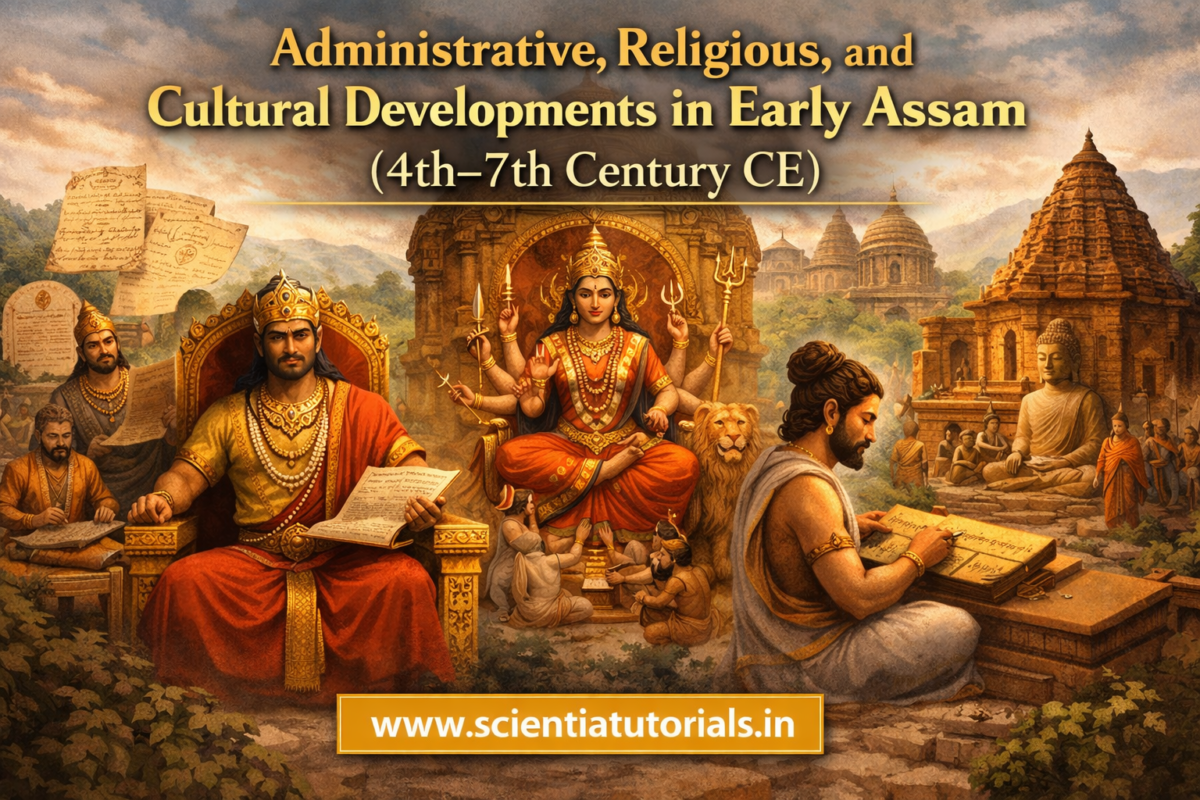

Administrative, Religious & Cultural Developments in Early Assam (4th–7th Century CE)
Module II: Early Historic Period and the Emergence of Kingdoms
Lesson: Administrative, Religious, and Cultural Developments in Early Assam
Timeline / Era Covered: c. 4th Century CE – 7th Century CE
Course: History of North-East India: From Early Kingdoms to Modern Integration
This lesson is systematically organized into four clearly structured sections, as detailed below:
- Chronologically Structured Study Module
- Short-Answer Type Questions
- Long-Answer Type Questions
- Multiple-Choice Questions (MCQs) with Answers and Detailed Explanations
Chronologically Structured Study Module
Introduction: Early Assam in the Early Historic Context
The period from the 4th to the 7th century CE marks a decisive phase in the historical evolution of Assam, corresponding broadly to the Early Historic Period in the Indian subcontinent. During this era, Assam—historically known as Kamarupa—underwent significant transformations in political administration, religious life, and cultural expressions. These developments laid the institutional and ideological foundations for later medieval Assamese society.
Early Assam was not an isolated frontier region. Instead, it was deeply connected to the Brahmaputra valley trade networks, religious movements from the Gangetic plains, and broader pan-Indian processes of state formation and cultural integration. The rise of organized administration, the spread of Brahmanical and Buddhist traditions, and the synthesis of indigenous and classical cultural forms defined this phase.
This lesson examines administrative structures, religious transformations, and cultural developments in a chronological and thematic manner, aligning with competitive examination requirements and academic frameworks.
I. Chronological Background of Early Assam (c. 4th–7th Century CE)
1. Transition from Proto-History to Early Historic Phase
Before the 4th century CE, Assam’s society was characterized by:
- Tribal and clan-based political organization
- Subsistence agriculture combined with forest-based economies
- Limited use of writing and monetization
The emergence of early states coincided with:
- Expansion of agrarian settlements in the Brahmaputra valley
- Adoption of Sanskritic political ideology
- Increasing contact with North India through trade and pilgrimage routes
The Early Historic phase thus represents the transition from chiefdoms to kingdoms, with centralized authority and codified administration.
II. Administrative Developments in Early Assam
1. Emergence of Monarchical Administration
The establishment of monarchy in Kamarupa marked a major administrative shift. The king was regarded as:
- The supreme political authority
- Protector of dharma
- Patron of religion and culture
The capital city, Pragjyotisha, served as the administrative and ceremonial center of the kingdom.
2. Central Administration
The king governed with the assistance of ministers and officials, reflecting early Indian models of governance:
Key features included:
- Council of Ministers (Mantriparishad): Advising the king on governance
- Royal Secretariat: Handling land grants, correspondence, and records
- Judicial Authority: The king as the highest court of appeal
Administrative terminology and concepts were largely derived from Sanskritic political traditions, indicating increasing cultural integration with the rest of India.
3. Land Revenue and Agrarian Expansion
One of the most important administrative developments was the land grant system:
- Land was donated to Brahmins and religious institutions
- Grants were often tax-free (agrahara)
- Copper plate inscriptions recorded these grants
Impact of land grants:
- Expansion of settled agriculture
- Spread of Brahmanical culture into rural areas
- Strengthening of royal authority over territory
This system transformed Assam’s economy from a tribal subsistence model to an agrarian surplus-based structure.
4. Provincial and Local Administration
The kingdom was divided into:
- Bhuktis (provinces)
- Vishayas (districts)
- Gramas (villages)
Local governance involved:
- Village headmen
- Clan leaders integrated into state structures
- Revenue collectors appointed by the crown
This administrative decentralization helped manage Assam’s diverse terrain and ethnic composition.
III. Religious Developments in Early Assam
1. Rise of Brahmanical Hinduism
From the 4th century CE onward, Brahmanical Hinduism became the dominant religious framework in Assam.
Key characteristics:
- Worship of Vishnu, Shiva, and Shakti
- Performance of Vedic rituals
- Emergence of Brahmin settlements through royal patronage
The kings projected themselves as upholders of varna-dharma, enhancing their legitimacy.
2. Shakti Cult and Regional Religious Identity
One of the most distinctive religious developments in Assam was the rise of Shakti worship:
- Emphasis on goddess-centered cults
- Integration of indigenous fertility and nature worship
- Later association with sacred centers like Kamakhya
This form of worship represented a synthesis of local traditions and Brahmanical theology, giving Assam a unique religious character.
3. Presence of Buddhism
Although Brahmanical Hinduism dominated, Buddhism also had a presence:
- Mahayana influence in eastern Assam
- Buddhist monks and scholars passing through Assam
- Cultural exchange with Bengal and Southeast Asia
Buddhism coexisted with Hinduism, contributing to religious pluralism.
4. Indigenous Beliefs and Syncretism
Indigenous tribal beliefs did not disappear; instead, they were absorbed into mainstream religion:
- Nature spirits associated with Hindu deities
- Tribal rituals incorporated into temple worship
- Local myths integrated into Sanskritic Puranic narratives
This syncretism ensured social cohesion in a multi-ethnic society.
IV. Cultural Developments in Early Assam
1. Sanskritization and Language
A major cultural transformation was the spread of Sanskrit:
- Language of administration and inscriptions
- Medium of religious texts and royal genealogies
- Tool for cultural integration
At the same time, local Prakrits and early Assamese forms continued in popular usage, laying the foundation for later Assamese language development.
2. Literature and Intellectual Life
Cultural patronage by kings encouraged:
- Composition of genealogical texts
- Recording of myths and legends
- Transmission of epics like the Ramayana and Mahabharata
Assam entered the broader Sanskritic intellectual sphere while preserving regional narratives.
3. Art and Architecture
Early Assamese art reflected both indigenous and pan-Indian influences:
Architectural features:
- Brick temples
- Early shikhara-style structures
- Use of terracotta decoration
Sculptural traditions:
- Images of Hindu deities
- Buddhist icons
- Local stylistic elements
These developments marked the beginnings of a distinct Assamese artistic tradition.
4. Social Structure and Daily Life
Society during this period was hierarchical but flexible:
- Emergence of caste divisions under Brahmanical influence
- Continued importance of kinship and clan identities
- Role of women in religious rituals and agrarian economy
The interaction between tribal social systems and caste-based organization produced a hybrid social order.
V. Chronological Assessment of the Period (4th–7th Century CE)
| Aspect | Key Developments |
|---|---|
| Administration | Monarchical rule, land grants, provincial governance |
| Religion | Brahmanical Hinduism, Shakti cult, Buddhism |
| Culture | Sanskritization, early literature, temple architecture |
| Society | Agrarian expansion, social stratification, syncretism |
This era established the institutional continuity that shaped Assam’s medieval and early modern history.
VI. Historical Significance and Examination Relevance
1. Long-Term Impact
The administrative, religious, and cultural systems developed during this period:
- Provided stability to the kingdom of Kamarupa
- Enabled integration with the Indian civilizational framework
- Shaped Assam’s distinct regional identity
2. Importance for Competitive Examinations
This lesson is crucial for:
- APSC (CCE) and State PSC examinations
- UGC-NET (History)
- TET, CTET, CUET (UG & PG)
- State-level recruitment exams across North-East India
Frequently asked themes include:
- Land grant system in early Assam
- Role of religion in state formation
- Cultural syncretism in North-East India
Conclusion
Between the 4th and 7th centuries CE, Early Assam witnessed profound transformations in administration, religion, and culture. The emergence of organized governance, the spread of Brahmanical and Shakti traditions, and the development of a rich cultural synthesis marked Assam’s transition into a mature historical society. These developments not only strengthened the kingdom of Kamarupa but also integrated the region into the broader currents of Indian history while preserving its unique identity.
This period thus stands as a foundational chapter in the historical evolution of North-East India and remains indispensable for academic study and competitive examinations alike.
Short Answer Type Questions
1. What was the historical name of early Assam during the Early Historic Period?
Answer:
Early Assam was historically known as Kamarupa, which emerged as a powerful political entity between the 4th and 7th centuries CE.
2. Which time period is covered under the Early Historic developments of Assam?
Answer:
The Early Historic developments of Assam broadly cover the period from the 4th century CE to the 7th century CE.
3. What was the capital of the Kamarupa kingdom?
Answer:
The capital of Kamarupa was Pragjyotisha, an important political and cultural center.
4. What form of government existed in early Assam during this period?
Answer:
Early Assam was governed under a monarchical system, where the king exercised supreme political, judicial, and military authority.
5. Mention two key features of the central administration of early Assam.
Answer:
- The king was assisted by ministers and officials.
- Royal orders and land grants were recorded through inscriptions.
6. What was the significance of land grants in early Assam?
Answer:
Land grants promoted agrarian expansion, strengthened royal authority, and facilitated the spread of Brahmanical culture.
7. To whom were land grants usually given?
Answer:
Land grants were primarily given to Brahmins and religious institutions, often as tax-free grants.
8. What were copper plate inscriptions used for?
Answer:
Copper plate inscriptions were used to record land grants, royal genealogies, and administrative orders.
9. How was local administration organized in early Assam?
Answer:
The kingdom was divided into provinces, districts, and villages, managed by local officials and village headmen.
10. Which religion received maximum royal patronage in early Assam?
Answer:
Brahmanical Hinduism received maximum royal patronage during this period.
11. Name two major deities worshipped in early Assam.
Answer:
The major deities worshipped were Vishnu and Shiva, along with the growing prominence of Shakti worship.
12. Why is Shakti worship considered significant in Assam’s religious history?
Answer:
Shakti worship represented a synthesis of indigenous fertility cults and Brahmanical traditions, giving Assam a distinct religious identity.
13. Did Buddhism exist in early Assam? Briefly explain.
Answer:
Yes, Buddhism existed in early Assam, mainly in its Mahayana form, and coexisted with Brahmanical Hinduism.
14. What role did indigenous beliefs play in early Assamese religion?
Answer:
Indigenous beliefs were assimilated into Hindu practices, leading to religious syncretism rather than displacement.
15. What language dominated administration and religious life in early Assam?
Answer:
Sanskrit dominated administration, inscriptions, and religious activities.
16. How did Sanskritization influence Assamese culture?
Answer:
Sanskritization introduced caste concepts, Brahmanical rituals, and pan-Indian cultural norms into Assamese society.
17. What type of literature developed during this period?
Answer:
Genealogical records, religious texts, and epic traditions like the Ramayana and Mahabharata became popular.
18. Mention two features of early Assamese art and architecture.
Answer:
- Construction of brick temples.
- Development of early sculptural representations of Hindu and Buddhist deities.
19. How did geography influence administration in early Assam?
Answer:
The Brahmaputra valley facilitated agriculture and communication, while hills required decentralized local governance.
20. What was the social structure of early Assamese society?
Answer:
Society was hierarchical but flexible, combining tribal kinship systems with emerging caste divisions.
21. How did early Assam maintain religious tolerance?
Answer:
Different faiths like Hinduism, Buddhism, and indigenous beliefs coexisted through mutual accommodation and syncretism.
22. What role did kings play in cultural development?
Answer:
Kings patronized temples, scholars, Brahmins, and artists, promoting cultural growth and stability.
23. Why is the Early Historic Period important in Assam’s history?
Answer:
It laid the foundations of state formation, organized administration, religious traditions, and cultural identity.
24. How did early Assam integrate with the rest of India?
Answer:
Through trade routes, Sanskrit culture, religious exchange, and political ideology.
25. Why is this lesson important for competitive examinations?
Answer:
It explains the origins of Assam’s political institutions, religious traditions, and cultural synthesis, frequently tested in exams.
Long Answer Type Questions with Answers
1. Examine the administrative structure of early Assam during the Early Historic Period.
Answer:
During the Early Historic Period (c. 4th–7th century CE), Assam—known as Kamarupa—developed a well-defined administrative system based on monarchical governance. The king was the supreme authority, responsible for administration, justice, military affairs, and religious patronage.
The central administration consisted of ministers and officials who assisted the king in governance. Provinces were divided into districts and villages, managed by local officials and village headmen. Land revenue formed the economic backbone of administration, with systematic land grants recorded on copper plates.
This administrative structure combined indigenous governance traditions with Sanskritic political ideals, ensuring effective control over a geographically diverse region.
2. Discuss the significance of land grants in the political and economic life of early Assam.
Answer:
Land grants were a defining feature of early Assamese administration. Kings donated land—often tax-free—to Brahmins and religious institutions. These grants promoted agrarian expansion, increased agricultural productivity, and integrated forest and tribal lands into the state system.
Politically, land grants strengthened royal authority by creating loyal beneficiaries dependent on the king. Economically, they helped shift Assam from a subsistence economy to a surplus-based agrarian economy. Culturally, they facilitated the spread of Brahmanical values, Sanskrit learning, and temple-centered settlements.
Thus, land grants played a crucial role in state formation and socio-economic transformation.
3. Analyze the role of monarchy in the governance of early Assam.
Answer:
The monarchy was the cornerstone of governance in early Assam. The king was viewed as the protector of dharma and the upholder of social and religious order. He exercised legislative, executive, and judicial authority.
Kings patronized religious institutions, granted land, appointed officials, and maintained law and order. Their authority was legitimized through religious rituals, Sanskrit genealogies, and association with divine ideals. This fusion of political power and religious legitimacy ensured stability and continuity in governance.
4. Describe the provincial and local administration of early Assam.
Answer:
Early Assam followed a hierarchical administrative division. The kingdom was divided into provinces, which were further subdivided into districts and villages. Local administration was handled by village headmen, revenue collectors, and clan leaders.
This decentralized system allowed efficient governance of Assam’s diverse terrain, especially the Brahmaputra valley and surrounding hills. Local officials acted as intermediaries between the state and the people, ensuring revenue collection and maintenance of order.
5. Evaluate the impact of Brahmanical Hinduism on early Assamese society.
Answer:
Brahmanical Hinduism profoundly influenced early Assamese society. With royal patronage, Brahmins settled in Assam and introduced Vedic rituals, caste concepts, and Sanskrit learning.
Temples emerged as religious and cultural centers. Social hierarchy began to take shape, though it remained flexible due to indigenous influences. Hinduism provided ideological legitimacy to kingship and helped integrate Assam into the broader Indian cultural sphere.
6. Explain the rise and importance of Shakti worship in early Assam.
Answer:
Shakti worship emerged as a distinctive feature of Assam’s religious landscape. Rooted in indigenous fertility cults and nature worship, it was gradually absorbed into Brahmanical Hinduism.
This form of worship emphasized the divine feminine and became deeply associated with regional identity. The synthesis of tribal beliefs and Sanskritic theology made Shakti worship uniquely influential in Assam, shaping its later religious traditions.
7. Discuss the coexistence of Buddhism and Hinduism in early Assam.
Answer:
Although Brahmanical Hinduism dominated, Buddhism also existed in early Assam, particularly in its Mahayana form. Buddhist monks and scholars passed through Assam, facilitating cultural exchange with eastern India and Southeast Asia.
Rather than conflict, Buddhism and Hinduism coexisted, reflecting religious tolerance and pluralism. Buddhist influences enriched art, philosophy, and intellectual life without challenging the dominance of Hindu traditions.
8. Analyze the role of indigenous beliefs in shaping Assamese religious culture.
Answer:
Indigenous beliefs played a vital role in shaping Assamese religious culture. Rather than being replaced, tribal deities and rituals were assimilated into Hindu practices.
Nature spirits were identified with Hindu gods, and local myths were incorporated into Puranic narratives. This syncretism ensured cultural continuity and social cohesion in a multi-ethnic society.
9. Examine the process of Sanskritization in early Assam.
Answer:
Sanskritization refers to the adoption of Sanskrit language, rituals, and social norms. In early Assam, Sanskrit became the language of administration, inscriptions, and religion.
Royal genealogies and land grants were recorded in Sanskrit, linking Assam with pan-Indian traditions. However, local languages continued in daily life, leading to a bilingual cultural environment.
10. Discuss the development of literature and learning in early Assam.
Answer:
Literary development in early Assam was closely linked to royal and religious patronage. Sanskrit texts, genealogies, and religious literature flourished. Epics like the Ramayana and Mahabharata gained popularity.
These literary traditions helped integrate Assam into the wider intellectual world of ancient India while preserving regional narratives and legends.
11. Describe the features of early Assamese art and architecture.
Answer:
Early Assamese art and architecture reflected both indigenous and classical influences. Brick temples, terracotta decorations, and early shikhara styles developed during this period.
Sculptures depicted Hindu deities and Buddhist figures, showcasing regional stylistic variations. These artistic expressions marked the beginnings of Assam’s distinct architectural tradition.
12. Analyze the social structure of early Assamese society.
Answer:
Early Assamese society was hierarchical yet flexible. While caste distinctions emerged under Brahmanical influence, tribal kinship systems remained strong.
Agriculture formed the economic base, and women played significant roles in household and religious life. This hybrid social structure allowed gradual social transformation without complete disruption of indigenous systems.
13. How did geography influence administration and culture in early Assam?
Answer:
The Brahmaputra valley facilitated agriculture, trade, and communication, supporting centralized administration. Hills and forests required decentralized governance and accommodation of tribal communities.
Geography thus shaped Assam’s administrative flexibility and cultural diversity.
14. Examine the role of religion in legitimizing political authority in early Assam.
Answer:
Religion played a crucial role in legitimizing kingship. Kings portrayed themselves as protectors of dharma and patrons of religious institutions.
Through rituals, temple construction, and land grants, rulers strengthened their moral authority and secured loyalty from religious elites.
15. Assess the importance of copper plate inscriptions as historical sources.
Answer:
Copper plate inscriptions are invaluable sources for understanding early Assam. They provide information on land grants, administrative practices, royal genealogy, and religious patronage.
These inscriptions offer direct evidence of political, economic, and cultural developments.
16. Discuss agrarian expansion and its consequences in early Assam.
Answer:
Agrarian expansion transformed Assam’s economy. Forests were cleared, settlements expanded, and surplus production increased.
This led to population growth, stronger state control, and cultural integration through Brahmin settlements.
17. Explain religious syncretism as a defining feature of early Assam.
Answer:
Religious syncretism involved the blending of Hindu, Buddhist, and indigenous traditions. This process allowed peaceful coexistence of diverse beliefs and created a unique Assamese religious identity.
18. Analyze the cultural integration of Assam with mainland India during this period.
Answer:
Cultural integration occurred through Sanskrit language, religious exchange, trade networks, and political ideology. Assam became part of the broader Indian civilization while maintaining regional uniqueness.
19. Evaluate the long-term significance of Early Historic developments in Assam.
Answer:
The Early Historic Period laid the foundations of state formation, religious traditions, and cultural identity. These developments shaped Assam’s medieval and modern history.
20. Why is the study of administrative, religious, and cultural developments essential for understanding early Assam?
Answer:
These developments explain how Assam transitioned from tribal societies to an organized kingdom. They reveal the roots of governance, belief systems, and cultural synthesis that define Assam’s historical identity.
Multiple Choice Questions (MCQs)
(Each question carries one correct answer)
Q1. What was the historical name of Assam during the Early Historic Period?
A. Davaka
B. Kamarupa
C. Anga
D. Suvarnabhumi
Correct Answer: B
Explanation:
During the Early Historic Period (4th–7th century CE), Assam was known as Kamarupa, a major political kingdom in the eastern Brahmaputra valley.
Q2. The Early Historic Period of Assam roughly corresponds to which centuries?
A. 1st–3rd century CE
B. 2nd–5th century CE
C. 4th–7th century CE
D. 6th–9th century CE
Correct Answer: C
Explanation:
The Early Historic phase in Assam begins around the 4th century CE with organized state formation and continues until the 7th century CE.
Q3. The capital of the Kamarupa kingdom was:
A. Haruppesvara
B. Devagiri
C. Tamralipti
D. Pragjyotisha
Correct Answer: D
Explanation:
Pragjyotisha served as the political and administrative capital of Kamarupa and was an important urban center.
Q4. What form of political system existed in early Assam?
A. Republic
B. Tribal confederacy
C. Monarchical system
D. Theocratic rule
Correct Answer: C
Explanation:
Early Assam was governed by a hereditary monarchy, where the king exercised supreme authority over administration, justice, and religion.
Q5. Which of the following best describes the role of the king in early Assam?
A. Only a military leader
B. Religious head alone
C. Supreme administrative, judicial, and religious authority
D. Elected representative
Correct Answer: C
Explanation:
The king combined political power with religious legitimacy and was considered the protector of dharma.
Q6. Land grants in early Assam were mainly issued to:
A. Traders
B. Soldiers
C. Brahmins and religious institutions
D. Foreign merchants
Correct Answer: C
Explanation:
Land grants were primarily given to Brahmins to promote agriculture, Brahmanical culture, and royal authority.
Q7. Which material was commonly used to record land grants?
A. Stone slabs
B. Palm leaves
C. Birch bark
D. Copper plates
Correct Answer: D
Explanation:
Copper plate inscriptions were durable and legally authoritative records of land grants and royal orders.
Q8. The land grant system helped early Assam mainly by:
A. Promoting nomadic lifestyle
B. Reducing agriculture
C. Expanding settled agrarian economy
D. Encouraging urban decline
Correct Answer: C
Explanation:
Land grants encouraged clearing of forests, expansion of cultivation, and surplus agricultural production.
Q9. Provincial administration in early Assam was necessary mainly due to:
A. Foreign invasions
B. Large population
C. Geographical diversity of the region
D. Religious conflicts
Correct Answer: C
Explanation:
The Brahmaputra valley, hills, and forests required decentralized administration for effective governance.
Q10. Which religion received maximum royal patronage in early Assam?
A. Jainism
B. Buddhism
C. Tribal animism
D. Brahmanical Hinduism
Correct Answer: D
Explanation:
Kings patronized Brahmanical Hinduism to legitimize authority and integrate Assam into pan-Indian culture.
Q11. Which deities were most prominently worshipped in early Assam?
A. Indra and Varuna
B. Surya and Agni
C. Vishnu, Shiva, and Shakti
D. Buddha and Mahavira
Correct Answer: C
Explanation:
Shaiva, Vaishnava, and Shakti traditions dominated early Assamese religious life.
Q12. The importance of Shakti worship in Assam lies in the fact that it:
A. Rejected Brahmanical traditions
B. Was limited to royal families
C. Synthesized indigenous and Sanskritic beliefs
D. Originated from Buddhism
Correct Answer: C
Explanation:
Shakti worship blended local fertility cults with Hindu theology, creating a distinct regional tradition.
Q13. Buddhism in early Assam was:
A. Completely absent
B. State religion
C. Present but secondary to Hinduism
D. Opposed by kings
Correct Answer: C
Explanation:
Buddhism existed mainly in Mahayana form and coexisted peacefully with Hinduism.
Q14. Which feature best defines religious life in early Assam?
A. Religious uniformity
B. Intolerance
C. Syncretism and coexistence
D. Constant conflict
Correct Answer: C
Explanation:
Hindu, Buddhist, and indigenous beliefs coexisted through cultural accommodation.
Q15. The dominant language of administration in early Assam was:
A. Pali
B. Prakrit
C. Tamil
D. Sanskrit
Correct Answer: D
Explanation:
Sanskrit was used in inscriptions, royal genealogies, and religious texts.
Q16. The process by which Sanskrit culture spread in early Assam is called:
A. Urbanization
B. Acculturation
C. Sanskritization
D. Aryanization
Correct Answer: C
Explanation:
Sanskritization involved adoption of Sanskrit language, rituals, and social norms.
Q17. Which type of literature flourished in early Assam?
A. Scientific treatises
B. Secular novels
C. Religious and genealogical texts
D. Commercial manuals
Correct Answer: C
Explanation:
Kings patronized religious texts and genealogies to legitimize rule.
Q18. Early Assamese art and architecture were mainly influenced by:
A. Greek traditions
B. Roman styles
C. Indigenous and pan-Indian traditions
D. Persian designs
Correct Answer: C
Explanation:
Local materials and styles blended with classical Indian architectural forms.
Q19. Temples in early Assam were mainly constructed using:
A. Marble
B. Wood
C. Granite
D. Bricks and terracotta
Correct Answer: D
Explanation:
Brick construction suited the alluvial Brahmaputra valley environment.
Q20. The social structure of early Assam can best be described as:
A. Completely egalitarian
B. Rigid caste-based
C. Hierarchical but flexible
D. Slave-based
Correct Answer: C
Explanation:
Caste ideas existed, but tribal kinship and flexibility remained strong.
Q21. Which factor played the most important role in economic growth?
A. Overseas trade
B. Mining
C. Agrarian expansion
D. Industrial production
Correct Answer: C
Explanation:
Agriculture formed the backbone of the early Assamese economy.
Q22. Geography influenced early Assam mainly by:
A. Preventing cultural contact
B. Causing political isolation
C. Encouraging decentralized administration
D. Promoting maritime trade
Correct Answer: C
Explanation:
Hills, forests, and rivers required local administrative autonomy.
Q23. Religious patronage by kings helped in:
A. Weakening monarchy
B. Reducing royal authority
C. Legitimizing political power
D. Eliminating tribal customs
Correct Answer: C
Explanation:
Religion provided moral and ideological support to kingship.
Q24. Copper plate inscriptions are important because they provide:
A. Mythological stories only
B. Foreign travel accounts
C. Direct evidence of administration and land grants
D. Literary criticism
Correct Answer: C
Explanation:
They are primary sources for political, economic, and religious history.
Q25. Why is the Early Historic Period crucial in Assam’s history?
A. It marks colonial rule
B. It ends tribal society
C. It lays the foundation of state, culture, and religion
D. It begins modern Assam
Correct Answer: C
Explanation:
This period marks the transition from tribal chiefdoms to an organized kingdom with lasting institutions.