
Cultural Renaissance and Identity in the Global Era
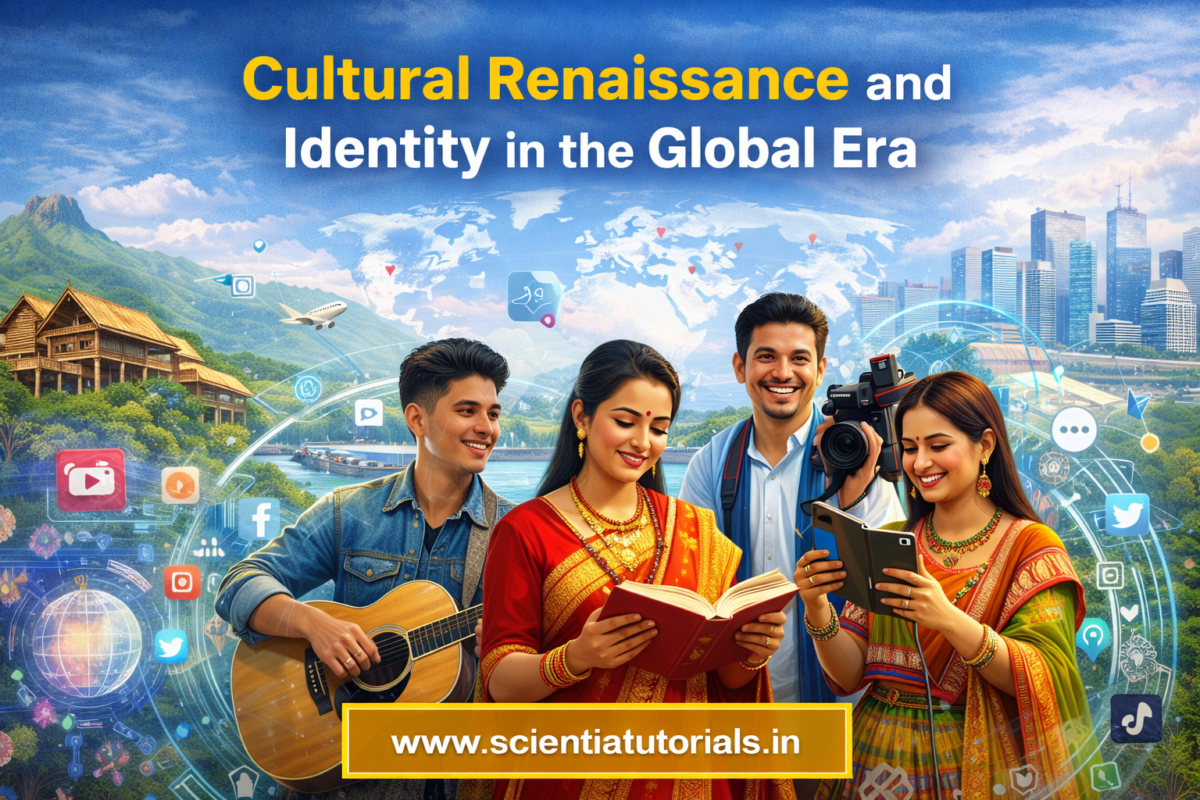

Cultural Renaissance and Identity in North-East India | Global Era
Course: History of North-East India: From Early Kingdoms to Modern Integration
Module X: Contemporary North-East India – Development and Integration
Timeline / Era Covered: 2000 CE – Present
Lesson: Cultural Renaissance and Identity in the Global Era
This lesson is systematically organized into four clearly structured sections, as detailed below:
- Chronologically Structured Study Module
- Short-Answer Type Questions
- Long-Answer Type Questions
- Multiple-Choice Questions (MCQs) with Answers and Detailed Explanations
Chronologically Structured Study Module
1. Introduction
The dawn of the 21st century marked a significant turning point in the cultural history of North-East India. After decades of political unrest, economic marginalisation, and identity assertion movements, the region entered a new phase characterised by cultural renaissance, global interaction, and re-articulation of identity. The forces of globalisation, digital communication, education, and migration have profoundly reshaped how communities in the North-East perceive themselves and present their identities to the wider world.
This lesson examines the emergence of a cultural renaissance in North-East India since 2000 CE, analysing how traditional identities have been preserved, reinterpreted, and projected globally. It also explores the tensions between global influences and indigenous cultural values, making this topic crucial for understanding contemporary socio-cultural dynamics.
2. Conceptual Framework: Culture, Identity, and Globalisation
2.1 Meaning of Cultural Renaissance
A cultural renaissance refers to the revival, reassertion, and creative reinterpretation of cultural traditions, languages, art forms, and collective identities. In the North-East, this renaissance does not imply a return to the past alone, but a dynamic synthesis of tradition and modernity.
2.2 Identity in the Global Era
Identity in the global era is:
- Multiple and layered
- Influenced by global media and local traditions
- Negotiated rather than fixed
For North-East India, identity formation involves balancing ethnic heritage, national belonging, and global citizenship.
3. Historical Background: Cultural Identity Before 2000 CE
Before 2000 CE, cultural identity in North-East India was shaped by:
- Colonial ethnographic classifications
- Post-independence nation-building policies
- Ethnic movements and autonomy struggles
Cultural expression often functioned as a tool of resistance, asserting ethnic distinctiveness against perceived political and cultural domination. While this period preserved many traditions, cultural expression remained largely regionally confined.
4. Transition to the Global Era (Late 1990s–Early 2000s)
The late 1990s and early 2000s witnessed transformative changes:
- Expansion of higher education
- Growth of mass media and satellite television
- Internet and mobile connectivity
These developments created conditions for cultural exchange beyond regional boundaries, enabling artists, writers, musicians, and intellectuals from the North-East to reach national and international audiences.
5. Cultural Renaissance in the 21st Century
5.1 Revival of Indigenous Languages
One of the most significant aspects of the cultural renaissance has been the renewed emphasis on indigenous languages. Since 2000 CE:
- Community-led initiatives have promoted mother-tongue education
- Literature in tribal and regional languages has expanded
- Digital platforms are used to document oral traditions
Language revival has become a powerful instrument for identity preservation in the global era.
5.2 Literature and Intellectual Expression
Contemporary writers from North-East India have gained national and global recognition. Their works address:
- Memory and identity
- Conflict and reconciliation
- Migration and belonging
This literary renaissance has enabled the region to narrate its own histories, challenging stereotypes and marginalisation.
5.3 Music, Fashion, and Visual Arts
Modern music bands, fashion designers, and visual artists have played a crucial role in reshaping cultural identity:
- Fusion of folk traditions with global genres
- Use of traditional motifs in contemporary fashion
- Visual art reflecting indigenous cosmologies
These expressions project a confident, modern, and globally connected North-East identity.
6. Role of Media and Digital Platforms
6.1 Digital Media as Cultural Space
Social media, streaming platforms, and digital archives have:
- Democratized cultural expression
- Enabled global visibility
- Preserved endangered traditions
Digital media allows young people to negotiate identity on their own terms.
6.2 Representation and Self-Narration
The global era has allowed North-East communities to move from being objects of representation to subjects of self-representation, redefining how their cultures are perceived nationally and internationally.
7. Youth, Education, and Identity Formation
7.1 Changing Aspirations
Education and global exposure have reshaped youth identity:
- Increased confidence and mobility
- Engagement with global ideas
- Stronger assertion of indigenous pride
Youth act as cultural mediators between tradition and modernity.
7.2 Campus Culture and Cultural Exchange
Universities and educational institutions have become spaces for:
- Cultural festivals
- Inter-ethnic dialogue
- Identity negotiation
These interactions strengthen both regional solidarity and national integration.
8. Cultural Festivals and Heritage Tourism
8.1 Revival and Reinvention of Festivals
Traditional festivals have been:
- Revived with modern organisational structures
- Promoted nationally and internationally
- Used as platforms for cultural diplomacy
Festivals now function as economic, cultural, and identity-building events.
8.2 Heritage and Cultural Tourism
Cultural tourism has expanded since 2000 CE, promoting:
- Indigenous crafts
- Performing arts
- Traditional cuisines
This has generated income while reinforcing cultural pride, though it also raises concerns about commodification.
9. Gender, Identity, and Cultural Change
Women have emerged as central figures in the cultural renaissance:
- As artists, writers, and entrepreneurs
- As preservers of oral traditions
- As leaders in cultural institutions
The global era has expanded spaces for gendered re-interpretation of tradition, blending empowerment with cultural continuity.
10. Cultural Renaissance and National Integration
The cultural renaissance of the North-East has contributed to:
- Greater national recognition
- Integration without cultural homogenisation
- Strengthening of pluralistic Indian identity
Rather than erasing difference, integration in the global era celebrates diversity.
11. Challenges in the Global Era
Despite positive developments, several challenges remain:
11.1 Cultural Commodification
Global markets sometimes reduce culture to consumable products, risking loss of authenticity.
11.2 Identity Anxiety
Rapid change creates tensions between generations and within communities.
11.3 Unequal Access
Not all communities benefit equally from digital and cultural opportunities.
12. Cultural Policy and Institutional Support
Government and non-government initiatives since 2000 CE have supported:
- Language documentation
- Cultural academies
- Art and heritage institutions
However, sustained policy support is essential to ensure inclusive cultural development.
13. Global Diaspora and Transnational Identity
Migration has created a North-East Indian diaspora that:
- Maintains cultural ties through digital platforms
- Acts as cultural ambassadors
- Contributes to transnational identity formation
Diaspora networks link local cultures to global spaces.
14. Contemporary Trends (2015–Present)
Recent trends include:
- Increased global recognition of North-East artists
- Digital storytelling and archiving
- Cultural entrepreneurship
The region is increasingly seen as a creative and cultural frontier rather than a peripheral space.
15. Conclusion
The cultural renaissance of North-East India in the global era represents a powerful transformation in how the region understands and expresses its identity. Since 2000 CE, traditional cultures have not merely survived globalisation but have actively engaged with it, producing new forms of expression rooted in indigenous heritage.
This renaissance has strengthened self-confidence, reshaped national perceptions, and integrated the North-East into global cultural networks without erasing its uniqueness. For students of contemporary history, this lesson highlights how culture functions as a dynamic force in development, integration, and identity formation.
Short Answer Type Questions with Answers
1. What is meant by cultural renaissance in the context of North-East India?
Answer:
Cultural renaissance refers to the revival, reinterpretation, and renewed expression of indigenous cultures, languages, art forms, and identities in North-East India in the post-2000 global era.
2. Which time period does the lesson “Cultural Renaissance and Identity in the Global Era” cover?
Answer:
The lesson covers the period from 2000 CE to the present.
3. How did globalisation influence cultural identity in North-East India after 2000 CE?
Answer:
Globalisation expanded exposure to global media, markets, and ideas, enabling local cultures to interact with global influences while redefining identity in new forms.
4. Why is identity described as ‘dynamic’ in the global era?
Answer:
Identity is dynamic because it is continuously shaped by social change, migration, digital communication, and interaction between local traditions and global influences.
5. What role did digital media play in the cultural renaissance of North-East India?
Answer:
Digital media provided platforms for self-expression, preservation of traditions, global visibility, and youth-led cultural innovation.
6. How has indigenous language revival contributed to identity formation?
Answer:
Revival of indigenous languages strengthened cultural pride, preserved oral traditions, and reinforced ethnic and community identities.
7. Mention one way literature contributed to cultural renaissance in North-East India.
Answer:
Literature enabled writers to narrate local histories, experiences of conflict, migration, and identity from indigenous perspectives.
8. What themes dominate contemporary literature from North-East India?
Answer:
Identity, memory, marginalisation, conflict, migration, and cultural belonging.
9. How has music contributed to cultural renaissance in the region?
Answer:
Music blended traditional folk elements with global genres, creating modern expressions rooted in indigenous culture.
10. What is meant by cultural self-representation?
Answer:
Cultural self-representation refers to communities narrating and portraying their own identities rather than being represented by external observers.
11. How has education influenced youth identity in North-East India?
Answer:
Education increased global exposure, confidence, mobility, and critical engagement while strengthening pride in indigenous roots.
12. Why are festivals important in the cultural renaissance of North-East India?
Answer:
Festivals preserve traditions, promote cultural exchange, strengthen identity, and support cultural tourism.
13. What is cultural tourism?
Answer:
Cultural tourism involves promoting heritage, festivals, crafts, and traditions to attract visitors and generate economic benefits.
14. Mention one benefit of cultural tourism in the North-East.
Answer:
It generates income and employment while reinforcing cultural pride and heritage preservation.
15. What is cultural commodification?
Answer:
Cultural commodification is the reduction of cultural practices into marketable products, sometimes leading to loss of authenticity.
16. How has the global era affected women’s roles in cultural expression?
Answer:
Women have emerged as writers, artists, entrepreneurs, and cultural leaders while reinterpreting traditions in empowering ways.
17. What challenges does globalisation pose to traditional culture?
Answer:
Loss of authenticity, identity anxiety, generational conflict, and unequal access to cultural platforms.
18. How does cultural renaissance contribute to national integration?
Answer:
It promotes recognition of diversity and strengthens integration without cultural homogenisation within India.
19. Why is youth considered a cultural mediator in the global era?
Answer:
Youth balance traditional values with modern influences, acting as bridges between generations and cultures.
20. What role do universities play in cultural exchange?
Answer:
Universities provide spaces for cultural dialogue, festivals, inter-ethnic interaction, and identity negotiation.
21. How has migration shaped identity in North-East India?
Answer:
Migration created transnational identities while maintaining cultural ties through digital and community networks.
22. What is meant by transnational identity?
Answer:
Transnational identity refers to identity shaped by connections across national borders, combining local roots with global experiences.
23. Why is cultural policy important in the global era?
Answer:
Cultural policy supports preservation, documentation, funding, and inclusive development of diverse cultural traditions.
24. How has the perception of North-East India changed after 2000 CE?
Answer:
It is increasingly viewed as a vibrant cultural and creative region rather than a marginal or isolated area.
25. Why is this lesson important for competitive examinations?
Answer:
It links culture, globalisation, identity, development, and national integration—key themes in contemporary history and social studies.
Long Answer Type Questions with Answers
1. Examine the meaning of cultural renaissance and explain its relevance to North-East India in the global era.
Answer:
A cultural renaissance refers to the revival, reinvention, and renewed confidence in cultural traditions, languages, arts, and identities. In North-East India, the cultural renaissance since 2000 CE has involved both preservation of indigenous heritage and creative engagement with global influences. Rather than rejecting globalisation, communities have adapted traditional practices to modern contexts. This renaissance has enabled the region to assert its identity nationally and internationally, transforming it from a marginalised cultural space into a dynamic centre of creativity and self-representation.
2. Discuss the historical background that shaped cultural identity in North-East India before 2000 CE.
Answer:
Before 2000 CE, cultural identity in North-East India was shaped by colonial ethnographic categorisation, post-independence nation-building, and ethnic assertion movements. Culture often functioned as a form of resistance against political marginalisation and cultural homogenisation. While traditions survived strongly at the community level, limited exposure and restricted platforms meant that cultural expressions remained regionally confined. These historical experiences laid the foundation for later cultural revival in the global era.
3. Analyse the impact of globalisation on cultural identity in North-East India after 2000 CE.
Answer:
Globalisation brought increased connectivity, media exposure, migration, and access to global markets. These forces reshaped identity by introducing new cultural influences while also creating opportunities for cultural assertion. In North-East India, globalisation did not erase indigenous identity; instead, it facilitated dialogue between tradition and modernity. Artists, writers, and youth began presenting local cultures on global platforms, leading to hybrid identities rooted in indigenous heritage.
4. Explain how digital media contributed to the cultural renaissance of North-East India.
Answer:
Digital media revolutionised cultural expression by democratizing access to platforms of representation. Social media, online publishing, and streaming services allowed artists and communities to document oral traditions, promote music and literature, and engage global audiences. Digital spaces enabled self-narration, reducing dependence on external representations and empowering communities to define their own identities.
5. Evaluate the role of indigenous language revival in identity formation in the global era.
Answer:
Language is a core component of cultural identity. Since 2000 CE, efforts to revive indigenous languages through literature, education, and digital documentation have strengthened community pride and inter-generational transmission of culture. Language revival counters cultural erosion and affirms identity in a global environment dominated by major languages, ensuring cultural continuity alongside modernisation.
6. Discuss the contribution of literature to the cultural renaissance in North-East India.
Answer:
Literature has played a transformative role by giving voice to regional histories, memories of conflict, migration experiences, and identity struggles. Contemporary writers from the North-East have challenged stereotypes and enriched Indian literature with diverse perspectives. Literary expression has enabled cultural self-representation and intellectual engagement with global audiences.
7. Analyse the role of music and performing arts in shaping modern North-East identity.
Answer:
Music and performing arts have blended traditional folk elements with global genres such as rock, jazz, and electronic music. This fusion preserves indigenous aesthetics while appealing to contemporary audiences. Performances at national and international platforms have helped project a confident, modern identity rooted in tradition.
8. Examine the importance of cultural self-representation in the global era.
Answer:
Cultural self-representation allows communities to narrate their own stories rather than being portrayed through external lenses. In North-East India, self-representation has corrected historical misrepresentations and fostered dignity and agency. It has also strengthened identity by allowing cultural expressions to emerge organically from within communities.
9. Discuss the role of youth in negotiating identity in the global era.
Answer:
Youth act as cultural mediators, balancing traditional values with global influences. Education, migration, and digital exposure have shaped their aspirations, while cultural roots remain significant. Youth initiatives in music, fashion, and activism demonstrate how identity can be both modern and indigenous.
10. Evaluate the contribution of educational institutions to cultural exchange and identity formation.
Answer:
Universities and colleges serve as spaces for intercultural dialogue, cultural festivals, and intellectual exchange. Students from diverse backgrounds interact, fostering mutual understanding and regional solidarity. Education also equips youth with tools to reinterpret culture critically and creatively.
11. Analyse the role of festivals in the cultural renaissance of North-East India.
Answer:
Festivals have been revived and reorganised to celebrate heritage while attracting national and international attention. They function as platforms for cultural performance, tourism, and community bonding. Festivals reinforce identity and serve as tools of cultural diplomacy.
12. Discuss the growth of cultural tourism and its impact on identity and economy.
Answer:
Cultural tourism promotes indigenous crafts, cuisine, and traditions, generating income and employment. It strengthens cultural pride but also raises concerns about commodification. Sustainable tourism practices are essential to ensure cultural integrity while benefiting local communities.
13. Examine gender dimensions of the cultural renaissance in North-East India.
Answer:
Women have emerged as prominent cultural agents—as artists, writers, entrepreneurs, and custodians of tradition. The global era has expanded opportunities for women to reinterpret traditions and assert leadership, contributing to both cultural continuity and social transformation.
14. Analyse the challenges posed by cultural commodification in the global era.
Answer:
Cultural commodification can reduce traditions to marketable products, stripping them of context and meaning. In North-East India, unchecked commercialisation risks loss of authenticity. Balancing economic benefits with cultural preservation remains a critical challenge.
15. Discuss identity anxiety and generational tensions in a rapidly globalising society.
Answer:
Rapid cultural change can create tensions between older generations focused on preservation and younger generations embracing change. Identity anxiety arises from fear of cultural loss. Dialogue and inclusive cultural practices help bridge these generational divides.
16. Evaluate the role of cultural policy and institutions since 2000 CE.
Answer:
Government and non-government institutions have supported language documentation, cultural academies, and artistic platforms. Effective cultural policy ensures inclusive representation, funding, and long-term sustainability of cultural initiatives.
17. Examine the role of migration and diaspora in shaping transnational identities.
Answer:
Migration has created diasporic communities that maintain cultural ties through digital communication and cultural events. Diaspora networks act as cultural ambassadors, linking local traditions with global spaces and creating layered identities.
18. Discuss how cultural renaissance contributes to national integration.
Answer:
Cultural renaissance promotes recognition of diversity and inclusion within India. Integration is achieved without cultural homogenisation, strengthening unity through respect for difference.
19. Analyse recent trends (2015–present) in cultural expression in North-East India.
Answer:
Recent trends include digital storytelling, global recognition of artists, cultural entrepreneurship, and innovative use of technology. These developments position the region as a creative frontier in contemporary India.
20. Conclude by evaluating the overall significance of cultural renaissance and identity in the global era for North-East India.
Answer:
The cultural renaissance since 2000 CE has transformed North-East India’s relationship with itself, the nation, and the world. By engaging creatively with globalisation, the region has preserved its heritage while redefining identity in modern terms. This process has strengthened self-confidence, visibility, and integration, making culture a vital force in contemporary development and national unity.
MCQs with Answers and Explanations
1. The term “cultural renaissance” in North-East India refers to:
A. Decline of indigenous cultures
B. Revival and creative reinterpretation of traditions
C. Total westernisation of society
D. Cultural uniformity across India
✅ Correct Answer: B. Revival and creative reinterpretation of traditions
Explanation:
Cultural renaissance implies revival, renewal, and reinterpretation of indigenous traditions, languages, and art forms, not their rejection or uniformity.
2. The lesson “Cultural Renaissance and Identity in the Global Era” primarily covers which period?
A. 1947–1962
B. 1962–1990
C. 1991–2000
D. 2000 CE–Present
✅ Correct Answer: D. 2000 CE–Present
Explanation:
The lesson focuses on cultural changes and identity formation in North-East India in the post-2000 globalised era.
3. Which factor played the most significant role in expanding cultural visibility after 2000 CE?
A. Military reforms
B. Digital media and internet connectivity
C. Colonial policies
D. Agricultural modernisation
✅ Correct Answer: B. Digital media and internet connectivity
Explanation:
Digital platforms enabled self-representation, global outreach, and preservation of cultural expressions.
4. Identity in the global era is best described as:
A. Fixed and unchanging
B. Uniform across regions
C. Dynamic and negotiated
D. Completely western
✅ Correct Answer: C. Dynamic and negotiated
Explanation:
Identity today evolves through interaction between tradition, modernity, and global influences.
5. Which of the following best explains “cultural self-representation”?
A. Representation by colonial writers
B. Government portrayal of culture
C. Communities narrating their own identities
D. Tourist-based cultural depiction
✅ Correct Answer: C. Communities narrating their own identities
Explanation:
Cultural self-representation allows communities to define and present their culture themselves.
6. Indigenous language revival contributes to identity mainly by:
A. Replacing national languages
B. Preserving oral traditions and cultural memory
C. Promoting cultural isolation
D. Encouraging migration
✅ Correct Answer: B. Preserving oral traditions and cultural memory
Explanation:
Language revival strengthens cultural continuity and identity preservation.
7. Contemporary literature from North-East India commonly addresses themes of:
A. Industrial growth only
B. Identity, memory, and marginalisation
C. Ancient empires exclusively
D. Mythology without context
✅ Correct Answer: B. Identity, memory, and marginalisation
Explanation:
Modern writings reflect lived experiences, conflict, belonging, and cultural assertion.
8. Which art form most clearly demonstrates fusion of tradition and global influence?
A. Folk music performed unchanged
B. Classical Sanskrit drama
C. Fusion music blending folk and global genres
D. Ritual chants only
✅ Correct Answer: C. Fusion music blending folk and global genres
Explanation:
Fusion music exemplifies cultural renaissance by adapting tradition to modern global forms.
9. Digital media helped cultural renaissance by:
A. Limiting cultural participation
B. Centralising cultural control
C. Democratising cultural expression
D. Replacing traditional culture
✅ Correct Answer: C. Democratising cultural expression
Explanation:
Digital tools allow wider participation and self-expression across communities.
10. Youth are considered cultural mediators because they:
A. Reject all traditions
B. Follow only global trends
C. Balance tradition with modern influences
D. Avoid cultural participation
✅ Correct Answer: C. Balance tradition with modern influences
Explanation:
Youth negotiate between inherited traditions and global exposure.
11. Cultural festivals in the global era primarily function as:
A. Religious rituals only
B. Political movements
C. Platforms of identity, economy, and diplomacy
D. Tools of cultural erasure
✅ Correct Answer: C. Platforms of identity, economy, and diplomacy
Explanation:
Festivals promote heritage, tourism, and cultural exchange.
12. Cultural tourism benefits North-East India mainly by:
A. Destroying traditions
B. Generating income and cultural pride
C. Replacing local culture
D. Reducing community participation
✅ Correct Answer: B. Generating income and cultural pride
Explanation:
When managed sustainably, cultural tourism supports economy and identity.
13. Cultural commodification refers to:
A. Cultural preservation
B. Commercial use of culture risking loss of authenticity
C. Cultural education
D. Cultural isolation
✅ Correct Answer: B. Commercial use of culture risking loss of authenticity
Explanation:
Over-commercialisation can dilute cultural meaning.
14. Which group has emerged prominently in cultural leadership since 2000 CE?
A. Colonial administrators
B. External scholars
C. Women artists and entrepreneurs
D. Military officials
✅ Correct Answer: C. Women artists and entrepreneurs
Explanation:
Women have become key contributors to cultural revival and reinterpretation.
15. Identity anxiety in the global era arises mainly due to:
A. Cultural stability
B. Slow social change
C. Rapid cultural transformation
D. Isolation from global forces
✅ Correct Answer: C. Rapid cultural transformation
Explanation:
Fast change creates tension between preservation and adaptation.
16. Universities contribute to cultural renaissance by:
A. Limiting cultural expression
B. Promoting only mainstream culture
C. Encouraging cultural dialogue and exchange
D. Avoiding cultural activities
✅ Correct Answer: C. Encouraging cultural dialogue and exchange
Explanation:
Educational spaces foster intercultural understanding and expression.
17. Transnational identity emerges due to:
A. Agricultural reforms
B. Internal migration only
C. Global migration and digital connectivity
D. Cultural isolation
✅ Correct Answer: C. Global migration and digital connectivity
Explanation:
Diaspora connections create identities that span national boundaries.
18. Diaspora communities contribute to cultural renaissance by:
A. Cutting ties with homeland
B. Acting as cultural ambassadors
C. Rejecting tradition
D. Promoting uniformity
✅ Correct Answer: B. Acting as cultural ambassadors
Explanation:
Diaspora networks promote culture globally while maintaining roots.
19. Cultural policy in the global era is important because it:
A. Suppresses local culture
B. Supports preservation and inclusive development
C. Promotes cultural uniformity
D. Eliminates traditional practices
✅ Correct Answer: B. Supports preservation and inclusive development
Explanation:
Policy support ensures sustainability of cultural initiatives.
20. Cultural renaissance strengthens national integration by:
A. Erasing differences
B. Promoting cultural homogenisation
C. Celebrating diversity within unity
D. Isolating regions
✅ Correct Answer: C. Celebrating diversity within unity
Explanation:
Integration respects diversity within India.
21. Which recent trend characterises post-2015 cultural expression?
A. Decline of digital storytelling
B. Increased global recognition of artists
C. Cultural withdrawal
D. Reduced youth participation
✅ Correct Answer: B. Increased global recognition of artists
Explanation:
Global platforms have expanded visibility of North-East cultural creators.
22. Cultural renaissance differs from cultural preservation because it:
A. Rejects tradition
B. Freezes culture in time
C. Allows adaptation and innovation
D. Promotes cultural loss
✅ Correct Answer: C. Allows adaptation and innovation
Explanation:
Renaissance involves renewal, not mere conservation.
23. Which concept best explains blending tradition with modern forms?
A. Cultural erosion
B. Cultural fusion
C. Cultural isolation
D. Cultural stagnation
✅ Correct Answer: B. Cultural fusion
Explanation:
Fusion creates new expressions rooted in tradition.
24. Unequal access to digital platforms leads to:
A. Uniform cultural growth
B. Cultural homogenisation
C. Uneven cultural benefits
D. Cultural stability
✅ Correct Answer: C. Uneven cultural benefits
Explanation:
Not all communities equally benefit from global cultural opportunities.
25. Why is this topic important for competitive examinations?
A. It is purely theoretical
B. It focuses only on art
C. It links culture, identity, and globalisation
D. It is outdated
✅ Correct Answer: C. It links culture, identity, and globalisation
Explanation:
The topic is interdisciplinary and relevant to contemporary history and society.