
Assam Movement and the Assam Accord
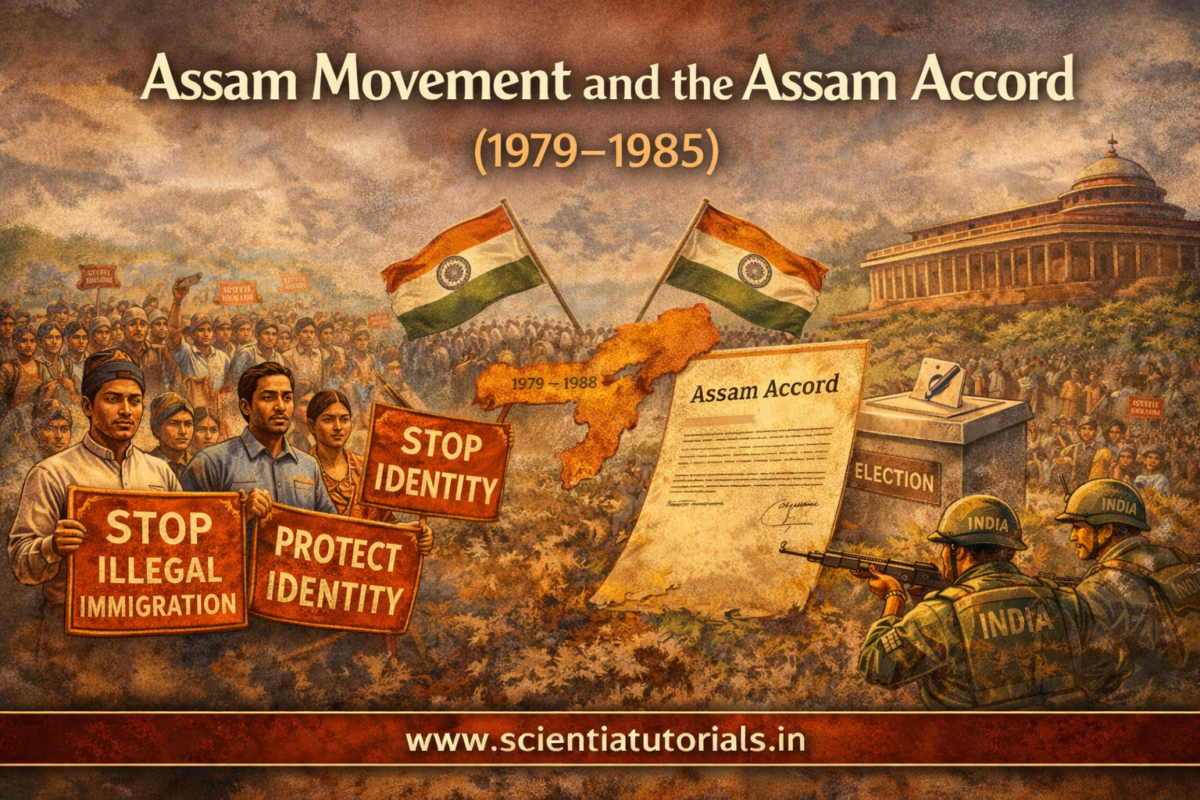

Assam Movement and Assam Accord (1979–1985) | History Notes
Course: History of North-East India: From Early Kingdoms to Modern Integration
Module IX: Insurgency, Identity, and Political Movements
Timeline / Era Covered: 1970s – 1990s
Lesson: Assam Movement and the Assam Accord
This lesson is systematically organized into four clearly structured sections, as detailed below:
- Chronologically Structured Study Module
- Short-Answer Type Questions
- Long-Answer Type Questions
- Multiple-Choice Questions (MCQs) with Answers and Detailed Explanations
Chronologically Structured Study Module
Introduction
The Assam Movement (1979–1985) stands as one of the most significant mass political movements in the post-independence history of North-East India. Emerging from widespread anxieties over illegal immigration, demographic change, cultural survival, and political marginalisation, the movement fundamentally reshaped Assam’s politics and had long-lasting implications for identity politics, federalism, and Centre–State relations in India.
Unlike many insurgent movements in the North-East, the Assam Movement was primarily a mass-based, civil agitation, led largely by students and supported by wide sections of Assamese society. Its culmination in the Assam Accord (1985) marked a rare instance where a prolonged popular movement was resolved through negotiation rather than prolonged armed conflict.
This lesson examines the origins, course, leadership, phases, and consequences of the Assam Movement, and critically evaluates the Assam Accord as an instrument of conflict resolution and political accommodation.
Historical Background: Roots of the Assam Movement
Colonial Legacy and Migration Patterns
Migration into Assam did not begin after independence. During the colonial period:
- British policies encouraged migration to expand agriculture
- Large numbers of peasants migrated from neighbouring regions
- Administrative boundaries ignored cultural and ethnic realities
While migration initially contributed to economic growth, it also planted the seeds of demographic imbalance and cultural anxiety.
Post-Independence Developments
After 1947, migration continued due to:
- Political instability in neighbouring regions
- Porous international borders
- Weak enforcement of citizenship laws
By the 1960s–70s, many Assamese-speaking communities feared becoming political and cultural minorities in their own state, creating fertile ground for mass mobilisation.
Immediate Causes of the Assam Movement
Detection of Foreign Nationals in Electoral Rolls
The immediate trigger of the movement was the discovery of a large number of suspected foreign nationals in electoral rolls in the late 1970s. This raised serious concerns about:
- Electoral integrity
- Political representation
- Democratic legitimacy
The issue transformed migration from a social concern into a political crisis.
Crisis of Identity and Political Marginalisation
The Assamese middle class and educated youth perceived:
- Loss of linguistic dominance
- Cultural dilution
- Economic competition for land and jobs
These anxieties were framed as a struggle to protect “jati, mati, aru bheti” (community, land, and hearth).
Leadership and Organisation of the Assam Movement
Role of Student Organisations
The movement was spearheaded by the All Assam Students’ Union (AASU), supported by the All Assam Gana Sangram Parishad (AAGSP).
Key characteristics:
- Youth-led leadership
- Non-party mass mobilisation
- Strong organisational discipline
Student leadership gave the movement moral legitimacy and mass appeal.
Nature of the Movement
The Assam Movement was:
- Non-violent in principle
- Statewide in scale
- Sustained over six years
However, prolonged agitation also resulted in periodic violence, breakdown of administration, and social polarisation.
Chronological Phases of the Assam Movement (1979–1985)
Phase I (1979–1980): Mobilisation and Mass Awakening
This phase witnessed:
- Large-scale rallies and protests
- Strikes and civil disobedience
- Boycott of elections
The movement rapidly gained mass support across urban and rural Assam.
Phase II (1980–1983): Intensification and Political Deadlock
Key developments:
- Suspension of normal political processes
- Boycott of the 1983 state elections
- Escalation of tensions
The failure to reach a political settlement deepened mistrust between the Centre and the movement leaders.
Phase III (1983): Violence and Crisis
The 1983 elections, conducted despite widespread opposition, marked a tragic phase. The period witnessed:
- Severe breakdown of law and order
- Communal and ethnic violence
- Loss of civilian lives
This phase exposed the limits of administrative coercion in resolving mass political movements.
Phase IV (1984–1985): Negotiation and Settlement
Recognising the unsustainable nature of prolonged unrest, both sides moved towards dialogue. Prolonged negotiations between movement leaders and the central government culminated in a historic agreement.
The Assam Accord (1985)
Signing of the Accord
The Assam Accord was signed on 15 August 1985, symbolically linking the resolution of the movement with India’s Independence Day.
Signatories included:
- Leaders of the Assam Movement
- Representatives of the Government of India
- Government of Assam
Key Provisions of the Assam Accord
1. Cut-off Date for Detection of Foreigners
- 1 January 1966 – 24 March 1971: Migrants to be detected and disenfranchised for a period
- Post–24 March 1971: Migrants to be detected and expelled
This cut-off linked Assam’s issue to the historical context of the Bangladesh Liberation War.
2. Citizenship and Electoral Safeguards
- Updating of electoral rolls
- Deletion of names of illegal migrants
- Protection of political rights of indigenous people
3. Cultural and Linguistic Safeguards
The Accord promised:
- Protection of Assamese language and culture
- Safeguards for social and cultural identity
These assurances addressed the movement’s core identity concerns.
4. Economic Development Measures
The Centre committed to:
- Accelerated economic development
- Infrastructure expansion
- Industrial investment
Development was seen as essential for long-term stability.
Political Consequences of the Assam Accord
Formation of a Regional Government
Following the Accord:
- A new regional political party emerged
- Former movement leaders entered electoral politics
- A government was formed reflecting popular mandate
This marked the transition from agitation to constitutional politics.
Strengthening of Regionalism
The Accord legitimised:
- Regional political aspirations
- Ethnic identity within democratic frameworks
- Negotiated federal accommodation
Assam became a model for peaceful conflict resolution through dialogue.
Limitations and Challenges of the Assam Accord
Implementation Deficit
Despite its promise, the Accord faced serious challenges:
- Slow and inconsistent implementation
- Administrative bottlenecks in detection processes
- Legal and procedural complexities
Delayed implementation weakened public trust.
Continuing Migration Debate
The question of:
- Who is a foreigner
- How to identify them
- How to balance humanitarian and legal concerns
remained unresolved, leading to renewed political debates in later decades.
Exclusion of Other Ethnic Concerns
The movement primarily reflected Assamese-speaking middle-class concerns. Other groups felt:
- Marginalised within the settlement
- Excluded from decision-making
This contributed to the emergence of new autonomy and ethnic movements within Assam.
The Assam Movement in the Context of Insurgency and Identity Politics
The Assam Movement illustrates a distinct trajectory within North-East politics:
- Mass mobilisation rather than armed insurgency
- Negotiation instead of prolonged militancy
- Constitutional settlement over secession
However, failure to fully implement the Accord indirectly contributed to:
- Rise of militant groups
- Deepening identity fragmentation
Critical Evaluation
Achievements
- Peaceful resolution of a mass movement
- Protection of regional identity through negotiation
- Strengthening of democratic participation
Shortcomings
- Incomplete implementation
- Persistence of identity conflicts
- Ambiguity in citizenship enforcement
The Accord succeeded politically but remained administratively fragile.
Conclusion
The Assam Movement (1979–1985) and the Assam Accord represent a landmark chapter in the modern history of North-East India. Rooted in identity anxieties and democratic concerns, the movement demonstrated the power of mass mobilisation in shaping state policy. The Assam Accord, in turn, showed that dialogue and federal accommodation could resolve even deeply polarising issues.
However, the long-term effectiveness of the Accord was undermined by weak implementation and evolving political realities. The experience of Assam underscores a crucial lesson: agreements resolve conflicts only when followed by sustained political will, administrative commitment, and inclusive governance.
Understanding the Assam Movement is essential for grasping contemporary debates on citizenship, migration, identity, and federalism in India.
Short Answer Type Questions
Lesson: Assam Movement and the Assam Accord (1979–1985)
1. What was the Assam Movement?
Answer:
The Assam Movement was a mass political agitation (1979–1985) demanding detection, deletion, and deportation of illegal immigrants from Assam to protect indigenous identity.
2. Which period did the Assam Movement cover?
Answer:
The movement lasted from 1979 to 1985, culminating in the signing of the Assam Accord.
3. What was the main cause of the Assam Movement?
Answer:
The primary cause was the presence of a large number of alleged illegal immigrants in Assam, particularly reflected in electoral rolls.
4. What issue triggered the Assam Movement in 1979?
Answer:
The discovery of thousands of suspected foreign nationals in the Mangaldoi parliamentary constituency electoral rolls triggered the movement.
5. Which organisation led the Assam Movement?
Answer:
The movement was led by the All Assam Students’ Union (AASU).
6. What role did students play in the Assam Movement?
Answer:
Students provided leadership, organisational discipline, and moral legitimacy, transforming the movement into a statewide mass agitation.
7. What does the slogan “jati, mati, aru bheti” signify?
Answer:
It signifies the protection of community (jati), land (mati), and home (bheti), reflecting Assamese identity concerns.
8. Why did the Assam Movement oppose the 1983 Assembly elections?
Answer:
The elections were opposed because they were held without resolving the issue of illegal immigrants, undermining democratic legitimacy.
9. What was the nature of the Assam Movement?
Answer:
It was primarily a non-violent, mass-based civil agitation, though it witnessed phases of violence due to prolonged unrest.
10. What were the major consequences of the 1983 elections in Assam?
Answer:
The elections led to political instability, breakdown of law and order, and widespread violence, deepening the crisis.
11. What is the Assam Accord?
Answer:
The Assam Accord was a political agreement signed in 1985 to end the Assam Movement by addressing issues of migration, identity, and development.
12. On which date was the Assam Accord signed?
Answer:
The Accord was signed on 15 August 1985.
13. Name the agreement that formally ended the Assam Movement.
Answer:
The Assam Accord formally ended the Assam Movement.
14. What was the cut-off date for detecting foreigners under the Assam Accord?
Answer:
24 March 1971 was fixed as the cut-off date for identifying illegal immigrants.
15. Why was 24 March 1971 chosen as the cut-off date?
Answer:
It corresponds to the eve of the Bangladesh Liberation War, marking a major influx of migrants into Assam.
16. How did the Assam Accord address citizenship issues?
Answer:
It provided for detection, disenfranchisement, and expulsion of illegal migrants while protecting the rights of indigenous citizens.
17. What cultural safeguards were promised in the Assam Accord?
Answer:
The Accord promised protection of Assamese language, culture, and social identity.
18. What economic assurances were included in the Assam Accord?
Answer:
The Centre promised accelerated economic development, infrastructure expansion, and industrial growth in Assam.
19. What political development followed the Assam Accord?
Answer:
A regional political party formed by former movement leaders came to power through democratic elections.
20. How did the Assam Movement differ from insurgent movements in the North-East?
Answer:
It was a mass-based, largely non-violent movement resolved through negotiation rather than prolonged armed insurgency.
21. What were the limitations of the Assam Accord?
Answer:
Poor implementation, administrative delays, and unresolved migration issues weakened its long-term effectiveness.
22. Why did the migration issue persist even after the Accord?
Answer:
Complex legal procedures, lack of political consensus, and administrative challenges delayed effective implementation.
23. How did the Assam Movement impact identity politics in Assam?
Answer:
It strengthened Assamese regional identity and legitimised identity-based political mobilisation.
24. Why is the Assam Movement significant in Indian federal history?
Answer:
It demonstrated that mass movements could be resolved through dialogue and federal accommodation.
25. Why is the Assam Accord still relevant today?
Answer:
Contemporary debates on citizenship, migration, and identity in Assam continue to be shaped by the Accord.
Long Answer Type Questions
Lesson: Assam Movement and the Assam Accord (1979–1985)
1. Analyse the historical background that led to the Assam Movement.
Answer:
The Assam Movement was rooted in long-standing demographic, political, and cultural anxieties. Colonial policies encouraged migration to Assam for agricultural expansion, altering demographic patterns. After independence, porous borders and political instability in neighbouring regions led to continued migration. By the 1970s, many Assamese communities feared political marginalisation and loss of cultural identity, creating conditions for a mass movement centred on citizenship and identity.
2. Examine the immediate causes of the Assam Movement.
Answer:
The immediate cause was the discovery of a large number of suspected foreign nationals in electoral rolls, particularly in the Mangaldoi constituency in 1979. This raised concerns about electoral integrity and democratic legitimacy. Migration thus became a political issue, transforming social anxiety into organised mass agitation.
3. Discuss the role of identity in shaping the Assam Movement.
Answer:
Identity was central to the Assam Movement. The slogan “jati, mati, aru bheti” symbolised the struggle to protect community, land, and homeland. The movement framed migration as a threat to Assamese linguistic, cultural, and political identity, mobilising society across class and regional lines.
4. Analyse the leadership and organisational structure of the Assam Movement.
Answer:
The movement was led primarily by the All Assam Students’ Union (AASU), supported by the All Assam Gana Sangram Parishad. Student leadership ensured discipline, non-party character, and moral legitimacy. This organisational strength enabled the movement to sustain mass participation for over six years.
5. Why is the Assam Movement considered a mass movement rather than an insurgency?
Answer:
Unlike insurgent movements, the Assam Movement relied mainly on civil disobedience, strikes, boycotts, and peaceful protests. Although violence occurred during certain phases, the movement’s core strategy remained non-violent mass mobilisation, resolved ultimately through negotiation rather than armed struggle.
6. Trace the major phases of the Assam Movement from 1979 to 1985.
Answer:
The movement evolved through phases of mobilisation (1979–80), intensification and political deadlock (1980–83), crisis and violence during the 1983 elections, and finally negotiation (1984–85). Each phase reflected changing strategies and state responses, culminating in a political settlement.
7. Critically examine the significance of the 1983 Assam Assembly elections.
Answer:
The 1983 elections, held amid a boycott by movement leaders, led to severe violence and loss of life. They exposed the limits of coercive electoral politics in resolving mass movements and intensified mistrust between the Centre and Assamese society.
8. Discuss the circumstances leading to the signing of the Assam Accord.
Answer:
Prolonged instability, economic disruption, and social unrest made continuation of the movement unsustainable. Both the movement leadership and the central government recognised the need for dialogue. Negotiations culminated in the signing of the Accord in 1985, symbolising a shift from confrontation to compromise.
9. Examine the main provisions of the Assam Accord.
Answer:
The Accord fixed 24 March 1971 as the cut-off date for detecting foreigners, provided for updating electoral rolls, promised cultural safeguards for Assamese identity, and assured economic development. These provisions aimed to balance humanitarian, legal, and political concerns.
10. Why was 24 March 1971 chosen as the cut-off date in the Assam Accord?
Answer:
The date corresponds to the eve of the Bangladesh Liberation War, which triggered a massive refugee influx into Assam. It was chosen as a historically justifiable compromise between competing claims.
11. Analyse the political impact of the Assam Accord on state politics.
Answer:
The Accord led to the transformation of movement leaders into elected representatives and the formation of a regional government. This marked a transition from agitation to constitutional politics and strengthened regionalism within the democratic framework.
12. Evaluate the Assam Accord as an example of negotiated conflict resolution.
Answer:
The Accord demonstrated that mass political conflicts rooted in identity could be resolved through negotiation and federal accommodation. It remains a rare instance of peaceful settlement of a prolonged movement in North-East India.
13. Discuss the limitations of the Assam Accord.
Answer:
Key limitations included delayed implementation, administrative complexity in detecting foreigners, and lack of clarity in enforcement mechanisms. These weaknesses eroded public confidence and left core issues unresolved.
14. Why did the migration issue persist even after the Assam Accord?
Answer:
Legal challenges, political hesitation, humanitarian concerns, and bureaucratic inefficiency hindered effective implementation. As a result, migration remained a contentious issue in subsequent decades.
15. Analyse the impact of the Assam Movement on identity politics in Assam.
Answer:
The movement institutionalised Assamese identity politics, legitimising ethnic mobilisation within democratic discourse. It also influenced later debates on citizenship, language, and federal accommodation.
16. Compare the Assam Movement with insurgent movements in other parts of North-East India.
Answer:
Unlike armed insurgencies, the Assam Movement relied on mass mobilisation and negotiation. While insurgencies often challenged state sovereignty, the Assam Movement sought reform within the Indian Union, highlighting different trajectories of protest.
17. Examine the role of the Centre in handling the Assam Movement.
Answer:
Initially marked by indecision and coercive measures, the Centre later adopted negotiation. The shift illustrated the importance of political dialogue over administrative force in managing identity-based movements.
18. Assess the social consequences of the Assam Movement.
Answer:
The movement generated political awareness and participation but also led to social polarisation and episodes of violence. Its long duration disrupted economic activity and strained inter-community relations.
19. Critically assess whether the Assam Accord fulfilled the aspirations of the movement.
Answer:
While the Accord achieved political settlement and cultural recognition, incomplete implementation meant that many aspirations—especially regarding migration control—remained unmet. Thus, success was partial and uneven.
20. Conclude by analysing the historical significance of the Assam Movement and the Assam Accord.
Answer:
The Assam Movement and the Assam Accord represent a landmark in India’s democratic history. They demonstrated the power of mass mobilisation, the centrality of identity in politics, and the potential of negotiated federal solutions. At the same time, they highlight that agreements require sustained political will and administrative commitment to achieve lasting peace.
MCQs with Answers and Explanations
Lesson: Assam Movement and the Assam Accord (1979–1985)
1. The Assam Movement was primarily a protest against
A. Industrial underdevelopment
B. Centralisation of power
C. Illegal immigration and demographic change
D. Linguistic reorganisation
Correct Answer: C
Explanation:
The Assam Movement focused on the detection, deletion, and deportation of illegal immigrants, whom protesters believed threatened Assamese political and cultural identity.
2. The Assam Movement began in which year?
A. 1975
B. 1977
C. 1979
D. 1981
Correct Answer: C
Explanation:
The movement began in 1979 following the discovery of a large number of suspected foreign nationals in electoral rolls.
3. The immediate trigger of the Assam Movement was
A. Language riots
B. Mangaldoi by-election controversy
C. State reorganisation
D. Industrial decline
Correct Answer: B
Explanation:
The discovery of a large number of alleged foreign nationals in the Mangaldoi parliamentary constituency electoral rolls triggered the agitation.
4. Which organisation led the Assam Movement?
A. Assam Pradesh Congress Committee
B. United Liberation Front of Assam
C. All Assam Students’ Union
D. Assam Sahitya Sabha
Correct Answer: C
Explanation:
The All Assam Students’ Union (AASU) provided leadership, organisation, and ideological direction to the movement.
5. The slogan “jati, mati, aru bheti” refers to the protection of
A. Religion, economy, and culture
B. Community, land, and home
C. Language, religion, and economy
D. State, constitution, and law
Correct Answer: B
Explanation:
The slogan symbolised Assamese concerns over identity (jati), land (mati), and homeland (bheti).
6. The Assam Movement was mainly
A. An armed insurgency
B. A peasant rebellion
C. A mass-based civil agitation
D. A labour movement
Correct Answer: C
Explanation:
Despite episodes of violence, the movement relied largely on non-violent mass mobilisation, strikes, and civil disobedience.
7. Which elections were widely boycotted during the Assam Movement?
A. 1977 Lok Sabha elections
B. 1980 Lok Sabha elections
C. 1983 Assam Assembly elections
D. 1984 Lok Sabha elections
Correct Answer: C
Explanation:
The 1983 Assembly elections were boycotted as the movement argued that electoral rolls were not cleansed of illegal immigrants.
8. The 1983 elections in Assam are remembered mainly for
A. High voter turnout
B. Peaceful political transition
C. Severe violence and breakdown of order
D. Formation of a regional party
Correct Answer: C
Explanation:
The elections led to widespread violence, exposing the limits of coercive electoral politics during mass agitation.
9. The agreement that formally ended the Assam Movement was the
A. Shillong Accord
B. Assam Agreement
C. Assam Accord
D. Guwahati Declaration
Correct Answer: C
Explanation:
The Assam Accord, signed in 1985, brought the six-year-long movement to an end.
10. On which date was the Assam Accord signed?
A. 26 January 1985
B. 15 August 1985
C. 24 March 1985
D. 2 October 1985
Correct Answer: B
Explanation:
The Accord was signed on 15 August 1985, symbolically linking it to Independence Day.
11. What cut-off date was fixed by the Assam Accord for detecting foreigners?
A. 1 January 1951
B. 26 January 1950
C. 24 March 1971
D. 15 August 1971
Correct Answer: C
Explanation:
24 March 1971, the eve of the Bangladesh Liberation War, was chosen as the cut-off date.
12. Migrants who entered Assam between 1966 and 1971 were to be
A. Granted full citizenship
B. Immediately deported
C. Disenfranchised for a fixed period
D. Given permanent residency
Correct Answer: C
Explanation:
Such migrants were to be detected and disenfranchised for a specified period before citizenship consideration.
13. One major assurance of the Assam Accord related to
A. Military deployment
B. Cultural and linguistic safeguards
C. Abolition of local councils
D. Religious autonomy
Correct Answer: B
Explanation:
The Accord promised protection of Assamese language, culture, and social identity.
14. The Assam Movement is significant because it
A. Led to secession
B. Was resolved through negotiation
C. Ended democratic politics
D. Created a new state
Correct Answer: B
Explanation:
Unlike many movements in the North-East, it was resolved through dialogue rather than prolonged insurgency.
15. Which political outcome followed the Assam Accord?
A. Imposition of President’s Rule
B. Formation of a regional government
C. Creation of a Union Territory
D. Military administration
Correct Answer: B
Explanation:
Movement leaders entered electoral politics, leading to the formation of a regional government.
16. A major limitation of the Assam Accord was
A. Excessive decentralisation
B. Lack of public support
C. Poor and delayed implementation
D. Judicial rejection
Correct Answer: C
Explanation:
Slow and inconsistent implementation weakened the Accord’s long-term impact.
17. Why did the migration issue persist even after 1985?
A. Complete lack of laws
B. Administrative and legal complexities
C. Absence of identity politics
D. Economic prosperity
Correct Answer: B
Explanation:
Detection and deportation involved complex legal procedures and administrative challenges.
18. The Assam Movement mainly represented the concerns of
A. Industrial workers
B. Tribal elites only
C. Assamese-speaking society
D. Foreign migrants
Correct Answer: C
Explanation:
The movement largely reflected Assamese middle-class and linguistic identity concerns.
19. Compared to insurgent movements, the Assam Movement was
A. More violent
B. Less organised
C. More democratic in character
D. Foreign-sponsored
Correct Answer: C
Explanation:
It relied on mass participation, civil protest, and negotiation within the democratic framework.
20. The Assam Movement strengthened
A. Pan-Indian nationalism alone
B. Identity-based regional politics
C. Military rule
D. Religious fundamentalism
Correct Answer: B
Explanation:
The movement legitimised identity-based regional politics within constitutional democracy.
21. The role of the central government during the movement can best be described as
A. Consistently accommodative
B. Entirely coercive
C. Initially hesitant, later negotiative
D. Completely absent
Correct Answer: C
Explanation:
The Centre initially relied on administrative measures but later moved towards dialogue.
22. The Assam Movement is important for federal studies because it
A. Abolished state autonomy
B. Demonstrated negotiated federal accommodation
C. Strengthened unitary governance
D. Ended Centre–State relations
Correct Answer: B
Explanation:
It showed how Centre–State conflicts rooted in identity could be resolved through negotiation.
23. One unintended consequence of the Assam Accord was
A. Complete political stability
B. Elimination of ethnic conflicts
C. Emergence of new ethnic demands
D. End of migration debates
Correct Answer: C
Explanation:
Other ethnic groups felt excluded, leading to fresh autonomy movements within Assam.
24. The Assam Movement differed from secessionist movements because it
A. Rejected identity politics
B. Sought reform within India
C. Demanded independence
D. Opposed democracy
Correct Answer: B
Explanation:
The movement aimed to reform citizenship and representation within the Indian Union.
25. The long-term significance of the Assam Movement lies in its
A. Military success
B. Economic transformation
C. Impact on citizenship and identity debates
D. Judicial precedents
Correct Answer: C
Explanation:
Debates on citizenship, migration, and identity in Assam continue to draw from the movement’s legacy.