
Treaty of Yandabo and the British Entry into the Region
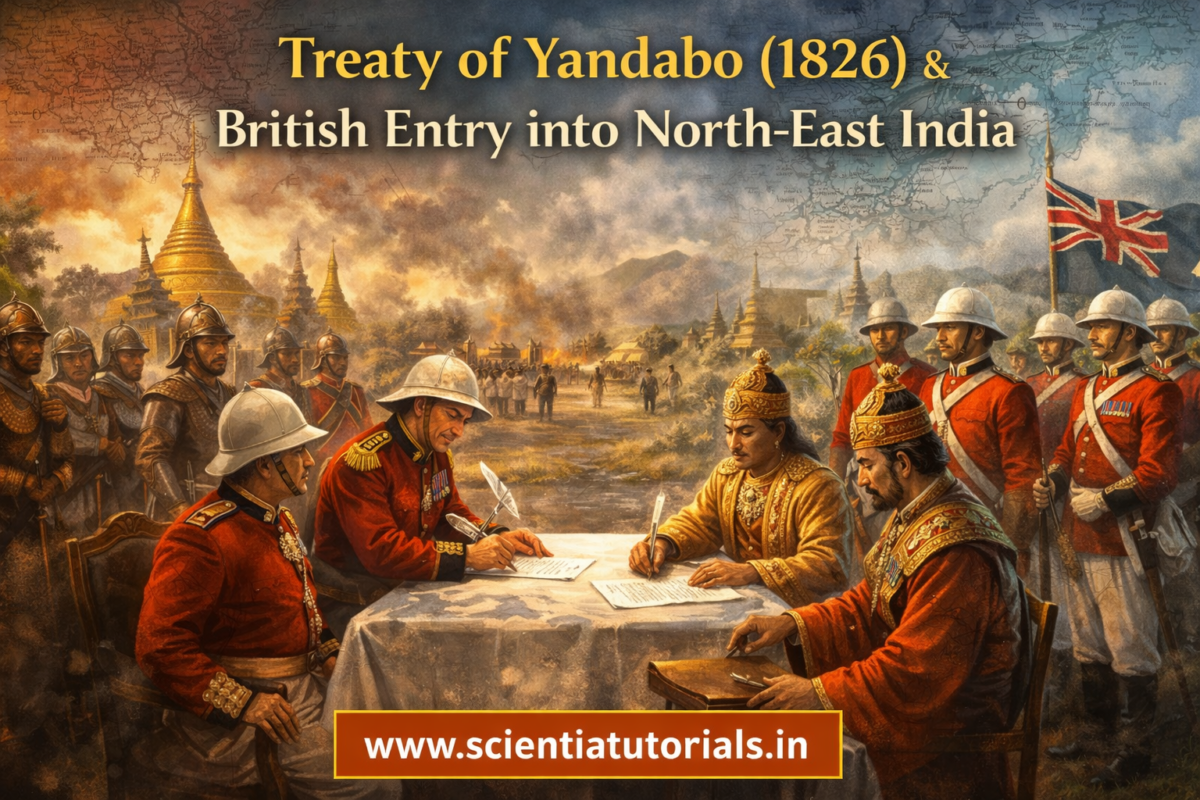

Treaty of Yandabo (1826) and British Entry into North-East India
Course: History of North-East India: From Early Kingdoms to Modern Integration
Module V: North-East India on the Eve of Colonial Rule
Timeline / Era Covered: 18th Century CE – Early 19th Century CE
Lesson: Treaty of Yandabo and the British Entry into the Region
This lesson is systematically organized into four clearly structured sections, as detailed below:
- Chronologically Structured Study Module
- Short-Answer Type Questions
- Long-Answer Type Questions
- Multiple-Choice Questions (MCQs) with Answers and Detailed Explanations
Chronologically Structured Study Module
Introduction: The Treaty of Yandabo as a Historical Turning Point
The Treaty of Yandabo (1826) stands as a watershed moment in the history of North-East India. Signed at the conclusion of the First Anglo-Burmese War, the treaty decisively ended Burmese political influence over Assam, Manipur, and adjoining frontier regions and opened the gates for systematic British intervention and eventual colonial consolidation. This lesson examines the treaty not merely as a diplomatic document but as a transformative event that reshaped the political, administrative, and strategic landscape of North-East India.
Chronologically structured, this study module traces the background to the treaty, its provisions, immediate consequences, and long-term implications for the region. The focus remains on how British entry into North-East India unfolded after 1826 and how indigenous political systems were gradually subordinated to colonial authority.
I. North-East India before the Treaty of Yandabo (18th – Early 19th Century)
1. Political Fragmentation and Regional Instability
By the late eighteenth century, North-East India was marked by political fragmentation. The Ahom kingdom in Assam, once a powerful and centralized state, was weakened by internal revolts, succession disputes, and administrative decay. Manipur faced repeated external threats, while smaller principalities and hill chiefs maintained varying degrees of autonomy.
This fragile political environment made the region vulnerable to external intervention, particularly from the expanding Burmese Konbaung dynasty, which sought to assert control over western frontier territories.
2. Burmese Expansion and Its Impact
Burmese invasions of Assam and Manipur during the early nineteenth century caused widespread devastation. Large-scale displacement, depopulation of villages, and breakdown of governance followed. Indigenous rulers proved incapable of resisting Burmese military power, creating a power vacuum that directly invited British involvement.
II. British Strategic Interests in the Eastern Frontier
1. Security of Bengal and Imperial Concerns
For the British East India Company, Bengal was the core of its Indian possessions. Burmese military presence in Assam brought a hostile power alarmingly close to British-controlled territories. Protecting Bengal’s eastern frontier became an overriding strategic concern.
2. North-East India as a Buffer Zone
British policymakers increasingly viewed North-East India as a buffer separating British India from South-East Asia. Control over this frontier was essential to prevent future invasions and to safeguard commercial and administrative interests.
III. The First Anglo-Burmese War (1824–1826): Prelude to the Treaty
1. Causes of the War
The First Anglo-Burmese War broke out due to escalating border conflicts, Burmese refusal to withdraw from occupied territories, and diplomatic failures. British fears of Burmese expansion converged with local appeals for protection from Assamese and Manipuri elites.
2. Military Operations Affecting North-East India
British campaigns focused on expelling Burmese forces from Assam and Manipur. Riverine transport along the Brahmaputra played a decisive role in British military success, allowing rapid movement of troops and supplies through difficult terrain.
IV. The Treaty of Yandabo (1826)
1. Signing and Historical Context
The Treaty of Yandabo was signed in February 1826 in Burma following the decisive defeat of Burmese forces. It marked the formal conclusion of the First Anglo-Burmese War and established British supremacy in the eastern frontier region.
2. Major Provisions of the Treaty
The treaty contained several crucial clauses that directly affected North-East India:
- Burma renounced all claims over Assam, Manipur, Cachar, and Jaintia.
- These territories were effectively transferred into the British sphere of influence.
- Burma agreed to cease interference in the affairs of North-East India.
These provisions legally sanctioned British entry into the region and eliminated Burmese political presence.
V. Immediate Consequences for North-East India
1. End of Burmese Influence
The most immediate outcome of the treaty was the complete withdrawal of Burmese authority from Assam and Manipur. This brought relief to war-torn populations but also ended any possibility of indigenous restoration independent of British control.
2. British Assumption of Authority
With no strong local power capable of asserting sovereignty, the British East India Company assumed responsibility for maintaining order. This marked the beginning of direct and indirect colonial governance in North-East India.
VI. British Entry into Assam after 1826
1. From Intervention to Annexation
Initially, the British claimed to intervene only to restore stability. However, the absence of a viable indigenous ruling structure led to gradual annexation. By the early 1830s, Assam was formally incorporated into British India.
2. Dismantling of Ahom Institutions
Traditional Ahom administrative systems, including the paik system, were dismantled. British revenue, judicial, and administrative frameworks replaced indigenous institutions, fundamentally altering governance patterns.
VII. Manipur and Indirect British Control
1. Restoration of the Monarchy
Unlike Assam, Manipur was not directly annexed. The British restored the Manipuri king to the throne but placed him under British protection, establishing a system of indirect rule.
2. Strategic Importance of Manipur
Manipur’s geographical position made it a vital frontier state. British control over Manipur ensured surveillance of eastern hill routes and strengthened frontier defense without the costs of direct administration.
VIII. Reorganization of Frontier Regions
1. Cachar, Jaintia, and Surrounding Areas
Territories such as Cachar and Jaintia, formerly under Burmese or semi-autonomous control, were reorganized under British administration. These areas were integrated into the colonial framework through treaties, annexation, or administrative restructuring.
2. Emergence of a Colonial Frontier System
The British developed a frontier management system involving military posts, political agents, and controlled interaction with hill communities. This laid the foundation for later colonial frontier policies.
IX. Economic Implications of British Entry
1. Commercialization of the Region
British rule facilitated the commercialization of North-East India’s economy. Assam, in particular, became central to tea cultivation, timber extraction, and river-based trade.
2. Integration into the Colonial Economy
Infrastructure development—roads, river ports, and administrative centers—integrated the region into the wider colonial economy, linking it more closely with Bengal and global markets.
X. Social and Demographic Changes
1. Population Movements
The end of warfare and the beginning of colonial economic activity encouraged migration. Laborers from other parts of India were brought into Assam, altering the region’s demographic composition.
2. Cultural and Social Transformation
Colonial administration introduced new legal systems, education patterns, and cultural influences, reshaping social structures while also marginalizing traditional elites.
XI. Long-Term Political Significance of the Treaty
1. Foundation of Colonial Rule
The Treaty of Yandabo laid the legal and political foundation for British colonial rule in North-East India. Subsequent policies and annexations stemmed directly from the authority derived from this treaty.
2. Redefinition of Regional Identity
The incorporation of North-East India into British India redefined its political identity. Boundaries drawn and administrative practices introduced during this period continue to influence the region’s modern political landscape.
XII. Historical Evaluation
The Treaty of Yandabo was not a neutral peace settlement but an instrument of imperial expansion. While it ended Burmese oppression and regional instability, it also marked the loss of indigenous sovereignty and the beginning of colonial domination. Understanding this dual legacy is essential for interpreting the modern history of North-East India.
Conclusion
Chronologically and analytically examined, the Treaty of Yandabo represents the decisive moment of British entry into North-East India. It transformed a fragmented and war-ravaged frontier into a strategically managed colonial region. The political, administrative, and economic changes that followed reshaped the destiny of Assam, Manipur, and neighboring areas, making the treaty a cornerstone in the history of North-East India’s transition from regional autonomy to colonial integration.
Examination-Oriented Key Points
- The Treaty of Yandabo (1826) ended the First Anglo-Burmese War.
- It eliminated Burmese influence over North-East India.
- Assam was annexed; Manipur came under indirect British rule.
- The treaty laid the foundation for British colonial administration in the region.
Short Answer Type Questions
Module V: North-East India on the Eve of Colonial Rule
Lesson: Treaty of Yandabo and the British Entry into the Region
Below is a carefully structured set of 25 Short Answer Type Questions with clear, concise, and examination-ready answers, fully aligned with the lesson objectives, module framework, and the overall course History of North-East India: From Early Kingdoms to Modern Integration.
1. What was the Treaty of Yandabo?
Answer:
The Treaty of Yandabo was a peace treaty signed in 1826 that ended the First Anglo-Burmese War and formalized British entry into North-East India.
2. In which year was the Treaty of Yandabo signed?
Answer:
The treaty was signed in 1826.
3. Which war concluded with the Treaty of Yandabo?
Answer:
The First Anglo-Burmese War (1824–1826).
4. Why is the Treaty of Yandabo considered a turning point in North-East Indian history?
Answer:
It marked the end of Burmese influence and the beginning of British political and administrative control in the region.
5. Which regions of North-East India were affected directly by the treaty?
Answer:
Assam, Manipur, Cachar, and Jaintia were directly affected.
6. What major territorial change resulted from the Treaty of Yandabo?
Answer:
Burma renounced all claims over Assam and Manipur, transferring them into the British sphere of influence.
7. How did the treaty affect Burmese authority in North-East India?
Answer:
It completely ended Burmese political and military authority in the region.
8. What was the condition of Assam before the treaty?
Answer:
Assam was politically unstable due to the decline of Ahom rule and Burmese occupation.
9. Why did the British East India Company intervene in North-East India?
Answer:
To secure Bengal’s eastern frontier and remove the Burmese threat.
10. Name the treaty that legalized British entry into North-East India.
Answer:
The Treaty of Yandabo.
11. How did the British initially justify their presence in Assam?
Answer:
They claimed to restore peace and political stability after Burmese withdrawal.
12. What happened to Ahom sovereignty after the treaty?
Answer:
Ahom sovereignty effectively ended, leading to British annexation of Assam.
13. What administrative system replaced Ahom rule in Assam?
Answer:
British colonial administration with new revenue, judicial, and district systems.
14. What type of rule did the British establish in Manipur after 1826?
Answer:
Indirect rule through the restoration of the Manipuri monarchy under British protection.
15. Why was Manipur strategically important to the British?
Answer:
It served as a frontier buffer and controlled routes leading to Burma and South-East Asia.
16. How did the treaty affect Cachar and Jaintia?
Answer:
These regions were brought under British administrative control after Burmese claims were renounced.
17. What role did the Brahmaputra valley play after British entry?
Answer:
It became a key administrative, military, and commercial corridor under British control.
18. Mention one immediate benefit of the treaty for local populations.
Answer:
The end of Burmese invasions and military oppression.
19. What long-term political process began with the Treaty of Yandabo?
Answer:
The gradual consolidation of British colonial rule in North-East India.
20. How did British entry alter the frontier character of North-East India?
Answer:
The region was transformed into a strategically managed colonial frontier and buffer zone.
21. What economic changes followed British entry into Assam?
Answer:
Commercialization of agriculture, especially the expansion of tea plantations.
22. How did British rule affect traditional institutions in Assam?
Answer:
Traditional institutions were dismantled or subordinated to colonial administration.
23. What demographic change followed British entry into the region?
Answer:
Migration of laborers from other parts of India into Assam.
24. Why is the Treaty of Yandabo seen as an instrument of imperial expansion?
Answer:
It legally enabled British annexation and political dominance over North-East India.
25. How does the Treaty of Yandabo connect Module V with later colonial integration?
Answer:
It laid the political and administrative foundation for full colonial integration of North-East India.
Long Answer Type Questions
Module V: North-East India on the Eve of Colonial Rule
Lesson: Treaty of Yandabo and the British Entry into the Region
The following section presents 20 well-structured Long Answer Type Questions with comprehensive, examination-oriented answers. Each answer is designed for 10–20 mark questions and follows a chronological, analytical, and thematic approach, fully aligned with the course History of North-East India: From Early Kingdoms to Modern Integration.
1. Examine the historical background that led to the Treaty of Yandabo.
Answer:
The Treaty of Yandabo was the outcome of prolonged political instability in North-East India and aggressive Burmese expansion during the late eighteenth and early nineteenth centuries. The decline of the Ahom kingdom, succession disputes, and administrative breakdown weakened Assam. Burma, under the Konbaung dynasty, exploited this weakness and occupied Assam and Manipur. The Burmese presence alarmed the British East India Company, particularly due to its proximity to Bengal. Escalating border conflicts and failed diplomacy culminated in the First Anglo-Burmese War (1824–1826), which ended with the Treaty of Yandabo.
2. Discuss the significance of the Treaty of Yandabo in the history of North-East India.
Answer:
The Treaty of Yandabo was a watershed in North-East Indian history. It ended Burmese political influence and legally enabled British entry into the region. By transferring Assam, Manipur, and adjacent areas into the British sphere, the treaty laid the foundation for colonial rule. It transformed North-East India from a contested frontier into a strategically managed colonial region, shaping its modern political trajectory.
3. Analyse the main provisions of the Treaty of Yandabo and their implications.
Answer:
The treaty required Burma to renounce all claims over Assam, Manipur, Cachar, and Jaintia, and to cease interference in the region’s affairs. These provisions eliminated Burmese authority and legitimized British control. The treaty’s implications were far-reaching, as it provided the legal basis for annexation, administrative reorganization, and long-term colonial governance in North-East India.
4. How did the Treaty of Yandabo end Burmese influence in North-East India?
Answer:
By formally compelling Burma to withdraw from Assam and Manipur and renounce future claims, the treaty ended Burmese military and political presence. This withdrawal removed the most immediate external threat but also created a power vacuum that the British East India Company quickly filled, preventing any revival of indigenous sovereignty.
5. Examine the political condition of Assam before and after the treaty.
Answer:
Before the treaty, Assam was marked by Ahom decline, Burmese occupation, and administrative chaos. After 1826, the British assumed control, initially as protectors and later as rulers. Traditional Ahom institutions were dismantled, and colonial administrative structures replaced them, fundamentally altering Assam’s political system.
6. Discuss the process of British annexation of Assam following the Treaty of Yandabo.
Answer:
Following the treaty, the British claimed temporary responsibility for governance due to the absence of a stable indigenous authority. Over time, this intervention turned into permanent annexation. By the early 1830s, Assam was fully incorporated into British India, marking the end of indigenous rule and the beginning of direct colonial administration.
7. Analyse the British policy towards Manipur after 1826.
Answer:
Unlike Assam, Manipur was not directly annexed. The British restored the Manipuri monarchy but placed it under British protection. This system of indirect rule allowed local traditions to continue while ensuring British strategic control over the eastern frontier.
8. Why did the British adopt different administrative approaches in Assam and Manipur?
Answer:
Assam lacked a viable ruling authority after the Ahom collapse, making direct rule more practical. Manipur, however, had a functioning monarchy and high strategic value as a buffer state. Indirect rule in Manipur ensured frontier security at minimal administrative cost.
9. Examine the strategic importance of North-East India that the Treaty of Yandabo revealed.
Answer:
The treaty highlighted North-East India’s role as a buffer between British India and South-East Asia. Control over river valleys, hill passes, and frontier zones was essential for imperial defense. British policymakers increasingly viewed the region as a gateway to Burma and beyond.
10. Discuss the role of the First Anglo-Burmese War in facilitating British entry into North-East India.
Answer:
The war militarily eliminated Burmese power and exposed indigenous weakness. British victory enabled the imposition of the Treaty of Yandabo, which legitimized British intervention and provided the legal framework for colonial expansion into the region.
11. Analyse the impact of the treaty on Cachar and Jaintia.
Answer:
Cachar and Jaintia, previously influenced by Burma or semi-autonomous, were reorganized under British control after 1826. Their integration strengthened British authority and expanded colonial administration across the region.
12. Evaluate the administrative changes introduced in North-East India after British entry.
Answer:
British administration introduced district systems, revenue settlements, courts, and military outposts. These changes replaced indigenous governance structures and integrated the region into the colonial bureaucratic framework.
13. Discuss the economic consequences of British entry after the treaty.
Answer:
British rule led to commercialization of the economy, particularly in Assam through tea cultivation and timber extraction. Infrastructure development connected the region to Bengal and global markets, altering traditional economic patterns.
14. Examine the social impact of the Treaty of Yandabo and British rule.
Answer:
The end of warfare brought temporary stability, but colonial rule disrupted traditional elites and institutions. Migration for plantation labor altered demographic patterns, while new legal and educational systems reshaped society.
15. How did the treaty contribute to the transformation of North-East India into a colonial frontier?
Answer:
The treaty enabled the British to reorganize the region as a frontier zone with military posts, political agents, and controlled interaction with hill communities. This frontier system became a defining feature of colonial governance.
16. Critically assess the Treaty of Yandabo as an instrument of imperialism.
Answer:
Although presented as a peace settlement, the treaty primarily served British imperial interests. It legitimized annexation, dismantled indigenous sovereignty, and facilitated colonial expansion under legal authority.
17. Discuss the long-term political legacy of the Treaty of Yandabo.
Answer:
The treaty permanently altered political boundaries and power relations. It laid the groundwork for British supremacy and shaped modern administrative divisions in North-East India.
18. Compare the impact of Burmese rule and British rule in North-East India.
Answer:
Burmese rule was marked by military occupation and devastation, while British rule emphasized administrative control and economic exploitation. Both undermined indigenous sovereignty, but British rule was more systematic and long-lasting.
19. How does the Treaty of Yandabo connect Module V with later colonial integration?
Answer:
The treaty represents the formal entry point of British colonialism in North-East India. Subsequent annexations, economic policies, and administrative reforms stemmed directly from the authority established in 1826.
20. Conclude by assessing the historical importance of the Treaty of Yandabo for modern North-East India.
Answer:
The Treaty of Yandabo was a decisive turning point that ended Burmese dominance and initiated British colonial rule. It reshaped political authority, administration, economy, and regional identity, making it central to understanding the modern history of North-East India.
Multiple Choice Questions (MCQs) with Answers and Explanations
Module V: North-East India on the Eve of Colonial Rule
Lesson: Treaty of Yandabo and the British Entry into the Region
Below is a well-structured set of 25 MCQs, each with the correct answer and an elaborate, concept-clearing explanation. The questions are aligned with university exams, State PSC, UPSC (Prelims foundation), and NET/SET-oriented preparation, following the lesson, module, and course objectives.
1. The Treaty of Yandabo was signed in
A. 1824
B. 1825
C. 1826
D. 1828
Correct Answer: C
Explanation:
The Treaty of Yandabo was signed in 1826, marking the formal end of the First Anglo-Burmese War and the beginning of British political dominance in North-East India.
2. The Treaty of Yandabo concluded which conflict?
A. Second Anglo-Burmese War
B. Anglo-Manipuri War
C. First Anglo-Burmese War
D. Anglo-Assamese War
Correct Answer: C
Explanation:
The treaty concluded the First Anglo-Burmese War (1824–1826), which arose due to Burmese expansion and British frontier concerns.
3. Which major power lost its influence over North-East India due to the Treaty of Yandabo?
A. China
B. France
C. Burma
D. Portugal
Correct Answer: C
Explanation:
The treaty forced Burma to withdraw from Assam, Manipur, and surrounding areas, ending its political and military influence in North-East India.
4. The Treaty of Yandabo is significant because it
A. restored Ahom rule
B. began indirect British trade
C. legalized British entry into North-East India
D. united regional kingdoms
Correct Answer: C
Explanation:
The treaty legally sanctioned British intervention and control, making it a turning point in the region’s colonial history.
5. Which regions were renounced by Burma under the treaty?
A. Bengal and Sylhet
B. Assam and Manipur
C. Tripura and Bhutan
D. Sikkim and Darjeeling
Correct Answer: B
Explanation:
Burma renounced all claims over Assam and Manipur, transferring them into the British sphere of influence.
6. What was the political condition of Assam before the treaty?
A. Strong centralized monarchy
B. Stable confederation
C. Decline of Ahom rule and Burmese occupation
D. British-administered province
Correct Answer: C
Explanation:
Assam was weakened by the decline of Ahom authority and Burmese military occupation, leading to instability.
7. Why did the British East India Company consider North-East India strategically important?
A. Religious influence
B. Fertile soil
C. Frontier security of Bengal
D. Dense population
Correct Answer: C
Explanation:
The region was vital for protecting Bengal’s eastern frontier from Burmese and other external threats.
8. The Treaty of Yandabo was signed after the defeat of
A. British forces
B. Assamese rebels
C. Burmese forces
D. Manipuri army
Correct Answer: C
Explanation:
The decisive defeat of Burmese forces compelled Burma to accept British terms.
9. Which treaty marked the formal British entry into North-East India?
A. Treaty of Allahabad
B. Treaty of Ava
C. Treaty of Yandabo
D. Treaty of Mandalay
Correct Answer: C
Explanation:
The Treaty of Yandabo (1826) formally legitimized British authority in the region.
10. What happened to Ahom sovereignty after the treaty?
A. It was restored
B. It continued under supervision
C. It gradually ended
D. It expanded
Correct Answer: C
Explanation:
Ahom sovereignty collapsed completely, leading to British annexation of Assam.
11. British rule in Assam after the treaty was
A. indirect
B. tribal
C. military only
D. direct colonial administration
Correct Answer: D
Explanation:
Assam was brought under direct British administration, unlike Manipur.
12. What form of administration was introduced in Manipur after 1826?
A. Direct annexation
B. Indirect rule
C. Military dictatorship
D. Tribal federation
Correct Answer: B
Explanation:
The British restored the Manipuri king under indirect rule, retaining strategic control.
13. Why was Manipur important to British frontier policy?
A. Trade revenue
B. Religious influence
C. Strategic buffer location
D. Mineral wealth
Correct Answer: C
Explanation:
Manipur served as a buffer state guarding routes into Burma and South-East Asia.
14. Which area was reorganized under British administration after the treaty?
A. Tibet
B. Cachar
C. Nepal
D. Sikkim
Correct Answer: B
Explanation:
Cachar, previously under Burmese influence, was reorganized under British control.
15. The Treaty of Yandabo contributed directly to
A. revival of indigenous kingdoms
B. decline of trade
C. colonial consolidation
D. cultural isolation
Correct Answer: C
Explanation:
The treaty laid the foundation for British colonial consolidation in North-East India.
16. One immediate effect of the treaty on local populations was
A. increase in taxation
B. end of Burmese invasions
C. mass urbanization
D. religious reform
Correct Answer: B
Explanation:
The treaty brought relief by ending Burmese military oppression.
17. The British initially justified their presence in Assam as
A. missionary work
B. commercial expansion
C. restoration of order
D. cultural reform
Correct Answer: C
Explanation:
British intervention was presented as necessary to restore peace and stability.
18. The treaty transformed North-East India primarily into
A. an isolated region
B. a self-governing zone
C. a colonial frontier and buffer
D. a trading republic
Correct Answer: C
Explanation:
Post-1826, the region was reorganized as a strategically managed colonial frontier.
19. Which economic activity expanded significantly after British entry into Assam?
A. Indigo cultivation
B. Cotton weaving
C. Tea plantations
D. Shipbuilding
Correct Answer: C
Explanation:
British control facilitated the rapid expansion of tea cultivation in Assam.
20. The Treaty of Yandabo is often described as
A. a defensive alliance
B. a religious accord
C. an instrument of imperialism
D. a cultural agreement
Correct Answer: C
Explanation:
Though framed as a peace treaty, it primarily served British imperial interests.
21. Which long-term change followed British entry after 1826?
A. Restoration of tribal autonomy
B. Permanent colonial administration
C. Withdrawal of all foreign forces
D. Decline of trade
Correct Answer: B
Explanation:
British entry resulted in permanent colonial governance of the region.
22. The Treaty of Yandabo helped redefine
A. religious identity
B. linguistic boundaries
C. political boundaries
D. cultural unity
Correct Answer: C
Explanation:
The treaty redrew political boundaries, shaping modern North-East India.
23. Which statement best describes the impact of the treaty on indigenous institutions?
A. Strengthened them
B. Left them unchanged
C. Gradually dismantled them
D. Fully revived them
Correct Answer: C
Explanation:
Colonial administration dismantled or subordinated traditional institutions.
24. The Treaty of Yandabo connects Module V with later colonial integration because it
A. ended all conflicts
B. restored monarchy everywhere
C. initiated British rule
D. encouraged independence
Correct Answer: C
Explanation:
The treaty marks the formal beginning of British colonial rule in the region.
25. Why is the Treaty of Yandabo essential for understanding modern North-East India?
A. It promoted democracy
B. It introduced Western education
C. It laid the colonial foundation
D. It ended regional diversity
Correct Answer: C
Explanation:
The treaty established the political and administrative foundations of modern North-East India under colonial rule.