
Conflicts, Alliances, and Regional Diplomacy
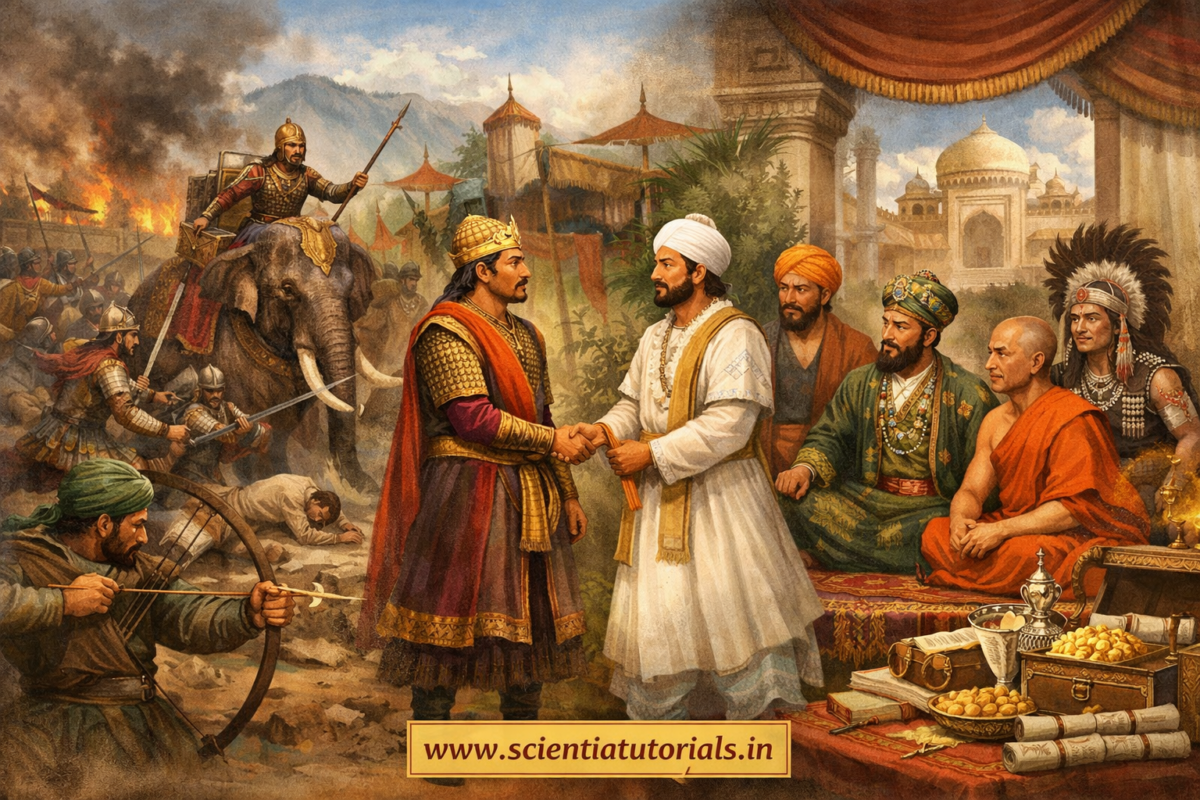

Conflicts, Alliances and Regional Diplomacy in Late Medieval North-East India
Course: History of North-East India: From Early Kingdoms to Modern Integration
Module IV: Late Medieval Period and the Rise of Indigenous States
Timeline / Era Covered: 13th Century CE – 18th Century CE
Lesson: Conflicts, Alliances, and Regional Diplomacy
This lesson is systematically organized into four clearly structured sections, as detailed below:
- Chronologically Structured Study Module
- Short-Answer Type Questions
- Long-Answer Type Questions
- Multiple-Choice Questions (MCQs) with Answers and Detailed Explanations
Chronologically Structured Study Module
Introduction: Political Dynamism in Late Medieval North-East India
The period from the 13th to the 18th century CE represents one of the most politically dynamic phases in the history of North-East India. This era was marked by the rise of powerful indigenous states, frequent military conflicts, strategic alliances, and complex systems of regional diplomacy. Unlike many parts of the Indian subcontinent where imperial conquest dominated political life, North-East India developed a distinct political culture based on negotiation, accommodation, and flexible statecraft.
Conflicts during this period were not merely wars of territorial expansion; they were deeply connected to issues of sovereignty, trade control, ethnic balance, and cultural autonomy. Alliances were often fluid, shifting according to political necessity, while diplomacy emerged as a vital tool for survival in a region characterized by difficult terrain and ethnic diversity. This lesson examines how conflicts, alliances, and diplomacy shaped the political history of North-East India in the late medieval period.
I. Political Background at the Beginning of the 13th Century
By the early 13th century, North-East India had moved beyond early medieval formations and entered a phase of state consolidation. Several indigenous kingdoms had emerged, each adapting to the region’s geography and social composition.
Key political features included:
- Fragmentation into multiple regional powers
- Absence of centralized imperial authority
- Strong tribal participation in state structures
- Emphasis on defense rather than aggressive expansion
The region’s hills, forests, and river systems discouraged large imperial control, making diplomacy and alliances as important as military strength.
II. Nature of Conflicts in Late Medieval North-East India
Characteristics of Warfare
Conflicts in North-East India differed significantly from those in the Gangetic plains. Warfare was shaped by:
- Difficult terrain and climatic conditions
- Limited cavalry use and reliance on infantry and river warfare
- Guerrilla tactics and fortified settlements
- Seasonal campaigns linked to agricultural cycles
Wars were often defensive in nature, aimed at preserving autonomy rather than building empires.
III. The Ahom Expansion and Regional Conflicts (13th–16th Century CE)
Rise of the Ahom Kingdom
The Ahoms entered the Brahmaputra valley in the early 13th century and gradually established a powerful and resilient state. Their political success rested on:
- Military organization based on the Paik system
- Strategic absorption of local chiefs and tribes
- Controlled expansion rather than reckless conquest
Conflicts with Local Kingdoms
From the 14th to the 16th centuries, the Ahoms engaged in sustained conflicts with neighboring powers such as:
- The Chutiya kingdom
- The Kachari kingdom
- Smaller tribal polities
These conflicts resulted in territorial expansion but also led to administrative integration rather than destruction of local elites.
IV. The Koch Kingdom and Power Struggles in Western Assam
Emergence of the Koch State
The Koch kingdom rose to prominence in the 16th century under strong leadership and became a major political force in western Assam and North Bengal.
Key features of Koch expansion included:
- Military consolidation of tribal groups
- Control over trade routes connecting Bengal and Assam
- Strategic marriages and alliances
Koch–Ahom Rivalry
The rivalry between the Ahoms and the Koch Kingdom became a defining feature of the 16th century. While military confrontations occurred, prolonged warfare was avoided through diplomacy, treaties, and shifting alliances.
V. External Threats and Mughal–Ahom Conflicts (17th Century CE)
Mughal Expansion Towards the North-East
From the early 17th century, the Mughal Empire sought to extend its influence into Assam, bringing North-East India into contact with a major imperial power.
The Mughal Empire posed a serious external challenge due to:
- Superior military resources
- Administrative experience
- Strategic interest in controlling eastern trade routes
Major Mughal–Ahom Wars
Between the early and mid-17th century, several major conflicts occurred. The most notable was the Ahom resistance that culminated in decisive battles preventing Mughal annexation.
Key features of these conflicts included:
- Use of riverine warfare by the Ahoms
- Mobilization of local populations
- Strong leadership and strategic planning
The failure of Mughal expansion marked a major political victory for indigenous state power.
VI. Diplomacy as a Tool of Survival and Statecraft
Treaties and Negotiations
Diplomacy played a central role in maintaining political balance. Treaties were used to:
- End prolonged wars
- Define boundaries
- Regulate tribute and trade
- Prevent unnecessary bloodshed
The Treaty of Ghilajharighat (1663) exemplifies how diplomacy was used even after military confrontation.
Marriage Alliances
Royal marriages were an important diplomatic tool. These alliances helped:
- Secure peace between rival states
- Legitimize rule over newly annexed territories
- Integrate diverse ethnic groups into state systems
VII. Alliances Among Indigenous Powers
Strategic Alliances
Alliances in North-East India were rarely permanent. They were shaped by:
- Immediate political threats
- Balance of power considerations
- Economic interests
Former enemies often became allies against a stronger external threat, especially during Mughal incursions.
Tribal Support and Confederations
Indigenous states relied heavily on tribal alliances. Chiefs were incorporated into administrative hierarchies in exchange for autonomy and privileges, creating flexible political confederations.
VIII. Regional Diplomacy Beyond Warfare
Trade and Diplomatic Relations
Trade was closely linked to diplomacy. Control of trade routes enhanced political power, while peaceful relations ensured commercial prosperity.
Key diplomatic trade relations existed between:
- Assam and Bengal
- Hill states and valley kingdoms
- North-East India and Southeast Asia
Diplomatic envoys and merchants often acted as intermediaries between states.
IX. Conflicts in the Hill Regions and Frontier Zones
Hill–Valley Relations
Conflicts between hill tribes and valley states were frequent but usually limited in scale. These conflicts often revolved around:
- Access to resources
- Control of passes and routes
- Tribute and taxation
Rather than total conquest, negotiated settlements were preferred.
Frontier Diplomacy
Frontier zones functioned as buffer regions. States avoided direct control over difficult terrain and instead relied on tributary arrangements and alliances with local chiefs.
X. The 18th Century: Political Fragmentation and Internal Conflicts
By the 18th century, many indigenous states faced internal challenges:
- Succession disputes
- Noble factionalism
- Administrative strain
- Decline of centralized authority
Internal conflicts weakened states, making diplomacy increasingly important for survival.
XI. Role of Conflicts and Diplomacy in State Formation
Conflicts helped states define boundaries and assert sovereignty, while diplomacy ensured long-term stability. Together, they contributed to:
- Consolidation of territorial states
- Integration of diverse populations
- Development of regional political identities
The late medieval political culture of North-East India was thus shaped by a balance between force and negotiation.
XII. Distinctive Features of North-East Indian Political Culture
Compared to other regions of India, North-East India displayed:
- Greater tolerance of political diversity
- Flexible alliances rather than rigid loyalties
- Emphasis on autonomy and negotiated authority
- Limited imperial ambition
This political culture allowed indigenous states to resist external domination for centuries.
Conclusion: Historical Significance of Conflicts, Alliances, and Diplomacy
The history of late medieval North-East India cannot be understood solely through battles and conquests. Conflicts, alliances, and diplomacy formed an interconnected system that allowed indigenous states to survive, adapt, and flourish in a challenging environment. Through strategic warfare, flexible alliances, and sophisticated diplomacy, regional powers preserved autonomy and shaped a unique political tradition.
These patterns of interaction laid the foundations for modern political identities in North-East India and explain the region’s long-standing emphasis on negotiation, accommodation, and cultural resilience.
Short Answer Type Questions with Answers
(Conflicts, Alliances, and Regional Diplomacy in Late Medieval North-East India)
1. Which centuries define the late medieval period in North-East India?
Answer:
The late medieval period in North-East India spans from the 13th century CE to the 18th century CE.
2. What was the dominant political feature of North-East India during the late medieval period?
Answer:
The region was characterized by multiple indigenous states, political fragmentation, and the absence of a centralized imperial authority.
3. Why was diplomacy important in late medieval North-East India?
Answer:
Diplomacy was essential due to difficult terrain, ethnic diversity, and limited resources, making negotiation more effective than prolonged warfare.
4. Name the major indigenous power that emerged in the Brahmaputra valley in the 13th century.
Answer:
The Ahom Kingdom emerged as a major power in the Brahmaputra valley.
5. What type of warfare was common in North-East India?
Answer:
Warfare was largely defensive, involving guerrilla tactics, riverine warfare, and fortified settlements.
6. Why were large imperial conquests rare in North-East India?
Answer:
Geographical barriers such as hills, forests, and rivers limited large-scale imperial expansion and favored smaller regional states.
7. Who were the main rivals of the Ahoms in the early phase of expansion?
Answer:
The Ahoms fought against the Chutiya kingdom, Kachari kingdom, and other local tribal polities.
8. How did the Ahoms integrate conquered territories?
Answer:
They absorbed local chiefs into the administration and allowed cultural and political autonomy under Ahom sovereignty.
9. Which kingdom dominated western Assam during the 16th century?
Answer:
The Koch Kingdom dominated western Assam.
10. What was the nature of Ahom–Koch relations?
Answer:
Relations alternated between conflict and cooperation, often resolved through diplomacy and alliances rather than prolonged war.
11. Which external empire posed the greatest threat to Assam in the 17th century?
Answer:
The Mughal Empire posed the greatest external threat.
12. How did the Ahoms counter Mughal military strength?
Answer:
They used river warfare, local knowledge, popular support, and strategic planning to resist Mughal advances.
13. What was the significance of the Treaty of Ghilajharighat (1663)?
Answer:
It marked a diplomatic settlement between the Ahoms and Mughals, temporarily defining political boundaries.
14. Why were marriage alliances important in regional diplomacy?
Answer:
Marriage alliances helped secure peace, legitimize rule, and integrate different ethnic and political groups.
15. What role did tribal chiefs play in state diplomacy?
Answer:
Tribal chiefs acted as intermediaries and allies, providing military support in exchange for autonomy and privileges.
16. How were alliances in North-East India different from permanent treaties?
Answer:
Alliances were flexible and temporary, changing according to political necessity and external threats.
17. What role did trade play in diplomacy?
Answer:
Trade encouraged peaceful relations, strengthened alliances, and linked diplomacy with economic prosperity.
18. How were hill–valley conflicts generally resolved?
Answer:
Most were settled through negotiation, tribute arrangements, or temporary alliances, rather than conquest.
19. What were frontier zones in late medieval North-East India?
Answer:
They were buffer regions between states, often governed indirectly through local chiefs and diplomatic arrangements.
20. Why did internal conflicts increase in the 18th century?
Answer:
Succession disputes, noble factionalism, and administrative strain weakened centralized authority.
21. How did internal conflicts affect indigenous states?
Answer:
They weakened political stability and made states more dependent on diplomacy for survival.
22. What was the primary objective of most conflicts in the region?
Answer:
The primary objective was defending autonomy and territorial integrity, not imperial expansion.
23. How did geography influence regional diplomacy?
Answer:
Geography encouraged limited warfare and promoted negotiation, alliances, and indirect control.
24. What distinguishes North-East Indian political culture from mainland India?
Answer:
It emphasized flexibility, negotiated authority, tolerance of diversity, and limited imperial ambition.
25. Why is the study of conflicts and diplomacy important for understanding North-East Indian history?
Answer:
Because it reveals how indigenous states survived external threats, managed diversity, and developed a unique political tradition.
Long Answer Type Questions with Answers
(Conflicts, Alliances, and Regional Diplomacy in Late Medieval North-East India)
1. Analyse the political conditions of North-East India at the beginning of the 13th century CE.
Answer:
At the beginning of the 13th century CE, North-East India was politically fragmented, marked by the presence of several indigenous kingdoms and tribal polities. There was no centralized imperial authority comparable to the Delhi Sultanate or later the Mughal Empire. Political power was decentralized, rooted in kinship ties, clan leadership, and control over land and resources. Geography—dense forests, hills, and river systems—encouraged the growth of smaller, autonomous states and made diplomacy and negotiated authority more effective than outright conquest.
2. Discuss the distinctive nature of warfare in late medieval North-East India.
Answer:
Warfare in late medieval North-East India differed significantly from that of the Indo-Gangetic plains. Military campaigns were generally defensive, limited in scale, and adapted to difficult terrain. Armies relied heavily on infantry, riverine fleets, and guerrilla tactics rather than cavalry. Seasonal warfare was common, and the objective was usually territorial security or control of trade routes rather than imperial expansion. These features shaped a political culture where diplomacy often complemented warfare.
3. Trace the rise and expansion of the Ahom Kingdom in the Brahmaputra valley.
Answer:
The Ahoms entered the Brahmaputra valley in the early 13th century and gradually established a powerful state. Their expansion was systematic and cautious. Instead of destroying defeated polities, the Ahoms absorbed local chiefs and populations into their administrative system. The Paik system enabled effective military mobilization and resource management. Through a combination of warfare, alliances, and diplomacy, the Ahoms consolidated control over much of eastern Assam while maintaining internal stability.
4. Examine the Ahom conflicts with neighbouring indigenous kingdoms.
Answer:
Between the 14th and 16th centuries, the Ahoms fought several wars against neighbouring kingdoms such as the Chutiyas and the Kacharis. These conflicts were primarily about territorial control, access to resources, and political dominance. However, conquest was followed by integration rather than extermination. Local elites were retained in administration, allowing the Ahoms to rule a culturally diverse population and reduce resistance.
5. Discuss the emergence and political significance of the Koch kingdom.
Answer:
The Koch kingdom emerged as a major political force in the 16th century in western Assam and parts of North Bengal. It unified several tribal groups and controlled important trade routes between Bengal and Assam. The Koch rulers combined military strength with strategic diplomacy, enabling rapid expansion. Their rise altered the balance of power in the region and brought them into both conflict and alliance with the Ahoms.
6. Analyse the nature of rivalry and diplomacy between the Ahoms and the Koch Kingdom.
Answer:
Ahom–Koch relations were marked by alternating phases of conflict and cooperation. While military confrontations occurred, neither side sought total annihilation of the other. Diplomatic negotiations, treaties, and shifting alliances were frequently employed to prevent prolonged warfare. This pragmatic approach reflected the political culture of the region, where balance of power was more important than permanent domination.
7. Evaluate the impact of Mughal expansion on North-East India in the 17th century.
Answer:
The expansion of the Mughal Empire into Assam in the 17th century brought North-East India into direct conflict with a powerful imperial state. Mughal interest was driven by strategic and economic considerations. However, despite their superior resources, the Mughals failed to establish lasting control due to Ahom resistance, geographical challenges, and effective local leadership. Mughal intervention intensified regional diplomacy and military preparedness among indigenous states.
8. Discuss the major features of the Mughal–Ahom conflicts.
Answer:
The Mughal–Ahom conflicts were characterized by prolonged military engagements, especially riverine warfare along the Brahmaputra. The Ahoms relied on local knowledge, fortified riverbanks, and popular support. Leadership and coordination played a crucial role in resisting Mughal advances. These conflicts demonstrated the capacity of an indigenous state to resist imperial power through strategic warfare and diplomacy.
9. Examine the role of diplomacy in resolving conflicts during the Mughal–Ahom encounters.
Answer:
Diplomacy played a crucial role alongside warfare. Treaties were negotiated to end hostilities, define boundaries, and regulate tribute. The Treaty of Ghilajharighat (1663) illustrates how political compromise was used to manage conflict, even though such treaties were often temporary. Diplomatic engagement allowed both sides to regroup and reassess strategies without continuous warfare.
10. Analyse marriage alliances as instruments of regional diplomacy.
Answer:
Marriage alliances were an important diplomatic tool in late medieval North-East India. Such alliances helped secure peace, legitimize political authority, and integrate diverse ethnic groups. By linking ruling families, marriage alliances reduced hostility and facilitated cooperation between rival states. They also helped newly annexed territories accept the authority of the ruling dynasty.
11. Discuss the role of tribal chiefs in alliances and diplomacy.
Answer:
Tribal chiefs were central to regional diplomacy. Indigenous states depended on their support for military manpower and local administration. In return, chiefs were granted autonomy, privileges, and recognition. This arrangement created flexible political confederations that strengthened state authority without undermining local identities.
12. Explain the significance of trade in shaping regional diplomacy.
Answer:
Trade routes connecting Assam with Bengal, hill regions, and Southeast Asia were vital economic assets. Control over trade encouraged peaceful relations and diplomatic engagement. States often preferred negotiation over warfare to ensure uninterrupted commercial activity. Merchants and envoys played a dual role as traders and diplomatic intermediaries.
13. Examine hill–valley relations and frontier diplomacy.
Answer:
Relations between hill tribes and valley states were marked by intermittent conflict and negotiation. Disputes often arose over tribute, access to resources, and control of routes. Instead of direct conquest, valley states relied on diplomacy, tribute systems, and alliances to manage frontier zones. These arrangements maintained stability while respecting local autonomy.
14. Discuss the concept of buffer zones in late medieval North-East India.
Answer:
Buffer zones were frontier regions lying between rival states. These areas were usually governed indirectly through local chiefs or tributary arrangements. Buffer zones reduced the likelihood of direct confrontation and served as spaces for negotiation and diplomacy. They were an essential feature of regional statecraft.
15. Analyse the role of alliances during periods of external threat.
Answer:
External threats, especially Mughal incursions, encouraged indigenous states to form temporary alliances. Former rivals often cooperated to resist a stronger enemy. These alliances were pragmatic and short-term, dissolving once the threat subsided. Such flexibility was a hallmark of regional political culture.
16. Examine the causes of internal conflicts within indigenous states in the 18th century.
Answer:
By the 18th century, many states faced internal challenges such as succession disputes, factional rivalry among nobles, administrative inefficiency, and economic strain. These internal conflicts weakened centralized authority and reduced the capacity of states to respond effectively to external pressures.
17. Discuss the impact of internal conflicts on diplomacy.
Answer:
Internal instability made diplomacy even more important. Weakened states relied on alliances, negotiations, and compromise to maintain territorial integrity. Diplomacy became a survival strategy rather than a choice, reflecting the changing balance of power within the region.
18. Evaluate how conflicts contributed to state formation.
Answer:
Conflicts helped define territorial boundaries, assert sovereignty, and strengthen administrative systems. Military challenges forced states to improve organization and leadership. When combined with diplomacy, conflict became a constructive force in the process of state formation.
19. Compare the political culture of North-East India with that of mainland India.
Answer:
Unlike mainland India, where large empires sought centralized control, North-East India developed a political culture emphasizing autonomy, negotiation, and balance of power. Flexible alliances, tolerance of diversity, and limited imperial ambition distinguished the region’s political traditions.
20. Assess the historical significance of conflicts, alliances, and diplomacy in late medieval North-East India.
Answer:
Conflicts, alliances, and diplomacy collectively shaped the political evolution of North-East India. They enabled indigenous states to survive external threats, manage internal diversity, and maintain autonomy for centuries. This political tradition laid the foundation for regional identities and continues to influence the historical consciousness of North-East India.
MCQs with Answers and Explanations
(Conflicts, Alliances, and Regional Diplomacy in Late Medieval North-East India)
1. The late medieval period in North-East India broadly covers which centuries?
A. 9th–12th century CE
B. 10th–14th century CE
C. 13th–18th century CE
D. 15th–19th century CE
Correct Answer: C
Explanation:
Module IV defines the late medieval phase as extending from the 13th to the 18th century CE, marked by indigenous state formation and regional diplomacy.
2. Which factor most strongly influenced political relations in North-East India?
A. Availability of cavalry
B. Centralized imperial rule
C. Geography and terrain
D. Overseas trade
Correct Answer: C
Explanation:
Hills, dense forests, and river systems limited large-scale conquest and encouraged diplomacy, alliances, and localized warfare.
3. Which kingdom emerged as a dominant power in the Brahmaputra valley from the 13th century?
A. Koch Kingdom
B. Kachari Kingdom
C. Ahom Kingdom
D. Chutiya Kingdom
Correct Answer: C
Explanation:
The Ahoms entered the Brahmaputra valley in the early 13th century and gradually established a stable and powerful state.
4. The primary objective of most conflicts in late medieval North-East India was to:
A. Build a pan-Indian empire
B. Control oceanic trade
C. Defend autonomy and territory
D. Spread religion
Correct Answer: C
Explanation:
Most wars were defensive, aimed at preserving sovereignty rather than imperial expansion.
5. Which type of warfare was most common in the region?
A. Cavalry-based warfare
B. Siege warfare
C. Riverine and guerrilla warfare
D. Naval warfare
Correct Answer: C
Explanation:
The terrain favoured river warfare, ambushes, and fortified settlements rather than large open-field battles.
6. How did the Ahoms usually treat defeated local rulers?
A. Exterminated them
B. Enslaved them
C. Integrated them into administration
D. Forced migration
Correct Answer: C
Explanation:
The Ahoms followed a policy of assimilation, allowing local elites to retain status under Ahom authority.
7. Which kingdom dominated western Assam during the 16th century?
A. Chutiya Kingdom
B. Kachari Kingdom
C. Ahom Kingdom
D. Koch Kingdom
Correct Answer: D
Explanation:
The Koch kingdom emerged as a powerful state controlling western Assam and important trade routes.
8. The relationship between the Ahoms and the Koch kingdom can best be described as:
A. Constant warfare
B. Permanent alliance
C. Alternating conflict and diplomacy
D. Complete isolation
Correct Answer: C
Explanation:
Their relations shifted between rivalry and cooperation depending on political circumstances.
9. Which external power posed the greatest threat to Assam in the 17th century?
A. Portuguese
B. Burmese
C. British
D. Mughal Empire
Correct Answer: D
Explanation:
The Mughal Empire attempted to extend its authority into Assam during the 17th century.
10. Why did the Mughal Empire fail to establish permanent control over Assam?
A. Lack of interest
B. Economic weakness
C. Strong Ahom resistance and geography
D. Religious opposition
Correct Answer: C
Explanation:
Riverine warfare, difficult terrain, and organized Ahom resistance prevented lasting Mughal control.
11. The Treaty of Ghilajharighat (1663) is associated with:
A. Ahom–Koch conflict
B. Koch–Mughal conflict
C. Mughal–Ahom diplomacy
D. Hill–valley relations
Correct Answer: C
Explanation:
The treaty was a diplomatic settlement following Mughal–Ahom military encounters.
12. What role did diplomacy play alongside warfare?
A. Replaced warfare completely
B. Weakened state authority
C. Managed conflict and preserved balance
D. Encouraged permanent peace
Correct Answer: C
Explanation:
Diplomacy helped limit destruction, define boundaries, and maintain political balance.
13. Marriage alliances were primarily used to:
A. Expand territory
B. Increase population
C. Secure peace and legitimacy
D. Promote religion
Correct Answer: C
Explanation:
Marriage alliances strengthened political ties and reduced hostility between rival states.
14. Tribal chiefs were important in diplomacy because they:
A. Controlled overseas trade
B. Led imperial armies
C. Acted as intermediaries and allies
D. Opposed state authority
Correct Answer: C
Explanation:
Indigenous states relied on tribal chiefs for military support and frontier management.
15. Alliances in late medieval North-East India were usually:
A. Permanent
B. Religious
C. Colonial
D. Flexible and temporary
Correct Answer: D
Explanation:
Alliances changed according to political needs and external threats.
16. What factor often transformed enemies into allies?
A. Cultural similarity
B. Economic prosperity
C. External military threat
D. Dynastic succession
Correct Answer: C
Explanation:
External threats, especially Mughal invasions, encouraged cooperation among indigenous states.
17. Trade influenced diplomacy mainly by:
A. Causing conflicts
B. Isolating states
C. Encouraging peaceful relations
D. Weakening rulers
Correct Answer: C
Explanation:
Peaceful relations ensured uninterrupted trade and economic stability.
18. Hill–valley conflicts usually revolved around:
A. Religious conversion
B. Imperial ambition
C. Resources and tribute
D. Language differences
Correct Answer: C
Explanation:
Most hill–valley disputes were economic and administrative rather than ideological.
19. Frontier zones in North-East India functioned mainly as:
A. Military capitals
B. Religious centres
C. Buffer regions
D. Trade monopolies
Correct Answer: C
Explanation:
Buffer zones reduced direct confrontation between rival states.
20. Why was indirect control preferred in frontier areas?
A. Lack of population
B. Religious differences
C. Difficult terrain and resistance
D. Absence of trade
Correct Answer: C
Explanation:
Direct administration was costly and impractical in remote hill regions.
21. Internal conflicts increased in the 18th century due to:
A. Foreign invasion only
B. Religious movements
C. Succession disputes and factionalism
D. Trade decline alone
Correct Answer: C
Explanation:
Internal political instability weakened indigenous states toward the end of the period.
22. Internal conflicts made diplomacy:
A. Less relevant
B. Impossible
C. More necessary for survival
D. Completely ineffective
Correct Answer: C
Explanation:
Weakened states depended more on negotiation and alliances to maintain stability.
23. Conflicts contributed to state formation by:
A. Destroying institutions
B. Eliminating diversity
C. Defining boundaries and authority
D. Ending diplomacy
Correct Answer: C
Explanation:
Warfare clarified territorial limits and strengthened administrative systems.
24. A key feature of North-East Indian political culture was:
A. Centralized imperialism
B. Religious uniformity
C. Negotiated authority and flexibility
D. Colonial dependency
Correct Answer: C
Explanation:
Political power was shared, negotiated, and adapted to local realities.
25. The study of conflicts, alliances, and diplomacy is important because it:
A. Explains colonial rule
B. Focuses only on warfare
C. Reveals indigenous political resilience
D. Ignores social history
Correct Answer: C
Explanation:
This theme highlights how indigenous states survived, adapted, and preserved autonomy through strategic statecraft.