
Trade Routes and Economic Networks in Early North-East India
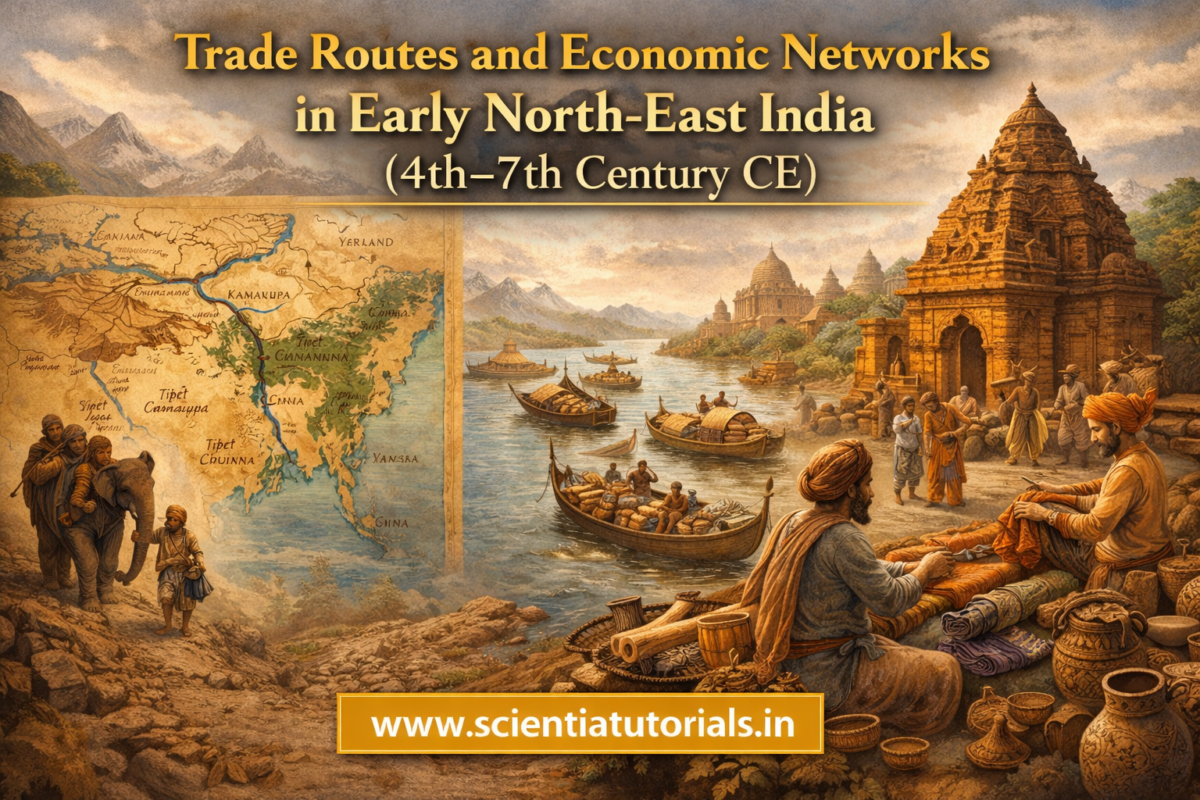

Trade Routes and Economic Networks in Early North-East India (4th–7th Century CE)
Module II: Early Historic Period and the Emergence of Kingdoms
Lesson: Trade Routes and Economic Networks in Early North-East India
Timeline / Era Covered: c. 4th Century CE – 7th Century CE
Course: History of North-East India: From Early Kingdoms to Modern Integration
This lesson is systematically organized into four clearly structured sections, as detailed below:
- Chronologically Structured Study Module
- Short-Answer Type Questions
- Long-Answer Type Questions
- Multiple-Choice Questions (MCQs) with Answers and Detailed Explanations
Chronologically Structured Study Module
Introduction: Trade and Economy in the Early Historic Context
The Early Historic Period (c. 4th–7th century CE) marked a transformative phase in the economic history of North-East India. During this era, the region—particularly the Brahmaputra valley—became increasingly integrated into inter-regional and trans-regional trade networks linking the Indian subcontinent with the Himalayan world, Tibet, China, and Southeast Asia. Trade routes and economic exchanges played a crucial role in shaping political power, urban growth, cultural interaction, and state formation.
Early North-East India was not an isolated frontier but an active participant in wider Asian commercial circuits. Kingdoms such as Kamarupa benefited immensely from their strategic geographical location, natural resources, and riverine communication systems. Trade supported royal revenues, strengthened administrative control, and facilitated cultural diffusion.
This lesson examines the chronological evolution of trade routes, economic networks, commodities exchanged, and their broader historical significance during the Early Historic Period.
I. Geographical Foundations of Trade in North-East India
1. Strategic Location of the Region
North-East India occupies a unique geographical position:
- It connects South Asia with East and Southeast Asia
- Lies between the Indian plains, Himalayan passes, and river valleys
- Acts as a gateway between India, Tibet, Myanmar, and China
This strategic location made the region a natural corridor for trade, migration, and cultural exchange.
2. Role of the Brahmaputra Valley
The Brahmaputra River system formed the backbone of early economic life:
- Provided navigable waterways for goods and people
- Linked inland settlements with distant regions
- Encouraged growth of market centers along riverbanks
Riverine trade was cheaper and safer than overland routes, making it central to early Assam’s economy.
II. Evolution of Trade Routes (4th–7th Century CE)
1. Early Overland Routes
During the early centuries CE, several overland routes passed through North-East India:
- Routes linking the Gangetic plains to Assam
- Mountain passes connecting Assam with Tibet and Bhutan
- Eastern corridors leading to Upper Myanmar and Yunnan
These routes enabled long-distance trade and diplomatic contacts.
2. Riverine Trade Networks
The Brahmaputra and its tributaries functioned as:
- Commercial highways
- Channels for transporting agricultural surplus
- Links between rural producers and urban markets
River ports emerged as nodal points in economic exchange.
3. Integration with Trans-Asian Networks
North-East India became indirectly connected with:
- The Silk Route through Himalayan corridors
- Southeast Asian maritime networks via eastern land routes
Although not a core Silk Route region, the area served as an important intermediary zone.
III. Major Trade Centers and Market Settlements
1. Pragjyotisha as a Commercial Hub
The capital city Pragjyotisha was not only an administrative center but also:
- A major trading node
- A meeting point of merchants and artisans
- A redistribution center for goods
Its location near river routes enhanced its commercial importance.
2. Secondary Trade Centers
Apart from the capital, smaller settlements developed as:
- Weekly markets (haats)
- River ports
- Craft production centers
These local markets integrated village economies with regional trade networks.
IV. Commodities Traded in Early North-East India
1. Export Commodities
North-East India was rich in natural resources, making it an exporter of:
- Forest products (timber, resins, herbs)
- Elephants and ivory
- Cotton and textiles
- Aromatic products
Such goods were in high demand in North India and beyond.
2. Imported Goods
In return, the region imported:
- Salt and metals
- Fine textiles
- Luxury items
- Religious and cultural artifacts
These imports contributed to changing consumption patterns and elite lifestyles.
3. Agricultural Surplus and Trade
Agriculture formed the base of trade:
- Expansion of wet rice cultivation
- Surplus production enabled market exchange
- Agrarian growth supported urban centers
The land grant system further encouraged agricultural expansion and surplus generation.
V. Economic Networks and State Formation
1. Trade and Royal Authority
Trade routes strengthened political power in early Assam:
- Control over routes increased royal revenue
- Taxes and tolls on trade funded administration
- Protection of merchants enhanced legitimacy
Kings patronized traders and market centers to stabilize their rule.
2. Role of Merchants and Guilds
Although inscriptions mention merchants indirectly, their role was vital:
- Facilitated long-distance exchange
- Acted as carriers of culture and ideas
- Connected Assam with distant regions
Merchant communities contributed to urbanization and economic diversification.
3. Economic Integration of Tribal Areas
Trade helped integrate tribal and frontier regions:
- Exchange of forest produce for agricultural goods
- Gradual incorporation into state economy
- Cultural interaction through trade contacts
This process reduced isolation and encouraged political integration.
VI. Trade and Cultural Exchange
1. Transmission of Religious Ideas
Trade routes acted as channels for:
- Spread of Brahmanical Hinduism
- Movement of Buddhist monks and scholars
- Exchange of ritual practices and beliefs
Religious institutions often emerged along trade routes.
2. Spread of Language and Scripts
Economic interaction promoted:
- Use of Sanskrit as a lingua franca
- Spread of inscriptions and record-keeping
- Cultural assimilation with the Indian mainland
Trade thus reinforced Sanskritization and cultural integration.
3. Artistic and Technological Exchange
Trade facilitated:
- Exchange of artistic motifs
- Introduction of new craft techniques
- Development of regional art styles
These influences enriched early Assamese culture.
VII. Chronological Overview of Trade Development
| Phase | Key Features |
|---|---|
| 4th–5th Century CE | Expansion of riverine trade, agrarian surplus |
| 5th–6th Century CE | Integration with Himalayan and eastern routes |
| 6th–7th Century CE | Consolidation of trade centers and state control |
This progression highlights the growing complexity of economic networks.
VIII. Historical Sources for Trade and Economy
1. Inscriptions
Copper plate inscriptions provide:
- Evidence of land grants and agrarian economy
- Indirect references to surplus production
- Insights into royal revenue systems
2. Literary and Foreign Accounts
Ancient texts and later traditions mention:
- Assam’s natural wealth
- Trade connections with eastern regions
- Strategic importance of the Brahmaputra valley
3. Archaeological Evidence
Archaeology reveals:
- Urban settlements
- Craft remains
- Trade-related artifacts
Together, these sources help reconstruct early economic life.
IX. Economic Significance of Trade Routes
1. Contribution to Prosperity
Trade increased:
- State revenue
- Urban growth
- Material culture
Economic prosperity supported political stability.
2. Role in Regional Integration
Trade routes integrated North-East India with:
- Mainland India
- Himalayan regions
- Southeast Asia
This integration shaped Assam’s long-term historical trajectory.
X. Examination Relevance and Analytical Importance
Key Themes for Competitive Exams
- Role of Brahmaputra in trade
- Trade routes linking Assam with Asia
- Economic basis of early state formation
Answer-Writing Pointers
- Use maps and routes in explanations
- Link trade with administration and culture
- Highlight chronological progression
Conclusion
Between the 4th and 7th centuries CE, trade routes and economic networks played a foundational role in shaping Early North-East India. The Brahmaputra valley emerged as a vibrant commercial corridor linking India with the eastern world. Trade supported agrarian expansion, strengthened royal authority, promoted urbanization, and facilitated cultural exchange.
Far from being a peripheral region, early Assam and the wider North-East actively participated in regional and trans-regional economic systems. These early trade networks laid the groundwork for the region’s later political, cultural, and economic developments, making them a crucial subject for understanding the historical evolution of North-East India and for success in competitive examinations.
Short Answer Type Questions with Answers
1. What is meant by the Early Historic Period in North-East India?
Answer:
The Early Historic Period in North-East India refers to the phase between the 4th and 7th centuries CE, marked by state formation, organized administration, and expanding trade networks.
2. Which kingdom dominated early Assam during this period?
Answer:
The kingdom of Kamarupa dominated early Assam during the Early Historic Period.
3. Why was North-East India strategically important for ancient trade?
Answer:
It acted as a gateway between mainland India, the Himalayas, Tibet, China, and Southeast Asia, facilitating inter-regional trade.
4. Name the major river system that supported trade in early Assam.
Answer:
The Brahmaputra river system was the backbone of trade and communication in early Assam.
5. How did riverine trade benefit early North-East India?
Answer:
Riverine trade enabled cheap transportation, linked rural producers with markets, and promoted urban growth along riverbanks.
6. What role did the Brahmaputra valley play in economic development?
Answer:
The Brahmaputra valley supported agriculture, navigation, market centers, and trade routes, forming the core of the regional economy.
7. Mention two types of trade routes used in early North-East India.
Answer:
- Overland routes through hills and passes
- Riverine routes along the Brahmaputra and its tributaries
8. Which ancient city functioned as a major trade and administrative center?
Answer:
Pragjyotisha functioned as a major political and commercial hub.
9. Name two regions connected with North-East India through overland routes.
Answer:
North-East India was connected with the Gangetic plains and Tibet–Bhutan Himalayan regions.
10. How was North-East India linked indirectly to the Silk Route?
Answer:
Through Himalayan passes and eastern corridors, North-East India acted as an intermediary zone connected to Silk Route networks.
11. What were the main export commodities of early North-East India?
Answer:
Forest products, elephants, ivory, cotton textiles, and aromatic substances were major exports.
12. Name two items imported into early Assam.
Answer:
Salt and metals were important imports, along with luxury goods and fine textiles.
13. How did agriculture support trade in early Assam?
Answer:
Agricultural surplus from wet rice cultivation enabled market exchange and urban sustenance.
14. What was the role of land grants in economic expansion?
Answer:
Land grants promoted agricultural expansion, surplus production, and integration of new areas into the economy.
15. How did trade strengthen royal authority?
Answer:
Kings controlled trade routes, collected tolls, protected merchants, and used revenue to maintain administration.
16. Who were the key agents of long-distance trade?
Answer:
Merchants and traders acted as key agents, connecting Assam with distant regions.
17. What was the importance of weekly markets (haats)?
Answer:
Haats linked village economies with regional trade networks and facilitated exchange of local produce.
18. How did trade help integrate tribal regions?
Answer:
Trade exchanged forest produce for agricultural goods, gradually integrating tribal areas into the state economy.
19. What role did trade routes play in cultural exchange?
Answer:
Trade routes enabled the spread of religious ideas, art forms, and cultural practices.
20. How did trade facilitate the spread of religion?
Answer:
Brahmanical Hinduism and Buddhism spread through merchants, monks, and travelers using trade routes.
21. Which language spread as a result of economic and cultural interaction?
Answer:
Sanskrit spread as a language of administration, religion, and cultural communication.
22. What archaeological evidence supports the existence of trade?
Answer:
Urban settlements, craft remains, and trade-related artifacts indicate active economic networks.
23. Why was North-East India not a core Silk Route region?
Answer:
It lay off the main Silk Route but functioned as an important connecting corridor.
24. How did geography influence trade patterns in the region?
Answer:
Rivers encouraged navigation, while hills and passes shaped overland trade routes and decentralized exchange.
25. Why are trade routes important for understanding early North-East Indian history?
Answer:
They explain economic growth, political power, cultural integration, and state formation in the region.
Long Answer Type Questions with Answers
1. Examine the significance of trade routes in the economic development of Early North-East India.
Answer:
Trade routes played a foundational role in the economic development of Early North-East India between the 4th and 7th centuries CE. The region’s strategic position connecting mainland India with the Himalayan world and Southeast Asia enabled the movement of goods, people, and ideas. Riverine and overland routes facilitated the circulation of agricultural surplus and forest products, leading to market expansion and urban growth. Trade revenue strengthened political authority and supported state formation, making commerce a key driver of economic prosperity.
2. Discuss the geographical factors that shaped trade and economic networks in Early North-East India.
Answer:
Geography decisively shaped early trade networks. The Brahmaputra valley provided fertile land and navigable waterways, while surrounding hills and mountain passes connected the region with Tibet, Bhutan, and Myanmar. Rivers encouraged internal trade, whereas overland routes facilitated long-distance exchange. This combination made North-East India both a regional economic zone and an inter-regional corridor.
3. Analyze the role of the Brahmaputra River system in Early Historic trade.
Answer:
The Brahmaputra River system functioned as the principal commercial artery of Early North-East India. It enabled bulk transport of goods, linked rural producers with urban markets, and supported river ports and trading settlements. Riverine trade reduced transportation costs and promoted the emergence of market centers, making the Brahmaputra valley the economic heartland of early Assam.
4. Evaluate the importance of overland trade routes in Early North-East India.
Answer:
Overland routes connected the Brahmaputra valley with the Gangetic plains, Himalayan regions, and Southeast Asia. These routes enabled the exchange of high-value goods such as luxury items, metals, and textiles. Though more difficult than river transport, overland routes played a crucial role in diplomatic contact, cultural exchange, and integration with trans-Asian trade networks.
5. Discuss the role of the kingdom of Kamarupa in controlling and benefiting from trade networks.
Answer:
Kamarupa strategically controlled riverine and overland routes passing through the Brahmaputra valley. By regulating trade, levying tolls, and protecting merchants, the state derived revenue and strengthened political authority. Trade supported administrative expansion and enhanced the kingdom’s regional importance, integrating Assam into wider economic systems.
6. Explain the economic importance of Pragjyotisha as a trade center.
Answer:
Pragjyotisha functioned as both the political capital and a major commercial hub. Its proximity to river routes enabled it to serve as a redistribution center for goods. Merchants, artisans, and officials congregated there, fostering urban growth and economic diversification.
7. Examine the major commodities exported from Early North-East India.
Answer:
Early North-East India exported forest products, timber, aromatic substances, ivory, elephants, and cotton textiles. These goods were highly valued in mainland India and neighboring regions. The export of natural resources made the region economically significant despite limited urbanization.
8. Analyze the nature and significance of imports into Early Assam.
Answer:
Imports included salt, metals, fine textiles, and luxury goods. These imports met local needs and enhanced elite lifestyles. They also introduced new technologies and cultural influences, contributing to social differentiation and material culture.
9. Discuss the relationship between agrarian expansion and trade in Early Assam.
Answer:
Agrarian expansion formed the economic base of trade. The clearing of forests and spread of wet rice cultivation generated surplus production, which entered market exchange. This surplus sustained urban centers and long-distance trade, linking agriculture with commerce.
10. Evaluate the role of land grants in strengthening economic networks.
Answer:
Land grants promoted agricultural expansion and surplus generation. By granting land to Brahmins and institutions, rulers integrated new areas into the economy. Increased productivity supported trade, markets, and state revenue.
11. Examine the role of merchants in Early North-East Indian trade.
Answer:
Merchants were key agents connecting local economies with distant regions. They facilitated the exchange of goods, carried cultural ideas, and supported urban growth. Though not prominently mentioned in inscriptions, their economic role was indispensable.
12. Discuss the importance of weekly markets (haats) in the regional economy.
Answer:
Weekly markets linked village producers with regional trade networks. They enabled the exchange of agricultural produce, forest goods, and crafts, integrating rural economies into broader commercial systems.
13. Analyze how trade routes contributed to state formation in Early North-East India.
Answer:
Control over trade routes enhanced royal revenue and authority. Taxes and tolls funded administration and military activities. By protecting trade, rulers gained legitimacy and strengthened state structures.
14. Explain the role of trade in integrating tribal and frontier regions.
Answer:
Trade exchanged forest products from tribal areas for agricultural goods from settled regions. This interaction gradually integrated tribal communities into the state economy, reducing isolation and promoting political cohesion.
15. Examine the connection between trade routes and cultural exchange.
Answer:
Trade routes facilitated the movement of religious ideas, artistic styles, and cultural practices. Merchants and travelers acted as carriers of culture, promoting interaction between North-East India and other regions.
16. Discuss the role of trade routes in the spread of religion in Early North-East India.
Answer:
Brahmanical Hinduism and Buddhism spread along trade routes through monks, scholars, and merchants. Religious institutions often developed near trade centers, reinforcing cultural integration.
17. Analyze the impact of trade on language and communication.
Answer:
Trade encouraged the spread of Sanskrit as a language of administration and culture. Economic interaction necessitated record-keeping and communication, reinforcing Sanskritization.
18. Examine archaeological evidence for trade and economic activity.
Answer:
Archaeological remains such as urban settlements, craft artifacts, and trade goods indicate active economic networks. These findings corroborate literary and inscriptional evidence.
19. Assess the role of North-East India as an intermediary zone in trans-Asian trade.
Answer:
Though not a core Silk Route region, North-East India served as a connecting corridor linking India with the Himalayan and Southeast Asian worlds. This intermediary role enhanced its strategic and economic importance.
20. Evaluate the long-term historical significance of Early Historic trade networks in North-East India.
Answer:
Early trade networks laid the foundation for economic integration, political stability, and cultural exchange. They shaped Assam’s later medieval and modern history by establishing patterns of connectivity and regional interaction.
MCQs with Answers & Explanations
Q1. The Early Historic trade networks of North-East India mainly developed during which period?
A. 1st–3rd century CE
B. 2nd–4th century CE
C. 4th–7th century CE
D. 7th–10th century CE
Correct Answer: C
Explanation:
The period from the 4th to the 7th century CE marks the Early Historic phase in North-East India, characterized by state formation, agrarian expansion, and organized trade networks.
Q2. Which kingdom played the most significant role in controlling early trade routes in Assam?
A. Davaka
B. Anga
C. Vanga
D. Kamarupa
Correct Answer: D
Explanation:
Kamarupa controlled the Brahmaputra valley and key overland routes, enabling it to regulate trade and derive revenue from economic exchanges.
Q3. Why was North-East India strategically important in ancient trade?
A. It had rich gold mines
B. It was a coastal region
C. It connected India with the Himalayan and Southeast Asian regions
D. It was politically dominant
Correct Answer: C
Explanation:
North-East India acted as a gateway between mainland India, Tibet, China, and Southeast Asia, making it crucial for inter-regional trade.
Q4. Which river system formed the backbone of trade in early Assam?
A. Ganga
B. Yamuna
C. Barak
D. Brahmaputra
Correct Answer: D
Explanation:
The Brahmaputra river system provided navigable waterways that facilitated internal and long-distance trade.
Q5. Riverine trade was preferred in early Assam mainly because it was:
A. Faster and more prestigious
B. Controlled by priests
C. Cheaper and safer than overland routes
D. Limited to royal use
Correct Answer: C
Explanation:
River transport allowed bulk movement of goods at lower cost and risk, making it ideal for trade.
Q6. Which ancient city emerged as an important administrative and commercial center?
A. Tamralipti
B. Pataliputra
C. Kanchipuram
D. Pragjyotisha
Correct Answer: D
Explanation:
Pragjyotisha functioned as both the political capital and a major redistribution center for trade goods.
Q7. Which of the following was NOT a type of trade route in Early North-East India?
A. Riverine routes
B. Overland hill routes
C. Himalayan passes
D. Maritime sea routes
Correct Answer: D
Explanation:
Early North-East India relied on riverine and overland routes, not maritime trade.
Q8. North-East India was indirectly connected to which major trans-Asian trade network?
A. Amber Route
B. Tea Route
C. Silk Route
D. Spice Route
Correct Answer: C
Explanation:
Though not on the main Silk Route, North-East India acted as an intermediary corridor linking India with eastern regions.
Q9. Which of the following was a major export of Early North-East India?
A. Gold coins
B. Spices from Malabar
C. Forest products and elephants
D. Silk from China
Correct Answer: C
Explanation:
The region exported forest produce, ivory, elephants, and aromatic goods, valued in distant markets.
Q10. Which item was commonly imported into early Assam?
A. Timber
B. Ivory
C. Cotton
D. Salt
Correct Answer: D
Explanation:
Salt and metals were important imports, as they were scarce in the region.
Q11. What economic factor made long-distance trade possible in early Assam?
A. Coin-based economy
B. Agrarian surplus
C. Industrial production
D. Urban population
Correct Answer: B
Explanation:
Surplus agricultural production supported markets, trade, and urban centers.
Q12. Land grants contributed to trade mainly by:
A. Reducing cultivation
B. Increasing nomadism
C. Expanding agriculture and surplus production
D. Eliminating local markets
Correct Answer: C
Explanation:
Land grants encouraged settlement and cultivation, strengthening the agrarian base of trade.
Q13. Weekly markets (haats) were important because they:
A. Served only royal needs
B. Functioned as religious centers
C. Linked village economies with regional trade
D. Replaced urban centers
Correct Answer: C
Explanation:
Haats connected rural producers with wider economic networks.
Q14. Which group played the most crucial role in long-distance trade?
A. Priests
B. Soldiers
C. Farmers
D. Merchants
Correct Answer: D
Explanation:
Merchants acted as intermediaries, transporting goods and facilitating exchange across regions.
Q15. How did trade strengthen royal authority?
A. By reducing taxation
B. By discouraging markets
C. Through tolls, taxes, and protection of trade routes
D. By limiting foreign contact
Correct Answer: C
Explanation:
Control of trade routes generated revenue and enhanced political power.
Q16. Which geographical feature encouraged decentralized trade patterns?
A. Flat plains
B. Coastal areas
C. Hills and forests
D. Deserts
Correct Answer: C
Explanation:
Hills and forests shaped localized overland routes and market centers.
Q17. Trade helped integrate tribal regions by:
A. Enforcing military rule
B. Exchanging forest produce for agricultural goods
C. Isolating them from markets
D. Eliminating indigenous practices
Correct Answer: B
Explanation:
Economic exchange reduced isolation and gradually integrated tribal areas into the state economy.
Q18. Which cultural process was promoted through trade networks?
A. Urban decline
B. Political fragmentation
C. Cultural and religious exchange
D. Linguistic isolation
Correct Answer: C
Explanation:
Trade routes carried ideas, beliefs, and cultural practices along with goods.
Q19. Trade routes facilitated the spread of which religions in Early North-East India?
A. Jainism alone
B. Christianity
C. Brahmanical Hinduism and Buddhism
D. Islam
Correct Answer: C
Explanation:
Merchants and monks used trade routes to spread religious ideas.
Q20. Which language gained prominence due to trade and administration?
A. Pali
B. Prakrit
C. Tamil
D. Sanskrit
Correct Answer: D
Explanation:
Sanskrit functioned as a cultural and administrative lingua franca across regions.
Q21. Archaeological evidence for trade includes:
A. Mythological texts
B. Royal legends
C. Urban settlements and craft remains
D. Religious hymns
Correct Answer: C
Explanation:
Material remains confirm economic activity and market presence.
Q22. North-East India’s role in trans-Asian trade can best be described as:
A. Core trade hub
B. Peripheral and isolated
C. Intermediary connecting corridor
D. Maritime trading power
Correct Answer: C
Explanation:
The region connected India with eastern and Himalayan regions.
Q23. Which factor limited large-scale urbanization despite active trade?
A. Lack of merchants
B. Absence of agriculture
C. Challenging terrain and dispersed settlements
D. Weak political authority
Correct Answer: C
Explanation:
Geography restricted dense urban growth, though trade flourished.
Q24. The relationship between trade and state formation in Early Assam was:
A. Unrelated
B. Negative
C. Mutually reinforcing
D. Accidental
Correct Answer: C
Explanation:
Trade revenue strengthened the state, while political stability promoted trade.
Q25. Why are trade routes essential for understanding Early North-East Indian history?
A. They explain religious decline
B. They show colonial influence
C. They reveal economic base, political power, and cultural integration
D. They focus only on foreign trade
Correct Answer: C
Explanation:
Trade routes illuminate how economy, polity, and culture developed together.