
Introduction of Modern Education, Missionaries, and Christianity
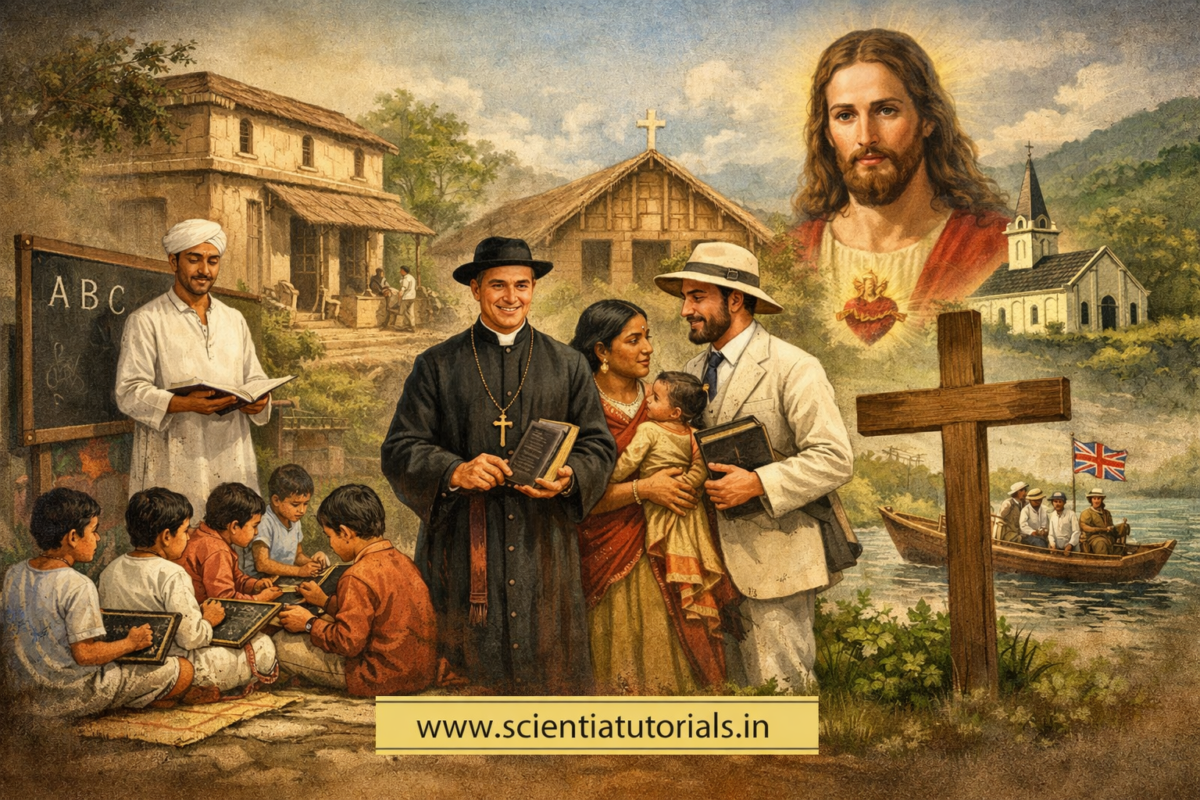

Modern Education, Missionaries and Christianity in North-East India (1826–1900)
Introduction of Modern Education, Missionaries, and Christianity
Chronologically Structured Study Module
Module VI: Colonial Rule and Administrative Reorganisation (1826–1900 CE)
This lesson is systematically organized into four clearly structured sections, as detailed below:
- Chronologically Structured Study Module
- Short-Answer Type Questions
- Long-Answer Type Questions
- Multiple-Choice Questions (MCQs) with Answers and Detailed Explanations
Chronologically Structured Study Module
I. Historical Context: North-East India on the Eve of Colonial Rule (Pre-1826)
Before the advent of British colonial rule, education in North-East India was largely traditional, informal, and community-based. Knowledge transmission took place through oral traditions, religious institutions, and customary practices. In Assam, Sanskrit learning centres (tols) associated with Vaishnavite monasteries (sattras) played an important role, while among hill societies, education was embedded in socialisation, rituals, and occupational training.
Christianity had no significant presence in the region before the nineteenth century. Religious life was dominated by indigenous belief systems, animism, ancestor worship, and regional forms of Hinduism, particularly Vaishnavism in the Brahmaputra valley.
The situation changed decisively after 1826, when colonial rule created new administrative, cultural, and ideological conditions.
II. Political Turning Point: Treaty of Yandabo and Colonial Entry (1826)
The Treaty of Yandabo (1826) marked the formal beginning of British rule in Assam and adjoining regions, integrating them into the administrative framework of the British Raj. This political shift laid the foundation for:
- Introduction of Western administrative systems
- Expansion of missionary activity
- Introduction of modern education
- Gradual spread of Christianity
Education and religion became important instruments of colonial governance, cultural transformation, and social reorganisation.
III. Early Phase of Missionary Activity (1826–1840s)
1. Entry of Christian Missionaries
The earliest Christian missionaries entered Assam soon after the establishment of British authority. Missionaries were encouraged by the colonial state as they were seen as agents of moral reform, education, and cultural “upliftment.”
Among the earliest and most influential missionary organisations was the American Baptist Mission, which began work in Assam in the 1830s.
2. Missionary Objectives
The main objectives of missionaries were:
- Spread of Christianity
- Introduction of Western-style education
- Translation of the Bible into local languages
- Social reform through moral instruction
While conversion was the ultimate aim, education became the most effective medium to reach local populations.
IV. Introduction of Modern Education: Early Developments (1830s–1850s)
1. Nature of Modern Education
Modern education introduced by missionaries and colonial authorities differed sharply from indigenous systems. Its key features included:
- Classroom-based instruction
- Use of textbooks and printed material
- Emphasis on literacy, arithmetic, and moral teaching
- Instruction in English and vernacular languages
2. Missionary Schools
Missionaries established elementary schools attached to churches and mission stations. These schools:
- Provided free or subsidised education
- Attracted children from diverse communities
- Introduced reading and writing in Assamese and tribal languages
Missionary schools became the earliest centres of modern learning in the region.
V. Language, Printing, and Education Reform
1. Development of Print Culture
Missionaries played a pioneering role in developing printing and publishing in North-East India. Printing presses were set up to publish:
- Religious tracts
- School textbooks
- Grammar books and dictionaries
This significantly contributed to the standardisation and modernisation of Assamese and tribal languages.
2. Language Policy and Education
The colonial state initially promoted Bengali as the language of administration and education, which caused resentment among Assamese elites. Missionary advocacy later contributed to the restoration of Assamese as a medium of instruction, strengthening regional identity.
VI. Expansion into Hill and Tribal Areas (1840s–1870s)
1. Missionaries in Hill Regions
From the mid-nineteenth century, missionary activity expanded into hill areas such as:
- Naga Hills
- Khasi and Jaintia Hills
- Mizo (Lushai) Hills
Missionaries often entered these areas before full colonial administration was established.
2. Education as a Tool of Engagement
In tribal societies, missionaries used education to:
- Learn local languages
- Establish schools and hostels
- Introduce Roman scripts for unwritten languages
Education became a bridge between tribal societies and the colonial-modern world.
VII. Christianity and Tribal Society: Conversion and Change
1. Patterns of Conversion
Conversion to Christianity was more widespread in hill and tribal areas than in the plains. Factors contributing to this included:
- Absence of rigid caste structures
- Appeal of egalitarian Christian teachings
- Access to education and healthcare through missions
Christianity offered new social identities and opportunities, especially to marginalised groups.
2. Social and Cultural Impact
Christian conversion led to:
- Decline of certain traditional rituals
- New moral codes and social norms
- Emergence of Christian village communities
At the same time, many indigenous cultural practices survived alongside Christianity.
VIII. Colonial State and Missionary Education: A Complex Relationship
The relationship between the colonial state and missionaries was cooperative but not identical.
1. Areas of Cooperation
- Missionary schools supplemented state education
- Missionaries helped pacify frontier regions
- Education created a small class of clerks and interpreters
2. Areas of Tension
- Colonial officials feared rapid mass conversions
- Missionaries criticised colonial exploitation
- Excessive cultural change was seen as destabilising
Thus, missionary education operated within limits set by colonial priorities.
IX. Education, Christianity, and Administrative Reorganisation
1. Formation of Educated Elites
Modern education led to the emergence of:
- Educated Assamese middle class
- Christian-educated tribal elites
- Interpreters, teachers, and clerks
These groups later played important roles in social reform and political mobilisation.
2. Administrative Utility
Education supported colonial administration by:
- Creating a literate workforce
- Facilitating record-keeping and communication
- Promoting loyalty to colonial authority
Christian institutions indirectly strengthened administrative integration.
X. Gender and Education: Limited but Significant Change
Missionary education also addressed female education, though on a limited scale.
- Girls’ schools were established in mission centres
- Emphasis was placed on moral and domestic education
- Literacy among women increased gradually
This marked an important departure from earlier norms, especially in tribal areas.
XI. Resistance and Cultural Anxiety
Not all communities welcomed missionary education and Christianity.
1. Resistance in the Plains
- Vaishnavite institutions viewed Christianity as a threat
- Educated elites feared erosion of indigenous culture
2. Cultural Negotiation in Hill Areas
- Selective acceptance of education
- Adaptation rather than total cultural replacement
- Syncretic practices emerged
Thus, the process was neither uniform nor uncontested.
XII. Late Nineteenth Century Developments (1870s–1900)
By the late nineteenth century:
- Missionary education was well established
- Christianity had deep roots in several hill societies
- Modern education expanded slowly beyond mission control
Government schools began to supplement missionary institutions, though missionaries continued to dominate hill education.
XIII. Long-Term Consequences of Missionary Education and Christianity
1. Educational Legacy
- Spread of literacy
- Foundation of modern schooling
- Development of regional languages
2. Social and Political Impact
- New leadership among tribal Christians
- Growth of identity consciousness
- Basis for later political mobilisation
3. Cultural Transformation
- Reshaping of belief systems
- Negotiation between tradition and modernity
XIV. Critical Assessment
While missionary education brought literacy and social mobility, it also:
- Promoted cultural alienation in some contexts
- Served colonial administrative interests
- Created new social divisions
Thus, it must be understood as part of the broader colonial project rather than a purely humanitarian effort.
XV. Conclusion
The introduction of modern education, missionaries, and Christianity in North-East India between 1826 and 1900 CE was a transformative process shaped by colonial power, missionary zeal, and indigenous responses. Education became a key instrument of social change, while Christianity reshaped cultural and religious landscapes, particularly in hill and tribal regions.
This period laid the foundations for modern education systems, new social identities, and political consciousness, whose effects continue to influence North-East India in the post-colonial era.
Short Answer Type Questions
Lesson: Introduction of Modern Education, Missionaries, and Christianity
Module VI: Colonial Rule and Administrative Reorganisation (1826–1900 CE)
1. What event marked the beginning of colonial rule in Assam?
Answer:
The Treaty of Yandabo (1826), which ended the First Anglo-Burmese War, marked the beginning of British rule in Assam under the British Raj.
2. What was the nature of education in North-East India before British rule?
Answer:
Education was informal and traditional, transmitted through religious institutions, oral traditions, and community practices.
3. Who introduced modern education in North-East India?
Answer:
Modern education was introduced mainly by Christian missionaries with indirect support from the colonial administration.
4. Which missionary organisation played a pioneering role in Assam?
Answer:
The American Baptist Mission played a pioneering role in introducing modern education and Christianity in Assam.
5. What were the main objectives of Christian missionaries?
Answer:
Their objectives included spreading Christianity, promoting Western education, translating religious texts, and moral reform.
6. How did missionary schools differ from traditional educational institutions?
Answer:
Missionary schools used classrooms, textbooks, printed materials, and formal curricula, unlike informal traditional learning systems.
7. Why did missionaries emphasise education as a tool of conversion?
Answer:
Education helped missionaries reach local populations, teach literacy, and introduce Christian values in a gradual and acceptable manner.
8. What role did printing presses play in educational development?
Answer:
Printing presses enabled the publication of textbooks, religious tracts, grammars, and dictionaries, aiding literacy and language standardisation.
9. How did missionary activity contribute to the development of Assamese language?
Answer:
Missionaries produced printed books and educational materials, helping standardise and revive Assamese as a language of instruction.
10. Why was Christianity more successful in hill areas than in the plains?
Answer:
Hill societies lacked rigid caste structures, and missionary education offered social equality and new opportunities.
11. Name two hill regions where missionary activity expanded.
Answer:
The Naga Hills and the Khasi-Jaintia Hills.
12. How did missionaries communicate with tribal societies?
Answer:
They learned local languages and developed Roman scripts for unwritten tribal languages.
13. What social changes followed conversion to Christianity?
Answer:
Conversion led to new moral values, village organisation, and decline of some traditional rituals.
14. How did colonial authorities view missionary education?
Answer:
They viewed it as useful for social control and administrative support but remained cautious about rapid cultural change.
15. What was the impact of modern education on colonial administration?
Answer:
It produced a literate workforce of clerks, teachers, and interpreters for colonial governance.
16. How did missionary education affect tribal leadership?
Answer:
It created a new educated Christian elite that gradually assumed leadership roles within tribal societies.
17. What role did missionaries play in female education?
Answer:
Missionaries established girls’ schools and promoted basic literacy and moral education among women.
18. How did indigenous religious institutions respond to Christianity?
Answer:
Institutions like Vaishnavite sattras viewed Christianity as a cultural and religious threat.
19. What was the relationship between missionaries and the colonial state?
Answer:
The relationship was cooperative but limited, with both sharing interests in stability and order.
20. How did modern education influence social mobility?
Answer:
It enabled individuals from modest backgrounds to access employment and social status.
21. What role did Christianity play in shaping tribal identity?
Answer:
Christianity provided new collective identities and strengthened community organisation.
22. Why did some communities resist missionary education?
Answer:
They feared loss of indigenous culture, religion, and traditional authority.
23. What changes occurred in the late nineteenth century?
Answer:
Missionary education expanded, Christianity deepened in hill areas, and government schools increased gradually.
24. Mention one long-term educational legacy of missionary activity.
Answer:
The foundation of modern schooling and spread of literacy in North-East India.
25. Why is the study of missionary education important for understanding modern North-East India?
Answer:
It explains the origins of modern education, Christian influence, and evolving social identities in the region.
Long Answer Type Questions
Lesson: Introduction of Modern Education, Missionaries, and Christianity
Module VI: Colonial Rule and Administrative Reorganisation (1826–1900 CE)
1. Examine the historical background that led to the introduction of modern education in North-East India.
Answer:
Before colonial rule, education in North-East India was informal and rooted in religious and community traditions. The Treaty of Yandabo (1826) brought the region under the authority of the British Raj, creating conditions for administrative consolidation. The colonial state required a literate population for governance, while missionaries viewed education as a means of religious and moral transformation. These combined administrative and evangelical needs laid the foundation for modern education.
2. Discuss the role of Christian missionaries in introducing modern education in Assam and adjoining hill areas.
Answer:
Christian missionaries were pioneers of modern education in North-East India. They established the first schools, introduced textbooks, and promoted literacy in vernacular languages. Education was closely linked with evangelisation, making missionary institutions centres of both learning and religious instruction. Their role was especially significant in hill areas where state education was minimal.
3. Analyse the contribution of the American Baptist Mission to education and Christianity in Assam.
Answer:
The American Baptist Mission played a decisive role in introducing modern education and Christianity. It established schools, churches, and printing presses, translated religious texts, and promoted Assamese language education. Its efforts significantly influenced literacy, religious change, and social transformation, particularly among tribal communities.
4. Examine how modern education differed from pre-colonial systems of learning in North-East India.
Answer:
Pre-colonial education was informal, orally transmitted, and closely tied to religion and customary practices. Modern education introduced formal classrooms, structured curricula, textbooks, examinations, and printed materials. It emphasised literacy, rational thinking, and moral discipline, marking a sharp departure from traditional modes of learning.
5. Discuss the role of printing and publishing in the spread of modern education.
Answer:
Missionaries introduced printing presses that published textbooks, religious tracts, grammars, and dictionaries. Print culture facilitated mass literacy, standardised languages, and supported classroom instruction. Printing also helped preserve and codify regional languages, contributing to cultural and intellectual development.
6. Analyse the language policy of missionary education and its impact on Assamese identity.
Answer:
Missionaries promoted education in vernacular languages to reach local populations effectively. Their advocacy for Assamese as a medium of instruction helped revive the language after a period of Bengali dominance. This strengthened regional identity and laid the foundation for later linguistic movements.
7. Examine the expansion of missionary activity into hill and tribal areas during the nineteenth century.
Answer:
Missionary activity expanded steadily into hill regions such as the Khasi, Jaintia, Naga, and Mizo hills. These areas lacked formal education systems, making them receptive to missionary schools. Education acted as an entry point for religious conversion and cultural engagement, often preceding full colonial administrative control.
8. Discuss why Christianity spread more rapidly among hill tribes than in the plains.
Answer:
Hill societies lacked rigid caste hierarchies, making them more receptive to the egalitarian ideals of Christianity. Missionary education offered literacy, healthcare, and social mobility. In contrast, the plains had established religious institutions that resisted conversion.
9. Evaluate the social and cultural impact of conversion to Christianity in tribal societies.
Answer:
Conversion led to changes in belief systems, moral values, and social organisation. While some traditional practices declined, others were adapted or retained. Christianity fostered new collective identities and community cohesion, though it also created cultural tensions and divisions.
10. Analyse the relationship between missionary education and colonial administration.
Answer:
Missionary education complemented colonial administration by producing clerks, teachers, and interpreters. While missionaries focused on moral reform, the colonial state valued education for administrative efficiency. However, the relationship was cautious, as excessive religious change was seen as potentially destabilising.
11. Discuss the role of modern education in the formation of an educated elite in North-East India.
Answer:
Modern education created a new class of educated individuals who found employment in administration, education, and mission institutions. This emerging elite played a key role in social reform, cultural revival, and later political mobilisation.
12. Examine the impact of missionary education on tribal leadership and authority.
Answer:
Traditional leadership structures were gradually supplemented or challenged by educated Christian elites. Literacy and education became new sources of authority, reshaping power relations within tribal societies.
13. Discuss the contribution of missionaries to women’s education.
Answer:
Missionaries introduced girls’ schools and promoted female literacy, especially in hill areas. Although limited in scope, this marked a significant shift from earlier norms and contributed to gradual social change.
14. Analyse indigenous responses to missionary education and Christianity in the plains.
Answer:
In the plains, religious institutions such as Vaishnavite sattras resisted Christian influence. Educated elites feared cultural erosion and responded by strengthening indigenous education and reform movements.
15. Examine the resistance and cultural anxiety generated by missionary activities.
Answer:
Missionary education and conversion created anxiety about loss of tradition, religion, and social cohesion. Resistance ranged from outright opposition to selective acceptance and adaptation of modern education.
16. Discuss the role of education in shaping new social identities among tribal Christians.
Answer:
Education helped create a shared Christian identity that transcended clan and village boundaries. It encouraged new forms of organisation, discipline, and collective consciousness.
17. Analyse the role of modern education in facilitating colonial integration of the region.
Answer:
Education facilitated communication, administration, and record-keeping, aiding colonial integration. It created intermediaries who linked local societies with the colonial state.
18. Examine late nineteenth-century developments in education and missionary work.
Answer:
By the late nineteenth century, missionary education was firmly established. Government schools began to supplement missionary institutions, though missionaries remained dominant in hill areas.
19. Discuss the long-term educational legacy of missionary activity in North-East India.
Answer:
Missionary efforts laid the foundation of modern schooling, literacy, and language development. They influenced curriculum, pedagogy, and institutional structures that continued into the post-colonial period.
20. Critically assess the role of missionaries as agents of social change.
Answer:
While missionaries promoted education and social reform, they also contributed to cultural displacement and served colonial interests. Their role must be understood as both transformative and problematic.
21. Analyse the cultural transformation brought about by Christianity in the nineteenth century.
Answer:
Christianity reshaped religious practices, moral values, and community organisation, particularly in hill societies. However, indigenous cultures adapted selectively rather than disappearing entirely.
22. Discuss the impact of missionary education on regional consciousness.
Answer:
Education encouraged literacy, historical awareness, and cultural pride, contributing to the emergence of regional and ethnic consciousness.
23. Examine the limitations of missionary education.
Answer:
Access was limited, curricula were religiously oriented, and cultural alienation sometimes resulted. Education primarily served colonial and missionary objectives rather than holistic development.
24. Analyse how missionary education influenced later political developments.
Answer:
Educated elites later played roles in social reform, identity assertion, and political movements, drawing upon skills acquired through missionary education.
25. Why is the study of modern education, missionaries, and Christianity essential for understanding colonial North-East India?
Answer:
It explains the origins of modern institutions, religious change, social mobility, and identity formation. These developments shaped the region’s integration into colonial and post-colonial India.
MCQs with Answers and Explanations
Lesson: Introduction of Modern Education, Missionaries, and Christianity
Module VI: Colonial Rule and Administrative Reorganisation (1826–1900 CE)
1. The introduction of modern education in North-East India became possible after:
A. Establishment of tea plantations
B. Treaty of Yandabo
C. Introduction of English education in Bengal
D. Forest Acts
Correct Answer: B
Explanation:
The Treaty of Yandabo (1826) brought Assam and surrounding regions under the authority of the British Raj, creating the political conditions for missionary activity and modern education.
2. Before colonial rule, education in North-East India was mainly:
A. School-based and textbook-oriented
B. English-medium
C. Informal and community-based
D. State-sponsored
Correct Answer: C
Explanation:
Pre-colonial education was largely informal, transmitted through religious institutions, oral traditions, and customary social practices.
3. Who were the pioneers of modern education in North-East India?
A. Local kings
B. British army officers
C. Christian missionaries
D. Indian nationalists
Correct Answer: C
Explanation:
Christian missionaries introduced formal schooling, textbooks, and literacy, making them pioneers of modern education in the region.
4. Which missionary organisation played a leading role in Assam?
A. Jesuit Mission
B. London Missionary Society
C. American Baptist Mission
D. Anglican Church Mission
Correct Answer: C
Explanation:
The American Baptist Mission was instrumental in establishing schools, churches, and printing presses in Assam.
5. Missionaries considered education primarily as a means to:
A. Promote industrial skills
B. Spread Christianity and moral values
C. Train soldiers
D. Encourage migration
Correct Answer: B
Explanation:
Education was viewed as the most effective tool for evangelisation and moral reform.
6. What distinguished modern education from indigenous systems?
A. Oral instruction
B. Religious orientation
C. Classroom teaching and textbooks
D. Family-based learning
Correct Answer: C
Explanation:
Modern education relied on formal classrooms, printed books, examinations, and structured curricula.
7. Which factor helped missionaries communicate effectively with tribal societies?
A. Military force
B. Use of interpreters only
C. Learning local languages
D. Economic incentives
Correct Answer: C
Explanation:
Missionaries learned local languages and often developed scripts to spread education and religious ideas.
8. Printing presses introduced by missionaries mainly helped in:
A. Export trade
B. Military administration
C. Publication of textbooks and religious tracts
D. Plantation management
Correct Answer: C
Explanation:
Printing facilitated mass literacy by producing educational and religious materials in local languages.
9. Missionary activity contributed significantly to the development of:
A. Persian language
B. Assamese language
C. Sanskrit literature
D. Urdu journalism
Correct Answer: B
Explanation:
Missionaries helped standardise and revive Assamese through printed books and educational use.
10. Christianity spread more rapidly in hill areas because:
A. Strong caste hierarchies existed
B. Missionaries avoided the plains
C. Hill societies were socially more egalitarian
D. Colonial laws forced conversion
Correct Answer: C
Explanation:
The absence of rigid caste systems made hill societies more receptive to Christian teachings.
11. Which hill region saw early missionary educational activity?
A. Arakan Hills
B. Khasi and Jaintia Hills
C. Western Ghats
D. Deccan Plateau
Correct Answer: B
Explanation:
Missionaries established schools and churches early in the Khasi and Jaintia Hills.
12. Conversion to Christianity often resulted in:
A. Complete cultural destruction
B. No social change
C. New moral codes and social organisation
D. Immediate political rebellion
Correct Answer: C
Explanation:
Christianity introduced new values and community structures, though many indigenous practices survived.
13. The colonial government viewed missionary education mainly as:
A. A threat to administration
B. A purely religious activity
C. Useful for administrative support
D. Completely unnecessary
Correct Answer: C
Explanation:
Missionary schools produced clerks, teachers, and interpreters useful for colonial governance.
14. Which group emerged due to modern education?
A. Zamindars
B. Educated middle class
C. Plantation labourers
D. Warrior aristocracy
Correct Answer: B
Explanation:
Modern education created a new educated class that later played roles in social and political life.
15. What was the role of missionary education in tribal leadership?
A. It abolished leadership
B. It strengthened only traditional chiefs
C. It produced new educated Christian leaders
D. It discouraged leadership
Correct Answer: C
Explanation:
Literacy and education created new forms of authority alongside traditional leadership.
16. Missionary contribution to women’s education was:
A. Non-existent
B. Very extensive and universal
C. Limited but significant
D. Compulsory
Correct Answer: C
Explanation:
Although limited in scope, missionary efforts marked an important beginning in female literacy.
17. Why did Vaishnavite institutions oppose Christianity?
A. Economic competition
B. Fear of political takeover
C. Threat to indigenous religious traditions
D. Language issues
Correct Answer: C
Explanation:
Christianity was seen as undermining established religious and cultural practices.
18. Which of the following best describes indigenous response to missionary education?
A. Total rejection everywhere
B. Blind acceptance
C. Mixed response of resistance and adaptation
D. Violent uprising only
Correct Answer: C
Explanation:
Responses varied, with selective acceptance, adaptation, and resistance depending on region and community.
19. By the late nineteenth century, education in hill areas was:
A. Entirely absent
B. Fully controlled by the state
C. Dominated by missionary institutions
D. Industrially oriented
Correct Answer: C
Explanation:
Missionaries continued to dominate hill education even as government schools slowly expanded.
20. One long-term impact of missionary education was:
A. Decline of literacy
B. Foundation of modern schooling
C. End of regional languages
D. Collapse of administration
Correct Answer: B
Explanation:
Missionary efforts laid the foundations of modern educational institutions in the region.
21. Christianity influenced tribal identity by:
A. Eliminating community bonds
B. Creating new collective identities
C. Promoting isolation
D. Preventing education
Correct Answer: B
Explanation:
Christianity fostered new forms of collective identity and organisation.
22. Modern education helped colonial administration mainly through:
A. Military recruitment
B. Creation of literate manpower
C. Land settlement
D. Tax collection only
Correct Answer: B
Explanation:
Education supplied clerks, teachers, and intermediaries essential for administration.
23. Missionary education often led to:
A. Cultural stagnation
B. Economic decline
C. Social mobility
D. Political disintegration
Correct Answer: C
Explanation:
Education enabled individuals to access new employment and social status.
24. Which statement best describes missionary education?
A. Purely humanitarian
B. Entirely exploitative
C. Both transformative and colonial in context
D. Irrelevant to society
Correct Answer: C
Explanation:
Missionary education brought literacy and reform but also served colonial interests.
25. Why is the study of modern education and Christianity important for North-East India?
A. It has only religious relevance
B. It explains present educational systems and identities
C. It focuses only on colonial administration
D. It ignores tribal society
Correct Answer: B
Explanation:
These developments shaped modern institutions, identities, and socio-political consciousness in the region.