
North-East India in Classical Indian Texts and Foreign Accounts
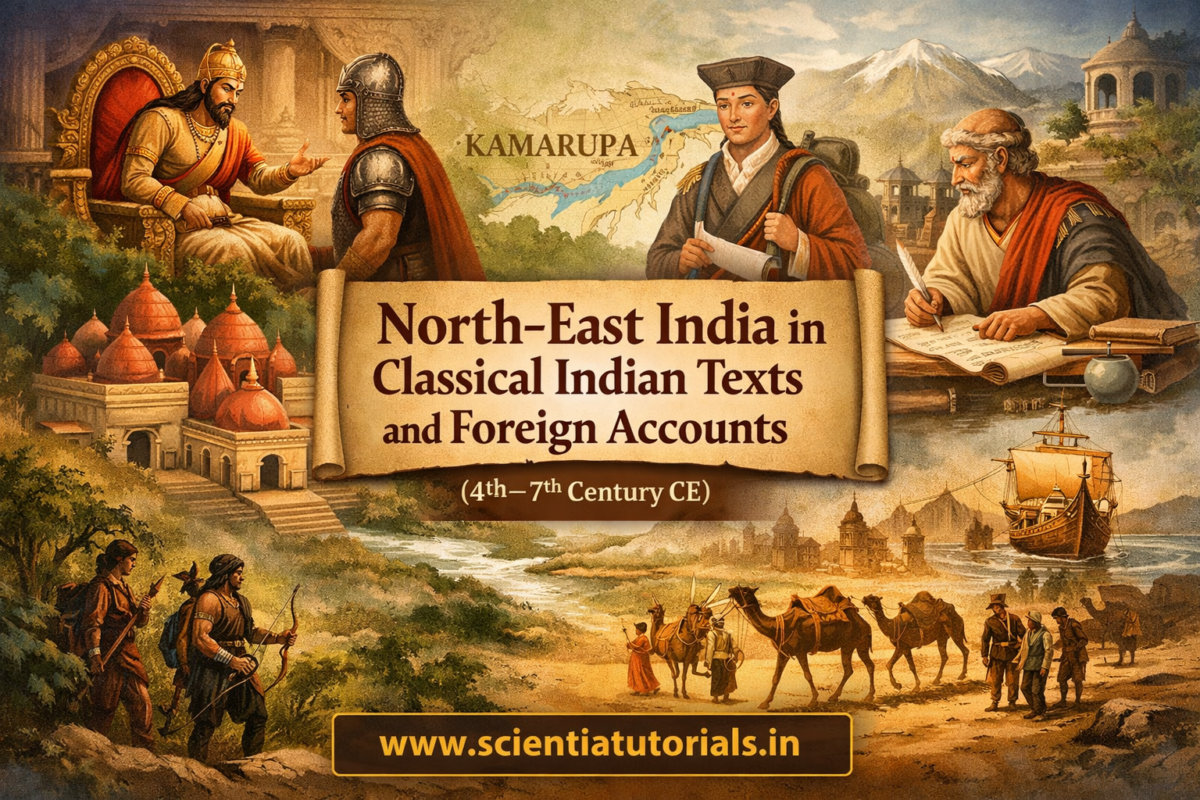

North-East India in Classical Indian Texts & Foreign Accounts (4th–7th Century CE)
History of North-East India: From Early Kingdoms to Modern Integration
Module II: Early Historic Period and the Emergence of Kingdoms
Timeline / Era Covered: c. 4th Century CE – 7th Century CE
Lesson: North-East India in Classical Indian Texts and Foreign Accounts
This lesson is systematically organized into four clearly structured sections, as detailed below:
- Chronologically Structured Study Module
- Short-Answer Type Questions
- Long-Answer Type Questions
- Multiple-Choice Questions (MCQs) with Answers and Detailed Explanations
Chronologically Structured Study Module
Introduction: Literary Sources and the Reconstruction of Early North-East Indian History
The early historic period of North-East India (c. 4th–7th century CE) is marked by the gradual emergence of regional polities, cultural integration, and expanding trans-regional interactions. Unlike the Gangetic plains, where inscriptions and archaeological remains are abundant, the history of North-East India for this period must be reconstructed primarily from classical Indian literary texts and foreign accounts, supplemented by limited epigraphic and archaeological evidence.
Classical Sanskrit literature, Buddhist texts, and Greco-Roman geographical writings provide fragmentary but invaluable references to the peoples, territories, trade routes, and politicalৰা
political identities of the eastern and north-eastern frontiers of the Indian subcontinent. These sources help historians trace the early conceptualization of regions such as Kamarupa, Pragjyotisha, and parts of present-day Tripura and Manipur, while also revealing how North-East India was perceived within wider Indian and trans-Asian worldviews.
Chronological Framework of Literary References (4th–7th Century CE)
From a chronological perspective, references to North-East India appear in three broad phases:
- Pre-Gupta and Early Gupta Period (4th–5th century CE)
- Mature Gupta and Post-Gupta Period (5th–6th century CE)
- Early Medieval Transition Phase (6th–7th century CE)
Each phase shows increasing clarity in political geography, ethnic identities, and cultural assimilation.
North-East India in Classical Indian Texts
1. Early Sanskrit and Itihasa Traditions (Pre-Gupta Context)
Although composed earlier, texts like the Mahabharata and the Ramayana continued to shape historical understanding during the early historic period.
Key References:
- Pragjyotisha is mentioned as a powerful frontier kingdom.
- The ruler Narakasura and later Bhagadatta are portrayed as influential figures.
- The region is described as culturally distinct yet politically significant.
Historical Significance:
- These references indicate early political formations in the Brahmaputra valley.
- They establish North-East India as part of the larger Indic civilizational imagination, rather than an isolated periphery.
2. Puranic Literature and Regional Identity Formation
The Puranas, especially the Vishnu Purana, Bhagavata Purana, and Brahmanda Purana, gained prominence during the Gupta and post-Gupta periods.
Key Contributions:
- Detailed genealogies of kings ruling Pragjyotisha-Kamarupa.
- Recognition of Kamarupa as a distinct territorial and cultural unit.
- Association of the region with sacred geography and mythological narratives.
Analytical Importance:
- Puranic texts reflect the process of Sanskritization in North-East India.
- They legitimize local dynasties by linking them to pan-Indian mythological lineages.
- These texts suggest increasing integration of the region into the Brahmanical cultural framework by the 6th–7th century CE.
3. Arthashastra and Political Awareness
The Arthashastra, traditionally attributed to Kautilya, contains indirect references to frontier regions and forest polities.
Relevance to North-East India:
- Mentions of borderland tribes (atavika janapadas) resonate with the political realities of the eastern Himalayas.
- Emphasis on trade routes, diplomacy, and frontier administration highlights the strategic value of eastern regions.
Historical Interpretation:
- The text suggests that North-East India was viewed as a strategic frontier zone, important for trade, security, and imperial diplomacy.
North-East India in Foreign Accounts
1. Greco-Roman Geographical Writings
The Periplus of the Erythraean Sea (1st–2nd Century CE Influence)
The Periplus of the Erythraean Sea, though earlier in date, remained influential in shaping Greco-Roman geographical knowledge well into the early historic period.
Key Insights:
- References to inland trade routes connecting eastern India to Southeast Asia.
- Indirect evidence of trans-regional trade networks affecting North-East India.
Historical Value:
- Confirms the economic relevance of eastern trade corridors linked to the Brahmaputra valley.
Ptolemy’s Geography (2nd Century CE)
The works of Ptolemy were widely consulted during later centuries.
Important References:
- Identification of places such as Kirradia (associated with Kirata peoples).
- Description of river systems resembling the Brahmaputra.
Interpretation:
- Highlights North-East India’s ethnic diversity.
- Demonstrates foreign awareness of the region’s geography and peoples.
2. Chinese Buddhist Pilgrims and Travel Accounts
Faxian (Fa-Hien) – Early 5th Century CE
The Chinese monk Faxian traveled through India during the Gupta period.
Observations Relevant to North-East India:
- Mentions frontier regions inhabited by non-urban, tribal communities.
- Notes the limited spread of Buddhism beyond core Gangetic regions.
Historical Implications:
- Suggests that large parts of North-East India retained indigenous belief systems during the early Gupta age.
Xuanzang (Hiuen Tsang) – 7th Century CE
The most detailed foreign account comes from Xuanzang, who visited India during the reign of Harshavardhana.
Key References to Kamarupa:
- Description of Kamarupa as a powerful and independent kingdom.
- Mentions King Bhaskaravarman, highlighting diplomatic ties with North India.
- Notes social customs, administrative practices, and religious traditions.
Historical Importance:
- Provides direct confirmation of Kamarupa’s political maturity by the 7th century CE.
- Shows the region’s integration into pan-Indian political and diplomatic networks.
Thematic Analysis: What These Texts Reveal About North-East India
Political Development
- Gradual emergence of organized kingdoms such as Pragjyotisha-Kamarupa.
- Transition from tribal polities to centralized monarchies.
Cultural Integration
- Progressive Sanskritization and incorporation into Brahmanical traditions.
- Continued coexistence of indigenous practices.
Economic Networks
- Participation in long-distance trade routes linking India, Southeast Asia, and China.
- Strategic importance of river valleys and mountain passes.
External Perception
- Viewed as a frontier yet significant region by both Indian and foreign observers.
- Recognized for its ethnic diversity and strategic value.
Limitations and Critical Evaluation of Literary Sources
While invaluable, these texts have certain limitations:
- Mythological exaggeration in epics and Puranas.
- Second-hand information in foreign accounts.
- Lack of detailed local perspectives from indigenous sources.
Hence, historians emphasize correlating literary evidence with archaeology and inscriptions for balanced reconstruction.
Conclusion: Historical Significance of Classical and Foreign Accounts
Between the 4th and 7th centuries CE, North-East India moved from being a mythologized frontier to a clearly recognized political and cultural region. Classical Indian texts integrated the region into the broader Indic worldview, while foreign accounts confirmed its political autonomy, economic relevance, and cultural distinctiveness.
Together, these sources form the foundation for understanding early state formation, cultural interaction, and regional identity in North-East India—making them indispensable for both academic study and competitive examinations.
Examination Relevance (For APSC, State PSCs, UGC-NET, CUET, TETs)
- Frequently asked topics on Pragjyotisha-Kamarupa
- Importance of Xuanzang’s account
- Role of Puranic literature in regional history
- Frontier concept in ancient Indian political thought
Short Answer Type Questions with Answers
(20–30 words where possible; some analytical answers slightly longer as per exam standards)
Q1. What is the importance of classical literary sources for reconstructing early North-East Indian history?
Answer:
Classical literary sources help reconstruct political, cultural, and geographical aspects of early North-East India where archaeological and epigraphic evidence is limited.
Q2. Which ancient Indian epic contains early references to Pragjyotisha?
Answer:
The Mahabharata contains references to Pragjyotisha and its ruler Bhagadatta.
Q3. Who was Bhagadatta, and why is he historically significant?
Answer:
Bhagadatta was the ruler of Pragjyotisha, noted in the Mahabharata as a powerful king allied with the Kauravas.
Q4. What does the term ‘Pragjyotisha’ signify in early Indian texts?
Answer:
Pragjyotisha refers to an early political and cultural region identified with the Brahmaputra valley of ancient Assam.
Q5. Name two Puranas that mention Kamarupa.
Answer:
The Vishnu Purana and the Bhagavata Purana mention Kamarupa.
Q6. How do Puranic texts help in understanding early Kamarupa?
Answer:
They provide genealogies of rulers, territorial identity, and evidence of Sanskritization in early Kamarupa.
Q7. What process of cultural change is reflected in the Puranic accounts of North-East India?
Answer:
The Puranic accounts reflect the process of Sanskritization and integration into the Brahmanical cultural framework.
Q8. What is the Arthashastra’s relevance to frontier regions like North-East India?
Answer:
The Arthashastra highlights frontier administration, forest tribes, and strategic importance of border regions.
Q9. Which foreign text provides early information about trade routes affecting North-East India?
Answer:
The Periplus of the Erythraean Sea provides indirect information on eastern inland trade routes.
Q10. How does Ptolemy’s Geography contribute to the study of North-East India?
Answer:
Ptolemy describes river systems and Kirata-inhabited regions, indicating awareness of North-East India.
Q11. Who were the Kiratas according to classical sources?
Answer:
Kiratas were hill and forest-dwelling communities inhabiting eastern Himalayan and North-East Indian regions.
Q12. Which Chinese pilgrim visited India during the Gupta period?
Answer:
The Chinese pilgrim Faxian visited India during the early 5th century CE.
Q13. What observations did Faxian make about frontier regions?
Answer:
Faxian noted sparse Buddhist influence and the prevalence of indigenous customs in frontier areas.
Q14. Which Chinese pilgrim provides the most detailed account of Kamarupa?
Answer:
Xuanzang provides the most detailed account of Kamarupa in the 7th century CE.
Q15. Which ruler of Kamarupa is mentioned by Xuanzang?
Answer:
Xuanzang mentions Bhaskaravarman, the powerful ruler of Kamarupa.
Q16. What does Xuanzang’s account reveal about Kamarupa’s political status?
Answer:
Xuanzang describes Kamarupa as an independent and well-organized kingdom with diplomatic ties to North India.
Q17. How was North-East India perceived by foreign travelers?
Answer:
Foreign travelers viewed North-East India as a frontier region with political significance, ethnic diversity, and strategic importance.
Q18. What role did trade routes play in integrating North-East India?
Answer:
Trade routes linked North-East India with the Gangetic plains, Southeast Asia, and China, enhancing economic integration.
Q19. What limitations exist in using classical texts as historical sources?
Answer:
They often contain mythological elements, exaggerations, and second-hand information lacking local perspectives.
Q20. Why is corroboration with archaeology necessary?
Answer:
Archaeological evidence helps verify and balance literary accounts, ensuring accurate historical reconstruction.
Q21. How do classical texts indicate early state formation in North-East India?
Answer:
They mention rulers, territorial identities, diplomacy, and administrative practices indicating organized political structures.
Q22. What does the term ‘frontier region’ imply in ancient Indian political thought?
Answer:
It implies regions at the margins of core kingdoms, strategically important for trade, defense, and diplomacy.
Q23. How did indigenous traditions coexist with Sanskritic culture?
Answer:
Local customs and beliefs continued alongside gradual adoption of Sanskrit language, rituals, and royal ideology.
Q24. What historical transition is visible between the 4th and 7th centuries CE?
Answer:
A transition from tribal polities to centralized kingdoms like Pragjyotisha-Kamarupa is visible.
Q25. Why are foreign accounts crucial for North-East Indian history?
Answer:
They provide external, relatively objective descriptions of political conditions, society, and regional importance.
Long Answer Type Questions with Answers
Q1. Discuss the importance of classical Indian texts for reconstructing the early history of North-East India.
Answer:
Classical Indian texts play a crucial role in reconstructing the early history of North-East India due to the scarcity of indigenous inscriptions and archaeological data for the period between the 4th and 7th centuries CE. Epics, Puranas, and political treatises provide references to regions like Pragjyotisha and Kamarupa, helping historians identify early political formations, cultural affiliations, and territorial identities.
These texts integrate North-East India into the broader Indic worldview and reflect early processes of Sanskritization, state formation, and cultural assimilation. Although mythological in tone, when critically analyzed, they offer valuable historical insights into the region’s early past.
Q2. Examine the references to Pragjyotisha in the Mahabharata and assess their historical significance.
Answer:
The Mahabharata refers to Pragjyotisha as a powerful eastern kingdom ruled by Bhagadatta. Bhagadatta’s participation in the Kurukshetra War as an ally of the Kauravas highlights the political recognition of Pragjyotisha within early Indian traditions.
Historically, these references indicate the existence of an organized polity in the Brahmaputra valley. Though epic narratives are partly legendary, they preserve memories of early state formations and frontier kingdoms that later evolved into Kamarupa.
Q3. Analyze the role of Puranic literature in the formation of Kamarupa’s historical identity.
Answer:
Puranic texts such as the Vishnu Purana and Bhagavata Purana played a key role in shaping the historical identity of Kamarupa. They provide genealogies of rulers, territorial descriptions, and mytho-historical narratives connecting local kings with pan-Indian traditions.
These texts reflect the process of Sanskritization by legitimizing regional dynasties within Brahmanical ideology. As a result, Kamarupa emerged not merely as a frontier region but as a recognized political and cultural entity in early historic India.
Q4. How do classical texts reflect the process of Sanskritization in North-East India?
Answer:
Classical texts reflect Sanskritization through the adoption of Sanskrit language, Brahmanical rituals, and mythological genealogies by regional elites. Puranic accounts associate North-East Indian rulers with divine or epic lineages, integrating them into the wider Hindu cultural framework.
This process did not erase indigenous traditions but created a composite culture where local customs coexisted with Sanskritic practices. The texts thus reveal gradual cultural assimilation rather than abrupt transformation.
Q5. Evaluate the relevance of the Arthashastra for understanding North-East India as a frontier region.
Answer:
The Arthashastra provides indirect but important insights into frontier regions like North-East India. It discusses forest tribes, border administration, diplomacy, and trade routes, which correspond to the political realities of eastern and north-eastern India.
The text highlights the strategic importance of frontier zones for imperial security and economic expansion. This suggests that North-East India was perceived as a politically significant borderland rather than an isolated wilderness.
Q6. Discuss the contribution of Greco-Roman geographical writings to the study of North-East India.
Answer:
Greco-Roman writings contributed to early knowledge of North-East India by documenting trade routes, river systems, and ethnic groups. Works like the Periplus of the Erythraean Sea indicate inland trade connections linking eastern India with Southeast Asia.
These accounts confirm that the region was part of wider commercial networks. Although indirect, they provide valuable external perspectives on the economic and geographical significance of North-East India.
Q7. Assess Ptolemy’s contribution to the geographical understanding of North-East India.
Answer:
Ptolemy contributed significantly by identifying river systems and regions inhabited by the Kirata people. His references suggest awareness of the Brahmaputra river and the eastern Himalayan zone.
While his geographical knowledge was approximate, it demonstrates that North-East India was known to the classical world as a distinct and inhabited region, not an unknown periphery.
Q8. Who were the Kiratas, and how are they represented in classical sources?
Answer:
The Kiratas were hill and forest-dwelling communities inhabiting the eastern Himalayas and parts of North-East India. Classical Indian and Greco-Roman sources depict them as martial, independent, and culturally distinct.
Their repeated mention highlights the ethnic diversity of the region and the coexistence of tribal societies alongside emerging kingdoms.
Q9. Examine the significance of Chinese pilgrim accounts for North-East Indian history.
Answer:
Chinese pilgrim accounts are crucial as they provide relatively objective, eyewitness descriptions of Indian regions. They focus on political organization, religious practices, and social life, offering insights unavailable in Indian literary sources.
For North-East India, these accounts help confirm the existence of organized kingdoms and clarify the region’s political and cultural status during the early historic period.
Q10. Discuss Faxian’s observations and their historical value.
Answer:
Faxian visited India in the early 5th century CE. He noted limited Buddhist influence in frontier regions and the persistence of indigenous customs.
His observations suggest that North-East India had not yet been fully integrated into mainstream religious networks, highlighting cultural diversity during the Gupta period.
Q11. Analyze Xuanzang’s account of Kamarupa.
Answer:
Xuanzang provides the most detailed account of Kamarupa in the 7th century CE. He describes it as an independent and prosperous kingdom with effective administration.
Xuanzang’s account confirms the political maturity of Kamarupa and its integration into inter-regional diplomatic networks.
Q12. Evaluate the historical importance of Bhaskaravarman based on literary sources.
Answer:
Bhaskaravarman, mentioned by Xuanzang, emerges as a powerful and diplomatic ruler of Kamarupa. His alliance with Harshavardhana indicates Kamarupa’s strategic importance in North Indian politics.
Literary sources portray him as a patron of learning and diplomacy, symbolizing the peak of early Kamarupa’s political power.
Q13. How do classical and foreign sources together enhance our understanding of early North-East India?
Answer:
Classical Indian texts provide internal cultural and political perspectives, while foreign accounts offer external, observational insights. Together, they create a more balanced historical narrative.
This combined approach helps overcome the limitations of individual sources and allows for a more accurate reconstruction of early North-East Indian history.
Q14. Discuss the role of trade networks in integrating North-East India during the early historic period.
Answer:
Trade networks connected North-East India with the Gangetic plains, Southeast Asia, and China. River routes and mountain passes facilitated the exchange of goods, ideas, and cultural practices.
Literary and foreign sources indicate that economic interactions played a key role in the region’s gradual integration into wider Asian networks.
Q15. Analyze the concept of ‘frontier’ as applied to North-East India in ancient texts.
Answer:
Ancient texts portray North-East India as a frontier region—geographically distant but strategically vital. It was associated with forest tribes, trade routes, and defensive importance.
This concept highlights the region’s dual identity as both marginal and indispensable in ancient Indian political thought.
Q16. What limitations must historians consider while using literary sources for North-East Indian history?
Answer:
Literary sources often contain mythological elements, exaggerations, and ideological biases. Foreign accounts may rely on second-hand information.
Therefore, historians must critically analyze these texts and corroborate them with archaeological and epigraphic evidence.
Q17. Explain the transition from tribal polities to organized kingdoms in North-East India.
Answer:
Between the 4th and 7th centuries CE, tribal communities gradually formed centralized political structures. Literary sources mention rulers, territories, and administrative systems.
This transition culminated in the emergence of kingdoms like Pragjyotisha-Kamarupa, marking early state formation in the region.
Q18. How did indigenous traditions survive alongside Sanskritic culture?
Answer:
Indigenous beliefs, rituals, and social practices continued even as Sanskritic elements were adopted by ruling elites. This led to cultural synthesis rather than replacement.
The coexistence of traditions enriched the region’s cultural landscape.
Q19. Discuss the political status of North-East India as reflected in foreign accounts.
Answer:
Foreign travelers recognized North-East India as politically autonomous and strategically important. Xuanzang’s description of Kamarupa confirms its independence and stability.
Such accounts counter the notion of the region as politically backward.
Q20. Conclude by assessing the overall historical value of classical and foreign accounts for North-East India.
Answer:
Classical Indian texts and foreign accounts form the backbone of early North-East Indian historiography. Despite limitations, they reveal political evolution, cultural integration, and regional identity formation.
When used critically and comparatively, these sources provide a reliable foundation for understanding North-East India between the 4th and 7th centuries CE.
MCQs with Answers and Explanations
Q1. Which ancient Indian epic provides the earliest literary reference to Pragjyotisha?
A. Ramayana
B. Arthashastra
C. Mahabharata
D. Vishnu Purana
Correct Answer: C
Explanation:
The Mahabharata mentions Pragjyotisha and its ruler Bhagadatta, indicating early political recognition of the region in epic traditions.
Q2. Bhagadatta, mentioned in classical literature, was the ruler of:
A. Kalinga
B. Vanga
C. Pragjyotisha
D. Anga
Correct Answer: C
Explanation:
Bhagadatta is described in the Mahabharata as the ruler of Pragjyotisha, associated with the Brahmaputra valley of ancient Assam.
Q3. Which region later emerged from Pragjyotisha as a major early historic kingdom?
A. Mithila
B. Kamarupa
C. Magadha
D. Kosala
Correct Answer: B
Explanation:
Pragjyotisha evolved into Kamarupa, which became a well-defined political and cultural kingdom between the 4th and 7th centuries CE.
Q4. Which category of Sanskrit literature provides genealogies of early Kamarupa rulers?
A. Upanishads
B. Smritis
C. Puranas
D. Aranyakas
Correct Answer: C
Explanation:
Puranic texts recorded dynastic genealogies and helped legitimize regional rulers within the Brahmanical tradition.
Q5. Which Purana explicitly mentions Kamarupa as a territorial unit?
A. Matsya Purana
B. Vishnu Purana
C. Agni Purana
D. Linga Purana
Correct Answer: B
Explanation:
The Vishnu Purana identifies Kamarupa as a distinct region and includes references to its rulers.
Q6. The Puranic references to North-East India mainly reflect which historical process?
A. Urbanization
B. Persianization
C. Sanskritization
D. Europeanization
Correct Answer: C
Explanation:
Puranic narratives show the adoption of Sanskrit language, Brahmanical rituals, and mythological genealogies by regional elites—key features of Sanskritization.
Q7. The Arthashastra is useful for understanding North-East India primarily because it discusses:
A. Temple architecture
B. Maritime law
C. Frontier administration
D. Buddhist philosophy
Correct Answer: C
Explanation:
The Arthashastra highlights frontier regions, forest tribes, trade routes, and administrative strategies relevant to North-East India.
Q8. In ancient Indian political thought, North-East India was largely viewed as a:
A. Core metropolitan region
B. Desert zone
C. Frontier region
D. Island territory
Correct Answer: C
Explanation:
Texts portray North-East India as a frontier—geographically distant but strategically important for trade, diplomacy, and defense.
Q9. Which foreign text provides indirect evidence of trade networks affecting North-East India?
A. Indica of Megasthenes
B. Natural History
C. Periplus of the Erythraean Sea
D. Geography of Strabo
Correct Answer: C
Explanation:
The Periplus of the Erythraean Sea refers to inland trade routes connecting eastern India with Southeast Asia.
Q10. Which Greco-Roman scholar described Kirata-inhabited regions?
A. Herodotus
B. Pliny
C. Ptolemy
D. Strabo
Correct Answer: C
Explanation:
Ptolemy identified regions associated with the Kirata people and eastern river systems.
Q11. The Kiratas mentioned in classical sources were mainly:
A. Coastal traders
B. Desert nomads
C. Hill and forest communities
D. Urban merchants
Correct Answer: C
Explanation:
Kiratas were indigenous hill and forest-dwelling groups inhabiting eastern Himalayan and North-East Indian regions.
Q12. Which Chinese pilgrim visited India during the Gupta period?
A. Xuanzang
B. Yijing
C. Faxian
D. Song Yun
Correct Answer: C
Explanation:
Faxian visited India in the early 5th century CE during the Gupta period.
Q13. Faxian’s observations suggest that frontier regions of India had:
A. Extensive Buddhist monasteries
B. Predominant Jain influence
C. Limited Buddhist penetration
D. Complete Brahmanical dominance
Correct Answer: C
Explanation:
Faxian noted that Buddhism was weak in frontier areas, indicating the persistence of indigenous belief systems.
Q14. Which Chinese pilgrim provides the most detailed account of Kamarupa?
A. Faxian
B. Yijing
C. Xuanzang
D. Hyecho
Correct Answer: C
Explanation:
Xuanzang visited India in the 7th century CE and described Kamarupa in detail.
Q15. According to Xuanzang, Kamarupa during the 7th century CE was:
A. A tribal confederacy
B. A dependent Gupta province
C. An independent kingdom
D. A Buddhist monastic state
Correct Answer: C
Explanation:
Xuanzang clearly states that Kamarupa was an independent and well-administered kingdom.
Q16. Which ruler of Kamarupa is mentioned by Xuanzang?
A. Narakasura
B. Bhagadatta
C. Bhaskaravarman
D. Mahendravarman
Correct Answer: C
Explanation:
Xuanzang mentions Bhaskaravarman, highlighting his diplomatic relations with Harshavardhana.
Q17. Bhaskaravarman’s alliance with Harshavardhana indicates:
A. Political subordination
B. Military defeat
C. Diplomatic engagement
D. Religious conversion
Correct Answer: C
Explanation:
The alliance reflects diplomatic cooperation between two powerful rulers, not subordination.
Q18. Which century marks the peak of early Kamarupa’s political prominence?
A. 3rd century CE
B. 4th century CE
C. 6th–7th century CE
D. 9th century CE
Correct Answer: C
Explanation:
Kamarupa reached political maturity during the 6th–7th centuries CE under rulers like Bhaskaravarman.
Q19. Classical Indian texts integrate North-East India mainly into:
A. Central Asian history
B. Persian world
C. Indic civilizational framework
D. Roman political system
Correct Answer: C
Explanation:
Epics and Puranas place North-East India within the broader Indic cultural and mythological world.
Q20. Which factor most helped integrate North-East India with the wider world?
A. Desert caravans
B. Maritime piracy
C. Trade routes
D. Colonial administration
Correct Answer: C
Explanation:
River valleys and mountain passes enabled trade with North India, Southeast Asia, and China.
Q21. A major limitation of classical literary sources is that they:
A. Are written in local languages
B. Lack archaeological value
C. Contain mythological elements
D. Focus only on economy
Correct Answer: C
Explanation:
Epics and Puranas often mix mythology with history, requiring critical interpretation.
Q22. Foreign accounts are especially valuable because they provide:
A. Mythological narratives
B. External and relatively objective observations
C. Royal inscriptions
D. Oral traditions
Correct Answer: B
Explanation:
Foreign travelers recorded firsthand observations, offering an external perspective on Indian regions.
Q23. The transition visible in North-East India between the 4th and 7th centuries CE was from:
A. Urban centers to villages
B. Kingdoms to empires
C. Tribal polities to organized states
D. Buddhism to Jainism
Correct Answer: C
Explanation:
Literary sources indicate gradual political centralization and early state formation.
Q24. Indigenous traditions in North-East India:
A. Disappeared due to Sanskritization
B. Were forcibly suppressed
C. Coexisted with Sanskritic culture
D. Survived only in isolated areas
Correct Answer: C
Explanation:
Cultural synthesis occurred, with local traditions continuing alongside Brahmanical practices.
Q25. The combined use of classical Indian texts and foreign accounts helps historians to:
A. Eliminate archaeological research
B. Avoid critical analysis
C. Build a balanced historical reconstruction
D. Focus only on mythology
Correct Answer: C
Explanation:
Using both internal and external sources allows historians to cross-check information and overcome individual source limitations.