
Constitutional Provisions: Sixth Schedule and Special Status
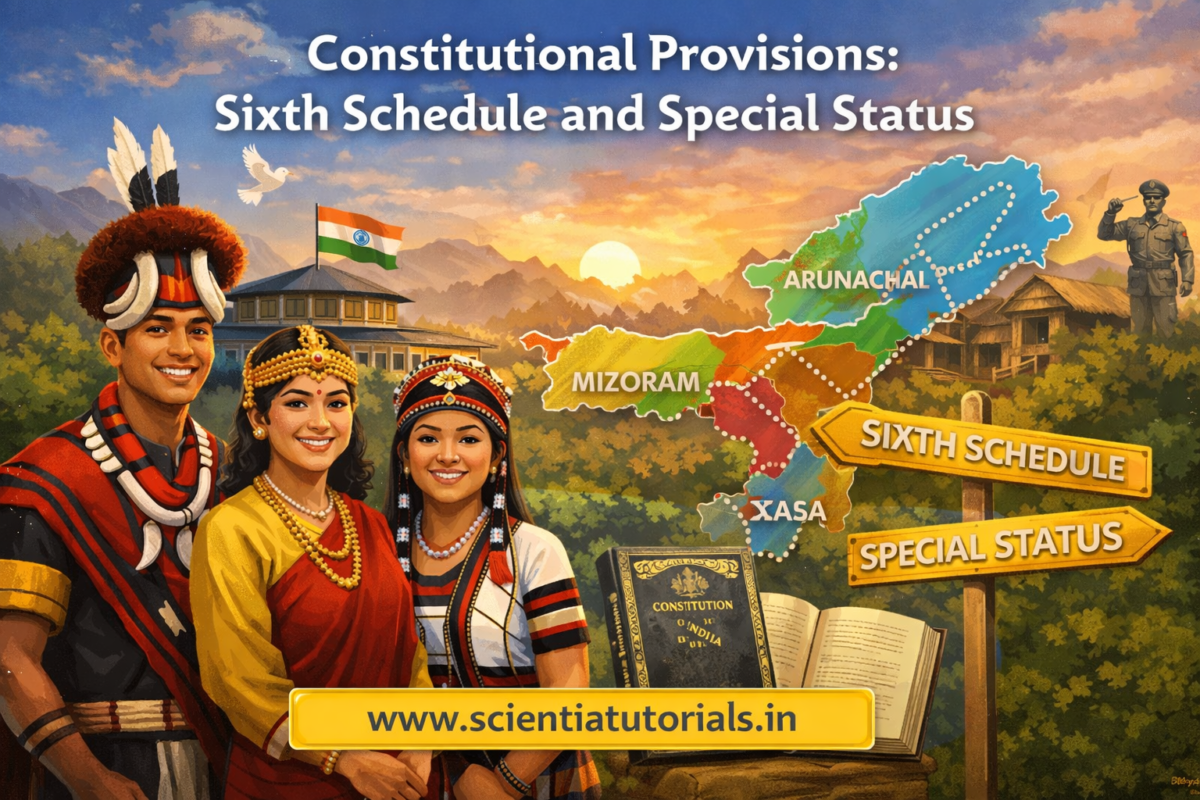

Sixth Schedule and Special Status in North-East India (1947–1971)
Course: History of North-East India: From Early Kingdoms to Modern Integration
Module VIII: Post-Independence Integration and State Formation
Timeline / Era Covered: 1947 CE – 1971 CE
Lesson: Constitutional Provisions – Sixth Schedule and Special Status
This lesson is systematically organized into four clearly structured sections, as detailed below:
- Chronologically Structured Study Module
- Short-Answer Type Questions
- Long-Answer Type Questions
- Multiple-Choice Questions (MCQs) with Answers and Detailed Explanations
Chronologically Structured Study Module
Introduction
The integration of North-East India into the Indian Union after 1947 presented unique constitutional, political, and administrative challenges. Unlike many other regions of India, the North-East was characterized by ethnic diversity, tribal autonomy, distinct customary laws, geographical isolation, and a colonial legacy of indirect administration. Recognising these complexities, the framers of the Constitution of India introduced special constitutional provisions to protect tribal identity, ensure self-governance, and facilitate gradual political integration.
Among these, the Sixth Schedule and related special status provisions played a decisive role in shaping post-independence governance in Assam and its hill regions. This lesson examines the historical background, constitutional debates, implementation, evolution, and impact of these provisions between 1947 CE and 1971 CE, a formative phase in the political restructuring of North-East India.
Historical Background: Colonial Legacy and Tribal Administration
Pre-1947 Administrative Framework
Under British rule, large parts of North-East India were governed through a policy of isolation and minimal intervention, especially in hill and tribal areas. The Inner Line Regulation (1873) and classification of areas as “Excluded” and “Partially Excluded Areas” under the Government of India Act, 1935 restricted legislative interference and preserved tribal autonomy.
Key characteristics of colonial administration included:
- Limited penetration of modern institutions
- Recognition of customary laws and traditional councils
- Administrative separation between plains and hills
- Political isolation from mainstream nationalist movements
This colonial framework profoundly influenced post-independence constitutional thinking.
Post-Independence Challenges (1947–1950)
Integration without Assimilation
At Independence, Indian leaders faced a dual challenge:
- National integration and territorial unity
- Protection of tribal identity and autonomy
There were strong apprehensions among tribal communities regarding:
- Loss of land and cultural identity
- Domination by plains populations
- Imposition of uniform laws
Simultaneously, the Indian state was concerned about political instability, border security, and secessionist tendencies in frontier regions.
Constituent Assembly Debates and the Birth of the Sixth Schedule
Role of Bardoloi Committee
To address tribal concerns, the Constituent Assembly appointed the North-East Frontier (Assam) Tribal and Excluded Areas Sub-Committee, popularly known as the Bardoloi Committee, under Gopinath Bordoloi.
Key recommendations:
- Autonomous councils with legislative and judicial powers
- Protection of customary laws and land rights
- Limited intervention by state legislatures
- Financial autonomy within the constitutional framework
These recommendations culminated in the incorporation of the Sixth Schedule in the Constitution (1950).
The Sixth Schedule: Concept and Objectives
Constitutional Philosophy
The Sixth Schedule was designed as a middle path between complete separation and forced assimilation, ensuring:
- Autonomy without sovereignty
- Integration with safeguards
- Self-rule within the Union
It applied primarily to tribal areas of Assam, which later included regions that became Meghalaya, Mizoram, and Tripura.
Structure and Provisions of the Sixth Schedule
Autonomous District Councils (ADCs)
The Sixth Schedule provided for the creation of Autonomous District Councils and Regional Councils.
Composition
- Elected representatives
- Limited nominated members
- Five-year tenure
Legislative Powers
ADCs could make laws on:
- Land and forest management
- Shifting cultivation
- Village administration
- Inheritance and social customs
Judicial Powers
- Village courts for trial of minor civil and criminal cases
- Adjudication based on customary law
Financial Powers
- Levy and collection of local taxes
- Management of council funds
- Grants-in-aid from the state
Early Implementation (1950–1960)
Sixth Schedule in Practice
During the first decade after independence:
- Autonomous councils were established in Garo Hills, Khasi-Jaintia Hills, Lushai Hills, and North Cachar Hills
- Traditional institutions were constitutionally recognized
- Councils acted as intermediaries between tribal societies and the Indian state
However, practical difficulties soon emerged:
- Limited financial resources
- Bureaucratic interference by Assam Government
- Demand for greater political autonomy
Emergence of Special Status Demands
Beyond the Sixth Schedule
By the late 1950s, many tribal leaders felt that:
- The Sixth Schedule did not go far enough
- Cultural autonomy without political power was inadequate
- Hill areas remained subordinate to Assam
This led to movements demanding separate states or special political arrangements, particularly in:
- Khasi-Jaintia and Garo Hills
- Lushai Hills (Mizoram)
- Frontier regions of NEFA
Meghalaya: From Autonomous State to Full Statehood
Autonomous State within Assam (1970)
In response to sustained agitation:
- The Assam Reorganisation (Meghalaya) Act, 1969 created an Autonomous State of Meghalaya within Assam
- It had its own legislature and council of ministers
Statehood (1972)
- Meghalaya became a full-fledged state in 1972
- The Sixth Schedule continued to protect tribal autonomy
This marked a successful constitutional transition from autonomy to statehood.
Mizoram: Sixth Schedule and Insurgency
Lushai Hills under Sixth Schedule
Initially governed through an Autonomous District Council, Mizoram witnessed:
- Dissatisfaction with limited autonomy
- Economic neglect
- Impact of the 1959 Mautam famine
Political Consequences
- Formation of Mizo National Front (1961)
- Armed insurgency (1966)
- Gradual shift towards Union Territory status (1972)
Here, the Sixth Schedule acted as a transitional mechanism rather than a permanent solution.
Arunachal Pradesh: Special Constitutional Status outside Sixth Schedule
NEFA and Article 371
Unlike other hill areas, Arunachal Pradesh:
- Was administered as North-East Frontier Agency (NEFA)
- Placed directly under the Union Government
- Governed through special constitutional provisions (Article 371-H later)
This reflects a parallel model of special status, shaped by:
- Strategic border concerns
- Sparse population
- Distinct tribal composition
Special Status Provisions: Broader Constitutional Framework
Apart from the Sixth Schedule, the Constitution incorporated:
- Special responsibilities of the Governor
- Direct Union control in sensitive frontier areas
- Legal protection of customary practices
These provisions emphasized asymmetrical federalism, allowing different regions to have different constitutional arrangements.
Evaluation of the Sixth Schedule (1947–1971)
Achievements
- Prevented immediate alienation of tribal communities
- Institutionalized self-governance
- Facilitated peaceful political evolution
- Preserved land and cultural rights
Limitations
- Financial dependence on states
- Administrative overlap
- Uneven development
- Inadequate response to rising political aspirations
Historical Significance
Between 1947 and 1971, the Sixth Schedule and special status provisions:
- Acted as constitutional shock absorbers
- Enabled gradual political integration
- Prevented large-scale fragmentation
- Laid the foundation for later state formation
They represent one of the most innovative experiments in constitutional accommodation of diversity in post-colonial India.
Conclusion
The Sixth Schedule and special constitutional provisions were not static legal arrangements but dynamic instruments of nation-building. In the context of North-East India, they balanced unity with diversity, sovereignty with autonomy, and integration with respect for identity.
Between 1947 CE and 1971 CE, these provisions played a pivotal role in shaping the political destiny of Nagaland, Meghalaya, Mizoram, and Arunachal Pradesh, making them indispensable to any serious understanding of post-independence integration of North-East India.
Short Answer Type Questions with Answers
Lesson: Constitutional Provisions – Sixth Schedule and Special Status
1. What was the main objective of the Sixth Schedule of the Constitution of India?
Answer:
The main objective of the Sixth Schedule was to provide autonomous self-governance to tribal areas of North-East India while ensuring their political integration with the Indian Union and protecting customary laws, land rights, and cultural identity.
2. Which region did the Sixth Schedule initially apply to?
Answer:
The Sixth Schedule initially applied to the tribal areas of Assam, including the Khasi, Jaintia, Garo, Lushai, and North Cachar Hills.
3. What historical factors necessitated special constitutional provisions for North-East India?
Answer:
Factors included ethnic diversity, tribal social structures, geographical isolation, colonial administrative policies, fear of cultural assimilation, and political instability after independence.
4. Who chaired the committee that recommended the Sixth Schedule?
Answer:
The committee was chaired by Gopinath Bordoloi, and it is popularly known as the Bardoloi Committee.
5. What are Autonomous District Councils (ADCs)?
Answer:
ADCs are constitutional bodies created under the Sixth Schedule to administer tribal areas with powers over legislation, judiciary, and local administration based on customary laws.
6. Mention any two legislative powers of Autonomous District Councils.
Answer:
ADCs can make laws relating to:
- Land and forest management
- Inheritance and customary practices
7. What judicial powers are given to Autonomous District Councils?
Answer:
They can establish village courts to try minor civil and criminal cases according to customary laws of the tribes.
8. How did the Sixth Schedule protect tribal land rights?
Answer:
It restricted the transfer of tribal land to non-tribals and placed land management under Autonomous District Councils.
9. Why did many hill leaders consider the Sixth Schedule inadequate by the 1960s?
Answer:
Because it provided administrative autonomy without full political power, limited financial resources, and continued control by the Assam Government.
10. What was the relationship between the Sixth Schedule and the creation of Meghalaya?
Answer:
The Sixth Schedule created autonomous councils that later evolved into the Autonomous State of Meghalaya (1970), which eventually led to full statehood in 1972.
11. When was Meghalaya formed as an autonomous state?
Answer:
Meghalaya was formed as an autonomous state within Assam in 1970 under the Assam Reorganisation Act, 1969.
12. How was Mizoram administered under the Sixth Schedule?
Answer:
Mizoram (then Lushai Hills) was administered through an Autonomous District Council, which later proved insufficient to meet political aspirations.
13. What event intensified dissatisfaction in Mizoram during Sixth Schedule administration?
Answer:
The Mautam Famine of 1959 intensified dissatisfaction and exposed administrative weaknesses.
14. How did Arunachal Pradesh differ constitutionally from Sixth Schedule areas?
Answer:
Arunachal Pradesh was administered as NEFA (North-East Frontier Agency) under direct Union control, not under the Sixth Schedule.
15. What was NEFA?
Answer:
NEFA was the administrative unit governing present-day Arunachal Pradesh, managed by the Union Government due to strategic and security concerns.
16. What is meant by “special status” in the North-East Indian context?
Answer:
It refers to constitutional arrangements granting special administrative, legislative, or financial powers to protect regional identity and ensure political stability.
17. How did the Sixth Schedule reflect asymmetrical federalism?
Answer:
It allowed different regions to have different constitutional arrangements, departing from uniform federal governance.
18. Name two hill areas that were under Sixth Schedule administration before statehood.
Answer:
- Khasi-Jaintia Hills
- Garo Hills
19. What role did the Governor play under the Sixth Schedule?
Answer:
The Governor had special discretionary powers to oversee council functioning and approve laws passed by ADCs.
20. What were the financial limitations of Autonomous District Councils?
Answer:
They depended heavily on grants-in-aid from state governments and lacked independent revenue sources.
21. How did the Sixth Schedule contribute to national integration?
Answer:
It reduced alienation by recognizing tribal identity and provided peaceful constitutional means for political participation.
22. Why is the Sixth Schedule considered an innovative constitutional experiment?
Answer:
Because it combined self-rule, customary law, and democratic governance within a modern constitutional framework.
23. What constitutional principle guided the framing of the Sixth Schedule?
Answer:
The principle of integration with autonomy, not forced assimilation.
24. Did the Sixth Schedule prevent insurgency in all areas?
Answer:
No. While it helped in some regions, it failed to prevent insurgency in areas like Mizoram, where political demands exceeded administrative autonomy.
25. What was the overall significance of the Sixth Schedule between 1947 and 1971?
Answer:
It acted as a transitional constitutional mechanism, enabling gradual integration, protecting tribal rights, and laying the groundwork for future state formation.
Long Answer Type Questions with Answers
Lesson: Constitutional Provisions – Sixth Schedule and Special Status
1. Examine the historical background that led to the incorporation of the Sixth Schedule in the Constitution of India.
Answer:
The Sixth Schedule emerged from the unique colonial and post-colonial context of North-East India. Under British rule, tribal areas were governed through indirect administration, classified as “Excluded” and “Partially Excluded Areas.” These regions had minimal exposure to modern institutions and retained strong customary systems.
At independence, tribal communities feared loss of land, identity, and autonomy within a centralized nation-state. Simultaneously, the Indian leadership faced challenges of national integration, border security, and political stability. To reconcile these concerns, the Constituent Assembly adopted a special constitutional arrangement that would allow tribal self-rule while maintaining Indian sovereignty. The Sixth Schedule thus represented a constitutional compromise rooted in historical realities.
2. Discuss the role of the Bardoloi Committee in shaping constitutional safeguards for tribal areas of North-East India.
Answer:
The Bardoloi Committee, formally known as the North-East Frontier (Assam) Tribal and Excluded Areas Sub-Committee, played a pivotal role in framing tribal safeguards. Headed by Gopinath Bordoloi, the committee undertook extensive consultations with tribal leaders.
It rejected both total isolation and complete assimilation, recommending autonomous councils with legislative, judicial, and financial powers. These recommendations directly shaped the Sixth Schedule. The committee ensured that tribal autonomy was constitutionally guaranteed, making it a foundational influence in post-independence governance of North-East India.
3. Explain the objectives and philosophy underlying the Sixth Schedule.
Answer:
The Sixth Schedule was guided by the philosophy of integration with autonomy. Its objectives were:
- To preserve tribal identity and culture
- To protect customary laws and land rights
- To enable self-governance through democratic institutions
- To facilitate gradual political integration
Rather than imposing uniform governance, the framers adopted asymmetrical federalism, allowing tribal regions to evolve politically at their own pace within the Indian Union.
4. Describe the structure and composition of Autonomous District Councils under the Sixth Schedule.
Answer:
Autonomous District Councils (ADCs) are elected bodies with limited nominated representation. They have a fixed tenure and function as local legislatures. ADCs are empowered to frame laws, administer justice in minor cases, manage resources, and oversee development activities. This institutional structure bridges traditional tribal governance with modern democratic administration.
5. Analyse the legislative powers of Autonomous District Councils.
Answer:
ADCs can legislate on land, forests, village administration, inheritance, marriage, and social customs. These powers enable councils to preserve customary practices while exercising constitutional authority. However, laws passed by ADCs require the Governor’s assent, reflecting a balance between autonomy and oversight.
6. Examine the judicial functions of the Sixth Schedule councils.
Answer:
The Sixth Schedule authorizes ADCs to establish village courts to adjudicate minor civil and criminal cases. These courts function based on customary laws, reinforcing indigenous justice systems. This judicial autonomy helped maintain tribal social order while reducing alienation from state institutions.
7. Discuss the financial powers and limitations of Autonomous District Councils.
Answer:
ADCs can levy local taxes and manage council funds, but they remain financially dependent on state and central grants. Limited revenue generation has constrained development initiatives, making financial autonomy one of the weakest aspects of the Sixth Schedule.
8. Evaluate the implementation of the Sixth Schedule during 1950–1960.
Answer:
In its early phase, the Sixth Schedule helped institutionalize tribal self-governance in hill areas of Assam. While it provided political recognition, administrative inefficiencies, bureaucratic interference, and inadequate funds gradually reduced its effectiveness.
9. Why did the Sixth Schedule fail to fully satisfy political aspirations in some regions?
Answer:
The Schedule offered administrative autonomy but not full political power. Growing awareness, education, and leadership mobilization led to demands for statehood. The gap between autonomy and sovereignty became increasingly evident by the 1960s.
10. Trace the role of the Sixth Schedule in the political evolution of Meghalaya.
Answer:
In the Khasi-Jaintia and Garo Hills, Sixth Schedule councils nurtured political leadership. Persistent demands resulted in the creation of the Autonomous State of Meghalaya in 1970, followed by full statehood. The Sixth Schedule thus functioned as a transitional constitutional mechanism.
11. Analyse the relationship between the Sixth Schedule and the Mizo movement.
Answer:
In Mizoram, Sixth Schedule autonomy proved insufficient. Economic neglect and the 1959 famine intensified dissatisfaction, leading to insurgency. This revealed the limitations of administrative autonomy in addressing deep political aspirations.
12. Explain why Arunachal Pradesh was kept outside the Sixth Schedule.
Answer:
Arunachal Pradesh was governed as NEFA under direct Union control due to strategic border concerns, sparse population, and administrative challenges. Instead of the Sixth Schedule, special constitutional provisions were adopted.
13. Discuss the concept of special status in the context of North-East India.
Answer:
Special status refers to constitutional arrangements granting differentiated governance structures. These provisions recognized regional diversity and allowed flexible integration, marking a departure from uniform federalism.
14. How does the Sixth Schedule reflect asymmetrical federalism in India?
Answer:
By granting unique powers to specific regions, the Sixth Schedule institutionalized asymmetrical federalism, acknowledging that diverse historical and social conditions require differentiated constitutional responses.
15. Examine the role of the Governor under the Sixth Schedule.
Answer:
The Governor exercises discretionary powers, approves council legislation, and ensures constitutional compliance. This role symbolizes the balance between autonomy and national oversight.
16. Assess the contribution of the Sixth Schedule to national integration.
Answer:
By constitutionally recognizing tribal autonomy, the Sixth Schedule reduced alienation and facilitated peaceful integration, preventing large-scale fragmentation during a sensitive post-independence phase.
17. Critically analyse the limitations of the Sixth Schedule.
Answer:
Limitations include financial dependence, administrative overlap, limited political power, and inability to address insurgent movements in some areas. These weaknesses necessitated further constitutional evolution.
18. Discuss the Sixth Schedule as a transitional constitutional arrangement.
Answer:
Rather than a permanent solution, the Sixth Schedule enabled gradual political maturation, leading to statehood for regions like Meghalaya and Mizoram.
19. Evaluate the Sixth Schedule’s role in preserving tribal identity.
Answer:
By safeguarding land rights, customs, and traditional institutions, the Sixth Schedule played a crucial role in cultural preservation amidst modernization pressures.
20. Conclude with an overall assessment of the Sixth Schedule and special status provisions between 1947 and 1971.
Answer:
Between 1947 and 1971, the Sixth Schedule and special status provisions functioned as constitutional shock absorbers. They balanced unity and diversity, enabled peaceful political evolution, and laid the foundations for state formation in North-East India. Despite limitations, they remain among the most innovative instruments of post-colonial constitutional governance in India.
MCQs with Answers and Explanations
Lesson: Constitutional Provisions – Sixth Schedule and Special Status
1. The Sixth Schedule is a part of which constitutional document?
A. Government of India Act, 1935
B. Indian Independence Act, 1947
C. Constitution of India
D. States Reorganisation Act, 1956
Correct Answer: C
Explanation:
The Sixth Schedule is an integral part of the Constitution of India (1950), designed to provide constitutional safeguards and autonomous governance to tribal areas of North-East India.
2. The primary objective of the Sixth Schedule was to:
A. Promote uniform laws across India
B. Provide complete political independence to tribal areas
C. Integrate tribal regions with autonomy
D. Abolish customary tribal institutions
Correct Answer: C
Explanation:
The Sixth Schedule aimed at integration with autonomy, not separation or forced assimilation. It sought to preserve tribal identity while ensuring political unity.
3. The Sixth Schedule initially applied to tribal areas of:
A. Nagaland only
B. Manipur and Tripura
C. Assam
D. Entire North-East India
Correct Answer: C
Explanation:
At the time of independence, most hill tribal areas were part of Assam, making it the primary state under Sixth Schedule administration.
4. The committee that recommended the Sixth Schedule was chaired by:
A. B. R. Ambedkar
B. Jawaharlal Nehru
C. Gopinath Bordoloi
D. Rajendra Prasad
Correct Answer: C
Explanation:
The Bardoloi Committee played a crucial role in recommending autonomy-based safeguards for tribal regions of Assam.
5. Which of the following bodies were created under the Sixth Schedule?
A. Gram Panchayats
B. Autonomous District Councils
C. Zilla Parishads
D. Municipal Corporations
Correct Answer: B
Explanation:
Autonomous District Councils (ADCs) are the core institutions under the Sixth Schedule, entrusted with legislative, judicial, and administrative powers.
6. Autonomous District Councils can make laws on:
A. Defence and foreign policy
B. Currency and banking
C. Land and forest management
D. National taxation
Correct Answer: C
Explanation:
ADCs have authority over local matters such as land, forests, customary laws, and village administration.
7. Which authority must approve laws passed by Autonomous District Councils?
A. President of India
B. Parliament
C. Governor of the State
D. Chief Minister
Correct Answer: C
Explanation:
The Governor’s assent ensures constitutional oversight while maintaining regional autonomy.
8. Judicial powers of ADCs mainly relate to:
A. Supreme Court appeals
B. High Court jurisdiction
C. Village courts and customary law
D. Military tribunals
Correct Answer: C
Explanation:
Village courts under ADCs adjudicate minor cases using customary laws, reinforcing traditional justice systems.
9. One major limitation of the Sixth Schedule has been:
A. Excessive financial independence
B. Over-centralisation of power
C. Financial dependence on states
D. Lack of legal recognition
Correct Answer: C
Explanation:
Although ADCs can levy local taxes, they depend heavily on grants from state and central governments.
10. The Sixth Schedule reflects which constitutional principle?
A. Unitary system
B. Centralised federalism
C. Asymmetrical federalism
D. Confederalism
Correct Answer: C
Explanation:
Asymmetrical federalism allows different regions to have different constitutional arrangements based on historical and social needs.
11. Which hill areas later evolved into the state of Meghalaya?
A. Lushai Hills
B. Khasi, Jaintia, and Garo Hills
C. Naga Hills
D. North Cachar Hills only
Correct Answer: B
Explanation:
The Khasi-Jaintia and Garo Hills were Sixth Schedule areas that later became Meghalaya.
12. Meghalaya was first created as:
A. Union Territory
B. Autonomous State within Assam
C. Directly administered region
D. Tribal reserve
Correct Answer: B
Explanation:
In 1970, Meghalaya became an Autonomous State within Assam before achieving full statehood.
13. In Mizoram, dissatisfaction with Sixth Schedule arrangements was intensified by:
A. Language policy
B. Border disputes
C. 1959 famine
D. Industrialisation
Correct Answer: C
Explanation:
The Mautam Famine exposed administrative weaknesses and contributed to political unrest.
14. Which organisation led the insurgent movement in Mizoram?
A. Naga National Council
B. United Liberation Front of Assam
C. Mizo National Front
D. All Party Hill Leaders’ Conference
Correct Answer: C
Explanation:
The Mizo National Front spearheaded the movement that challenged Sixth Schedule governance.
15. Arunachal Pradesh was initially administered as:
A. A Sixth Schedule area
B. Autonomous district
C. North-East Frontier Agency (NEFA)
D. Union Territory
Correct Answer: C
Explanation:
Arunachal Pradesh remained outside the Sixth Schedule due to strategic and security considerations.
16. Special status provisions in the North-East primarily aimed to:
A. Encourage migration
B. Promote cultural assimilation
C. Protect tribal identity and stability
D. Reduce central authority
Correct Answer: C
Explanation:
Special status provisions safeguarded cultural, social, and political uniqueness of tribal regions.
17. Which authority exercised direct control over NEFA?
A. Assam Government
B. District Councils
C. Union Government
D. Tribal Councils
Correct Answer: C
Explanation:
Due to border sensitivity, NEFA was administered directly by the Union Government.
18. The Sixth Schedule can best be described as:
A. Permanent constitutional solution
B. Transitional constitutional mechanism
C. Colonial legacy
D. Emergency provision
Correct Answer: B
Explanation:
It facilitated gradual political evolution, often leading to statehood.
19. Which of the following is NOT a power of ADCs?
A. Managing village administration
B. Levying local taxes
C. Declaring independence
D. Regulating customary laws
Correct Answer: C
Explanation:
ADCs function within the Indian constitutional framework and cannot claim sovereignty.
20. The Sixth Schedule helped national integration by:
A. Suppressing tribal identity
B. Encouraging secession
C. Providing constitutional accommodation
D. Abolishing customary laws
Correct Answer: C
Explanation:
Recognition of diversity reduced alienation and strengthened unity.
21. The Governor’s role under the Sixth Schedule signifies:
A. Complete autonomy
B. Military oversight
C. Balance between autonomy and unity
D. Judicial supremacy
Correct Answer: C
Explanation:
Governor’s discretionary powers ensure harmony between regional self-rule and national interests.
22. Which concept best explains differentiated governance in North-East India?
A. Uniform federalism
B. Asymmetrical federalism
C. Dual citizenship
D. Parliamentary sovereignty
Correct Answer: B
Explanation:
Different constitutional arrangements for different regions define asymmetrical federalism.
23. Sixth Schedule provisions were mainly applicable to:
A. Urban regions
B. Industrial belts
C. Tribal and hill areas
D. Coastal plains
Correct Answer: C
Explanation:
The Schedule was framed specifically for tribal-dominated hill regions.
24. Which development exposed limitations of Sixth Schedule governance?
A. State reorganisation
B. Economic growth
C. Insurgency movements
D. Cultural revival
Correct Answer: C
Explanation:
Insurgencies, especially in Mizoram, revealed that autonomy alone could not satisfy political aspirations.
25. Overall, the Sixth Schedule between 1947 and 1971 functioned as:
A. A rigid administrative system
B. A barrier to integration
C. A constitutional bridge to statehood
D. A colonial remnant
Correct Answer: C
Explanation:
It acted as a constitutional bridge, enabling peaceful political evolution and eventual state formation.