
Reorganisation of States in the North-East
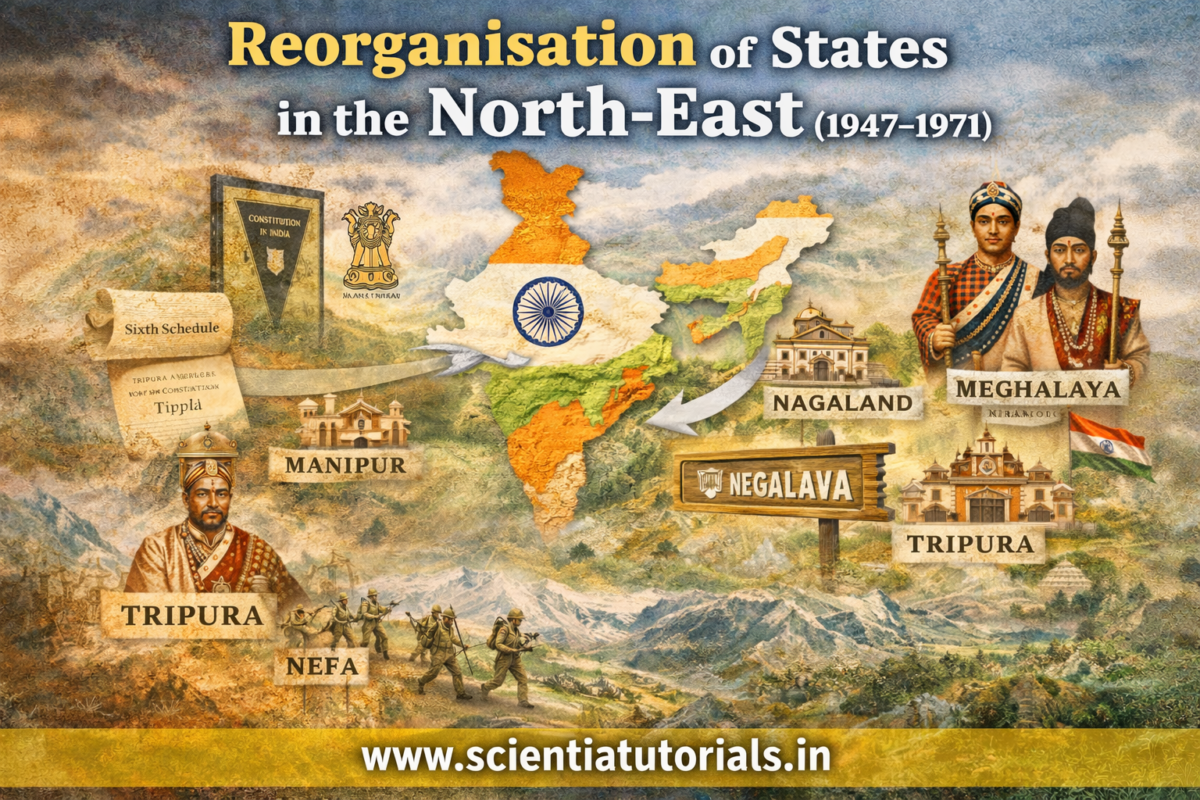

Reorganisation of States in the North-East (1947–1971) | Integration & State Formation
Module VIII: Post-Independence Integration and State Formation
Lesson: Reorganisation of States in the North-East (1947–1971 CE)
This lesson is systematically organized into four clearly structured sections, as detailed below:
- Chronologically Structured Study Module
- Short-Answer Type Questions
- Long-Answer Type Questions
- Multiple-Choice Questions (MCQs) with Answers and Detailed Explanations
Chronologically Structured Study Module
1. Introduction: Reorganisation as a Core Issue after Independence
The reorganisation of states in North-East India after independence was not a simple administrative exercise but a deeply political process shaped by colonial legacies, ethnic diversity, strategic concerns, and the evolving nature of Indian federalism. Between 1947 and 1971, the Indian Union attempted to transform a frontier region—historically governed through indirect and exceptional arrangements—into an integral part of a democratic nation-state.
Unlike many other regions of India, where linguistic reorganisation became the dominant principle, the North-East followed a more complex path. Here, state reorganisation was driven by ethnic identity, tribal autonomy, political unrest, and security considerations, rather than language alone. Understanding this process is essential to grasp the political geography and federal structure of contemporary North-East India.
2. Colonial Legacy and Administrative Structure at Independence (1947)
2.1 Fragmented Political Geography
At the time of independence, North-East India consisted of:
- Assam as the only full province
- Manipur and Tripura as princely states
- Hill areas such as the Naga Hills, Lushai Hills, and North-East Frontier Tracts administered separately
This fragmentation was a direct outcome of British frontier policies that deliberately kept hill regions outside mainstream political institutions. Consequently, the region lacked a uniform administrative framework.
2.2 Implications for Reorganisation
Because of this legacy, the Indian government faced two immediate challenges:
- Integrating diverse regions into the Indian Union
- Reorganising administrative units in a manner that ensured stability, representation, and national security
Reorganisation in the North-East, therefore, had to proceed cautiously and incrementally.
3. Early Post-Independence Administrative Arrangements (1947–1950)
3.1 Merger of Princely States
Manipur and Tripura merged with the Indian Union in 1949. Their integration laid the groundwork for later reorganisation but also highlighted tensions between central authority and regional aspirations.
3.2 Introduction of the Indian Constitution
The Constitution of India (1950) provided a framework for reorganisation by recognising the special conditions of tribal areas. Instead of immediate state formation, the Constitution emphasized administrative flexibility and constitutional safeguards.
4. Part A, B, and C States: A Transitional Phase
In the early years after independence, India adopted a system of Part A, Part B, and Part C states:
- Assam became a Part A state
- Manipur and Tripura were designated Part C states, administered by the Centre
This classification reflected the experimental nature of post-colonial governance in the North-East. While it ensured administrative control, it also postponed full political autonomy, sowing the seeds for future reorganisation demands.
5. The Sixth Schedule and the Question of Autonomy
5.1 Purpose of the Sixth Schedule
One of the most significant constitutional measures affecting reorganisation was the Sixth Schedule of the Indian Constitution, which provided Autonomous District Councils in tribal areas of Assam.
These councils had powers over:
- Land and forest management
- Customary laws
- Local administration
5.2 Impact on State Reorganisation
The Sixth Schedule was intended as an alternative to immediate statehood. While it addressed tribal concerns to some extent, it did not fully satisfy aspirations for political equality and self-rule. Over time, autonomous councils became stepping stones toward demands for separate states.
6. States Reorganisation Act, 1956: A Turning Point
6.1 National Context
The States Reorganisation Act 1956 reorganised Indian states primarily on linguistic lines. However, the North-East was treated as a special case due to its ethnic diversity and strategic sensitivity.
6.2 Impact on the North-East
Under the Act:
- Assam remained intact as a large multilingual state
- Manipur and Tripura were converted into Union Territories
- Hill areas continued under special administrative arrangements
This cautious approach reflected the government’s fear that rapid reorganisation could destabilise the region.
7. Assam as the Core State and Emerging Tensions
7.1 Assam’s Dominant Position
In the 1950s, Assam functioned as the administrative and political core of the North-East. Many hill areas were governed from Assam, which led to perceptions of domination by the plains.
7.2 Language and Cultural Policies
Assam’s language policies, particularly the promotion of Assamese, intensified tensions with hill communities. These policies became a major factor driving demands for separate statehood in the hills.
8. Naga Hills and the Limits of Administrative Reorganisation
8.1 Political Assertion in the Naga Hills
The Naga Hills presented the earliest and most serious challenge to reorganisation within the Indian Union. Many Naga leaders rejected inclusion within Assam and questioned integration itself.
8.2 Creation of Nagaland (1963)
The formation of Nagaland marked a decisive shift in India’s approach. For the first time, statehood was granted primarily on the basis of ethnic identity and political assertion, rather than language.
Nagaland’s creation demonstrated that reorganisation in the North-East would follow a distinct path compared to mainland India.
9. Reorganisation Movements in the Hill Regions of Assam
9.1 Khasi, Garo, and Jaintia Hills
Despite Sixth Schedule protections, political mobilisation grew in the Khasi, Garo, and Jaintia Hills. Leaders argued that autonomy within Assam was insufficient and demanded a separate state to protect tribal identity and political rights.
9.2 Mizo Hills (Lushai Hills)
In the Mizo Hills, administrative neglect and economic hardship—especially the 1959 famine—fuelled political unrest. What began as demands for better administration gradually evolved into demands for separation from Assam.
10. Union Territories as Transitional Units
10.1 Manipur and Tripura as Union Territories
After 1956, Manipur and Tripura functioned as Union Territories. This arrangement allowed the Centre to exercise direct control while gradually expanding political institutions.
10.2 Political Consequences
While Union Territory status ensured stability, it also reinforced perceptions of political inequality. By the 1960s, strong movements emerged demanding full statehood.
11. North-East Frontier Agency (NEFA) and Strategic Reorganisation
The North-East Frontier Agency (later Arunachal Pradesh) remained under direct central administration throughout this period. Its sensitive border with China made security considerations paramount.
The 1962 Sino-Indian War reinforced the government’s reluctance to grant statehood, but it also highlighted the need for administrative reform and political participation.
12. The 1960s: Decade of Reorganisation Pressures
The 1960s witnessed intensified demands for reorganisation across the North-East:
- Ethnic identity became the primary basis of political mobilisation
- Assam’s territorial integrity came under sustained challenge
- The Centre increasingly viewed state formation as a tool for conflict management
This decade marked a shift from administrative accommodation to political reorganisation.
13. Towards New States: The End of the Era (up to 1971)
By 1971, the foundations for major changes had been laid:
- Nagaland was already a full-fledged state
- Meghalaya existed as an autonomous state within Assam (1970)
- Manipur and Tripura were on the path to statehood (achieved in 1972)
Although some changes formally occurred after 1971, the political processes driving them were firmly rooted in this period.
14. Significance of Reorganisation in the North-East
The reorganisation of states in the North-East was significant for several reasons:
- It redefined Indian federalism beyond linguistic principles
- It acknowledged ethnic and tribal identity as legitimate political bases
- It demonstrated the Indian state’s preference for negotiation over assimilation
However, it also institutionalised identity-based politics, shaping future movements.
15. Critical Assessment: Successes and Limitations
15.1 Achievements
- Gradual integration without large-scale fragmentation
- Constitutional recognition of diversity
- Reduction of some regional grievances through statehood
15.2 Limitations
- Persistent ethnic tensions
- Uneven development
- Continued demands for autonomy and reorganisation
Thus, reorganisation remained an ongoing process rather than a completed task.
16. Conclusion: Reorganisation as a Dynamic Process
The reorganisation of states in North-East India between 1947 and 1971 was a complex, negotiated, and historically conditioned process. Unlike other parts of India, the North-East followed a distinct trajectory shaped by colonial legacies, ethnic diversity, and strategic imperatives.
By 1971, the broad framework of the region’s political geography had been established, but reorganisation continued beyond this period. The experience of the North-East demonstrates that Indian federalism is not static but adaptive, capable of accommodating diversity through constitutional innovation and political compromise.
Short Answer Type Questions with Answers
Q1. What is meant by the reorganisation of states in North-East India?
Answer:
Reorganisation of states in North-East India refers to the post-independence process of restructuring administrative and political boundaries to accommodate ethnic diversity, autonomy demands, and national integration.
Q2. Why was state reorganisation in the North-East different from other parts of India?
Answer:
Unlike other regions where language was the main basis, reorganisation in the North-East was driven by ethnic identity, tribal autonomy, political unrest, and strategic concerns.
Q3. What was the administrative structure of North-East India in 1947?
Answer:
Assam was the only full province, Manipur and Tripura were princely states, and most hill areas were governed separately under special administrative arrangements.
Q4. How did colonial frontier policies affect post-independence reorganisation?
Answer:
They created administrative fragmentation and political isolation, making reorganisation gradual and complex after independence.
Q5. What role did the Indian Constitution play in the reorganisation process?
Answer:
The Constitution provided flexibility and safeguards for tribal areas, allowing gradual reorganisation rather than immediate state formation.
Q6. What were Part A and Part C states in the early post-independence period?
Answer:
Part A states were former British provinces like Assam, while Part C states such as Manipur and Tripura were centrally administered.
Q7. Why was the Sixth Schedule introduced?
Answer:
To provide autonomy to tribal areas through Autonomous District Councils and protect land, customs, and local governance.
Q8. Why did the Sixth Schedule not fully satisfy political aspirations?
Answer:
Because it offered limited autonomy without full political equality or statehood.
Q9. What was the significance of the States Reorganisation Act 1956 for the North-East?
Answer:
It reorganised Indian states while treating the North-East as a special case, keeping Assam intact and converting Manipur and Tripura into Union Territories.
Q10. Why was linguistic reorganisation applied cautiously in the North-East?
Answer:
Due to ethnic diversity, overlapping identities, and concerns about political instability and security.
Q11. How did Assam’s position influence reorganisation demands?
Answer:
Assam’s administrative dominance over hill areas led to fears of cultural and political marginalisation, triggering demands for separate states.
Q12. What role did language policy play in hill–plains tensions?
Answer:
Promotion of Assamese language intensified resentment among hill communities, strengthening reorganisation movements.
Q13. Why were the Naga Hills a major challenge to reorganisation?
Answer:
Because Naga leaders rejected inclusion within Assam and questioned integration into India itself.
Q14. Which was the first state created in the North-East mainly on ethnic grounds?
Answer:
Nagaland.
Q15. What was the significance of Nagaland’s creation in 1963?
Answer:
It marked a shift from linguistic to ethnic-based state formation and set a precedent for future reorganisation.
Q16. Why did the Khasi, Garo, and Jaintia Hills demand separation from Assam?
Answer:
Due to dissatisfaction with autonomy arrangements and fear of Assamese dominance.
Q17. What factors caused political unrest in the Mizo Hills?
Answer:
Administrative neglect, economic hardship, and the 1959 famine.
Q18. Why were Manipur and Tripura made Union Territories in 1956?
Answer:
To ensure central control and administrative stability during the transitional phase of reorganisation.
Q19. How did Union Territory status affect political aspirations?
Answer:
It delayed full autonomy and strengthened demands for statehood.
Q20. What was the North-East Frontier Agency (NEFA)?
Answer:
A centrally administered frontier region due to its sensitive international borders.
Q21. How did the 1962 Sino-Indian War influence reorganisation policy?
Answer:
It reinforced security concerns and justified continued central control over frontier areas.
Q22. Why did the 1960s become a crucial decade for reorganisation?
Answer:
Because ethnic movements intensified and the Centre increasingly viewed statehood as a solution to political unrest.
Q23. What major changes had occurred by 1971?
Answer:
Nagaland was a state, Meghalaya had autonomous status, and Manipur and Tripura were moving toward statehood.
Q24. How did reorganisation reshape Indian federalism?
Answer:
It expanded federalism beyond linguistic principles to include ethnic and tribal identities.
Q25. Why is the reorganisation of the North-East considered an ongoing process?
Answer:
Because ethnic aspirations, autonomy demands, and political negotiations continued beyond 1971.
Long Answer Type Questions with Answers
Lesson: Reorganisation of States in the North-East (1947–1971 CE)
Q1. Examine the historical background that made the reorganisation of states in North-East India necessary after 1947.
Answer:
At independence, North-East India inherited a fragmented administrative structure shaped by colonial frontier policies. Assam was the only province, while Manipur and Tripura were princely states and most hill regions were governed separately. This fragmentation, combined with ethnic diversity and limited nationalist integration, made reorganisation essential to ensure political stability, representation, and national integration within the Indian Union.
Q2. Why did the North-East follow a different path of state reorganisation compared to the rest of India?
Answer:
While much of India was reorganised primarily on linguistic lines, the North-East followed an ethnic-political path. Tribal identity, customary institutions, historical isolation, and strategic border concerns outweighed linguistic considerations. As a result, reorganisation was gradual, negotiated, and sensitive to local aspirations rather than uniform.
Q3. Analyse the impact of colonial frontier policies on post-independence reorganisation in the North-East.
Answer:
Colonial policies deliberately isolated hill regions from mainstream administration, preserving tribal autonomy but delaying political integration. After independence, this legacy resulted in uneven political development and distrust of central authority. Reorganisation thus had to address both administrative integration and historical grievances, making the process cautious and incremental.
Q4. Discuss the early post-independence administrative arrangements in North-East India (1947–1950).
Answer:
In the initial years, Assam functioned as a Part A state, while Manipur and Tripura were treated as Part C states under central administration. Hill areas remained under special arrangements. These transitional structures ensured stability but postponed full political autonomy, laying the groundwork for later reorganisation movements.
Q5. Evaluate the role of the Indian Constitution in shaping the reorganisation of states in the North-East.
Answer:
The Constitution of India provided a flexible framework that recognised regional diversity. Instead of enforcing uniformity, it introduced special provisions for tribal areas, allowing gradual reorganisation. This constitutional approach balanced national unity with local autonomy, shaping the distinctive trajectory of the North-East.
Q6. Critically examine the significance of the Sixth Schedule in the reorganisation process.
Answer:
The Sixth Schedule granted autonomy to tribal areas through Autonomous District Councils with powers over land and customary laws. While it protected tribal interests, it did not grant full political equality. Over time, these councils became stepping stones toward demands for separate states, highlighting both the strengths and limitations of autonomy without statehood.
Q7. Explain the system of Part A and Part C states and its relevance to the North-East.
Answer:
The Part A–Part C classification was a transitional administrative system. Assam became a Part A state, while Manipur and Tripura were Part C states under central control. This arrangement allowed administrative consolidation but delayed democratic self-rule, contributing to later demands for reorganisation.
Q8. Assess the implications of the States Reorganisation Act 1956 for North-East India.
Answer:
The Act reorganised states mainly on linguistic lines but treated the North-East as a special case. Assam remained intact, while Manipur and Tripura became Union Territories. This cautious approach reflected concerns about ethnic diversity and security but intensified demands for reorganisation in hill regions.
Q9. Why was linguistic reorganisation not fully implemented in the North-East?
Answer:
The North-East’s ethnic complexity and overlapping identities made linguistic boundaries impractical. Applying linguistic principles risked intensifying conflicts and undermining stability, prompting the Centre to prioritise political and ethnic considerations instead.
Q10. Examine Assam’s role as the core state and its impact on reorganisation movements.
Answer:
Assam served as the administrative hub of the region, governing many hill areas. While this facilitated coordination, it also created perceptions of plains domination. Language policies and centralised administration under Assam fuelled resentment and demands for separate statehood among hill communities.
Q11. Analyse the origins of the Naga Hills movement in the context of state reorganisation.
Answer:
The Naga movement stemmed from a distinct historical experience and early political consciousness. Many Naga leaders rejected inclusion within Assam and questioned integration into India. This posed the earliest and most serious challenge to conventional reorganisation strategies.
Q12. Discuss the significance of the creation of Nagaland.
Answer:
Nagaland’s creation marked a decisive shift toward ethnic-based state formation. It demonstrated the Indian state’s willingness to accommodate identity-based aspirations within the federal framework and set a precedent for future reorganisation in the region.
Q13. Examine political mobilisation in the Khasi, Garo, and Jaintia Hills.
Answer:
Despite Sixth Schedule safeguards, leaders in these hills argued that autonomy within Assam was insufficient. Concerns over cultural preservation and political marginalisation led to sustained movements for separate statehood, reflecting the limits of administrative autonomy.
Q14. Analyse the causes of political unrest in the Mizo Hills.
Answer:
Administrative neglect, economic hardship, and the devastating 1959 famine intensified dissatisfaction. Over time, these grievances transformed into organised political movements seeking separation from Assam, highlighting the link between governance failure and reorganisation demands.
Q15. Discuss the role of Union Territories in the reorganisation process.
Answer:
Union Territory status for Manipur and Tripura after 1956 allowed the Centre to maintain control while developing political institutions. However, this arrangement also reinforced perceptions of inequality, strengthening demands for full statehood in the 1960s.
Q16. Examine the administrative significance of the North-East Frontier Agency (NEFA).
Answer:
NEFA remained under direct central administration due to its sensitive borders with China. Security concerns dominated reorganisation policy here, especially after the 1962 Sino-Indian War, delaying statehood but gradually expanding political participation.
Q17. How did security considerations influence state reorganisation in the North-East?
Answer:
International borders, insurgencies, and geopolitical tensions compelled the Indian state to adopt a cautious approach. Security considerations often justified delayed reorganisation and stronger central oversight, especially in frontier regions.
Q18. Why did the 1960s become a decisive decade for reorganisation in the North-East?
Answer:
During the 1960s, ethnic movements intensified across the region, Assam’s territorial integrity was increasingly challenged, and the Centre began viewing state formation as a strategy for conflict management and political accommodation.
Q19. Assess the achievements of state reorganisation in the North-East by 1971.
Answer:
By 1971, Nagaland had become a state, Meghalaya had gained autonomous status, and Manipur and Tripura were moving toward statehood. Reorganisation reduced some grievances but did not eliminate ethnic tensions, indicating partial success.
Q20. Critically evaluate the limitations of state reorganisation in the North-East.
Answer:
While reorganisation addressed some political demands, it also institutionalised identity-based politics and left issues of development and inter-ethnic relations unresolved. Many movements continued beyond 1971, revealing the limitations of statehood as a complete solution.
Q21. “State reorganisation in the North-East reshaped Indian federalism.” Explain.
Answer:
The North-East experience expanded Indian federalism beyond linguistic principles, incorporating ethnic identity and autonomy as legitimate bases for state formation. This adaptability strengthened federalism but also introduced new complexities.
Q22. Analyse the relationship between autonomy, statehood, and integration in the North-East.
Answer:
Autonomy arrangements initially sought to integrate diversity without fragmentation. However, as aspirations evolved, statehood emerged as a means of deeper integration rather than separation, illustrating the dynamic relationship between autonomy and unity.
Q23. Compare reorganisation in the North-East with linguistic reorganisation in mainland India.
Answer:
Mainland reorganisation prioritised language and administrative efficiency, while the North-East focused on ethnic identity, historical experience, and security. This contrast highlights regional variation within Indian federalism.
Q24. Explain why reorganisation in the North-East is described as a negotiated process.
Answer:
Reorganisation involved dialogue, constitutional amendments, and political compromise rather than unilateral decisions. The gradual creation of states reflects negotiation between regional aspirations and national priorities.
Q25. “Reorganisation of states in the North-East was a process, not an event.” Discuss.
Answer:
From 1947 to 1971, reorganisation unfolded through multiple stages—autonomy, Union Territory status, and eventual statehood. Continuing demands after 1971 confirm that reorganisation was an ongoing, adaptive process rather than a single administrative act.
MCQs with Answers and Detailed Explanations
Lesson: Reorganisation of States in the North-East
Q1. At the time of Indian independence in 1947, which was the only full province in North-East India?
A. Tripura
B. Manipur
C. Assam
D. Naga Hills
Correct Answer: C
Explanation:
Assam was the only province inherited from British India. Manipur and Tripura were princely states, while hill areas were under special administration.
Q2. State reorganisation in the North-East differed from the rest of India mainly because it was based on:
A. Language
B. Religion
C. Ethnic identity and autonomy
D. Economic planning
Correct Answer: C
Explanation:
Unlike mainland India where linguistic reorganisation dominated, the North-East followed an ethnic-political model shaped by tribal identity and autonomy demands.
Q3. Which colonial policy most influenced post-independence reorganisation in the North-East?
A. Permanent Settlement
B. Subsidiary Alliance
C. Frontier and excluded area policy
D. Ryotwari system
Correct Answer: C
Explanation:
British frontier policies isolated hill areas, creating administrative fragmentation that complicated reorganisation after 1947.
Q4. Manipur and Tripura were initially classified as which type of states after independence?
A. Part A states
B. Part B states
C. Part C states
D. Autonomous states
Correct Answer: C
Explanation:
They were Part C states under central administration before later reclassification.
Q5. The Sixth Schedule of the Indian Constitution primarily aimed to:
A. Promote linguistic unity
B. Ensure military security
C. Provide tribal self-governance
D. Accelerate industrialisation
Correct Answer: C
Explanation:
The Sixth Schedule created Autonomous District Councils to protect tribal land, customs, and governance.
Q6. The Sixth Schedule was first applied mainly to which region?
A. Princely states
B. Assam plains
C. Hill areas of Assam
D. NEFA
Correct Answer: C
Explanation:
It was designed mainly for the tribal hill areas within Assam.
Q7. Which Act reorganised Indian states primarily on linguistic lines?
A. Indian Independence Act
B. Government of India Act, 1935
C. States Reorganisation Act 1956
D. North-Eastern Areas Act
Correct Answer: C
Explanation:
The States Reorganisation Act, 1956 reorganised states mainly on linguistic principles, though the North-East was treated as a special case.
Q8. Under the States Reorganisation Act, 1956, Manipur and Tripura became:
A. Full-fledged states
B. Autonomous regions
C. Union Territories
D. Excluded areas
Correct Answer: C
Explanation:
Both were converted into Union Territories to ensure central control during the transitional phase.
Q9. Why was linguistic reorganisation applied cautiously in the North-East?
A. Absence of written languages
B. Ethnic diversity and security concerns
C. Strong opposition from Assam alone
D. Economic backwardness
Correct Answer: B
Explanation:
Multiple ethnic identities and sensitive international borders required a cautious approach.
Q10. Assam’s role as the administrative core of the North-East led to:
A. Rapid industrial growth
B. Smooth integration of hill areas
C. Perceptions of plains dominance
D. Decline of ethnic identity
Correct Answer: C
Explanation:
Administrative control from Assam created fears of political and cultural domination among hill communities.
Q11. Which issue intensified hill–plains tensions in Assam?
A. Trade policy
B. Religious reform
C. Language policy
D. Land revenue
Correct Answer: C
Explanation:
Promotion of Assamese as the state language alienated hill communities and strengthened reorganisation movements.
Q12. The earliest major challenge to reorganisation within the Indian Union came from:
A. Mizo Hills
B. Khasi Hills
C. Naga Hills
D. Karbi Anglong
Correct Answer: C
Explanation:
The Naga movement questioned not only Assam’s authority but integration with India itself.
Q13. The creation of Nagaland was significant because it:
A. Followed linguistic principles
B. Ended all insurgencies
C. Recognised ethnic identity as a basis for statehood
D. Reduced Assam’s economic power
Correct Answer: C
Explanation:
Nagaland was the first state in India formed primarily on ethnic-political grounds.
Q14. Which hill groups later formed the state of Meghalaya?
A. Naga and Mizo
B. Khasi, Garo, and Jaintia
C. Karbi and Dimasa
D. Lushai and Hmar
Correct Answer: B
Explanation:
Meghalaya emerged from the Khasi, Garo, and Jaintia Hills.
Q15. Political unrest in the Mizo Hills was intensified by:
A. Industrial decline
B. Religious conflict
C. The 1959 famine
D. Language policy
Correct Answer: C
Explanation:
The 1959 famine exposed administrative neglect and fuelled political mobilisation.
Q16. Union Territory status for Manipur and Tripura resulted in:
A. Immediate political satisfaction
B. Decline in political institutions
C. Strengthened demands for statehood
D. End of regional movements
Correct Answer: C
Explanation:
UT status delayed political equality, leading to stronger statehood movements in the 1960s.
Q17. What was the North-East Frontier Agency (NEFA)?
A. A princely state
B. A linguistic province
C. A centrally administered frontier region
D. An autonomous district council
Correct Answer: C
Explanation:
NEFA was centrally governed due to strategic concerns and later became Arunachal Pradesh.
Q18. The 1962 Sino-Indian War influenced reorganisation by:
A. Accelerating statehood for NEFA
B. Ending tribal autonomy
C. Increasing central control in frontier areas
D. Reducing military presence
Correct Answer: C
Explanation:
Security concerns justified continued central administration of frontier regions.
Q19. The 1960s are considered crucial for reorganisation because:
A. Linguistic movements declined
B. Ethnic movements intensified
C. Economic reforms were introduced
D. Colonial policies ended
Correct Answer: B
Explanation:
Ethnic-based political movements peaked during the 1960s, pressuring the Centre to reorganise states.
Q20. By 1971, which of the following had already become a full-fledged state?
A. Meghalaya
B. Manipur
C. Tripura
D. Nagaland
Correct Answer: D
Explanation:
Nagaland achieved statehood in 1963; others followed later.
Q21. Reorganisation in the North-East reshaped Indian federalism by:
A. Eliminating state autonomy
B. Prioritising religion over language
C. Expanding federal principles beyond language
D. Centralising all power
Correct Answer: C
Explanation:
Ethnic identity and autonomy became legitimate bases for state formation.
Q22. Which approach best describes reorganisation policy in the North-East?
A. Sudden and uniform
B. Military-driven
C. Gradual and negotiated
D. Economically motivated
Correct Answer: C
Explanation:
Reorganisation occurred through dialogue, constitutional amendments, and political compromise.
Q23. One major limitation of reorganisation was that it:
A. Removed all ethnic identities
B. Solved every political conflict
C. Institutionalised identity-based politics
D. Ended autonomy movements
Correct Answer: C
Explanation:
While reducing some grievances, reorganisation also entrenched identity politics.
Q24. The reorganisation of states in the North-East can best be described as:
A. A single administrative decision
B. A purely linguistic exercise
C. An ongoing historical process
D. A colonial legacy
Correct Answer: C
Explanation:
Reorganisation unfolded over decades and continued beyond 1971.
Q25. The primary objective of state reorganisation in the North-East was to:
A. Promote economic liberalisation
B. Ensure political integration and stability
C. Reduce population pressure
D. Expand industrial corridors
Correct Answer: B
Explanation:
Reorganisation aimed to integrate diverse regions into India while accommodating ethnic aspirations.