
Resistance Movements and Early Anti-Colonial Responses
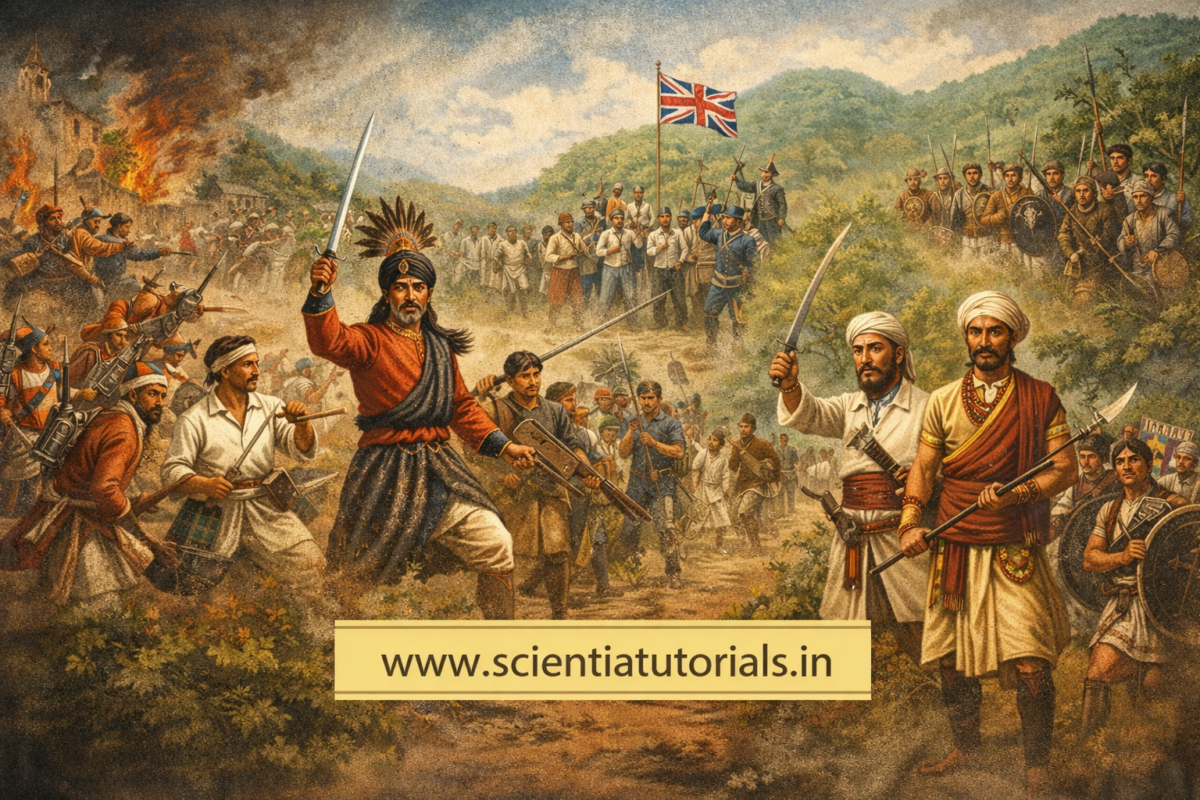

Resistance Movements in North-East India (1826–1900) | Colonial Rule
Course: History of North-East India: From Early Kingdoms to Modern Integration
Module VI: Colonial Rule and Administrative Reorganisation
Timeline / Era Covered: 1826 CE – 1900 CE
Lesson: Resistance Movements and Early Anti-Colonial Responses
This lesson is systematically organized into four clearly structured sections, as detailed below:
- Chronologically Structured Study Module
- Short-Answer Type Questions
- Long-Answer Type Questions
- Multiple-Choice Questions (MCQs) with Answers and Detailed Explanations
Chronologically Structured Study Module
I. Introduction: Colonial Expansion and the Roots of Resistance (1826 onwards)
The year 1826 CE marks a decisive turning point in the history of North-East India with the signing of the Treaty of Yandabo, through which the British East India Company formally annexed Assam and gradually extended its control over the surrounding hill regions. The imposition of colonial rule brought profound political, economic, social, and cultural disruptions. Indigenous political institutions were dismantled, traditional land systems were altered, forced labor was institutionalised, and new revenue mechanisms were introduced.
These changes generated widespread resistance, both organised and spontaneous. Unlike later nationalist movements, early resistance in North-East India was region-specific, community-led, and rooted in traditional authority structures. Nevertheless, these movements laid the foundations of anti-colonial consciousness in the region.
This lesson examines these resistance movements chronologically, highlighting their causes, leadership, methods, regional spread, and historical significance.
II. Early Phase of Resistance (1826–1838): Ahom and Assamese Responses
1. Collapse of the Ahom Polity and British Annexation
Following the Burmese invasions and British intervention, the Ahom state—once a powerful indigenous polity—collapsed. British administrators initially promised restoration of Ahom authority but later opted for direct annexation, creating deep resentment among the Assamese nobility and peasantry.
2. Gomdhar Konwar’s Revolt (1828)
One of the earliest organised resistances was led by Gomdhar Konwar, an Ahom prince who proclaimed himself king and attempted to restore Ahom sovereignty.
Key Features:
- Took place in Upper Assam (1828)
- Involved former Ahom officials and disbanded soldiers
- Reflected resistance to British betrayal and administrative takeover
Outcome and Significance:
- Quickly suppressed by the British
- Marked the first armed challenge to colonial authority in Assam
- Demonstrated continuity of Ahom political legitimacy
III. Peasant and Tribal Resistance (1830s–1850s)
1. The Khasi Resistance under Tirot Sing (1829–1833)
In the Khasi Hills, British attempts to construct roads linking Sylhet to Assam infringed upon tribal autonomy and land rights. This provoked resistance under Tirot Sing, the Syiem (chief) of Nongkhlaw.
Characteristics:
- Guerrilla warfare using hill terrain
- Unity among Khasi chiefs
- Defence of customary land ownership
Impact:
- British eventually captured Tirot Sing
- Reinforced the British policy of indirect rule in hill areas
- Established tribal resistance as a key pattern in North-East India
2. Kachari and Jaintia Resistance
Similar opposition emerged among the Kachari and Jaintia communities, where colonial interference in succession, tribute, and justice systems generated unrest.
Common Themes:
- Defence of traditional authority
- Resistance to revenue extraction
- Preservation of indigenous cultural practices
IV. The 1857 Revolt and North-East India: A Regional Perspective
The Revolt of 1857 had limited direct impact in North-East India due to:
- Sparse military presence
- Strong British control
- Absence of large sepoy concentrations
However, the ideas of rebellion and resistance resonated indirectly, reinforcing local opposition to colonial rule.
Manipur and the Aftermath
Manipur remained a princely state but British political interference increased after 1857, sowing seeds for future confrontation.
V. The Mid-19th Century Tribal Uprisings (1850s–1870s)
1. The Santhal and Influence on Frontier Regions
While primarily outside Assam, the Santhal rebellion influenced British frontier policies, leading to tighter surveillance of tribal regions in the North-East.
2. Lushai (Mizo) Resistance
The British punitive expeditions into the Lushai Hills (present-day Mizoram) triggered fierce resistance.
Key Aspects:
- Raids against British outposts
- Defence of village autonomy
- Strong community participation
This resistance ultimately led to the formal annexation of the Lushai Hills in the late 19th century.
VI. The 1861 Phulaguri Dhawa: Peasant Resistance in Assam
One of the most significant peasant uprisings occurred at Phulaguri in Nagaon district.
Causes:
- Increased taxation
- Monopoly control over betel nut and pan
- Exploitative revenue practices
Events:
- Large peasant assemblies
- Non-violent but defiant protests
- Confrontation with colonial officials
Significance:
- Early expression of mass peasant resistance
- Demonstrated economic grievances as a catalyst
- Precursor to later organised peasant movements
VII. Naga Resistance and Defence of Autonomy (1870s–1890s)
British expansion into Naga territories met sustained resistance from various Naga tribes.
Nature of Resistance:
- Village-based warfare
- Refusal to accept British authority
- Defence of customary laws
The British eventually imposed control through military expeditions and administrative restructuring, but Naga resistance shaped colonial frontier governance.
VIII. The Manipur Uprising of 1891
The most dramatic late-19th-century resistance occurred in Manipur following British interference in royal succession.
Key Event:
- Anglo-Manipur War (1891)
Leaders:
- Tikendrajit Singh
- Thangal General
Causes:
- British political interference
- Violation of Manipur’s sovereignty
- Arrest of royal officials
Outcome:
- Execution of leaders
- Manipur reduced to a princely state under tighter British supervision
Historical Importance:
- Strong assertion of political sovereignty
- Symbol of resistance to imperial domination
- Influenced later nationalist narratives in Manipur
IX. Religious, Cultural, and Social Dimensions of Resistance
Resistance was not limited to armed rebellion. Cultural preservation became a powerful form of opposition.
Forms:
- Defence of traditional religious practices
- Rejection of missionary interference
- Protection of customary law and village institutions
These efforts preserved indigenous identities and slowed cultural assimilation.
X. British Counter-Strategies and Administrative Reorganisation
In response to resistance, the British adopted a combination of:
- Military suppression
- Indirect rule in hill areas
- Legal codification of customary laws
- Creation of Inner Line Regulations
These measures aimed to pacify resistance while ensuring administrative control.
XI. Nature and Limitations of Early Resistance Movements
Strengths:
- Strong local leadership
- Deep cultural legitimacy
- Community participation
Limitations:
- Lack of inter-regional coordination
- Absence of modern political ideology
- Military inferiority
Despite these constraints, these movements formed the moral and historical foundation of later anti-colonial struggles.
XII. Historical Significance and Legacy
The resistance movements of 1826–1900 were not isolated revolts but systematic responses to colonial intrusion. They:
- Preserved indigenous political memory
- Challenged the inevitability of colonial dominance
- Influenced later nationalist and regional movements
- Shaped the unique trajectory of North-East India’s integration into modern India
XIII. Conclusion
Between 1826 and 1900, North-East India witnessed a rich and diverse spectrum of resistance movements rooted in political sovereignty, economic justice, cultural preservation, and social autonomy. Although fragmented and regionally confined, these early anti-colonial responses reflect a deep-seated rejection of imperial control and a determination to defend indigenous ways of life.
Understanding these movements is essential for appreciating the distinctive historical experience of North-East India and its enduring legacy within the broader narrative of Indian resistance to colonialism.
Short Answer Type Questions
Module VI: Colonial Rule and Administrative Reorganisation
Lesson: Resistance Movements and Early Anti-Colonial Responses
Timeline: 1826 CE – 1900 CE
Q1. Why is the year 1826 considered a turning point in the history of North-East India?
Answer:
The year 1826 marks the beginning of British colonial rule in Assam following the Treaty of Yandabo, which ended the First Anglo-Burmese War and transferred Assam to British control.
Q2. What was the Treaty of Yandabo?
Answer:
The Treaty of Yandabo (1826) was an agreement between the British East India Company and Burma that resulted in British annexation of Assam, Manipur’s independence under British influence, and the opening of North-East India to colonial administration.
Q3. Who was Gomdhar Konwar?
Answer:
Gomdhar Konwar was an Ahom prince who led the first armed resistance against British rule in Assam in 1828, attempting to restore Ahom sovereignty.
Q4. What were the main causes of Gomdhar Konwar’s revolt?
Answer:
The revolt was caused by British betrayal of promises to restore Ahom rule, abolition of traditional offices, and loss of political authority among the Ahom nobility.
Q5. Why was Gomdhar Konwar’s revolt historically significant?
Answer:
It was the earliest organised armed resistance against British rule in Assam and symbolised continuity of Ahom political legitimacy.
Q6. Who led the Khasi resistance against the British in the 1820s?
Answer:
The Khasi resistance was led by Tirot Sing, the Syiem (chief) of Nongkhlaw.
Q7. What triggered the Khasi resistance movement?
Answer:
The British attempt to construct a road through Khasi territory without consent, threatening tribal autonomy and land rights, triggered the resistance.
Q8. What methods were used in the Khasi resistance?
Answer:
The resistance relied on guerrilla warfare, use of hilly terrain, surprise attacks, and unity among Khasi chiefs.
Q9. How did the British respond to tribal resistance in the hill regions?
Answer:
The British used military expeditions followed by indirect rule, allowing limited autonomy while asserting political control.
Q10. Why did the Revolt of 1857 have limited impact in North-East India?
Answer:
The region lacked large sepoy concentrations, had strong British military presence, and was geographically isolated from the main centres of the revolt.
Q11. What was the Phulaguri Dhawa of 1861?
Answer:
The Phulaguri Dhawa was a peasant uprising in Nagaon district against increased taxation and British monopoly policies on local produce.
Q12. What were the main causes of the Phulaguri Dhawa?
Answer:
Excessive revenue demands, exploitation by colonial officials, and restrictions on traditional agricultural and trading practices.
Q13. Why is the Phulaguri Dhawa considered important?
Answer:
It represented an early form of mass peasant resistance based on economic grievances rather than royal leadership.
Q14. How did British expansion affect the Naga tribes?
Answer:
British expansion threatened Naga village autonomy, customary laws, and traditional governance, leading to prolonged resistance.
Q15. What was the nature of Naga resistance?
Answer:
It was village-based, decentralised, and focused on defending land, customs, and political independence.
Q16. What led to resistance in the Lushai (Mizo) Hills?
Answer:
British punitive expeditions, interference in village life, and attempts to impose colonial administration led to Mizo resistance.
Q17. What was the Anglo-Manipur War of 1891?
Answer:
It was a military conflict resulting from British interference in Manipur’s royal succession, leading to the defeat of Manipur.
Q18. Name two leaders of the Manipur resistance of 1891.
Answer:
The resistance was led by Tikendrajit Singh and Thangal General.
Q19. What was the outcome of the Manipur uprising?
Answer:
Manipur lost its sovereignty and became a princely state under strict British supervision.
Q20. How did cultural factors contribute to resistance movements?
Answer:
Communities resisted missionary activities, defended traditional religions, and preserved customary laws as forms of cultural resistance.
Q21. What role did traditional chiefs play in early resistance movements?
Answer:
Traditional chiefs acted as leaders, mobilised communities, and legitimised resistance through customary authority.
Q22. What were the limitations of early resistance movements?
Answer:
They lacked regional coordination, modern political ideology, and military resources to challenge British power effectively.
Q23. How did the British counter resistance in North-East India?
Answer:
Through military suppression, indirect rule, administrative reorganisation, and legal recognition of selected customary practices.
Q24. Why were early resistance movements region-specific?
Answer:
They were rooted in local grievances, tribal autonomy, and traditional political systems rather than pan-Indian nationalism.
Q25. What is the historical significance of early anti-colonial resistance in North-East India?
Answer:
These movements preserved indigenous identity, challenged colonial authority, and laid the foundation for later nationalist and regional movements.
Long Answer Type Questions
Module VI: Colonial Rule and Administrative Reorganisation
Lesson: Resistance Movements and Early Anti-Colonial Responses
Timeline: 1826 CE – 1900 CE
Q1. Discuss the political and historical significance of 1826 CE in the history of North-East India.
Answer:
The year 1826 CE marked a watershed in the history of North-East India with the signing of the Treaty of Yandabo, which concluded the First Anglo-Burmese War. As a result, Assam came under British control, ending centuries of indigenous rule under the Ahoms. This transition fundamentally altered political authority, administrative structures, and regional power relations. The dismantling of traditional institutions generated resentment and laid the foundation for early resistance movements across both plains and hill regions.
Q2. Examine the nature of early resistance movements in North-East India during the first decade of British rule.
Answer:
Early resistance movements were largely political and dynastic in nature, led by displaced elites and traditional chiefs. They sought restoration of indigenous authority rather than complete overthrow of colonialism. These movements reminded the British that colonial domination was contested from its very inception in the region.
Q3. Analyse the causes and significance of the revolt led by Gomdhar Konwar.
Answer:
Gomdhar Konwar’s revolt of 1828 arose from British betrayal of assurances to restore Ahom sovereignty. The abolition of Ahom offices and imposition of foreign administration provoked the uprising. Though short-lived, it was historically significant as the first armed resistance against British rule in Assam and symbolised continuity of Ahom political legitimacy.
Q4. How did the collapse of the Ahom state contribute to resistance against colonial rule?
Answer:
The fall of the Ahom state disrupted established systems of governance, land revenue, and military organisation. Dispossessed nobles and officials became centres of opposition, while peasants resented new revenue demands. This created a fertile ground for resistance rooted in memories of pre-colonial sovereignty.
Q5. Discuss the Khasi resistance movement under Tirot Sing.
Answer:
The Khasi resistance (1829–1833) was triggered by British attempts to construct strategic roads through Khasi territory. Led by Tirot Sing, the movement relied on guerrilla warfare and unity among Khasi chiefs. It represented a strong defence of tribal autonomy and customary land rights, forcing the British to adopt cautious frontier policies.
Q6. What role did geography play in shaping resistance movements in hill regions?
Answer:
The rugged terrain of hills enabled guerrilla tactics and limited British military effectiveness. Indigenous groups used forests and mountains to their advantage, prolonging resistance and shaping British reliance on indirect rule in these areas.
Q7. Examine the nature of tribal resistance in North-East India during the mid-19th century.
Answer:
Tribal resistance was decentralised, community-based, and aimed at preserving autonomy rather than capturing state power. It was rooted in defence of land, customary law, and social institutions. Such resistance compelled the British to adopt special administrative arrangements.
Q8. Why did the Revolt of 1857 have limited direct impact in North-East India?
Answer:
North-East India lacked large concentrations of sepoys and was geographically isolated from major centres of rebellion. Strong British control and the absence of a unified leadership limited the spread of the revolt, though its ideological impact was felt indirectly.
Q9. Analyse the causes and consequences of the Phulaguri Dhawa of 1861.
Answer:
The Phulaguri Dhawa emerged due to excessive taxation and British monopolies over local produce. Peasants protested collectively, marking an early form of economic resistance. Though suppressed, it highlighted agrarian discontent and foreshadowed later mass movements.
Q10. Discuss the economic dimensions of early resistance movements in Assam.
Answer:
Economic grievances such as high revenue demands, loss of customary rights, and monopolistic practices played a crucial role. These factors mobilised peasants and linked economic exploitation to political resistance.
Q11. Examine the resistance of the Naga tribes against British expansion.
Answer:
Naga resistance was village-centred and aimed at protecting autonomy. Persistent opposition delayed British penetration and shaped the creation of special frontier policies recognising customary institutions.
Q12. How did resistance movements in the Lushai (Mizo) Hills differ from those in the plains?
Answer:
Lushai resistance was characterised by raids and collective village action, while plains movements often involved peasants reacting to revenue policies. The difference reflected contrasting social structures and political traditions.
Q13. Analyse the causes and outcomes of the Anglo-Manipur War of 1891.
Answer:
The conflict arose from British interference in Manipur’s royal succession. The defeat of Manipur resulted in loss of sovereignty and imposition of indirect British control, marking a decisive end to political independence in the region.
Q14. Assess the leadership of Tikendrajit Singh and Thangal General in the Manipur resistance.
Answer:
Both leaders symbolised defiance against imperial authority. Their execution transformed them into enduring symbols of sacrifice and resistance in Manipuri historical memory.
Q15. Discuss the cultural and religious dimensions of resistance in North-East India.
Answer:
Resistance often took cultural forms, including defence of traditional religions and rejection of missionary influence. These efforts preserved indigenous identities and slowed cultural assimilation.
Q16. How did traditional chiefs contribute to resistance movements?
Answer:
Traditional chiefs legitimised resistance through customary authority, allowing mobilisation of communities and continuity of indigenous political culture.
Q17. Examine British counter-strategies to resistance in North-East India.
Answer:
The British combined military suppression with indirect rule, administrative reorganisation, and legal recognition of customary practices to pacify resistance while maintaining control.
Q18. Why were early resistance movements largely region-specific?
Answer:
They were rooted in local grievances, tribal autonomy, and traditional authority systems rather than pan-Indian nationalist ideology.
Q19. Evaluate the limitations of early resistance movements.
Answer:
Lack of coordination, modern political vision, and military resources limited their effectiveness against colonial power.
Q20. Discuss the historical significance of early anti-colonial resistance in North-East India.
Answer:
These movements preserved indigenous political memory, challenged colonial legitimacy, and laid the groundwork for later nationalist and regional struggles.
MCQs with Answers and Explanations
Module VI: Colonial Rule and Administrative Reorganisation
Lesson: Resistance Movements and Early Anti-Colonial Responses
Timeline: 1826 CE – 1900 CE
Q1. Which event formally brought Assam under British rule?
A. Treaty of Purandar
B. Treaty of Yandabo
C. Treaty of Allahabad
D. Treaty of Bassein
Correct Answer: B
Explanation:
The Treaty of Yandabo (1826) ended the First Anglo-Burmese War and transferred Assam to British control, marking the beginning of colonial rule in North-East India.
Q2. The earliest armed resistance against British rule in Assam was led by:
A. Tirot Sing
B. Tikendrajit Singh
C. Gomdhar Konwar
D. Thangal General
Correct Answer: C
Explanation:
Gomdhar Konwar, an Ahom prince, led the first armed revolt in 1828, attempting to restore Ahom sovereignty after British annexation.
Q3. Gomdhar Konwar’s revolt mainly represented:
A. Peasant economic protest
B. Religious reform movement
C. Dynastic and political resistance
D. Missionary opposition
Correct Answer: C
Explanation:
The revolt was led by displaced Ahom nobility and aimed at restoring traditional political authority rather than addressing mass economic grievances.
Q4. The Khasi resistance against the British was led by:
A. Pa Togan Nengminza
B. Birsa Munda
C. Tirot Sing
D. Rani Gaidinliu
Correct Answer: C
Explanation:
Tirot Sing, the Syiem of Nongkhlaw, led the Khasi resistance (1829–1833) to protect tribal autonomy and land rights.
Q5. What immediate issue triggered the Khasi resistance?
A. Introduction of tea plantations
B. Construction of roads through Khasi territory
C. Imposition of English education
D. Missionary activities
Correct Answer: B
Explanation:
The British attempted to build strategic roads through Khasi Hills without consent, threatening traditional land ownership and autonomy.
Q6. Which method was commonly used in hill resistance movements?
A. Parliamentary petitions
B. Guerrilla warfare
C. Non-cooperation
D. Satyagraha
Correct Answer: B
Explanation:
Hill tribes used guerrilla tactics, taking advantage of difficult terrain to resist British military advances.
Q7. Why did the Revolt of 1857 have limited impact in North-East India?
A. Popular support for the British
B. Absence of agrarian distress
C. Geographical isolation and limited sepoy presence
D. Strong nationalist organisations
Correct Answer: C
Explanation:
North-East India lacked large sepoy concentrations and was geographically distant from major centres of the revolt.
Q8. The Phulaguri Dhawa of 1861 was primarily a:
A. Tribal uprising
B. Religious movement
C. Peasant protest
D. Dynastic revolt
Correct Answer: C
Explanation:
The Phulaguri Dhawa was a peasant uprising against excessive taxation and colonial monopolies.
Q9. Which district was the centre of the Phulaguri Dhawa?
A. Dibrugarh
B. Nagaon
C. Sivasagar
D. Cachar
Correct Answer: B
Explanation:
The uprising took place in Nagaon district, highlighting agrarian discontent in colonial Assam.
Q10. What made the Phulaguri Dhawa historically important?
A. It was supported by the British
B. It was the first nationalist movement
C. It reflected organised peasant resistance
D. It resulted in immediate policy reversal
Correct Answer: C
Explanation:
The movement showed collective peasant action based on economic grievances rather than elite leadership.
Q11. Naga resistance against the British was mainly:
A. Centralised under a single king
B. Village-based and decentralised
C. Led by missionaries
D. Focused on trade expansion
Correct Answer: B
Explanation:
Naga resistance was organised at the village level, aiming to defend customary laws and autonomy.
Q12. British expansion into Naga areas was resisted mainly to protect:
A. Tea plantations
B. Missionary schools
C. Village autonomy and customary law
D. Royal succession
Correct Answer: C
Explanation:
Naga tribes resisted intrusion to preserve their traditional governance and social systems.
Q13. Resistance in the Lushai (Mizo) Hills was provoked mainly by:
A. Land revenue settlements
B. British punitive expeditions
C. Spread of English education
D. Industrial labour recruitment
Correct Answer: B
Explanation:
British military expeditions into Lushai territory disrupted village life, leading to sustained resistance.
Q14. The Anglo-Manipur War took place in:
A. 1857
B. 1878
C. 1891
D. 1905
Correct Answer: C
Explanation:
The Anglo-Manipur War of 1891 was a decisive conflict that ended Manipur’s political autonomy.
Q15. Which leaders were associated with the Manipur resistance of 1891?
A. Gomdhar Konwar and Tirot Sing
B. Tikendrajit Singh and Thangal General
C. Birsa Munda and Sidhu Kanhu
D. Rani Gaidinliu and Jadonang
Correct Answer: B
Explanation:
Tikendrajit Singh and Thangal General symbolised Manipur’s armed resistance against British interference.
Q16. What was the outcome of the Manipur uprising?
A. Restoration of full independence
B. Immediate merger with British India
C. Manipur became a princely state under British control
D. British withdrawal from the region
Correct Answer: C
Explanation:
After defeat, Manipur lost sovereignty and was placed under strict British supervision.
Q17. Early resistance movements in North-East India were generally:
A. Pan-Indian and nationalist
B. Region-specific and localised
C. Led by industrial workers
D. Urban-based
Correct Answer: B
Explanation:
These movements arose from local grievances tied to traditional authority and autonomy, not all-India nationalism.
Q18. Which factor limited the success of early resistance movements?
A. Lack of public support
B. Absence of cultural identity
C. Military and organisational weakness
D. Strong nationalist ideology
Correct Answer: C
Explanation:
Colonial military superiority and lack of coordination weakened resistance efforts.
Q19. Cultural resistance in North-East India mainly involved:
A. Westernisation
B. Defence of traditional religions and customs
C. Industrial reforms
D. Adoption of English law
Correct Answer: B
Explanation:
Communities resisted cultural domination by preserving indigenous beliefs and customary practices.
Q20. How did the British respond to repeated resistance in hill areas?
A. Total withdrawal
B. Complete assimilation
C. Indirect rule and special administrative measures
D. Grant of full independence
Correct Answer: C
Explanation:
The British adopted indirect rule, recognising customary laws to maintain control with minimal conflict.
Q21. Which feature distinguishes tribal resistance from peasant resistance?
A. Use of violence
B. Defence of customary autonomy
C. Opposition to taxation
D. Presence of written petitions
Correct Answer: B
Explanation:
Tribal resistance focused on preserving autonomy and social institutions, while peasant movements centred on economic issues.
Q22. Early resistance movements mainly aimed at:
A. Socialist revolution
B. Restoration of traditional authority
C. Establishment of parliamentary democracy
D. Industrial modernisation
Correct Answer: B
Explanation:
Most movements sought to restore or protect indigenous political systems rather than create new ideologies.
Q23. Which factor best explains the fragmented nature of resistance?
A. British encouragement
B. Linguistic diversity
C. Strong inter-regional unity
D. Presence of nationalist parties
Correct Answer: B
Explanation:
Ethnic, cultural, and regional diversity limited coordination across North-East India.
Q24. The long-term significance of early resistance lies in:
A. Immediate British defeat
B. Economic reforms
C. Preservation of indigenous political memory
D. Industrial growth
Correct Answer: C
Explanation:
Though unsuccessful militarily, these movements sustained anti-colonial consciousness and identity.
Q25. Early anti-colonial resistance in North-East India can best be described as:
A. Accidental and unplanned
B. Imported from mainland India
C. Rooted in local traditions and autonomy
D. Entirely religious in nature
Correct Answer: C
Explanation:
Resistance emerged organically from local political, social, and cultural contexts unique to the region.