
Sources for the Early History of North-East India: Archaeological, Literary, and Oral Traditions
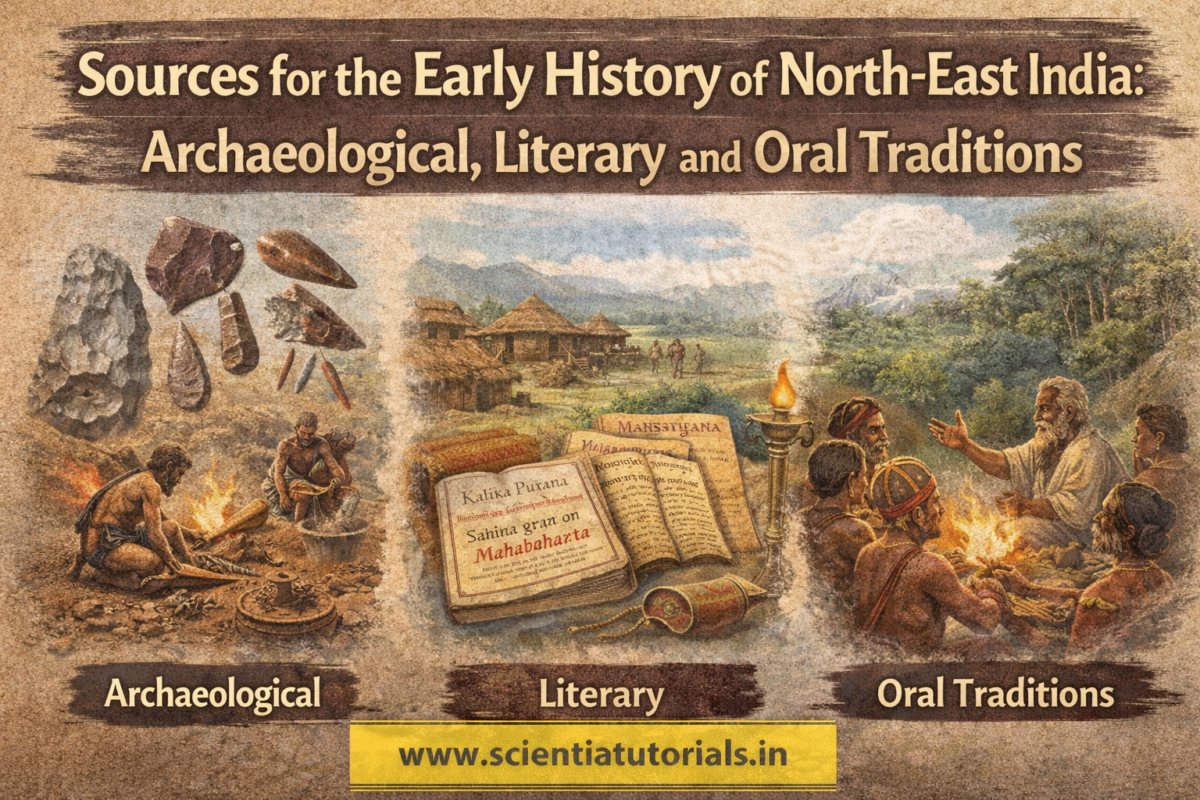

Sources for Early History of North-East India: Archaeological, Literary & Oral Traditions
Course: History of North-East India: From Early Kingdoms to Modern Integration
Module I: Geographical, Ethnic, and Cultural Foundations of North-East India
Timeline / Era Covered: Prehistory – Early Historic Background (Before 4th Century CE)
Lesson: Sources for the Early History of North-East India – Archaeological, Literary, and Oral Traditions
This lesson is systematically organized into four clearly structured sections, as detailed below:
- Chronologically Structured Study Module
- Short-Answer Type Questions
- Long-Answer Type Questions
- Multiple-Choice Questions (MCQs) with Answers and Detailed Explanations
Chronologically Structured Study Module
Introduction: The Problem of Sources in Early North-East Indian History
The reconstruction of the early history of North-East India poses unique challenges due to the limited availability of indigenous written records before the 4th century CE. Unlike regions such as the Gangetic plains, where inscriptions, chronicles, and literary texts appear relatively early, North-East India entered recorded history much later. As a result, historians must rely on a multi-source and interdisciplinary framework to understand the region’s past.
This lesson focuses on three major categories of historical sources used to study the early history of North-East India:
- Archaeological Sources
- Literary Sources (Indigenous and External)
- Oral Traditions and Folk Memory
Together, these sources help reconstruct patterns of migration, settlement, culture, economy, and early political formation from prehistoric times to the early historic period.
Chronological Framework of Source Availability
For analytical clarity, the sources for early North-East Indian history may be understood in relation to the following chronological phases:
- Prehistoric Period (Before c. 500 BCE) – Archaeological and oral sources dominate
- Protohistoric Period (c. 500 BCE – 1st century CE) – Archaeology with indirect literary references
- Early Historic Period (1st – 4th century CE) – Archaeology combined with early inscriptions and literary texts
This framework highlights how source diversity increases over time, though archaeology and oral traditions remain crucial throughout.
I. Archaeological Sources: The Primary Evidence
1. Nature of Archaeological Sources
Archaeological sources form the most reliable foundation for studying the early history of North-East India, especially for prehistoric and protohistoric periods. These include:
- Stone tools (Paleolithic, Mesolithic, Neolithic)
- Pottery and ceramics
- Settlement remains
- Burial sites
- Early metal objects
Such material evidence provides direct insight into technology, subsistence, and social organization.
2. Prehistoric Archaeology of North-East India
Archaeological findings indicate early human presence across hill and valley regions. Evidence includes:
- Paleolithic tools such as hand axes and choppers
- Mesolithic microliths
- Neolithic polished stone tools and pottery
Neolithic archaeology is particularly significant in understanding the beginnings of agriculture, shifting cultivation, and settled life.
3. Protohistoric Archaeological Evidence
During the protohistoric phase, archaeological remains show:
- Improved pottery styles
- Limited use of copper and metal
- More permanent settlement patterns
These developments reflect increasing social complexity and interaction with neighboring regions.
4. Importance of Archaeology
Archaeology helps historians:
- Reconstruct pre-literate history
- Identify migration and settlement patterns
- Understand continuity and change in culture
For competitive examinations, archaeology is crucial because it bridges the gap between prehistory and recorded history.
II. Literary Sources: Indigenous and External Traditions
1. Indigenous Literary Sources
Indigenous literary references to North-East India appear mainly in Sanskrit texts composed outside the region. Important sources include:
- Kalika Purana
- Mahabharata
- Ramayana
These texts mention regions such as Pragjyotisha and Kamarupa, providing early geographical and political references.
2. Nature and Limitations of Indigenous Texts
While valuable, these sources have limitations:
- Mythological and religious orientation
- Chronological ambiguity
- External perspective rather than local narrative
Therefore, literary sources must be critically correlated with archaeology.
3. External Literary Sources
References from outside India also contribute indirectly to early North-East Indian history. These include:
- Early travel accounts
- Later Chinese and Southeast Asian records referring to trans-Himalayan routes
Though sparse for the period before the 4th century CE, such sources highlight cross-regional interaction.
4. Role of Sanskrit Language and Culture
The spread of Sanskrit texts reflects:
- Cultural contact with the Indian subcontinent
- Emergence of early political authority
- Religious and ritual integration
This phase marks the transition to early historic consciousness.
III. Oral Traditions: Indigenous Memory and Cultural Continuity
1. Nature of Oral Traditions
Oral traditions include:
- Myths of origin
- Migration legends
- Clan genealogies
- Folk songs and rituals
They represent the indigenous voice of history and are especially significant in hill societies.
2. Historical Value of Oral Traditions
Oral traditions help historians understand:
- Migration routes and settlement origins
- Social organization and kinship systems
- Cultural values and worldview
They preserve historical memory where writing was absent.
3. Continuity Across Time
Many oral traditions exhibit remarkable continuity, linking prehistoric and early historic periods. Practices such as:
- Clan-based identity
- Shifting cultivation
- Ritual practices
demonstrate cultural persistence over centuries.
4. Limitations of Oral Sources
Despite their value, oral traditions have limitations:
- Symbolic and mythical elements
- Chronological vagueness
- Variation across communities
Historians therefore use oral traditions alongside archaeology and literature, not in isolation.
IV. Correlation of Sources: An Interdisciplinary Approach
No single source is sufficient to reconstruct early North-East Indian history. Modern historiography emphasizes source correlation:
- Archaeology provides material evidence
- Literature offers political and cultural references
- Oral traditions preserve indigenous memory
When combined, these sources create a balanced and credible historical narrative.
V. Sources and Regional Variation
1. Hill Regions
- Dominance of oral traditions
- Limited early inscriptions
- Strong cultural continuity
2. River Valleys (Brahmaputra Valley)
- Rich archaeological remains
- Early literary references
- Emergence of inscriptions in later periods
This explains the contrast between hill autonomy and valley centralization.
VI. Historiographical Perspectives
Historians studying North-East India increasingly reject single-source approaches. Instead, they adopt:
- Archaeological anthropology
- Historical linguistics
- Comparative folklore studies
This shift reflects a more inclusive and region-sensitive historiography.
VII. Importance of Sources for Understanding Early Political Formation
Sources help explain:
- Emergence of early polities such as Pragjyotisha
- Cultural integration into the Indian subcontinent
- Survival of indigenous institutions
Without archaeological and oral sources, early political history would remain incomplete.
Examination-Oriented Key Points
- Archaeology is the primary source for prehistory
- Literary sources must be critically evaluated
- Oral traditions preserve indigenous perspectives
- Source correlation is essential
- North-East India requires a multi-disciplinary approach
Practice Questions for Competitive Examinations
Short Answer:
- Why are archaeological sources crucial for early North-East Indian history?
Descriptive:
2. Discuss the importance and limitations of literary sources for reconstructing early North-East Indian history.
Analytical:
3. Examine the role of oral traditions as historical sources in the study of North-East India.
Conclusion
The early history of North-East India can only be reconstructed through a careful and critical use of archaeological, literary, and oral sources. Each category has its strengths and limitations, but together they provide a holistic understanding of the region’s past. Archaeology reveals material life, literary sources offer political and cultural context, and oral traditions preserve indigenous memory. This integrated approach is essential not only for academic research but also for competitive examinations, where understanding sources is key to interpreting the historical development of North-East India.
Short Answer Type Questions with Answers
(Prehistory – Early Historic Background, Before 4th Century CE)
1. Why is the study of sources crucial for early North-East Indian history?
Answer:
Because early North-East India lacks indigenous written records, sources are essential to reconstruct its history using archaeology, literature, and oral traditions.
2. Name the three major categories of sources for early North-East Indian history.
Answer:
Archaeological sources, literary sources, and oral traditions.
3. Which type of source is most important for prehistoric history?
Answer:
Archaeological sources are the most important for prehistoric history.
4. What are archaeological sources?
Answer:
They are material remains such as tools, pottery, settlements, and burial sites used to study past human life.
5. Mention two types of stone tools found in North-East India.
Answer:
Hand axes and microliths.
6. What do Neolithic archaeological remains indicate about early society?
Answer:
They indicate the beginning of agriculture, pottery making, and settled life.
7. Why is archaeology called the foundation of pre-literate history?
Answer:
Because it provides direct material evidence where written records are absent.
8. What is meant by protohistoric period?
Answer:
A transitional phase where societies lacked indigenous writing but are known through archaeology and later texts.
9. Name one important river valley rich in archaeological evidence.
Answer:
The Brahmaputra Valley.
10. What are literary sources?
Answer:
Written texts that provide information about historical events, regions, and societies.
11. Which type of literary texts mention early North-East India?
Answer:
Ancient Sanskrit texts and epics.
12. Name one Purana that refers to early Assam.
Answer:
The Kalika Purana.
13. Which ancient epics mention Pragjyotisha?
Answer:
The Mahabharata and the Ramayana.
14. Why are literary sources considered limited for early North-East Indian history?
Answer:
Because they are often mythological, externally written, and chronologically vague.
15. What is the value of Sanskrit texts for early North-East India?
Answer:
They provide early references to regions, political entities, and cultural integration.
16. What are oral traditions?
Answer:
Historically transmitted stories, myths, songs, and genealogies passed orally across generations.
17. Which societies rely most on oral traditions?
Answer:
Hill and tribal societies of North-East India.
18. What type of historical information do oral traditions preserve?
Answer:
Migration legends, clan origins, social customs, and cultural memory.
19. Why are oral traditions important historical sources?
Answer:
They preserve indigenous perspectives absent in written records.
20. Mention one limitation of oral traditions as historical sources.
Answer:
They often lack precise chronology and contain mythical elements.
21. Why must oral traditions be correlated with archaeology?
Answer:
To verify historical accuracy and avoid purely symbolic interpretations.
22. What does source correlation mean?
Answer:
Using archaeological, literary, and oral sources together to construct reliable history.
23. Which regions rely more on oral sources than written ones?
Answer:
Hill regions of North-East India.
24. How do sources help in understanding early political formation?
Answer:
They explain settlement patterns, cultural interaction, and emergence of early polities.
25. Why are questions on historical sources common in competitive exams?
Answer:
Because understanding sources is essential for historical analysis and interpretation.
Long Answer Type Questions with Answers
(Prehistory – Early Historic Background, Before 4th Century CE)
1. Discuss the importance of sources in reconstructing the early history of North-East India.
Answer:
The early history of North-East India cannot be reconstructed through conventional written records alone because indigenous inscriptions and chronicles appear relatively late. Therefore, historians depend on archaeological remains, literary references from outside the region, and oral traditions preserved by indigenous communities. These sources together help reconstruct migration patterns, settlement history, cultural practices, and early political developments. Without a multi-source approach, the early history of the region would remain fragmented and incomplete.
2. Explain why archaeological sources are considered the foundation of early North-East Indian history.
Answer:
Archaeological sources are the foundation of early North-East Indian history because they provide direct material evidence for periods lacking written records. Stone tools, pottery, settlement remains, and early metal objects help trace prehistoric and protohistoric cultures. Archaeology enables historians to understand subsistence patterns, technological progress, and social organization, thereby bridging the gap between prehistory and early history.
3. Examine the contribution of prehistoric archaeology to the understanding of early North-East India.
Answer:
Prehistoric archaeology reveals the earliest human presence in North-East India through Paleolithic, Mesolithic, and Neolithic remains. Stone tools indicate hunting-gathering economies, while Neolithic evidence shows the emergence of agriculture, pottery, and semi-sedentary settlements. These findings demonstrate early adaptation to diverse ecological zones and form the cultural base for later historical developments.
4. Discuss the significance of Neolithic archaeological remains in North-East India.
Answer:
Neolithic remains are particularly significant because they mark a major transformation from food gathering to food production. Polished stone tools, pottery, and evidence of agriculture indicate settled life and population growth. These developments explain the long-term continuity of practices such as shifting cultivation and clan-based social organization in the region.
5. What does protohistoric archaeology reveal about early North-East Indian society?
Answer:
Protohistoric archaeology reveals increasing social complexity, improved pottery styles, limited use of metals, and more permanent settlements. Although writing was absent, material culture suggests growing interaction with neighboring regions and the gradual emergence of organized social structures.
6. Analyze the strengths and limitations of archaeological sources.
Answer:
The strength of archaeology lies in its objectivity and direct evidence. However, it has limitations such as incomplete preservation, lack of precise chronology, and limited insight into beliefs and political ideas. Therefore, archaeology must be supplemented with literary and oral sources.
7. Discuss the role of literary sources in the early history of North-East India.
Answer:
Literary sources provide early references to regions, peoples, and political entities of North-East India. Sanskrit texts composed outside the region mention places like Pragjyotisha and Kamarupa, offering valuable historical clues. These sources help place North-East India within the broader cultural and political framework of ancient India.
8. Examine the historical value of the Kalika Purana for early Assam.
Answer:
The Kalika Purana is an important Sanskrit text that provides early references to Assam and its religious and cultural life. It sheds light on regional traditions, sacred geography, and early political authority. However, its religious orientation and mythological elements require careful historical interpretation.
9. How do the Mahabharata and the Ramayana contribute to the early history of North-East India?
Answer:
Both epics mention Pragjyotisha and associated rulers, indicating the region’s awareness in early Indian literary tradition. These references help establish early political and geographical identity but must be corroborated with archaeology due to their mythological nature.
10. Why must literary sources be used cautiously while reconstructing early North-East Indian history?
Answer:
Literary sources often contain mythological narratives, exaggerations, and symbolic descriptions. They were written from external perspectives and lack precise chronology. Hence, historians must critically analyze and corroborate them with archaeological evidence.
11. Discuss the role of Sanskrit culture and language as reflected in early literary sources.
Answer:
The presence of Sanskrit texts reflects cultural contact and integration with the broader Indian subcontinent. It indicates the gradual emergence of religious institutions, ritual authority, and early political organization in the plains of North-East India.
12. What are oral traditions, and why are they important historical sources?
Answer:
Oral traditions are stories, myths, songs, genealogies, and migration legends transmitted orally across generations. They are crucial because they preserve indigenous perspectives and historical memory in societies where writing was absent.
13. Examine the historical value of oral traditions in the hill societies of North-East India.
Answer:
In hill societies, oral traditions preserve information about clan origins, migration routes, social organization, and customary laws. They provide continuity between prehistoric and historic periods and reflect cultural resilience.
14. Discuss the limitations of oral traditions as historical sources.
Answer:
Oral traditions often lack precise chronology, incorporate mythical elements, and vary across communities. Memory distortion over time can affect accuracy. Therefore, they must be corroborated with other sources.
15. Explain how oral traditions help in understanding migration and settlement patterns.
Answer:
Migration legends and clan genealogies provide clues about routes, origins, and settlement areas of different communities. When correlated with linguistic and archaeological evidence, they help reconstruct population movements.
16. Why is source correlation essential for studying early North-East Indian history?
Answer:
No single source provides a complete picture. Archaeology offers material evidence, literature provides political and cultural context, and oral traditions preserve indigenous memory. Correlating these sources ensures balanced and reliable historical reconstruction.
17. Discuss regional variation in the availability of historical sources in North-East India.
Answer:
Hill regions rely heavily on oral traditions due to the absence of early writing, while river valleys such as the Brahmaputra Valley provide richer archaeological and literary evidence. This explains differing historical trajectories.
18. Examine the role of archaeology in understanding early political formation.
Answer:
Archaeological evidence of settlements, surplus production, and craft specialization helps trace the emergence of early political authority. It provides material context for literary references to early polities.
19. Discuss the contribution of oral traditions to cultural continuity.
Answer:
Oral traditions preserve customs, rituals, and social values over long periods, demonstrating cultural continuity from prehistoric to historic times. They reinforce group identity and historical consciousness.
20. Analyze the interdisciplinary approach used in studying early North-East Indian history.
Answer:
Modern historians integrate archaeology, literature, anthropology, linguistics, and folklore studies. This interdisciplinary approach compensates for source limitations and provides a holistic understanding.
21. Why is early North-East Indian history described as source-challenged but not source-less?
Answer:
Although written records are scarce, abundant archaeological evidence and rich oral traditions exist. When used together, these sources provide meaningful historical insights.
22. Discuss the role of sources in understanding cultural integration of North-East India.
Answer:
Sources reveal how North-East India interacted with neighboring regions culturally and politically, leading to gradual integration without loss of indigenous identity.
23. Evaluate the importance of studying sources for competitive examinations.
Answer:
Understanding sources helps candidates critically analyze historical narratives, assess reliability, and answer analytical questions—skills essential for mains examinations.
24. How do sources help bridge the gap between prehistory and early history?
Answer:
Archaeology and oral traditions provide continuity where written records are absent, while early literary references mark the transition to recorded history.
25. Conclude by assessing the overall significance of archaeological, literary, and oral sources for early North-East Indian history.
Answer:
The early history of North-East India can only be reconstructed through an integrated use of archaeological, literary, and oral sources. Archaeology reveals material life, literature provides cultural and political context, and oral traditions preserve indigenous memory. Together, they form a comprehensive framework essential for understanding the region’s early past.
MCQs with Answers and Explanations
(Prehistory – Early Historic Background, Before 4th Century CE)
1. Why is the study of historical sources especially important for early North-East India?
A. Because abundant inscriptions are available
B. Because early dynastic chronicles exist
C. Because indigenous written records are scarce
D. Because colonial documents dominate
Correct Answer: C. Because indigenous written records are scarce
Explanation:
Before the 4th century CE, North-East India produced very few indigenous written records. Hence, historians rely on archaeology, external literary references, and oral traditions to reconstruct early history.
2. Which of the following is the most important source for prehistoric history?
A. Literary texts
B. Inscriptions
C. Archaeological evidence
D. Coins
Correct Answer: C. Archaeological evidence
Explanation:
Prehistory refers to the period before writing. Therefore, material remains such as tools, pottery, and settlements are the primary sources.
3. Which category of sources provides direct material evidence of early human life?
A. Oral traditions
B. Archaeological sources
C. Religious texts
D. Foreign accounts
Correct Answer: B. Archaeological sources
Explanation:
Archaeological sources consist of physical remains that directly reflect technology, economy, and settlement patterns.
4. Stone tools found in North-East India belong mainly to which periods?
A. Medieval and modern
B. Early historic only
C. Paleolithic, Mesolithic, and Neolithic
D. Iron Age only
Correct Answer: C. Paleolithic, Mesolithic, and Neolithic
Explanation:
Archaeological evidence from North-East India shows continuous prehistoric occupation through these stone-tool phases.
5. Which archaeological evidence best indicates the beginning of agriculture?
A. Hand axes
B. Microliths
C. Polished stone tools and pottery
D. Copper coins
Correct Answer: C. Polished stone tools and pottery
Explanation:
Polished tools and pottery are key markers of the Neolithic phase, associated with agriculture and settled life.
6. The protohistoric period is best defined as:
A. A fully literate period
B. A period known only through mythology
C. A phase without indigenous writing but known through archaeology
D. A medieval transition phase
Correct Answer: C. A phase without indigenous writing but known through archaeology
Explanation:
Protohistory lies between prehistory and history, where writing is absent locally but societies show complex material culture.
7. Which river valley is especially rich in archaeological remains?
A. Indus Valley
B. Narmada Valley
C. Brahmaputra Valley
D. Godavari Valley
Correct Answer: C. Brahmaputra Valley
Explanation:
The Brahmaputra Valley provided fertile land and attracted early settlements, leaving rich archaeological traces.
8. Literary sources for early North-East India were mainly composed:
A. Within the region by local rulers
B. Outside the region by Sanskrit scholars
C. By colonial administrators
D. By medieval travelers
Correct Answer: B. Outside the region by Sanskrit scholars
Explanation:
Most early literary references come from Sanskrit texts composed outside North-East India.
9. Which type of texts first mention regions like Pragjyotisha and Kamarupa?
A. Persian chronicles
B. Chinese travelogues
C. Sanskrit epics and Puranas
D. Colonial gazetteers
Correct Answer: C. Sanskrit epics and Puranas
Explanation:
Early geographical and political references appear in Sanskrit religious and epic literature.
10. The Kalika Purana is important because it:
A. Provides exact historical chronology
B. Describes colonial administration
C. Mentions early Assam’s religious and cultural life
D. Records trade statistics
Correct Answer: C. Mentions early Assam’s religious and cultural life
Explanation:
The Kalika Purana contains early references to Assam, though its mythological nature requires critical analysis.
11. The Mahabharata and Ramayana are useful historical sources mainly because they:
A. Give detailed archaeological data
B. Provide exact dates
C. Indicate early awareness of North-East India
D. Replace oral traditions
Correct Answer: C. Indicate early awareness of North-East India
Explanation:
These epics mention Pragjyotisha, showing that the region was known in early Indian tradition.
12. Why must literary sources be used cautiously?
A. They are always inaccurate
B. They lack any historical value
C. They are often mythological and symbolic
D. They are written in regional languages
Correct Answer: C. They are often mythological and symbolic
Explanation:
Literary texts mix myth, religion, and history, making critical evaluation essential.
13. Which source best preserves indigenous perspectives of history?
A. Sanskrit texts
B. Colonial records
C. Oral traditions
D. Inscriptions
Correct Answer: C. Oral traditions
Explanation:
Oral traditions are transmitted within communities and reflect indigenous memory and identity.
14. Oral traditions include all except:
A. Migration legends
B. Clan genealogies
C. Folk songs and myths
D. Official administrative orders
Correct Answer: D. Official administrative orders
Explanation:
Administrative orders are written documents, not part of oral tradition.
15. Which societies rely most heavily on oral traditions?
A. Urban societies
B. Hill and tribal societies
C. Colonial societies
D. Industrial societies
Correct Answer: B. Hill and tribal societies
Explanation:
Hill societies of North-East India preserved history orally due to the absence of early writing.
16. A major limitation of oral traditions is that they:
A. Are completely unreliable
B. Lack precise chronology
C. Are written by outsiders
D. Ignore culture
Correct Answer: B. Lack precise chronology
Explanation:
Oral traditions often preserve memory symbolically rather than in exact dates.
17. Why should oral traditions be correlated with archaeology?
A. To replace oral memory
B. To confirm historical plausibility
C. To discard mythology
D. To create written records
Correct Answer: B. To confirm historical plausibility
Explanation:
Correlation helps separate symbolic elements from historical facts.
18. What does “source correlation” mean?
A. Using only one type of source
B. Rejecting oral traditions
C. Combining multiple sources for accuracy
D. Prioritizing literary texts
Correct Answer: C. Combining multiple sources for accuracy
Explanation:
Modern historiography stresses using archaeology, literature, and oral traditions together.
19. Which source type helps bridge the gap between prehistory and early history?
A. Archaeology alone
B. Coins
C. Archaeology combined with oral traditions
D. Colonial surveys
Correct Answer: C. Archaeology combined with oral traditions
Explanation:
Together they provide continuity where writing is absent.
20. Which region shows stronger reliance on oral traditions than written sources?
A. River valleys
B. Coastal plains
C. Hill regions
D. Urban centers
Correct Answer: C. Hill regions
Explanation:
Geographical isolation delayed writing traditions in hill areas.
21. Archaeological sources help historians understand all except:
A. Technology
B. Subsistence patterns
C. Settlement history
D. Exact religious doctrines
Correct Answer: D. Exact religious doctrines
Explanation:
Beliefs are better understood through literature and oral traditions than material remains alone.
22. Literary sources mainly help in understanding:
A. Tool technology
B. Political and cultural references
C. Stone-age economy
D. Climate change
Correct Answer: B. Political and cultural references
Explanation:
Texts often focus on rulers, rituals, and regional identity.
23. Which approach is most suitable for studying early North-East Indian history?
A. Single-source approach
B. Colonial approach
C. Interdisciplinary approach
D. Mythological approach
Correct Answer: C. Interdisciplinary approach
Explanation:
Combining archaeology, literature, anthropology, and folklore gives a balanced reconstruction.
24. Early North-East Indian history is best described as:
A. Source-less
B. Well-documented
C. Source-challenged but reconstructable
D. Purely mythical
Correct Answer: C. Source-challenged but reconstructable
Explanation:
Although written records are limited, multiple alternative sources exist.
25. Why are questions on historical sources common in competitive examinations?
A. They are factual only
B. They test memorization skills
C. They assess analytical understanding of history
D. They replace political history
Correct Answer: C. They assess analytical understanding of history
Explanation:
Understanding sources helps candidates evaluate reliability, bias, and interpretation—key skills for mains answers.