
North-East India at the Threshold of Independence
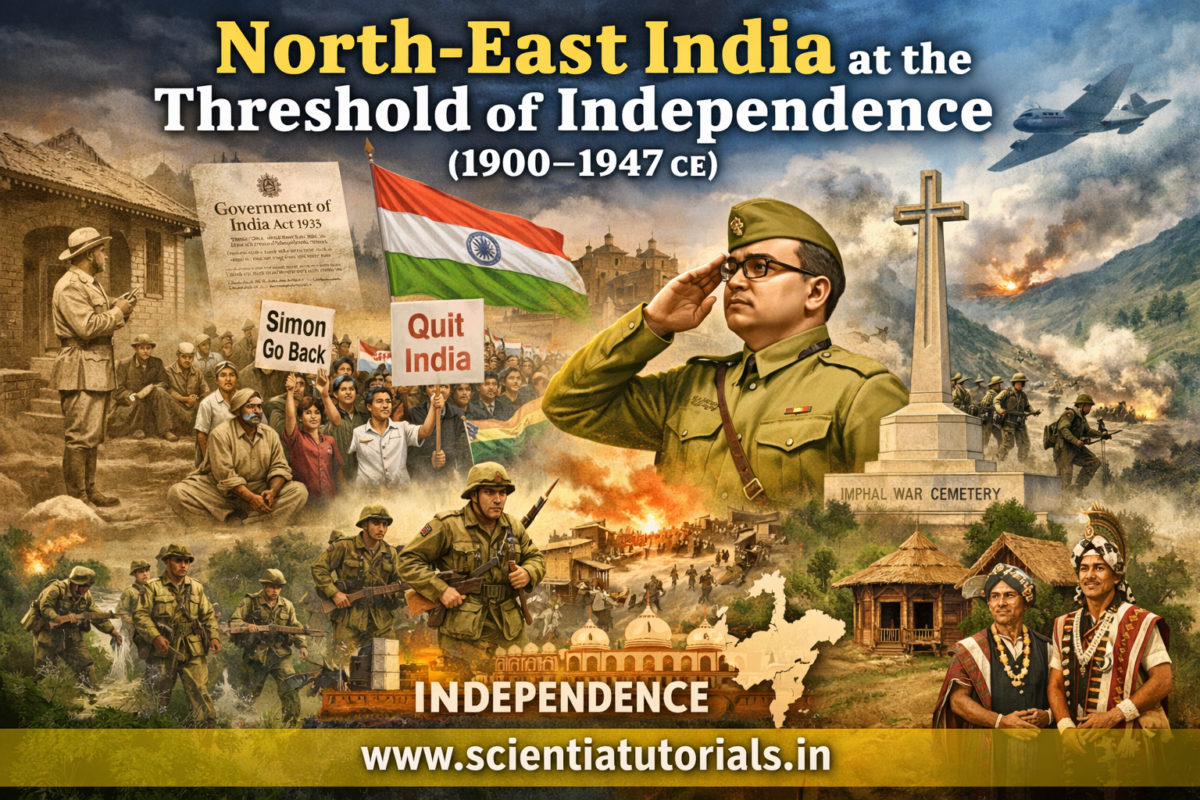

North-East India at the Threshold of Independence (1900–1947) | Freedom Struggle & Integration
Module VII: National Movement and Political Awakening
Lesson: North-East India at the Threshold of Independence
Timeline / Era Covered: 1900 CE – 1947 CE
This lesson is systematically organized into four clearly structured sections, as detailed below:
- Chronologically Structured Study Module
- Short-Answer Type Questions
- Long-Answer Type Questions
- Multiple-Choice Questions (MCQs) with Answers and Detailed Explanations
Chronologically Structured Study Module
1. Introduction: North-East India in the Final Phase of Colonial Rule
The first half of the twentieth century marked a decisive phase in the political history of North-East India. Between 1900 CE and 1947 CE, the region experienced a complex transformation shaped by colonial administrative consolidation, rising nationalist consciousness, ethnic and cultural assertions, and strategic geopolitical considerations during global conflicts. While North-East India remained geographically distant from the political centers of British India, it was deeply affected by the national freedom struggle and constitutional developments unfolding at the all-India level.
The lesson “North-East India at the Threshold of Independence” focuses on how the region entered the final years of colonial rule with distinct political trajectories, social dynamics, and constitutional challenges. Unlike many other regions, nationalism in North-East India developed alongside strong tribal identities, missionary influence, frontier policies, and wartime militarization. Understanding this phase is essential to grasp the region’s post-independence political integration and continuing challenges.
2. Colonial Administrative Context in the Early 20th Century (1900–1919)
At the beginning of the twentieth century, British authority in North-East India was consolidated through administrative divisions rather than popular political participation. Assam, which included present-day Arunachal Pradesh (then the North-East Frontier Tracts), Nagaland, Mizoram (Lushai Hills), Meghalaya (Garo, Khasi, and Jaintia Hills), and parts of Manipur and Tripura, was governed largely through special regulations and frontier policies.
2.1 Excluded and Partially Excluded Areas
The British classified large tracts of the hills as “Excluded” or “Backward” areas, keeping them outside mainstream political processes. These areas were administered through political officers rather than elected representatives. This policy had two major consequences:
- It limited early exposure to nationalist politics
- It preserved tribal autonomy but also delayed political integration
2.2 Impact of Missionary Education
Christian missionaries played a major role in spreading Western education, literacy, and new social values among tribal communities. While missionaries avoided direct nationalist politics, their work unintentionally created an educated elite that later articulated political demands for autonomy, representation, and self-rule.
3. Growth of Nationalist Influence in Assam and the Plains (1919–1927)
The post–First World War period marked the first significant penetration of Indian nationalism into the plains of Assam.
3.1 Entry of the Indian National Congress
The Indian National Congress began organizing provincial committees in Assam after 1918. Assamese leaders such as Tarun Ram Phukan and Gopinath Bordoloi helped connect regional concerns with the broader nationalist agenda.
3.2 Non-Cooperation Movement (1920–1922)
The Non-Cooperation Movement had a moderate but symbolically important impact in Assam. Students withdrew from government institutions, lawyers gave up legal practice, and khadi and swadeshi gained popularity in urban centers such as Guwahati and Jorhat. However, the movement’s reach into hill areas remained limited due to administrative restrictions.
4. Constitutional Reforms and Political Awakening (1927–1935)
4.1 Simon Commission and Regional Response
The arrival of the Simon Commission in 1928 generated widespread protest in Assam, similar to other parts of India. Though hill regions were largely excluded from these protests, the plains witnessed demonstrations, strikes, and the slogan “Simon Go Back.”
4.2 Emergence of Regional Political Consciousness
During this phase, Assamese nationalism increasingly emphasized:
- Protection of Assamese language and culture
- Economic concerns related to tea plantations and migration
- Demand for greater provincial autonomy
These concerns were articulated within the framework of Indian nationalism, but with a strong regional identity.
4.3 Government of India Act, 1935
The Government of India Act 1935 was a landmark in the political history of North-East India. It introduced provincial autonomy and legislative assemblies, while continuing the system of excluded areas for hill regions.
5. Provincial Autonomy and Congress Ministry in Assam (1937–1939)
Following elections under the 1935 Act, Assam witnessed the formation of a Congress ministry under Gopinath Bordoloi in 1938.
5.1 Significance of Congress Rule
The Congress ministry attempted to balance nationalist goals with regional sensitivities. Key features included:
- Efforts to protect indigenous land rights
- Promotion of Assamese language
- Cautious engagement with hill leaders
5.2 Hill–Plains Divide
Despite Congress rule, hill areas remained constitutionally and politically separate. Tribal leaders were more concerned with safeguarding autonomy than participating in all-India nationalist movements.
6. Second World War and Strategic Importance of North-East India (1939–1945)
The outbreak of the Second World War transformed North-East India into a strategic frontier.
6.1 Japanese Invasion and the Battle of Imphal–Kohima
The Japanese advance into Burma brought war directly to the region. The battles of Imphal and Kohima (1944) turned Assam, Manipur, and Nagaland into major war zones. Infrastructure development, forced labor, displacement, and military requisitions deeply affected local populations.
6.2 Indian National Army and Subhas Chandra Bose
The presence of the Indian National Army under Subhas Chandra Bose left a powerful psychological impact. Although direct participation from the region was limited, the INA’s advance to the eastern frontier symbolized the vulnerability of British rule.
7. Quit India Movement and Regional Variations (1942)
The Quit India Movement marked the most intense phase of the freedom struggle.
7.1 Impact in Assam
In Assam, Quit India led to strikes, sabotage of communication lines, and repression by colonial authorities. Many leaders were arrested, and underground activities continued in rural areas.
7.2 Limited Response in Hill Areas
In contrast, hill regions saw minimal participation due to:
- Administrative isolation
- Fear of wartime instability
- Focus on local autonomy rather than independence
8. Political Developments in Manipur and Tripura
8.1 Manipur
Manipur experienced a gradual political awakening during the 1940s. The end of princely autocracy and demands for constitutional reform gained momentum, especially after the war.
8.2 Tripura
In Tripura, educated elites and peasant movements began demanding reforms, setting the stage for post-independence democratic transitions.
9. Cabinet Mission and the Question of Integration (1946)
The arrival of the Cabinet Mission raised crucial questions regarding the future of frontier regions.
9.1 Hill Leaders and Autonomy
Tribal leaders expressed apprehension about being absorbed into an Indian nation-state dominated by plains populations. These concerns later influenced the Sixth Schedule of the Constitution.
10. North-East India at the Moment of Independence (1947)
At independence in 1947, North-East India entered the Indian Union with:
- Uneven political awareness
- Strong regional and tribal identities
- Legacy of colonial frontier policies
Assam became a full-fledged province within India, while Manipur and Tripura began the process of integration as princely states. Hill areas remained administratively distinct, setting the foundation for post-independence reorganization and autonomy movements.
11. Historical Significance and Legacy
The period from 1900 to 1947 shaped the political destiny of North-East India in enduring ways:
- Nationalism developed alongside ethnic assertion
- Colonial exclusion delayed political integration
- Wartime experiences altered economic and strategic realities
These factors explain many post-independence challenges, including demands for autonomy, statehood, and recognition of cultural diversity.
12. Conclusion: Threshold of Independence and Beyond
North-East India reached independence not merely as a passive frontier but as a region shaped by layered historical experiences—colonial administration, nationalist struggle, wartime trauma, and constitutional uncertainty. While the freedom movement created a framework for political integration, the region’s unique historical trajectory ensured that independence was both a moment of hope and the beginning of new negotiations with the Indian nation-state.
Short Answer Type Questions with Answers
Q1. What was the political condition of North-East India at the beginning of the 20th century?
Answer:
At the beginning of the 20th century, North-East India was under firm British control, with Assam as a province and most hill areas administered separately under special frontier regulations.
Q2. Why were hill areas of North-East India kept outside mainstream politics?
Answer:
Hill areas were classified as excluded or backward regions to prevent political agitation, preserve tribal autonomy, and maintain colonial control through indirect administration.
Q3. What role did missionaries play in the political awakening of North-East India?
Answer:
Missionaries promoted education, literacy, and social reform, creating an educated tribal elite that later articulated political demands, though missionaries avoided direct nationalist involvement.
Q4. When did the Indian National Congress begin its organized activities in Assam?
Answer:
The Indian National Congress began organized political activities in Assam after the First World War, particularly from 1918 onwards.
Q5. How did the Non-Cooperation Movement affect Assam?
Answer:
The Non-Cooperation Movement encouraged student protests, boycott of institutions, and promotion of khadi, though its impact was limited mainly to urban and plains areas.
Q6. Why was nationalist participation weak in hill regions?
Answer:
Nationalist participation was weak due to administrative isolation, lack of political exposure, and greater concern for protecting tribal customs and autonomy.
Q7. What was the significance of the Simon Commission in Assam?
Answer:
The Simon Commission sparked protests in Assam and strengthened regional nationalist consciousness aligned with the broader Indian freedom struggle.
Q8. Name two major political concerns of Assamese nationalism.
Answer:
Protection of Assamese language and culture, and economic concerns related to land, tea plantations, and migration.
Q9. What changes were introduced by the Government of India Act 1935 in Assam?
Answer:
It introduced provincial autonomy, legislative assemblies, and allowed elected Indian ministries while retaining excluded status for hill areas.
Q10. Who led the Congress ministry in Assam after the 1937 elections?
Answer:
Gopinath Bordoloi led the Congress ministry in Assam after the 1937 provincial elections.
Q11. Why was the hill–plains divide significant during Congress rule?
Answer:
Hill areas remained constitutionally separate and politically cautious, while the plains actively participated in nationalist governance.
Q12. How did the Second World War affect North-East India?
Answer:
The region became strategically important, witnessing militarization, infrastructure development, displacement, and economic disruption.
Q13. What was the impact of the Battle of Imphal–Kohima on the region?
Answer:
It brought direct warfare to North-East India, causing civilian suffering and highlighting the region’s strategic importance in global politics.
Q14. What influence did the Indian National Army have in the region?
Answer:
The INA’s advance boosted anti-colonial morale and exposed British vulnerability, though direct local participation was limited.
Q15. Why was Subhas Chandra Bose significant for North-East India?
Answer:
His leadership symbolized militant nationalism and brought the freedom struggle to India’s eastern frontier.
Q16. What was the nature of the Quit India Movement in Assam?
Answer:
Assam witnessed strikes, sabotage, arrests, and underground resistance, though repression was severe.
Q17. Why did the Quit India Movement have limited impact in hill areas?
Answer:
Wartime fears, administrative restrictions, and emphasis on local autonomy reduced participation.
Q18. How did political awakening occur in Manipur during the 1940s?
Answer:
Political reforms, demands for constitutional government, and opposition to autocratic rule gained momentum after World War II.
Q19. What political changes were visible in Tripura before independence?
Answer:
Educated elites and peasant movements began demanding administrative and political reforms.
Q20. What was the role of the Cabinet Mission regarding North-East India?
Answer:
It raised questions about the constitutional future and integration of frontier and tribal areas into independent India.
Q21. Why were tribal leaders apprehensive about independence?
Answer:
They feared loss of autonomy and domination by plains populations within a centralized nation-state.
Q22. What was Assam’s status at independence in 1947?
Answer:
Assam became a full-fledged province of independent India.
Q23. How did Manipur and Tripura join India after independence?
Answer:
They were integrated into India through constitutional and political processes as former princely states.
Q24. Mention one major legacy of colonial frontier policy in North-East India.
Answer:
Delayed political integration and emergence of post-independence autonomy movements.
Q25. Why is the period 1900–1947 crucial for understanding modern North-East India?
Answer:
It shaped regional nationalism, ethnic identity, administrative structures, and post-independence political challenges.
Long Answer Type Questions with Answers
Q1. Examine the political and administrative position of North-East India at the beginning of the 20th century.
Answer:
At the beginning of the 20th century, North-East India occupied a marginal yet strategically important position within British India. Assam functioned as a province, while vast hill areas were administered under special frontier regulations. The British followed a policy of minimal political integration, keeping tribal regions outside representative institutions. This administrative separation limited early nationalist influence but preserved tribal autonomy. As a result, the region entered the twentieth century politically fragmented and unevenly exposed to modern political ideas.
Q2. Analyse the impact of British frontier policies on political development in North-East India.
Answer:
British frontier policies deliberately isolated hill areas through indirect rule and special regulations. These policies aimed to maintain stability and prevent nationalist agitation near international borders. While they protected tribal customs, they delayed political awakening and integration. The long-term impact was a sharp hill–plains divide, which later complicated constitutional integration and contributed to post-independence autonomy movements.
Q3. Discuss the role of missionary education in shaping political consciousness in North-East India.
Answer:
Missionaries played a crucial role in introducing Western education, literacy, and new social values. Although they avoided nationalist politics, their educational institutions produced an educated indigenous elite capable of political articulation. This elite later led movements for autonomy, representation, and constitutional safeguards. Thus, missionary education indirectly contributed to political awakening rather than nationalist mobilization.
Q4. Trace the growth of nationalist politics in Assam after the First World War.
Answer:
After the First World War, nationalist politics gained momentum in Assam with the expansion of the Indian National Congress. Local leaders linked regional issues such as land rights and language with the all-India freedom struggle. Movements like Non-Cooperation mobilized students, professionals, and urban populations, marking Assam’s formal entry into Indian nationalism.
Q5. Evaluate the impact of the Non-Cooperation Movement in North-East India.
Answer:
The Non-Cooperation Movement had limited but symbolic impact in North-East India. In Assam’s plains, students boycotted institutions and promoted swadeshi, while hill areas remained largely unaffected due to isolation and administrative control. The movement nevertheless marked the beginning of mass political participation in the region.
Q6. Assess the significance of the Simon Commission protests in Assam.
Answer:
The arrival of the Simon Commission triggered protests in Assam similar to other parts of India. Demonstrations strengthened nationalist unity and highlighted demands for self-rule. Though hill areas remained excluded, the protests consolidated Assam’s political alignment with national movements.
Q7. Discuss the emergence of Assamese nationalism during the inter-war period.
Answer:
Assamese nationalism emerged as a blend of regional and national concerns. It focused on protecting language, culture, and land rights while supporting Indian independence. Migration, economic exploitation, and administrative neglect shaped this identity. Assamese nationalism thus complemented rather than contradicted Indian nationalism.
Q8. Examine the importance of the Government of India Act, 1935 for North-East India.
Answer:
The Government of India Act 1935 introduced provincial autonomy and legislative assemblies in Assam. While it enabled Indian ministries, it retained excluded areas, reinforcing political separation. The Act marked a constitutional advance but failed to integrate hill regions into mainstream politics.
Q9. Analyse the achievements and limitations of the Congress ministry in Assam (1937–1939).
Answer:
Under Gopinath Bordoloi, the Congress ministry promoted Assamese language, protected indigenous land rights, and aligned provincial governance with nationalist goals. However, constitutional constraints and excluded areas limited its reach. The ministry exposed the challenge of governing a politically diverse region.
Q10. Explain the significance of World War II for North-East India.
Answer:
World War II transformed North-East India into a strategic military zone. Infrastructure expansion, forced labour, and population displacement followed. The war brought global conflict to local communities and weakened British authority, accelerating political change.
Q11. Discuss the impact of the Battle of Imphal–Kohima on regional society.
Answer:
The Imphal–Kohima battles caused immense destruction and civilian suffering. They highlighted the strategic importance of the region and disrupted traditional economies. The experience permanently altered social and political perceptions of colonial rule.
Q12. Assess the influence of the Indian National Army in North-East India.
Answer:
The Indian National Army brought militant nationalism to the eastern frontier. Though local participation was limited, its presence exposed British vulnerability and inspired nationalist sentiment.
Q13. Evaluate the role of Subhas Chandra Bose in shaping nationalist imagination in the region.
Answer:
Subhas Chandra Bose symbolized revolutionary nationalism. His leadership of the INA and advance toward India’s eastern borders created psychological momentum against colonial rule, especially during wartime uncertainty.
Q14. Analyse the Quit India Movement in Assam.
Answer:
The Quit India Movement triggered widespread protests, strikes, and repression in Assam. Leaders were arrested, but underground resistance continued. The movement marked the peak of mass nationalism in the province.
Q15. Why did the Quit India Movement have limited impact in hill areas?
Answer:
Hill areas remained largely unaffected due to administrative isolation, wartime insecurity, and tribal priorities focused on autonomy rather than mass nationalism.
Q16. Examine political developments in Manipur during the 1940s.
Answer:
In Manipur, wartime experiences and exposure to modern politics generated demands for constitutional reforms. Political awakening intensified after the war, leading to challenges against princely autocracy and paving the way for post-independence integration.
Q17. Discuss the nature of political awakening in Tripura before independence.
Answer:
Tripura witnessed the emergence of educated elites and peasant movements demanding reforms. Though limited, these developments laid the foundation for democratic transformation after independence.
Q18. Analyse the role of the Cabinet Mission in shaping the future of North-East India.
Answer:
The Cabinet Mission highlighted uncertainties regarding frontier regions. Tribal leaders expressed fears of losing autonomy, influencing later constitutional safeguards.
Q19. Why were tribal leaders apprehensive about joining independent India?
Answer:
They feared cultural assimilation, loss of traditional authority, and domination by plains populations, preferring safeguards and autonomy.
Q20. Evaluate North-East India’s position at the time of independence in 1947.
Answer:
At independence, North-East India was politically fragmented, with uneven nationalist participation. Assam became a province, princely states began integration, and hill areas remained administratively distinct, shaping post-independence challenges.
Q21. Discuss the long-term legacy of colonial policies on post-independence North-East India.
Answer:
Colonial isolation delayed integration and encouraged autonomy movements. These legacies influenced constitutional arrangements, state reorganization, and ongoing political demands.
Q22. Critically analyse the hill–plains divide during the freedom struggle.
Answer:
The divide reflected differing historical experiences and priorities. While plains embraced nationalism, hills emphasized autonomy. This divergence shaped constitutional negotiations after independence.
Q23. Explain why North-East India’s freedom struggle differed from other regions of India.
Answer:
Geographical isolation, frontier administration, tribal society, and wartime militarization produced a distinct trajectory where nationalism coexisted with ethnic assertion.
Q24. How did wartime experiences accelerate political change in North-East India?
Answer:
War exposed colonial vulnerability, expanded infrastructure, and politicized populations, accelerating demands for reform and self-rule.
Q25. “Independence was both an end and a beginning for North-East India.” Explain.
Answer:
Independence ended colonial rule but initiated new challenges of integration, identity, and autonomy, making 1947 a transitional rather than conclusive moment.
MCQs with Answers and Explanations
Q1. At the beginning of the 20th century, most hill areas of North-East India were administered as:
A. Princely states
B. Directly governed provinces
C. Excluded or backward areas
D. Federated tribal republics
Correct Answer: C
Explanation:
The British followed a frontier policy under which most hill areas were declared excluded or backward areas, kept outside representative political institutions.
Q2. Which province acted as the political nucleus of nationalist activities in North-East India?
A. Manipur
B. Tripura
C. Assam
D. Lushai Hills
Correct Answer: C
Explanation:
Assam was the only full province in the region and became the main center of nationalist politics and Congress activities.
Q3. Missionary education in hill areas primarily resulted in:
A. Immediate mass nationalism
B. Armed resistance to British rule
C. Creation of an educated tribal elite
D. Decline of tribal identity
Correct Answer: C
Explanation:
Missionary education spread literacy and modern education, producing an educated elite that later articulated political and constitutional demands.
Q4. Organized activities of the Indian National Congress in Assam began mainly after:
A. 1905
B. 1914
C. 1918
D. 1935
Correct Answer: C
Explanation:
Congress influence expanded in Assam after World War I, particularly from 1918 onward.
Q5. Which movement marked the first large-scale participation of Assam in Indian nationalism?
A. Civil Disobedience Movement
B. Quit India Movement
C. Non-Cooperation Movement
D. Swadeshi Movement
Correct Answer: C
Explanation:
The Non-Cooperation Movement (1920–22) marked the first mass nationalist mobilization in Assam.
Q6. Why did nationalist movements have limited reach in hill regions?
A. Lack of British administration
B. Administrative isolation and frontier regulations
C. Strong princely resistance
D. Dominance of peasant movements
Correct Answer: B
Explanation:
Hill regions were kept administratively isolated, limiting political contact and nationalist mobilization.
Q7. Protests against the Simon Commission in Assam were significant because they:
A. Led to armed rebellion
B. United regional and national demands
C. Ended colonial rule
D. Abolished excluded areas
Correct Answer: B
Explanation:
Simon Commission protests strengthened nationalist unity and linked Assamese political concerns with the all-India freedom struggle.
Q8. Assamese nationalism during the inter-war period mainly emphasized:
A. Complete political separation
B. Linguistic, cultural, and economic protection
C. Tribal autonomy alone
D. Socialist revolution
Correct Answer: B
Explanation:
Assamese nationalism focused on protecting language, land, culture, and regional interests within Indian nationalism.
Q9. The Government of India Act 1935 introduced:
A. Complete independence
B. Provincial autonomy
C. Universal adult franchise
D. Abolition of frontier policies
Correct Answer: B
Explanation:
The Act provided provincial autonomy and elected ministries but retained excluded areas.
Q10. Who headed the Congress ministry in Assam after the 1937 elections?
A. Tarun Ram Phukan
B. Bishnuram Medhi
C. Gopinath Bordoloi
D. Sarat Chandra Bose
Correct Answer: C
Explanation:
Gopinath Bordoloi became the first Congress Chief Minister of Assam.
Q11. The hill–plains divide during Congress rule existed mainly due to:
A. Economic backwardness of plains
B. Constitutional exclusion of hill areas
C. Religious differences
D. Linguistic conflicts
Correct Answer: B
Explanation:
Hill areas remained constitutionally excluded from representative institutions under colonial law.
Q12. During World War II, North-East India gained importance mainly because of its:
A. Agricultural output
B. Mineral wealth
C. Strategic military location
D. Industrial development
Correct Answer: C
Explanation:
Its proximity to Burma made the region a strategic military zone during the war.
Q13. The Battle of Imphal–Kohima (1944) was significant because it:
A. Ended British rule immediately
B. Was fought between Indian groups
C. Brought global war to Indian soil
D. Resulted in Indian independence
Correct Answer: C
Explanation:
The battle made North-East India a direct theatre of World War II, deeply affecting civilian life.
Q14. The presence of the Indian National Army in the region mainly:
A. Militarized tribal society
B. Inspired nationalist sentiment
C. Established parallel governments
D. Controlled Assam permanently
Correct Answer: B
Explanation:
The INA’s advance exposed British vulnerability and boosted nationalist morale.
Q15. Subhas Chandra Bose is associated with:
A. Constitutional nationalism
B. Moderate politics
C. Revolutionary and militant nationalism
D. Tribal autonomy movements
Correct Answer: C
Explanation:
Bose symbolized militant nationalism and led the INA against British rule.
Q16. The Quit India Movement in Assam was characterized by:
A. Complete non-violence only
B. No British repression
C. Arrests, strikes, and underground activities
D. Tribal-led mass uprisings
Correct Answer: C
Explanation:
British repression was severe, but underground resistance continued.
Q17. Why did hill areas show limited response to the Quit India Movement?
A. Support for British rule
B. Fear of Japanese invasion and focus on autonomy
C. Lack of leadership
D. Economic prosperity
Correct Answer: B
Explanation:
Wartime insecurity and concern for local autonomy limited participation.
Q18. Political awakening in Manipur during the 1940s was mainly linked to:
A. Tea plantation economy
B. Missionary movements
C. Constitutional reform demands
D. Linguistic movements
Correct Answer: C
Explanation:
Exposure to modern politics led to demands for constitutional government.
Q19. Before independence, Tripura witnessed:
A. Total political stagnation
B. Peasant and elite reform movements
C. Strong Congress dominance
D. Early socialist revolution
Correct Answer: B
Explanation:
Political consciousness grew through peasant and educated elite movements.
Q20. The Cabinet Mission created anxiety among tribal leaders because of:
A. Partition plans
B. Fear of loss of autonomy
C. Economic policies
D. Religious reforms
Correct Answer: B
Explanation:
Tribal leaders feared domination by plains populations in a centralized state.
Q21. At independence in 1947, Assam became:
A. A princely state
B. A centrally administered area
C. A province of India
D. A tribal federation
Correct Answer: C
Explanation:
Assam entered independent India as a full-fledged province.
Q22. Manipur and Tripura after 1947 were:
A. Independent republics
B. Direct British colonies
C. Former princely states integrated into India
D. Excluded areas
Correct Answer: C
Explanation:
Both were princely states that joined the Indian Union after independence.
Q23. One major legacy of colonial frontier policy was:
A. Immediate national integration
B. Decline of tribal identity
C. Rise of autonomy movements
D. Industrialization of hill areas
Correct Answer: C
Explanation:
Colonial isolation delayed integration and contributed to autonomy demands.
Q24. Nationalism in North-East India before 1947 was marked by:
A. Uniform participation
B. Complete rejection of Indian nationalism
C. Regional variation and diversity
D. Absence of political consciousness
Correct Answer: C
Explanation:
Participation varied between plains and hill regions due to historical and administrative factors.
Q25. The period 1900–1947 is crucial because it:
A. Ended all political problems
B. Created modern tribal states
C. Shaped post-independence political challenges
D. Eliminated ethnic identities
Correct Answer: C
Explanation:
Developments during this period explain many post-independence integration and autonomy issues.